
Laserinduced breakdown spectroscopy LIBS Motivation There is growing
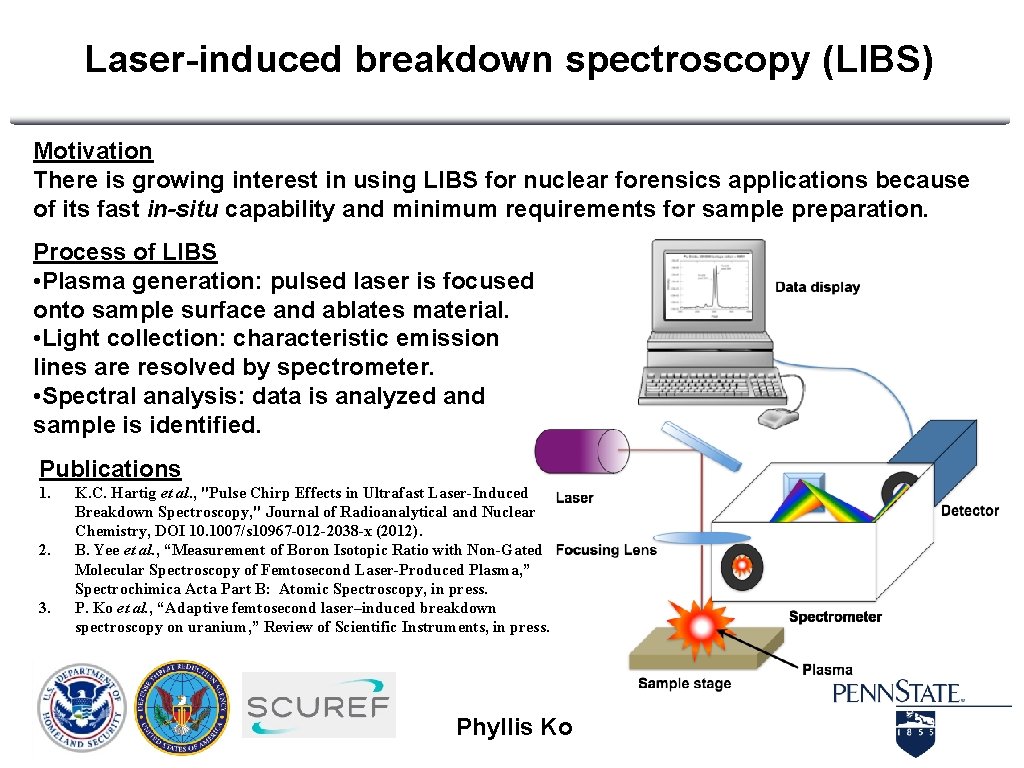
Laser-induced breakdown spectroscopy (LIBS) Motivation There is growing interest in using LIBS for nuclear forensics applications because of its fast in-situ capability and minimum requirements for sample preparation. Process of LIBS • Plasma generation: pulsed laser is focused onto sample surface and ablates material. • Light collection: characteristic emission lines are resolved by spectrometer. • Spectral analysis: data is analyzed and sample is identified. Publications 1. 2. 3. K. C. Hartig et al. , "Pulse Chirp Effects in Ultrafast Laser-Induced Breakdown Spectroscopy, " Journal of Radioanalytical and Nuclear Chemistry, DOI 10. 1007/s 10967 -012 -2038 -x (2012). B. Yee et al. , “Measurement of Boron Isotopic Ratio with Non-Gated Molecular Spectroscopy of Femtosecond Laser-Produced Plasma, ” Spectrochimica Acta Part B: Atomic Spectroscopy, in press. P. Ko et al. , “Adaptive femtosecond laser–induced breakdown spectroscopy on uranium, ” Review of Scientific Instruments, in press. Phyllis Ko

We are attempting to improve LIBS sensitivity of nuclear materials Natural uranium sample LIBS diagnostics setup Vacuum Chamber SPIDER Spectrometer CCD Camera Digital Delay Generator Mounting uranium on sample holder Oscilloscope Phyllis Ko Typical LIBS spectra of natural uranium metal
- Slides: 2