
Laserdriven Ps excitation in the Aegis antimatter experiment



- Slides: 74
Laser-driven Ps excitation in the Aegis antimatter experiment Marco G. Giammarchi and Fabrizio Castelli Dipartimento di Fisica dell’Universita’ di Milano Istituto Nazionale Fisica Nucleare - Milano A E g I S Spectroscopy Antimatter Interferometry Experiment Gravity Outline of talk: • The Physics of Aegis • The production of a H beam • The gravity measurement • Positronium energy levels in magnetic field • Positronium laser excitation Varenna - July 2009 AEGIS: AD-6 Experiment http: //aegis. web. cern. ch/aegis/
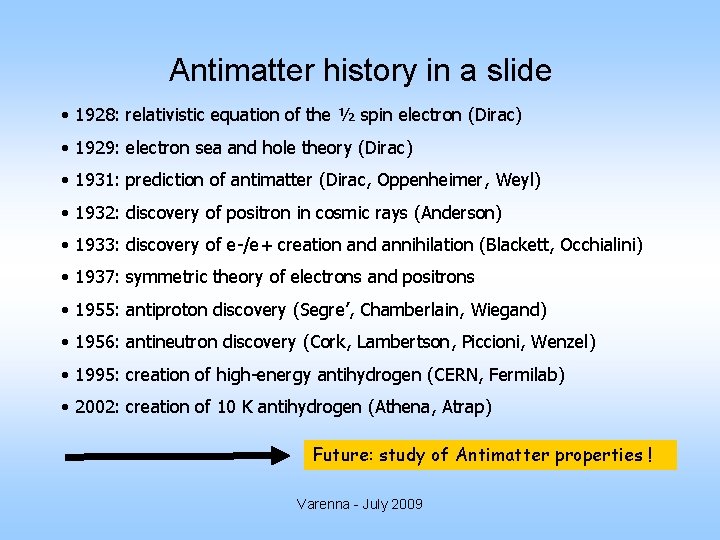
Antimatter history in a slide • 1928: relativistic equation of the ½ spin electron (Dirac) • 1929: electron sea and hole theory (Dirac) • 1931: prediction of antimatter (Dirac, Oppenheimer, Weyl) • 1932: discovery of positron in cosmic rays (Anderson) • 1933: discovery of e-/e+ creation and annihilation (Blackett, Occhialini) • 1937: symmetric theory of electrons and positrons • 1955: antiproton discovery (Segre’, Chamberlain, Wiegand) • 1956: antineutron discovery (Cork, Lambertson, Piccioni, Wenzel) • 1995: creation of high-energy antihydrogen (CERN, Fermilab) • 2002: creation of 10 K antihydrogen (Athena, Atrap) Future: study of Antimatter properties ! Varenna - July 2009
AEGIS Collaboration CERN, Geneva, Switzerland M. Doser, D. Perini, T. Niinikoski, A. Dudarev, T. W. Eisel, R. Van Weelderen, F. Haug, L. . Dufay-Chanat, J. L. . Servai LAPP, Annecy, France. P. Nédélec, D. Sillou Queen’s U Belfast, UK G. Gribakin, H. R. J. Walters INFN Firenze, Italy G. Ferrari, M. Prevedelli, G. M. Tino INFN Genova, University of Genova, Italy C. Carraro, V. Lagomarsino, G. Manuzio, G. Testera, S. Zavatarelli INFN Milano, University of Milano, Italy I. Boscolo, F. Castelli, S. Cialdi, M. G. Giammarchi, D. Trezzi, A. Vairo, F. Villa INFN Padova/Trento, Univ. Padova, Univ. Trento, Italy R. S. Brusa, D. Fabris, M. Lunardon, S. Mariazzi, S. Moretto, G. Nebbia, S. Pesente, G. Viesti INFN Pavia – Italy University of Brescia, University of Pavia. G. Bonomi, A. Fontana, A. Rotondi, A. Zenoni MPI- K, Heidelberg, Germany C. Canali, R. Heyne, A. Kellerbauer, C. Morhard, U. Warring Kirchhoff Institute of Physics U of Heidelberg, Germany M. K. Oberthaler INFN Milano, Politecnico di Milano, Italy G. Consolati, A. Dupasquier, R. Ferragut, F. Quasso INR, Moscow, Russia A. S. Belov, S. N. Gninenko, V. A. Matveev, A. V. Turbabin ITHEP, Moscow, Russia. V. M. Byakov, S. V. Stepanov, D. S. Zvezhinskij New York University, USA H. H. Stroke Laboratoire Aimé Cotton, Orsay, France. L. Cabaret, D. Comparat University of Oslo, Norway O. Rohne, S. Stapnes CEA Saclay, France M. Chappellier, M. de Combarieu, P. Forget, P. Pari INRNE, Sofia, Bulgaria N. Djourelov Czech Technical University, Prague, Czech Republic V. Petráček, D. Krasnický ETH Zurich, Switzerland S. D. Hogan, F. Merkt Institute for Nuclear Problems of the Belarus State. University, Belarus G. Drobychev Qatar University, Qatar I. Y. Al-Qaradawi Varenna - July 2009
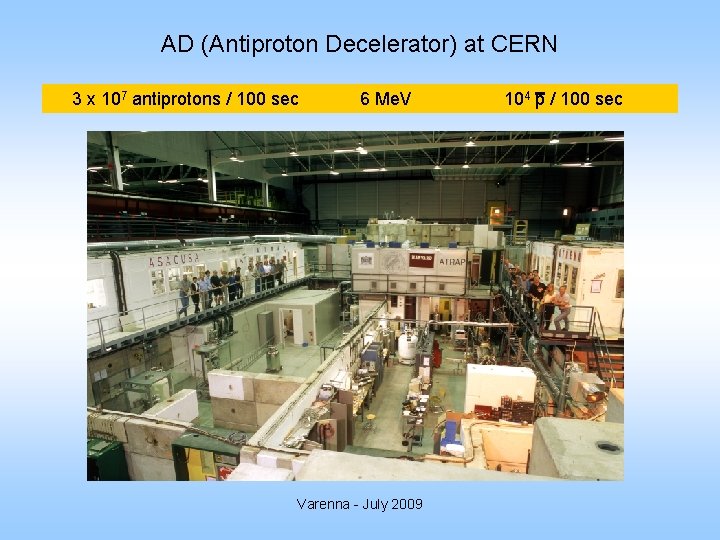
AD (Antiproton Decelerator) at CERN 3 x 10⁷ antiprotons / 100 sec 6 Me. V Varenna - July 2009 104 p / 100 sec
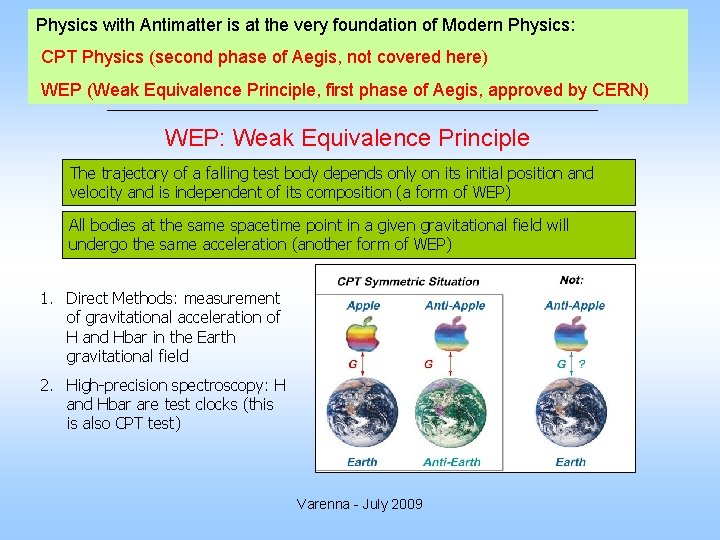
Physics with Antimatter is at the very foundation of Modern Physics: CPT Physics (second phase of Aegis, not covered here) WEP (Weak Equivalence Principle, first phase of Aegis, approved by CERN) WEP: Weak Equivalence Principle The trajectory of a falling test body depends only on its initial position and velocity and is independent of its composition (a form of WEP) All bodies at the same spacetime point in a given gravitational field will undergo the same acceleration (another form of WEP) 1. Direct Methods: measurement of gravitational acceleration of H and Hbar in the Earth gravitational field 2. High-precision spectroscopy: H and Hbar are test clocks (this is also CPT test) Varenna - July 2009
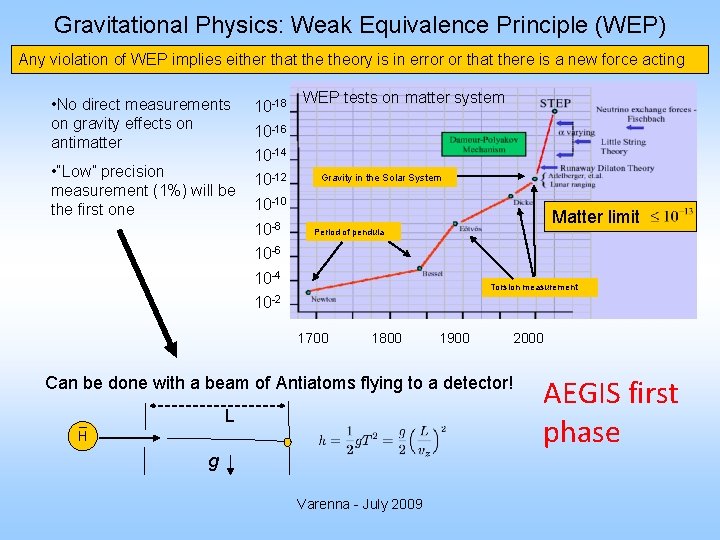
Gravitational Physics: Weak Equivalence Principle (WEP) Any violation of WEP implies either that theory is in error or that there is a new force acting • No direct measurements on gravity effects on antimatter 10 -18 WEP tests on matter system 10 -16 10 -14 • “Low” precision 10 -12 measurement (1%) will be 10 -10 the first one 10 -8 10 -6 10 -4 10 -2 Gravity in the Solar System Matter limit Period of pendula Torsion measurement 1700 1800 1900 Can be done with a beam of Antiatoms flying to a detector! L H g Varenna - July 2009 2000 AEGIS first phase
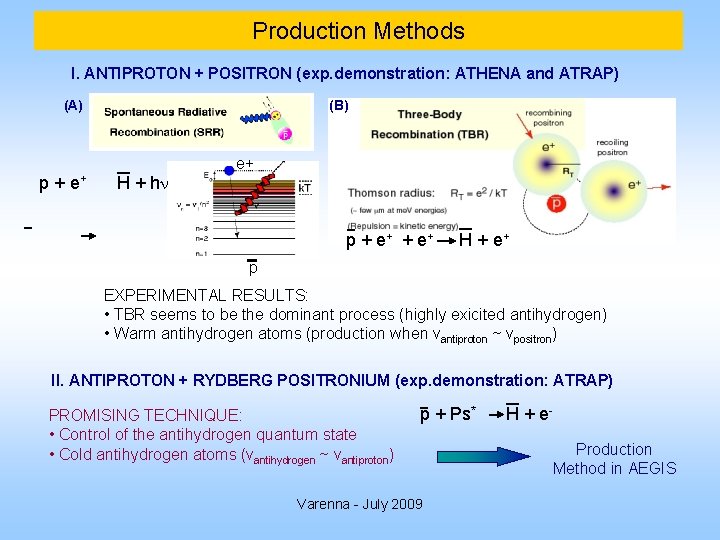
Production Methods I. ANTIPROTON + POSITRON (exp. demonstration: ATHENA and ATRAP) (A) (B) p + e+ H + hn e+ p + e+ H + e+ p EXPERIMENTAL RESULTS: • TBR seems to be the dominant process (highly exicited antihydrogen) • Warm antihydrogen atoms (production when vantiproton ~ vpositron) II. ANTIPROTON + RYDBERG POSITRONIUM (exp. demonstration: ATRAP) PROMISING TECHNIQUE: • Control of the antihydrogen quantum state • Cold antihydrogen atoms (vantihydrogen ~ vantiproton) p + Ps* H + e- Varenna - July 2009 Production Method in AEGIS
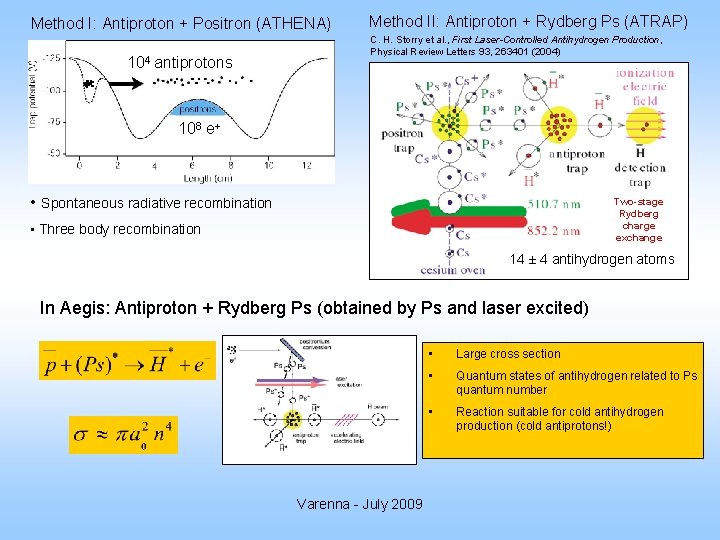
Method I: Antiproton + Positron (ATHENA) 104 antiprotons Method II: Antiproton + Rydberg Ps (ATRAP) C. H. Storry et al. , First Laser-Controlled Antihydrogen Production, Physical Review Letters 93, 263401 (2004) 108 e+ • Spontaneous radiative recombination Two-stage Rydberg charge exchange • Three body recombination 14 ± 4 antihydrogen atoms In Aegis: Antiproton + Rydberg Ps (obtained by Ps and laser excited) Varenna - July 2009 • Large cross section • Quantum states of antihydrogen related to Ps quantum number • Reaction suitable for cold antihydrogen production (cold antiprotons!)
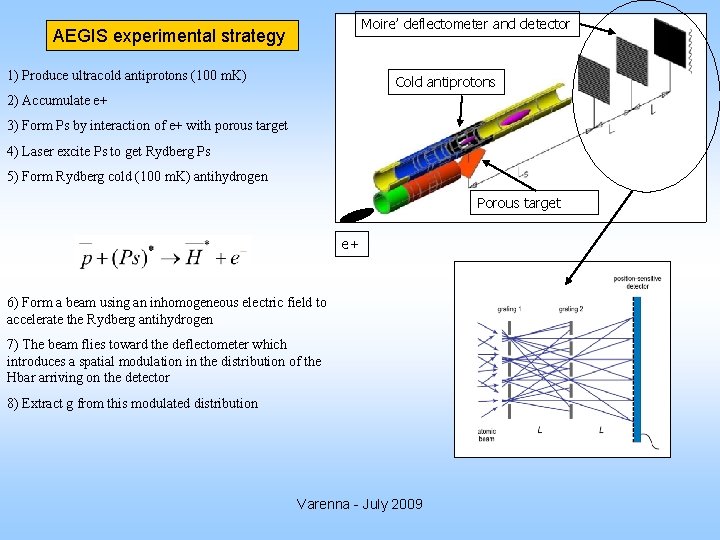
Moire’ deflectometer and detector AEGIS experimental strategy 1) Produce ultracold antiprotons (100 m. K) Cold antiprotons 2) Accumulate e+ 3) Form Ps by interaction of e+ with porous target 4) Laser excite Ps to get Rydberg Ps 5) Form Rydberg cold (100 m. K) antihydrogen Porous target e+ 6) Form a beam using an inhomogeneous electric field to accelerate the Rydberg antihydrogen 7) The beam flies toward the deflectometer which introduces a spatial modulation in the distribution of the Hbar arriving on the detector 8) Extract g from this modulated distribution Varenna - July 2009
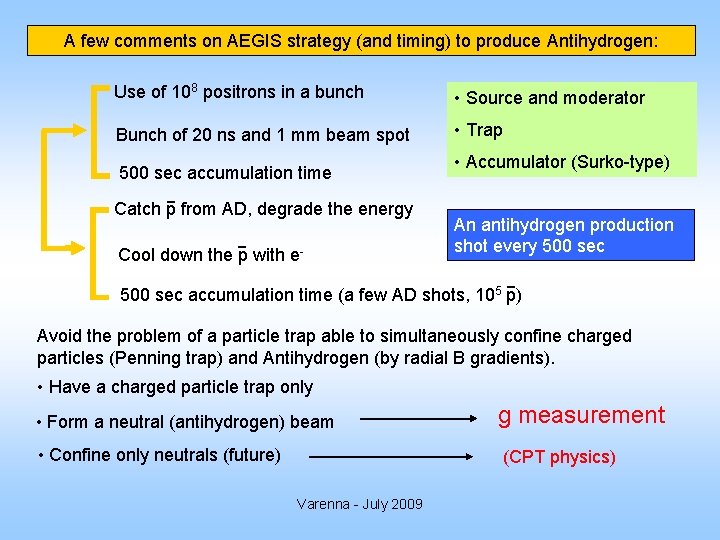
A few comments on AEGIS strategy (and timing) to produce Antihydrogen: Use of 108 positrons in a bunch • Source and moderator Bunch of 20 ns and 1 mm beam spot • Trap 500 sec accumulation time Catch p from AD, degrade the energy Cool down the p with e- • Accumulator (Surko-type) An antihydrogen production shot every 500 sec accumulation time (a few AD shots, 105 p) Avoid the problem of a particle trap able to simultaneously confine charged particles (Penning trap) and Antihydrogen (by radial B gradients). • Have a charged particle trap only • Form a neutral (antihydrogen) beam g measurement • Confine only neutrals (future) (CPT physics) Varenna - July 2009
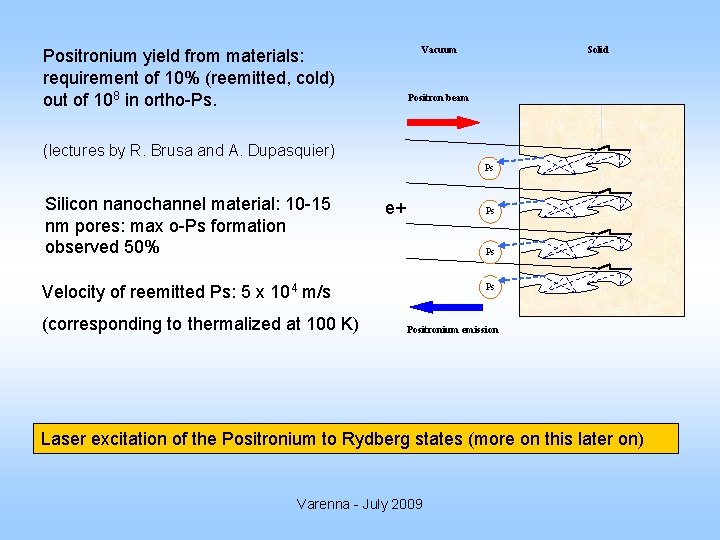
Vacuum Positronium yield from materials: requirement of 10% (reemitted, cold) out of 108 in ortho-Ps. Solid Positron beam (lectures by R. Brusa and A. Dupasquier) Ps Silicon nanochannel material: 10 -15 nm pores: max o-Ps formation observed 50% e+ Ps Ps Ps Velocity of reemitted Ps: 5 x 10⁴ m/s (corresponding to thermalized at 100 K) Positronium emission Laser excitation of the Positronium to Rydberg states (more on this later on) Varenna - July 2009
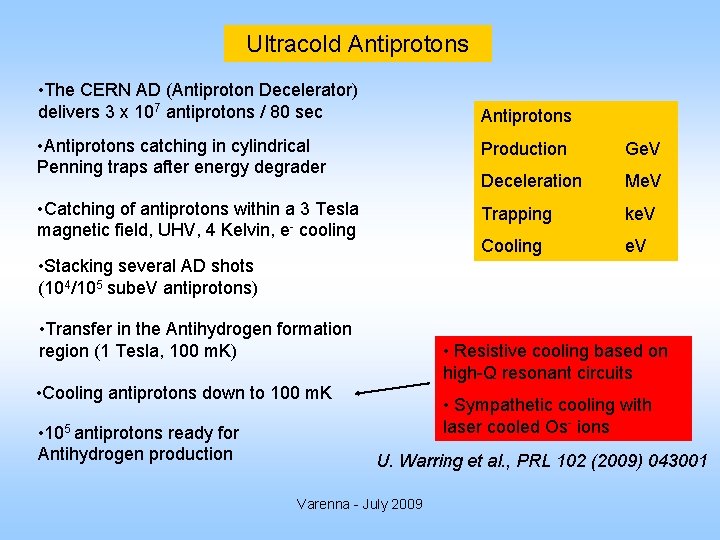
Ultracold Antiprotons • The CERN AD (Antiproton Decelerator) delivers 3 x 10⁷ antiprotons / 80 sec Antiprotons • Antiprotons catching in cylindrical Penning traps after energy degrader Production Ge. V Deceleration Me. V • Catching of antiprotons within a 3 Tesla magnetic field, UHV, 4 Kelvin, e- cooling Trapping ke. V Cooling e. V • Stacking several AD shots (104/105 sube. V antiprotons) • Transfer in the Antihydrogen formation region (1 Tesla, 100 m. K) • Resistive cooling based on high-Q resonant circuits • Cooling antiprotons down to 100 m. K • 105 antiprotons ready for Antihydrogen production • Sympathetic cooling with laser cooled Os- ions U. Warring et al. , PRL 102 (2009) 043001 Varenna - July 2009
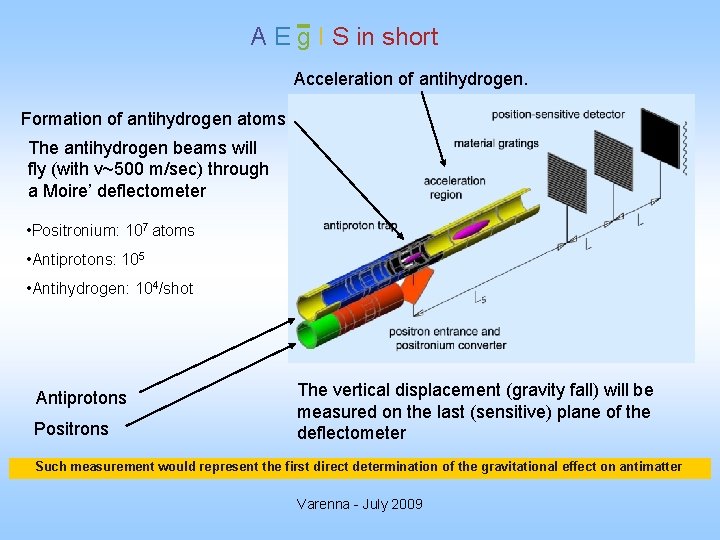
A E g I S in short Acceleration of antihydrogen. Formation of antihydrogen atoms The antihydrogen beams will fly (with v~500 m/sec) through a Moire’ deflectometer • Positronium: 107 atoms • Antiprotons: 105 • Antihydrogen: 104/shot Antiprotons Positrons The vertical displacement (gravity fall) will be measured on the last (sensitive) plane of the deflectometer Such measurement would represent the first direct determination of the gravitational effect on antimatter Varenna - July 2009
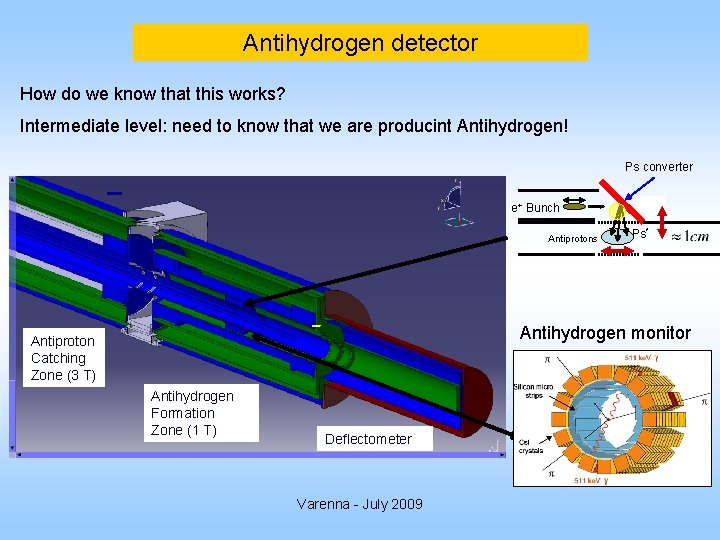
Antihydrogen detector How do we know that this works? Intermediate level: need to know that we are producint Antihydrogen! Ps converter e+ Bunch Antiprotons Ps* Antihydrogen monitor Antiproton Catching Zone (3 T) Antihydrogen Formation Zone (1 T) Deflectometer Varenna - July 2009
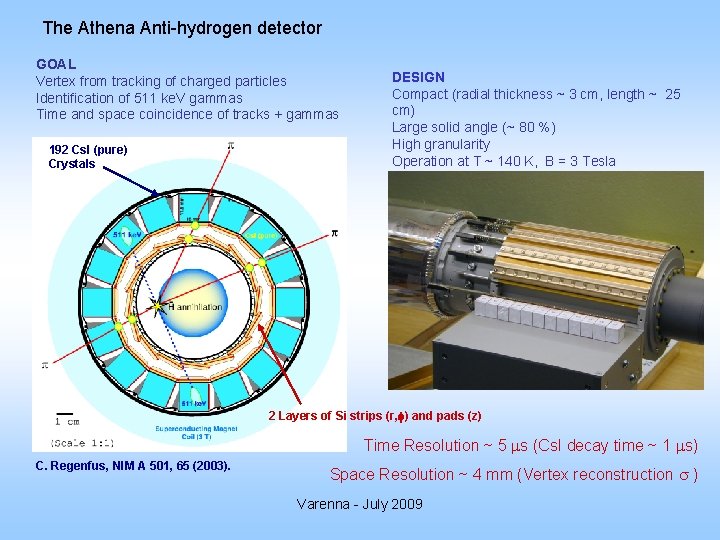
The Athena Anti-hydrogen detector GOAL Vertex from tracking of charged particles Identification of 511 ke. V gammas Time and space coincidence of tracks + gammas 192 Cs. I (pure) Crystals DESIGN Compact (radial thickness ~ 3 cm, length ~ 25 cm) Large solid angle (~ 80 %) High granularity Operation at T ~ 140 K, B = 3 Tesla 2 Layers of Si strips (r, f) and pads (z) Time Resolution ~ 5 s (Cs. I decay time ~ 1 s) C. Regenfus, NIM A 501, 65 (2003). Space Resolution ~ 4 mm (Vertex reconstruction s ) Varenna - July 2009
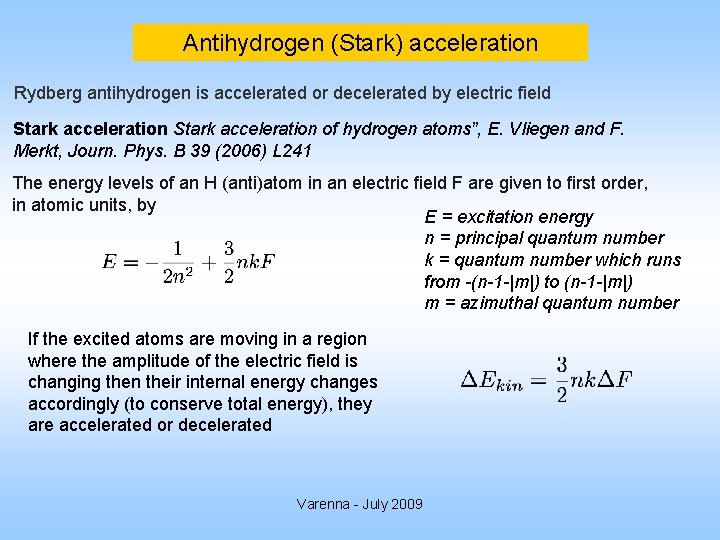
Antihydrogen (Stark) acceleration Rydberg antihydrogen is accelerated or decelerated by electric field Stark acceleration of hydrogen atoms”, E. Vliegen and F. Merkt, Journ. Phys. B 39 (2006) L 241 The energy levels of an H (anti)atom in an electric field F are given to first order, in atomic units, by E = excitation energy n = principal quantum number k = quantum number which runs from -(n-1 -|m|) to (n-1 -|m|) m = azimuthal quantum number If the excited atoms are moving in a region where the amplitude of the electric field is changing then their internal energy changes accordingly (to conserve total energy), they are accelerated or decelerated Varenna - July 2009
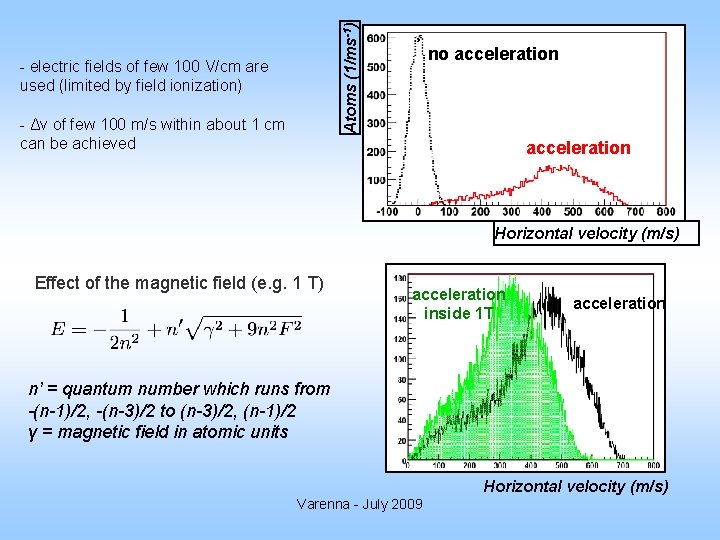
Atoms (1/ms-1) - electric fields of few 100 V/cm are used (limited by field ionization) - Δv of few 100 m/s within about 1 cm can be achieved no acceleration Horizontal velocity (m/s) Effect of the magnetic field (e. g. 1 T) acceleration inside 1 T acceleration n’ = quantum number which runs from -(n-1)/2, -(n-3)/2 to (n-3)/2, (n-1)/2 γ = magnetic field in atomic units Horizontal velocity (m/s) Varenna - July 2009
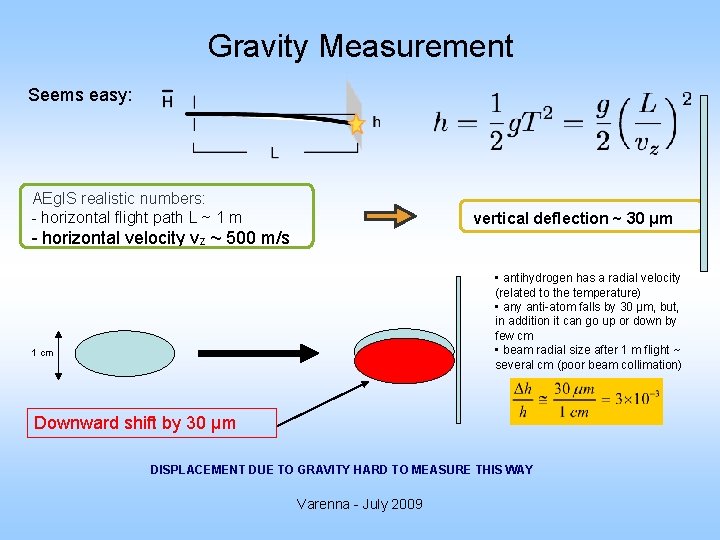
Gravity Measurement Seems easy: AEg. IS realistic numbers: - horizontal flight path L ~ 1 m vertical deflection ~ 30 μm - horizontal velocity vz ~ 500 m/s • antihydrogen has a radial velocity (related to the temperature) • any anti-atom falls by 30 μm, but, in addition it can go up or down by few cm • beam radial size after 1 m flight ~ several cm (poor beam collimation) 1 cm Downward shift by 30 μm DISPLACEMENT DUE TO GRAVITY HARD TO MEASURE THIS WAY Varenna - July 2009
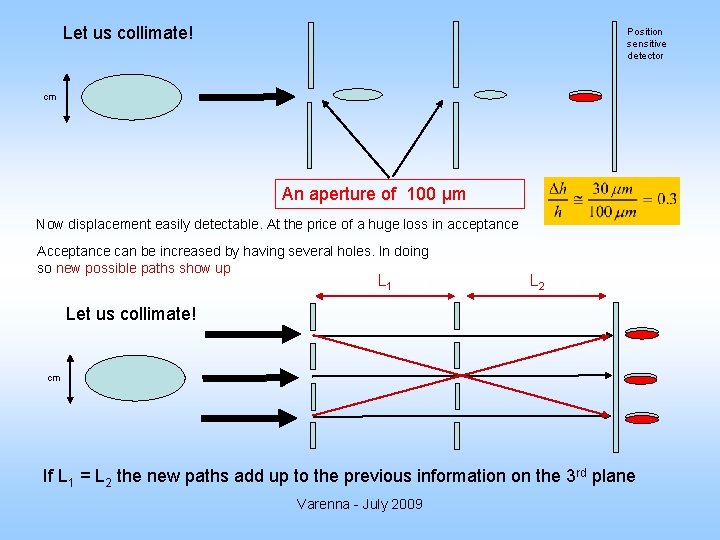
Let us collimate! Position sensitive detector cm An aperture of 100 μm Now displacement easily detectable. At the price of a huge loss in acceptance Acceptance can be increased by having several holes. In doing so new possible paths show up L 1 L 2 Let us collimate! cm If L 1 = L 2 the new paths add up to the previous information on the 3 rd plane Varenna - July 2009
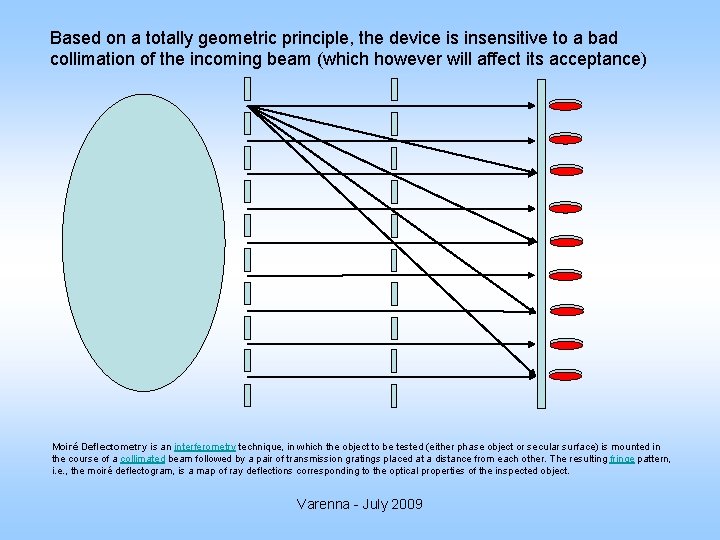
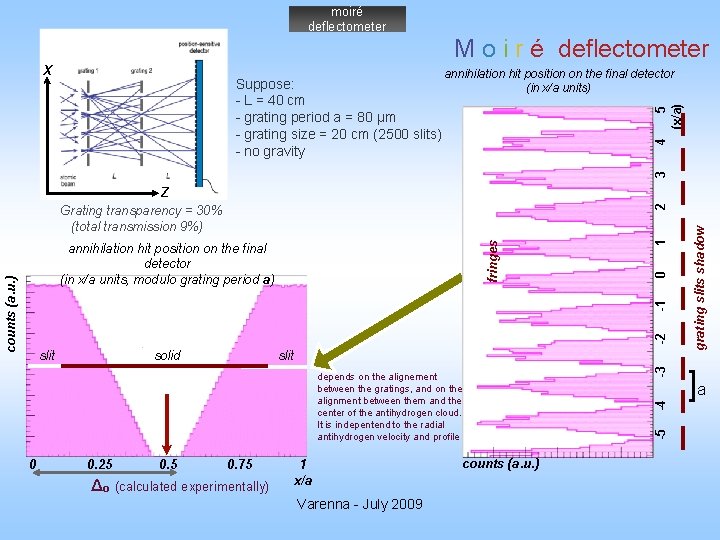
Based on a totally geometric principle, the device is insensitive to a bad collimation of the incoming beam (which however will affect its acceptance) Moiré Deflectometry is an interferometry technique, in which the object to be tested (either phase object or secular surface) is mounted in the course of a collimated beam followed by a pair of transmission gratings placed at a distance from each other. The resulting fringe pattern, i. e. , the moiré deflectogram, is a map of ray deflections corresponding to the optical properties of the inspected object. Varenna - July 2009
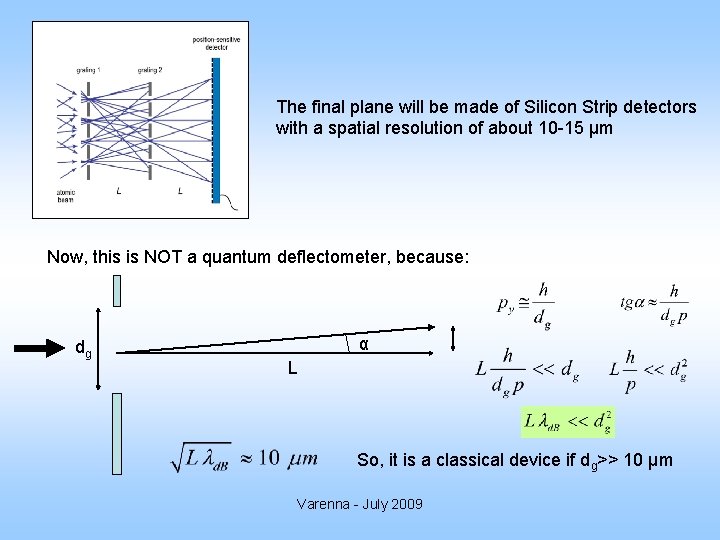
The final plane will be made of Silicon Strip detectors with a spatial resolution of about 10 -15 μm Now, this is NOT a quantum deflectometer, because: dg α L So, it is a classical device if dg>> 10 μm Varenna - July 2009
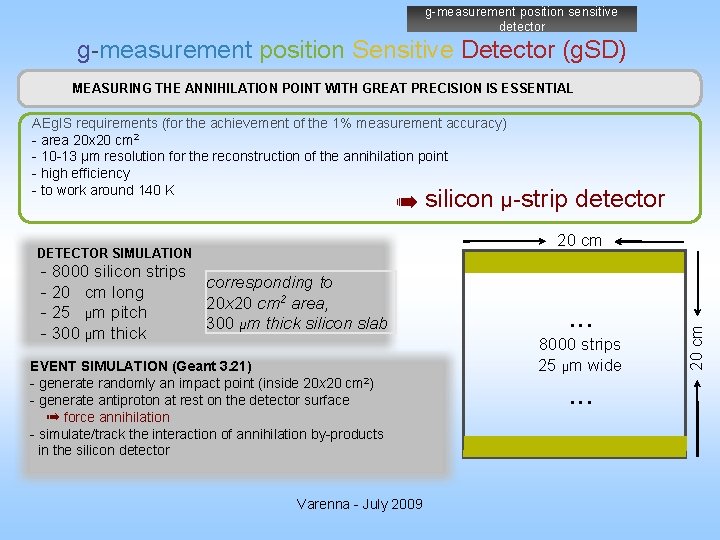
g-measurement position sensitive detector g-measurement position Sensitive Detector (g. SD) MEASURING THE ANNIHILATION POINT WITH GREAT PRECISION IS ESSENTIAL AEg. IS requirements (for the achievement of the 1% measurement accuracy) - area 20 x 20 cm 2 - 10 -13 μm resolution for the reconstruction of the annihilation point - high efficiency - to work around 140 K ➠ silicon μ-strip detector - 8000 silicon strips - 20 cm long - 25 μm pitch - 300 μm thick corresponding to 20 x 20 cm 2 area, 300 μm thick silicon slab EVENT SIMULATION (Geant 3. 21) - generate randomly an impact point (inside 20 x 20 cm 2) - generate antiproton at rest on the detector surface ➠ force annihilation - simulate/track the interaction of annihilation by-products in the silicon detector Varenna - July 2009 . . . 8000 strips 25 μm wide . . . 20 cm DETECTOR SIMULATION
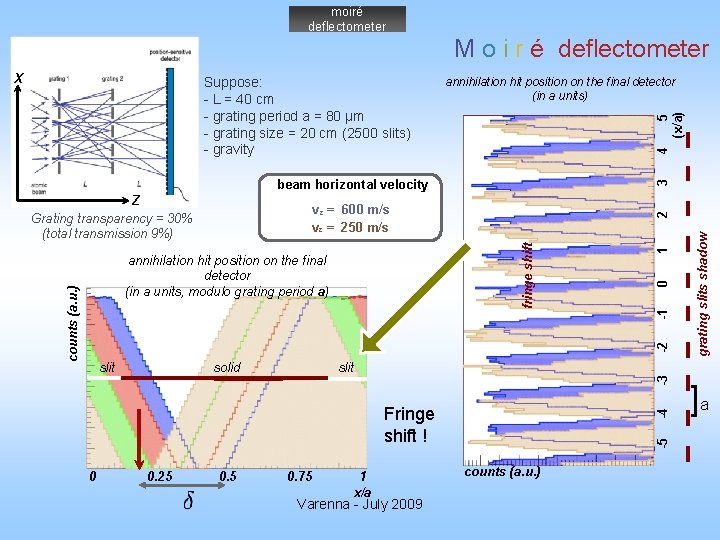
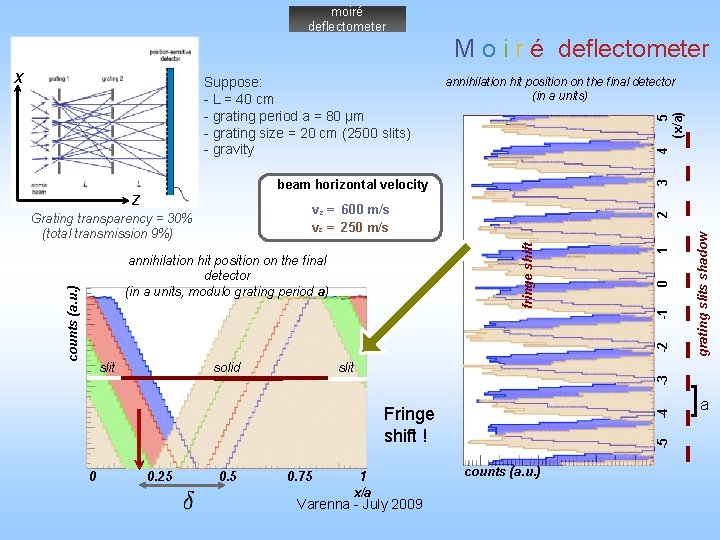
moiré deflectometer M o i r é deflectometer 4 5 (x/a) annihilation hit position on the final detector (in a units) -2 solid slit -3 slit 0. 25 0. 75 1 x/a Varenna - July 2009 -5 -4 Fringe shift ! 0 grating slits shadow fringe shift annihilation hit position on the final detector (in a units, modulo grating period a) counts (a. u. ) 2 vz = 600 m/s vz = 250 m/s 1 Z Grating transparency = 30% (total transmission 9%) 3 beam horizontal velocity 0 Suppose: - L = 40 cm - grating period a = 80 μm - grating size = 20 cm (2500 slits) - gravity -1 X counts (a. u. ) ]a
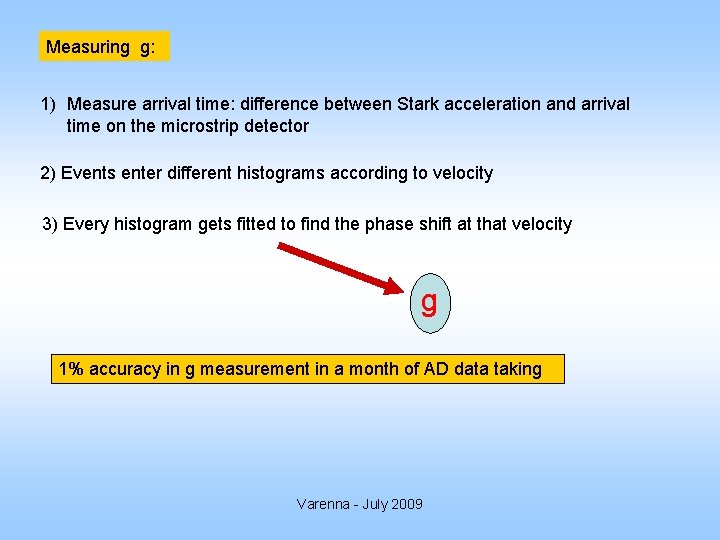
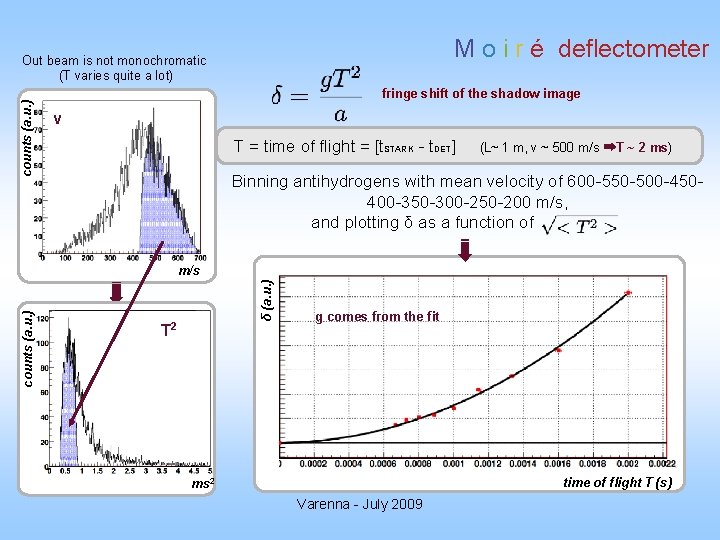
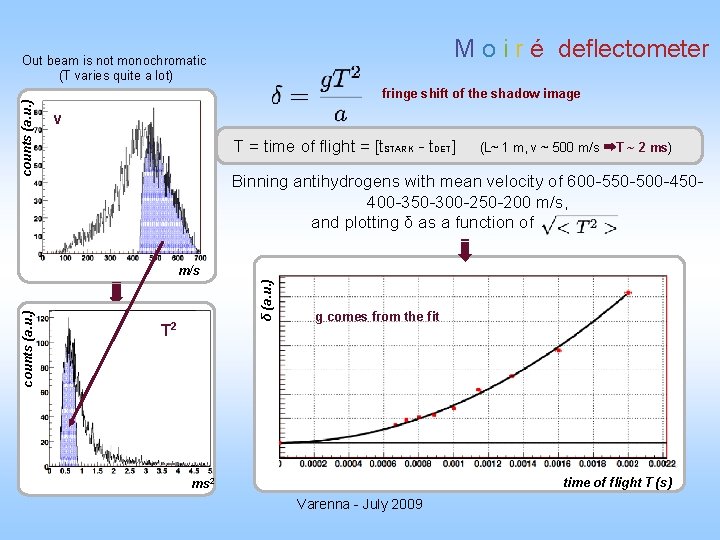
Measuring g: 1) Measure arrival time: difference between Stark acceleration and arrival time on the microstrip detector 2) Events enter different histograms according to velocity 3) Every histogram gets fitted to find the phase shift at that velocity g 1% accuracy in g measurement in a month of AD data taking Varenna - July 2009
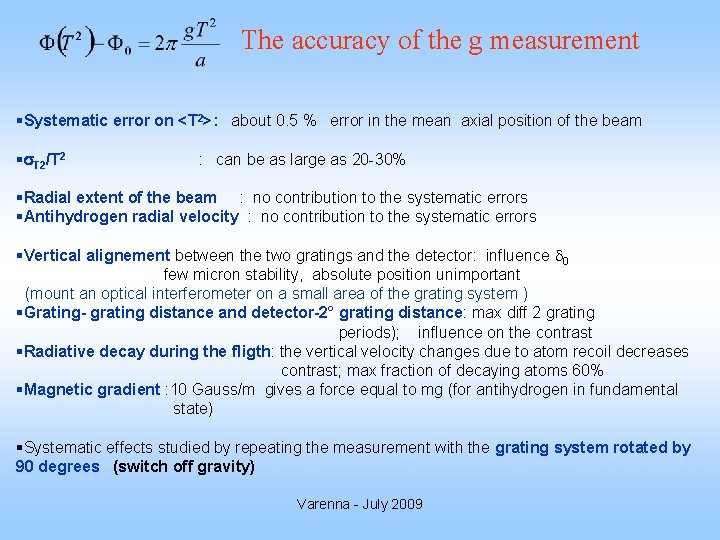
The accuracy of the g measurement §Systematic error on <T 2>: about 0. 5 % error in the mean axial position of the beam §s. T 2/T 2 : can be as large as 20 -30% §Radial extent of the beam : no contribution to the systematic errors §Antihydrogen radial velocity : no contribution to the systematic errors §Vertical alignement between the two gratings and the detector: influence d 0 few micron stability, absolute position unimportant (mount an optical interferometer on a small area of the grating system ) §Grating- grating distance and detector-2° grating distance: max diff 2 grating periods); influence on the contrast §Radiative decay during the fligth: the vertical velocity changes due to atom recoil decreases contrast; max fraction of decaying atoms 60% §Magnetic gradient : 10 Gauss/m gives a force equal to mg (for antihydrogen in fundamental state) §Systematic effects studied by repeating the measurement with the grating system rotated by 90 degrees (switch off gravity) Varenna - July 2009
M o i r é deflectometer counts (a. u. ) Out beam is not monochromatic (T varies quite a lot) fringe shift of the shadow image v T = time of flight = [t. STARK - t. DET] (L~ 1 m, v ~ 500 m/s ➠T ~ 2 ms) Binning antihydrogens with mean velocity of 600 -550 -500 -450400 -350 -300 -250 -200 m/s, and plotting δ as a function of ➠ counts (a. u. ) ➠ δ (a. u. ) m/s T 2 g comes from the fit time of flight T (s) ms 2 Varenna - July 2009
Now, before moving on to more serious problems, we would like to thank the organizers for this pleasant time here Varenna - July 2009
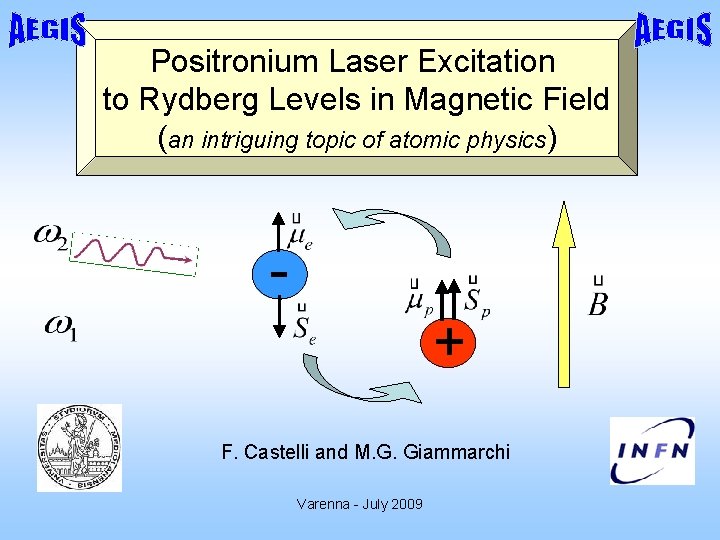
Positronium Laser Excitation to Rydberg Levels in Magnetic Field (an intriguing topic of atomic physics) + F. Castelli and M. G. Giammarchi Varenna - July 2009
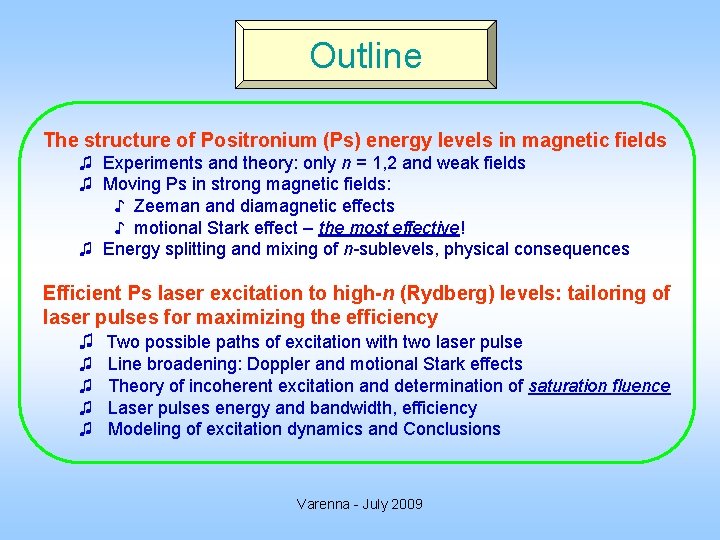
Outline The structure of Positronium (Ps) energy levels in magnetic fields ♫ Experiments and theory: only n = 1, 2 and weak fields ♫ Moving Ps in strong magnetic fields: ♪ Zeeman and diamagnetic effects ♪ motional Stark effect – the most effective! ♫ Energy splitting and mixing of n-sublevels, physical consequences Efficient Ps laser excitation to high-n (Rydberg) levels: tailoring of laser pulses for maximizing the efficiency ♫ Two possible paths of excitation with two laser pulse ♫ Line broadening: Doppler and motional Stark effects ♫ Theory of incoherent excitation and determination of saturation fluence ♫ Laser pulses energy and bandwidth, efficiency ♫ Modeling of excitation dynamics and Conclusions Varenna - July 2009
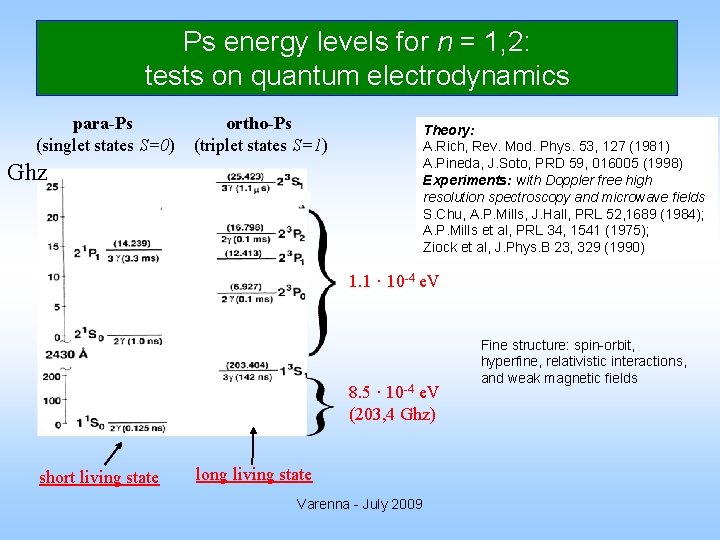
Ps energy levels for n = 1, 2: tests on quantum electrodynamics para-Ps (singlet states S=0) ortho-Ps (triplet states S=1) Theory: A. Rich, Rev. Mod. Phys. 53, 127 (1981) A. Pineda, J. Soto, PRD 59, 016005 (1998) Experiments: with Doppler free high resolution spectroscopy and microwave fields S. Chu, A. P. Mills, J. Hall, PRL 52, 1689 (1984); A. P. Mills et al, PRL 34, 1541 (1975); Ziock et al, J. Phys. B 23, 329 (1990) Ghz 1. 1 · 10 -4 e. V 8. 5 · 10 -4 e. V (203, 4 Ghz) short living state long living state Varenna - July 2009 Fine structure: spin-orbit, hyperfine, relativistic interactions, and weak magnetic fields
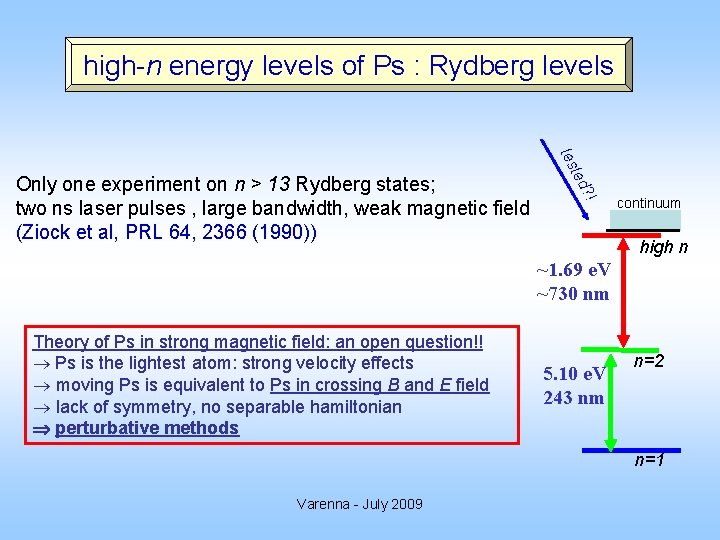
high-n energy levels of Ps : Rydberg levels ? ! ted tes Only one experiment on n > 13 Rydberg states; two ns laser pulses , large bandwidth, weak magnetic field (Ziock et al, PRL 64, 2366 (1990)) continuum high n ~1. 69 e. V ~730 nm Theory of Ps in strong magnetic field: an open question!! Ps is the lightest atom: strong velocity effects moving Ps is equivalent to Ps in crossing B and E field lack of symmetry, no separable hamiltonian perturbative methods 5. 10 e. V 243 nm n=2 n=1 Varenna - July 2009
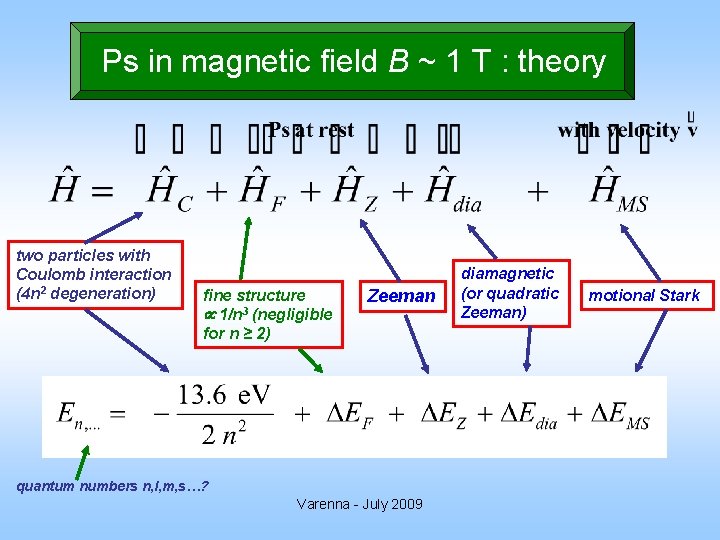
Ps in magnetic field B ~ 1 T : theory two particles with Coulomb interaction (4 n 2 degeneration) fine structure 1/n 3 (negligible for n ≥ 2) Zeeman quantum numbers n, l, m, s…? Varenna - July 2009 diamagnetic (or quadratic Zeeman) motional Stark
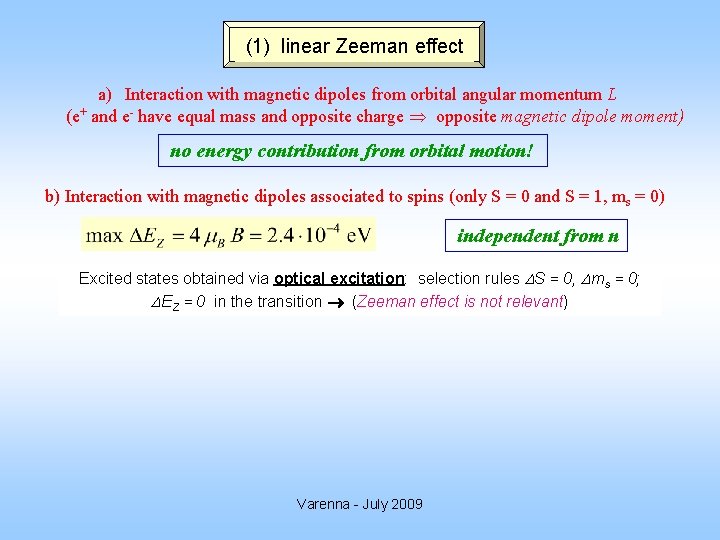
(1) linear Zeeman effect a) Interaction with magnetic dipoles from orbital angular momentum L (e+ and e- have equal mass and opposite charge opposite magnetic dipole moment) no energy contribution from orbital motion! b) Interaction with magnetic dipoles associated to spins (only S = 0 and S = 1, ms = 0) independent from n Excited states obtained via optical excitation: selection rules S = 0, ms = 0; EZ = 0 in the transition (Zeeman effect is not relevant) Varenna - July 2009
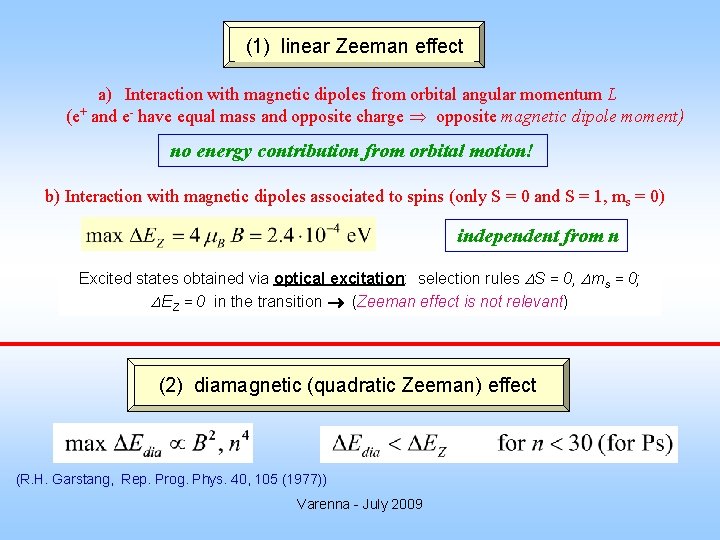
(1) linear Zeeman effect a) Interaction with magnetic dipoles from orbital angular momentum L (e+ and e- have equal mass and opposite charge opposite magnetic dipole moment) no energy contribution from orbital motion! b) Interaction with magnetic dipoles associated to spins (only S = 0 and S = 1, ms = 0) independent from n Excited states obtained via optical excitation: selection rules S = 0, ms = 0; EZ = 0 in the transition (Zeeman effect is not relevant) (2) diamagnetic (quadratic Zeeman) effect (R. H. Garstang, Rep. Prog. Phys. 40, 105 (1977)) Varenna - July 2009
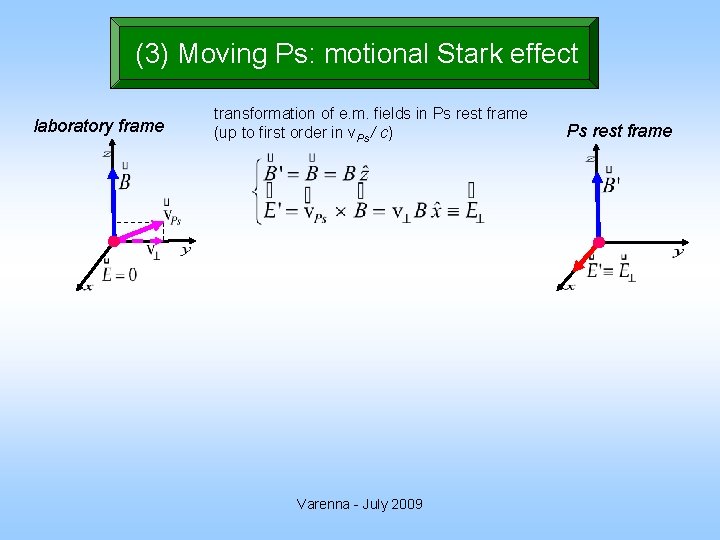
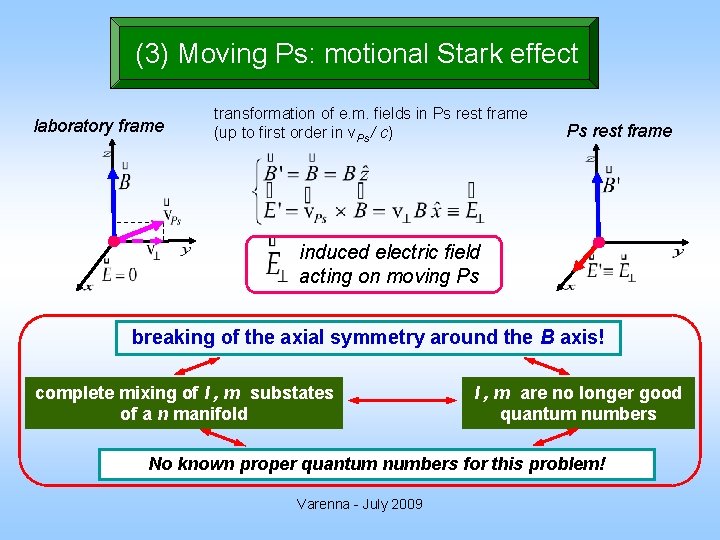
(3) Moving Ps: motional Stark effect laboratory frame transformation of e. m. fields in Ps rest frame (up to first order in v. Ps / c) Varenna - July 2009 Ps rest frame
(3) Moving Ps: motional Stark effect laboratory frame transformation of e. m. fields in Ps rest frame (up to first order in v. Ps / c) Ps rest frame induced electric field acting on moving Ps breaking of the axial symmetry around the B axis! complete mixing of l , m substates of a n manifold l , m are no longer good quantum numbers No known proper quantum numbers for this problem! Varenna - July 2009
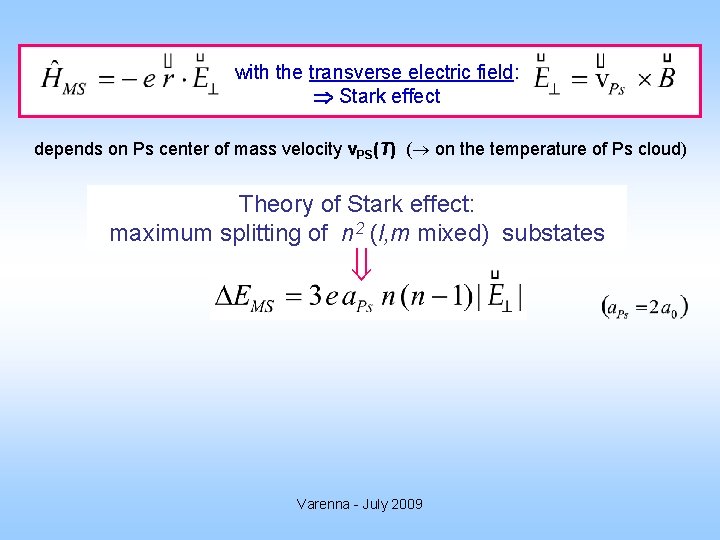
with the transverse electric field: Stark effect depends on Ps center of mass velocity v. PS(T) ( on the temperature of Ps cloud) Theory of Stark effect: maximum splitting of n 2 (l, m mixed) substates Varenna - July 2009
with the transverse electric field: Stark effect depends on Ps center of mass velocity v. PS(T) ( on the temperature of Ps cloud) Theory of Stark effect: maximum splitting of n 2 (l, m mixed) substates Ps : the lightest atom motional Stark effect is largerly the dominant contribution to sublevel splitting energy for Rydberg Ps Varenna - July 2009
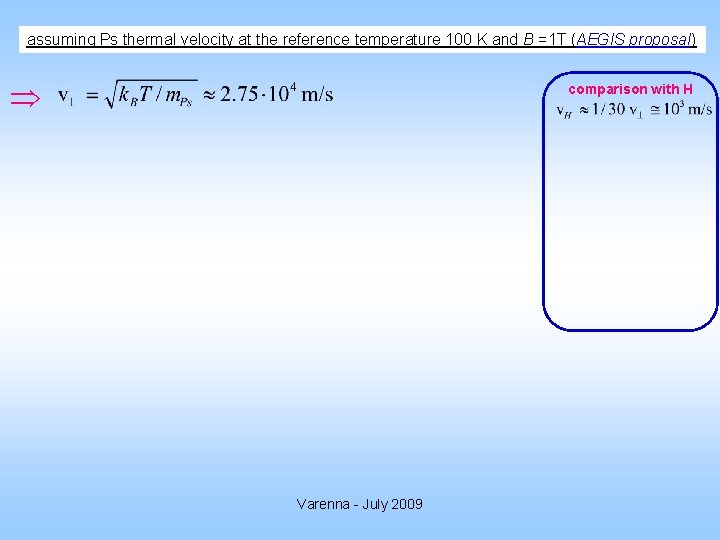
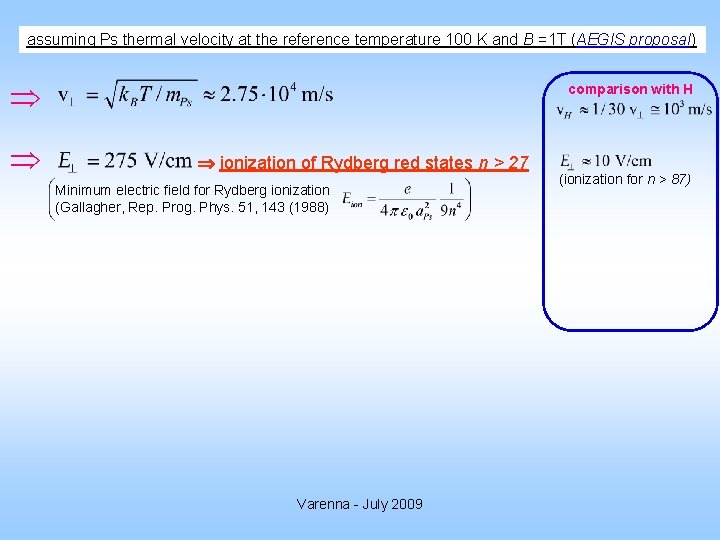
assuming Ps thermal velocity at the reference temperature 100 K and B =1 T (AEGIS proposal) comparison with H Varenna - July 2009
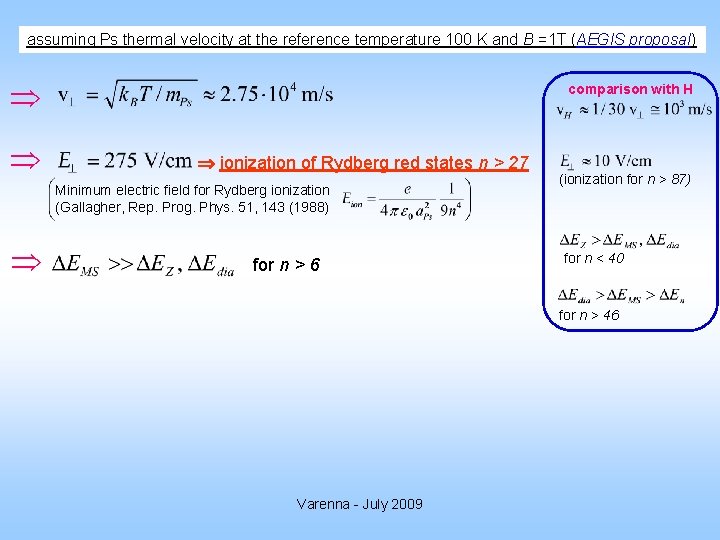
assuming Ps thermal velocity at the reference temperature 100 K and B =1 T (AEGIS proposal) comparison with H ionization of Rydberg red states n > 27 Minimum electric field for Rydberg ionization (Gallagher, Rep. Prog. Phys. 51, 143 (1988) Varenna - July 2009 (ionization for n > 87)
assuming Ps thermal velocity at the reference temperature 100 K and B =1 T (AEGIS proposal) comparison with H ionization of Rydberg red states n > 27 Minimum electric field for Rydberg ionization (Gallagher, Rep. Prog. Phys. 51, 143 (1988) for n > 6 (ionization for n > 87) for n < 40 for n > 46 Varenna - July 2009
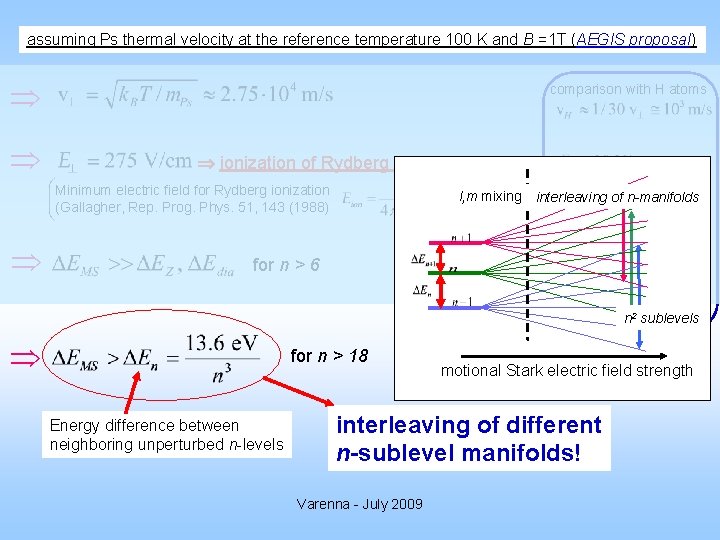
assuming Ps thermal velocity at the reference temperature 100 K and B =1 T (AEGIS proposal) comparison with H atoms ionization of Rydberg red states n > 27 (ionization for n > 87) l, m mixing interleaving of n-manifolds Minimum electric field for Rydberg ionization (Gallagher, Rep. Prog. Phys. 51, 143 (1988) for n < 40 for n > 6 for n > 46 n 2 sublevels for n > 18 Energy difference between neighboring unperturbed n-levels motional Stark electric field strength interleaving of different n-sublevel manifolds! Varenna - July 2009
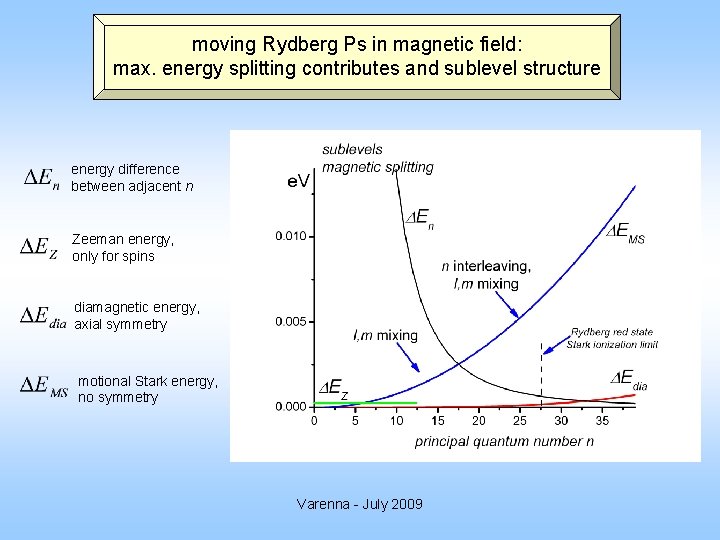
moving Rydberg Ps in magnetic field: max. energy splitting contributes and sublevel structure energy difference between adjacent n Zeeman energy, only for spins diamagnetic energy, axial symmetry motional Stark energy, no symmetry Varenna - July 2009
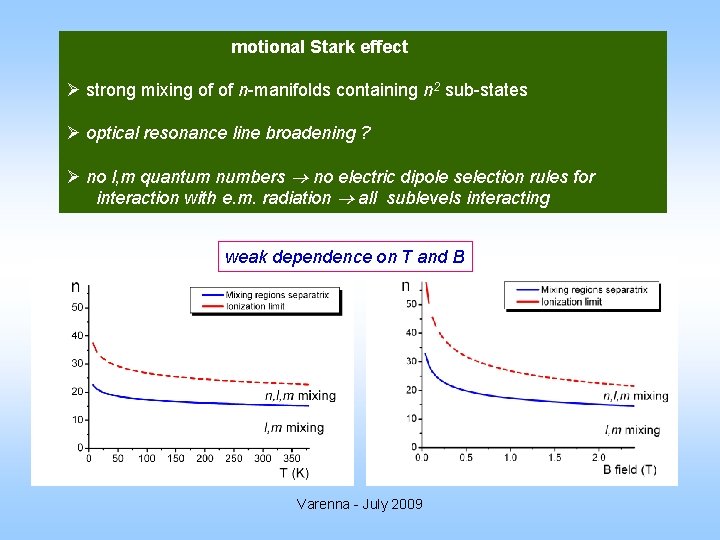
motional Stark effect Ø strong mixing of of n-manifolds containing n 2 sub-states Ø optical resonance line broadening ? Ø no l, m quantum numbers no electric dipole selection rules for interaction with e. m. radiation all sublevels interacting weak dependence on T and B Varenna - July 2009
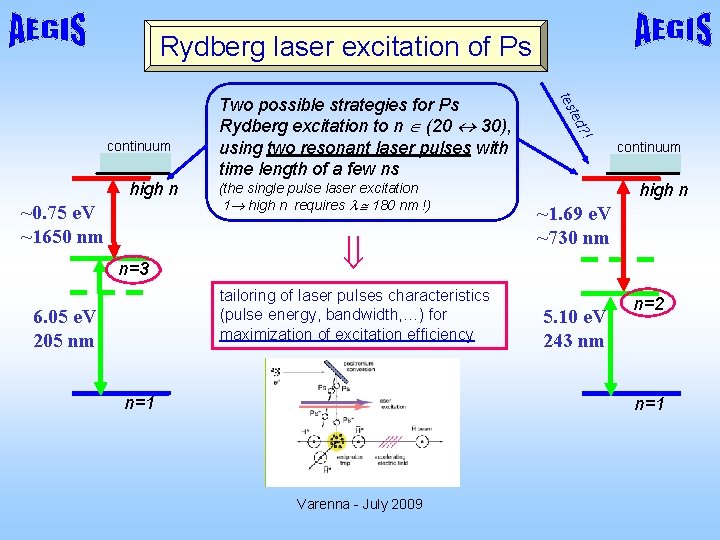
Rydberg laser excitation of Ps ~0. 75 e. V ~1650 nm n=3 (the single pulse laser excitation 1 high n requires 180 nm !) tailoring of laser pulses characteristics (pulse energy, bandwidth, …) for maximization of excitation efficiency 6. 05 e. V 205 nm n=1 ? ! high n ted tes continuum Two possible strategies for Ps Rydberg excitation to n (20 30), using two resonant laser pulses with time length of a few ns continuum high n ~1. 69 e. V ~730 nm 5. 10 e. V 243 nm n=2 n=1 Varenna - July 2009
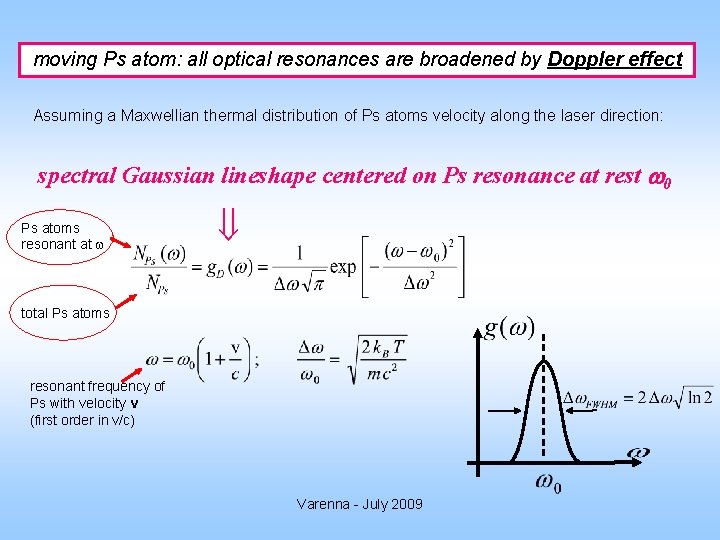
moving Ps atom: all optical resonances are broadened by Doppler effect Assuming a Maxwellian thermal distribution of Ps atoms velocity along the laser direction: spectral Gaussian lineshape centered on Ps resonance at rest 0 Ps atoms resonant at total Ps atoms resonant frequency of Ps with velocity v (first order in v/c) Varenna - July 2009
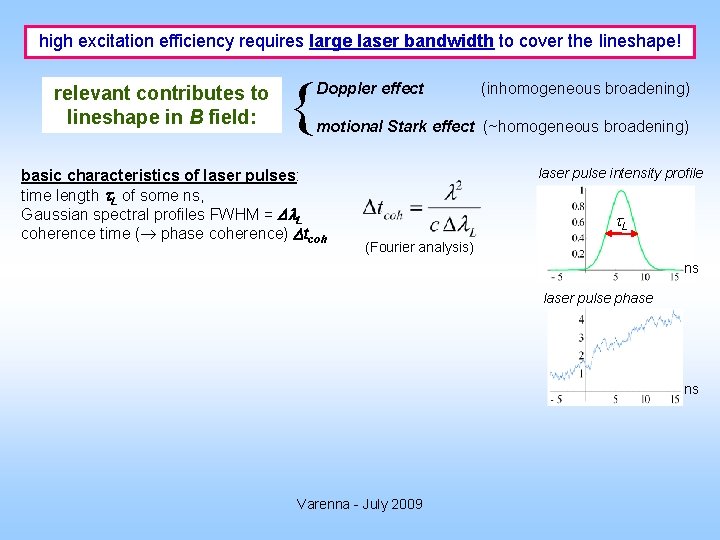
high excitation efficiency requires large laser bandwidth to cover the lineshape! relevant contributes to lineshape in B field: Doppler effect (inhomogeneous broadening) motional Stark effect (~homogeneous broadening) Varenna - July 2009
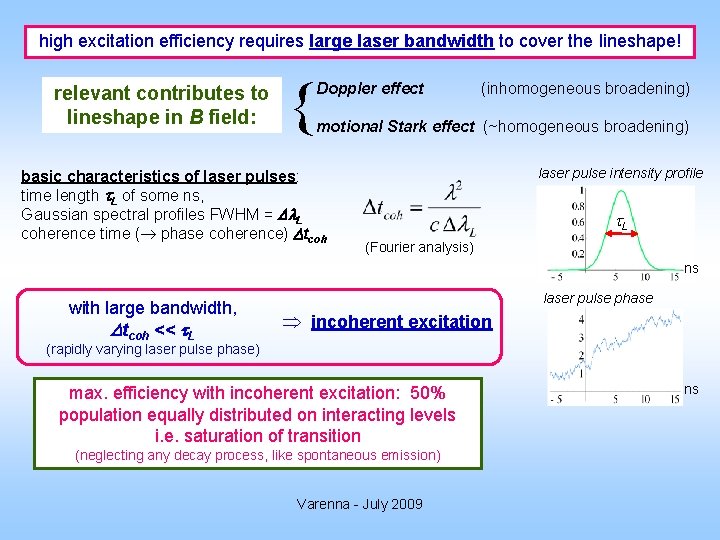
high excitation efficiency requires large laser bandwidth to cover the lineshape! relevant contributes to lineshape in B field: Doppler effect (inhomogeneous broadening) motional Stark effect (~homogeneous broadening) basic characteristics of laser pulses: time length L of some ns, Gaussian spectral profiles FWHM = L coherence time ( phase coherence) tcoh laser pulse intensity profile L (Fourier analysis) ns laser pulse phase ns Varenna - July 2009
high excitation efficiency requires large laser bandwidth to cover the lineshape! relevant contributes to lineshape in B field: Doppler effect (inhomogeneous broadening) motional Stark effect (~homogeneous broadening) basic characteristics of laser pulses: time length L of some ns, Gaussian spectral profiles FWHM = L coherence time ( phase coherence) tcoh laser pulse intensity profile L (Fourier analysis) ns with large bandwidth, tcoh << L laser pulse phase incoherent excitation (rapidly varying laser pulse phase) max. efficiency with incoherent excitation: 50% population equally distributed on interacting levels i. e. saturation of transition (neglecting any decay process, like spontaneous emission) Varenna - July 2009 ns
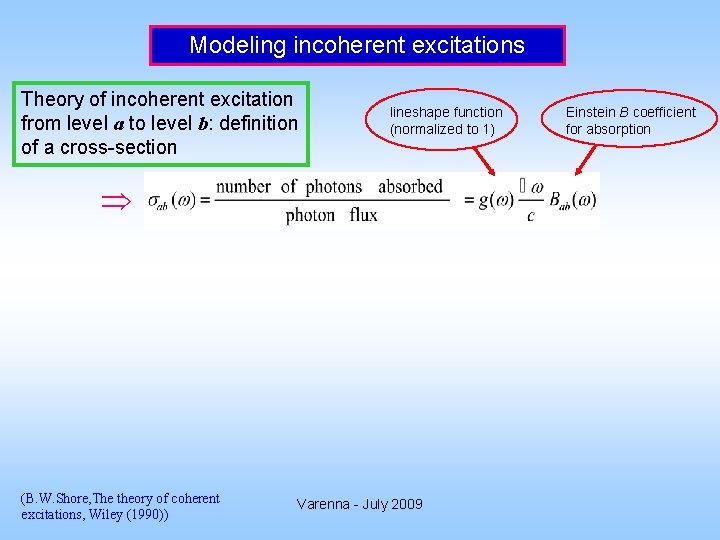
Modeling incoherent excitations Theory of incoherent excitation from level a to level b: definition of a cross-section lineshape function (normalized to 1) (B. W. Shore, The theory of coherent excitations, Wiley (1990)) Varenna - July 2009 Einstein B coefficient for absorption
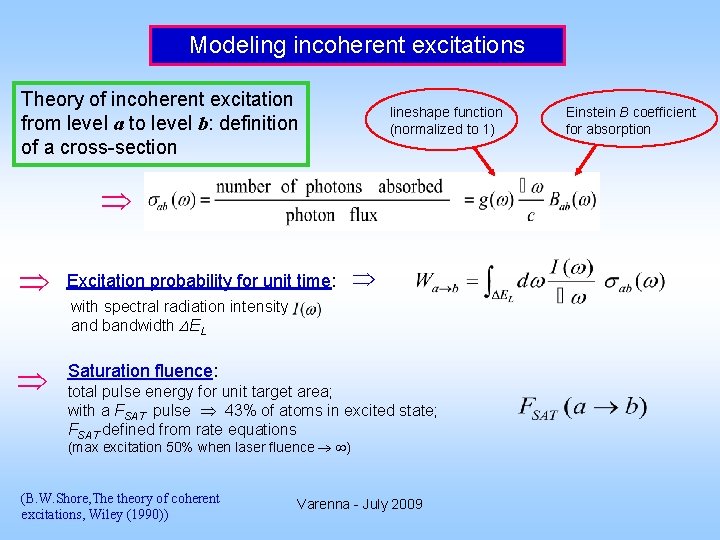
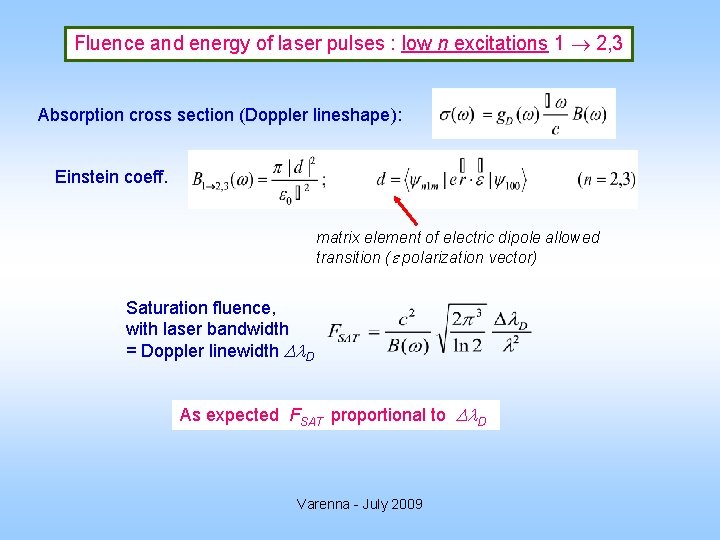
Modeling incoherent excitations Theory of incoherent excitation from level a to level b: definition of a cross-section lineshape function (normalized to 1) Excitation probability for unit time: Saturation fluence: with spectral radiation intensity and bandwidth EL total pulse energy for unit target area; with a FSAT pulse 43% of atoms in excited state; FSAT defined from rate equations (max excitation 50% when laser fluence ) (B. W. Shore, The theory of coherent excitations, Wiley (1990)) Varenna - July 2009 Einstein B coefficient for absorption
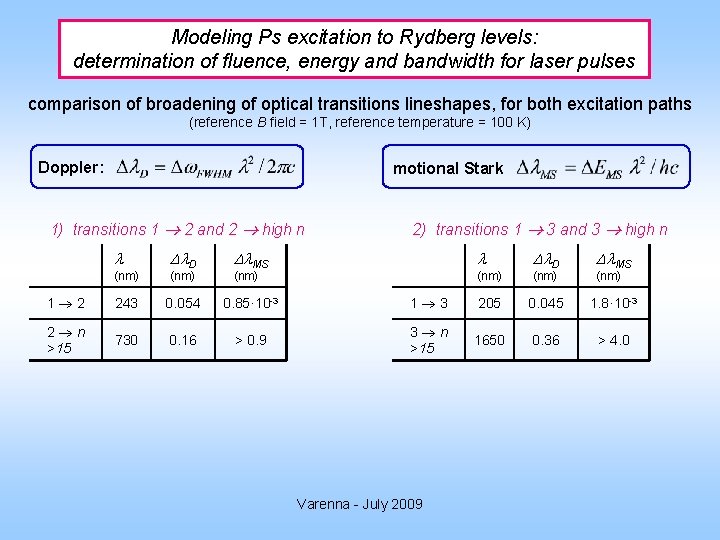
Modeling Ps excitation to Rydberg levels: determination of fluence, energy and bandwidth for laser pulses comparison of broadening of optical transitions lineshapes, for both excitation paths (reference B field = 1 T, reference temperature = 100 K) Doppler: motional Stark 1) transitions 1 2 and 2 high n (nm) D MS (nm) 2) transitions 1 3 and 3 high n (nm) D MS (nm) 1 2 243 0. 054 0. 85· 10 -3 1 3 205 0. 045 1. 8· 10 -3 2 n >15 730 0. 16 > 0. 9 3 n >15 1650 0. 36 > 4. 0 Varenna - July 2009
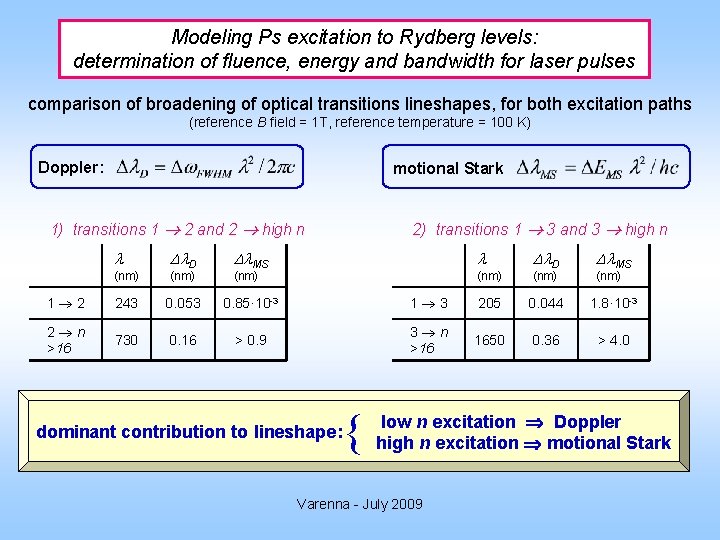
Modeling Ps excitation to Rydberg levels: determination of fluence, energy and bandwidth for laser pulses comparison of broadening of optical transitions lineshapes, for both excitation paths (reference B field = 1 T, reference temperature = 100 K) Doppler: motional Stark 1) transitions 1 2 and 2 high n (nm) D MS (nm) 2) transitions 1 3 and 3 high n (nm) D MS (nm) 1 2 243 0. 053 0. 85· 10 -3 1 3 205 0. 044 1. 8· 10 -3 2 n >16 730 0. 16 > 0. 9 3 n >16 1650 0. 36 > 4. 0 dominant contribution to lineshape: low n excitation Doppler high n excitation motional Stark Varenna - July 2009
Fluence and energy of laser pulses : low n excitations 1 2, 3 Absorption cross section (Doppler lineshape): Einstein coeff. matrix element of electric dipole allowed transition ( polarization vector) Saturation fluence, with laser bandwidth = Doppler linewidth D As expected FSAT proportional to D Varenna - July 2009
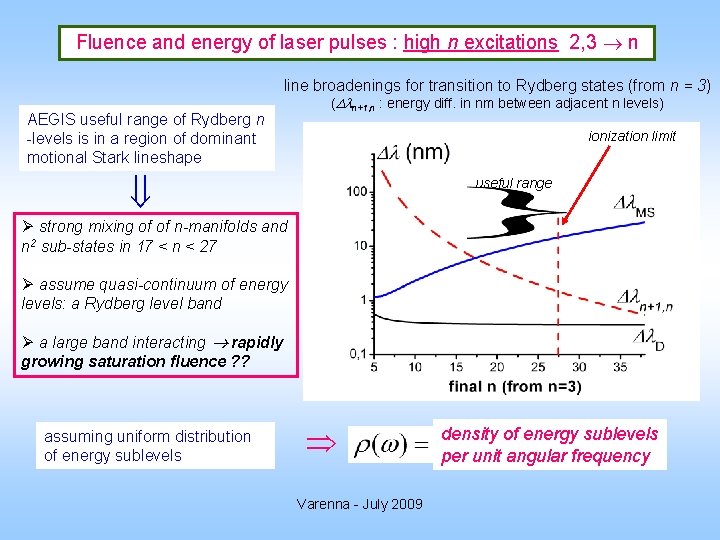
Fluence and energy of laser pulses : high n excitations 2, 3 n line broadenings for transition to Rydberg states (from n = 3) AEGIS useful range of Rydberg n -levels is in a region of dominant motional Stark lineshape ( n+1, n : energy diff. in nm between adjacent n levels) ionization limit useful range Ø strong mixing of of n-manifolds and n 2 sub-states in 17 < n < 27 Ø assume quasi-continuum of energy levels: a Rydberg level band Ø a large band interacting rapidly growing saturation fluence ? ? assuming uniform distribution of energy sublevels Varenna - July 2009 density of energy sublevels per unit angular frequency
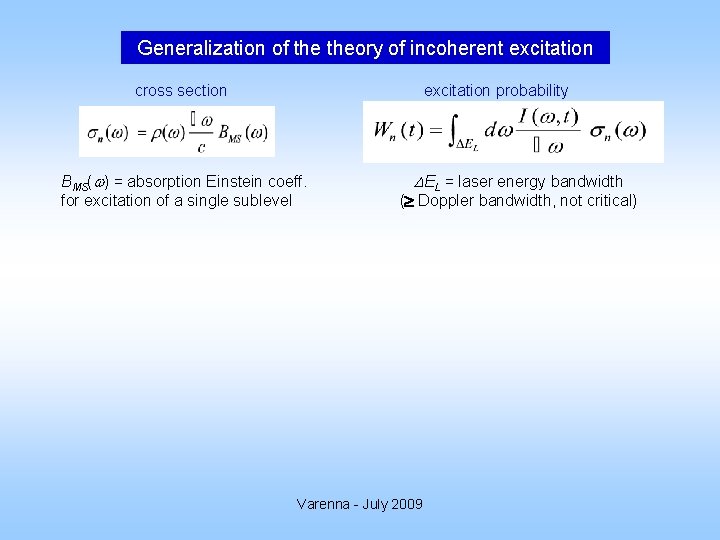
Generalization of theory of incoherent excitation cross section excitation probability BMS( ) = absorption Einstein coeff. for excitation of a single sublevel EL = laser energy bandwidth ( Doppler bandwidth, not critical) Varenna - July 2009
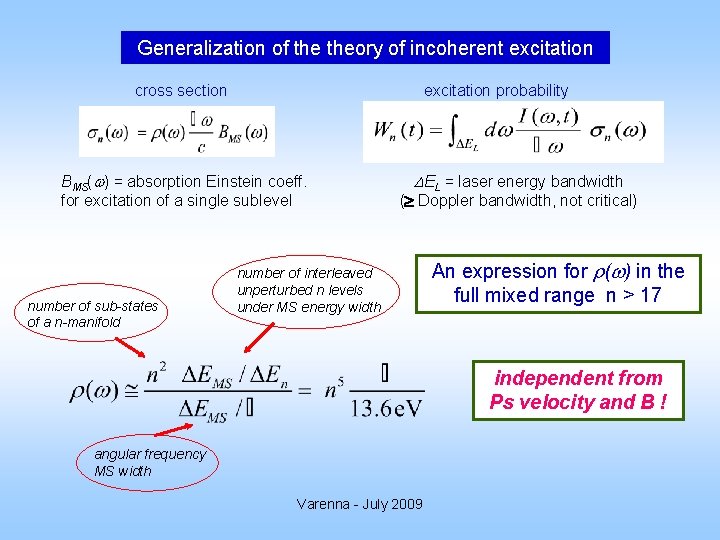
Generalization of theory of incoherent excitation cross section excitation probability BMS( ) = absorption Einstein coeff. for excitation of a single sublevel number of sub-states of a n-manifold EL = laser energy bandwidth ( Doppler bandwidth, not critical) number of interleaved unperturbed n levels under MS energy width An expression for ( ) in the full mixed range n > 17 independent from Ps velocity and B ! angular frequency MS width Varenna - July 2009
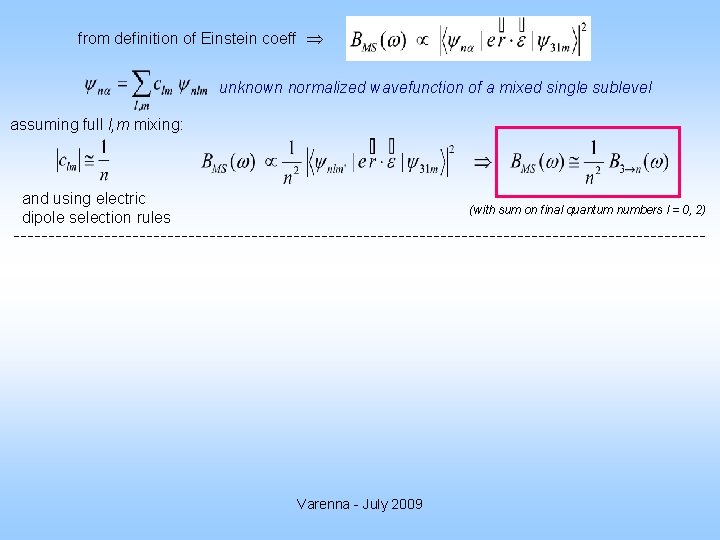
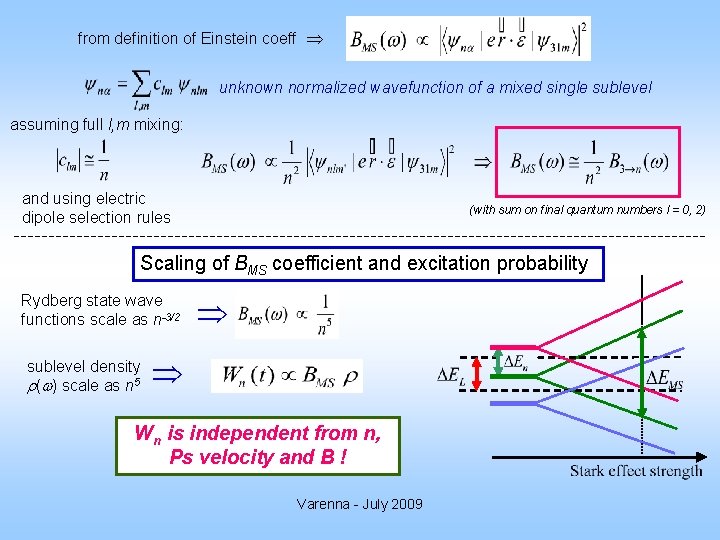
from definition of Einstein coeff unknown normalized wavefunction of a mixed single sublevel assuming full l, m mixing: and using electric dipole selection rules (with sum on final quantum numbers l = 0, 2) Varenna - July 2009
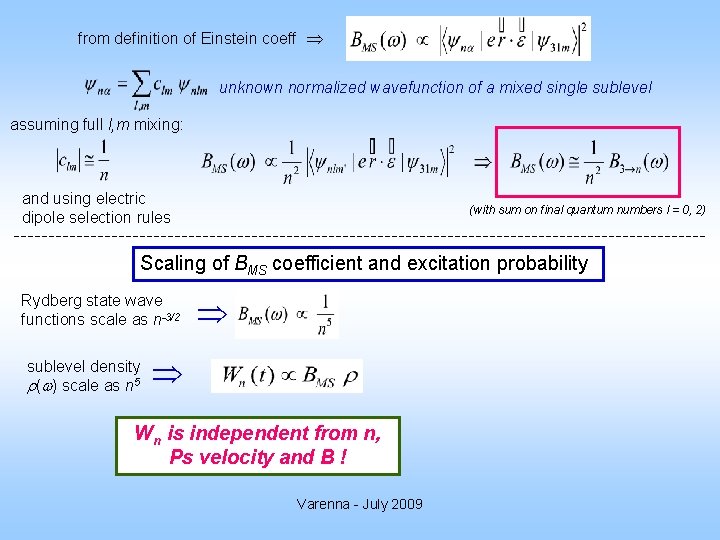
from definition of Einstein coeff unknown normalized wavefunction of a mixed single sublevel assuming full l, m mixing: and using electric dipole selection rules (with sum on final quantum numbers l = 0, 2) Scaling of BMS coefficient and excitation probability Rydberg state wave functions scale as n-3/2 sublevel density ( ) scale as n 5 Wn is independent from n, Ps velocity and B ! Varenna - July 2009
from definition of Einstein coeff unknown normalized wavefunction of a mixed single sublevel assuming full l, m mixing: and using electric dipole selection rules (with sum on final quantum numbers l = 0, 2) Scaling of BMS coefficient and excitation probability Rydberg state wave functions scale as n-3/2 sublevel density ( ) scale as n 5 Wn is independent from n, Ps velocity and B ! Varenna - July 2009
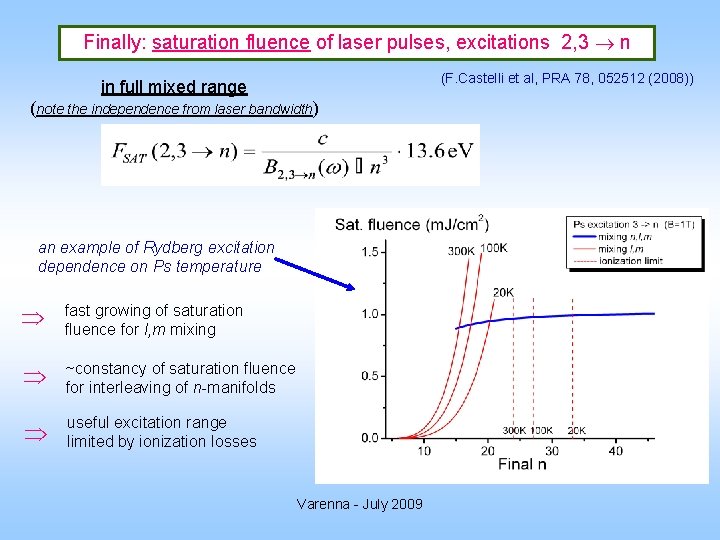
Finally: saturation fluence of laser pulses, excitations 2, 3 n (F. Castelli et al, PRA 78, 052512 (2008)) in full mixed range (note the independence from laser bandwidth) an example of Rydberg excitation dependence on Ps temperature fast growing of saturation fluence for l, m mixing ~constancy of saturation fluence for interleaving of n-manifolds useful excitation range limited by ionization losses Varenna - July 2009
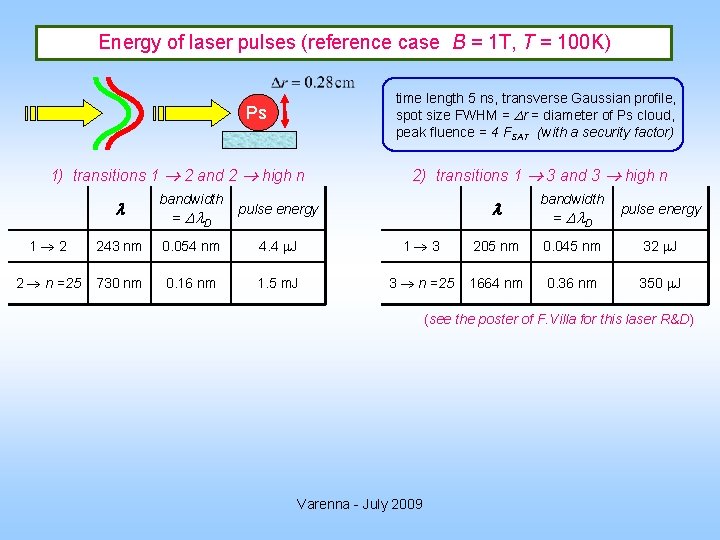
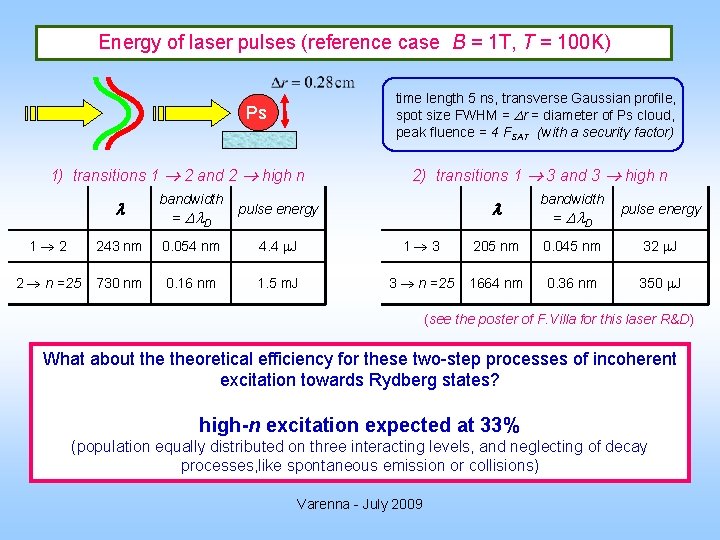
Energy of laser pulses (reference case B = 1 T, T = 100 K) time length 5 ns, transverse Gaussian profile, spot size FWHM = r = diameter of Ps cloud, peak fluence = 4 FSAT (with a security factor) Ps 1) transitions 1 2 and 2 high n bandwidth = D pulse energy 1 2 243 nm 0. 054 nm 4. 4 J 2 n =25 730 nm 0. 16 nm 1. 5 m. J 2) transitions 1 3 and 3 high n bandwidth 1 3 205 nm 0. 045 nm 32 J 3 n =25 1664 nm 0. 36 nm 350 J = pulse energy D (see the poster of F. Villa for this laser R&D) Varenna - July 2009
Energy of laser pulses (reference case B = 1 T, T = 100 K) time length 5 ns, transverse Gaussian profile, spot size FWHM = r = diameter of Ps cloud, peak fluence = 4 FSAT (with a security factor) Ps 1) transitions 1 2 and 2 high n bandwidth = D pulse energy 1 2 243 nm 0. 054 nm 4. 4 J 2 n =25 730 nm 0. 16 nm 1. 5 m. J 2) transitions 1 3 and 3 high n bandwidth 1 3 205 nm 0. 045 nm 32 J 3 n =25 1664 nm 0. 36 nm 350 J = pulse energy D (see the poster of F. Villa for this laser R&D) What about theoretical efficiency for these two-step processes of incoherent excitation towards Rydberg states? high-n excitation expected at 33% (population equally distributed on three interacting levels, and neglecting of decay processes, like spontaneous emission or collisions) Varenna - July 2009
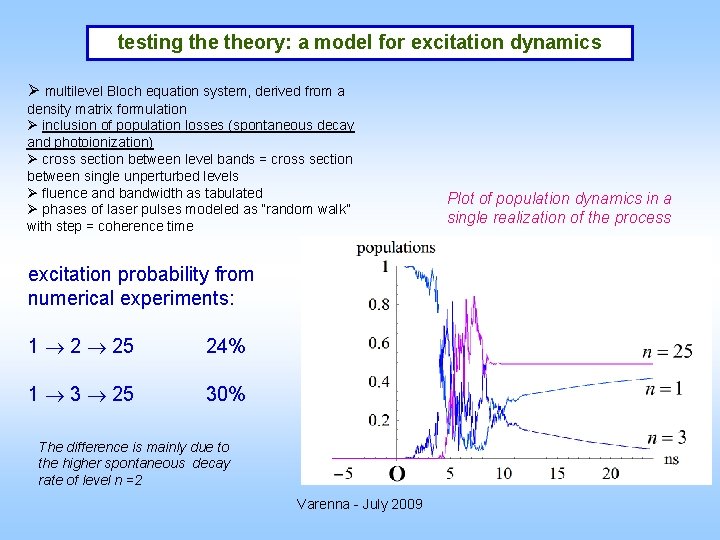
testing theory: a model for excitation dynamics Ø multilevel Bloch equation system, derived from a density matrix formulation Ø inclusion of population losses (spontaneous decay and photoionization) Ø cross section between level bands = cross section between single unperturbed levels Ø fluence and bandwidth as tabulated Ø phases of laser pulses modeled as “random walk” with step = coherence time excitation probability from numerical experiments: 1 2 25 24% 1 3 25 30% The difference is mainly due to the higher spontaneous decay rate of level n =2 Varenna - July 2009 Plot of population dynamics in a single realization of the process
Conclusions ♫ Development of a “first order” analysis of the energy level structure of a moving Ps atom in magnetic field; ♫ Formulation of a generalized theory of incoherent excitation, for application in sublevel full mixing cases; ♫ Determination of laser pulse characteristics, to the goal of maximum efficiency in Ps excitation for AEGIS Varenna - July 2009
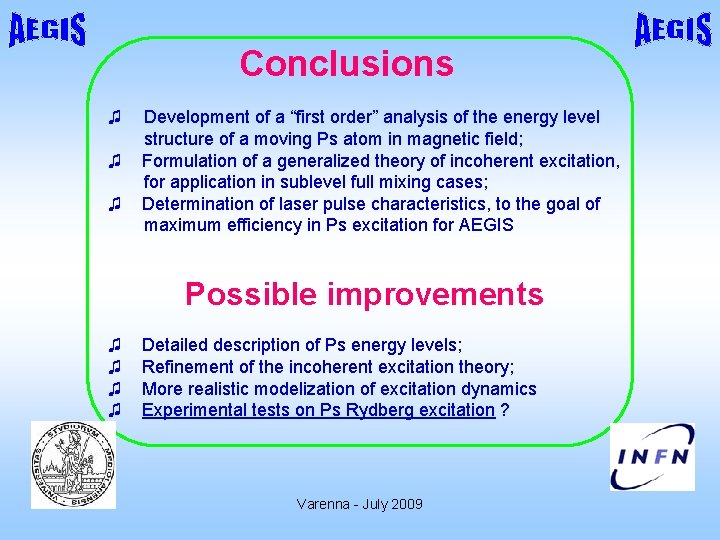
Conclusions ♫ Development of a “first order” analysis of the energy level structure of a moving Ps atom in magnetic field; ♫ Formulation of a generalized theory of incoherent excitation, for application in sublevel full mixing cases; ♫ Determination of laser pulse characteristics, to the goal of maximum efficiency in Ps excitation for AEGIS Possible improvements ♫ Detailed description of Ps energy levels; ♫ Refinement of the incoherent excitation theory; ♫ More realistic modelization of excitation dynamics ♫ Experimental tests on Ps Rydberg excitation ? Varenna - July 2009
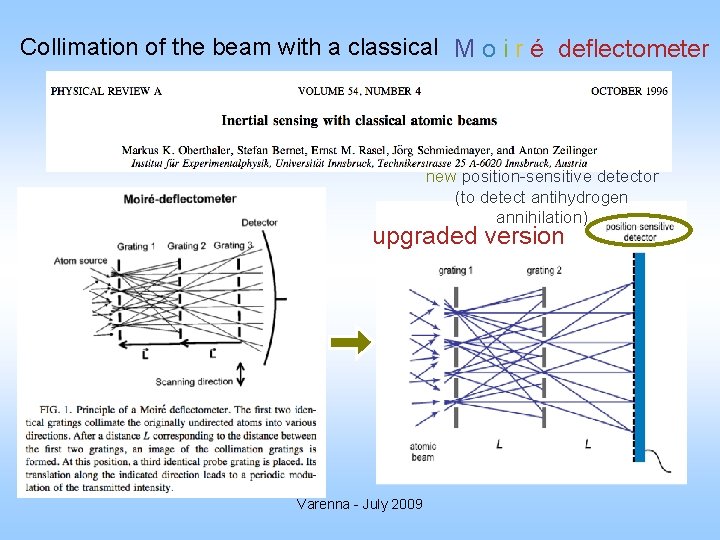
Collimation of the beam with a classical M o i r é deflectometer new position-sensitive detector (to detect antihydrogen annihilation) upgraded version Varenna - July 2009
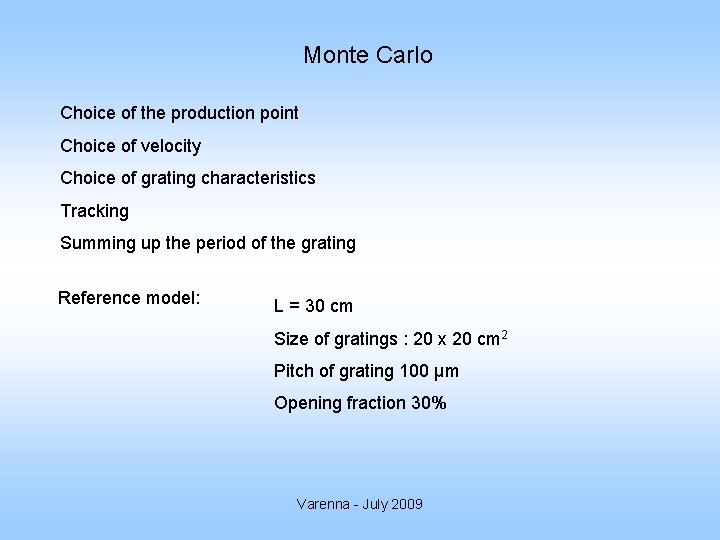
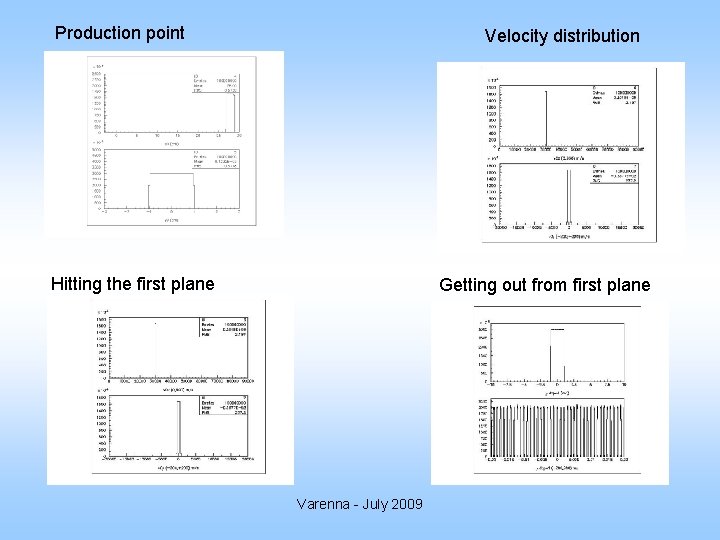
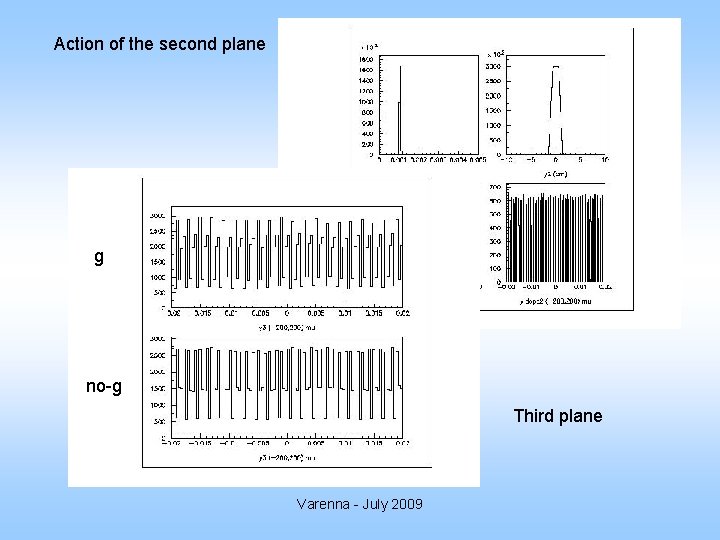
Monte Carlo Choice of the production point Choice of velocity Choice of grating characteristics Tracking Summing up the period of the grating Reference model: L = 30 cm Size of gratings : 20 x 20 cm 2 Pitch of grating 100 μm Opening fraction 30% Varenna - July 2009
Production point Velocity distribution Hitting the first plane Getting out from first plane Varenna - July 2009
Action of the second plane g no-g Third plane Varenna - July 2009
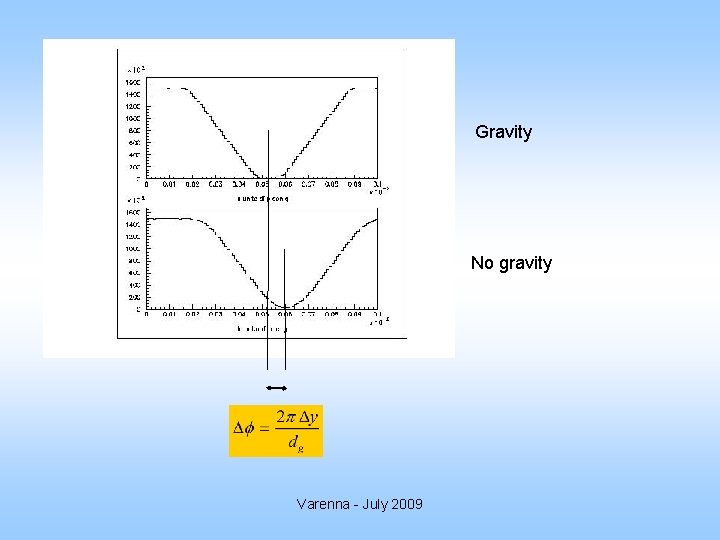
Gravity No gravity Varenna - July 2009
moiré deflectometer M o i r é deflectometer 5 (x/a) annihilation hit position on the final detector (in x/a units) 3 Suppose: - L = 40 cm - grating period a = 80 μm - grating size = 20 cm (2500 slits) - no gravity 4 X depends on the alignement between the gratings, and on the alignment between them and the center of the antihydrogen cloud. It is indepentend to the radial antihydrogen velocity and profile 0 0. 25 0. 75 Δo (calculated experimentally) 1 x/a Varenna - July 2009 counts (a. u. ) -3 slit -4 solid -5 slit grating slits shadow 1 -2 -1 counts (a. u. ) annihilation hit position on the final detector (in x/a units, modulo grating period a) 0 fringes 2 Z Grating transparency = 30% (total transmission 9%) ]a
moiré deflectometer M o i r é deflectometer 4 5 (x/a) annihilation hit position on the final detector (in a units) -2 solid slit -3 slit 0. 25 0. 75 1 x/a Varenna - July 2009 -5 -4 Fringe shift ! 0 grating slits shadow fringe shift annihilation hit position on the final detector (in a units, modulo grating period a) counts (a. u. ) 2 vz = 600 m/s vz = 250 m/s 1 Z Grating transparency = 30% (total transmission 9%) 3 beam horizontal velocity 0 Suppose: - L = 40 cm - grating period a = 80 μm - grating size = 20 cm (2500 slits) - gravity -1 X counts (a. u. ) ]a
M o i r é deflectometer counts (a. u. ) Out beam is not monochromatic (T varies quite a lot) fringe shift of the shadow image v T = time of flight = [t. STARK - t. DET] (L~ 1 m, v ~ 500 m/s ➠T ~ 2 ms) Binning antihydrogens with mean velocity of 600 -550 -500 -450400 -350 -300 -250 -200 m/s, and plotting δ as a function of ➠ counts (a. u. ) ➠ δ (a. u. ) m/s T 2 g comes from the fit time of flight T (s) ms 2 Varenna - July 2009