
Laserdiamond interaction Modelling the device damage during laser
- Slides: 29
Laser-diamond interaction – Modelling the device damage during laser graphitization Tzveta Apostolova 1, Stefano Lagomarsino 2, 3, Silvio Sciortino 2, 3, Chiara Corsi 4, 5, Marco Bellini 6 1 Institute for Nuclear Research and Nuclear Energy 2 Istituto Nazionale di Fisica Nucleare 3 Dipartimento di Fisica, Università di Firenze 4 Dipartimento di Fisica, Università di Firenze 5 LENS Florence 6 INO-CNR Florence
Motivation • Laser engineering of diamond for writing conductive paths is an important subject of research for its application in radiation detection (3 D detectors)[1, 2]. [1] S. Lagomarsino et al Appl. Phys. Lett. 103, 233507 (2013) [2] S. Lagomarsino , et al Diamond & Related Materials 43 (2014) 23– 28 • A deep insight of the process of laser graphitization of diamond is critical to tune at best the laser parameters and obtain low resistivity channels with minimum damage of the surrounding diamond lattice. • Simulate ultra-short laser-induced electronic excitation, absorption, and the subsequent relaxation processes in CVD monocrystalline diamond and compare to the results of experiment.
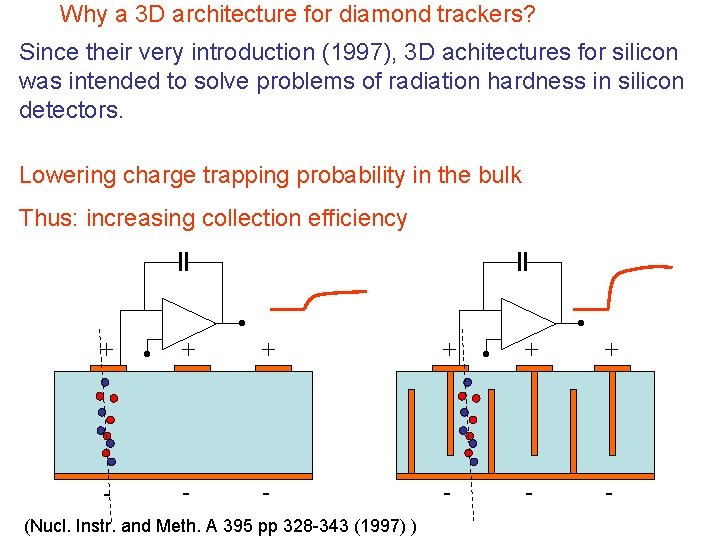
Why a 3 D architecture for diamond trackers? Since their very introduction (1997), 3 D achitectures for silicon was intended to solve problems of radiation hardness in silicon detectors. Lowering charge trapping probability in the bulk Thus: increasing collection efficiency + + + - - - (Nucl. Instr. and Meth. A 395 pp 328 -343 (1997) )
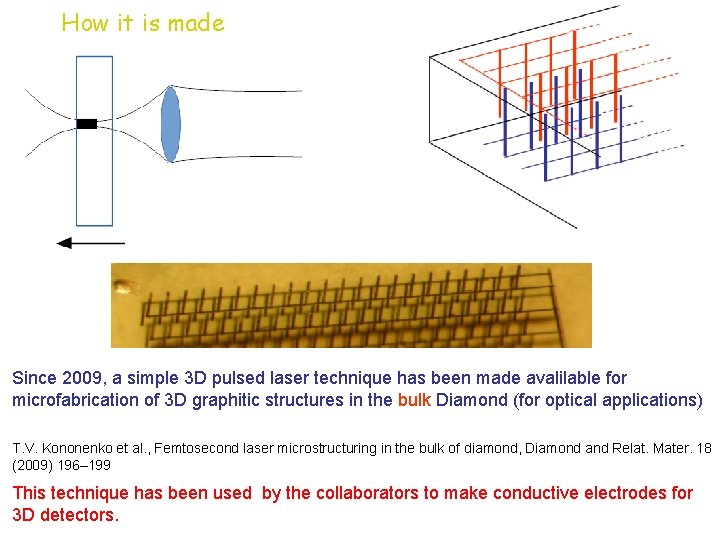
How it is made Since 2009, a simple 3 D pulsed laser technique has been made avalilable for microfabrication of 3 D graphitic structures in the bulk Diamond (for optical applications) T. V. Kononenko et al. , Femtosecond laser microstructuring in the bulk of diamond, Diamond and Relat. Mater. 18 (2009) 196– 199 This technique has been used by the collaborators to make conductive electrodes for 3 D detectors.
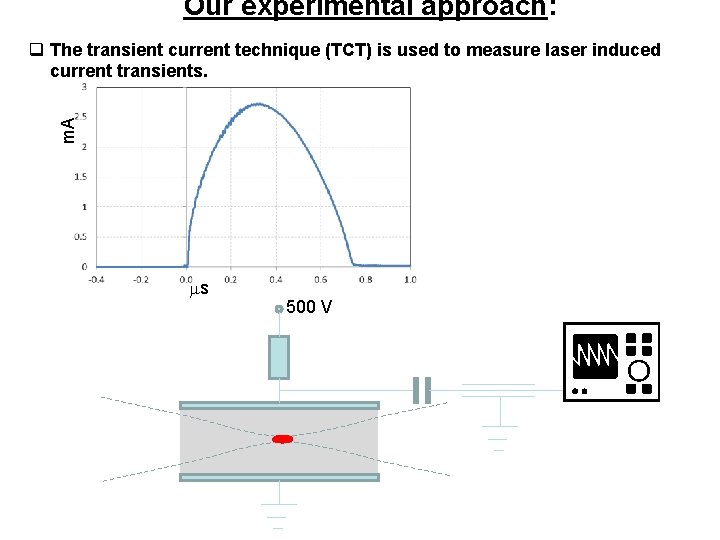
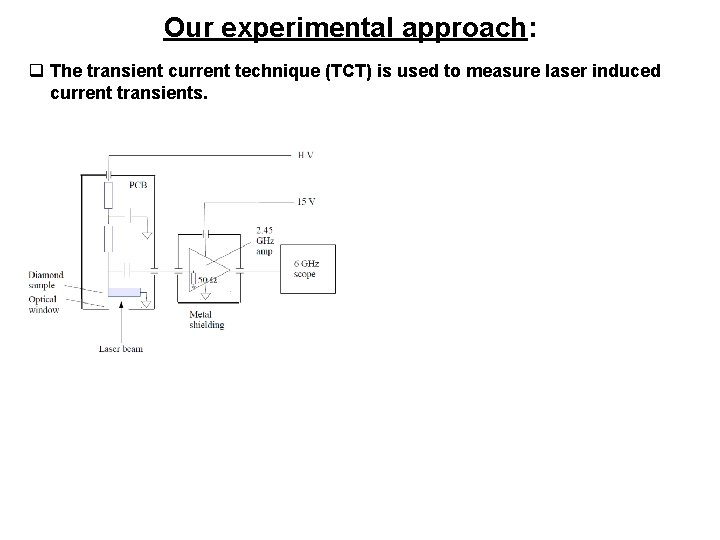
Our experimental approach: m. A q The transient current technique (TCT) is used to measure laser induced current transients. s 500 V
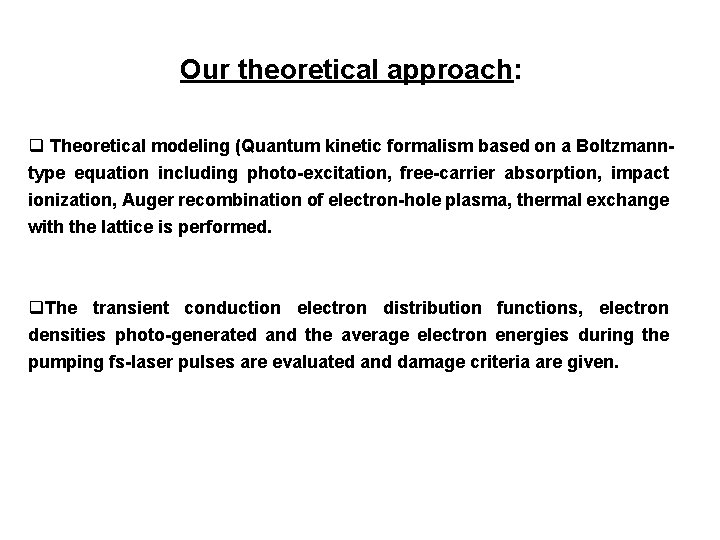
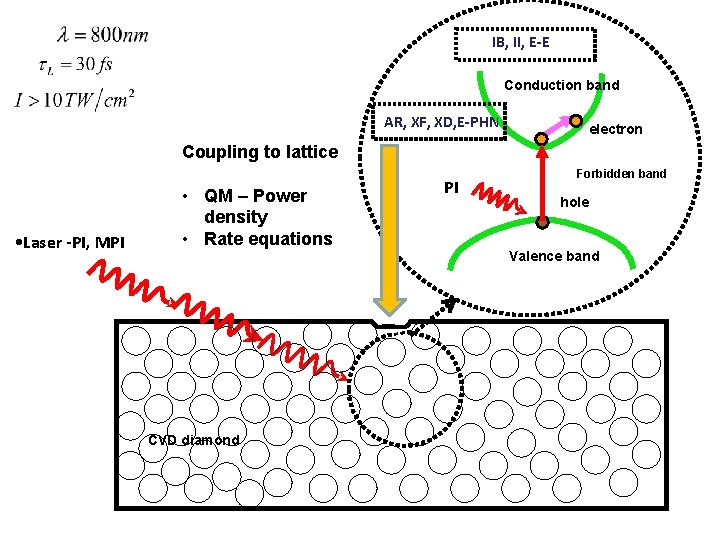
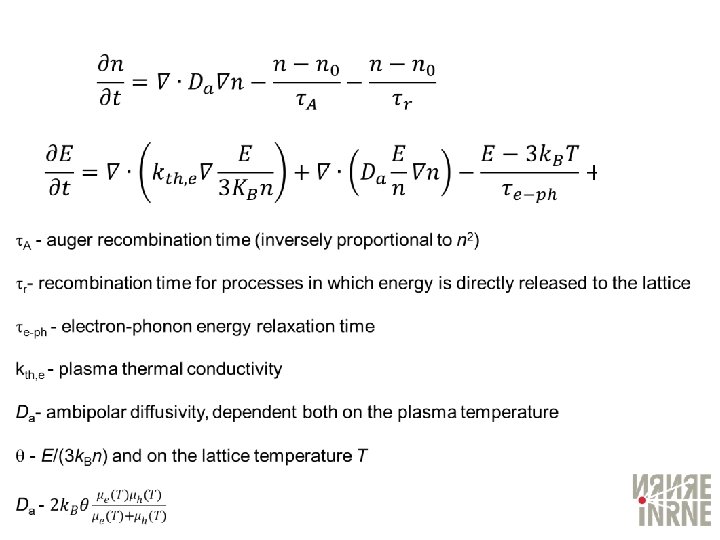
Our theoretical approach: q Theoretical modeling (Quantum kinetic formalism based on a Boltzmanntype equation including photo-excitation, free-carrier absorption, impact ionization, Auger recombination of electron-hole plasma, thermal exchange with the lattice is performed. q. The transient conduction electron distribution functions, electron densities photo-generated and the average electron energies during the pumping fs-laser pulses are evaluated and damage criteria are given.
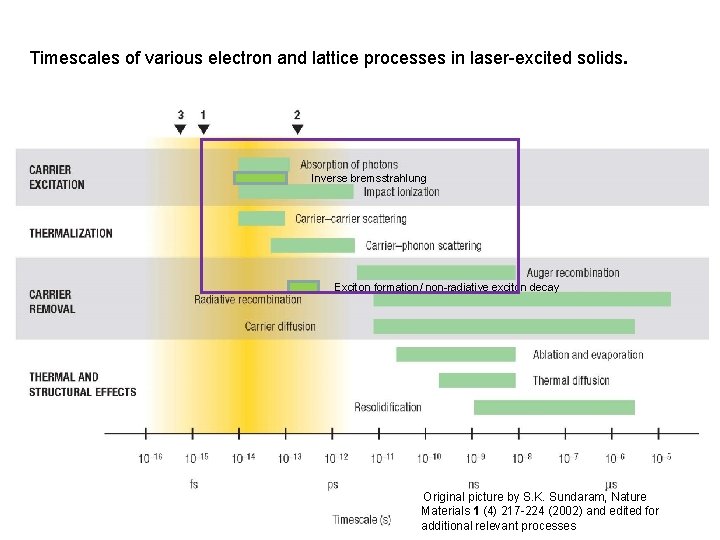
Timescales of various electron and lattice processes in laser-excited solids. Inverse bremsstrahlung Exciton formation/ non-radiative exciton decay Original picture by S. K. Sundaram, Nature Materials 1 (4) 217 -224 (2002) and edited for additional relevant processes
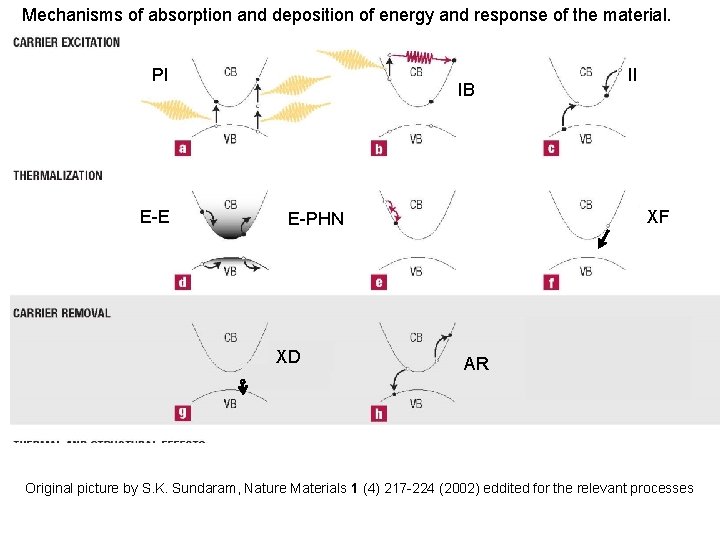
Mechanisms of absorption and deposition of energy and response of the material. PI E-E IB XF E-PHN XD II AR Original picture by S. K. Sundaram, Nature Materials 1 (4) 217 -224 (2002) eddited for the relevant processes
IB, II, E-E Conduction band AR, XF, XD, E-PHN Coupling to lattice • Laser -PI, MPI • QM – Power density • Rate equations CVD diamond electron Laser radiation PI Forbidden band hole Valence band
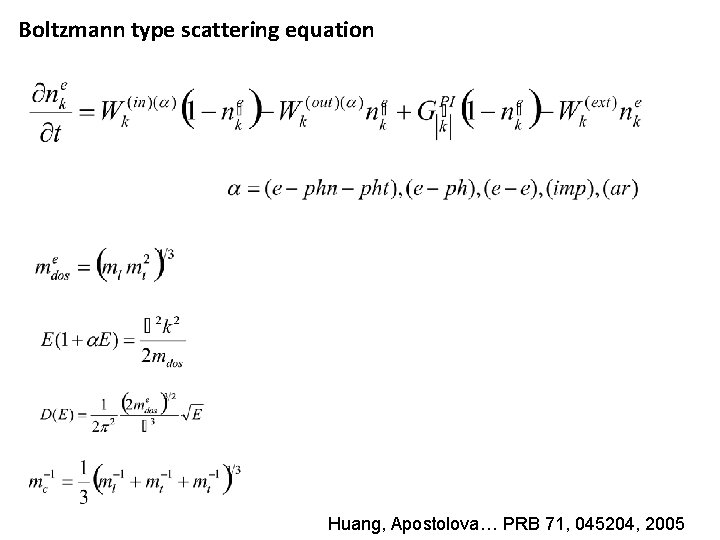
Boltzmann type scattering equation Huang, Apostolova… PRB 71, 045204, 2005
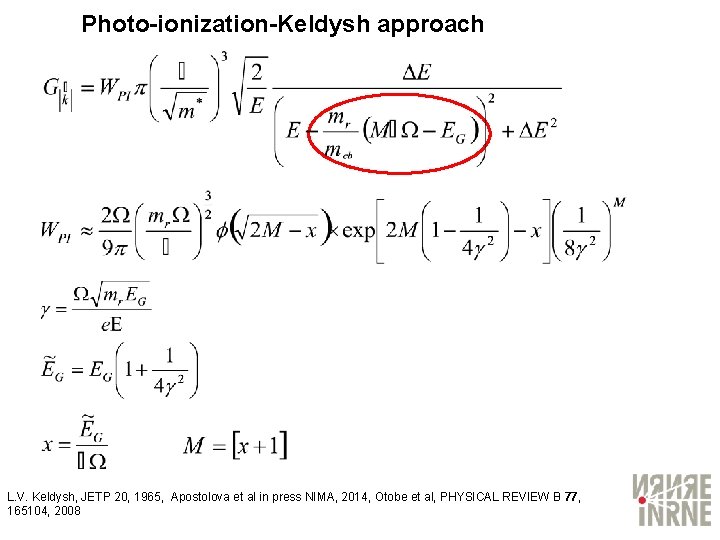
Photo-ionization-Keldysh approach L. V. Keldysh, JETP 20, 1965, Apostolova et al in press NIMA, 2014, Otobe et al, PHYSICAL REVIEW B 77, 165104, 2008
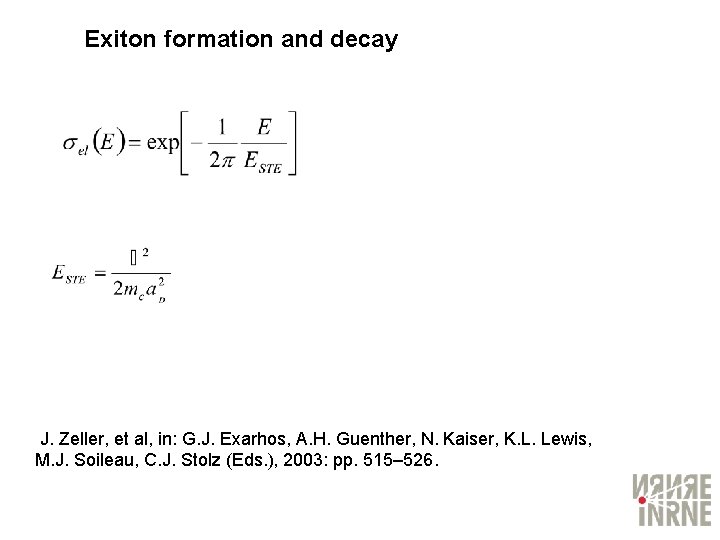
Exiton formation and decay J. Zeller, et al, in: G. J. Exarhos, A. H. Guenther, N. Kaiser, K. L. Lewis, M. J. Soileau, C. J. Stolz (Eds. ), 2003: pp. 515– 526.
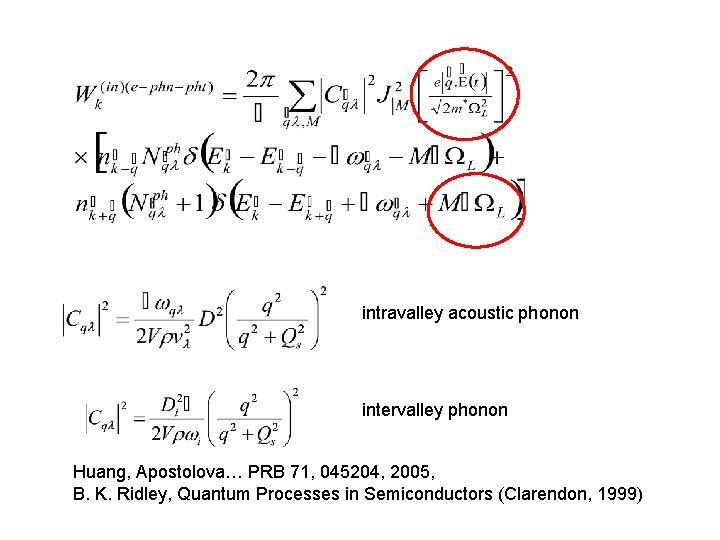
intravalley acoustic phonon intervalley phonon Huang, Apostolova… PRB 71, 045204, 2005, B. K. Ridley, Quantum Processes in Semiconductors (Clarendon, 1999)
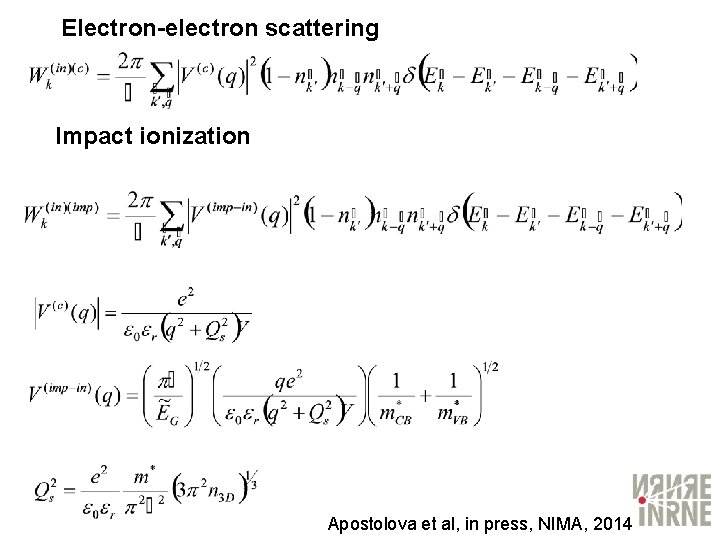
Electron-electron scattering Impact ionization Apostolova et al, in press, NIMA, 2014
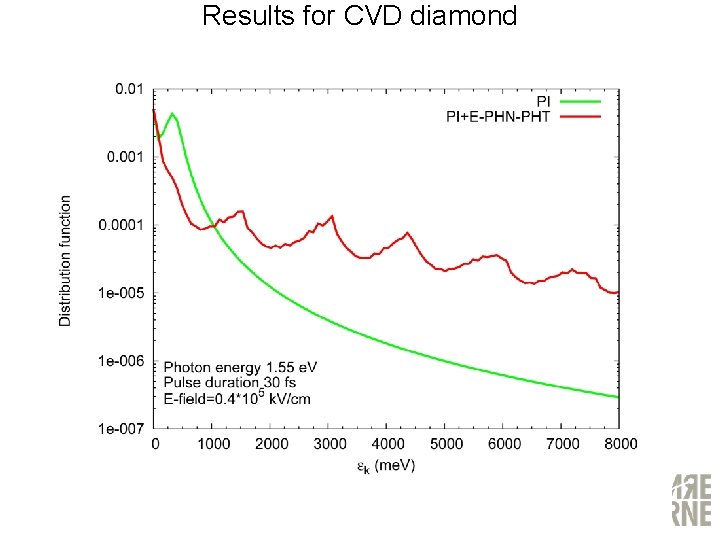
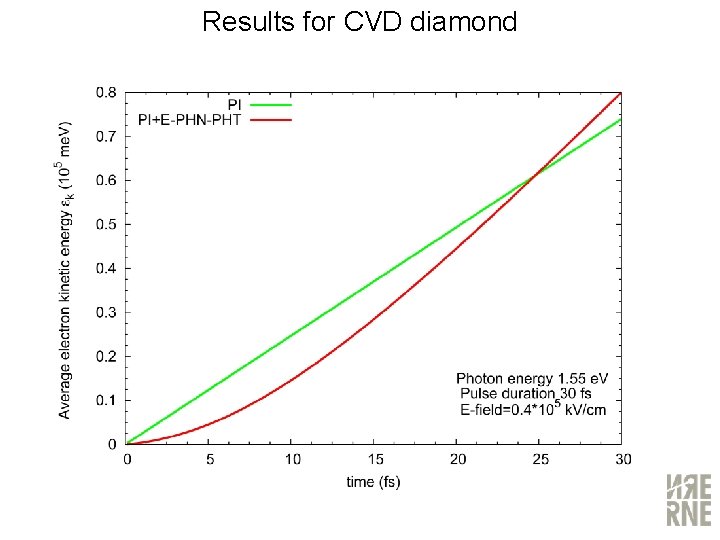
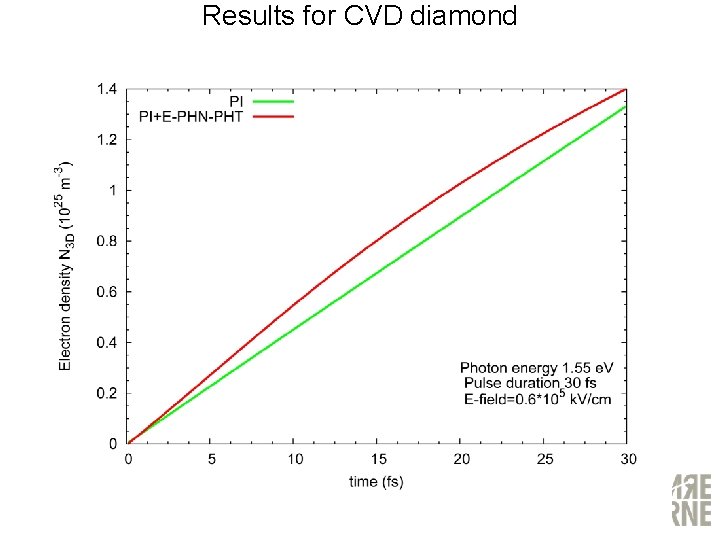
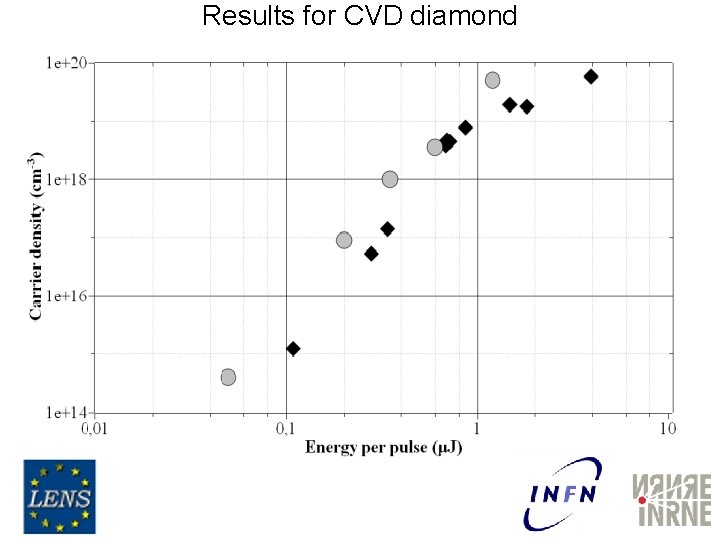
Results for CVD diamond
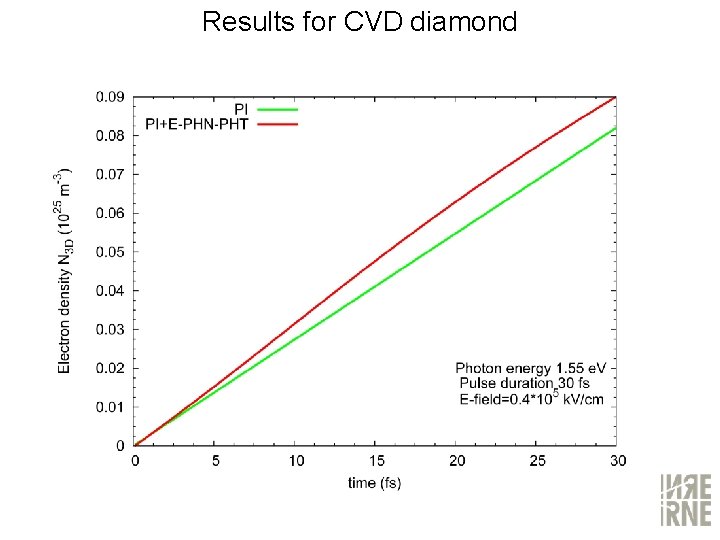
Results for CVD diamond
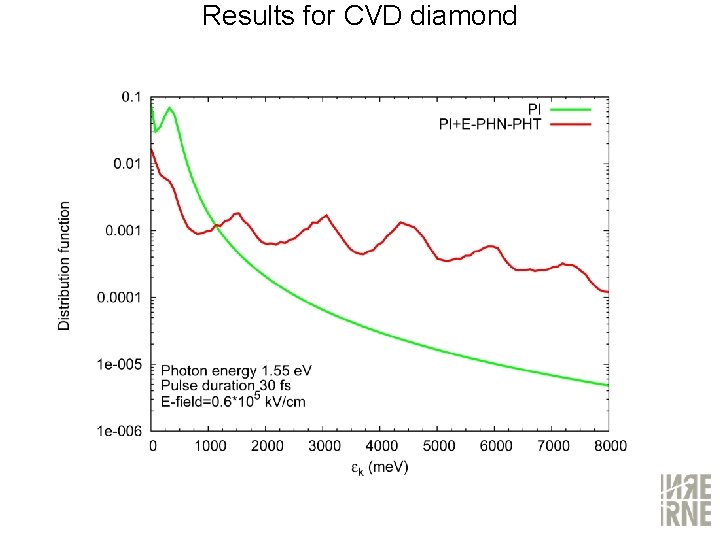
Results for CVD diamond
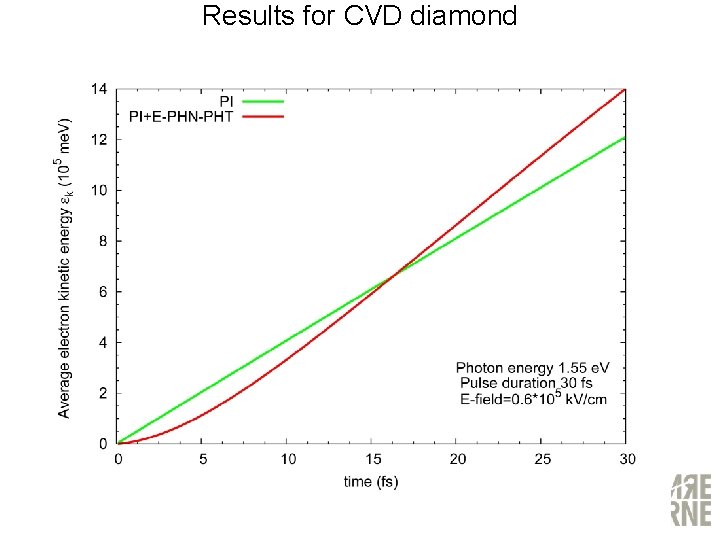
Results for CVD diamond
Results for CVD diamond
Results for CVD diamond
Results for CVD diamond
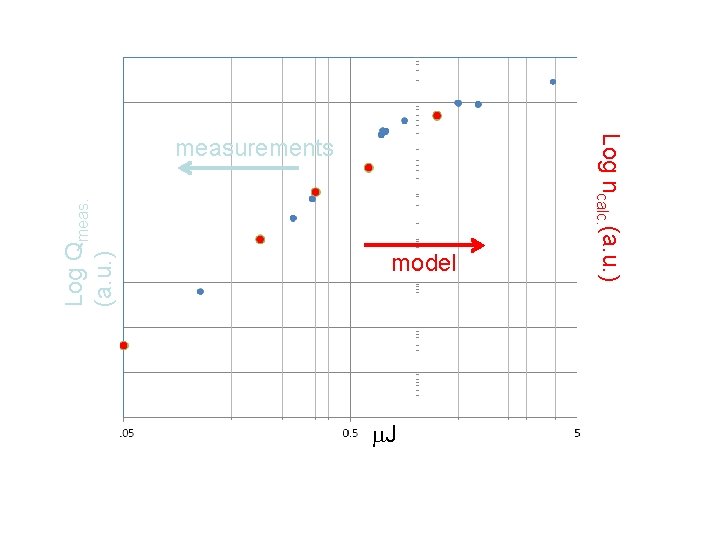
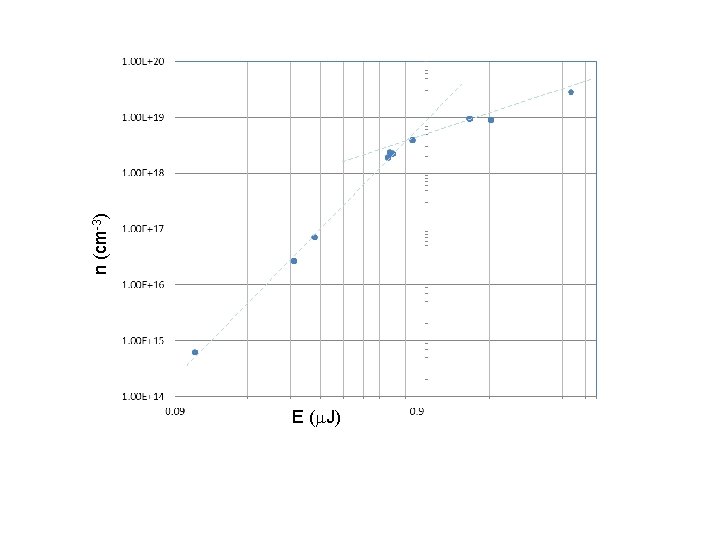
Log Qmeas. (a. u. ) model J Log ncalc. (a. u. ) measurements
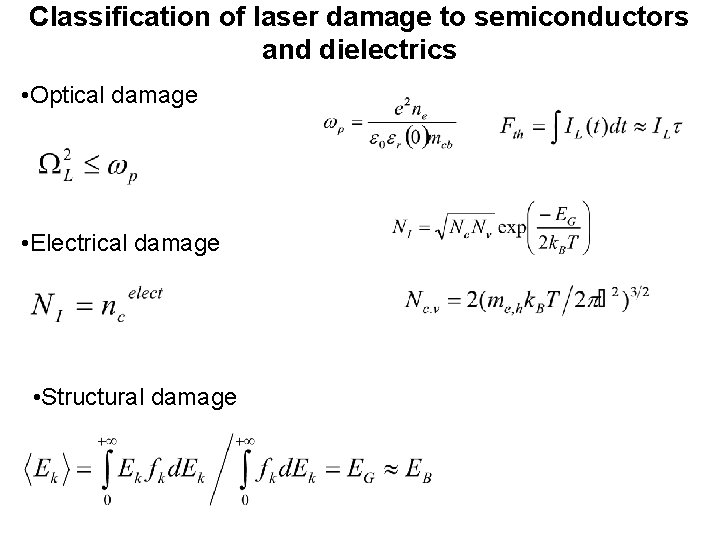
Classification of laser damage to semiconductors and dielectrics • Optical damage • Electrical damage • Structural damage
Conclusions • A theoretical simulation accounting for the excitation processes in the bulk of diamond, induced by femtosecond laser irradiation has been carried out. • The input parameters correspond to the experimental conditions of fabrication of graphitic conductive channels, from low field intensity to below about the threshold of laser graphitization. • The model is in very good qualitative agreement with the experimental measurements of transient currents excited by the laser beam focused inside the diamond bulk.
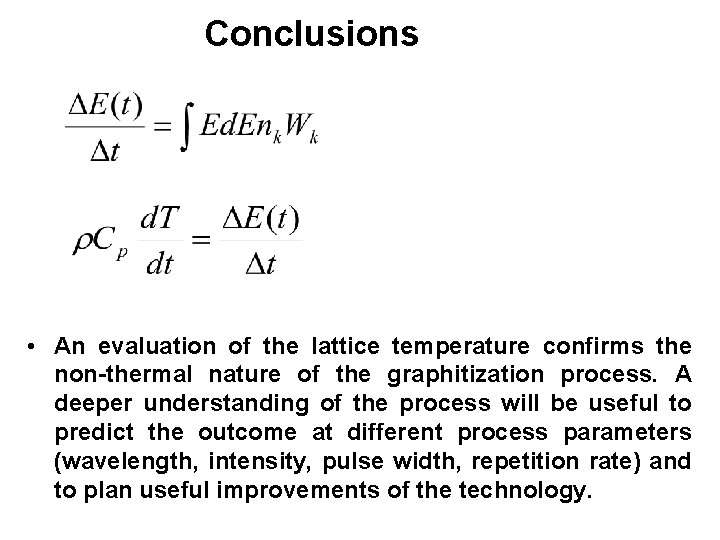
Conclusions • An evaluation of the lattice temperature confirms the non-thermal nature of the graphitization process. A deeper understanding of the process will be useful to predict the outcome at different process parameters (wavelength, intensity, pulse width, repetition rate) and to plan useful improvements of the technology.
Outlook • More processes will be added to the calculation such as electron-electron scattering, electron-phonon scattering, impact ionization as well as non-radiative recombination for indirect band-gap materials. • The calculation will be extended to times after the end of the applied laser irradiation, i. e. , tens and hundreds of picoseconds.
E ( J) n (cm-3)
Our experimental approach: q The transient current technique (TCT) is used to measure laser induced current transients.