
Lasercontrolled Proton Beam for Medical Imaging Dr Carol
Laser-controlled Proton Beam for Medical Imaging Dr. Carol Johnstone, Dave Johnson (FNAL), Prof. Shaoul Ezekiel (MIT) Sept 23, 2009 FFAG Workshop Dave Johnson 1
Proton Radiography: Introduction v Proton radiography, like x-ray radiography, relies on the variation in the transmission of particles through an object to image small density variations in the object. v Unlike proton therapy where the Bragg peak is located in the tumor, the protons must penetrate the object and energy loss measured behind the object-> detector must be located behind the object. v The density resolution is inversely proportional to the square of the slope of the transmission curve, hence the density resolutions thousands of times better than with X-rays because of the large increase in energy deposition by protons. v Folding in resolution issues and the rbe of protons, in practice protons demonstrate about 5 times higher density resolution than optimized X-ray beam, for the same deposited dose. (I would imagine this would be a real plus for visualization of density anomalies in soft tissue. Sept 23, 2009 FFAG Workshop Dave Johnson 2
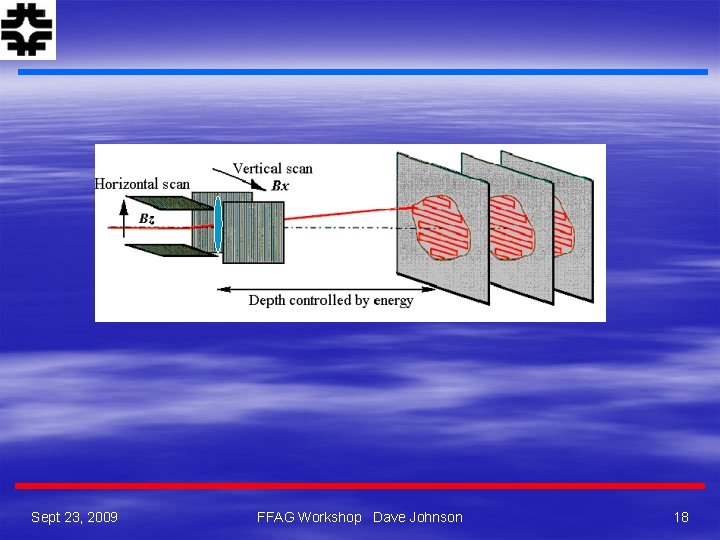
Proton Radiography: Introduction v Because of multiple coulomb scattering, the spatial resolution of proton radiography is lower compared to X-ray’s so that sharp discontinuities are slightly smeared in density. (Can this be made up in reduction of pixel size? ) v A raster scanning system is required so that the position of the incident proton beam is know at any instant in time. v The most obvious technique to afford raster scanning is the utilization of fast magnetic fields to scan a small proton beam across the volume in x and y. v A novel technique to create the proton “beamlets” employs a laser to create the proton beam used for scanning. Sept 23, 2009 FFAG Workshop Dave Johnson 3
A New Technique v Technique*: v Employ a laser to perform selective extraction of a proton beam from a larger, parent H- beam through the photodetachment of the outer electron. v The neutralized hydrogen beam is separated from the parent H- beam with a simple fixed magnetic field. v After separation from the H- beam the neutral beam is converted to protons by stripping foil. v This proton “beamlet” may then be manipulated using conventional accelerator optics. *technology awarded DOE/URA patent (U. S. PATENT NO. 5, 760, 395) Sept 23, 2009 FFAG Workshop Dave Johnson 4

Potential Utilizations v Uses: proton radiography, proton cardiography, proton irradiation, and similar medical applications for the diagnosis and treatment of tumors v Example - proton cardiography: vreal-time imaging of heart activity requires ~10 images of the heart per heart beat (20 images/sec). vproton beam is swept horizontally across a width of +/-15 cm (at a 3 m lever arm) at a rate of 2. 5 k. Hz and vertically at a rate of 20 Hz. v. The spot size of the beam ~ mm. Sept 23, 2009 FFAG Workshop Dave Johnson 5
Potential Proof of Principal Opportunity v. Fermilab has established a 400 Me. V Htest area for muon collider R&D. v. The H- beam is bunched in 200 Mhz with ~109 H- per bunch and operates at 15 Hz. v. This area contains a 5 -10 meter symmetric insert where this technique may be tested. Sept 23, 2009 FFAG Workshop Dave Johnson 6
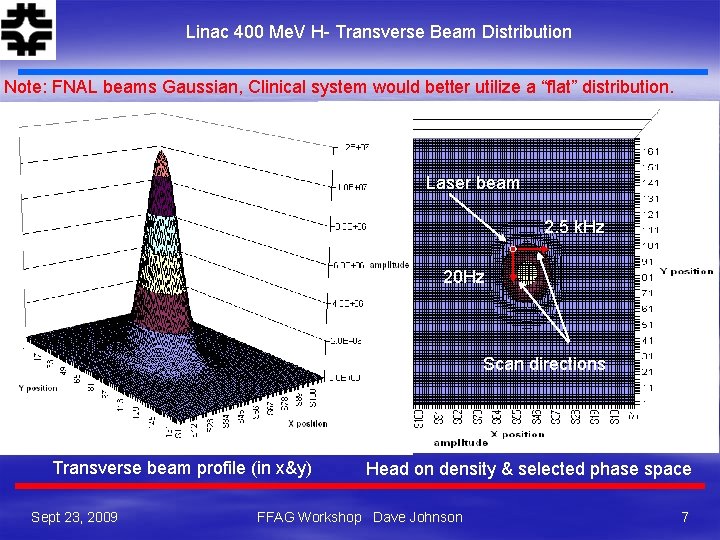
Linac 400 Me. V H- Transverse Beam Distribution Note: FNAL beams Gaussian, Clinical system would better utilize a “flat” distribution. Laser beam 2. 5 k. Hz 20 Hz Scan directions Transverse beam profile (in x&y) Sept 23, 2009 Head on density & selected phase space FFAG Workshop Dave Johnson 7
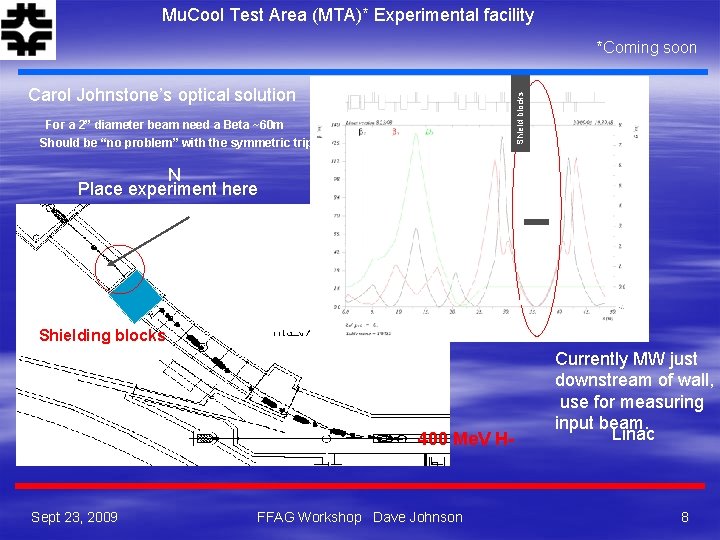
Mu. Cool Test Area (MTA)* Experimental facility *Coming soon Shield blocks Carol Johnstone’s optical solution For a 2” diameter beam need a Beta ~60 m Should be “no problem” with the symmetric triplets N Place experiment here Shielding blocks 400 Me. V H- Sept 23, 2009 FFAG Workshop Dave Johnson Currently MW just downstream of wall, use for measuring input beam. Linac 8
What Could be Done? § Proof of Principal Experiment (Phase I) – Utilizing a fixed laser beam offset to H- beam axis, verify the production of a proton “beamlet” from the H- , using a downstream detector. – Characterize extracted proton beamlet (xrel, yrel, sx, sy, I) then move beam off axis and repeat measurements. § Phase II – Install precursor commercial method for scanning beam horizontally and vertically and validate response. (such as pockels cell array or galvanometers) § Phase III – Install downstream proton optics for controlling beam scanning geometry of at a multi-density phantom (simulation of a biological subject. – Measure transverse and energy profile of each beamlet as it passes through the phantom Sept 23, 2009 FFAG Workshop Dave Johnson 9
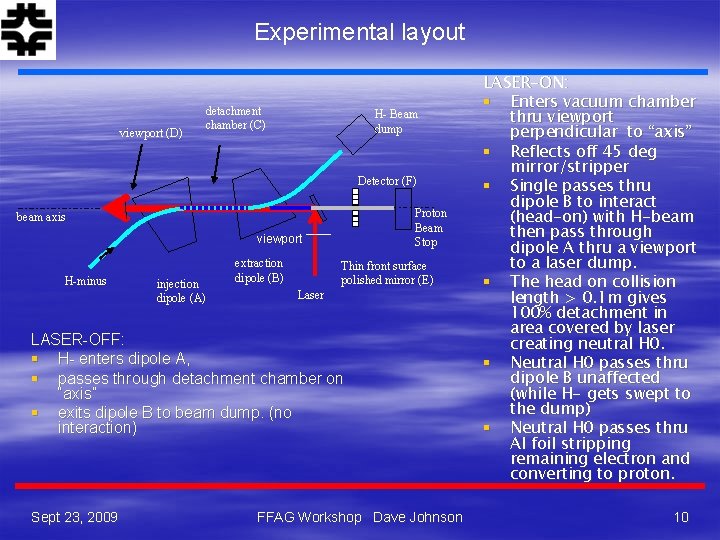
Experimental layout viewport (D) detachment chamber (C) H- Beam dump Detector (F) Proton Beam Stop beam axis viewport H-minus injection dipole (A) extraction dipole (B) Thin front surface polished mirror (E) Laser LASER-OFF: § H- enters dipole A, § passes through detachment chamber on “axis” § exits dipole B to beam dump. (no interaction) Sept 23, 2009 FFAG Workshop Dave Johnson LASER-ON: § Enters vacuum chamber thru viewport perpendicular to “axis” § Reflects off 45 deg mirror/stripper § Single passes thru dipole B to interact (head-on) with H-beam then pass through dipole A thru a viewport to a laser dump. § The head on collision length > 0. 1 m gives 100% detachment in area covered by laser creating neutral H 0. § Neutral H 0 passes thru dipole B unaffected (while H- gets swept to the dump) § Neutral H 0 passes thru Al foil stripping remaining electron and converting to proton. 10
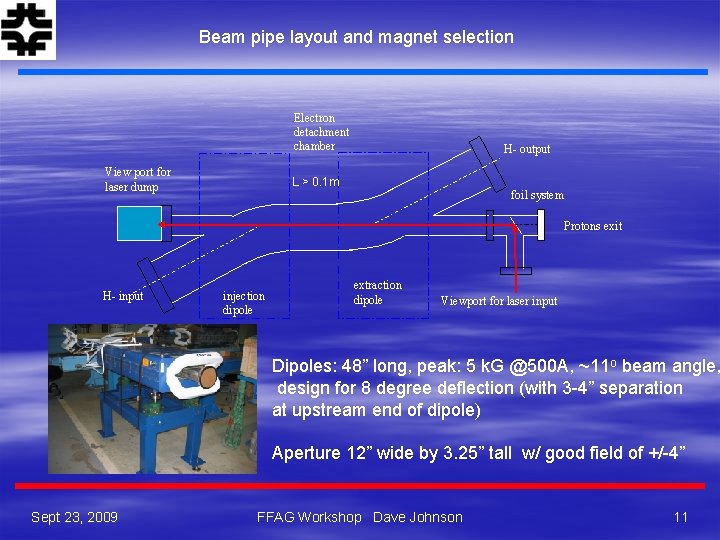
Beam pipe layout and magnet selection Electron detachment chamber View port for laser dump H- output L > 0. 1 m foil system Protons exit H- input injection dipole extraction dipole Viewport for laser input Dipoles: 48” long, peak: 5 k. G @500 A, ~11 o beam angle, design for 8 degree deflection (with 3 -4” separation at upstream end of dipole) Aperture 12” wide by 3. 25” tall w/ good field of +/-4” Sept 23, 2009 FFAG Workshop Dave Johnson 11
Issues v Photoneutralization cross section, optimization of laser wavelength/photon energy v Laser energy, repetition rate v Scanning system v Foil/mirror issues v Detector v Data acquisition Sept 23, 2009 FFAG Workshop Dave Johnson 12
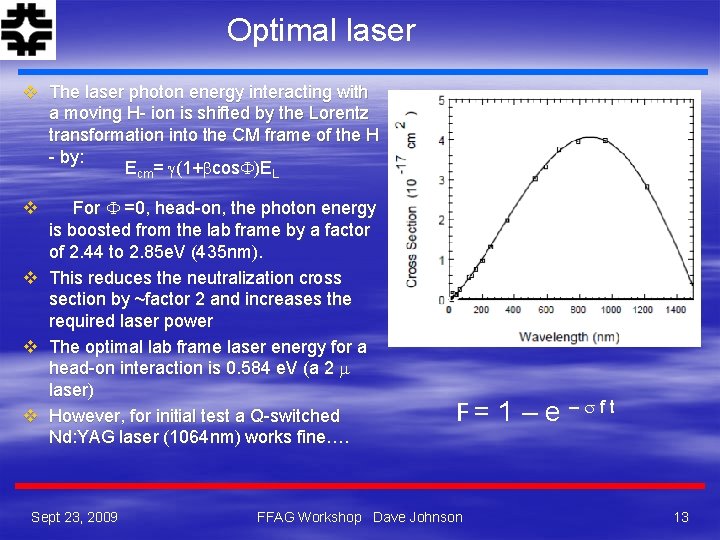
Optimal laser v The laser photon energy interacting with a moving H- ion is shifted by the Lorentz transformation into the CM frame of the H - by: Ecm= g(1+bcos. F)EL v v For F =0, head-on, the photon energy is boosted from the lab frame by a factor of 2. 44 to 2. 85 e. V (435 nm). This reduces the neutralization cross section by ~factor 2 and increases the required laser power The optimal lab frame laser energy for a head-on interaction is 0. 584 e. V (a 2 m laser) However, for initial test a Q-switched Nd: YAG laser (1064 nm) works fine…. Sept 23, 2009 F= 1 – e –sft FFAG Workshop Dave Johnson 13
Laser § For a 1064 nm (Nd: YAG) laser and a ½ meter interaction length with head on collision: § To get 100% neutralization with a 3 mm diameter laser beam requires only 6 m. J laser pulse. § The interaction time of ~2 ns is well within the laser pulse width of a commercial Q-switch YAG laser. § 100% Neutralization is still reached for 20 m. J even with reduction of the interaction region to 10 cm. § For rapid scanning for proton radiography will require much different laser parameters: For example: a 2. 5 khz rate across the H- beam the laser parameters which optimize the neutralization might be: – 2 m laser, 300 m. J, 20 ns pulse operating at 2. 5 khz with a 1 mm laser beam size with an average power of. 75 watts. § Room for optimization… Sept 23, 2009 FFAG Workshop Dave Johnson 14

§ DONE Sept 23, 2009 FFAG Workshop Dave Johnson 15
Sept 23, 2009 FFAG Workshop Dave Johnson 16
Sept 23, 2009 FFAG Workshop Dave Johnson 17
Sept 23, 2009 FFAG Workshop Dave Johnson 18
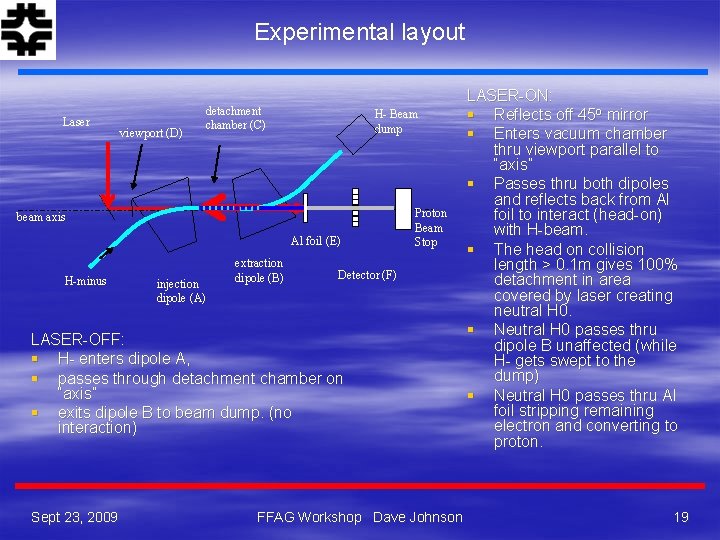
Experimental layout Laser viewport (D) detachment chamber (C) H- Beam dump beam axis Al foil (E) H-minus injection dipole (A) extraction dipole (B) Proton Beam Stop Detector (F) LASER-OFF: § H- enters dipole A, § passes through detachment chamber on “axis” § exits dipole B to beam dump. (no interaction) Sept 23, 2009 FFAG Workshop Dave Johnson LASER-ON: § Reflects off 45 o mirror § Enters vacuum chamber thru viewport parallel to “axis” § Passes thru both dipoles and reflects back from Al foil to interact (head-on) with H-beam. § The head on collision length > 0. 1 m gives 100% detachment in area covered by laser creating neutral H 0. § Neutral H 0 passes thru dipole B unaffected (while H- gets swept to the dump) § Neutral H 0 passes thru Al foil stripping remaining electron and converting to proton. 19
- Slides: 19