
Laser system schematic 400 s 5 50 Hz
- Slides: 16
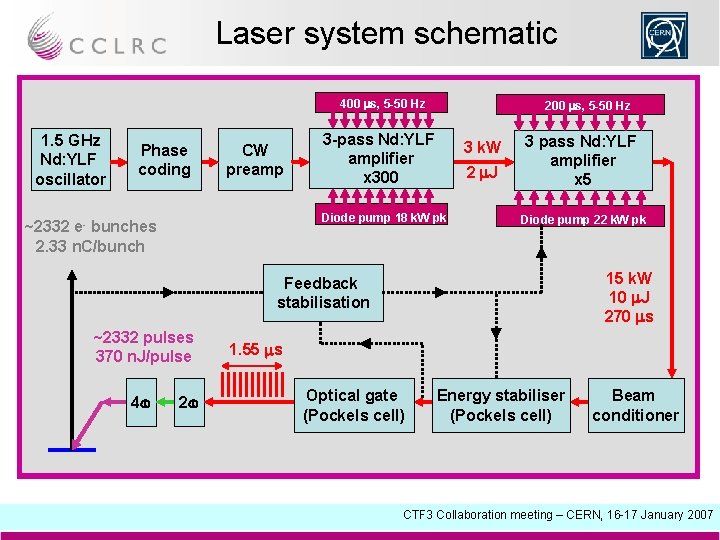
Laser system schematic 400 s, 5 -50 Hz 1. 5 GHz Nd: YLF oscillator Phase coding CW preamp 200 s, 5 -50 Hz 3 -pass Nd: YLF amplifier x 300 3 k. W 2 J Diode pump 18 k. W pk ~2332 e- bunches 2. 33 n. C/bunch 3 pass Nd: YLF 200 s, 5 -50 Hz amplifier x 5 Diode pump 22 k. W pk 15 k. W 10 J 270 s Feedback stabilisation ~2332 pulses 370 n. J/pulse 4 2 1. 55 s Optical gate (Pockels cell) Energy stabiliser (Pockels cell) Beam conditioner CTF 3 Collaboration meeting – CERN, 16 -17 January 2007
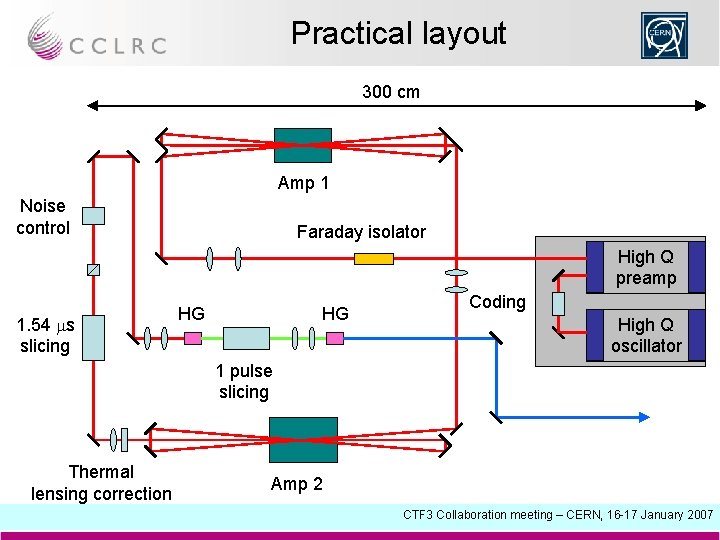
Practical layout 300 cm Amp 1 Noise control Faraday isolator High Q preamp 1. 54 ms slicing HG HG Coding High Q oscillator 1 pulse slicing Thermal lensing correction Amp 2 CTF 3 Collaboration meeting – CERN, 16 -17 January 2007
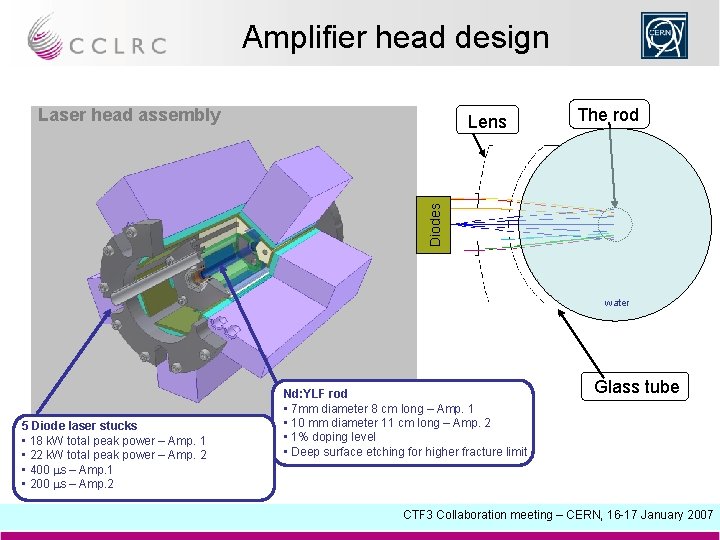
Amplifier head design Laser head assembly The rod Diodes Lens water 5 Diode laser stucks • 18 k. W total peak power – Amp. 1 • 22 k. W total peak power – Amp. 2 • 400 ms – Amp. 1 • 200 ms – Amp. 2 Nd: YLF rod • 7 mm diameter 8 cm long – Amp. 1 • 10 mm diameter 11 cm long – Amp. 2 • 1% doping level • Deep surface etching for higher fracture limit Glass tube CTF 3 Collaboration meeting – CERN, 16 -17 January 2007
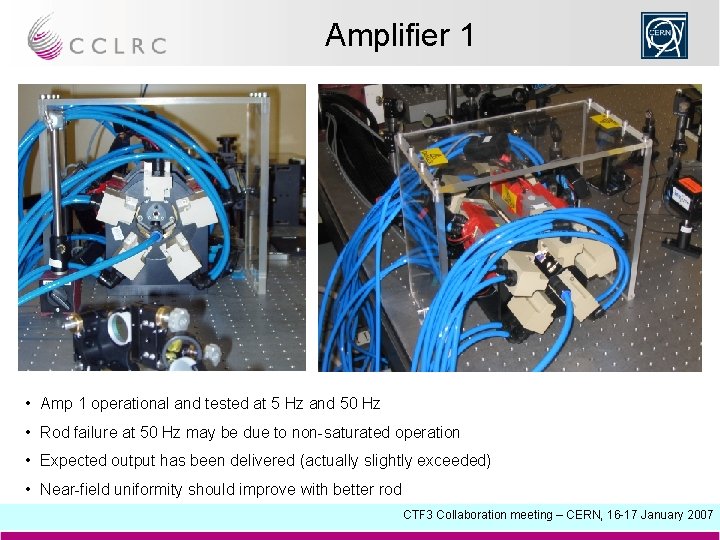
Amplifier 1 • Amp 1 operational and tested at 5 Hz and 50 Hz • Rod failure at 50 Hz may be due to non-saturated operation • Expected output has been delivered (actually slightly exceeded) • Near-field uniformity should improve with better rod CTF 3 Collaboration meeting – CERN, 16 -17 January 2007
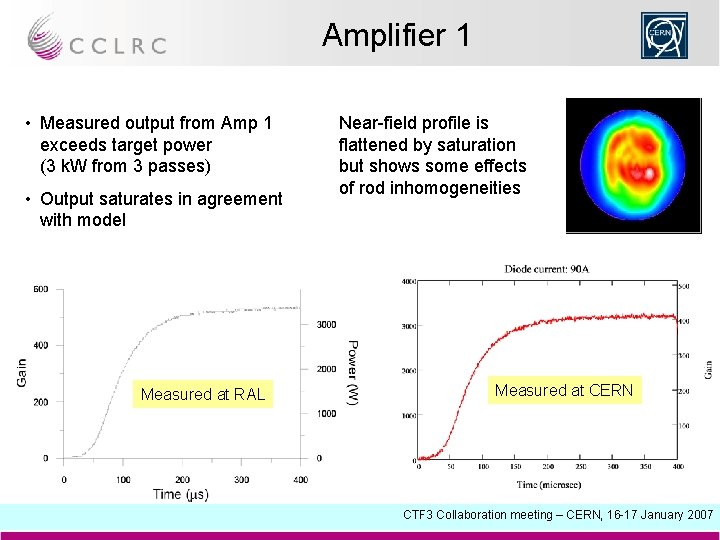
Amplifier 1 • Measured output from Amp 1 exceeds target power (3 k. W from 3 passes) • Output saturates in agreement with model Measured at RAL Near-field profile is flattened by saturation but shows some effects of rod inhomogeneities Measured at CERN CTF 3 Collaboration meeting – CERN, 16 -17 January 2007
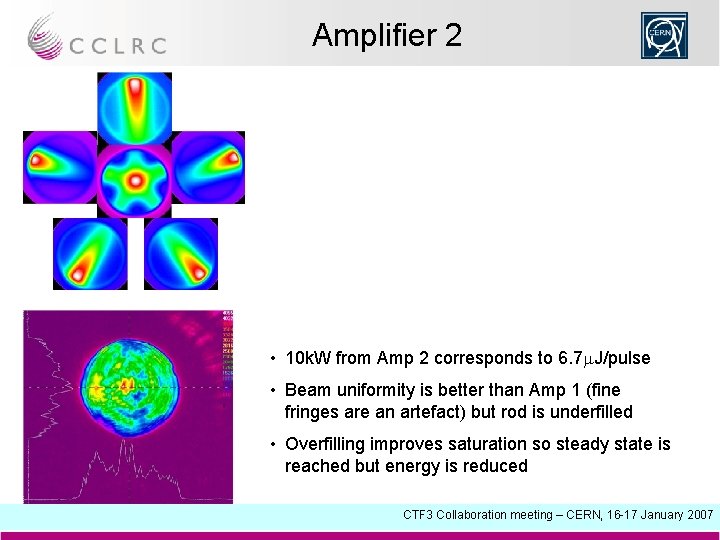
Amplifier 2 • 10 k. W from Amp 2 corresponds to 6. 7 m. J/pulse • Beam uniformity is better than Amp 1 (fine fringes are an artefact) but rod is underfilled • Overfilling improves saturation so steady state is reached but energy is reduced CTF 3 Collaboration meeting – CERN, 16 -17 January 2007
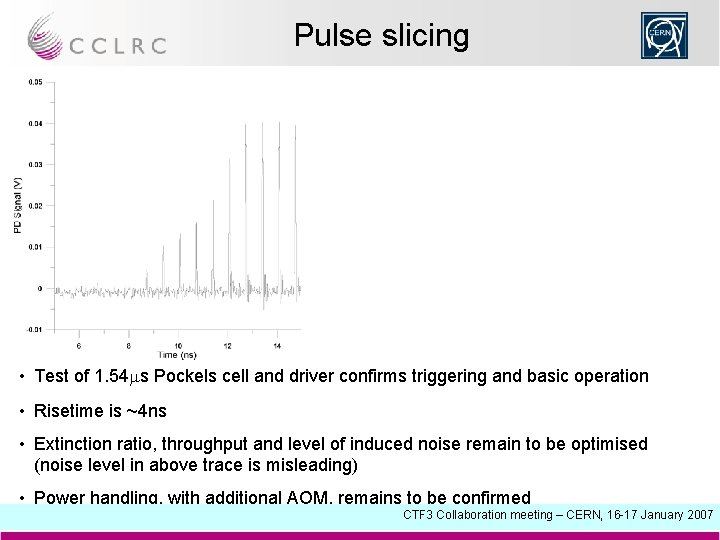
Pulse slicing • Test of 1. 54 ms Pockels cell and driver confirms triggering and basic operation • Risetime is ~4 ns • Extinction ratio, throughput and level of induced noise remain to be optimised (noise level in above trace is misleading) • Power handling, with additional AOM, remains to be confirmed CTF 3 Collaboration meeting – CERN, 16 -17 January 2007
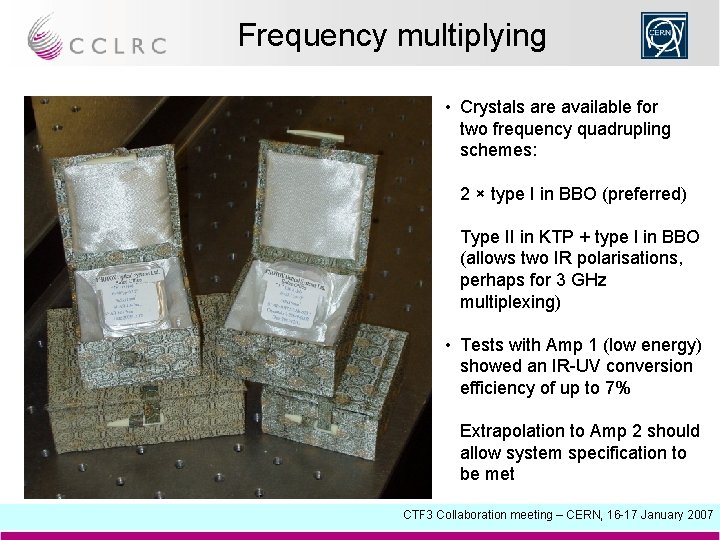
Frequency multiplying • Crystals are available for two frequency quadrupling schemes: 2 × type I in BBO (preferred) Type II in KTP + type I in BBO (allows two IR polarisations, perhaps for 3 GHz multiplexing) • Tests with Amp 1 (low energy) showed an IR-UV conversion efficiency of up to 7% Extrapolation to Amp 2 should allow system specification to be met CTF 3 Collaboration meeting – CERN, 16 -17 January 2007
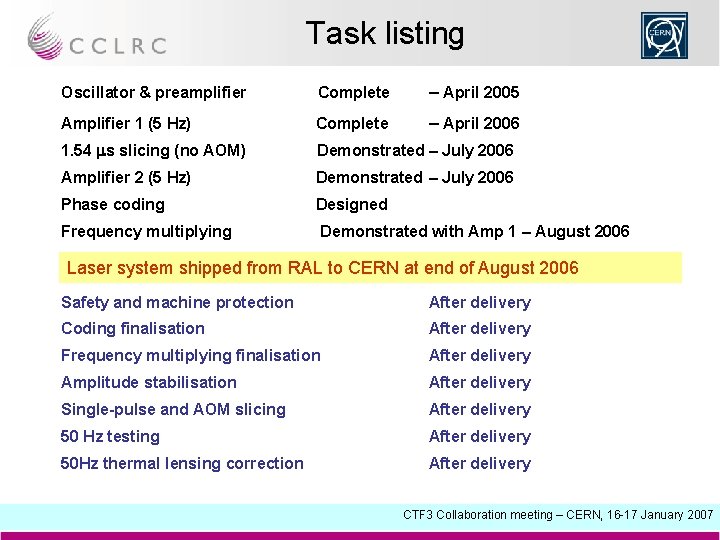
Task listing Oscillator & preamplifier Complete – April 2005 Amplifier 1 (5 Hz) Complete – April 2006 1. 54 s slicing (no AOM) Demonstrated – July 2006 Amplifier 2 (5 Hz) Demonstrated – July 2006 Phase coding Designed Frequency multiplying Demonstrated with Amp 1 – August 2006 Laser system shipped from RAL to CERN at end of August 2006 Safety and machine protection After delivery Coding finalisation After delivery Frequency multiplying finalisation After delivery Amplitude stabilisation After delivery Single-pulse and AOM slicing After delivery 50 Hz testing After delivery 50 Hz thermal lensing correction After delivery CTF 3 Collaboration meeting – CERN, 16 -17 January 2007
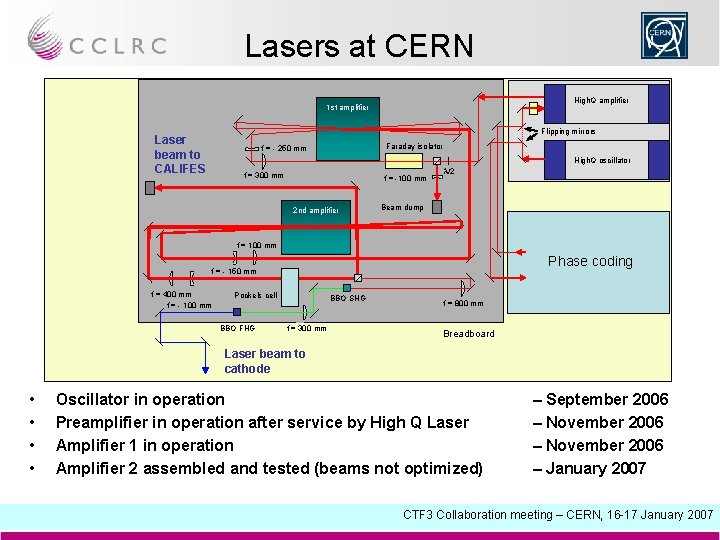
Lasers at CERN High. Q amplifier 1 st amplifier Flipping mirrors Laser beam to CALIFES Faraday isolator f = - 250 mm High. Q oscillator f = 300 mm f = -100 mm 2 nd amplifier l/2 Beam dump f = 100 mm Phase coding f = - 150 mm f = 400 mm f = - 100 mm Pockels cell BBO FHG BBO SHG f = 300 mm f = 800 mm Breadboard Laser beam to cathode • • Oscillator in operation Preamplifier in operation after service by High Q Laser Amplifier 1 in operation Amplifier 2 assembled and tested (beams not optimized) – September 2006 – November 2006 – January 2007 CTF 3 Collaboration meeting – CERN, 16 -17 January 2007
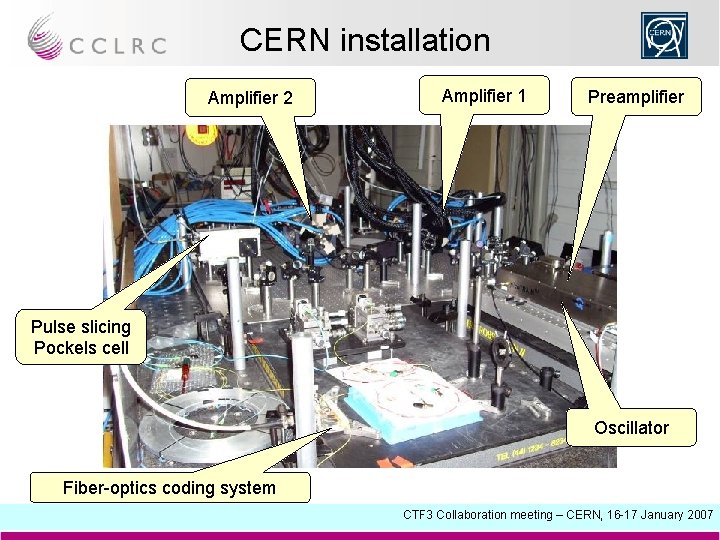
CERN installation Amplifier 2 Amplifier 1 Preamplifier Pulse slicing Pockels cell Oscillator Fiber-optics coding system CTF 3 Collaboration meeting – CERN, 16 -17 January 2007
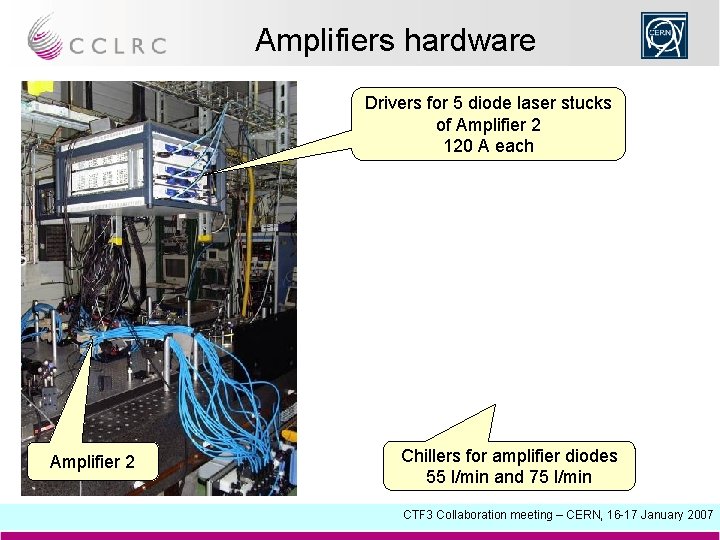
Amplifiers hardware Drivers for 5 diode laser stucks of Amplifier 2 120 A each Amplifier 2 Chillers for amplifier diodes 55 l/min and 75 l/min CTF 3 Collaboration meeting – CERN, 16 -17 January 2007
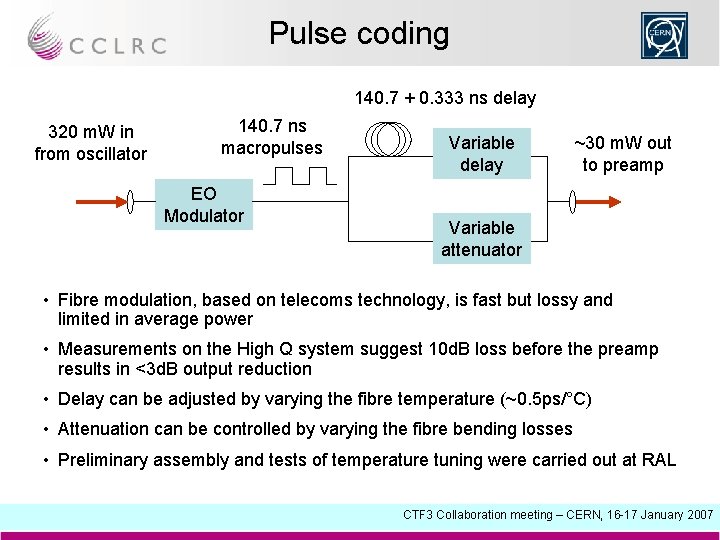
Pulse coding 140. 7 + 0. 333 ns delay 320 m. W in from oscillator 140. 7 ns macropulses EO Modulator Variable delay ~30 m. W out to preamp Variable attenuator • Fibre modulation, based on telecoms technology, is fast but lossy and limited in average power • Measurements on the High Q system suggest 10 d. B loss before the preamp results in <3 d. B output reduction • Delay can be adjusted by varying the fibre temperature (~0. 5 ps/°C) • Attenuation can be controlled by varying the fibre bending losses • Preliminary assembly and tests of temperature tuning were carried out at RAL CTF 3 Collaboration meeting – CERN, 16 -17 January 2007
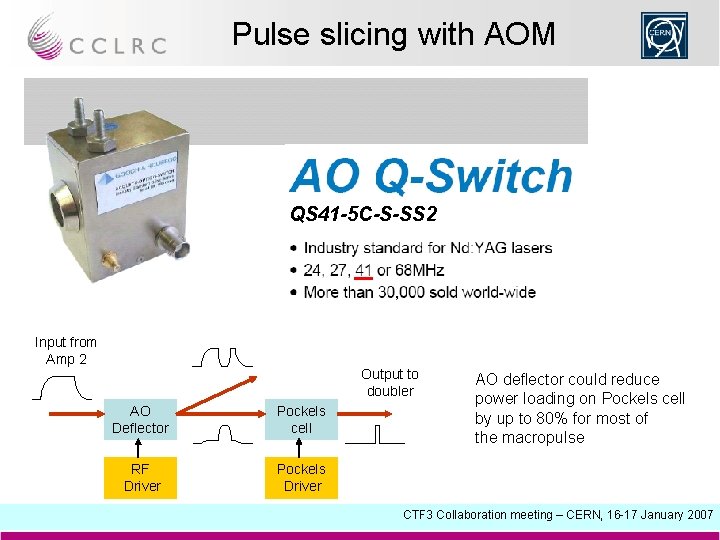
Pulse slicing with AOM QS 41 -5 C-S-SS 2 Input from Amp 2 Output to doubler AO Deflector Pockels cell RF Driver Pockels Driver AO deflector could reduce power loading on Pockels cell by up to 80% for most of the macropulse CTF 3 Collaboration meeting – CERN, 16 -17 January 2007
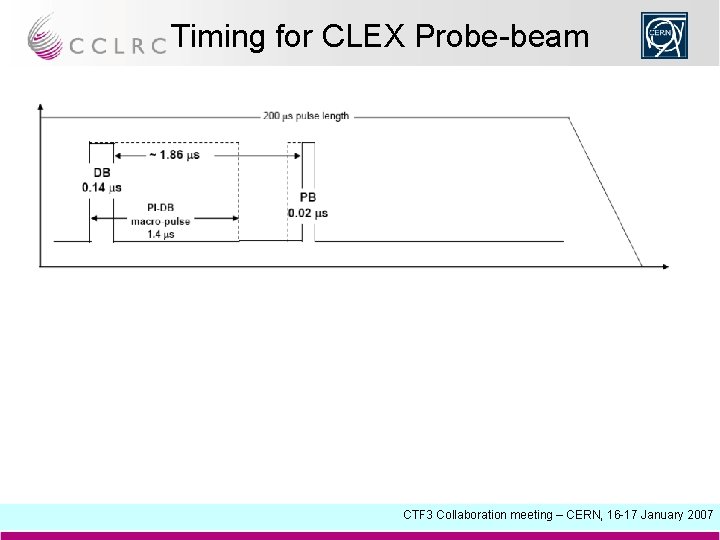
Timing for CLEX Probe-beam CTF 3 Collaboration meeting – CERN, 16 -17 January 2007
Thank you for your attention Acknowledgments RAL CERN Marta Dival Graeme Hirst Kurdi Gabor Emma Springate Bill Martin Ian Musgrave Guy Suberlucq Roberto Losito Nathalie Champault Arvind Kumar CTF 3 Collaboration meeting – CERN, 16 -17 January 2007