
Laser surface coating of bulk metallic glass composition
Laser surface coating of bulk metallic glass composition on high carbon low alloy steel A. Basu 1*, J. Dutta Majumdar 2, N. B. Dahotre 3, I. Manna 2 1 Metallurgical & Materials Engineering Department, N. I. T. , Rourkela Orissa. 769008 2 Metallurgical & Materials Engineering Department, I. I. T. , Kharagpur, W. B. 721302 3 Department of Materials Science and Engineering, University of Tennessee, Knoxville, TN 37996, USA *basua@nitrkl. ac. in 63 rd ATM, 16 th November, 2009
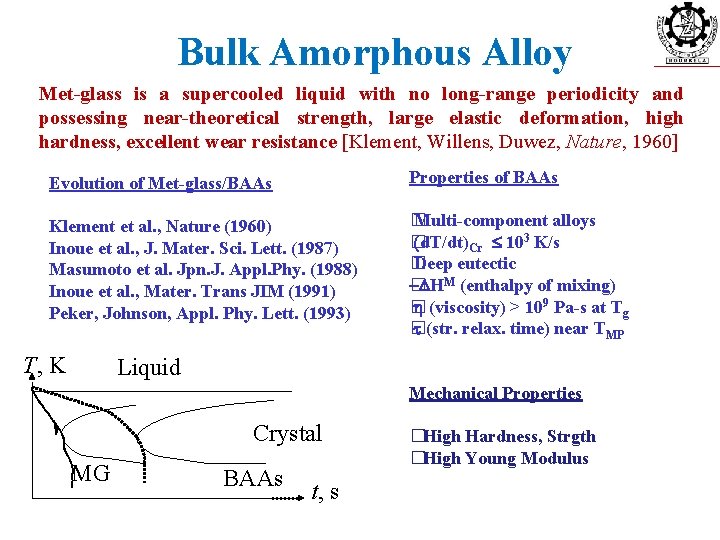
Bulk Amorphous Alloy Met-glass is a supercooled liquid with no long-range periodicity and possessing near-theoretical strength, large elastic deformation, high hardness, excellent wear resistance [Klement, Willens, Duwez, Nature, 1960] Evolution of Met-glass/BAAs Properties of BAAs Klement et al. , Nature (1960) Inoue et al. , J. Mater. Sci. Lett. (1987) Masumoto et al. Jpn. J. Appl. Phy. (1988) Inoue et al. , Mater. Trans JIM (1991) Peker, Johnson, Appl. Phy. Lett. (1993) � Multi-component alloys � (d. T/dt)Cr 103 K/s � Deep eutectic -DHM (enthalpy of mixing) � � h (viscosity) > 109 Pa-s at Tg � t (str. relax. time) near TMP T, K Liquid Mechanical Properties Crystal MG BAAs t, s �High Hardness, Strgth �High Young Modulus
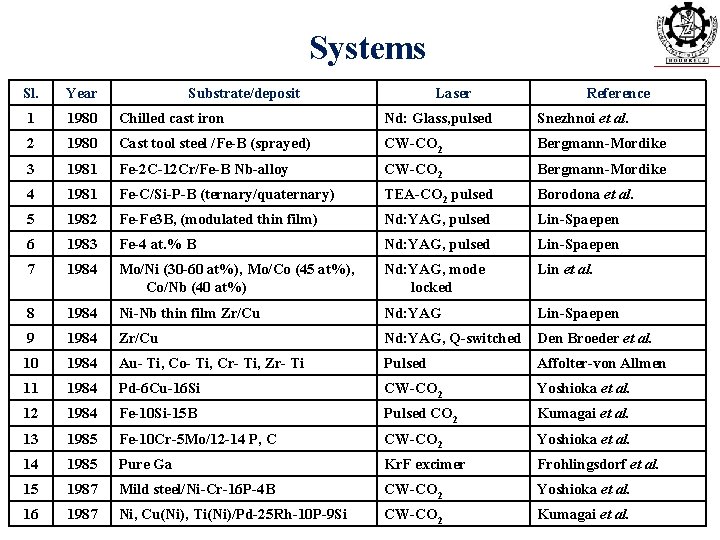
Systems Sl. Year Substrate/deposit Laser Reference 1 1980 Chilled cast iron Nd: Glass, pulsed Snezhnoi et al. 2 1980 Cast tool steel /Fe-B (sprayed) CW-CO 2 Bergmann-Mordike 3 1981 Fe-2 C-12 Cr/Fe-B Nb-alloy CW-CO 2 Bergmann-Mordike 4 1981 Fe-C/Si-P-B (ternary/quaternary) TEA-CO 2 pulsed Borodona et al. 5 1982 Fe-Fe 3 B, (modulated thin film) Nd: YAG, pulsed Lin-Spaepen 6 1983 Fe-4 at. % B Nd: YAG, pulsed Lin-Spaepen 7 1984 Mo/Ni (30 -60 at%), Mo/Co (45 at%), Co/Nb (40 at%) Nd: YAG, mode locked Lin et al. 8 1984 Ni-Nb thin film Zr/Cu Nd: YAG Lin-Spaepen 9 1984 Zr/Cu Nd: YAG, Q-switched Den Broeder et al. 10 1984 Au- Ti, Co- Ti, Cr- Ti, Zr- Ti Pulsed Affolter-von Allmen 11 1984 Pd-6 Cu-16 Si CW-CO 2 Yoshioka et al. 12 1984 Fe-10 Si-15 B Pulsed CO 2 Kumagai et al. 13 1985 Fe-10 Cr-5 Mo/12 -14 P, C CW-CO 2 Yoshioka et al. 14 1985 Pure Ga Kr. F excimer Frohlingsdorf et al. 15 1987 Mild steel/Ni-Cr-16 P-4 B CW-CO 2 Yoshioka et al. 16 1987 Ni, Cu(Ni), Ti(Ni)/Pd-25 Rh-10 P-9 Si CW-CO 2 Kumagai et al.
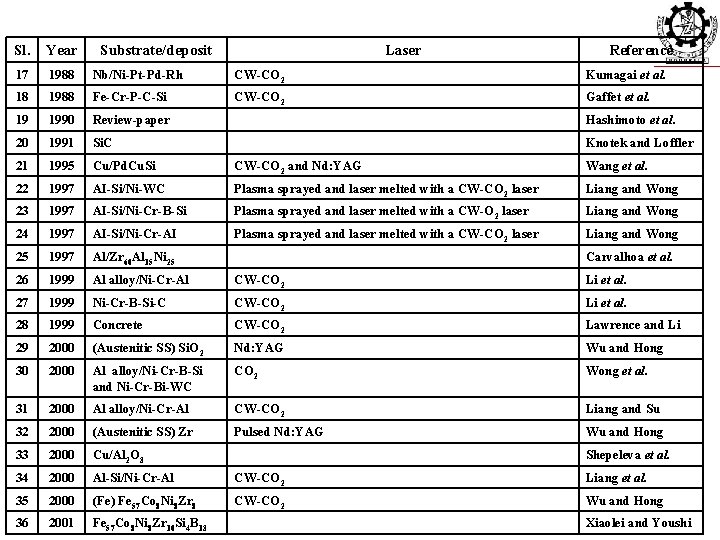
Sl. Year Substrate/deposit Laser Reference 17 1988 Nb/Ni-Pt-Pd-Rh CW-CO 2 Kumagai et al. 18 1988 Fe-Cr-P-C-Si CW-CO 2 Gaffet et al. 19 1990 Review-paper Hashimoto et al. 20 1991 Si. C Knotek and Loffler 21 1995 Cu/Pd. Cu. Si CW-CO 2 and Nd: YAG Wang et al. 22 1997 AI-Si/Ni-WC Plasma sprayed and laser melted with a CW-CO 2 laser Liang and Wong 23 1997 AI-Si/Ni-Cr-B-Si Plasma sprayed and laser melted with a CW-O 2 laser Liang and Wong 24 1997 AI-Si/Ni-Cr-AI Plasma sprayed and laser melted with a CW-CO 2 laser Liang and Wong 25 1997 Al/Zr 60 Al 15 Ni 25 26 1999 Al alloy/Ni-Cr-Al CW-CO 2 Li et al. 27 1999 Ni-Cr-B-Si-C CW-CO 2 Li et al. 28 1999 Concrete CW-CO 2 Lawrence and Li 29 2000 (Austenitic SS) Si. O 2 Nd: YAG Wu and Hong 30 2000 Al alloy/Ni-Cr-B-Si and Ni-Cr-Bi-WC CO 2 Wong et al. 31 2000 Al alloy/Ni-Cr-Al CW-CO 2 Liang and Su 32 2000 (Austenitic SS) Zr Pulsed Nd: YAG Wu and Hong 33 2000 Cu/Al 2 O 3 34 2000 Al-Si/Ni-Cr-Al CW-CO 2 Liang et al. 35 2000 (Fe) Fe 57 Co 8 Ni 8 Zr 8 CW-CO 2 Wu and Hong 36 2001 Fe 57 Co 8 Ni 8 Zr 10 Si 4 B 13 Carvalhoa et al. Shepeleva et al. Xiaolei and Youshi
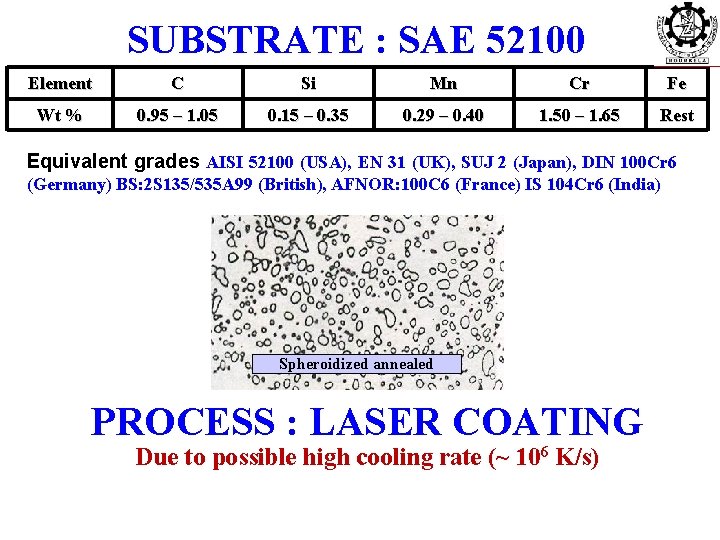
SUBSTRATE : SAE 52100 Element C Si Mn Cr Fe Wt % 0. 95 – 1. 05 0. 15 – 0. 35 0. 29 – 0. 40 1. 50 – 1. 65 Rest Equivalent grades AISI 52100 (USA), EN 31 (UK), SUJ 2 (Japan), DIN 100 Cr 6 (Germany) BS: 2 S 135/535 A 99 (British), AFNOR: 100 C 6 (France) IS 104 Cr 6 (India) Spheroidized annealed PROCESS : LASER COATING Due to possible high cooling rate (~ 106 K/s)
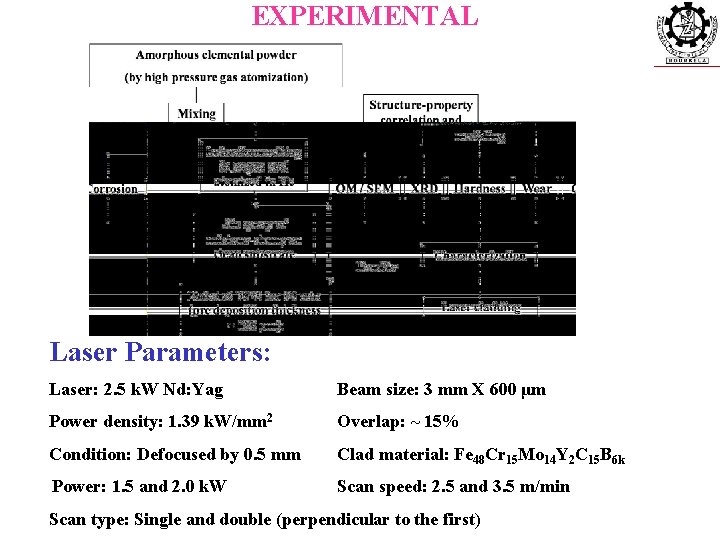
EXPERIMENTAL Laser Parameters: Laser: 2. 5 k. W Nd: Yag Beam size: 3 mm X 600 μm Power density: 1. 39 k. W/mm 2 Overlap: ~ 15% Condition: Defocused by 0. 5 mm Clad material: Fe 48 Cr 15 Mo 14 Y 2 C 15 B 6 k Power: 1. 5 and 2. 0 k. W Scan speed: 2. 5 and 3. 5 m/min Scan type: Single and double (perpendicular to the first)
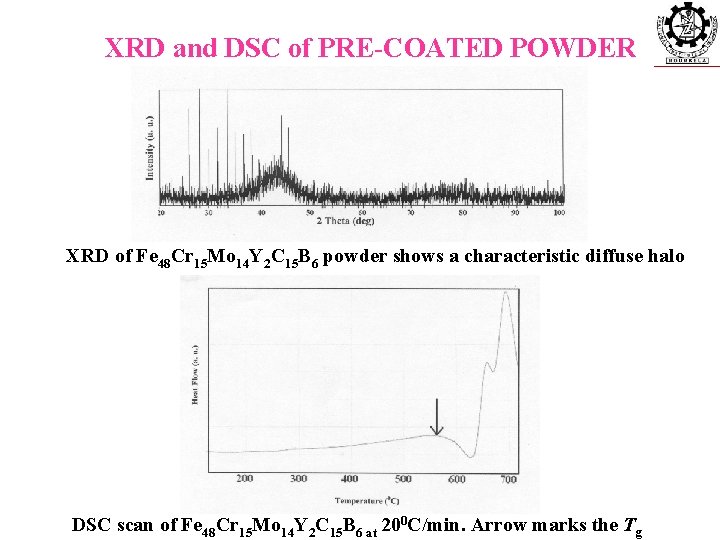
XRD and DSC of PRE-COATED POWDER XRD of Fe 48 Cr 15 Mo 14 Y 2 C 15 B 6 powder shows a characteristic diffuse halo DSC scan of Fe 48 Cr 15 Mo 14 Y 2 C 15 B 6 at 200 C/min. Arrow marks the Tg
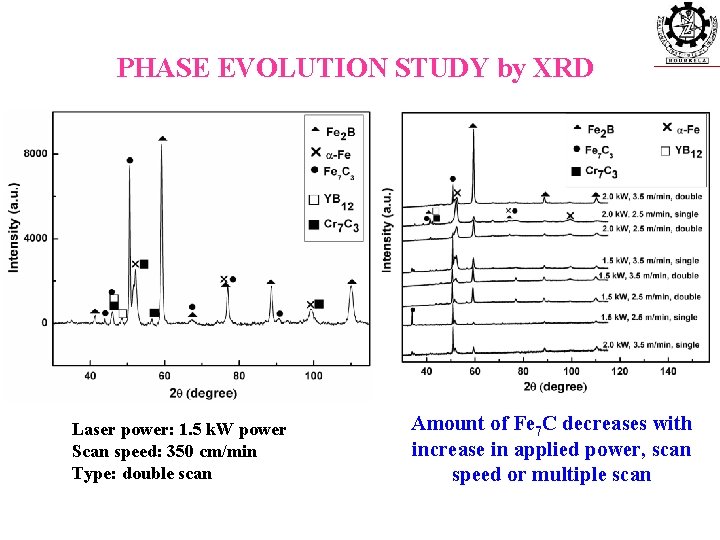
PHASE EVOLUTION STUDY by XRD Laser power: 1. 5 k. W power Scan speed: 350 cm/min Type: double scan Amount of Fe 7 C decreases with increase in applied power, scan speed or multiple scan
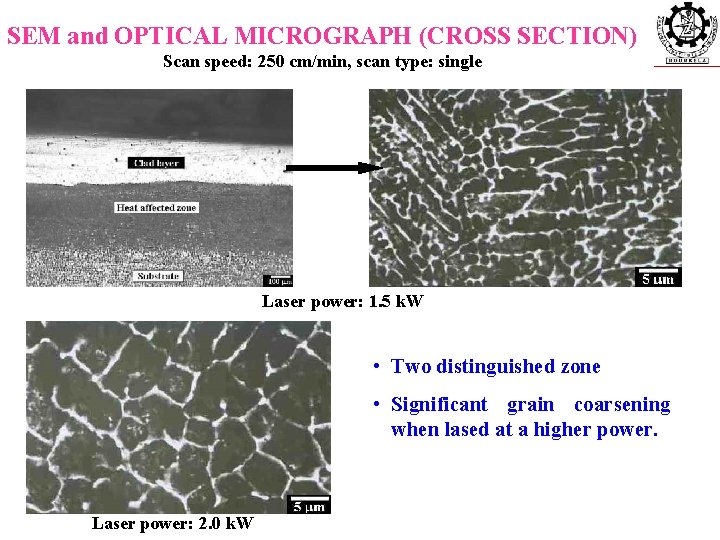
SEM and OPTICAL MICROGRAPH (CROSS SECTION) Scan speed: 250 cm/min, scan type: single Laser power: 1. 5 k. W • Two distinguished zone • Significant grain coarsening when lased at a higher power. Laser power: 2. 0 k. W
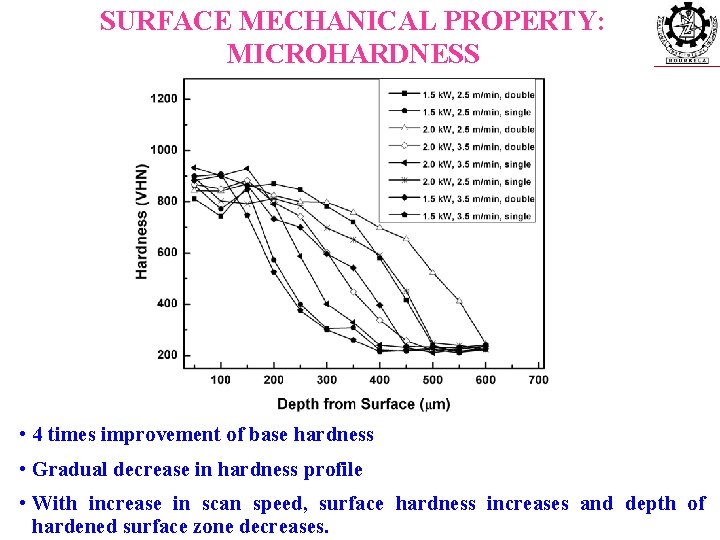
SURFACE MECHANICAL PROPERTY: MICROHARDNESS • 4 times improvement of base hardness • Gradual decrease in hardness profile • With increase in scan speed, surface hardness increases and depth of hardened surface zone decreases.
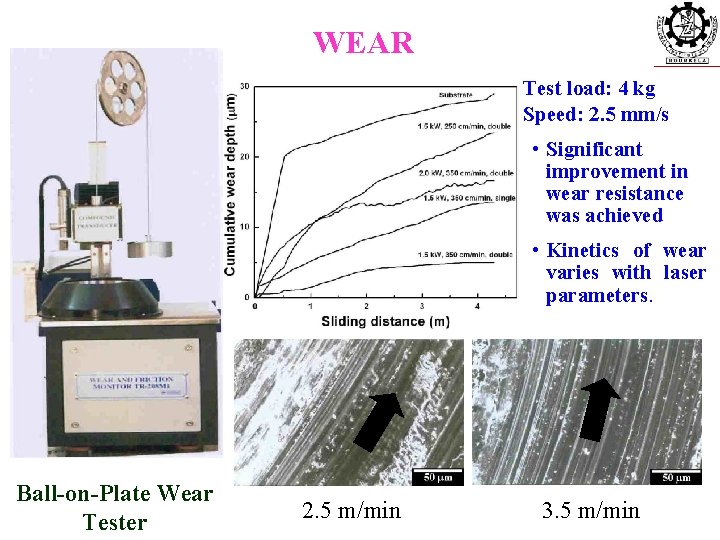
WEAR Test load: 4 kg Speed: 2. 5 mm/s • Significant improvement in wear resistance was achieved • Kinetics of wear varies with laser parameters. Ball-on-Plate Wear Tester 2. 5 m/min 3. 5 m/min
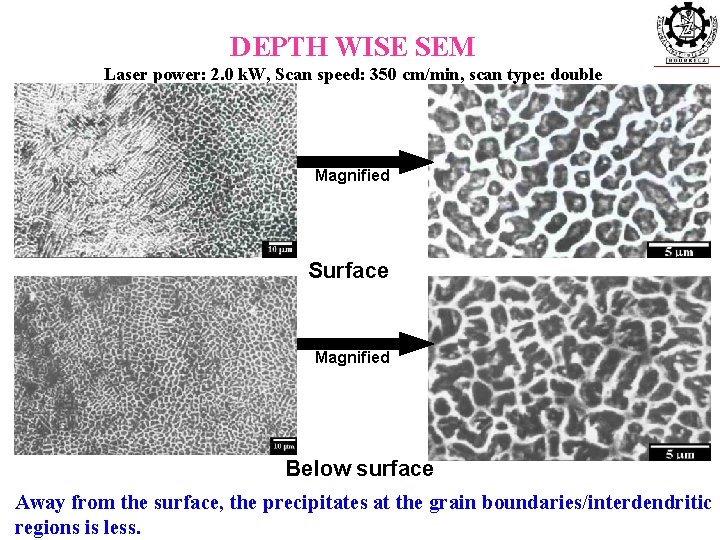
DEPTH WISE SEM Laser power: 2. 0 k. W, Scan speed: 350 cm/min, scan type: double Magnified Surface Magnified Below surface Away from the surface, the precipitates at the grain boundaries/interdendritic regions is less.
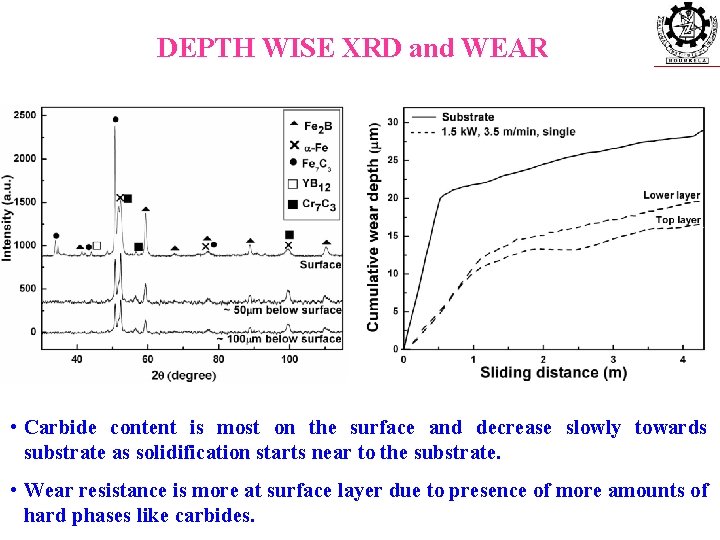
DEPTH WISE XRD and WEAR • Carbide content is most on the surface and decrease slowly towards substrate as solidification starts near to the substrate. • Wear resistance is more at surface layer due to presence of more amounts of hard phases like carbides.
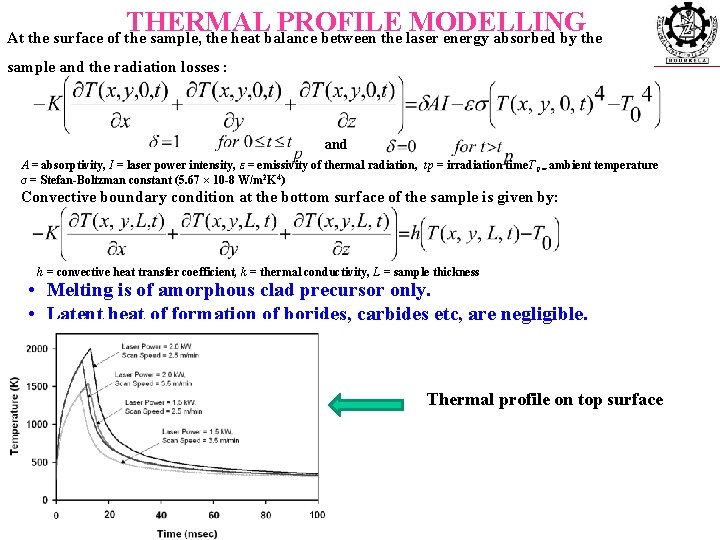
THERMAL PROFILE MODELLING At the surface of the sample, the heat balance between the laser energy absorbed by the sample and the radiation losses : and A = absorptivity, I = laser power intensity, ε = emissivity of thermal radiation, tp = irradiation time. T 0 = ambient temperature σ = Stefan-Boltzman constant (5. 67 × 10 -8 W/m 2 K 4) Convective boundary condition at the bottom surface of the sample is given by: h = convective heat transfer coefficient, k = thermal conductivity, L = sample thickness • Melting is of amorphous clad precursor only. • Latent heat of formation of borides, carbides etc, are negligible. Thermal profile on top surface
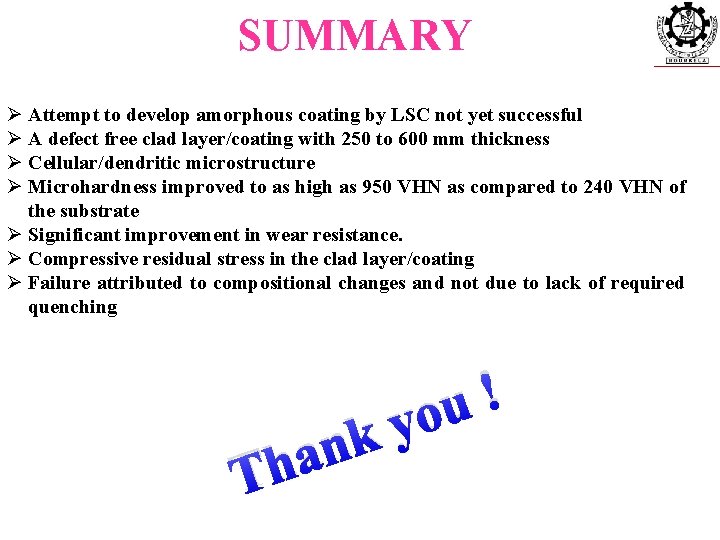
SUMMARY Ø Attempt to develop amorphous coating by LSC not yet successful Ø A defect free clad layer/coating with 250 to 600 mm thickness Ø Cellular/dendritic microstructure Ø Microhardness improved to as high as 950 VHN as compared to 240 VHN of the substrate Ø Significant improvement in wear resistance. Ø Compressive residual stress in the clad layer/coating Ø Failure attributed to compositional changes and not due to lack of required quenching n a Th ! u o y k
- Slides: 15