
Laser spectroscopy of gallium isotopes using the ISCOOL
- Slides: 13
Laser spectroscopy of gallium isotopes using the ISCOOL RFQ cooler. A proposal to the INTC, February 2006
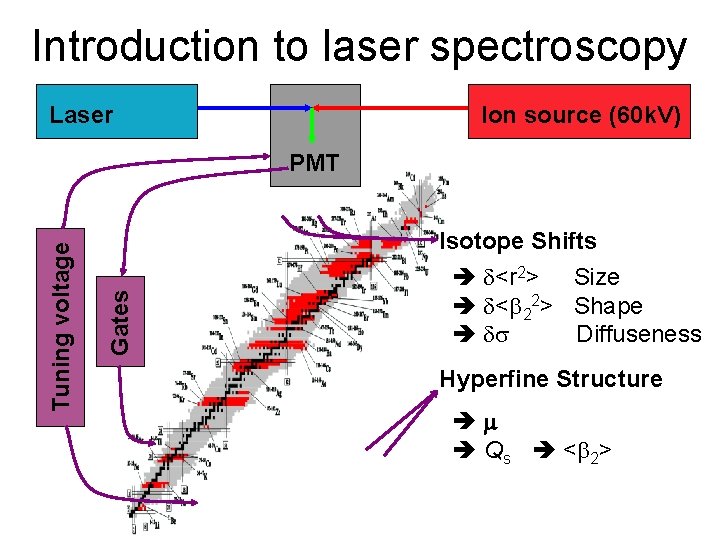
Introduction to laser spectroscopy Laser Ion source (60 k. V) Gates Tuning voltage PMT Isotope Shifts <r 2> Size < 22> Shape Diffuseness Hyperfine Structure Qs < 2>
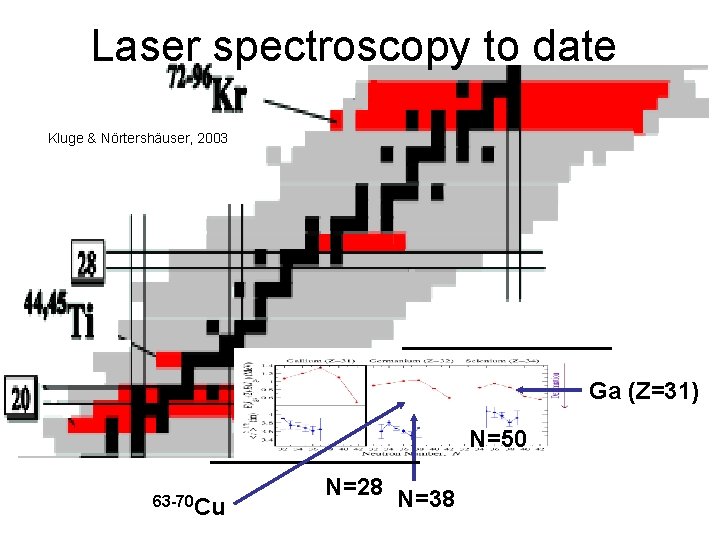
Laser spectroscopy to date Kluge & Nörtershäuser, 2003 Ga (Z=31) N=50 63 -70 Cu N=28 N=38
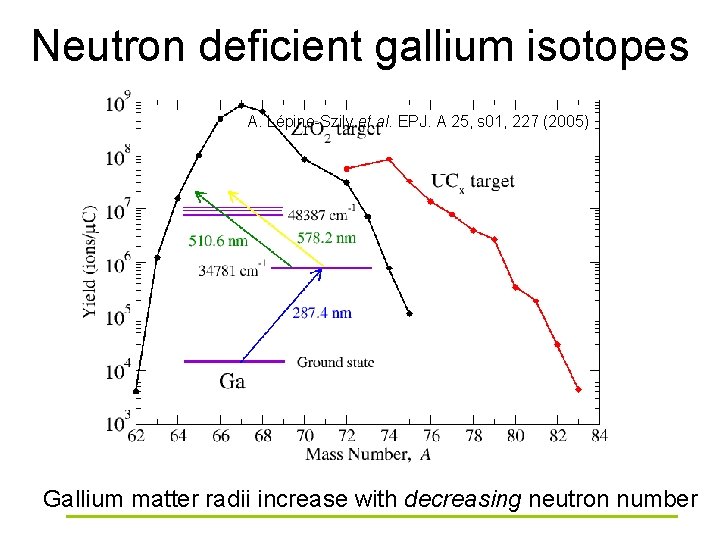
Neutron deficient gallium isotopes A. Lépine-Szily et al. EPJ. A 25, s 01, 227 (2005) Gallium matter radii increase with decreasing neutron number
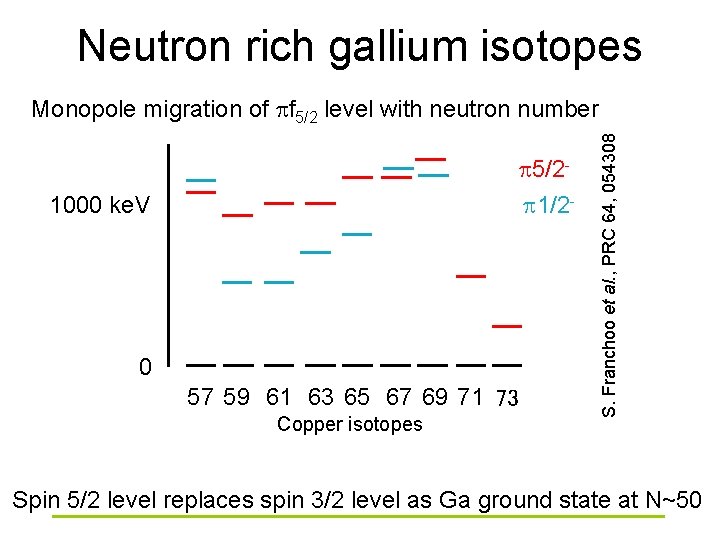
Neutron rich gallium isotopes 5/2 1/2 - 1000 ke. V 0 57 59 61 63 65 67 69 71 73 Copper isotopes S. Franchoo et al. , PRC 64, 054308 Monopole migration of f 5/2 level with neutron number Spin 5/2 level replaces spin 3/2 level as Ga ground state at N~50
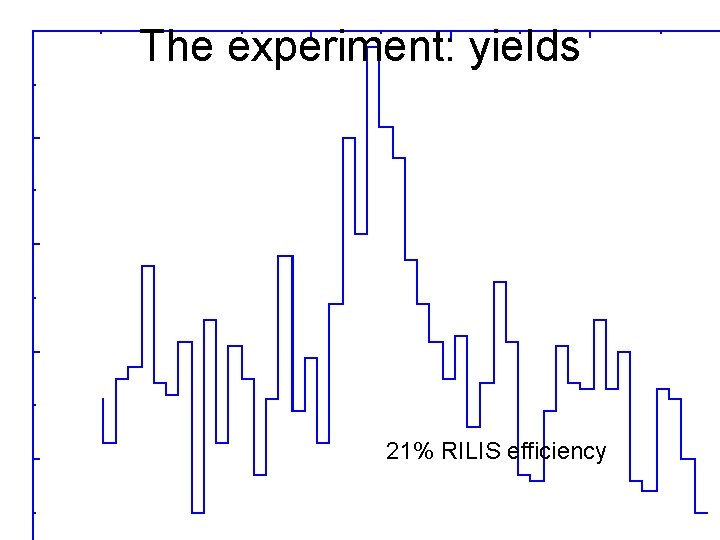
The experiment: yields 21% RILIS efficiency
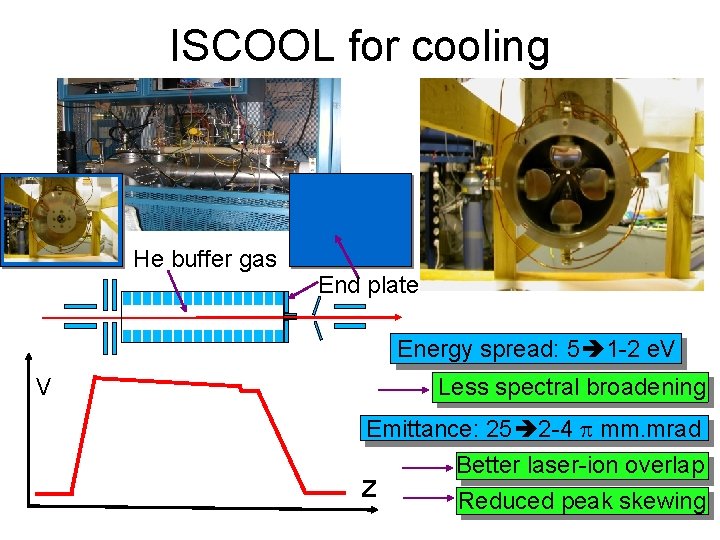
ISCOOL for cooling He buffer gas End plate Energy spread: 5 1 -2 e. V V Less spectral broadening Emittance: 25 2 -4 mm. mrad Better laser-ion overlap z Reduced peak skewing
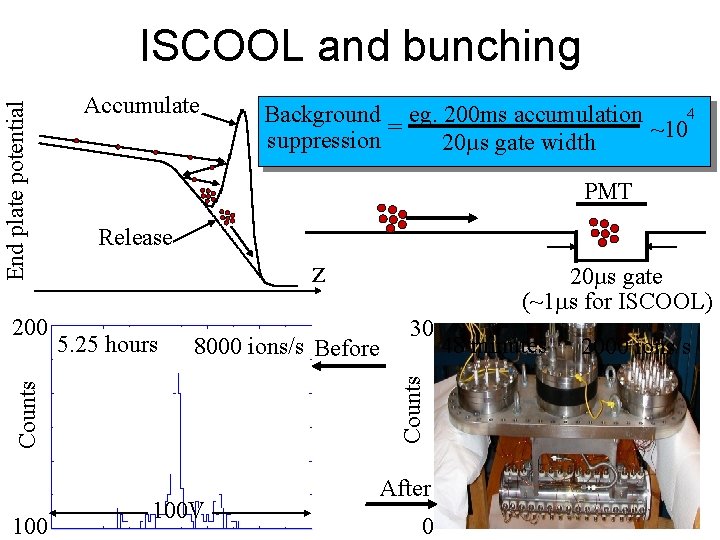
100 4 Background eg. 200 ms accumulation = ~10 suppression 20µs gate width PMT Release z 5. 25 hours 8000 ions/s Before Counts 200 Accumulate 20µs gate (~1 s for ISCOOL) 30 Counts End plate potential ISCOOL and bunching 100 V After 0 48 minutes 2000 ions/s
B. Cheal et al. , Phys. Lett. B 645 (2007) 133 Benchmarking ISCOOL Yttrium data taken at JYFL. Repeat and compare. (Spins of 98 m, 100, 102 could be confirmed if time available).
Summary • An investigation of charge radii and nuclear moments of Ga from N=32 to N=52. • Neutron deficient Ga show an anomalous behaviour of the matter radii. • Neutron rich Ga isotopes will be assigned spins and moments to help chart the effect of monopole migration. • A study of yttrium isotopes will be used to optimise ISCOOL and provide a comparison with JYFL (eg. bunch accumulation).
The proposers The University of Manchester, UK J. Billowes, P. Campbell, B. Cheal, E. B. Mané Junior Universität Mainz, Germany K. Blaum, R. Neugart ISOLDE, CERN, Switzerland P. Delahaye and the ISOLDE collaboration IKS, KU Leuven, Belgium K. T. Flanagan, G. Neyens, D. Yordanov The University of Birmingham, UK D. H. Forest, G. Tungate University of Jyväskylä, Finland A. Jokinen, I. D. Moore, J. Äystö VSM, KU Leuven, Belgium P. Lievens New York University, USA H. H. Stroke
Isobaric contamination • Rb (A>80) and Ti. O (A=62 -66) contamination? • Purity enhanced using RILIS (21% efficiency vs 0. 7% otherwise) and eg. by using low work function surfaces being developed at ISOLDE. • Bunch accumulation times of only 10 ms or 20 ms if there are space charge problems. • Rb suppression by 2 orders of magnitude reported using a “proton-neutron converter” “Protons are directed onto a tantalum rod mounted parallel to the target and thus only secondary neutrons emitted under large angles hit the target” - U. Köster
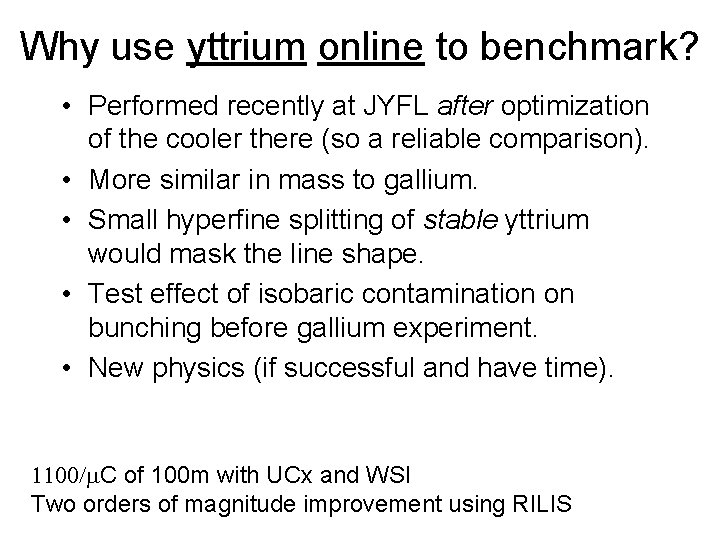
Why use yttrium online to benchmark? • Performed recently at JYFL after optimization of the cooler there (so a reliable comparison). • More similar in mass to gallium. • Small hyperfine splitting of stable yttrium would mask the line shape. • Test effect of isobaric contamination on bunching before gallium experiment. • New physics (if successful and have time). 1100/ C of 100 m with UCx and WSI Two orders of magnitude improvement using RILIS