
Laser spectroscopy and betaNMR for nuclear physics and
Laser spectroscopy and beta-NMR for nuclear physics and applications • Laser spectroscopy setups at ISOLDE • Example – COLLAPS setup: laser and beta-NMR spectroscopy • Results: nuclear structure and towards applications Magdalena Kowalska CERN, PH-Dept
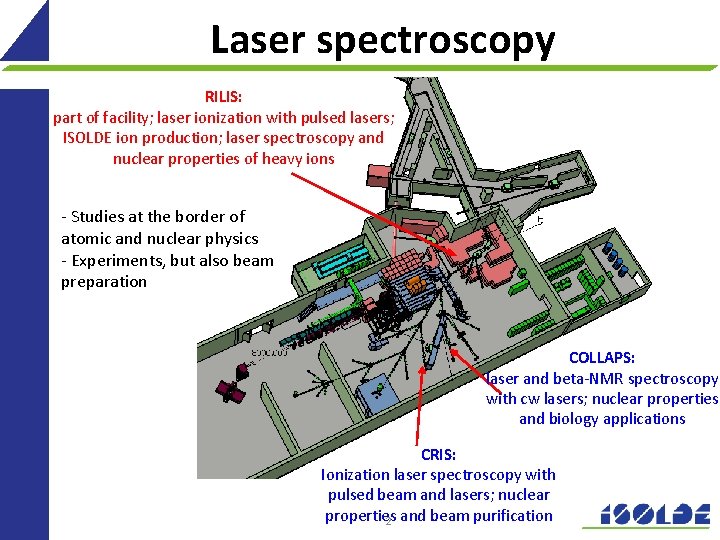
Laser spectroscopy RILIS: part of facility; laser ionization with pulsed lasers; ISOLDE ion production; laser spectroscopy and nuclear properties of heavy ions - Studies at the border of atomic and nuclear physics - Experiments, but also beam preparation COLLAPS: laser and beta-NMR spectroscopy with cw lasers; nuclear properties and biology applications CRIS: Ionization laser spectroscopy with pulsed beam and lasers; nuclear properties 2 and beam purification
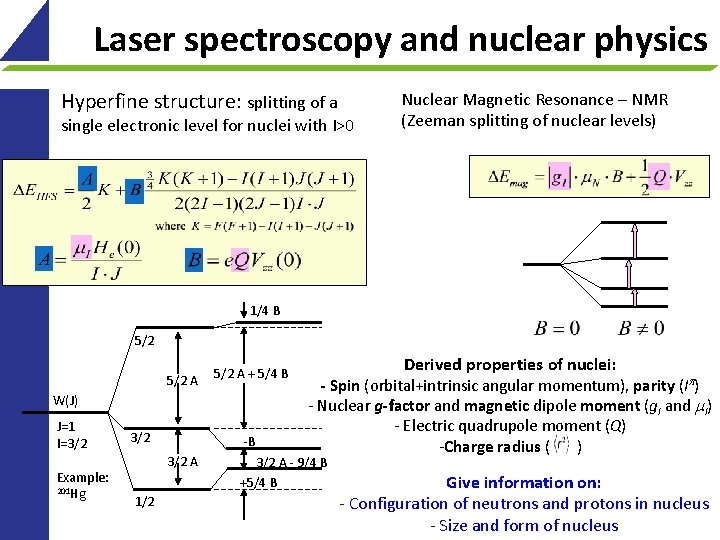
Laser spectroscopy and nuclear physics Hyperfine structure: splitting of a single electronic level for nuclei with I>0 Nuclear Magnetic Resonance – NMR (Zeeman splitting of nuclear levels) 1/4 B 5/2 A + 5/4 B W(J) J=1 I=3/2 Example: 201 Hg 3/2 -B 3/2 A 1/2 Derived properties of nuclei: - Spin (orbital+intrinsic angular momentum), parity (Ip) - Nuclear g-factor and magnetic dipole moment (g. I and m. I) - Electric quadrupole moment (Q) -Charge radius ( ) 3/2 A - 9/4 B +5/4 B Give information on: - Configuration of neutrons and protons in nucleus - Size and form of nucleus
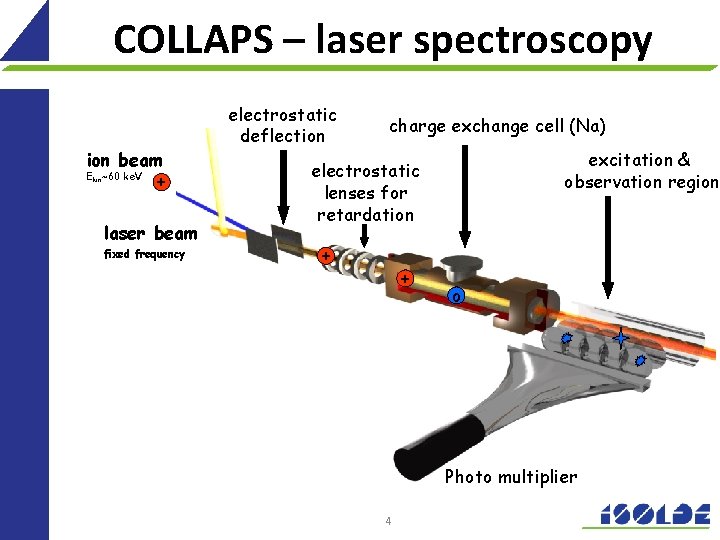
COLLAPS – laser spectroscopy ion beam E ~60 ke. V + kin laser beam fixed frequency electrostatic deflection charge exchange cell (Na) excitation & observation region electrostatic lenses for retardation + + o Photo multiplier 4

COLLAPS – beta-NMR Beta- Nuclear Magnetic Resonance: Beta particles (e-, e+) can be used as a detection tool, instead of rf absorption (beams down to 1000 ions/s can be studied) - Nuclear spins are polarized with laser light – asymmetry in beta emission Measured decay asymmetry: Results: Larmor frequency Magnetic and electric moments of nuclei (position of last nucleons, shapes) Beam from ISOLDE 5
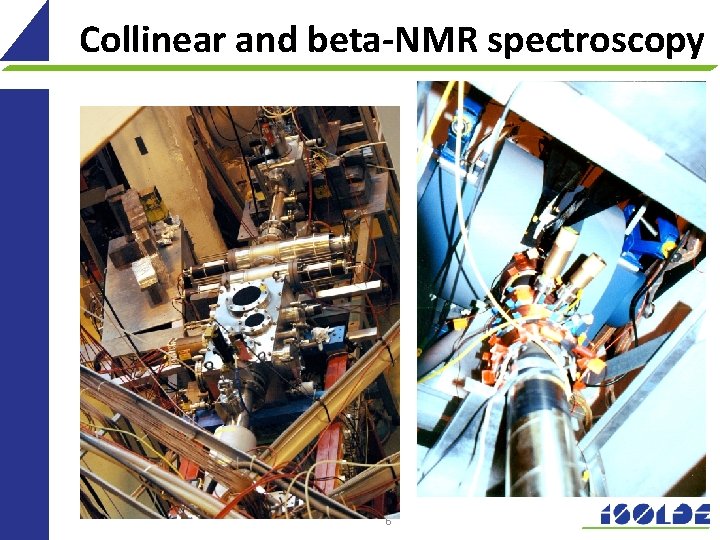
Collinear and beta-NMR spectroscopy 6
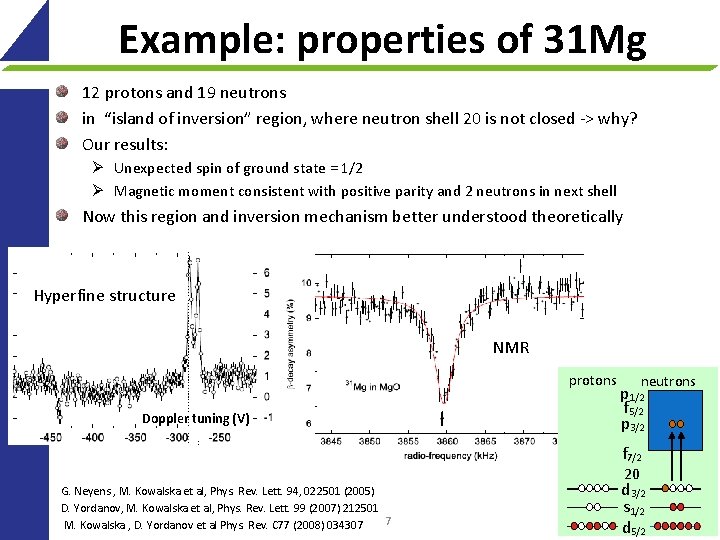
Example: properties of 31 Mg 12 protons and 19 neutrons in “island of inversion” region, where neutron shell 20 is not closed -> why? Our results: Ø Unexpected spin of ground state = 1/2 Ø Magnetic moment consistent with positive parity and 2 neutrons in next shell Now this region and inversion mechanism better understood theoretically Hyperfine structure NMR protons Doppler tuning (V) neutrons p 1/2 f 5/2 p 3/2 f 7/2 G. Neyens , M. Kowalska et al, Phys. Rev. Lett. 94, 022501 (2005) D. Yordanov, M. Kowalska et al, Phys. Rev. Lett. 99 (2007) 212501 7 M. Kowalska , D. Yordanov et al Phys. Rev. C 77 (2008) 034307 20 d 3/2 s 1/2 d 5/2
Towards Beta-NMR in biology Interest Metal ion interaction with biomolecules For many ions: no convenient physical and spectroscopic properties to study ligand environment Zn(II), Cu(I), Mg(II): among most abundant cations in living organisms; essential for proper regulation of cell bioenergetics, protein synthesis and enzymatic chemistry: Challenge: closed electron shells, thus invisible in many methods; in NMR: almost invisible signals due to small abundance, nuclear spin >1/2, and small sensitivity (due to small magnetic moment) Proposed solution: NMR – increase many-fold method’s sensitivity => try for first time beta-NMR in liquids (10 orders of magnitude higher sensitivity) 8
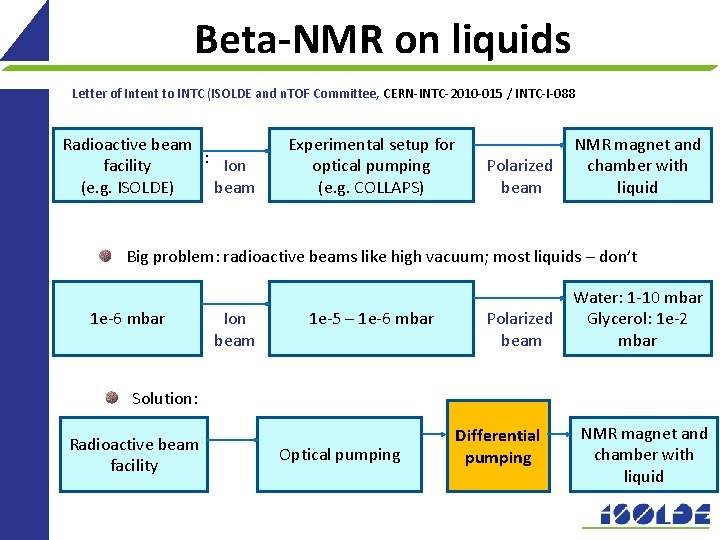
Beta-NMR on liquids Letter of Intent to INTC (ISOLDE and n. TOF Committee, CERN-INTC-2010 -015 / INTC-I-088 Radioactive beam Simple idea: Ion facility (e. g. ISOLDE) beam Experimental setup for optical pumping (e. g. COLLAPS) Polarized beam NMR magnet and chamber with liquid Big problem: radioactive beams like high vacuum; most liquids – don’t 1 e-6 mbar Ion beam 1 e-5 – 1 e-6 mbar Polarized beam Water: 1 -10 mbar Glycerol: 1 e-2 mbar Solution: Radioactive beam facility Optical pumping 9 Differential pumping NMR magnet and chamber with liquid
Beta-NMR on liquids: proof-of-principle Experiment performed in August 2012: Liquid maintained due to 6 orders of magnitude vacuum difference Test beam: 31 Mg studied earlier by COLLAPS: Ø Ø Good beam intensity Large beta asymmetry Short half-life – small influence of relaxation Spin 1/2 – no additional interactions which broaden signals First-ever beta-NMR signal in a liquid M. Stachura, A. Gottberg, M. Kowalska, et al, in preparation
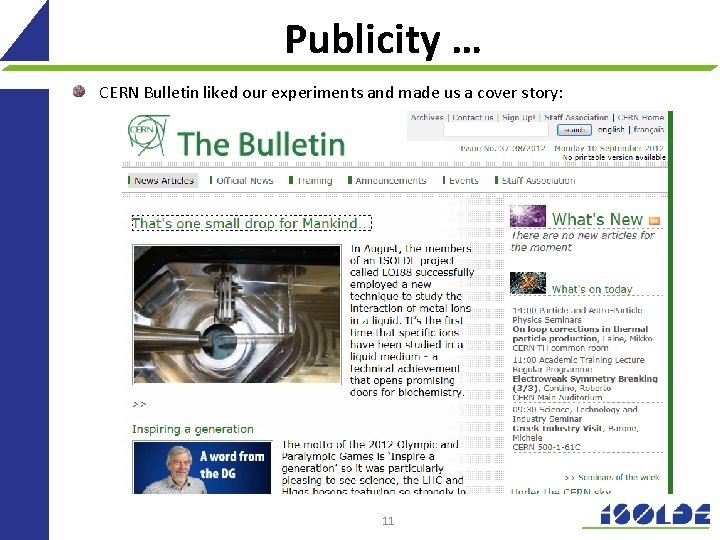
Publicity … CERN Bulletin liked our experiments and made us a cover story: 11
Summary and outlook Laser spectroscopy on radionuclides: Ø At the border of atomic and nuclear physics Ø Used to study properties of nuclei and to prepare RIB beams Example - COLLAPS setup: Ø Laser and beta-NMR spectroscopy Ø Valuable nuclear structure results Towards beta-NMR on liquids: Ø Promising to study metal-biomolecule interaction Ø Successful proof-of-principle experiment Ø Towards dedicated liquid beta-NMR beamline 12
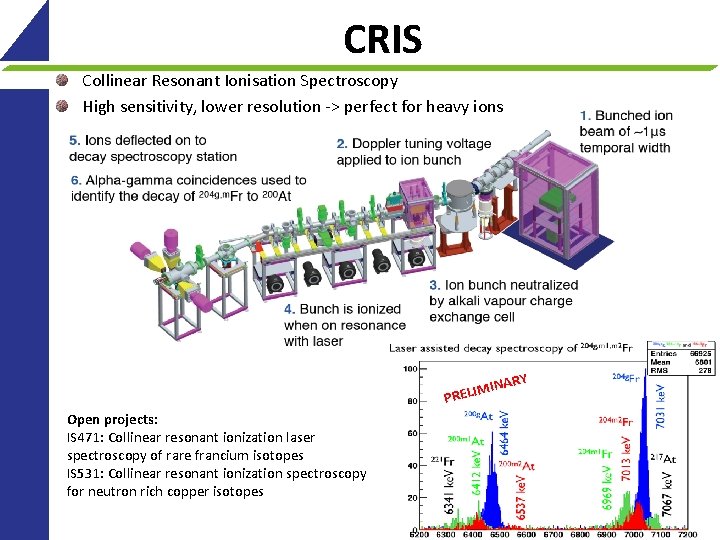
CRIS Collinear Resonant Ionisation Spectroscopy High sensitivity, lower resolution -> perfect for heavy ions IN RELIM P Open projects: IS 471: Collinear resonant ionization laser spectroscopy of rare francium isotopes IS 531: Collinear resonant ionization spectroscopy for neutron rich copper isotopes 13 ARY
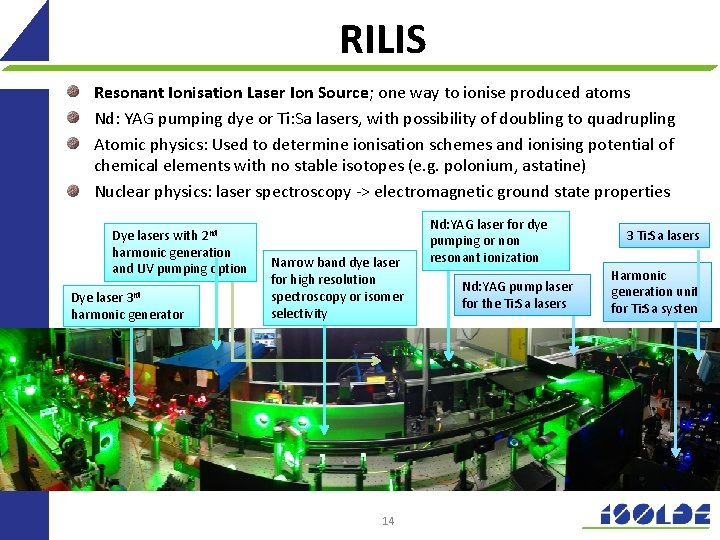
RILIS Resonant Ionisation Laser Ion Source; one way to ionise produced atoms Nd: YAG pumping dye or Ti: Sa lasers, with possibility of doubling to quadrupling Atomic physics: Used to determine ionisation schemes and ionising potential of chemical elements with no stable isotopes (e. g. polonium, astatine) Nuclear physics: laser spectroscopy -> electromagnetic ground state properties Dye lasers with 2 nd harmonic generation and UV pumping option Dye laser 3 rd harmonic generator Narrow band dye laser for high resolution spectroscopy or isomer selectivity 14 Nd: YAG laser for dye pumping or non resonant ionization Nd: YAG pump laser for the Ti: Sa lasers 3 Ti: Sa lasers Harmonic generation unit for Ti: Sa system
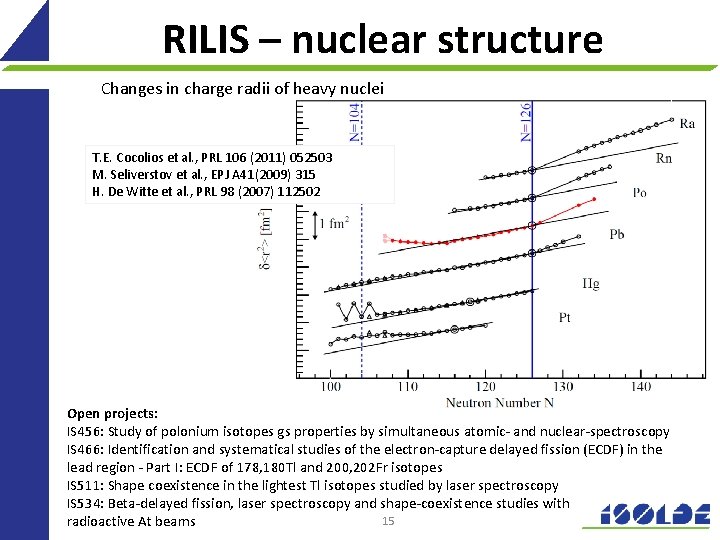
RILIS – nuclear structure Changes in charge radii of heavy nuclei T. E. Cocolios et al. , PRL 106 (2011) 052503 M. Seliverstov et al. , EPJ A 41(2009) 315 H. De Witte et al. , PRL 98 (2007) 112502 Open projects: IS 456: Study of polonium isotopes gs properties by simultaneous atomic- and nuclear-spectroscopy IS 466: Identification and systematical studies of the electron-capture delayed fission (ECDF) in the lead region - Part I: ECDF of 178, 180 Tl and 200, 202 Fr isotopes IS 511: Shape coexistence in the lightest Tl isotopes studied by laser spectroscopy IS 534: Beta-delayed fission, laser spectroscopy and shape-coexistence studies with 15 radioactive At beams
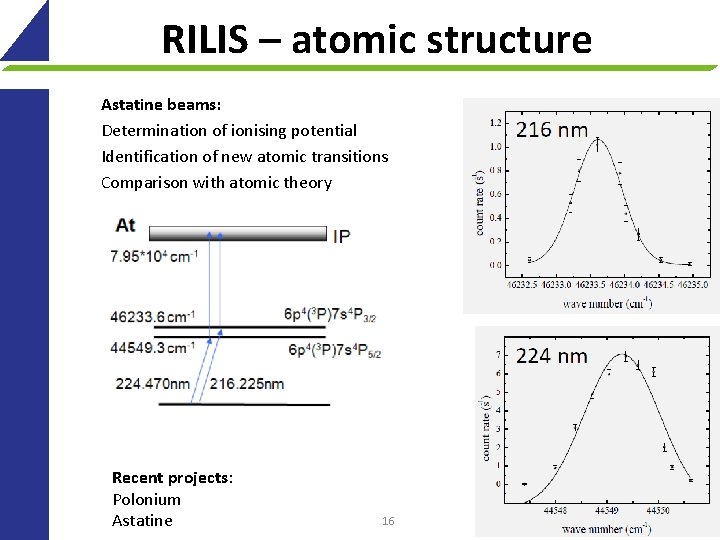
RILIS – atomic structure Astatine beams: Determination of ionising potential Identification of new atomic transitions Comparison with atomic theory Recent projects: Polonium Astatine 16
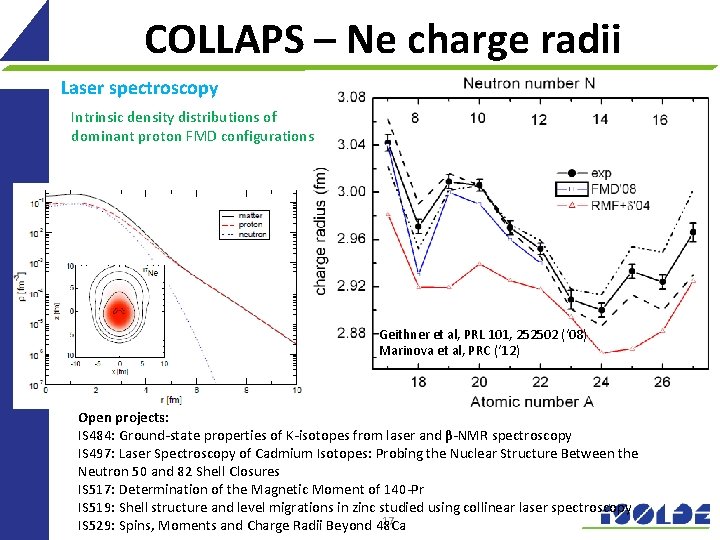
COLLAPS – Ne charge radii Laser spectroscopy Intrinsic density distributions of dominant proton FMD configurations Geithner et al, PRL 101, 252502 (‘ 08) Marinova et al, PRC (‘ 12) Open projects: IS 484: Ground-state properties of K-isotopes from laser and β-NMR spectroscopy IS 497: Laser Spectroscopy of Cadmium Isotopes: Probing the Nuclear Structure Between the Neutron 50 and 82 Shell Closures IS 517: Determination of the Magnetic Moment of 140 -Pr IS 519: Shell structure and level migrations in zinc studied using collinear laser spectroscopy 17 IS 529: Spins, Moments and Charge Radii Beyond 48 Ca
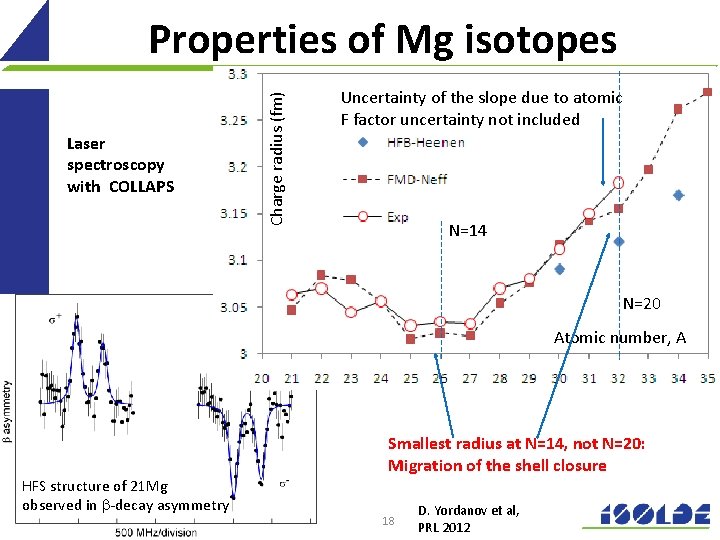
Laser spectroscopy with COLLAPS Charge radius (fm) Properties of Mg isotopes Uncertainty of the slope due to atomic F factor uncertainty not included N=14 N=20 Atomic number, A Smallest radius at N=14, not N=20: Migration of the shell closure HFS structure of 21 Mg observed in b-decay asymmetry 18 D. Yordanov et al, PRL 2012
- Slides: 18