
Laser plasma accelerator towards a compact e and
![Recent results on e-beam : Energy distribution improvements e-beam Charge in [150 -190] Me.](https://slidetodoc.com/presentation_image_h/123f6c2e20d8cc61f3bf0e920f8aae96/image-29.jpg "Recent results on e-beam : Energy distribution improvements e-beam Charge in [150 -190] Me.")
- Slides: 55
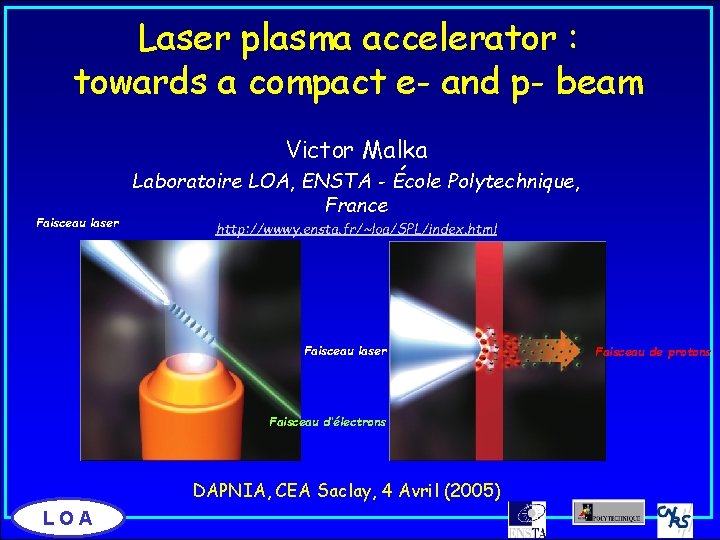
Laser plasma accelerator : towards a compact e- and p- beam Victor Malka Faisceau laser Laboratoire LOA, ENSTA - École Polytechnique, France http: //wwwy. ensta. fr/~loa/SPL/index. html Faisceau laser Faisceau d’électrons DAPNIA, CEA Saclay, 4 Avril (2005) LOA Faisceau de protons
Laser group ELF F. Burgy B. Mercier J. Ph. Rousseau Collaborators VLPL S. Kiselev A. Pukhov SPL Particle group E. D’humière Y. Glinec J. Faure M. Manclossi A. Tafo B. J. J. Santos V. Malka CEA/DAM Ile-de-France, France E. Lefebvre (simulations) T. Hosokai University of Tokyo, Japan LOA With the support of EEC/CARE/Phin project
Outline • Motivations • Excitation of relativistic electron plasma waves • e-beam : physical process and recent results • p-beam : physical process and recent results • Applications for Society • Benefits for Science. • Conclusion LOA
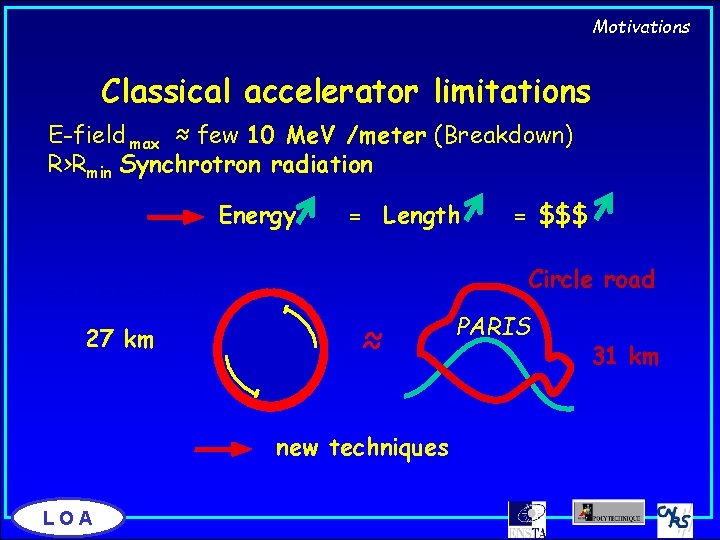
Motivations Classical accelerator limitations E-field max ≈ few 10 Me. V /meter (Breakdown) R>Rmin Synchrotron radiation Energy = Length Circle road LEP at CERN 27 km ≈ new techniques LOA = $$$ PARIS 31 km
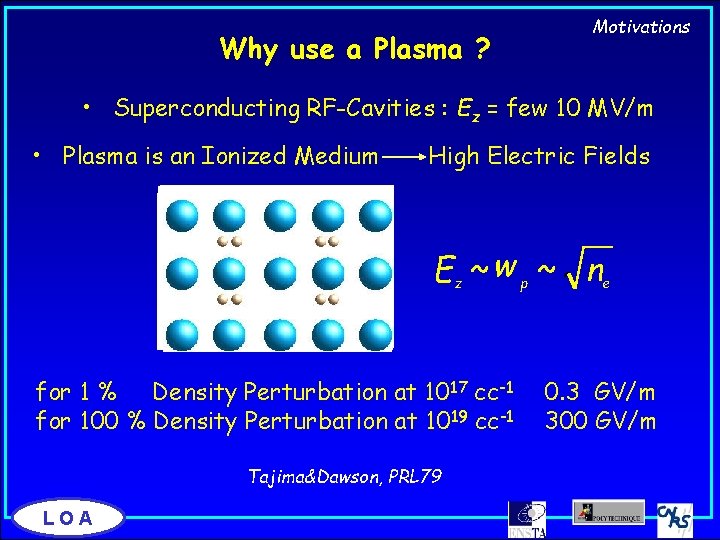
Why use a Plasma ? Motivations • Superconducting RF-Cavities : Ez = few 10 MV/m • Plasma is an Ionized Medium High Electric Fields Ez ~ w p ~ ne for 1 % Density Perturbation at 1017 cc-1 for 100 % Density Perturbation at 1019 cc-1 Tajima&Dawson, PRL 79 LOA 0. 3 GV/m 300 GV/m
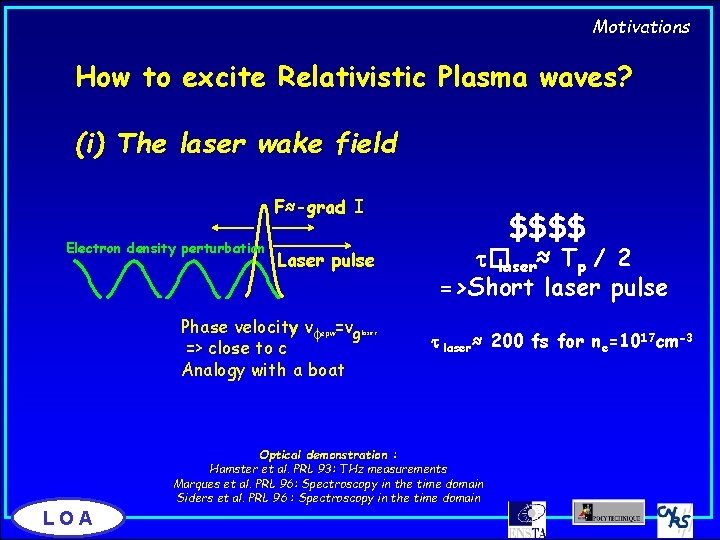
Motivations How to excite Relativistic Plasma waves? (i) The laser wake field F≈-grad I Electron density perturbation Laser pulse Phase velocity v vfepw=vg => close to c Analogy with a boat laser $$$$ �laser≈ Tp / 2 =>Short laser pulse laser≈ 200 fs for ne=1017 cm-3 Optical demonstration : Hamster et al. PRL 93: THz measurements Marques et al. PRL 96: Spectroscopy in the time domain Siders et al. PRL 96 : Spectroscopy in the time domain LOA
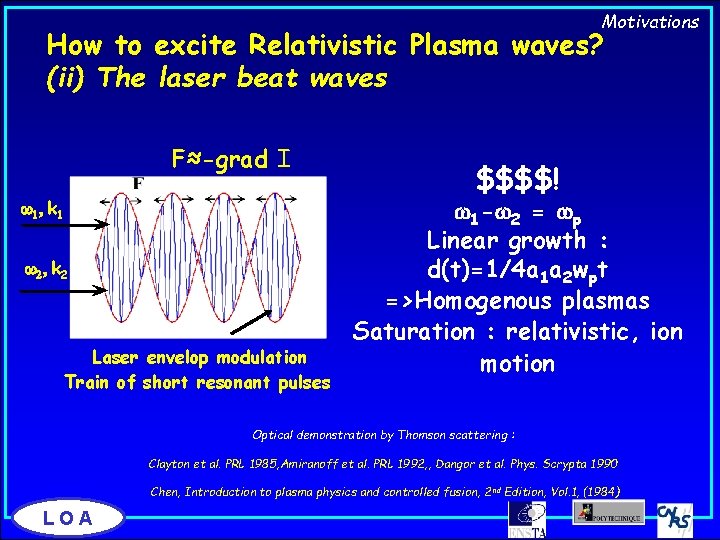
Motivations How to excite Relativistic Plasma waves? (ii) The laser beat waves F≈-grad I k k 2 Laser envelop modulation Train of short resonant pulses $$$$! 1 - 2 = p Linear growth : d(t)=1/4 a 1 a 2 wpt =>Homogenous plasmas Saturation : relativistic, ion motion Optical demonstration by Thomson scattering : Clayton et al. PRL 1985, Amiranoff et al. PRL 1992, , Dangor et al. Phys. Scrypta 1990 Chen, Introduction to plasma physics and controlled fusion, 2 nd Edition, Vol. 1, (1984) LOA
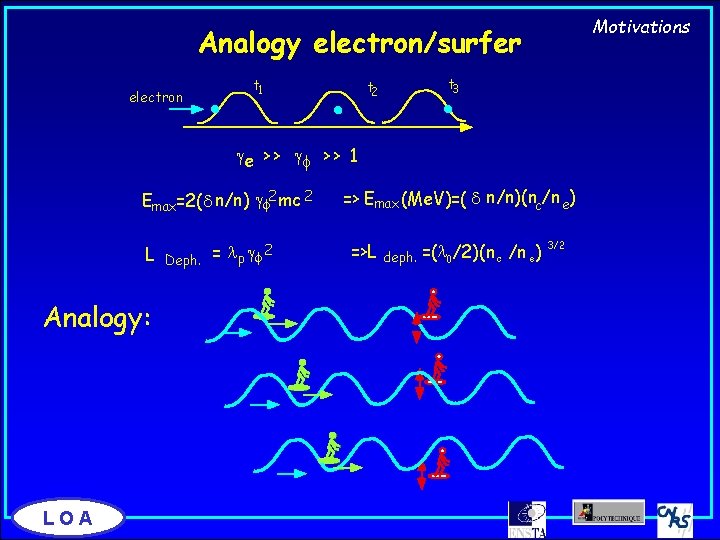
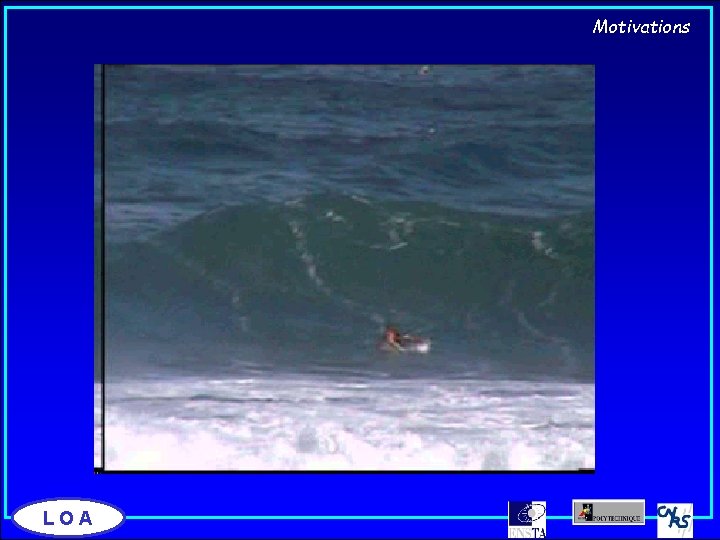
Motivations Analogy electron/surfer electron t 1 t 3 t 2 ge > > gf > > 1 Emax=2(d n/n) gf 2 mc 2 L Analogy: LOA Deph. = l p gf 2 => Emax (Me. V)=( d n/n)(nc/n e) =>L deph. =(l 0/2)(n c /n e) 3/2
Motivations LOA
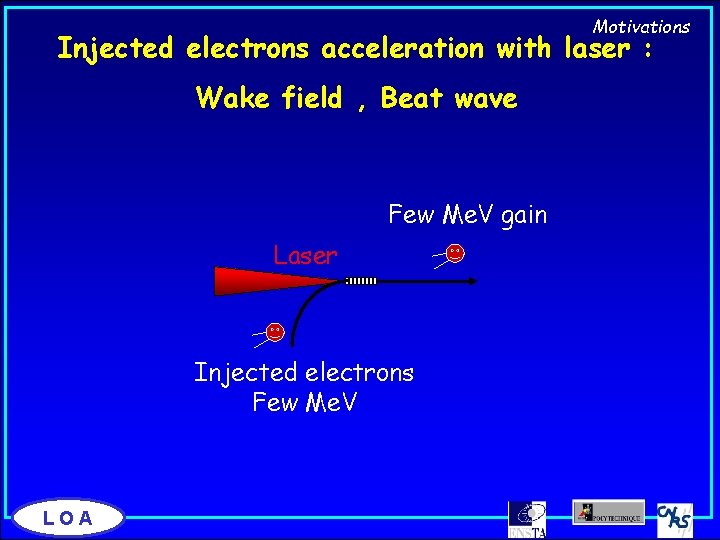
Motivations Injected electrons acceleration with laser : Wake field , Beat wave Few Me. V gain Laser Injected electrons Few Me. V LOA
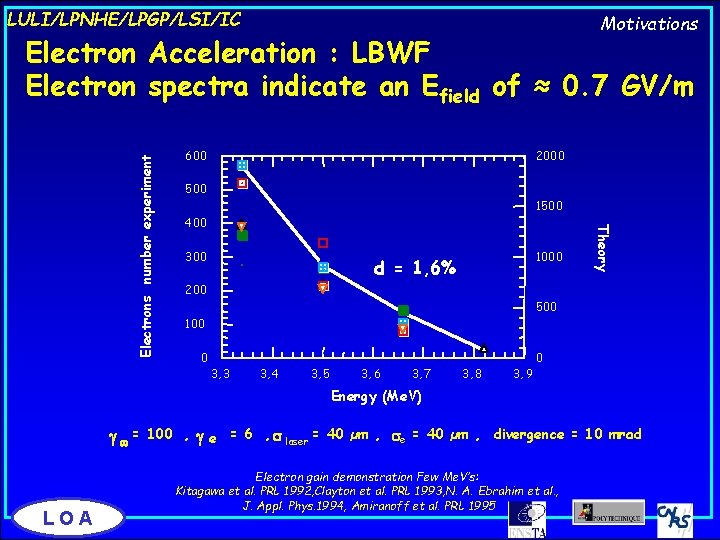
LULI/LPNHE/LPGP/LSI/IC Motivations 600 2000 500 1500 400 300 1000 d = 1, 6% Theory Electrons number experiment Electron Acceleration : LBWF Electron spectra indicate an Efield of ≈ 0. 7 GV/m 200 500 100 0 3, 3 3, 4 3, 5 3, 6 3, 7 3, 8 3, 9 0 Energy (Me. V) g = LOA 100 , ge = 6 , s laser = 40 µm , se = 40 µm , divergence = 10 mrad Electron gain demonstration Few Me. V’s: Kitagawa et al. PRL 1992, Clayton et al. PRL 1993, N. A. Ebrahim et al. , J. Appl. Phys. 1994, Amiranoff et al. PRL 1995
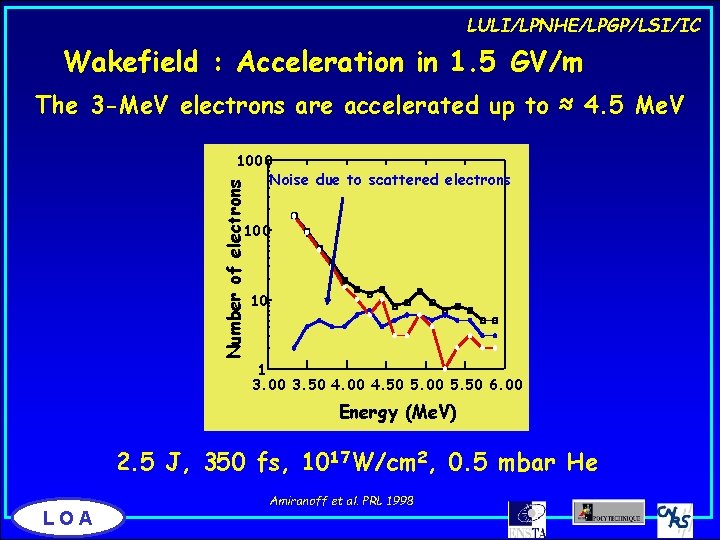
LULI/LPNHE/LPGP/LSI/IC Wakefield : Acceleration in 1. 5 GV/m The 3 -Me. V electrons are accelerated up to ≈ 4. 5 Me. V Number of electrons 1000 Noise due to scattered electrons 100 10 1 3. 00 3. 50 4. 00 4. 50 5. 00 5. 50 6. 00 Energy (Me. V) 2. 5 J, 350 fs, 1017 W/cm 2, 0. 5 mbar He LOA Amiranoff et al. PRL 1998
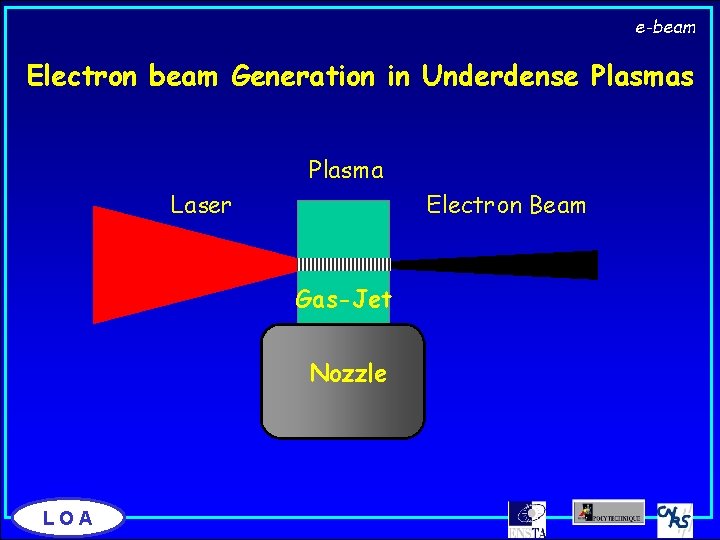
e-beam Electron beam Generation in Underdense Plasmas Plasma Laser Electron Beam Gas-Jet Nozzle LOA
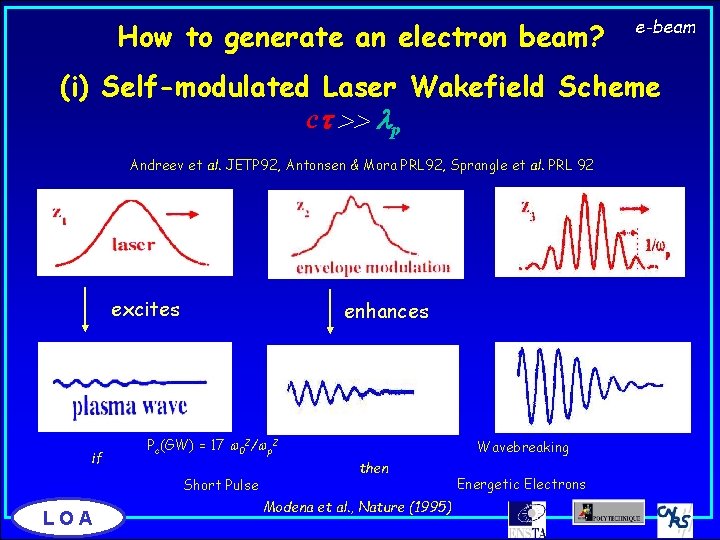
How to generate an electron beam? e-beam (i) Self-modulated Laser Wakefield Scheme ct >> lp Andreev et al. JETP 92, Antonsen & Mora PRL 92, Sprangle et al. PRL 92 excites if enhances Pc(GW) = 17 w 02/wp 2 Short Pulse LOA Wavebreaking then Modena et al. , Nature (1995) Energetic Electrons
e-beam wave breaking : from waves to particles LOA
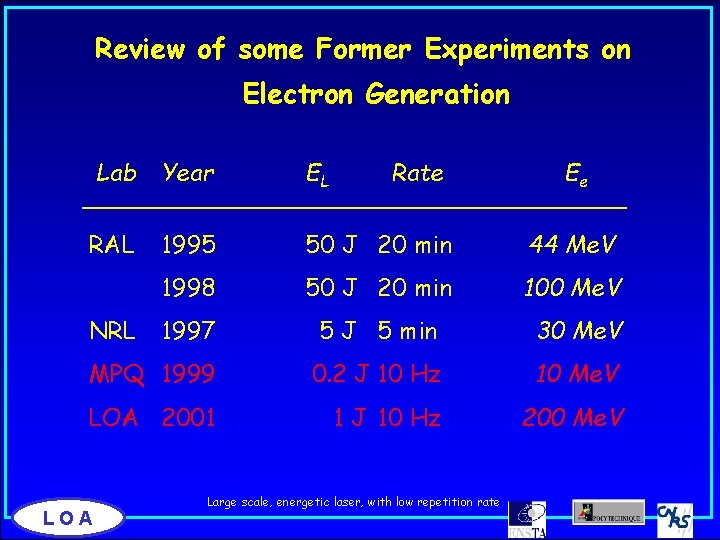
Review of some Former Experiments on Electron Generation Lab Year EL RAL 1995 50 J 20 min 44 Me. V 1998 50 J 20 min 100 Me. V 1997 5 J 5 min 30 Me. V MPQ 1999 0. 2 J 10 Hz 10 Me. V LOA 2001 1 J 10 Hz 200 Me. V NRL LOA Rate Large scale, energetic laser, with low repetition rate Ee
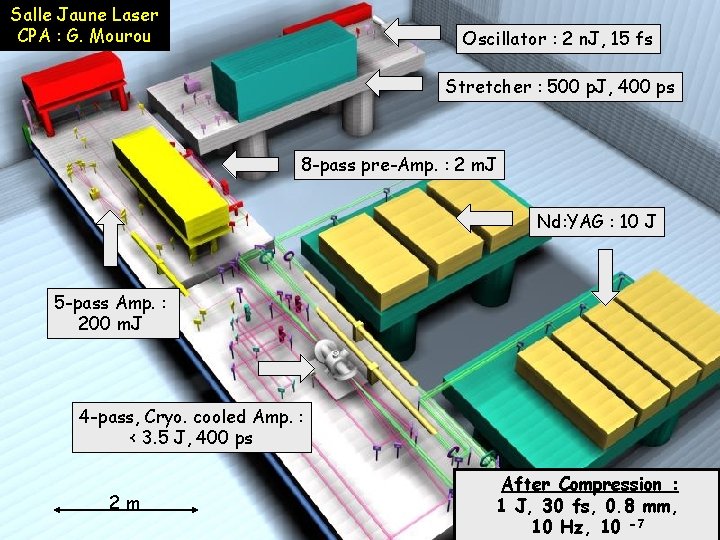
Salle Jaune Laser CPA : G. Mourou Oscillator : 2 n. J, 15 fs Stretcher : 500 p. J, 400 ps 8 -pass pre-Amp. : 2 m. J Nd: YAG : 10 J 5 -pass Amp. : 200 m. J 4 -pass, Cryo. cooled Amp. : < 3. 5 J, 400 ps LOA 2 m After Compression : 1 J, 30 fs, 0. 8 mm, 10 Hz, 10 -7
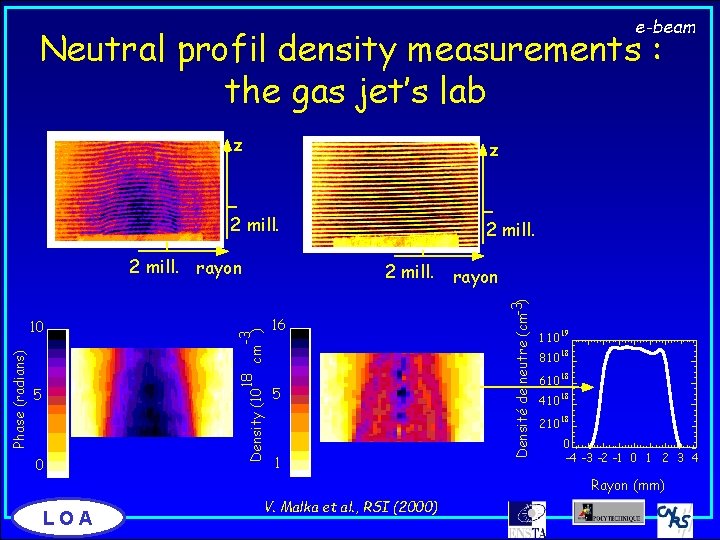
e-beam Neutral profil density measurements : the gas jet’s lab z z 2 mill. rayon 0 16 5 1 Densité de neutre (cm-3) 5 -3 18 Density (10 cm ) Phase (radians) 10 2 mill. rayon 1 1019 8 1018 6 1018 4 1018 2 1018 0 -4 -3 -2 -1 0 1 2 3 4 Rayon (mm) LOA V. Malka et al. , RSI (2000)
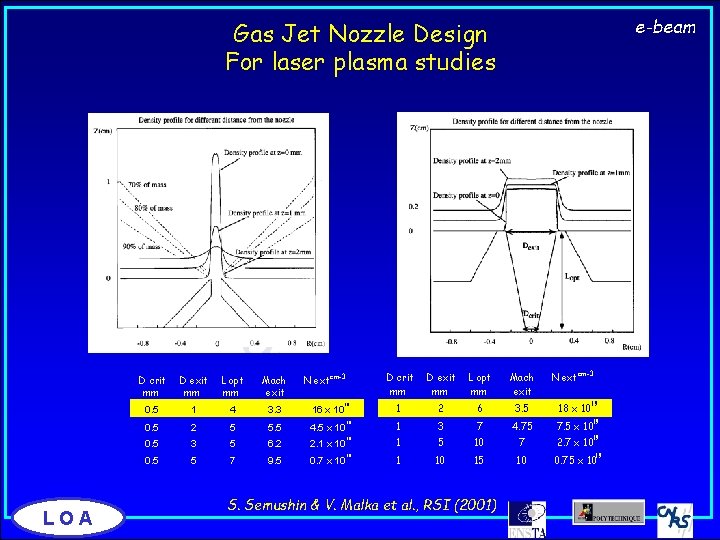
e-beam Gas Jet Nozzle Design For laser plasma studies LOA N ext D exit mm L opt mm Mach exit 19 1 2 6 3. 5 18 x 10 19 1 3 7 4. 75 7. 5 x 10 19 1 5 10 7 2. 7 x 10 19 1 10 15 10 0. 75 x 10 D exit mm L opt mm Mach exit 0. 5 1 4 3. 3 16 x 10 0. 5 2 5 5. 5 4. 5 x 10 0. 5 3 5 6. 2 2. 1 x 10 0. 5 5 7 9. 5 0. 7 x 10 S. Semushin & V. Malka et al. , RSI (2001) N ext cm-3 D crit mm 19 19
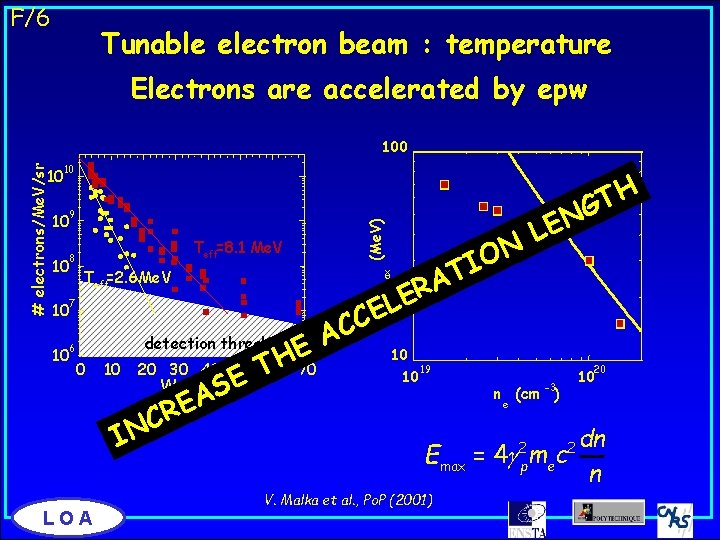
F/6 Tunable electron beam : temperature Electrons are accelerated by epw # electrons/Me. V/sr 100 10 10 Teff=2. 6 Me. V 7 10 C A E H 10 20 30 40 50 T 60 70 E W (Me. V) S A E R C IN detection threshold 6 10 max 10 Teff=8. 1 Me. V 0 LOA N O I N E L T A R E L CE E 8 (Me. V) 9 10 H T G 10 19 10 20 10 -3 n (cm ) e dn E max = 4 g mec n V. Malka et al. , Po. P (2001) 2 p 2
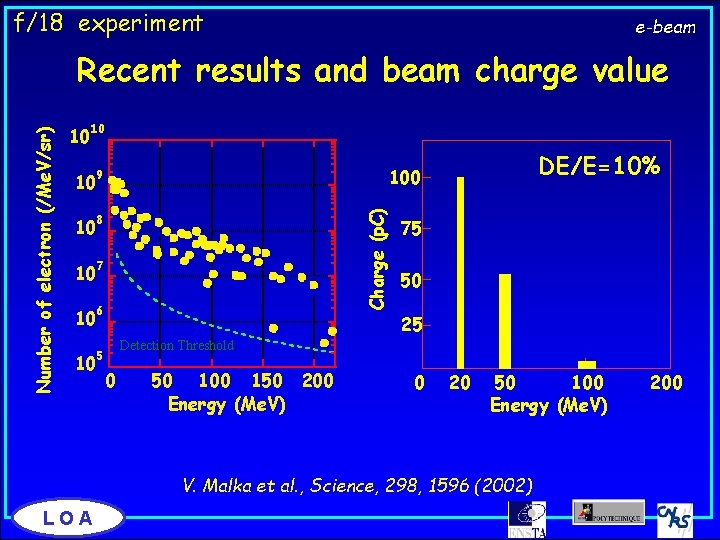
f/18 experiment e-beam 10 10 10 8 10 7 10 6 10 75 50 25 Detection Threshold 5 10 DE/E=10% 100 9 Charge (p. C) Number of electron (/Me. V/sr) Recent results and beam charge value 0 50 100 150 200 Energy (Me. V) 0 20 50 100 Energy (Me. V) V. Malka et al. , Science, 298, 1596 (2002) LOA 200
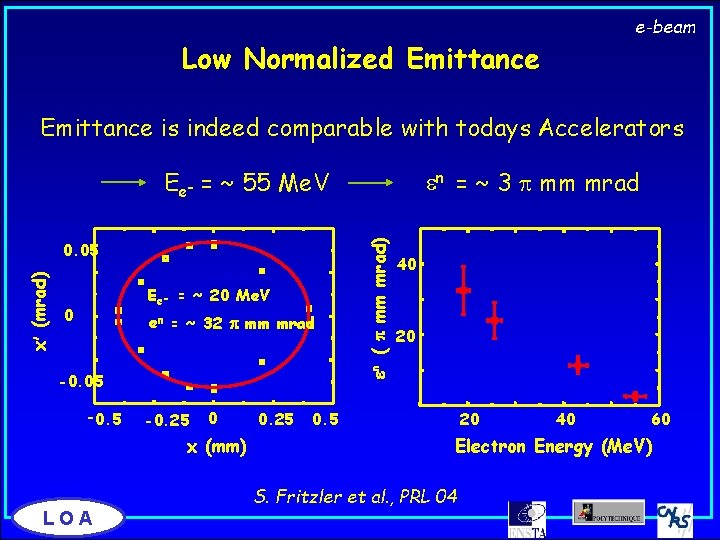
e-beam Low Normalized Emittance is indeed comparable with todays Accelerators en = ~ 3 mm mrad x (mrad) 0. 05 Ee- = ~ 20 Me. V 0 en = ~ 32 mm mrad -0. 05 - 0. 5 -0. 25 0 x (mm) LOA 0. 25 n ( mm mrad) Ee- = ~ 55 Me. V 40 20 20 0. 5 40 60 Electron Energy (Me. V) S. Fritzler et al. , PRL 04
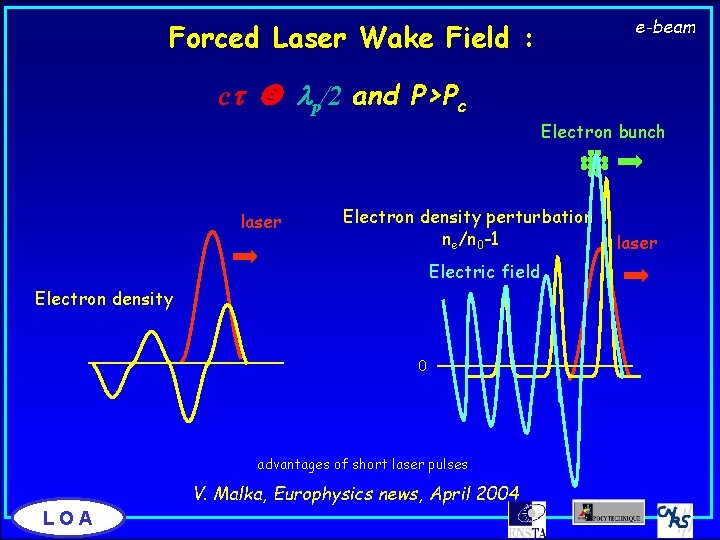
e-beam Forced Laser Wake Field : ct lp/2 and P>Pc Electron bunch laser Electron density perturbation ne/n 0 -1 Electric field Electron density 0 advantages of short laser pulses V. Malka, Europhysics news, April 2004 LOA laser
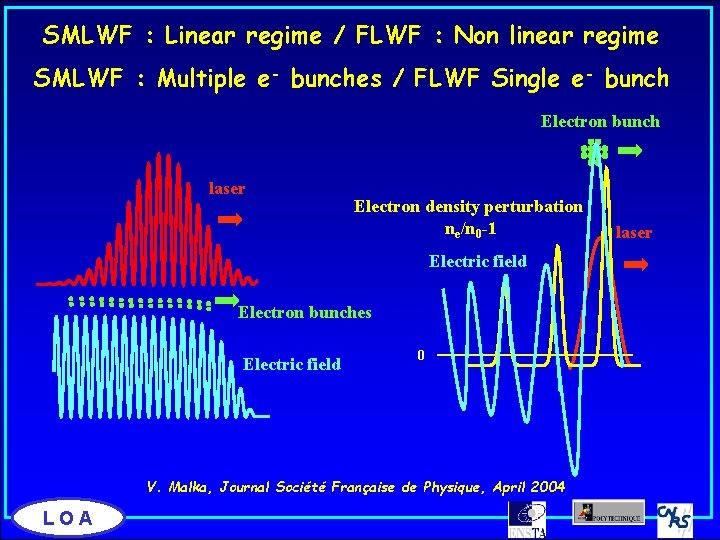
SMLWF : Linear regime / FLWF : Non linear regime SMLWF : Multiple e- bunches / FLWF Single e- bunch Electron bunch laser Electron density perturbation ne/n 0 -1 Electric field Electron bunches Electric field 0 V. Malka, Journal Société Française de Physique, April 2004 LOA laser
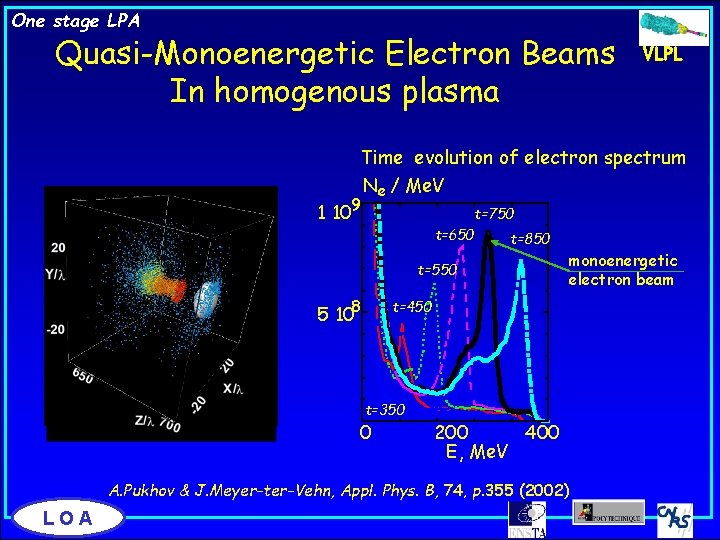
One stage LPA Quasi-Monoenergetic Electron Beams In homogenous plasma VLPL Time evolution of electron spectrum Ne / Me. V 1 109 t=750 t=650 t=850 t=550 5 108 monoenergetic electron beam t=450 t=350 0 200 400 E, Me. V A. Pukhov & J. Meyer-ter-Vehn, Appl. Phys. B, 74, p. 355 (2002) LOA
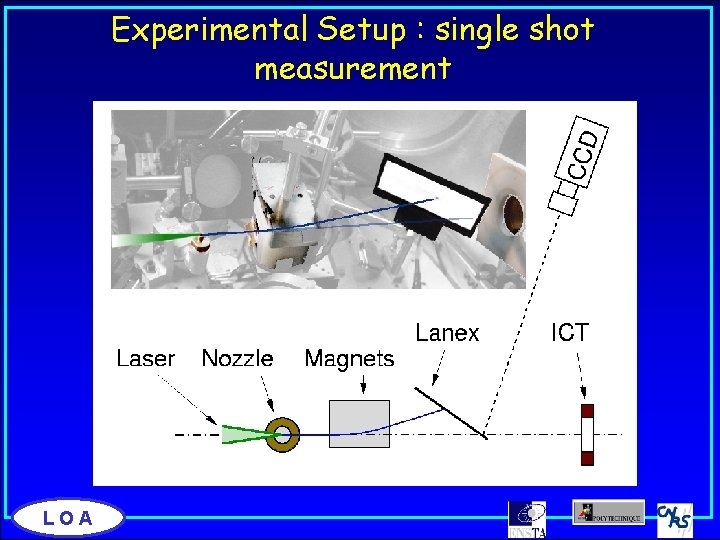
Experimental Setup : single shot measurement LOA
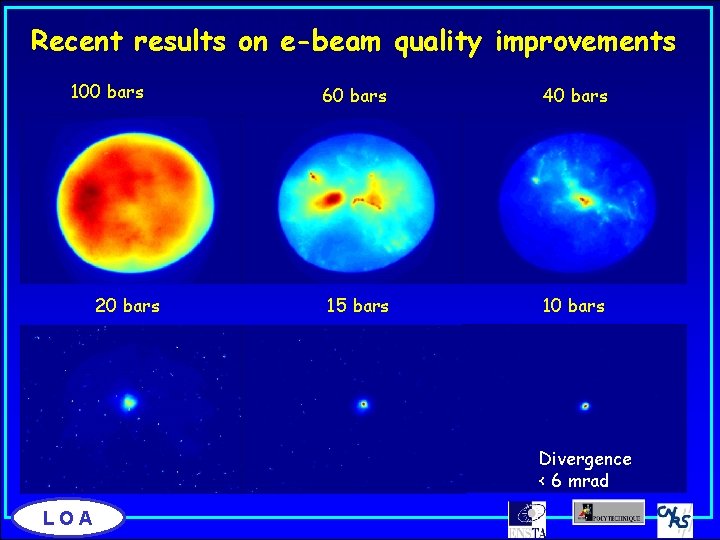
Qualité spatiale du faisceau d’électrons: Recent results on e-beam quality improvements Dépend fortement de la propagation laser 100 bars 20 bars 60 bars 40 bars 15 bars 10 bars Divergence < 6 mrad LOA
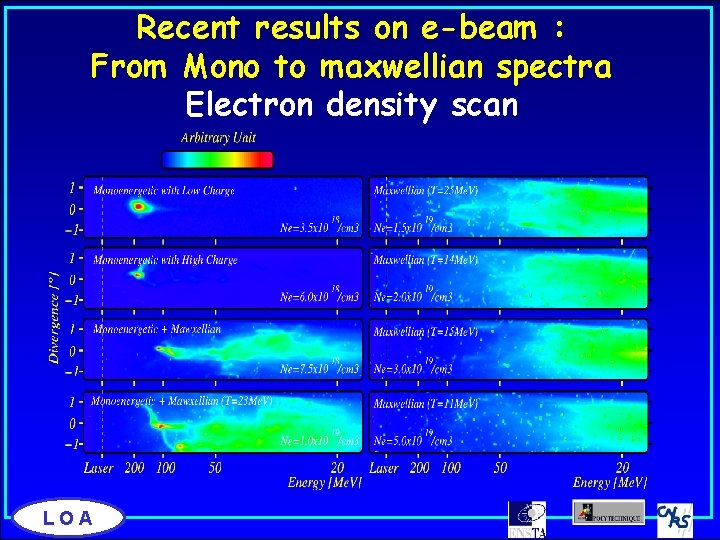
Recent results on e-beam : From Mono to maxwellian spectra Electron density scan LOA
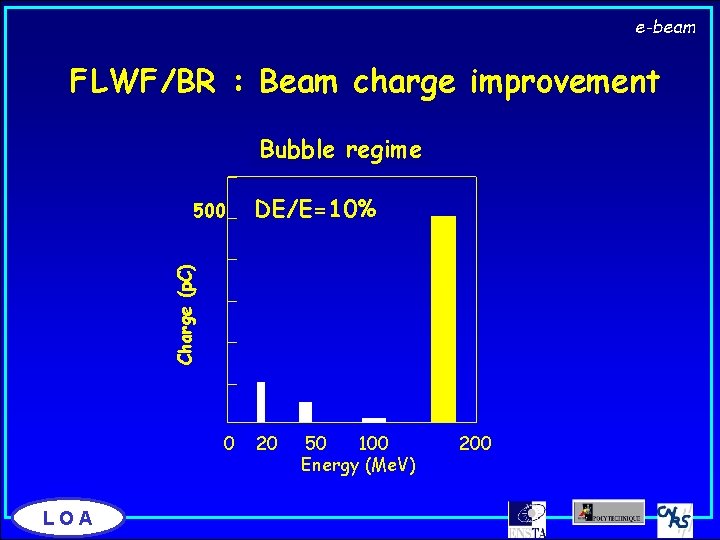
Recent results on e-beam : Energy distribution improvements e-beam Charge in [150 -190] Me. V : (500 ± 200) p. C Experiment PIC LOA J. Faure et al. , Nature , 30 september Nature 2004 C. Geddes et al. , S. Mangles et al. , in Nature this week too RAL, LBNL and in Tokyo
e-beam FLWF/BR : Beam charge improvement FLWF Bubble regime DE/E=10% Charge (p. C) 500 0 LOA 20 50 100 Energy (Me. V) 200
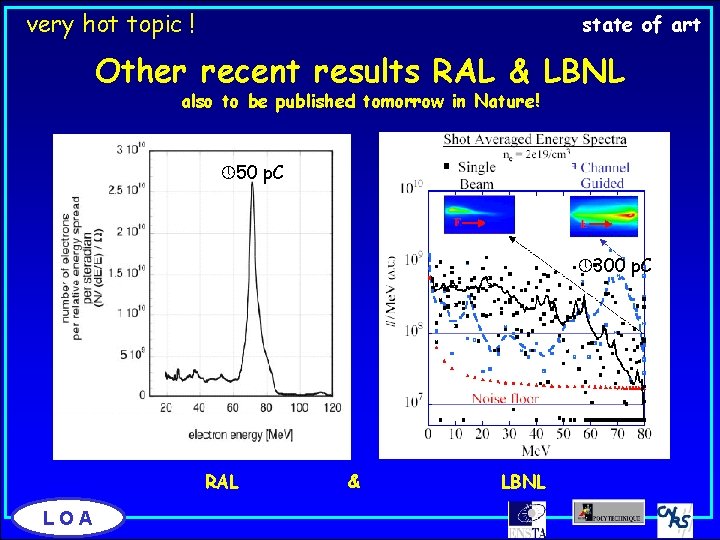
very hot topic ! state of art Other recent results RAL & LBNL also to be published tomorrow in Nature! 50 p. C 300 p. C RAL LOA & LBNL
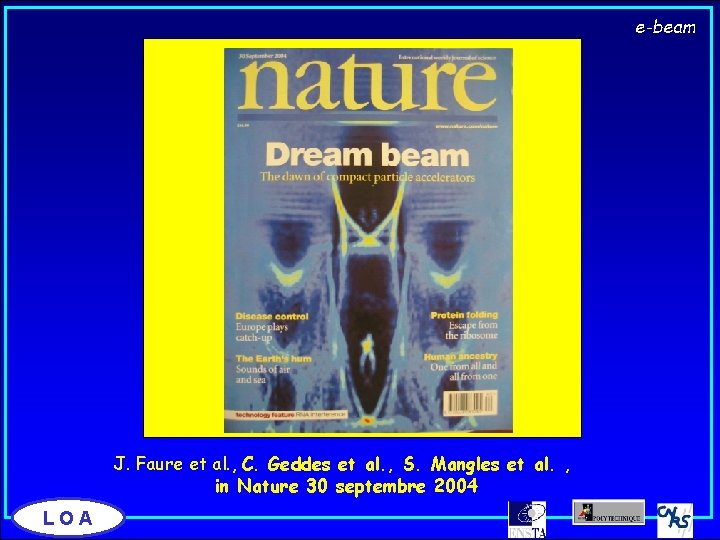
e-beam J. Faure et al. , C. Geddes et al. , S. Mangles et al. , in Nature 30 septembre 2004 LOA
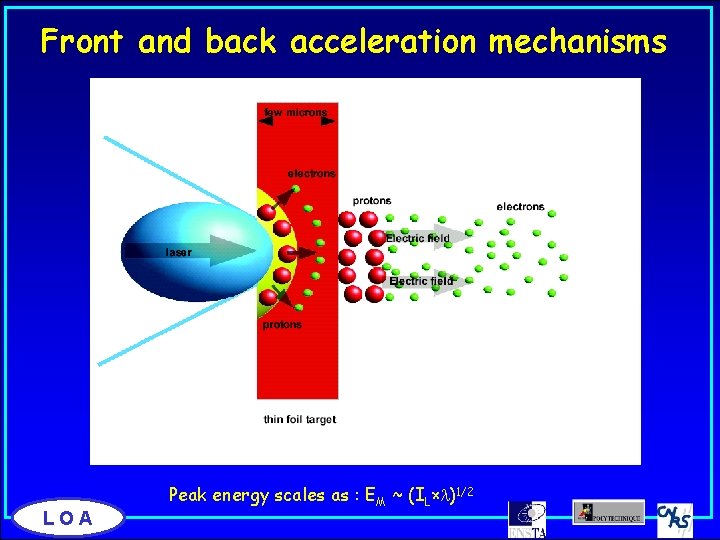
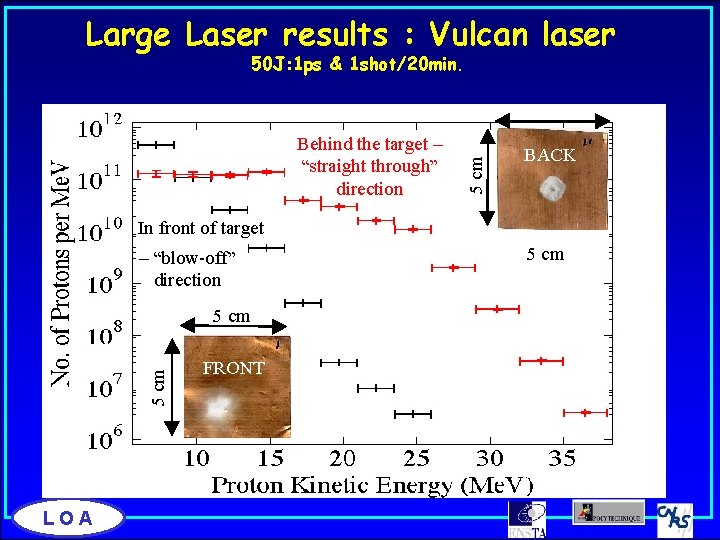
Front and back acceleration mechanisms LOA Peak energy scales as : EM ~ (IL×l)1/2
Large Laser results : Vulcan laser Behind the target – “straight through” direction 5 cm 50 J: 1 ps & 1 shot/20 min. BACK In front of target – “blow-off” direction 5 cm LOA FRONT 5 cm
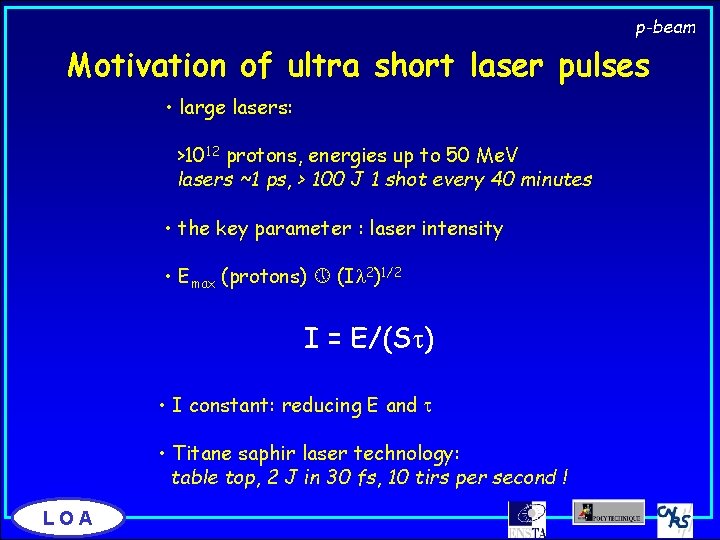
p-beam Motivation of ultra short laser pulses • large lasers: >1012 protons, energies up to 50 Me. V lasers ~1 ps, > 100 J 1 shot every 40 minutes • the key parameter : laser intensity • Emax (protons) (Il 2)1/2 I = E/(St) • I constant: reducing E and t • Titane saphir laser technology: table top, 2 J in 30 fs, 10 tirs per second ! LOA
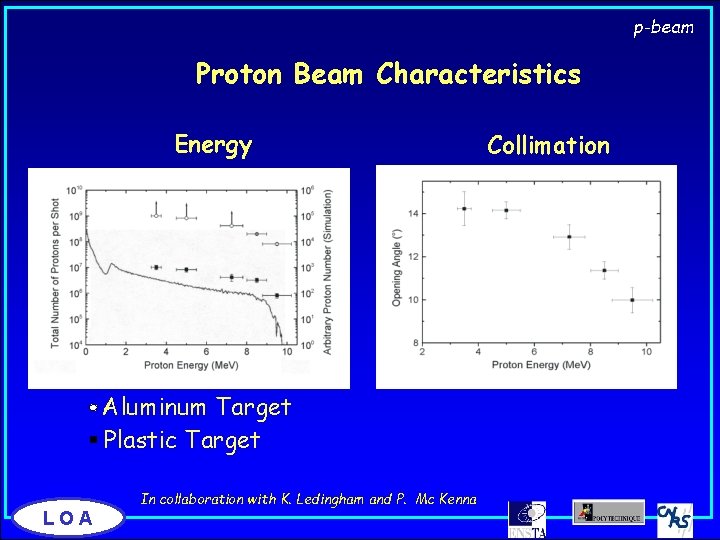
p-beam Proton Beam Characteristics Energy Aluminum Target Plastic Target LOA In collaboration with K. Ledingham and P. Mc Kenna Collimation
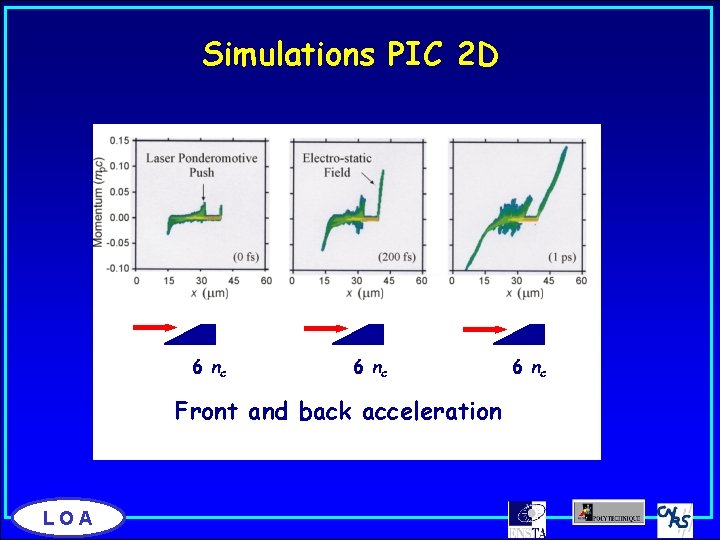
Simulations PIC 2 D 6 nc Front and back acceleration LOA 6 nc
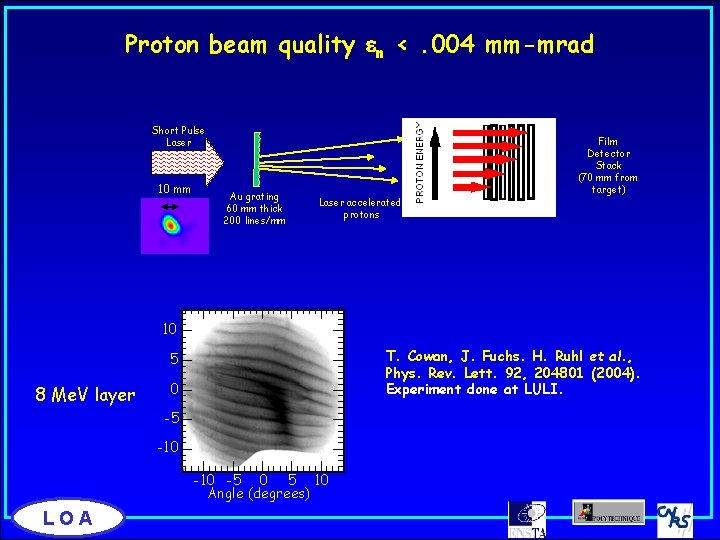
Proton beam quality n <. 004 mm-mrad Short Pulse Laser 10 mm Au grating 60 mm thick 200 lines/mm Laser accelerated protons Film Detector Stack (70 mm from target) 10 T. Cowan, J. Fuchs. H. Ruhl et al. , Phys. Rev. Lett. 92, 204801 (2004). Experiment done at LULI. 5 8 Me. V layer 0 -5 -10 -5 0 5 10 Angle (degrees) LOA
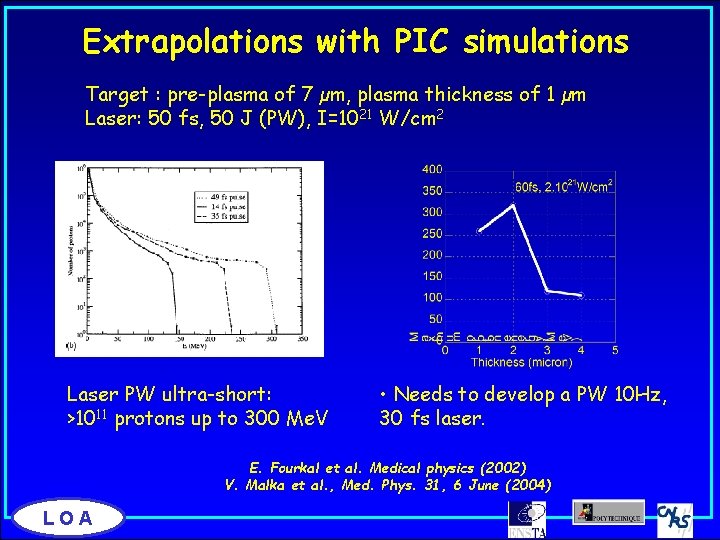
Extrapolations with PIC simulations Target : pre-plasma of 7 µm, plasma thickness of 1 µm Laser: 50 fs, 50 J (PW), I=1021 W/cm 2 Laser PW ultra-short: >1011 protons up to 300 Me. V • Needs to develop a PW 10 Hz, 30 fs laser. E. Fourkal et al. Medical physics (2002) V. Malka et al. , Med. Phys. 31, 6 June (2004) LOA
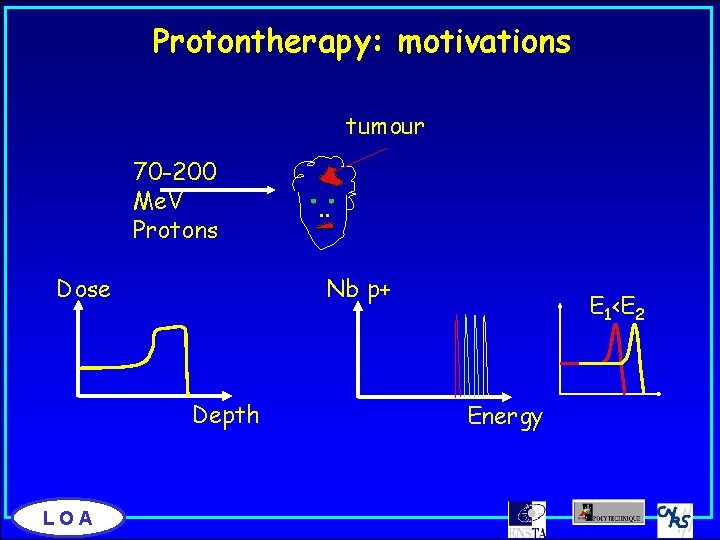
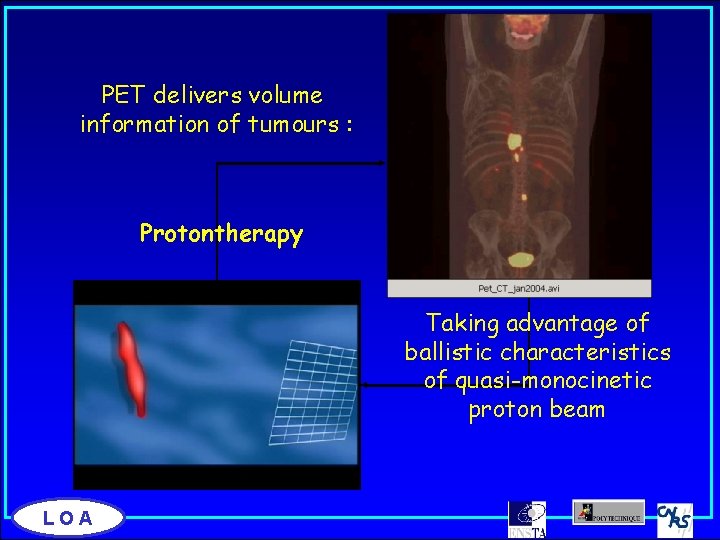
Protontherapy: motivations tumour 70 -200 Me. V Protons Dose Nb p+ Depth LOA . . E 1<E 2 Energy
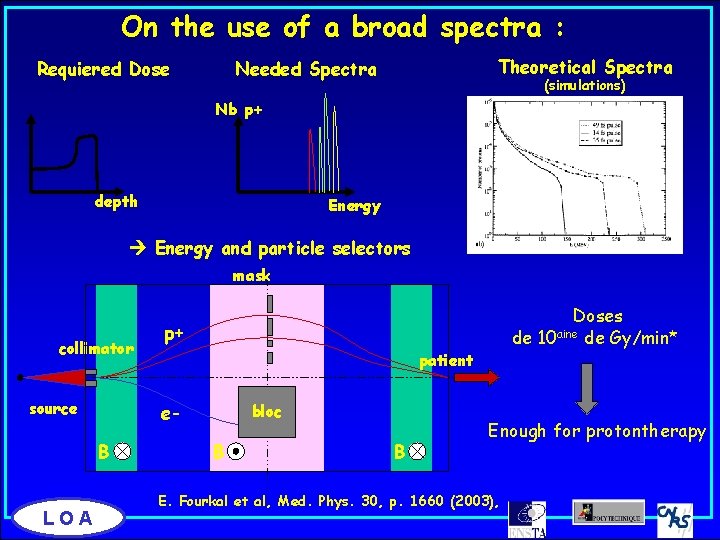
On the use of a broad spectra : Requiered Dose Theoretical Spectra Needed Spectra (simulations) Nb p+ depth Energy and particle selectors mask collimator source LOA p+ patient e. B Doses de 10 aine de Gy/min* bloc B B Enough for protontherapy E. Fourkal et al, Med. Phys. 30, p. 1660 (2003),
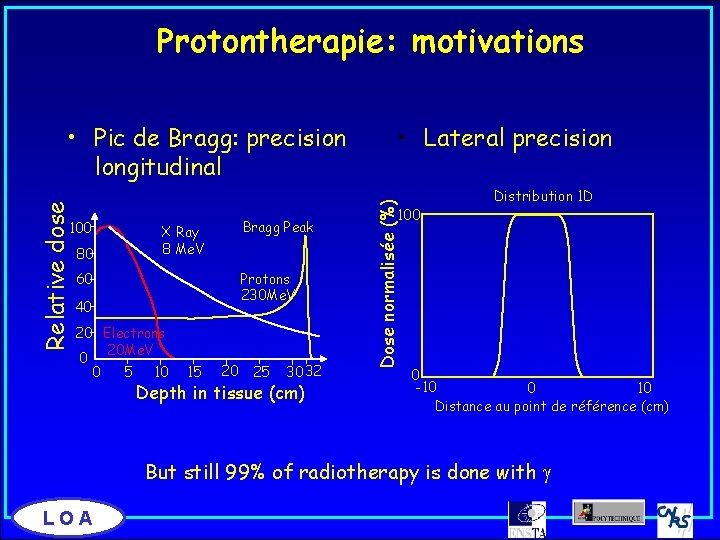
Protontherapie: motivations 100 80 Bragg Peak X Ray 8 Me. V Protons 230 Me. V 60 40 20 Electrons 20 Me. V 0 0 10 5 15 20 25 30 32 Depth in tissue (cm) • Lateral precision Dose normalisée (%) Relative dose • Pic de Bragg: precision longitudinal 100 Distribution 1 D 0 -10 10 0 Distance au point de référence (cm) But still 99% of radiotherapy is done with g LOA
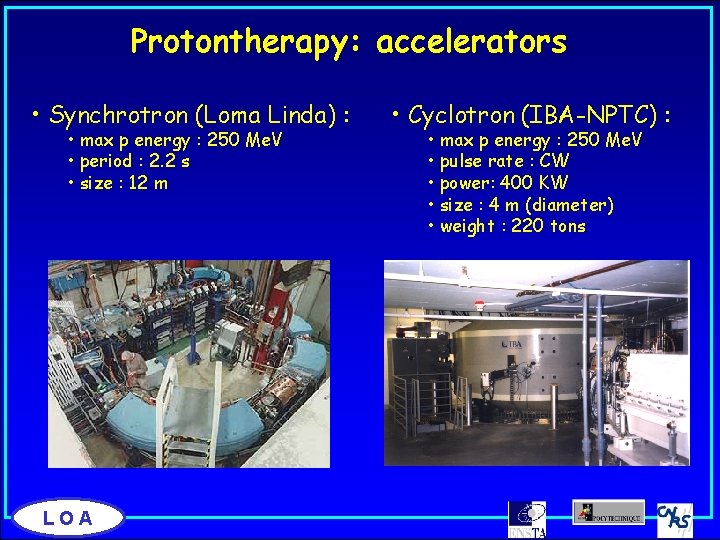
Protontherapy: accelerators • Synchrotron (Loma Linda) : • max p energy : 250 Me. V • period : 2. 2 s • size : 12 m LOA • Cyclotron (IBA-NPTC) : • max p energy : 250 Me. V • pulse rate : CW • power: 400 KW • size : 4 m (diameter) • weight : 220 tons
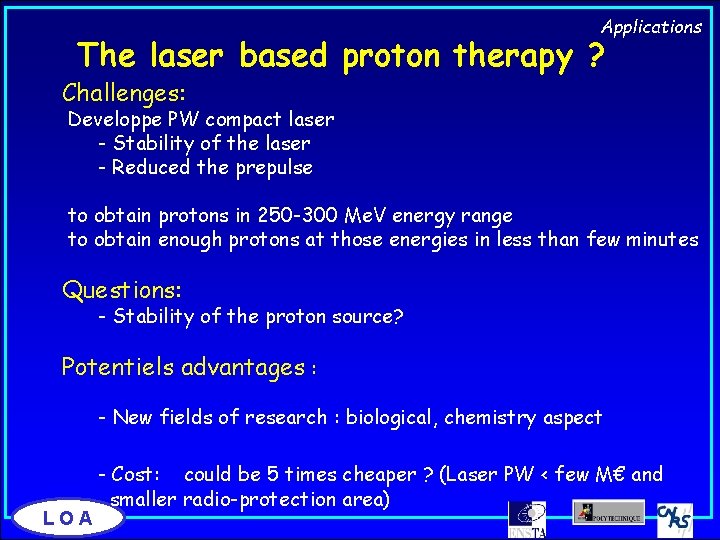
Applications The laser based proton therapy ? Challenges: Developpe PW compact laser - Stability of the laser - Reduced the prepulse to obtain protons in 250 -300 Me. V energy range to obtain enough protons at those energies in less than few minutes Questions: - Stability of the proton source? Potentiels advantages : - New fields of research : biological, chemistry aspect LOA - Cost: could be 5 times cheaper ? (Laser PW < few M€ and smaller radio-protection area)
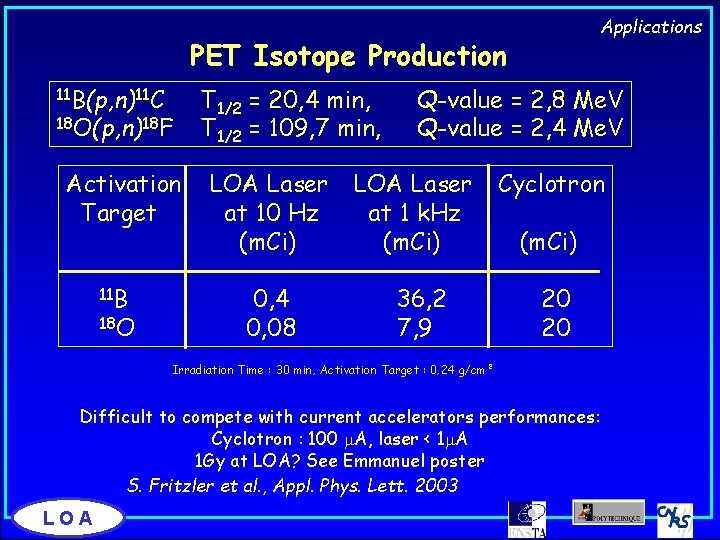
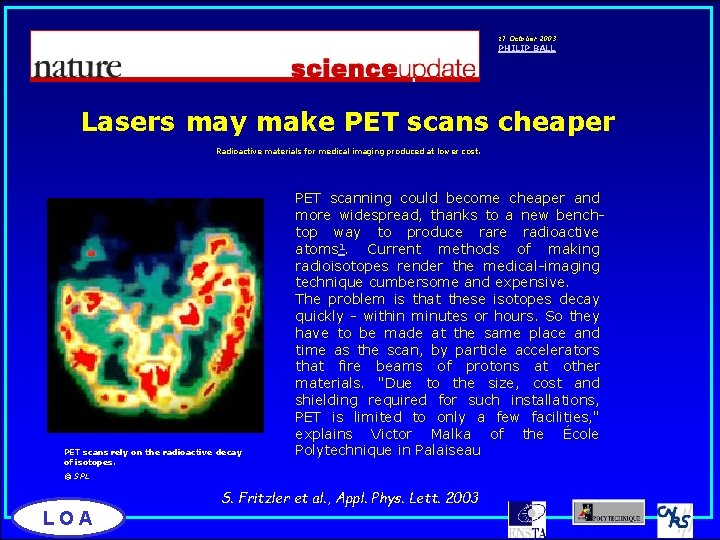
Applications PET Isotope Production 11 B(p, n)11 C 18 O(p, n)18 F Activation Target 11 B 18 O T 1/2 = 20, 4 min, T 1/2 = 109, 7 min, LOA Laser at 10 Hz (m. Ci) 0, 4 0, 08 Q-value = 2, 8 Me. V Q-value = 2, 4 Me. V LOA Laser at 1 k. Hz (m. Ci) 36, 2 7, 9 Cyclotron (m. Ci) 20 20 Irradiation Time : 30 min, Activation Target : 0, 24 g/cm² Difficult to compete with current accelerators performances: Cyclotron : 100 m. A, laser < 1 m. A 1 Gy at LOA? See Emmanuel poster S. Fritzler et al. , Appl. Phys. Lett. 2003 LOA
17 October 2003 PHILIP BALL Lasers may make PET scans cheaper Radioactive materials for medical imaging produced at lower cost. PET scans rely on the radioactive decay of isotopes. PET scanning could become cheaper and more widespread, thanks to a new benchtop way to produce rare radioactive atoms 1. Current methods of making radioisotopes render the medical-imaging technique cumbersome and expensive. The problem is that these isotopes decay quickly - within minutes or hours. So they have to be made at the same place and time as the scan, by particle accelerators that fire beams of protons at other materials. "Due to the size, cost and shielding required for such installations, PET is limited to only a few facilities, " explains Victor Malka of the École Polytechnique in Palaiseau © SPL S. Fritzler et al. , Appl. Phys. Lett. 2003 LOA
PET delivers volume information of tumours : Protontherapy Taking advantage of ballistic characteristics of quasi-monocinetic proton beam LOA
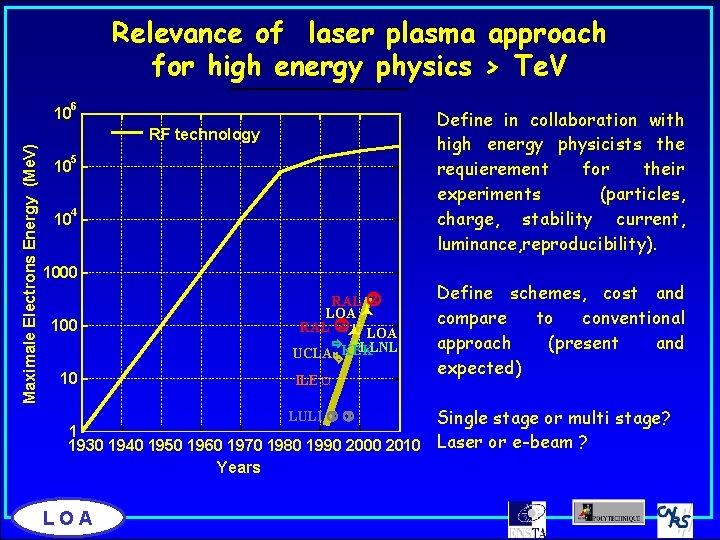
Relevance of laser plasma approach for high energy physics > Te. V 6 10 Define in collaboration with high energy physicists the requierement for their experiments (particles, charge, stability current, luminance, reproducibility). Maximale Electrons Energy (Me. V) RF technology 5 10 4 10 1000 RAL LOA *LLNL UCLA KEK 100 10 ILE ¤ Define schemes, cost and compare to conventional approach (present and expected) Single stage or multi stage? 1 1930 1940 1950 1960 1970 1980 1990 2000 2010 Laser or e-beam ? LULI Years LOA
Conclusion and future of laser plasma accelerator • Laser particle acceleration has been demonstrated • E-fields up to 1000 GV/m • Good quality • Quasi monoenergetic e-beam are produced • Energy gains of 1 Me. V to 200 Me. V • Electron sources up to ≈ 1 Ge. V (n. C, <100 fs) = XFEL • For high energy the requierements are extreme: Luminosity : 1000 bunches/s with 1 n. C per bunch at 1 Te. V : =>much more than 1000*1000 J/s=1 MJ/s 1 MW particle : 10 -100 MW laser ? • Research related to laser technology evolution • Lasers parameters must be flexible: 0. 1 J-5 fs, 30 J-30 fs, 1 MJ-1 ps ? LOA
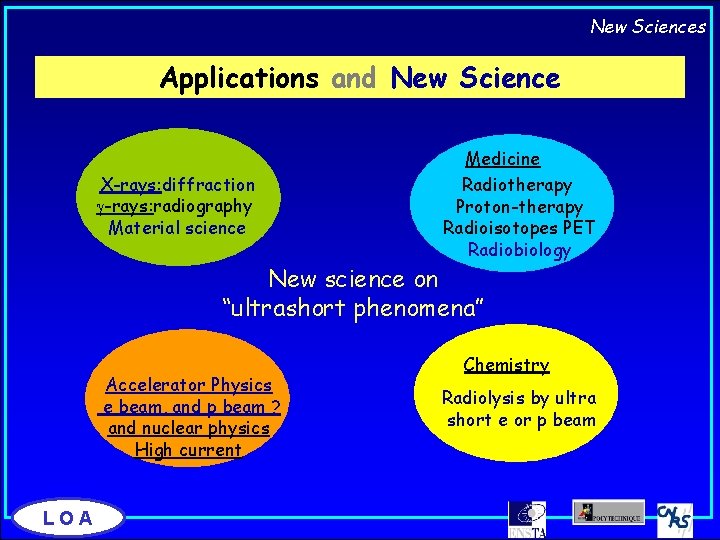
New Sciences Applications and New Science X-rays: diffraction g-rays: radiography Material science Medicine Radiotherapy Proton-therapy Radioisotopes PET Radiobiology New science on “ultrashort phenomena” Accelerator Physics e beam, and p beam ? and nuclear physics High current LOA Chemistry Radiolysis by ultra short e or p beam
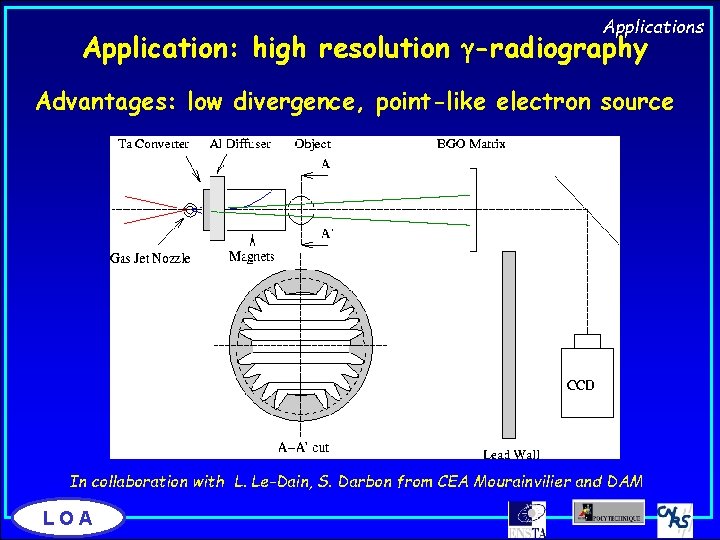
Applications Application: high resolution g-radiography Advantages: low divergence, point-like electron source In collaboration with L. Le-Dain, S. Darbon from CEA Mourainvilier and DAM LOA
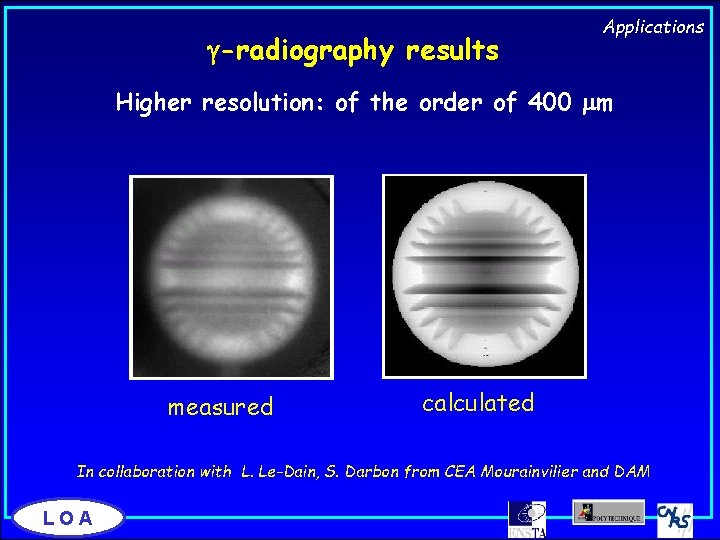
g-radiography results Applications Higher resolution: of the order of 400 mm measured calculated In collaboration with L. Le-Dain, S. Darbon from CEA Mourainvilier and DAM LOA
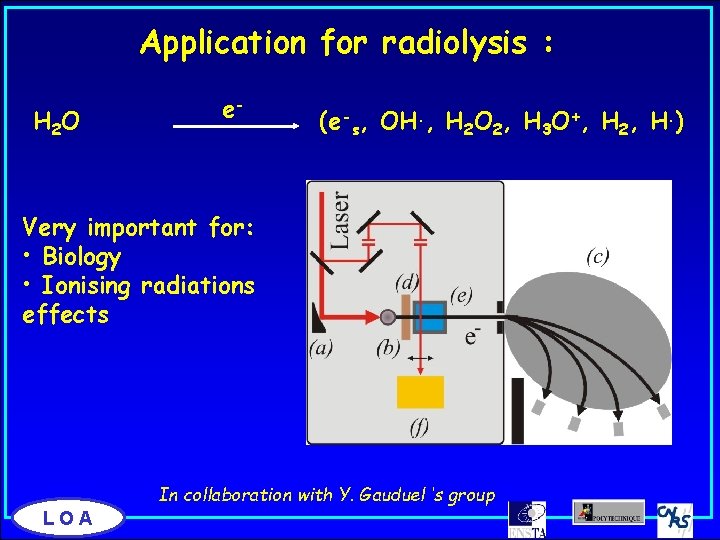
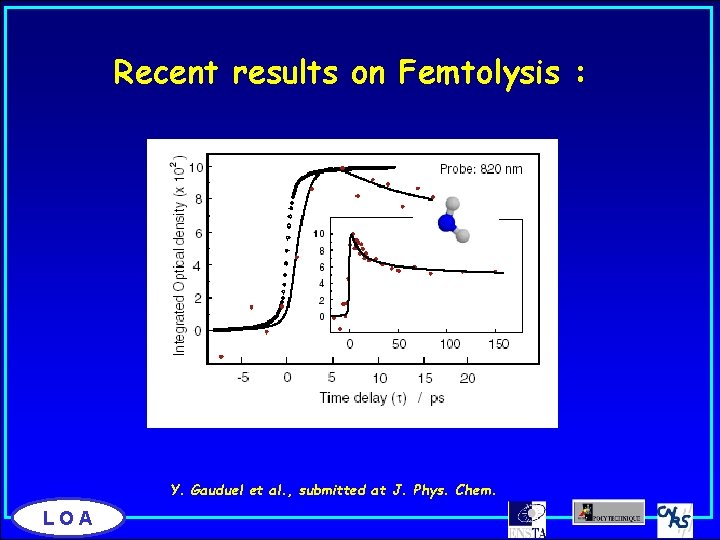
Application for radiolysis : H 2 O e- (e-s, OH. , H 2 O 2, H 3 O+, H 2, H. ) Very important for: • Biology • Ionising radiations effects In collaboration with Y. Gauduel ‘s group LOA
Recent results on Femtolysis : Y. Gauduel et al. , submitted at J. Phys. Chem. LOA
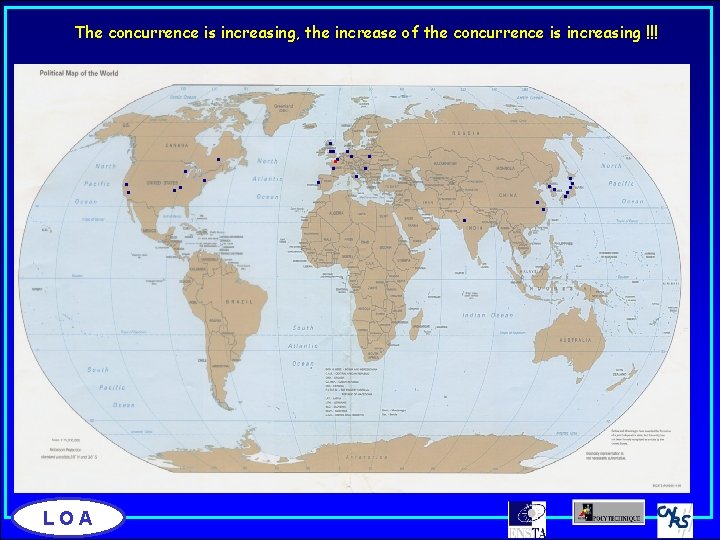
The concurrence is increasing, the increase of the concurrence is increasing !!! . . LOA . . . .