
Laser Offset Stabilization for Terahertz THz Frequency Generation
Laser Offset Stabilization for Terahertz (THz) Frequency Generation Kevin Cossel Dr. Geoff Blake California Institute of Technology
What is Terahertz Spectroscopy? § ~1 x 10¹¹ -1 x 10¹³ Hz or ~0. 1 -10 Terahertz (THz) § ~3 - 300 cm-1 § ~3000 - 30 µm § Also known as far-infrared (FIR) or sub-millimeter spectroscopy § Study low-energy processes both in the laboratory and in remote sensing applications
Why study Thz region? § Many uses § High-resolution spectroscopy § Vibration-rotation coupling § Lower spectral density expected § Remote sensing § Astronomy: § Matched to emission from cold dust clouds § Characterize organic material (especially amino acids) present in the interstellar medium § Lower spectral density expected § SOFIA & Herschel § Need lab data first
THz sources § Existing sources have problems § Solid-state electronic oscillators § Power drops above 200 MHz § Doubling/tripling not good above 1 THz § Lasers § Low frequency = long lifetime, no direct bandgap lasers § Quantum cascade lasers – >3 THz, 10 Kelvin, narrow tunability § THz Time Domain Spectroscopy § § § Probe with sub-picosecond pulses Gate detector with laser Limited resolution § Optical-heterodyne
Purpose § Develop a spectrometer that can be used to characterize the spectra of molecules in the range of ~0. 5 -10 Terahertz (THz) § Need THz source § Inexpensive § Multiterahertz bandwidth § Accurate § Low linewidth (<10 MHz) § High-stability
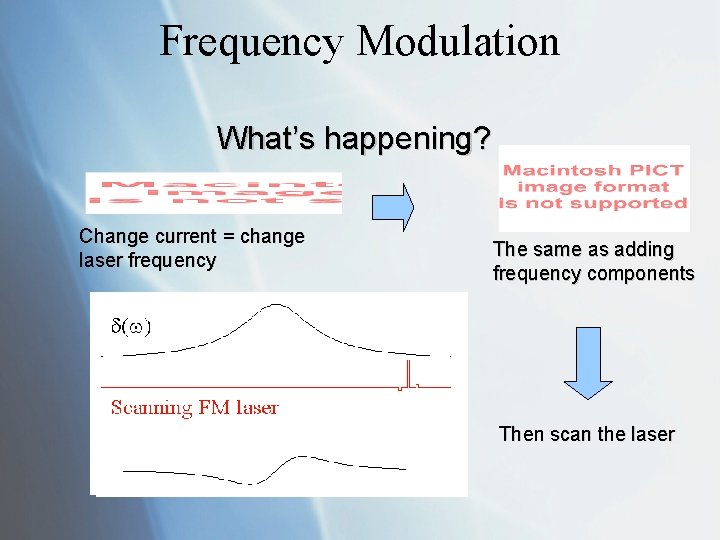
Frequency Modulation What’s happening? Change current = change laser frequency The same as adding frequency components Then scan the laser
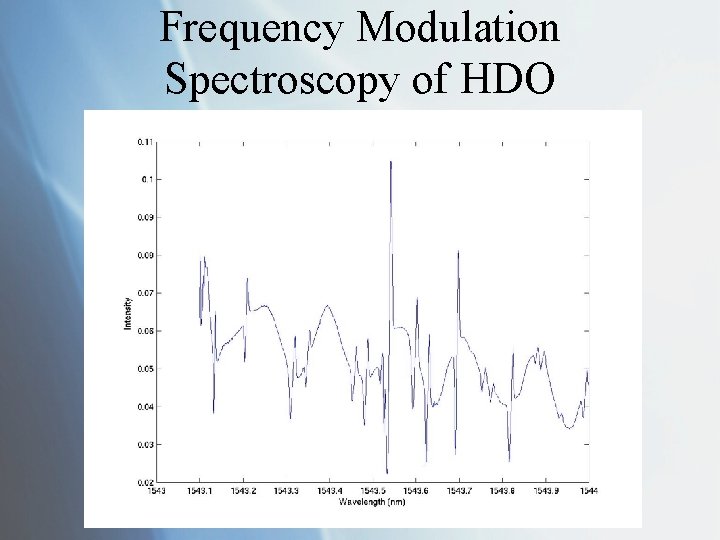
Frequency Modulation Spectroscopy of HDO
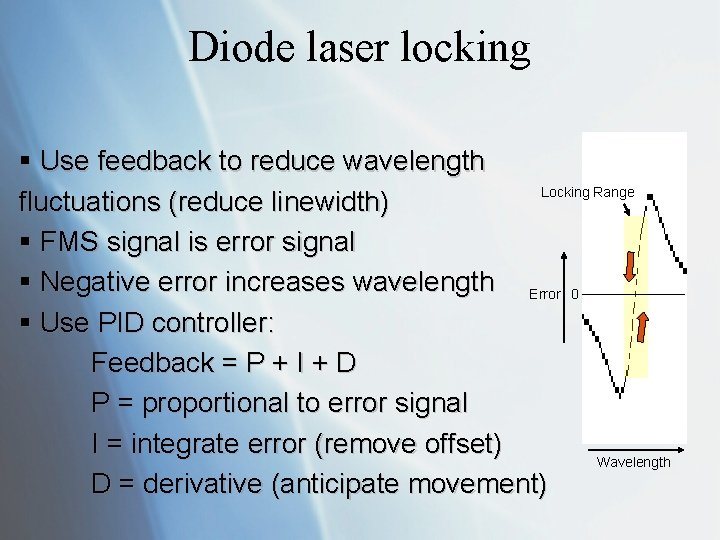
Diode laser locking § Use feedback to reduce wavelength Locking Range fluctuations (reduce linewidth) § FMS signal is error signal § Negative error increases wavelength Error 0 § Use PID controller: Feedback = P + I + D P = proportional to error signal I = integrate error (remove offset) Wavelength D = derivative (anticipate movement)
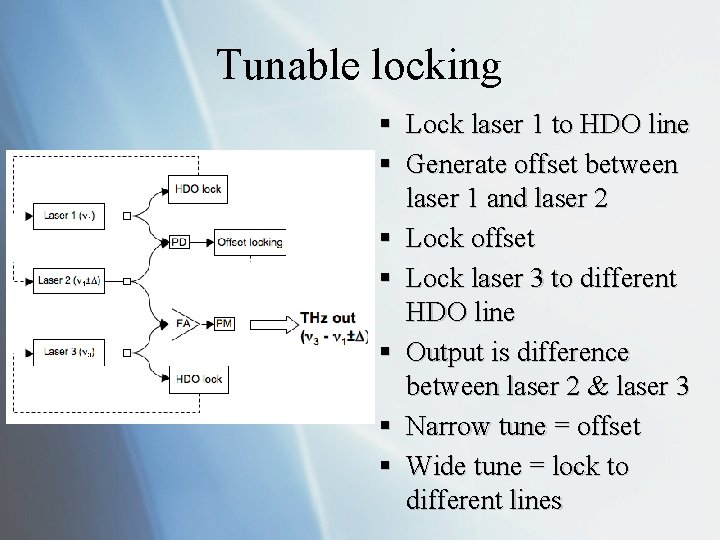
Tunable locking § Lock laser 1 to HDO line § Generate offset between laser 1 and laser 2 § Lock offset § Lock laser 3 to different HDO line § Output is difference between laser 2 & laser 3 § Narrow tune = offset § Wide tune = lock to different lines
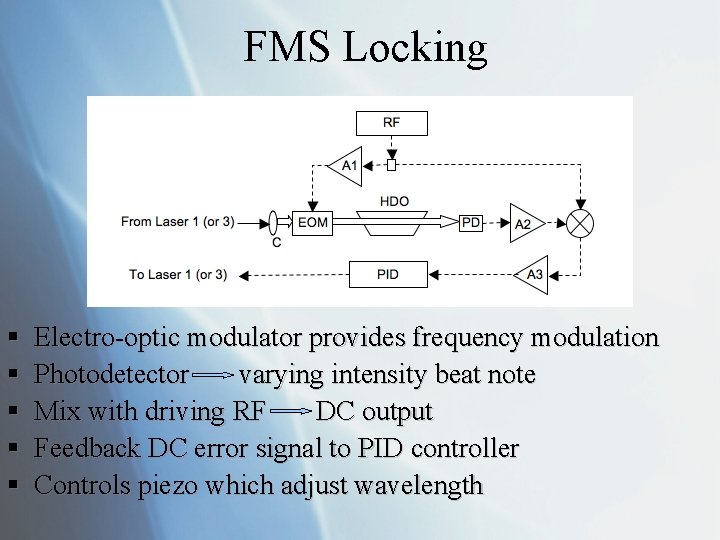
FMS Locking § § § Electro-optic modulator provides frequency modulation Photodetector varying intensity beat note Mix with driving RF DC output Feedback DC error signal to PID controller Controls piezo which adjust wavelength
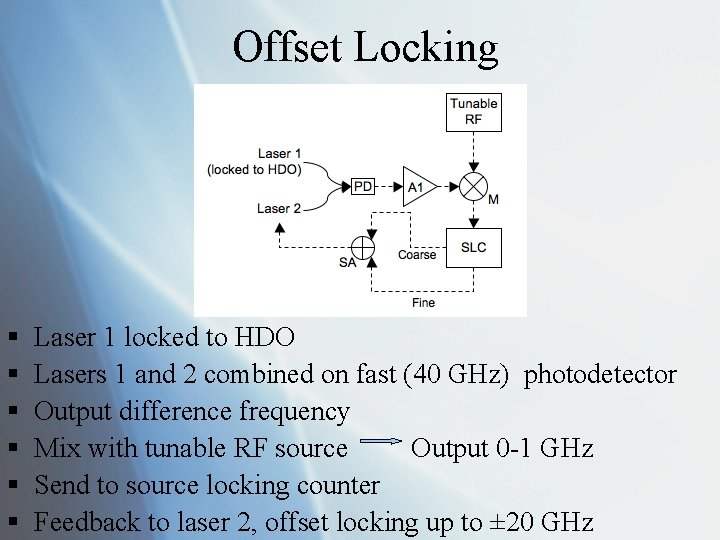
Offset Locking § § § Laser 1 locked to HDO Lasers 1 and 2 combined on fast (40 GHz) photodetector Output difference frequency Mix with tunable RF source Output 0 -1 GHz Send to source locking counter Feedback to laser 2, offset locking up to ± 20 GHz
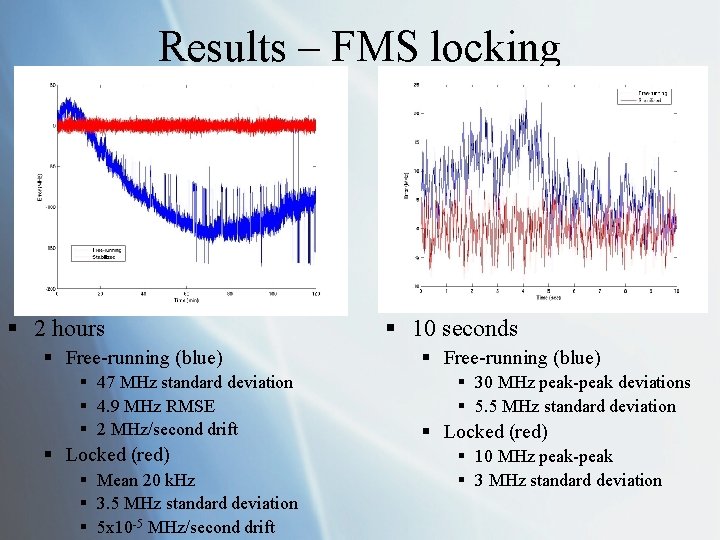
Results – FMS locking § 2 hours § Free-running (blue) § 47 MHz standard deviation § 4. 9 MHz RMSE § 2 MHz/second drift § Locked (red) § Mean 20 k. Hz § 3. 5 MHz standard deviation § 5 x 10 -5 MHz/second drift § 10 seconds § Free-running (blue) § 30 MHz peak-peak deviations § 5. 5 MHz standard deviation § Locked (red) § 10 MHz peak-peak § 3 MHz standard deviation
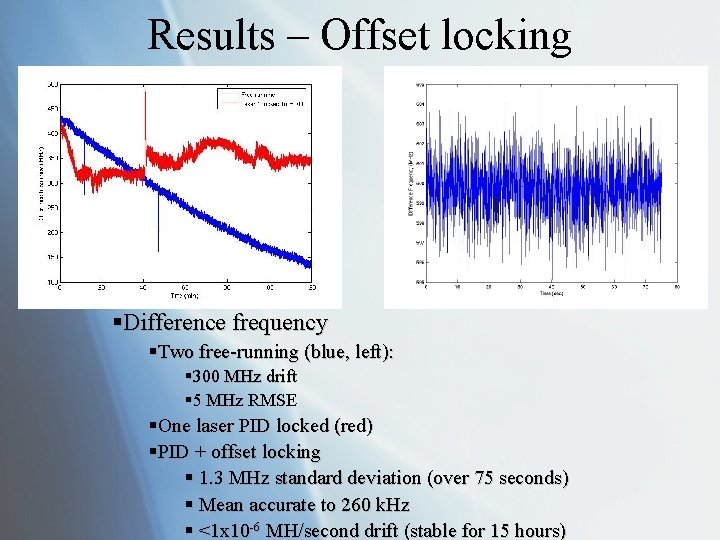
Results – Offset locking §Difference frequency §Two free-running (blue, left): § 300 MHz drift § 5 MHz RMSE §One laser PID locked (red) §PID + offset locking § 1. 3 MHz standard deviation (over 75 seconds) § Mean accurate to 260 k. Hz § <1 x 10 -6 MH/second drift (stable for 15 hours)
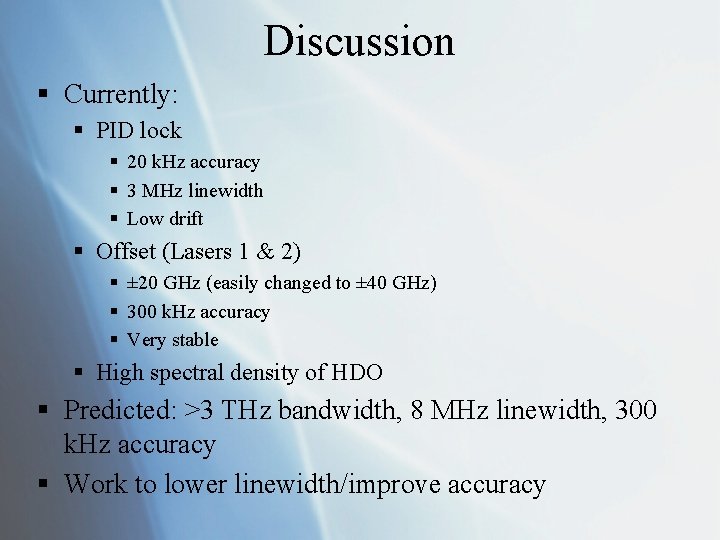
Discussion § Currently: § PID lock § 20 k. Hz accuracy § 3 MHz linewidth § Low drift § Offset (Lasers 1 & 2) § ± 20 GHz (easily changed to ± 40 GHz) § 300 k. Hz accuracy § Very stable § High spectral density of HDO § Predicted: >3 THz bandwidth, 8 MHz linewidth, 300 k. Hz accuracy § Work to lower linewidth/improve accuracy
Conclusion § Developed a technique for generating a tunable THz difference between two lasers with a final linewidth of <10 MHz § Combine lasers on Er. As/In. Ga. As photomixer to generate THz radiation § Other techniques could provide higher stability at the cost of tunability or wide bandwidth but limited resolution § Compromise system § Working on improving linewidth (hopefully 1 MHz) and bandwidth (up to 15 THz) § Tunability/linewidth combination already useful for spectroscopy (developing Fourier transform terahertz spectrometer)
Acknowledgements Dr. Geoff Blake Rogier Braakman Matthew Kelley Dan Holland NSF Grant
- Slides: 16