
LASER ITS APPLICATIONS CO4 PartI Dr Prabodh Sahai
LASER & IT’S APPLICATIONS (CO-4 Part-I) Dr. Prabodh Sahai Saxena Prof & Head Deptt of Physics LNCT BHOPAL
Contents Ø Introduction of laser Ø Principle of laser Ø Einstein’s coefficients Ø Main components of laser Ø Importance of third energy level Ø Types of lasers

Introduction Ø The word laser is an acronym that stands for “light amplification by the stimulated emission of radiation”. Lasers are essentially have following characteristicsØ highly directional, Ø highly intense, Ø highly monochromatic & Ø highly coherent optical light source.
Ø Laser based on the principle of stimulated emission. Ø Stimulated emission was postulated by Einstein as early as in 1917. Ø In 1960, a solid state Ruby laser is developed by Maiman on this principle. Ø In 1961, a gas state He-Ne laser is developed by Ali Javan and others in Bell telephone laboratory.
Principle of Laser
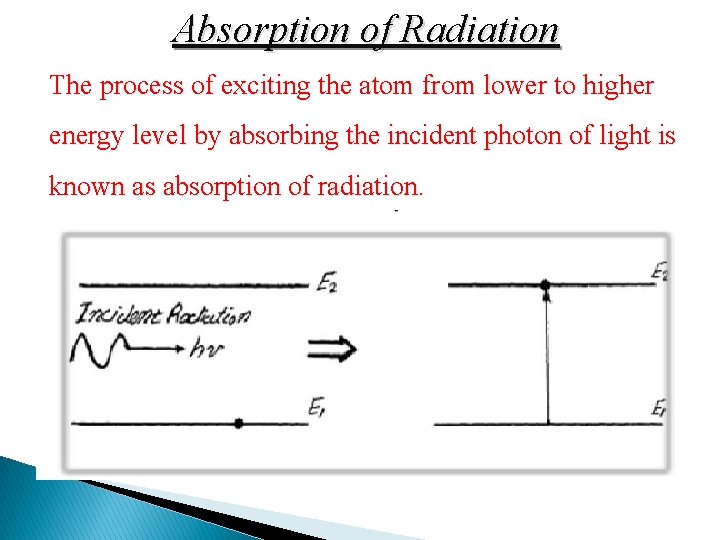
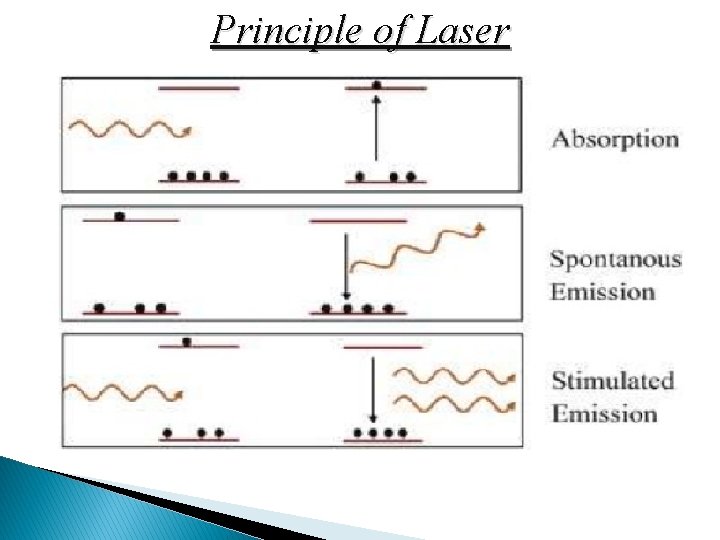
Absorption of Radiation The process of exciting the atom from lower to higher energy level by absorbing the incident photon of light is known as absorption of radiation.
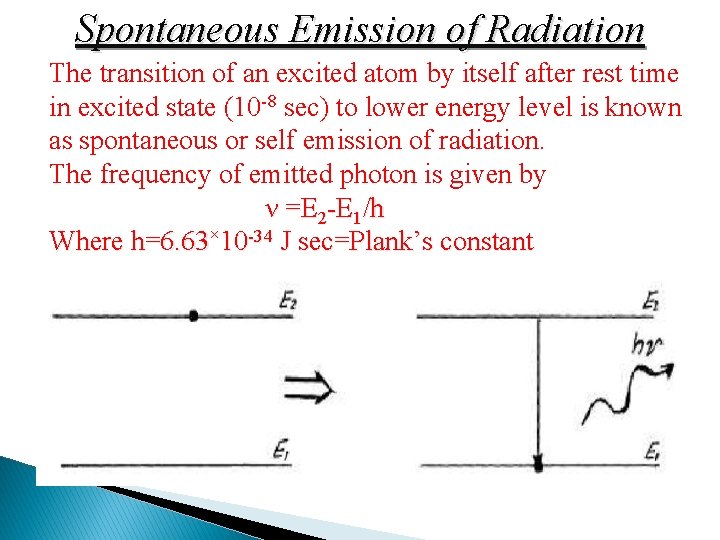
Spontaneous Emission of Radiation The transition of an excited atom by itself after rest time in excited state (10 -8 sec) to lower energy level is known as spontaneous or self emission of radiation. The frequency of emitted photon is given by ν =E 2 -E 1/h Where h=6. 63˟ 10 -34 J sec=Plank’s constant
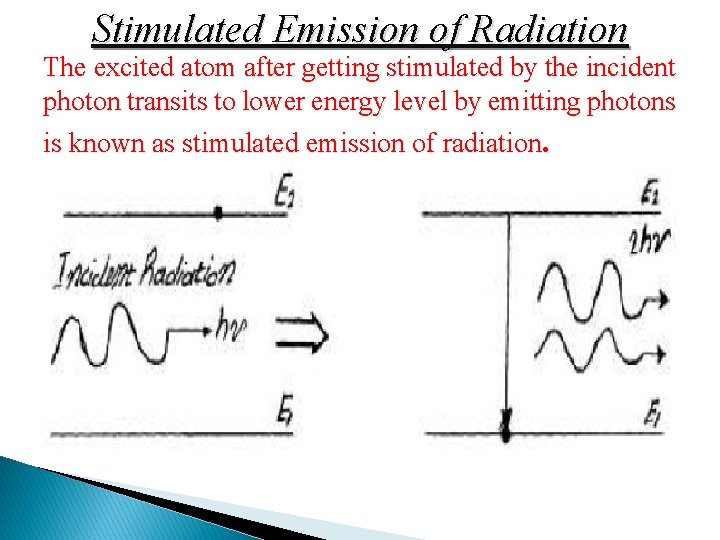
Stimulated Emission of Radiation The excited atom after getting stimulated by the incident photon transits to lower energy level by emitting photons is known as stimulated emission of radiation.
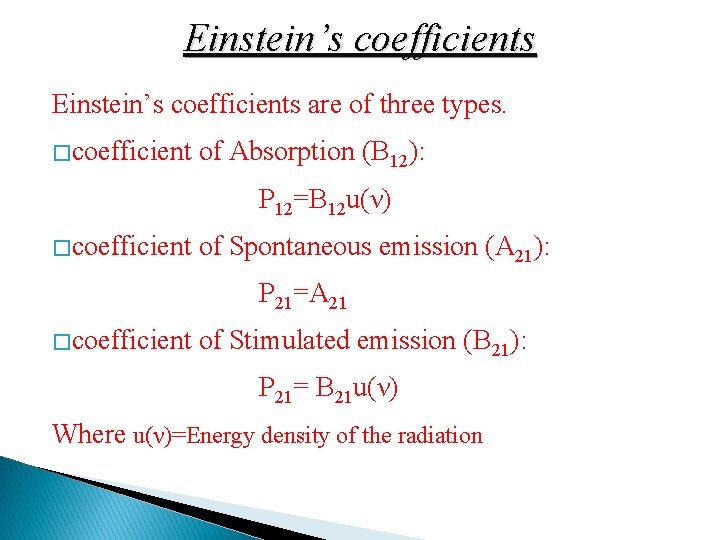
Einstein’s coefficients are of three types. � coefficient of Absorption (B 12): P 12=B 12 u(ν) � coefficient of Spontaneous emission (A 21): P 21=A 21 � coefficient of Stimulated emission (B 21): P 21= B 21 u(ν) Where u(ν)=Energy density of the radiation
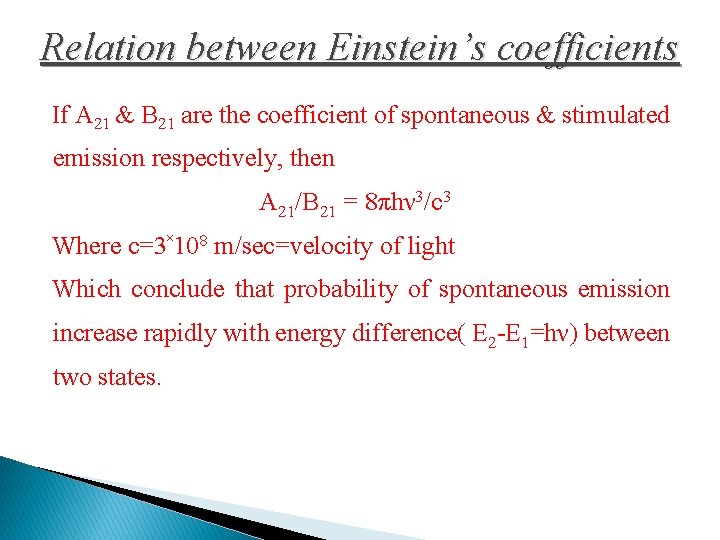
Relation between Einstein’s coefficients If A 21 & B 21 are the coefficient of spontaneous & stimulated emission respectively, then A 21/B 21 = 8πhν 3/c 3 Where c=3˟ 108 m/sec=velocity of light Which conclude that probability of spontaneous emission increase rapidly with energy difference( E 2 -E 1=hν) between two states.
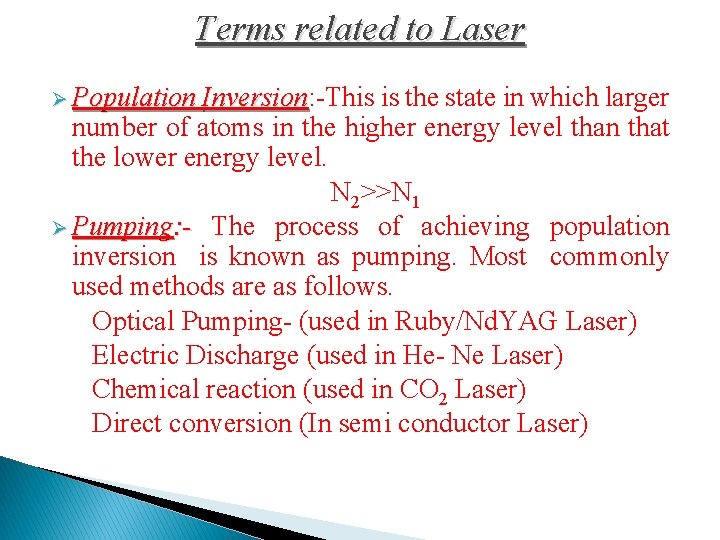
Terms related to Laser Ø Population Inversion: -This is the state in which larger Inversion number of atoms in the higher energy level than that the lower energy level. N 2>>N 1 Ø Pumping: - The process of achieving population inversion is known as pumping. Most commonly used methods are as follows. Optical Pumping- (used in Ruby/Nd. YAG Laser) Electric Discharge (used in He- Ne Laser) Chemical reaction (used in CO 2 Laser) Direct conversion (In semi conductor Laser)
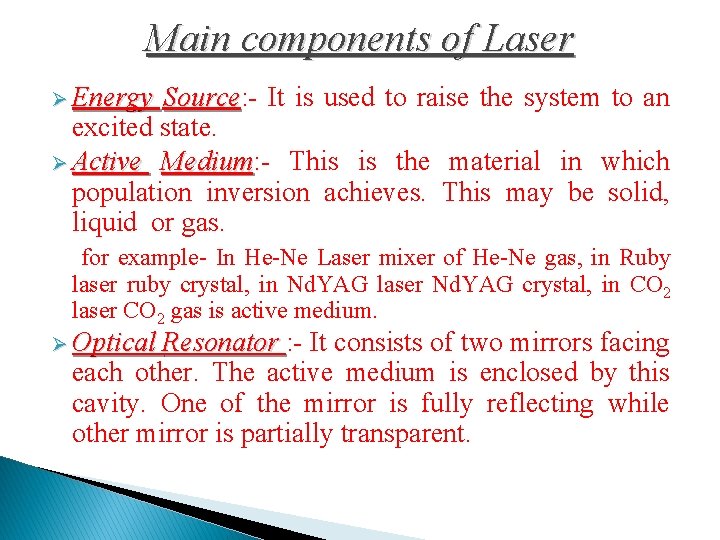
Main components of Laser Ø Energy Source: - Source It is used to raise the system to an excited state. Ø Active Medium: - Medium This is the material in which population inversion achieves. This may be solid, liquid or gas. for example- In He-Ne Laser mixer of He-Ne gas, in Ruby laser ruby crystal, in Nd. YAG laser Nd. YAG crystal, in CO 2 laser CO 2 gas is active medium. Ø Optical Resonator : - It consists of two mirrors facing each other. The active medium is enclosed by this cavity. One of the mirror is fully reflecting while other mirror is partially transparent.
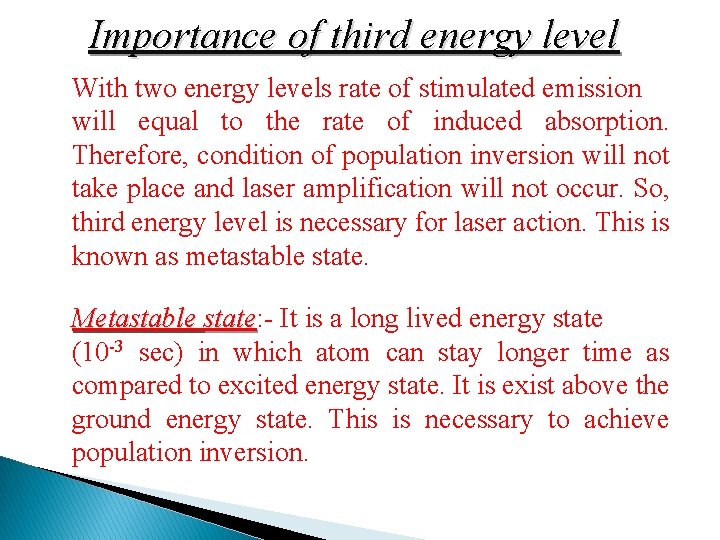
Importance of third energy level With two energy levels rate of stimulated emission will equal to the rate of induced absorption. Therefore, condition of population inversion will not take place and laser amplification will not occur. So, third energy level is necessary for laser action. This is known as metastable state. Metastable state: - It is a long lived energy state state (10 -3 sec) in which atom can stay longer time as compared to excited energy state. It is exist above the ground energy state. This is necessary to achieve population inversion.
Types of Lasers Among the various kinds of lasers some important types of lasers are listed below: Ø Solid state laser : Ruby laser, Nd. YAG Laser Ø Gas laser : He-Ne laser, Co 2 laser Ø Liquid laser : Europium chelate laser Ø Dye laser : Courmarin dye laser Ø Semiconductor laser : Inp laser
- Slides: 14