
Laser Interferometer Gravitationalwave Observatory LIGO 2000 Industrial Physics
Laser Interferometer Gravitational-wave Observatory LIGO 2000 Industrial Physics Forum LIGO-G 9900 XX-00 -M Barry Barish 7 November 2000
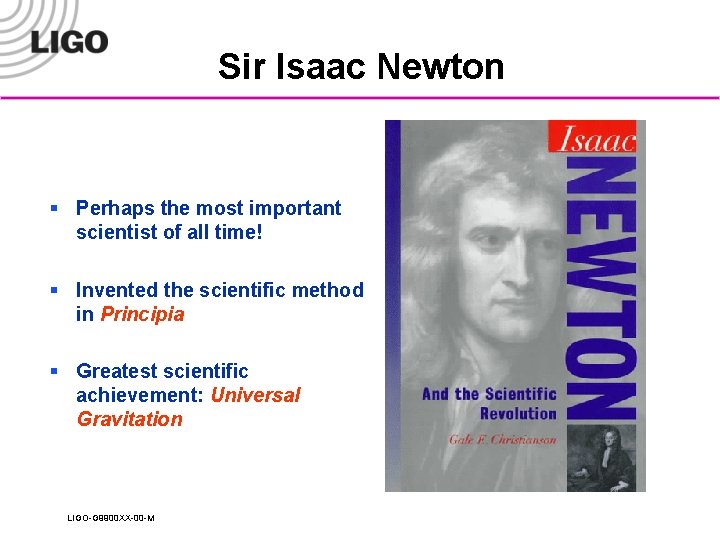
Sir Isaac Newton § Perhaps the most important scientist of all time! § Invented the scientific method in Principia § Greatest scientific achievement: Universal Gravitation LIGO-G 9900 XX-00 -M
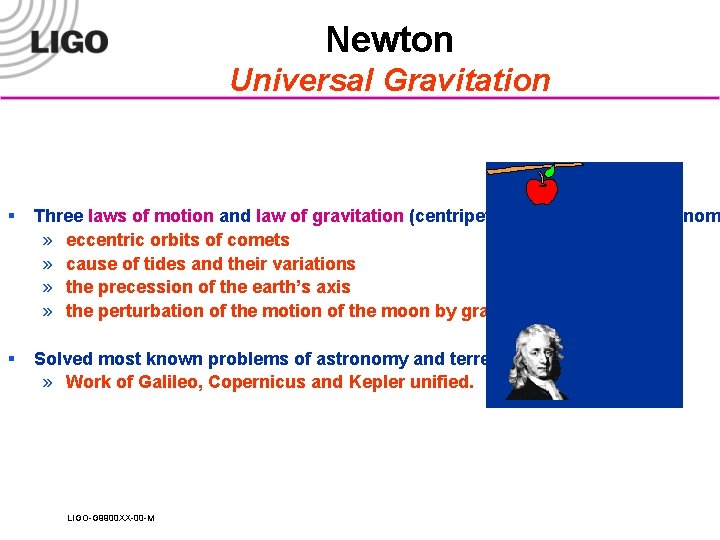
Newton Universal Gravitation § Three laws of motion and law of gravitation (centripetal force) disparate phenom » eccentric orbits of comets » cause of tides and their variations » the precession of the earth’s axis » the perturbation of the moon by gravity of the sun § Solved most known problems of astronomy and terrestrial physics » Work of Galileo, Copernicus and Kepler unified. LIGO-G 9900 XX-00 -M
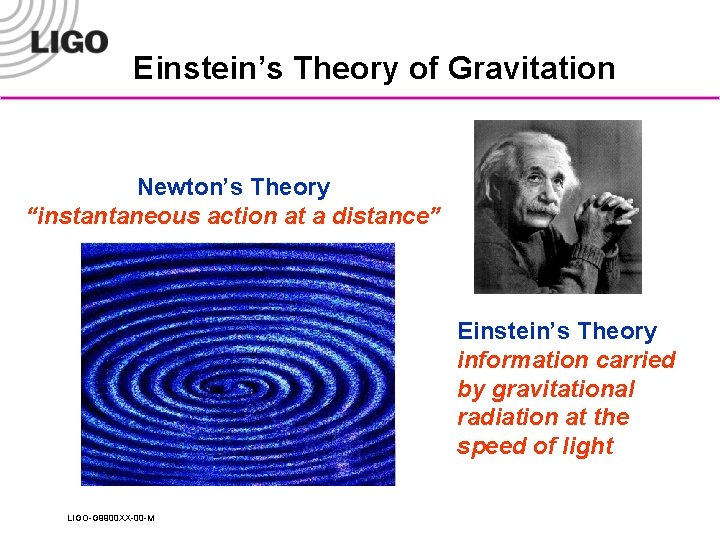
Einstein’s Theory of Gravitation Newton’s Theory “instantaneous action at a distance” Einstein’s Theory information carried by gravitational radiation at the speed of light LIGO-G 9900 XX-00 -M
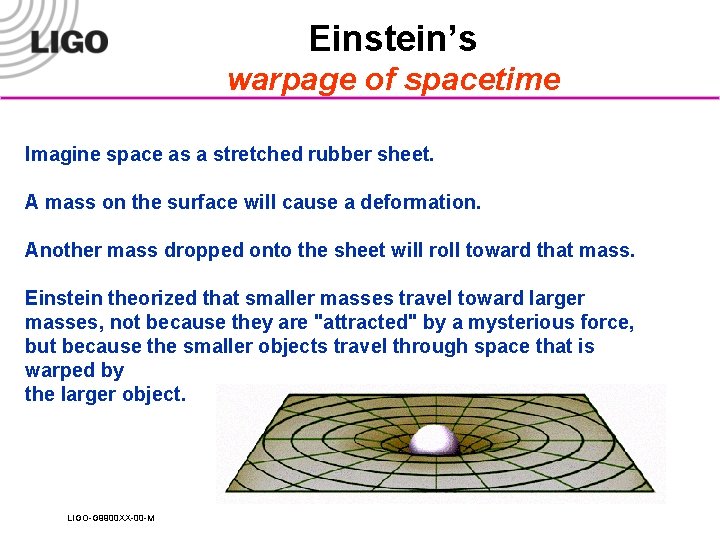
Einstein’s warpage of spacetime Imagine space as a stretched rubber sheet. A mass on the surface will cause a deformation. Another mass dropped onto the sheet will roll toward that mass. Einstein theorized that smaller masses travel toward larger masses, not because they are "attracted" by a mysterious force, but because the smaller objects travel through space that is warped by the larger object. LIGO-G 9900 XX-00 -M
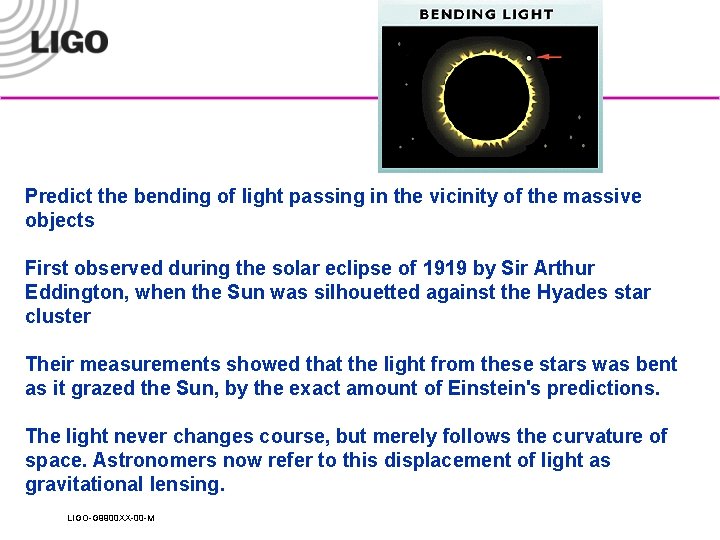
Predict the bending of light passing in the vicinity of the massive objects First observed during the solar eclipse of 1919 by Sir Arthur Eddington, when the Sun was silhouetted against the Hyades star cluster Their measurements showed that the light from these stars was bent as it grazed the Sun, by the exact amount of Einstein's predictions. The light never changes course, but merely follows the curvature of space. Astronomers now refer to this displacement of light as gravitational lensing. LIGO-G 9900 XX-00 -M
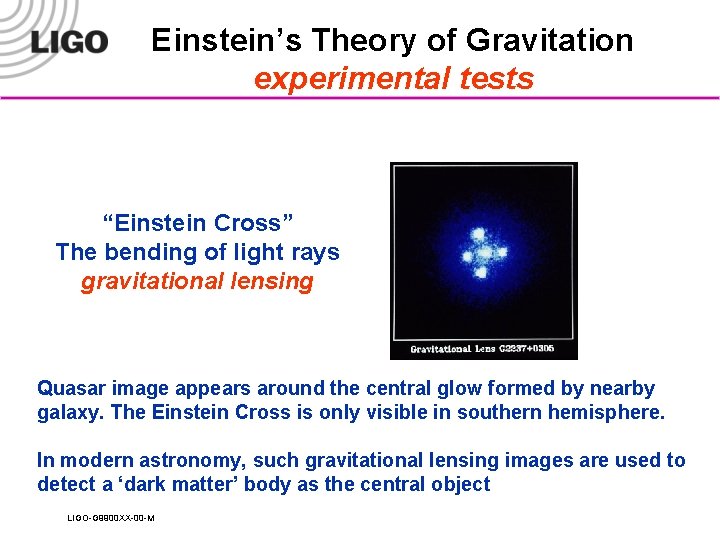
Einstein’s Theory of Gravitation experimental tests “Einstein Cross” The bending of light rays gravitational lensing Quasar image appears around the central glow formed by nearby galaxy. The Einstein Cross is only visible in southern hemisphere. In modern astronomy, such gravitational lensing images are used to detect a ‘dark matter’ body as the central object LIGO-G 9900 XX-00 -M
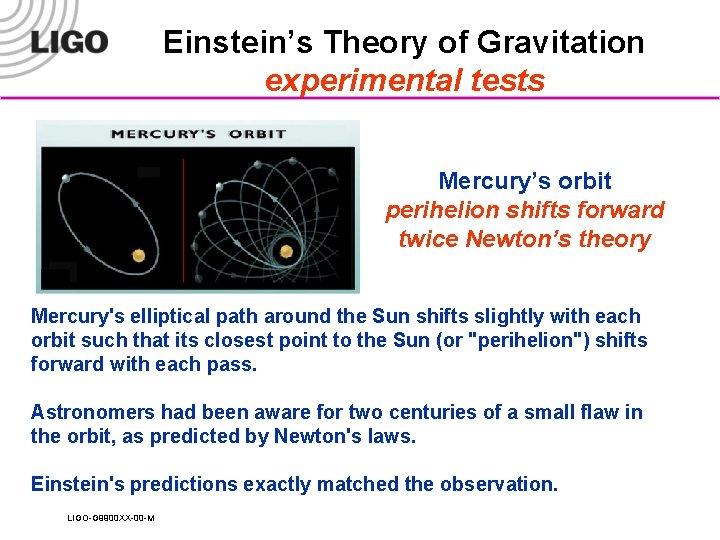
Einstein’s Theory of Gravitation experimental tests Mercury’s orbit perihelion shifts forward twice Newton’s theory Mercury's elliptical path around the Sun shifts slightly with each orbit such that its closest point to the Sun (or "perihelion") shifts forward with each pass. Astronomers had been aware for two centuries of a small flaw in the orbit, as predicted by Newton's laws. Einstein's predictions exactly matched the observation. LIGO-G 9900 XX-00 -M
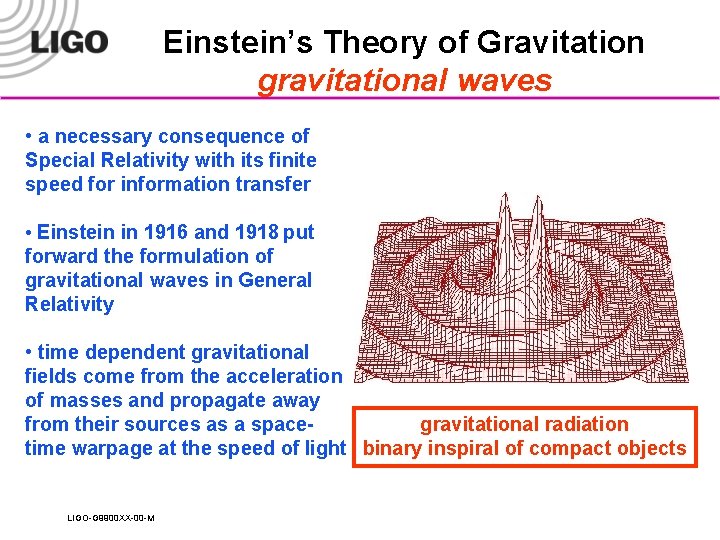
Einstein’s Theory of Gravitation gravitational waves • a necessary consequence of Special Relativity with its finite speed for information transfer • Einstein in 1916 and 1918 put forward the formulation of gravitational waves in General Relativity • time dependent gravitational fields come from the acceleration of masses and propagate away from their sources as a spacegravitational radiation time warpage at the speed of light binary inspiral of compact objects LIGO-G 9900 XX-00 -M
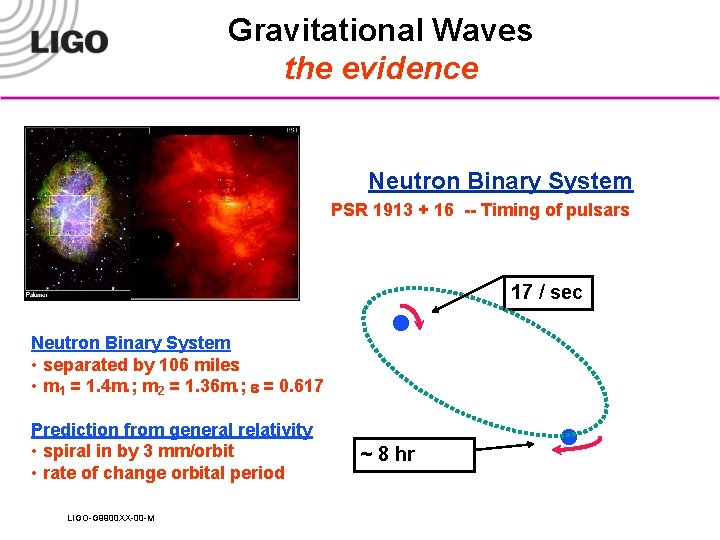
Gravitational Waves the evidence Neutron Binary System PSR 1913 + 16 -- Timing of pulsars Neutron Binary System • separated by 106 miles • m 1 = 1. 4 m ; m 2 = 1. 36 m ; e = 0. 617 Prediction from general relativity • spiral in by 3 mm/orbit • rate of change orbital period LIGO-G 9900 XX-00 -M · ~ 8 hr 17 / sec ·
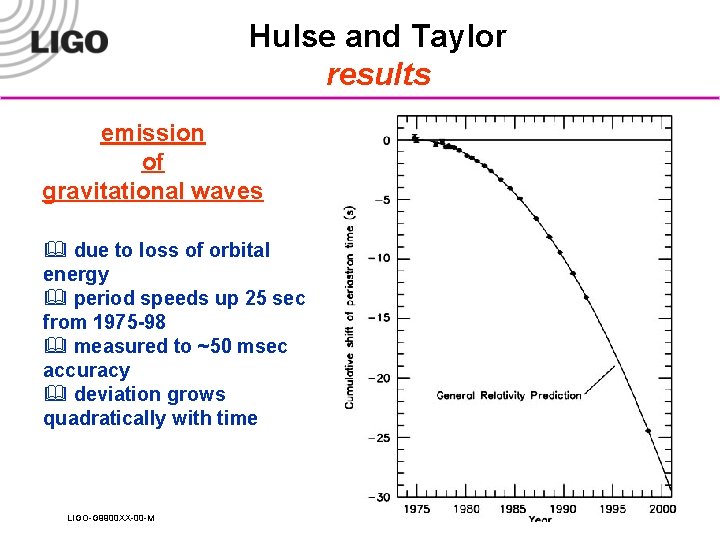
Hulse and Taylor results emission of gravitational waves & due to loss of orbital energy & period speeds up 25 sec from 1975 -98 & measured to ~50 msec accuracy & deviation grows quadratically with time LIGO-G 9900 XX-00 -M
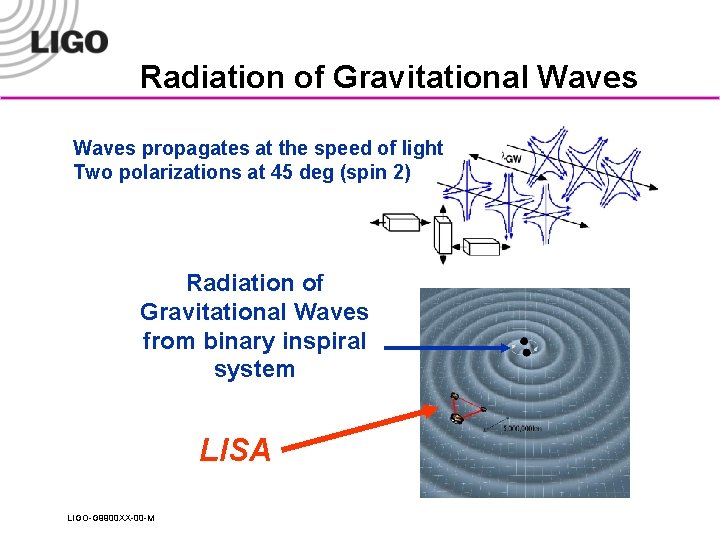
Radiation of Gravitational Waves propagates at the speed of light Two polarizations at 45 deg (spin 2) Radiation of Gravitational Waves from binary inspiral system LISA LIGO-G 9900 XX-00 -M
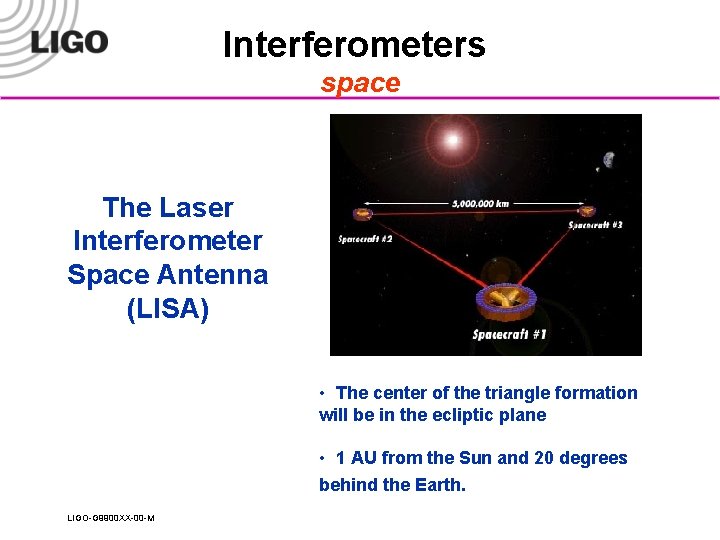
Interferometers space The Laser Interferometer Space Antenna (LISA) • The center of the triangle formation will be in the ecliptic plane • 1 AU from the Sun and 20 degrees behind the Earth. LIGO-G 9900 XX-00 -M
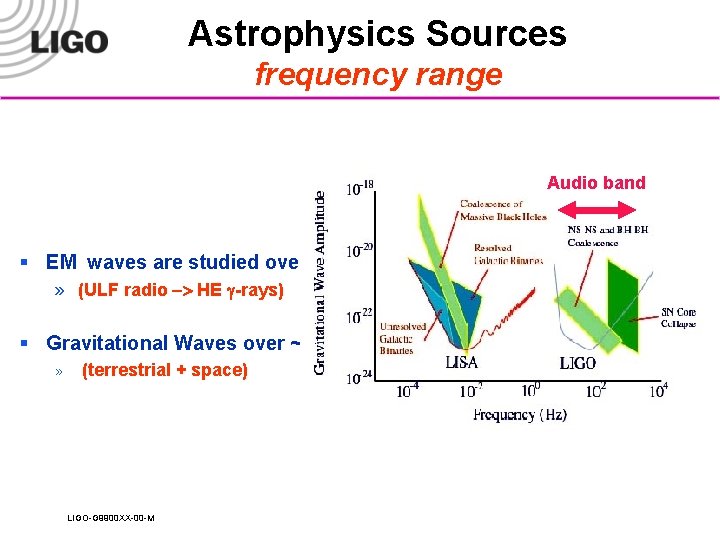
Astrophysics Sources frequency range Audio band § EM waves are studied over ~20 orders of magnitude » (ULF radio -> HE -rays) § Gravitational Waves over ~10 orders of magnitude » (terrestrial + space) LIGO-G 9900 XX-00 -M
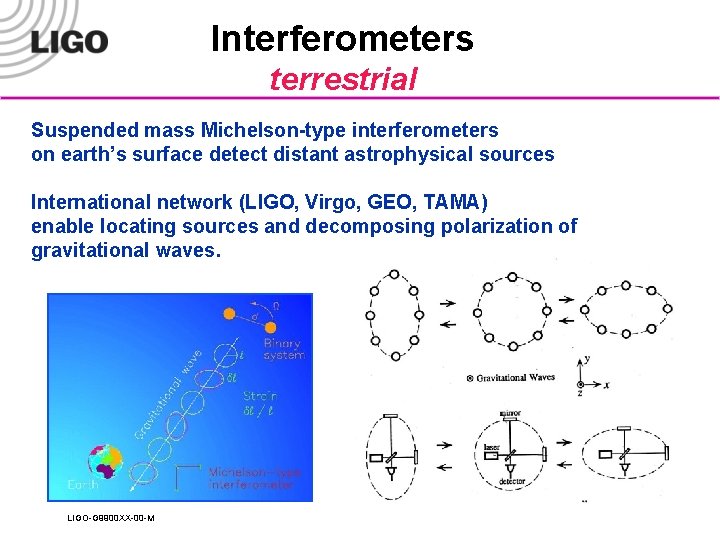
Interferometers terrestrial Suspended mass Michelson-type interferometers on earth’s surface detect distant astrophysical sources International network (LIGO, Virgo, GEO, TAMA) enable locating sources and decomposing polarization of gravitational waves. LIGO-G 9900 XX-00 -M
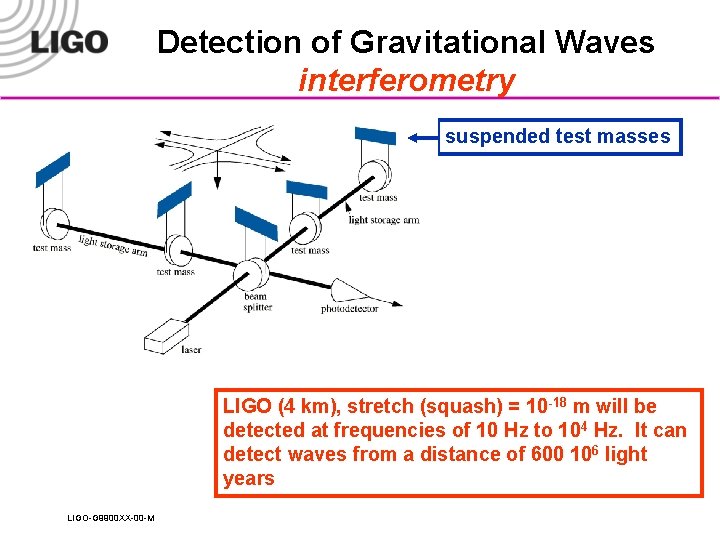
Detection of Gravitational Waves interferometry suspended test masses LIGO (4 km), stretch (squash) = 10 -18 m will be detected at frequencies of 10 Hz to 104 Hz. It can detect waves from a distance of 600 106 light years LIGO-G 9900 XX-00 -M
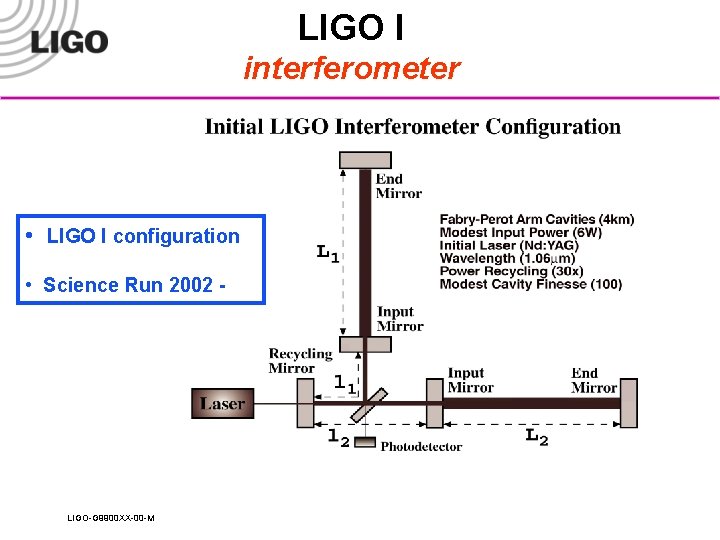
LIGO I interferometer • LIGO I configuration • Science Run 2002 - LIGO-G 9900 XX-00 -M
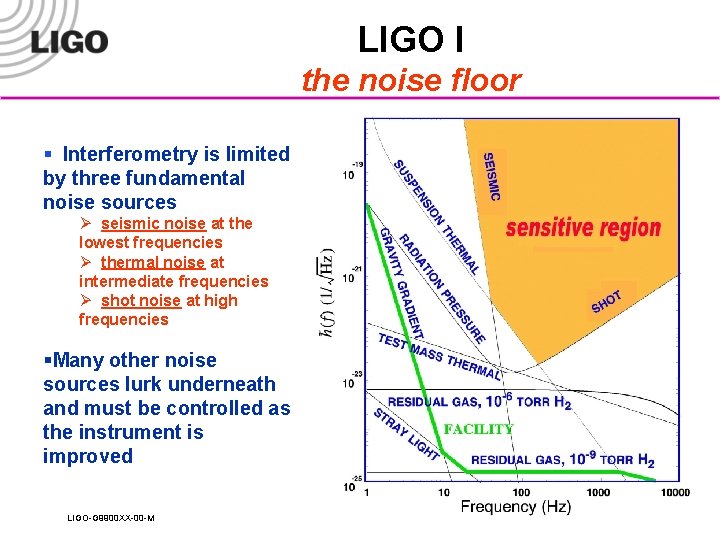
LIGO I the noise floor § Interferometry is limited by three fundamental noise sources Ø seismic noise at the lowest frequencies Ø thermal noise at intermediate frequencies Ø shot noise at high frequencies §Many other noise sources lurk underneath and must be controlled as the instrument is improved LIGO-G 9900 XX-00 -M
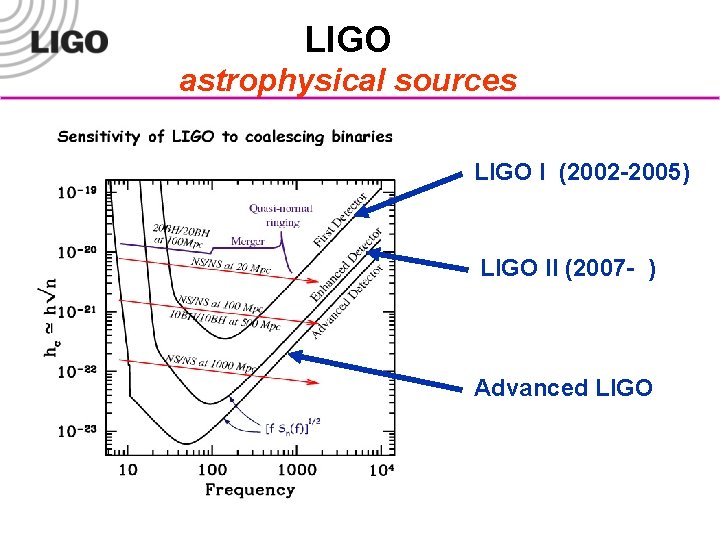
LIGO astrophysical sources LIGO I (2002 -2005) LIGO II (2007 - ) Advanced LIGO-G 9900 XX-00 -M
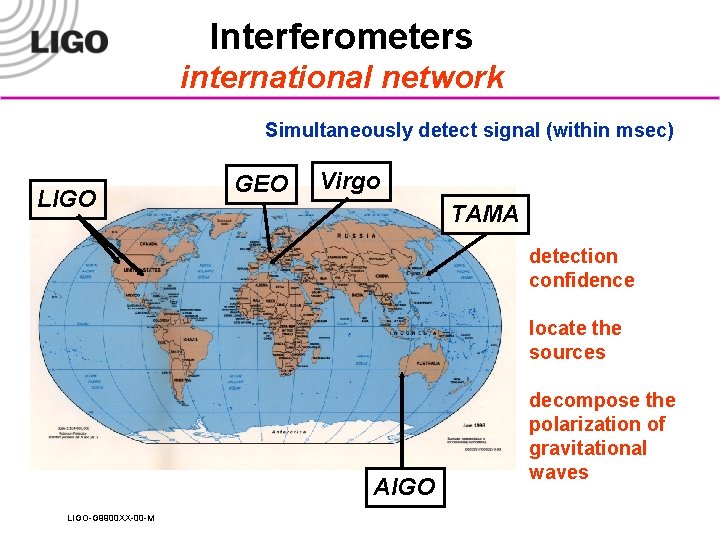
Interferometers international network Simultaneously detect signal (within msec) LIGO GEO Virgo TAMA detection confidence locate the sources AIGO LIGO-G 9900 XX-00 -M decompose the polarization of gravitational waves
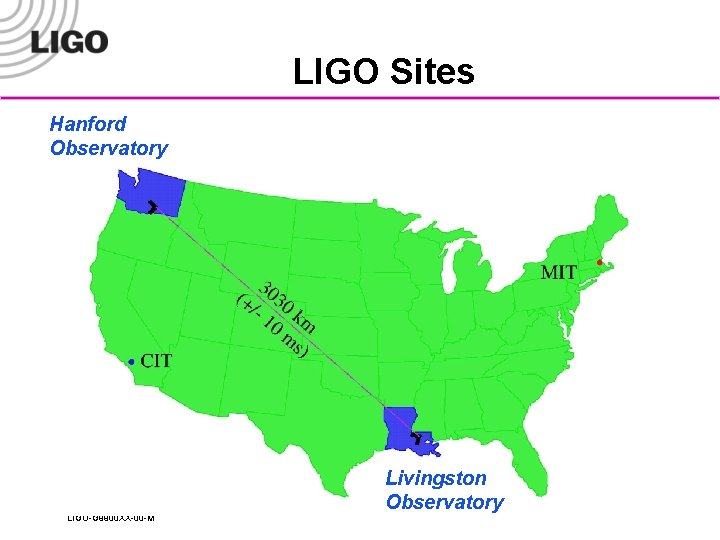
LIGO Sites Hanford Observatory LIGO-G 9900 XX-00 -M Livingston Observatory
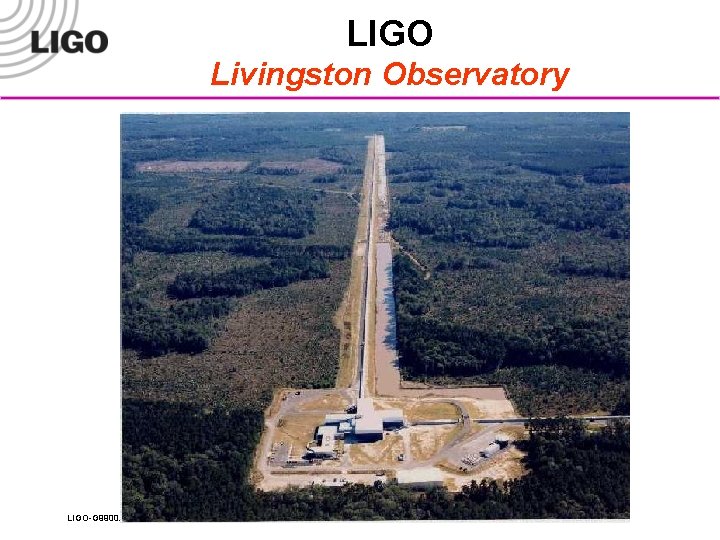
LIGO Livingston Observatory LIGO-G 9900 XX-00 -M
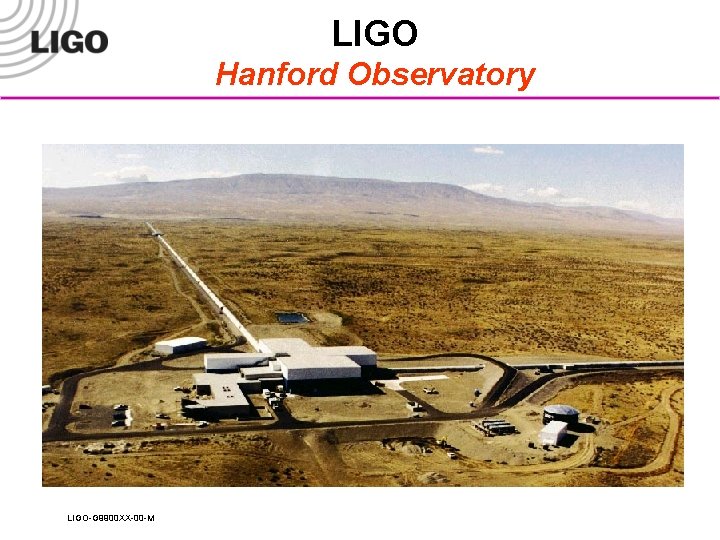
LIGO Hanford Observatory LIGO-G 9900 XX-00 -M
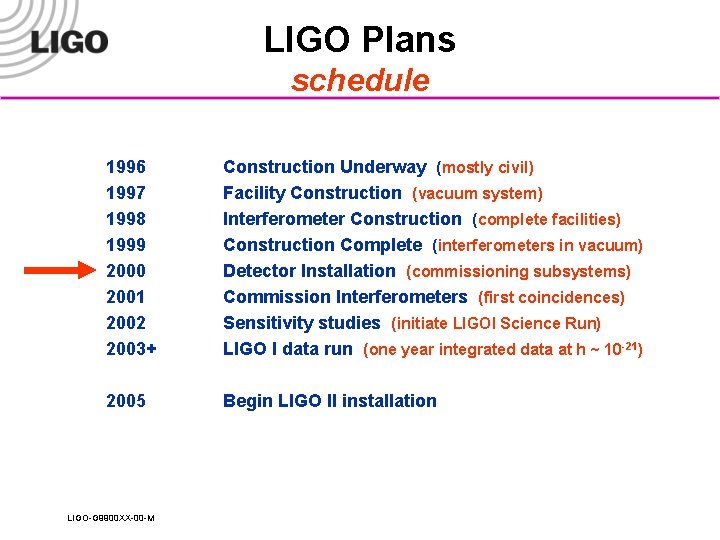
LIGO Plans schedule 1996 1997 1998 1999 2000 2001 2002 2003+ Construction Underway (mostly civil) Facility Construction (vacuum system) Interferometer Construction (complete facilities) Construction Complete (interferometers in vacuum) Detector Installation (commissioning subsystems) Commission Interferometers (first coincidences) Sensitivity studies (initiate LIGOI Science Run) LIGO I data run (one year integrated data at h ~ 10 -21) 2005 Begin LIGO II installation LIGO-G 9900 XX-00 -M
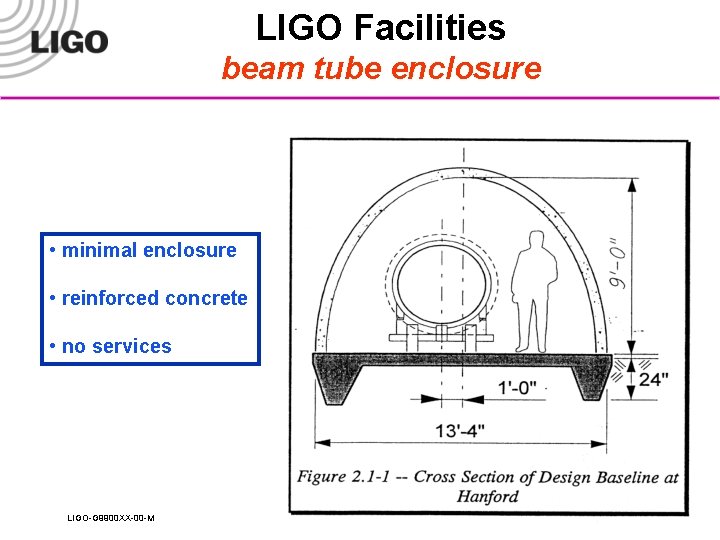
LIGO Facilities beam tube enclosure • minimal enclosure • reinforced concrete • no services LIGO-G 9900 XX-00 -M
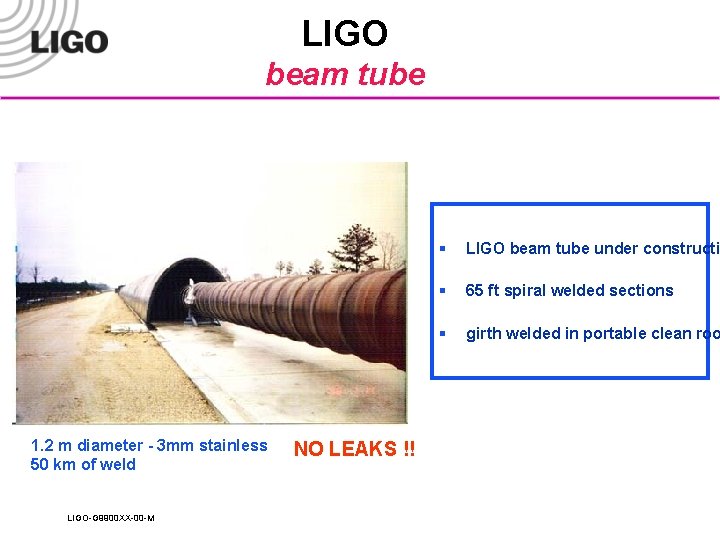
LIGO beam tube 1. 2 m diameter - 3 mm stainless 50 km of weld LIGO-G 9900 XX-00 -M NO LEAKS !! § LIGO beam tube under constructi § 65 ft spiral welded sections § girth welded in portable clean roo
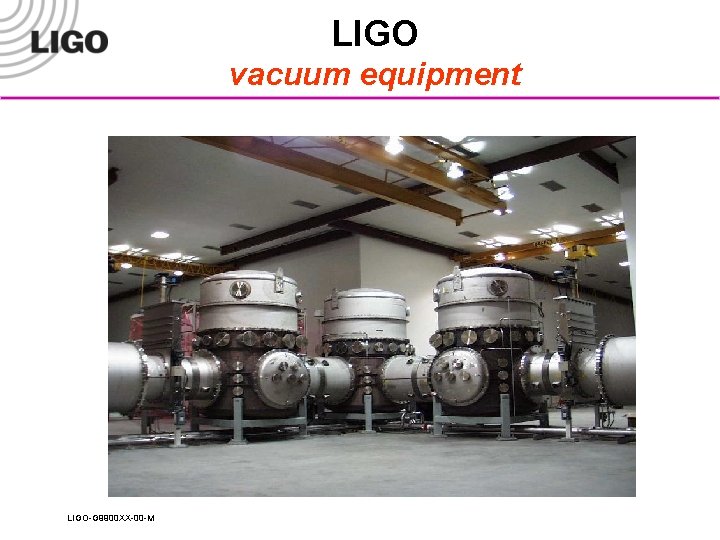
LIGO vacuum equipment LIGO-G 9900 XX-00 -M
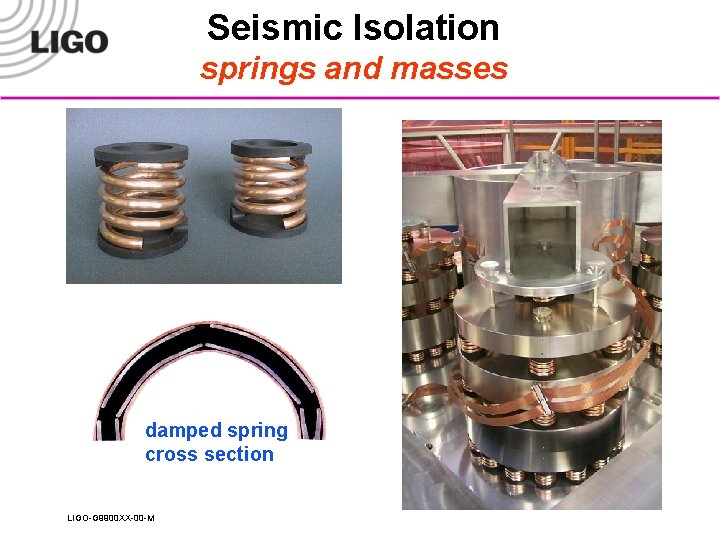
Seismic Isolation springs and masses damped spring cross section LIGO-G 9900 XX-00 -M
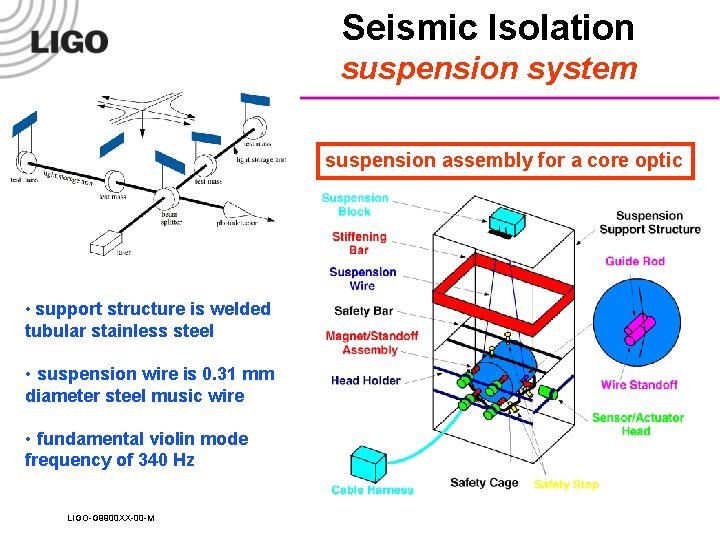
Seismic Isolation suspension system suspension assembly for a core optic • support structure is welded tubular stainless steel • suspension wire is 0. 31 mm diameter steel music wire • fundamental violin mode frequency of 340 Hz LIGO-G 9900 XX-00 -M
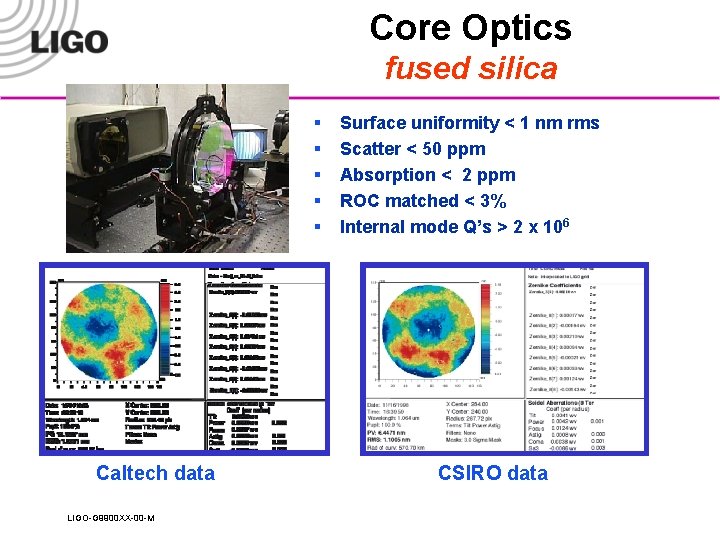
Core Optics fused silica § § § Caltech data LIGO-G 9900 XX-00 -M Surface uniformity < 1 nm rms Scatter < 50 ppm Absorption < 2 ppm ROC matched < 3% Internal mode Q’s > 2 x 10⁶ CSIRO data
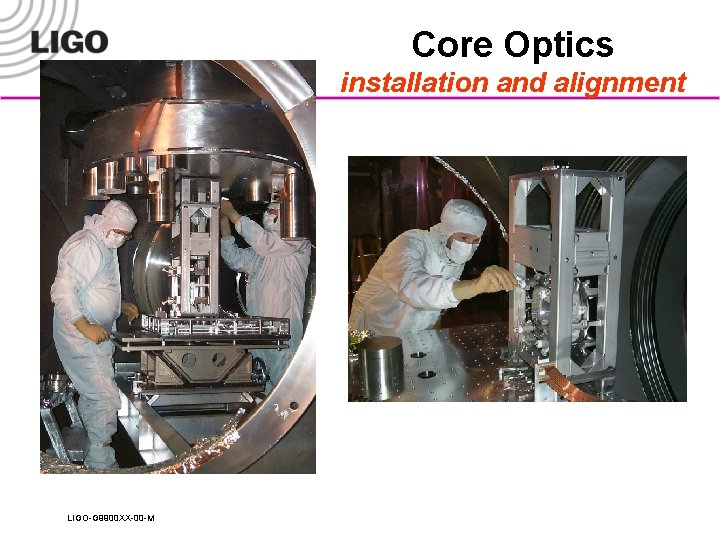
Core Optics installation and alignment LIGO-G 9900 XX-00 -M
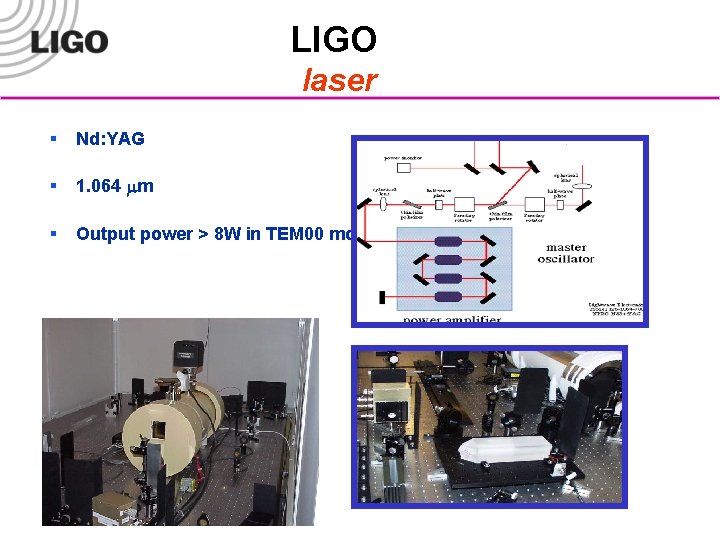
LIGO laser § Nd: YAG § 1. 064 mm § Output power > 8 W in TEM 00 mode LIGO-G 9900 XX-00 -M
Commissioning configurations § Mode cleaner and Pre-Stabilized Laser § 2 km one-arm cavity § short Michelson interferometer studies § Lock entire Michelson Fabry-Perot interferometer “First Lock” LIGO-G 9900 XX-00 -M
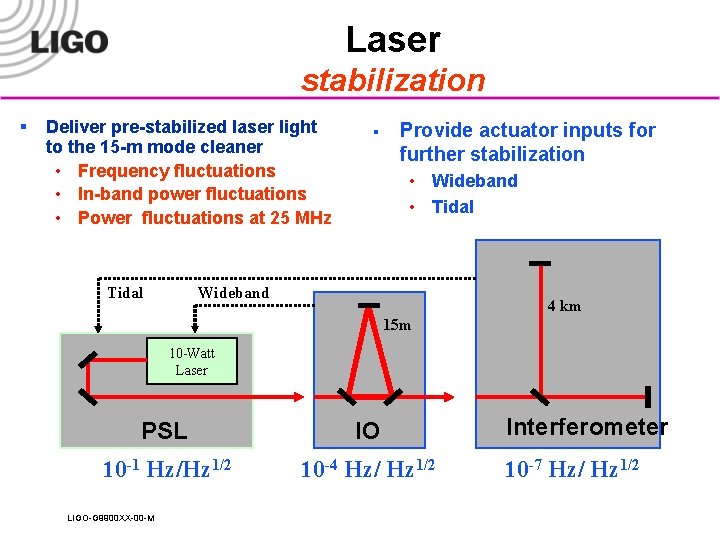
Laser stabilization § Deliver pre-stabilized laser light to the 15 -m mode cleaner • Frequency fluctuations • In-band power fluctuations • Power fluctuations at 25 MHz Tidal § Provide actuator inputs for further stabilization • Wideband • Tidal Wideband 4 km 15 m 10 -Watt Laser PSL IO 10 -1 Hz/Hz 1/2 10 -4 Hz/ Hz 1/2 LIGO-G 9900 XX-00 -M Interferometer 10 -7 Hz/ Hz 1/2
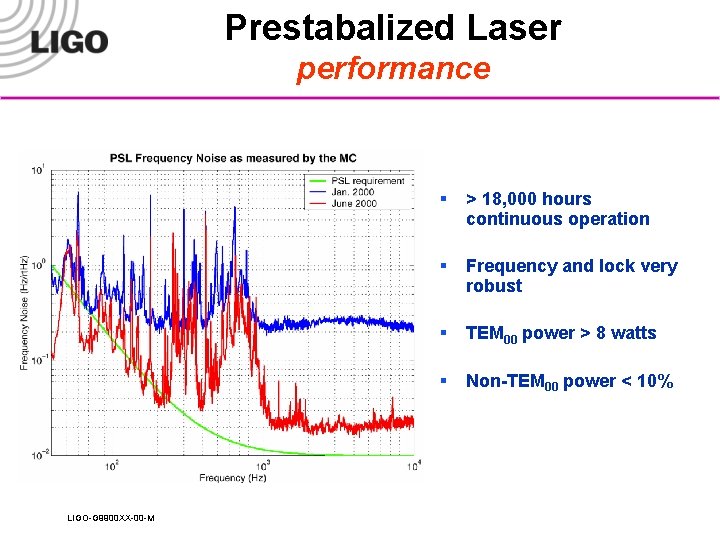
Prestabalized Laser performance LIGO-G 9900 XX-00 -M § > 18, 000 hours continuous operation § Frequency and lock very robust § TEM 00 power > 8 watts § Non-TEM 00 power < 10%
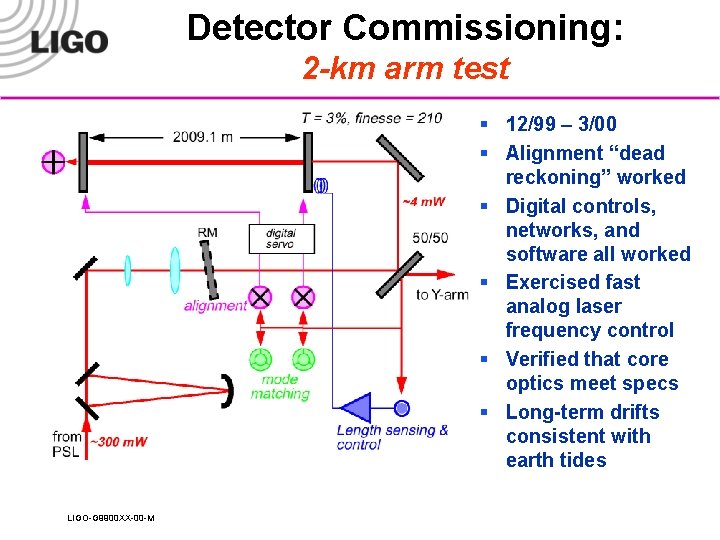
Detector Commissioning: 2 -km arm test § 12/99 – 3/00 § Alignment “dead reckoning” worked § Digital controls, networks, and software all worked § Exercised fast analog laser frequency control § Verified that core optics meet specs § Long-term drifts consistent with earth tides LIGO-G 9900 XX-00 -M
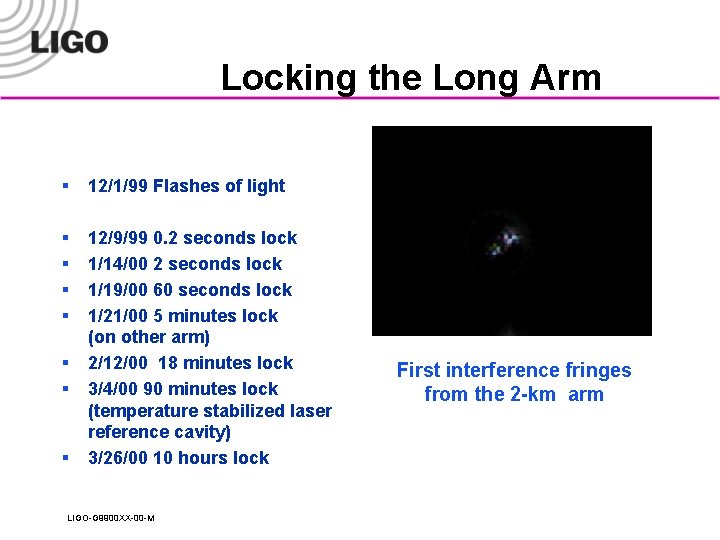
Locking the Long Arm § 12/1/99 Flashes of light § § 12/9/99 0. 2 seconds lock 1/14/00 2 seconds lock 1/19/00 60 seconds lock 1/21/00 5 minutes lock (on other arm) 2/12/00 18 minutes lock 3/4/00 90 minutes lock (temperature stabilized laser reference cavity) 3/26/00 10 hours lock § § § LIGO-G 9900 XX-00 -M First interference fringes from the 2 -km arm
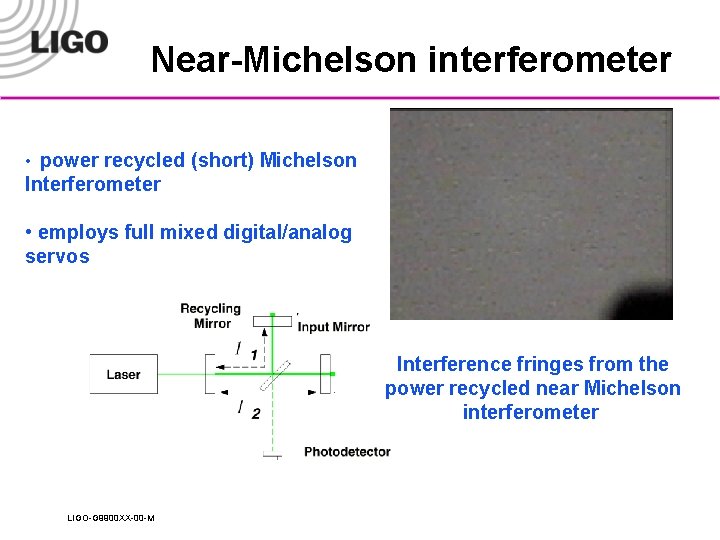
Near-Michelson interferometer power recycled (short) Michelson Interferometer • • employs full mixed digital/analog servos Interference fringes from the power recycled near Michelson interferometer LIGO-G 9900 XX-00 -M
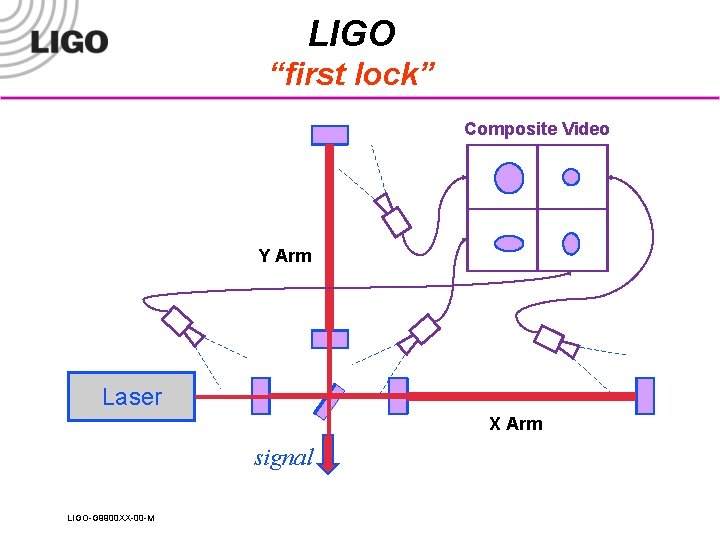
LIGO “first lock” Composite Video Y Arm Laser X Arm signal LIGO-G 9900 XX-00 -M
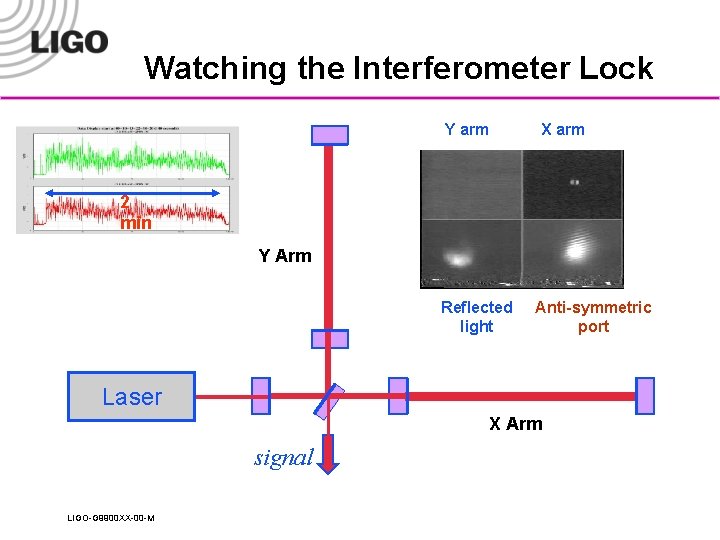
Watching the Interferometer Lock Y arm X arm 2 min Y Arm Reflected light Anti-symmetric port Laser X Arm signal LIGO-G 9900 XX-00 -M
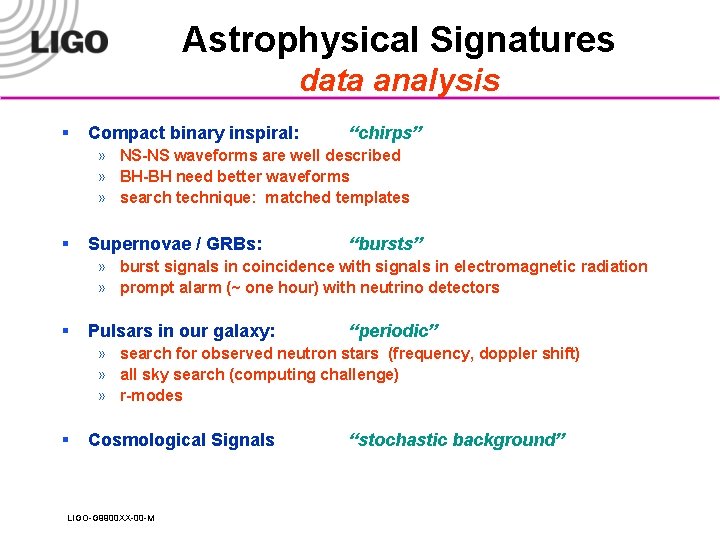
Astrophysical Signatures data analysis § Compact binary inspiral: “chirps” » NS-NS waveforms are well described » BH-BH need better waveforms » search technique: matched templates § Supernovae / GRBs: “bursts” » burst signals in coincidence with signals in electromagnetic radiation » prompt alarm (~ one hour) with neutrino detectors § Pulsars in our galaxy: “periodic” » search for observed neutron stars (frequency, doppler shift) » all sky search (computing challenge) » r-modes § Cosmological Signals LIGO-G 9900 XX-00 -M “stochastic background”
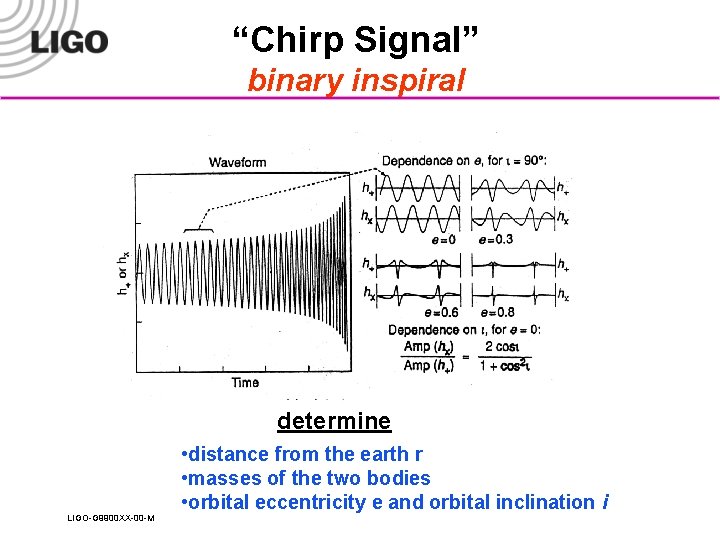
“Chirp Signal” binary inspiral determine LIGO-G 9900 XX-00 -M • distance from the earth r • masses of the two bodies • orbital eccentricity e and orbital inclination i
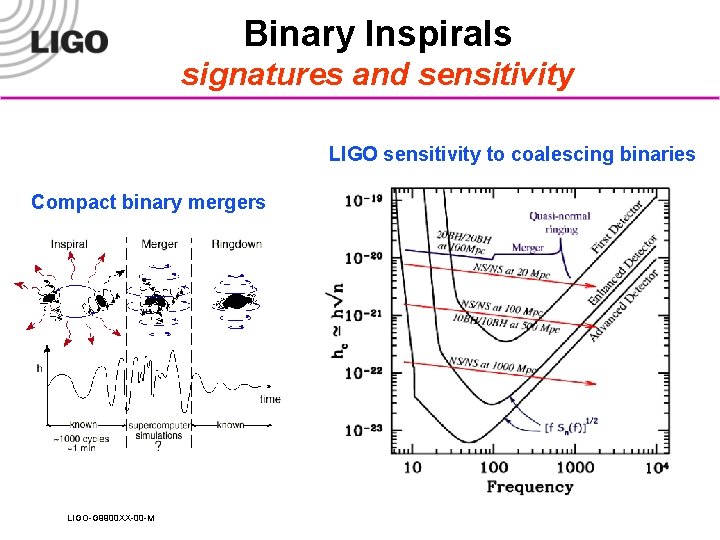
Binary Inspirals signatures and sensitivity LIGO sensitivity to coalescing binaries Compact binary mergers LIGO-G 9900 XX-00 -M
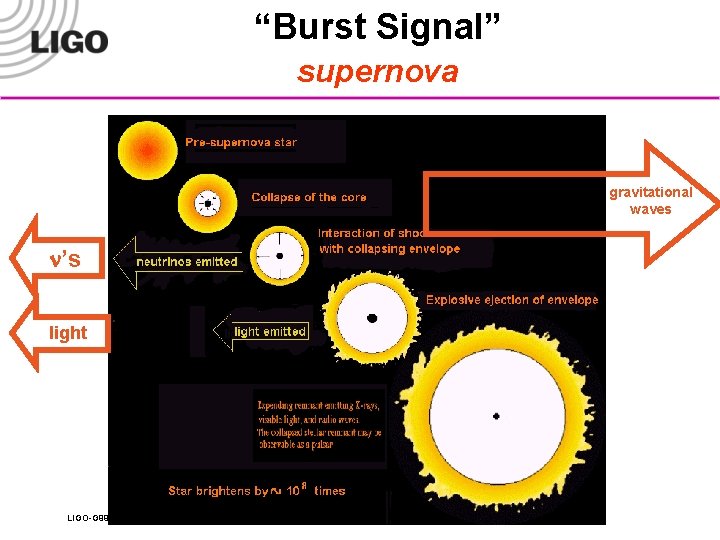
“Burst Signal” supernova gravitational waves n’s light LIGO-G 9900 XX-00 -M
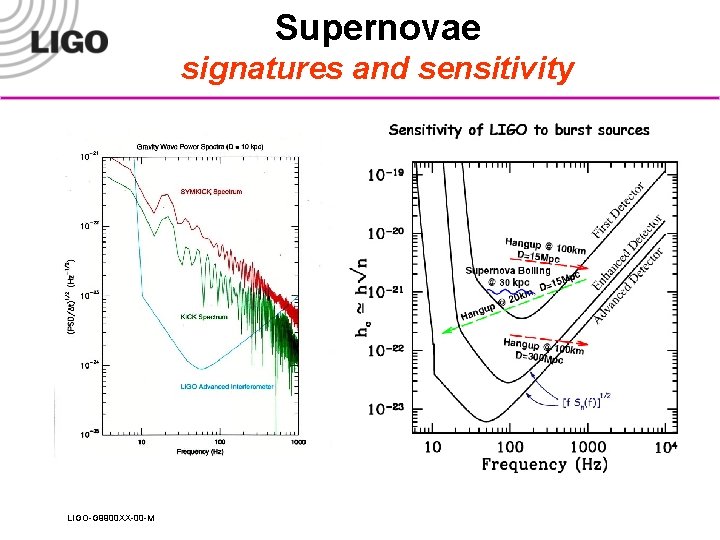
Supernovae signatures and sensitivity LIGO-G 9900 XX-00 -M
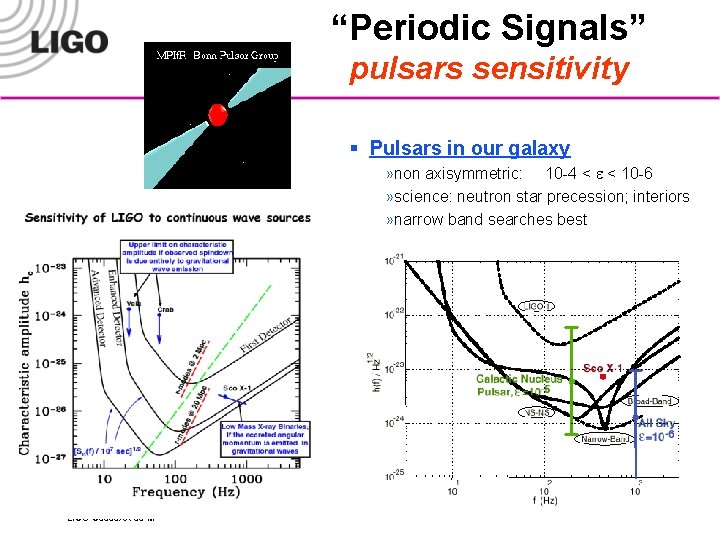
“Periodic Signals” pulsars sensitivity § Pulsars in our galaxy » non axisymmetric: 10 -4 < e < 10 -6 » science: neutron star precession; interiors » narrow band searches best LIGO-G 9900 XX-00 -M
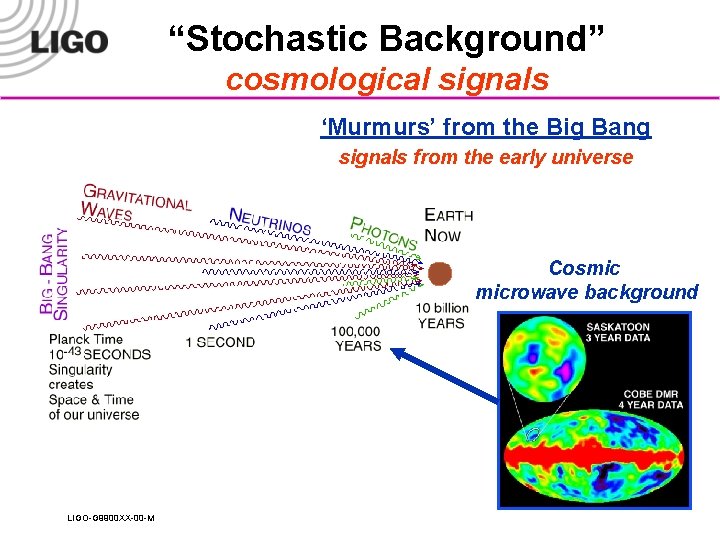
“Stochastic Background” cosmological signals ‘Murmurs’ from the Big Bang signals from the early universe Cosmic microwave background LIGO-G 9900 XX-00 -M
LIGO conclusions § LIGO construction complete § LIGO commissioning and testing ‘on track’ § “First Lock” officially established 20 Oct 00 § Engineering test runs begin now, during period when emphasis is on commissioning, detector sensitivity and reliability § First Science Run will begin during 2002 § Significant improvements in sensitivity anticipated to begin about 2006 LIGO-G 9900 XX-00 -M
- Slides: 48