
Laser Guidestar System Status Thomas Stalcup June 15






- Slides: 25
Laser Guidestar System Status Thomas Stalcup June 15, 2006
Outline • This talk – Hardware details of laser beam projector and wavefront sensor • Next: Christoph Baranec – On-sky testing results of wavefront sensing and tomographic reconstruction • Next: Michael Lloyd-Hart – Expected system performance and science goals Thomas Stalcup June 15, 2006
Laser Guidestar Advantages • Use a laser to create an artificial star • Can point anywhere (at least, anywhere approved by the FAA and Space Command…. ) • Virtually 100% sky coverage Thomas Stalcup June 15, 2006
System Overview • Beam projector – Projects five beams, 4 Watts each • Laser wavefront sensor • Natural star tip/tilt sensor • Natural star wavefront sensor to verify laser wavefront data during testing Thomas Stalcup June 15, 2006
Rayleigh Lasers • Use relatively inexpensive, reliable doubled Nd: YAG technology • Uses Rayleigh scattering in atmosphere • Must operate at lower altitudes than sodium-line lasers • Use range gating to restrict return to telescope depth of field Thomas Stalcup June 15, 2006
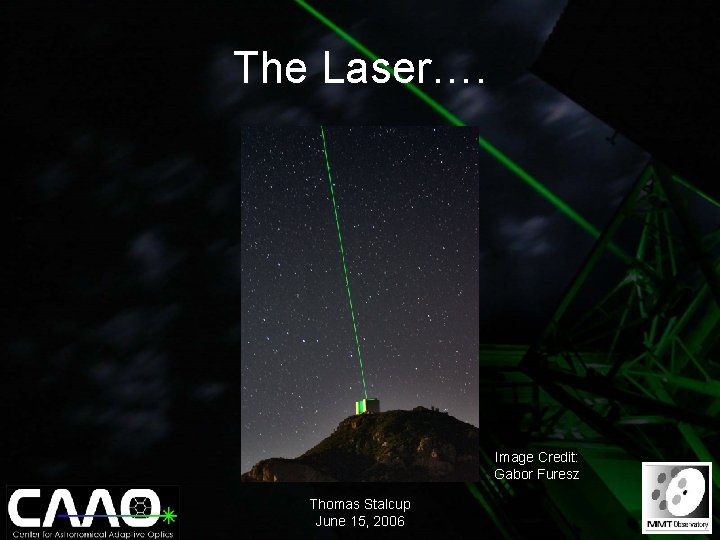
The Laser…. Image Credit: Gabor Furesz Thomas Stalcup June 15, 2006
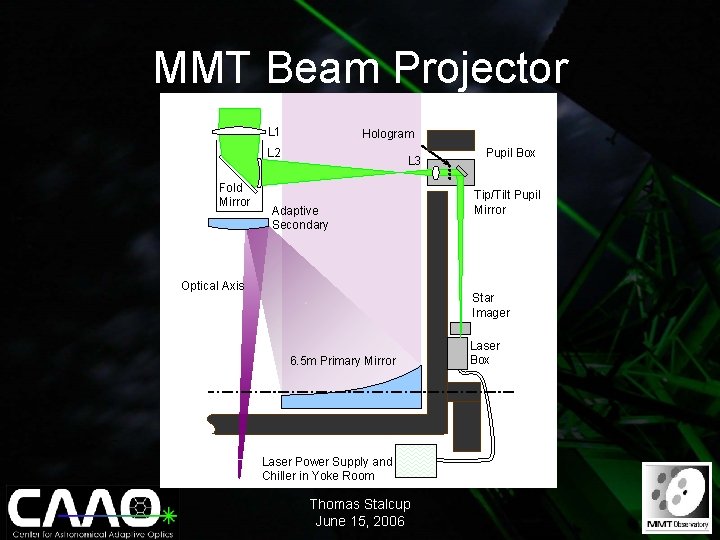
MMT Beam Projector L 1 Hologram L 2 Fold Mirror L 3 Adaptive Secondary Optical Axis Pupil Box Tip/Tilt Pupil Mirror Star Imager 6. 5 m Primary Mirror Laser Power Supply and Chiller in Yoke Room Thomas Stalcup June 15, 2006 Laser Box
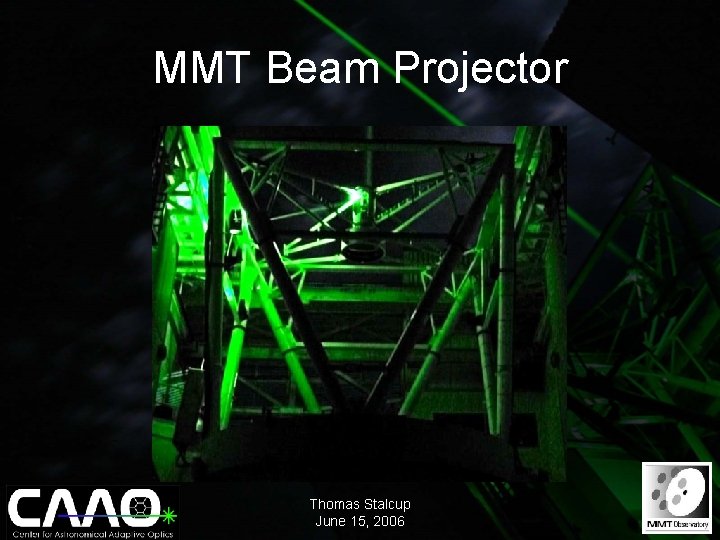
MMT Beam Projector Thomas Stalcup June 15, 2006
Laser Box • Two lasers combined with a polarizing beam splitter – 30 W combined output • Insulated, temperature controlled enclosure • Beam overlap controls – Waist imaging camera – Steering mirrors Thomas Stalcup June 15, 2006
Laser Box Optics Thomas Stalcup June 15, 2006
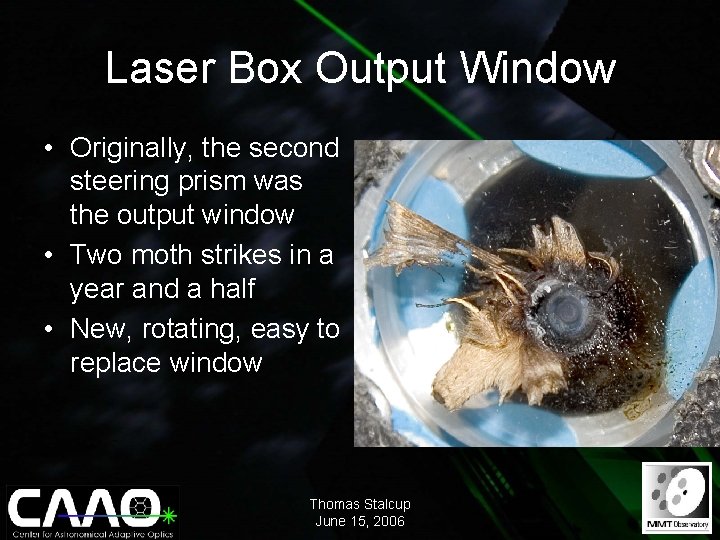
Laser Box Output Window • Originally, the second steering prism was the output window • Two moth strikes in a year and a half • New, rotating, easy to replace window Thomas Stalcup June 15, 2006
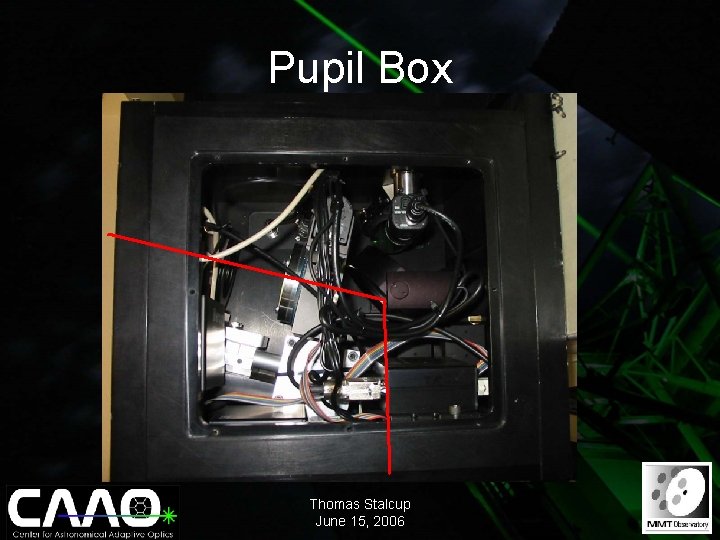
Pupil Box • First lens of beam expander / projection optics • Hologram to create five beams – Mounted on rotation stage • Fast steering mirror at a pupil Thomas Stalcup June 15, 2006
Pupil Box Thomas Stalcup June 15, 2006
Hub Optics • 48 cm diameter fused silica positive element • Lightweight fused silica fold mirror • 30 cm diameter SF 6 negative element Thomas Stalcup June 15, 2006
Hub Optics Thomas Stalcup June 15, 2006
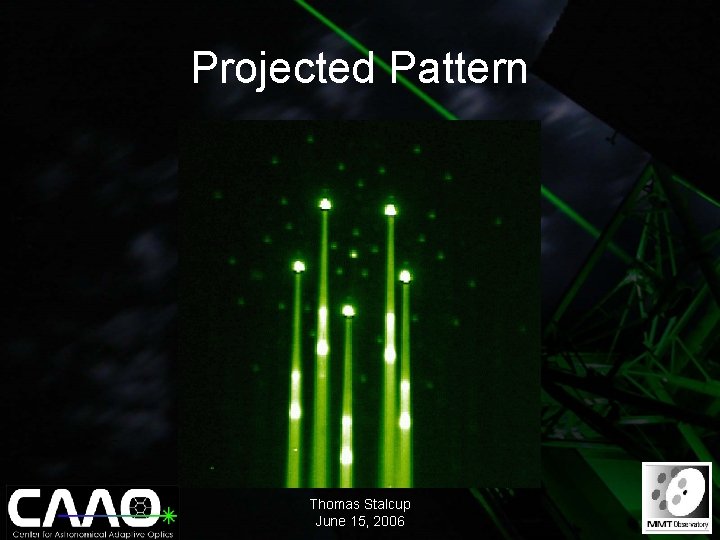
Beam Projector On-Sky Tests • December 2005 spot quality – Star FWHM of 0. 92 arcseconds – Laser FWHM of 1. 20 arcseconds Thomas Stalcup June 15, 2006
Projected Pattern Thomas Stalcup June 15, 2006
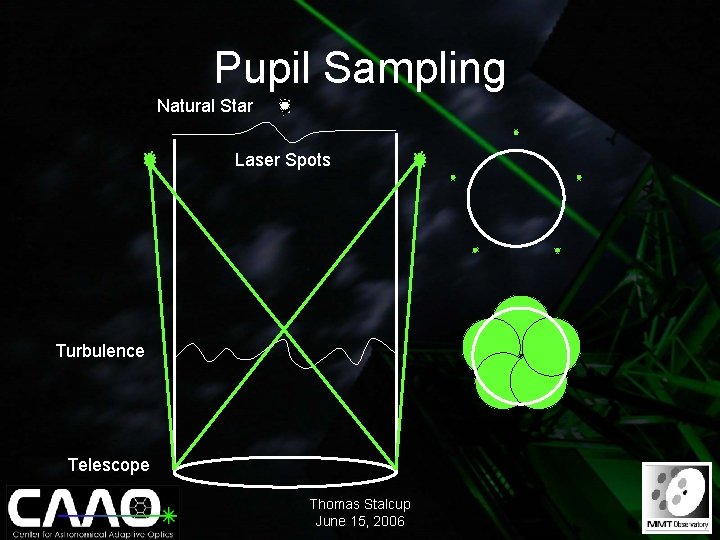
Laser Wavefront Sensor • Dynamic Refocus system • Prism array instead of lenslet array • Gated CCD camera Thomas Stalcup June 15, 2006
Pupil Sampling Natural Star Laser Spots Turbulence Telescope Thomas Stalcup June 15, 2006
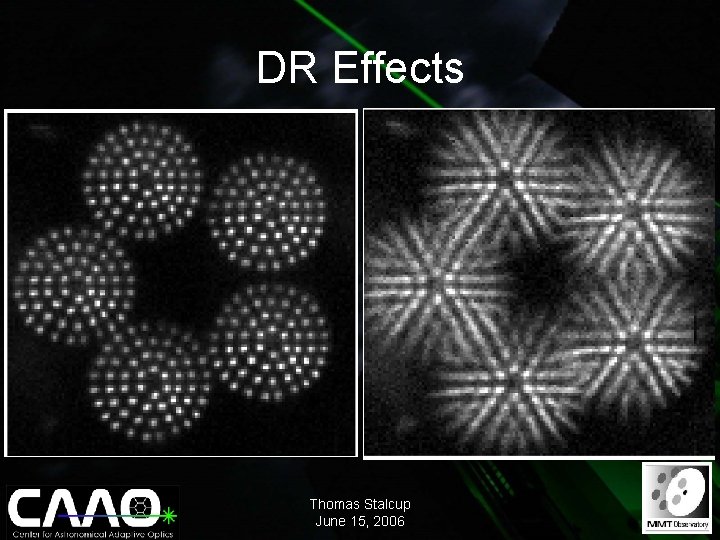
Dynamic Refocus • Use a moving element to keep rising laser pulse in sharp focus to allow longer range gate • Can collect more photons • Corrects for spot elongation in subapertures away from the projection axis Thomas Stalcup June 15, 2006
DR Effects Thomas Stalcup June 15, 2006
DR Principles • A moving mirror adjusts the wavefront sensor focus • At the native f/15, the mirror must move 81 mm • At f/0. 5, the mirror needs to move just 150 µm • Even 150 µm at 5 k. Hz is not easy – Mount the mirror on a high-Q mechanical resonator Thomas Stalcup June 15, 2006
DR System Mechanics Thomas Stalcup June 15, 2006
Wavefront Sensor Camera • CCD is a CCID 18 from MIT/Lincoln Labs – – Electronic shutter 16 amplifiers Split frame transfer 128 x 128 pixels • Little Joe controller from Scimeasure • Can not transition shutter while reading pixels – Needs accurate timing to interleave reading lines in between shutter transitions Thomas Stalcup June 15, 2006
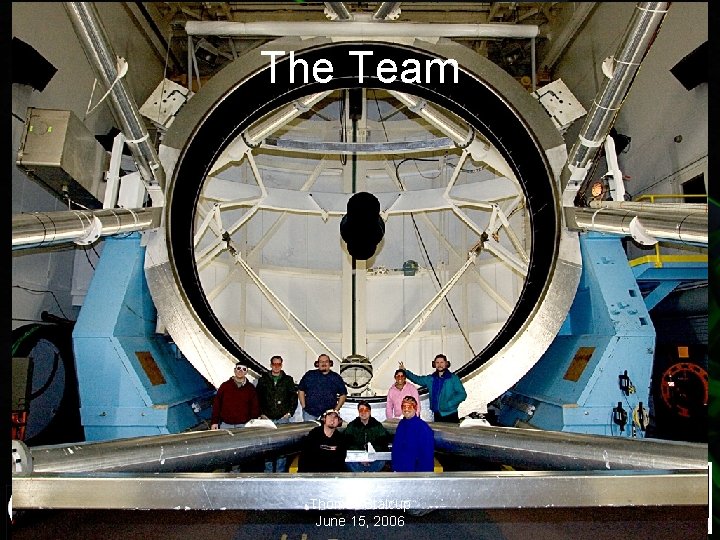
The Team Thomas Stalcup June 15, 2006