
Laser Fringe Stabilization of 35 nm IP Beam
Laser Fringe Stabilization of 35 nm IP Beam Size Monitor (Shintake monitor) for ATF 2/ILC Taikan SUEHARA The University of Tokyo Taikan SUEHARA, Joint Meeting of PRPPC in Honolulu, Hawaii, 2006/10/30
Contents 1. About ATF 2 and Shintake-monitor – Shintake-monitor uses laser fringe to obtain beam size 2. Effect of laser fringe phase fluctuation on the resolution of Shintake-monitor – Estimation by a Monte Carlo simulation 3. Status & test result (preliminary) of phase stabilization system 4. Summary Taikan SUEHARA, Joint Meeting of PRPPC in Honolulu, Hawaii, 2006/10/30
About ATF 2 and Shintake-monitor Taikan SUEHARA, Joint Meeting of PRPPC in Honolulu, Hawaii, 2006/10/30
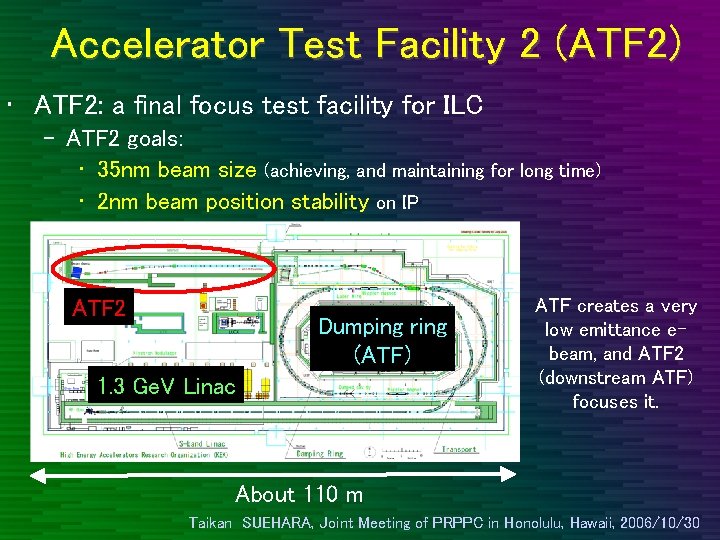
Accelerator Test Facility 2 (ATF 2) • ATF 2: a final focus test facility for ILC – ATF 2 goals: • 35 nm beam size (achieving, and maintaining for long time) • 2 nm beam position stability on IP ATF 2 Dumping ring (ATF) 1. 3 Ge. V Linac ATF creates a very low emittance ebeam, and ATF 2 (downstream ATF) focuses it. About 110 m Taikan SUEHARA, Joint Meeting of PRPPC in Honolulu, Hawaii, 2006/10/30
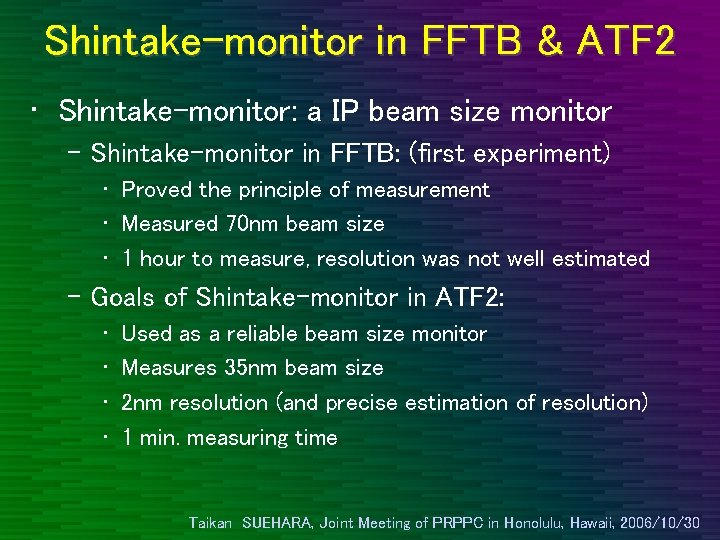
Shintake-monitor in FFTB & ATF 2 • Shintake-monitor: a IP beam size monitor – Shintake-monitor in FFTB: (first experiment) • Proved the principle of measurement • Measured 70 nm beam size • 1 hour to measure, resolution was not well estimated – Goals of Shintake-monitor in ATF 2: • • Used as a reliable beam size monitor Measures 35 nm beam size 2 nm resolution (and precise estimation of resolution) 1 min. measuring time Taikan SUEHARA, Joint Meeting of PRPPC in Honolulu, Hawaii, 2006/10/30
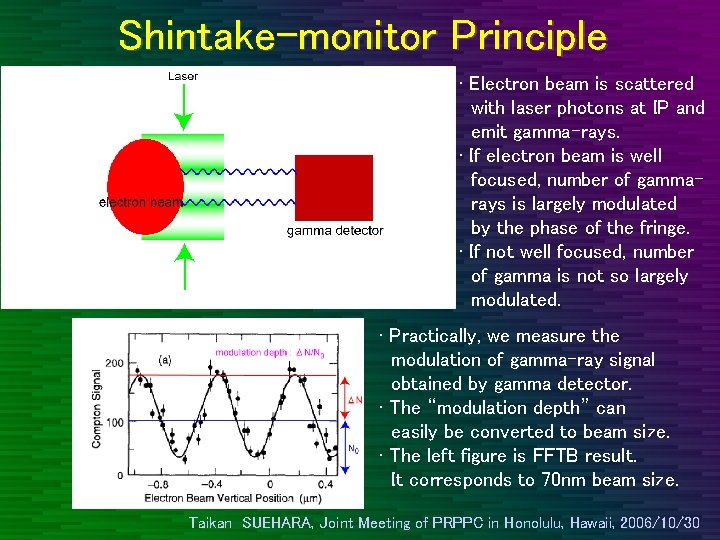
Shintake-monitor Principle • Electron beam is scattered with laser photons at IP and emit gamma-rays. • If electron beam is well focused, number of gammarays is largely modulated by the phase of the fringe. • If not well focused, number of gamma is not so largely modulated. • Practically, we measure the modulation of gamma-ray signal obtained by gamma detector. • The “modulation depth” can easily be converted to beam size. • The left figure is FFTB result. It corresponds to 70 nm beam size. Taikan SUEHARA, Joint Meeting of PRPPC in Honolulu, Hawaii, 2006/10/30
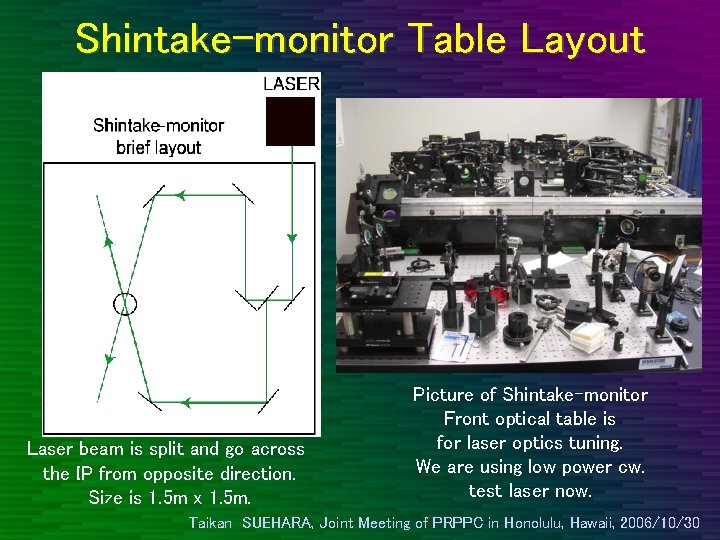
Shintake-monitor Table Layout Laser beam is split and go across the IP from opposite direction. Size is 1. 5 m x 1. 5 m. Picture of Shintake-monitor Front optical table is for laser optics tuning. We are using low power cw. test laser now. Taikan SUEHARA, Joint Meeting of PRPPC in Honolulu, Hawaii, 2006/10/30
Effect of laser fringe phase fluctuation on the resolution of Shintake-monitor Taikan SUEHARA, Joint Meeting of PRPPC in Honolulu, Hawaii, 2006/10/30

Required Modulation Resolution GOAL : to measure 35 nm beam size by < 2 nm resolution zoom Beam size modulation 33 nm 73% 35 nm 70% 37 nm 67% 2 nm beam size corresponds to 3% modulation (around 35 nm). We need 3% modulation resolution. Then, how much stability of laser fringe phase do we need to achieve 3% modulation resolution? We performed a Monte Carlo simulation to obtain that relation. Taikan SUEHARA, Joint Meeting of PRPPC in Honolulu, Hawaii, 2006/10/30
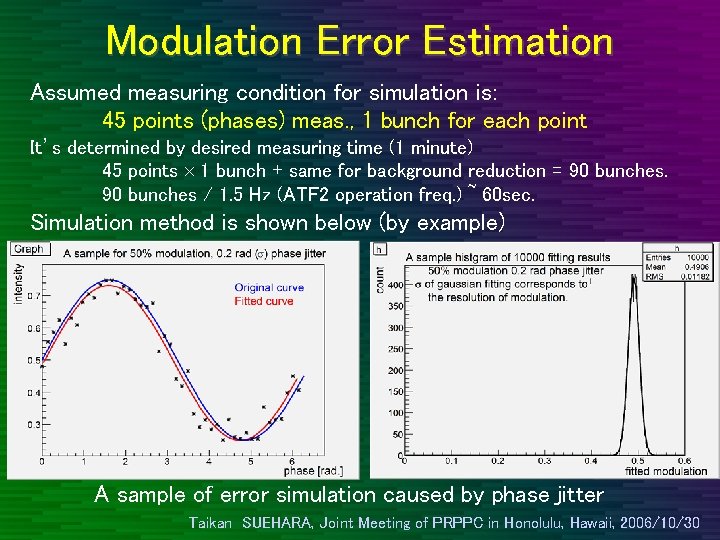
Modulation Error Estimation Assumed measuring condition for simulation is: 45 points (phases) meas. , 1 bunch for each point It’s determined by desired measuring time (1 minute) 45 points 1 bunch + same for background reduction = 90 bunches / 1. 5 Hz (ATF 2 operation freq. ) ~ 60 sec. Simulation method is shown below (by example) A sample of error simulation caused by phase jitter Taikan SUEHARA, Joint Meeting of PRPPC in Honolulu, Hawaii, 2006/10/30
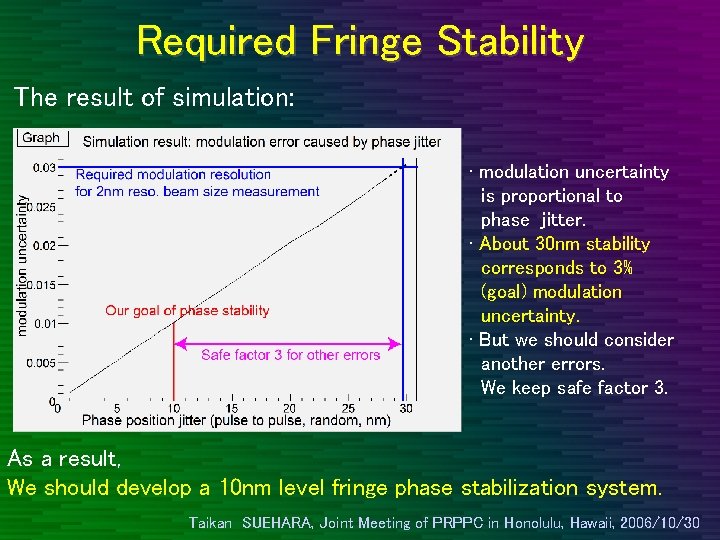
Required Fringe Stability The result of simulation: • modulation uncertainty is proportional to phase jitter. • About 30 nm stability corresponds to 3% (goal) modulation uncertainty. • But we should consider another errors. We keep safe factor 3. As a result, We should develop a 10 nm level fringe phase stabilization system. Taikan SUEHARA, Joint Meeting of PRPPC in Honolulu, Hawaii, 2006/10/30

Status & Test Result (Preliminary) of Phase Stabilization System Taikan SUEHARA, Joint Meeting of PRPPC in Honolulu, Hawaii, 2006/10/30
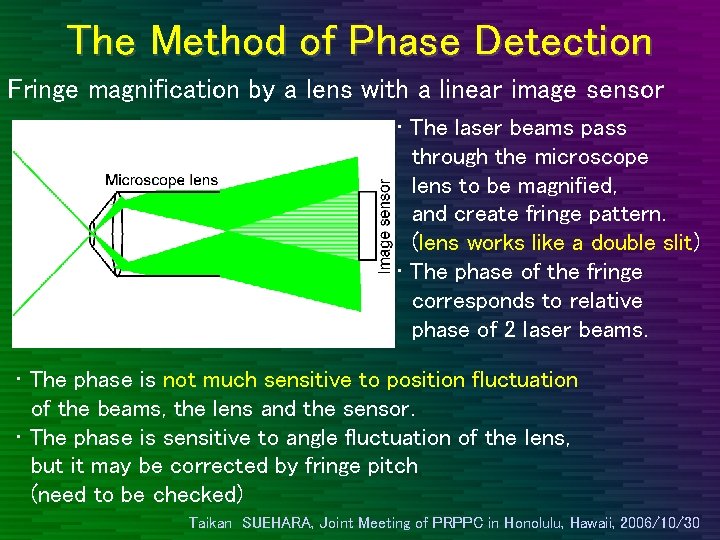
The Method of Phase Detection Fringe magnification by a lens with a linear image sensor • The laser beams pass through the microscope lens to be magnified, and create fringe pattern. (lens works like a double slit) • The phase of the fringe corresponds to relative phase of 2 laser beams. • The phase is not much sensitive to position fluctuation of the beams, the lens and the sensor. • The phase is sensitive to angle fluctuation of the lens, but it may be corrected by fringe pitch (need to be checked) Taikan SUEHARA, Joint Meeting of PRPPC in Honolulu, Hawaii, 2006/10/30
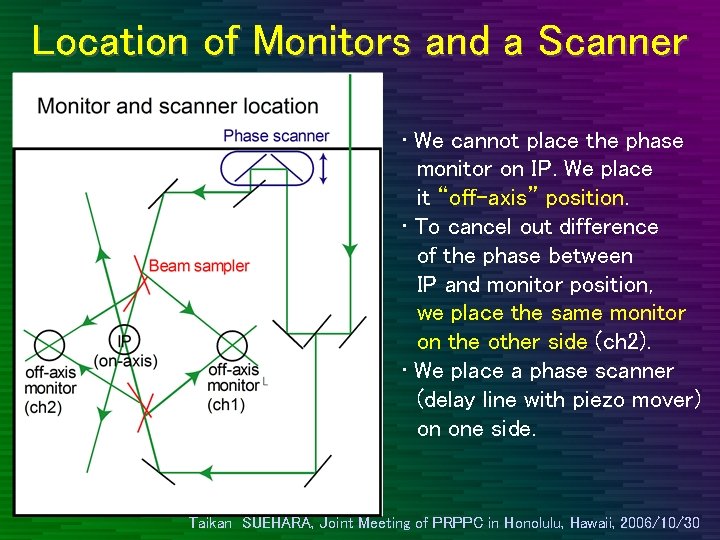
Location of Monitors and a Scanner • We cannot place the phase monitor on IP. We place it “off-axis” position. • To cancel out difference of the phase between IP and monitor position, we place the same monitor on the other side (ch 2). • We place a phase scanner (delay line with piezo mover) on one side. Taikan SUEHARA, Joint Meeting of PRPPC in Honolulu, Hawaii, 2006/10/30
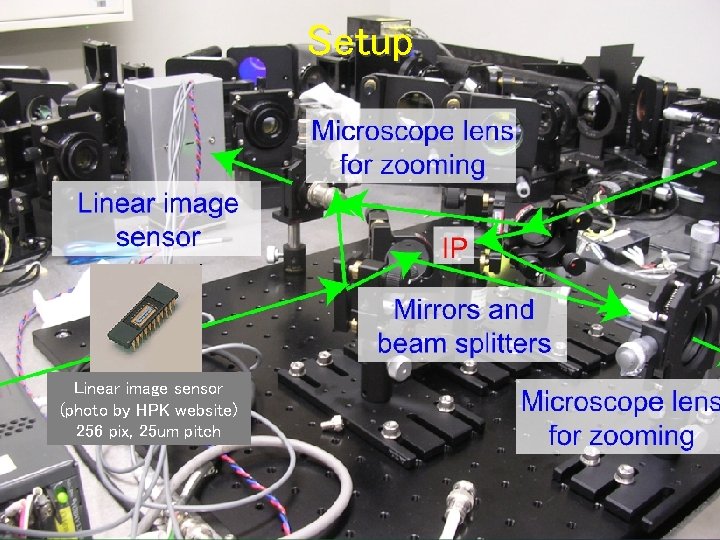
Setup Linear image sensor (photo by HPK website) 256 pix, 25 um pitch Taikan SUEHARA, Joint Meeting of PRPPC in Honolulu, Hawaii, 2006/10/30

Fringe Phase Scanning System • Optical delay line used for phase stabilization and scan • Resolution of piezo stage is 1 nm, corresponds to 2 nm phase resolution. • The stage can be controlled by PC up to 300 Hz (sufficient speed for stabilization). Taikan SUEHARA, Joint Meeting of PRPPC in Honolulu, Hawaii, 2006/10/30
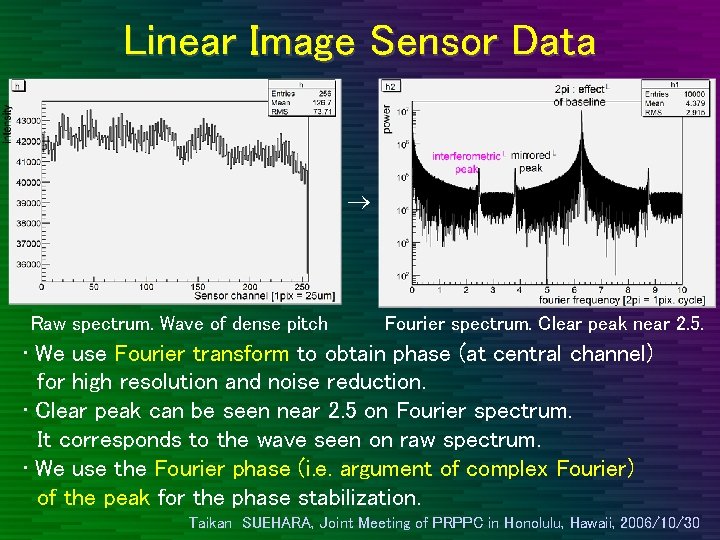
Linear Image Sensor Data Raw spectrum. Wave of dense pitch Fourier spectrum. Clear peak near 2. 5. • We use Fourier transform to obtain phase (at central channel) for high resolution and noise reduction. • Clear peak can be seen near 2. 5 on Fourier spectrum. It corresponds to the wave seen on raw spectrum. • We use the Fourier phase (i. e. argument of complex Fourier) of the peak for the phase stabilization. Taikan SUEHARA, Joint Meeting of PRPPC in Honolulu, Hawaii, 2006/10/30
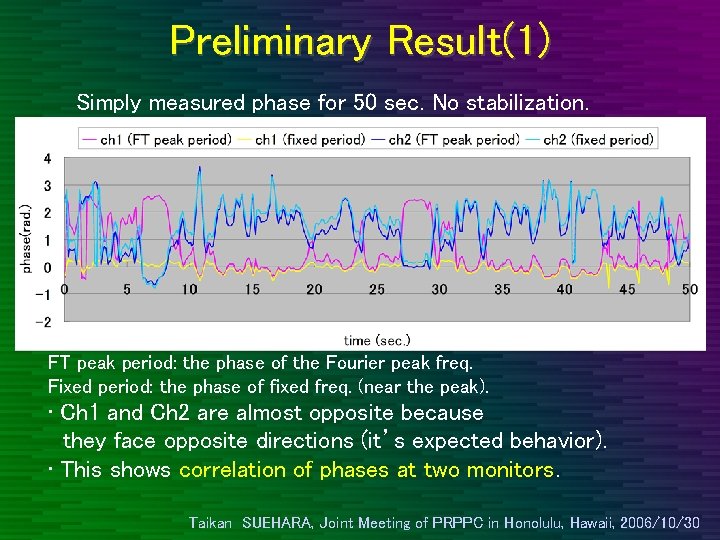
Preliminary Result(1) Simply measured phase for 50 sec. No stabilization. FT peak period: the phase of the Fourier peak freq. Fixed period: the phase of fixed freq. (near the peak). • Ch 1 and Ch 2 are almost opposite because they face opposite directions (it’s expected behavior). • This shows correlation of phases at two monitors. Taikan SUEHARA, Joint Meeting of PRPPC in Honolulu, Hawaii, 2006/10/30
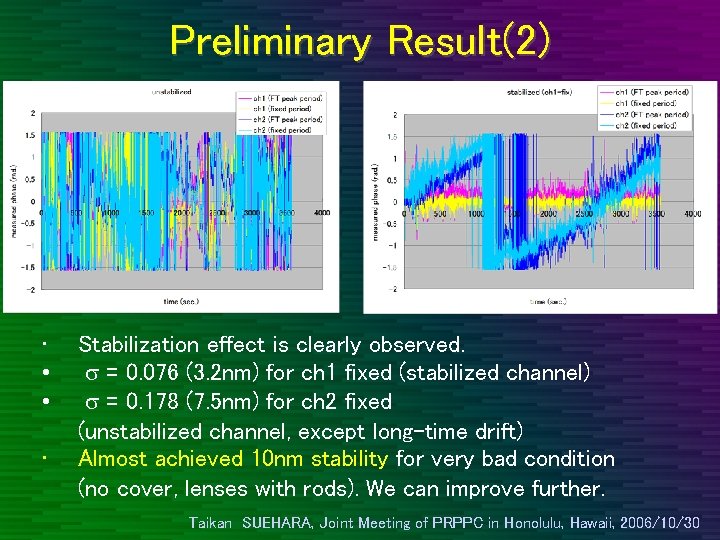
Preliminary Result(2) • • Stabilization effect is clearly observed. s = 0. 076 (3. 2 nm) for ch 1 fixed (stabilized channel) s = 0. 178 (7. 5 nm) for ch 2 fixed (unstabilized channel, except long-time drift) Almost achieved 10 nm stability for very bad condition (no cover, lenses with rods). We can improve further. Taikan SUEHARA, Joint Meeting of PRPPC in Honolulu, Hawaii, 2006/10/30
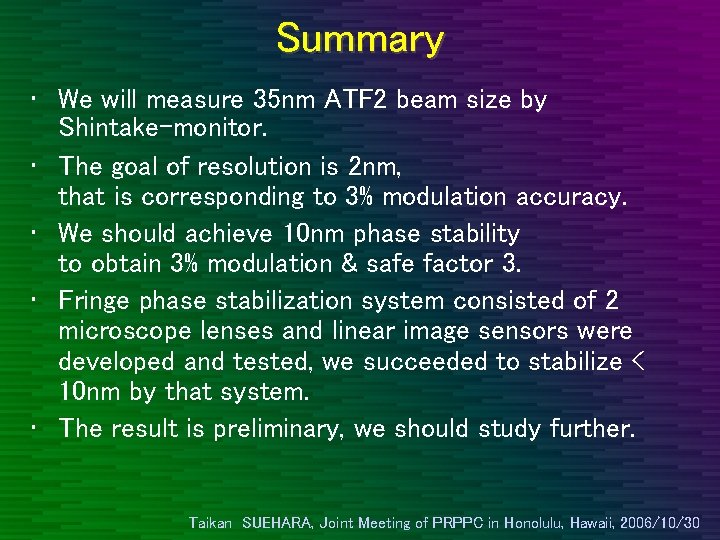
Summary • We will measure 35 nm ATF 2 beam size by Shintake-monitor. • The goal of resolution is 2 nm, that is corresponding to 3% modulation accuracy. • We should achieve 10 nm phase stability to obtain 3% modulation & safe factor 3. • Fringe phase stabilization system consisted of 2 microscope lenses and linear image sensors were developed and tested, we succeeded to stabilize < 10 nm by that system. • The result is preliminary, we should study further. Taikan SUEHARA, Joint Meeting of PRPPC in Honolulu, Hawaii, 2006/10/30

Thank you !! Taikan SUEHARA, Joint Meeting of PRPPC in Honolulu, Hawaii, 2006/10/30
ATF 2 Shintake-monitor group • Students – Taikan SUEHARA (Univ. of Tokyo, D 2) • Optics (main table, laser table) • Overall design, etc. – Hakutaro YODA (Univ. of Tokyo, M 1) • Gamma detector • Staffs – Tatsuya KUME (KEK) • Optics support (fringe stabilization etc. ) – Yosuke Honda (KEK) • Support (optics etc. ) – T. Tauchi (KEK), T. Sanuki (Univ. of Tokyo) • Advisor (ATF 2, overall) Taikan SUEHARA, Joint Meeting of PRPPC in Honolulu, Hawaii, 2006/10/30
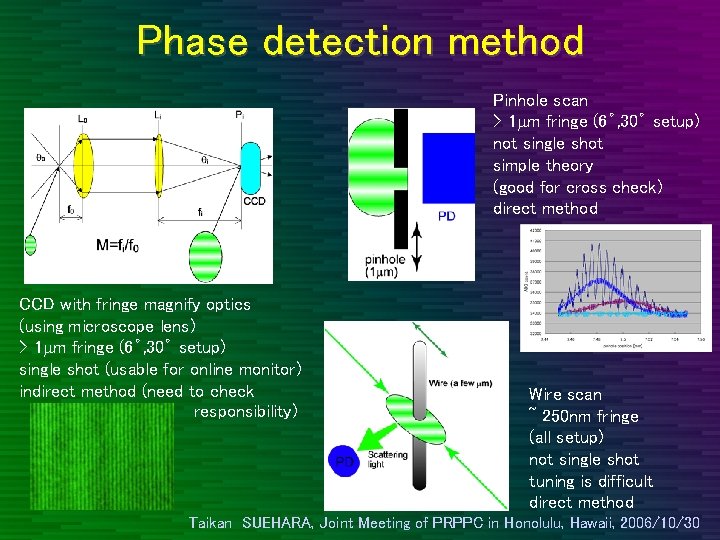
Phase detection method Pinhole scan > 1 mm fringe (6゜, 30゜ setup) not single shot simple theory (good for cross check) direct method CCD with fringe magnify optics (using microscope lens) > 1 mm fringe (6゜, 30゜ setup) single shot (usable for online monitor) indirect method (need to check responsibility) Wire scan ~ 250 nm fringe (all setup) not single shot tuning is difficult direct method Taikan SUEHARA, Joint Meeting of PRPPC in Honolulu, Hawaii, 2006/10/30
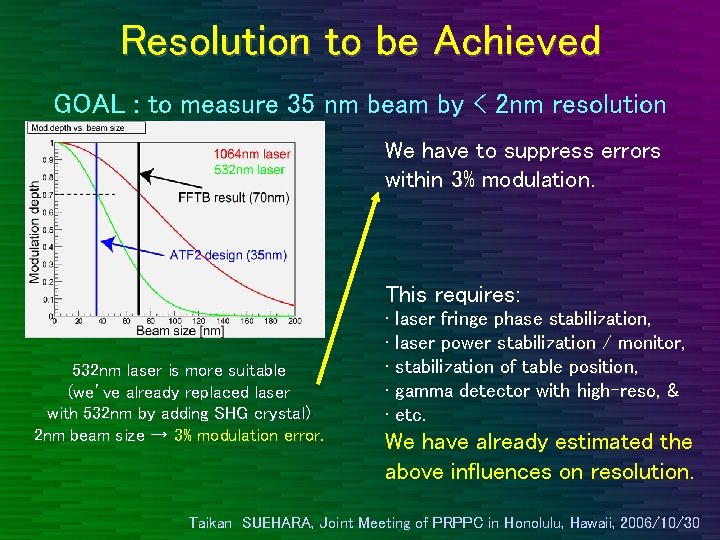
Resolution to be Achieved GOAL : to measure 35 nm beam by < 2 nm resolution We have to suppress errors within 3% modulation. This requires: 532 nm laser is more suitable (we’ve already replaced laser with 532 nm by adding SHG crystal) 2 nm beam size → 3% modulation error. • laser fringe phase stabilization, • laser power stabilization / monitor, • stabilization of table position, • gamma detector with high-reso, & • etc. We have already estimated the above influences on resolution. Taikan SUEHARA, Joint Meeting of PRPPC in Honolulu, Hawaii, 2006/10/30

Fringe phase stabilization strategy Taikan SUEHARA, Joint Meeting of PRPPC in Honolulu, Hawaii, 2006/10/30

Stabilize to what? • We have to know the point of origin of stabilization. • We want to stabilize fringe to beam position – We cannot stabilize directly to “beam position”. – How to obtain beam position? (2 possibilities) • IP BPM. The other purpose of ATF 2 is to achieve 2 nm stabilization of beam position. IP BPM is used to achieve that. → We can use the BPM center as the point of origin. • Position of the Final Doublet can be translated to beam position → Position of the Final Doublet can also be the point of origin. • We are creating a stabilization system for above 2 points of origin (may be selectable). Taikan SUEHARA, Joint Meeting of PRPPC in Honolulu, Hawaii, 2006/10/30
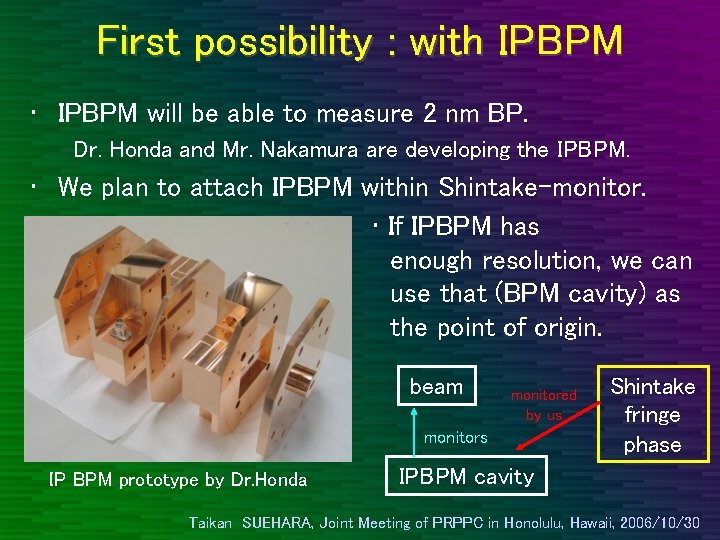
First possibility : with IPBPM • IPBPM will be able to measure 2 nm BP. Dr. Honda and Mr. Nakamura are developing the IPBPM. • We plan to attach IPBPM within Shintake-monitor. • If IPBPM has enough resolution, we can use that (BPM cavity) as the point of origin. beam monitored by us monitors IP BPM prototype by Dr. Honda Shintake fringe phase IPBPM cavity Taikan SUEHARA, Joint Meeting of PRPPC in Honolulu, Hawaii, 2006/10/30
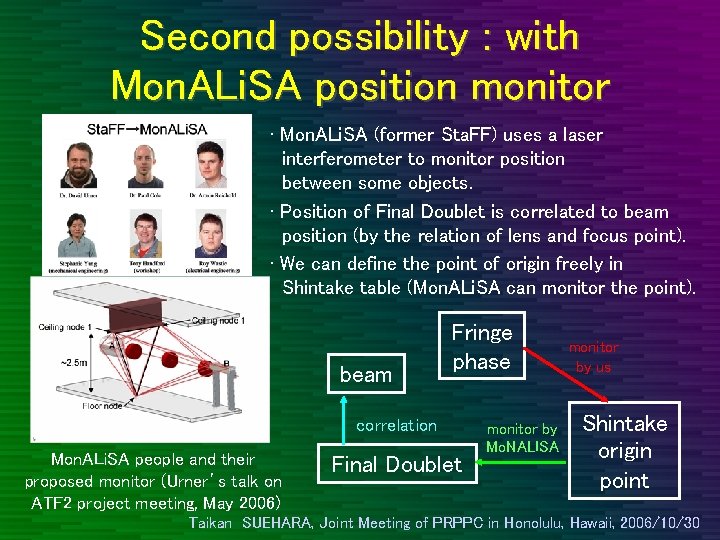
Second possibility : with Mon. ALi. SA position monitor • Mon. ALi. SA (former Sta. FF) uses a laser interferometer to monitor position between some objects. • Position of Final Doublet is correlated to beam position (by the relation of lens and focus point). • We can define the point of origin freely in Shintake table (Mon. ALi. SA can monitor the point). beam Fringe phase correlation Mon. ALi. SA people and their proposed monitor (Urner’s talk on ATF 2 project meeting, May 2006) Final Doublet monitor by Mo. NALISA monitor by us Shintake origin point Taikan SUEHARA, Joint Meeting of PRPPC in Honolulu, Hawaii, 2006/10/30
- Slides: 28