
Laser cooling of alkali atoms BoseEinstein condensate Atom

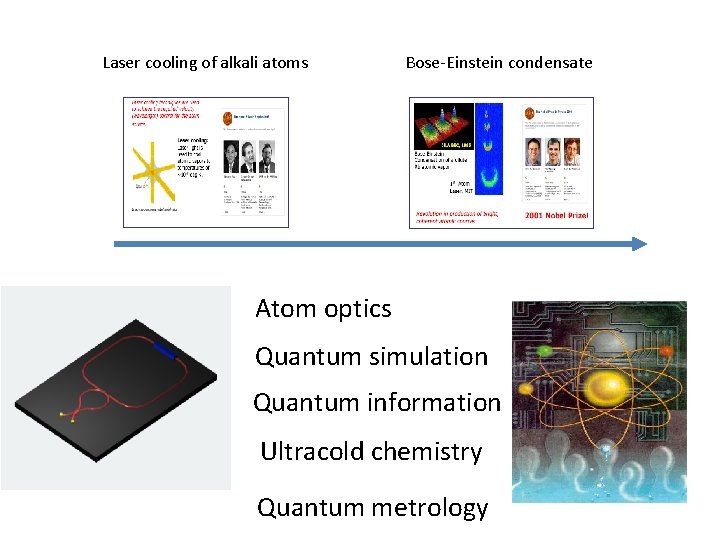
Laser cooling of alkali atoms Bose-Einstein condensate Atom optics Quantum simulation Quantum information Ultracold chemistry Quantum metrology
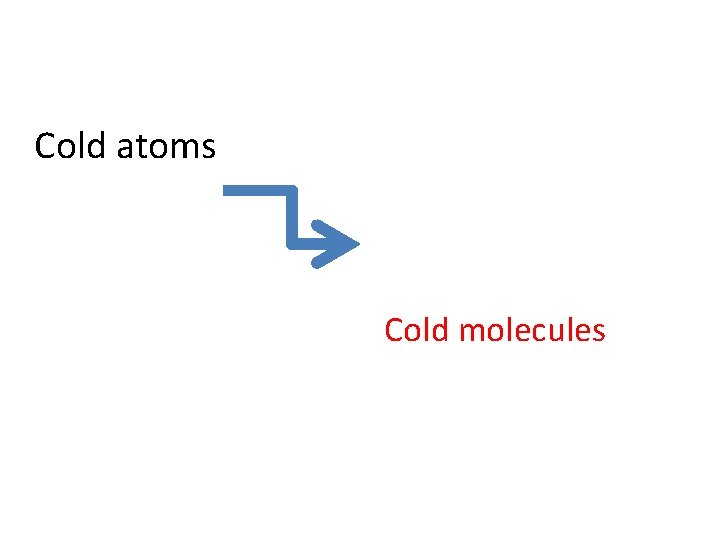
Cold atoms Cold molecules
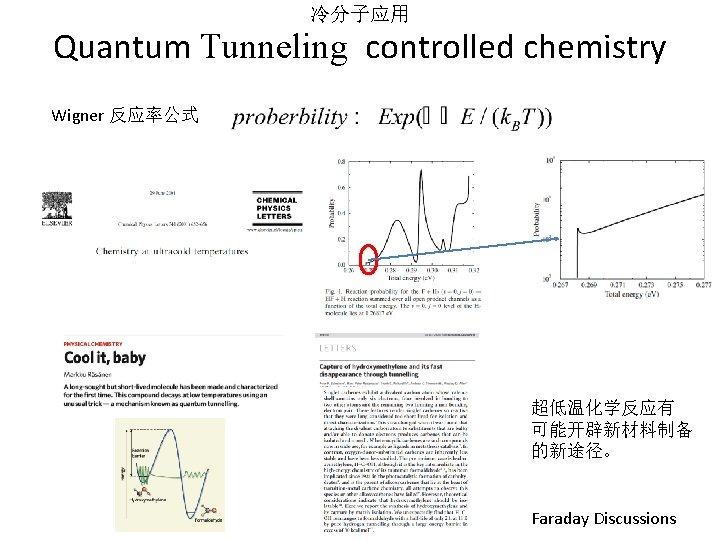
冷分子应用 Quantum Tunneling controlled chemistry Wigner 反应率公式 超低温化学反应有 可能开辟新材料制备 的新途径。 Faraday Discussions

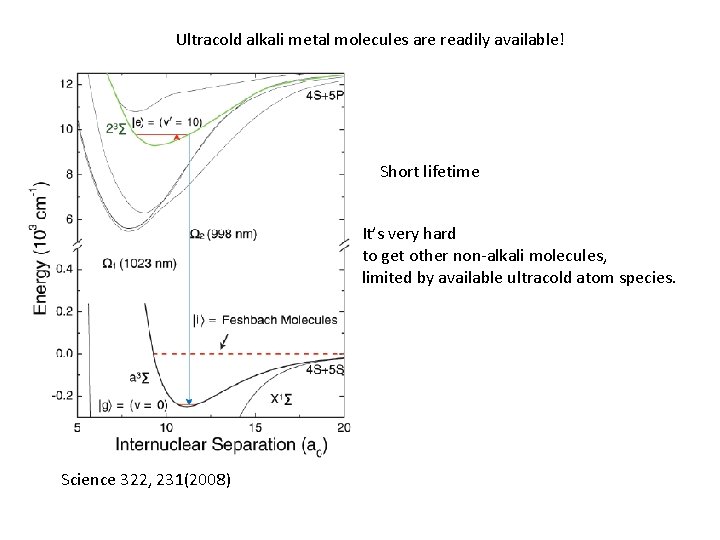
Ultracold alkali metal molecules are readily available! Short lifetime It’s very hard to get other non-alkali molecules, limited by available ultracold atom species. Science 322, 231(2008)
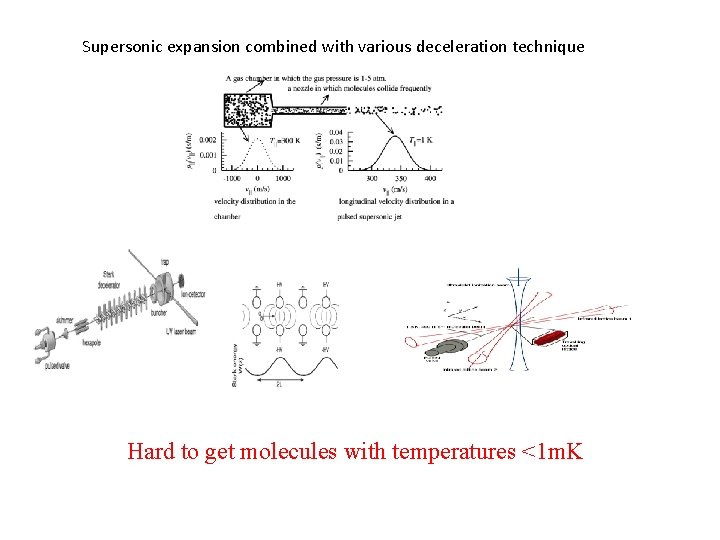
Supersonic expansion combined with various deceleration technique Hard to get molecules with temperatures <1 m. K
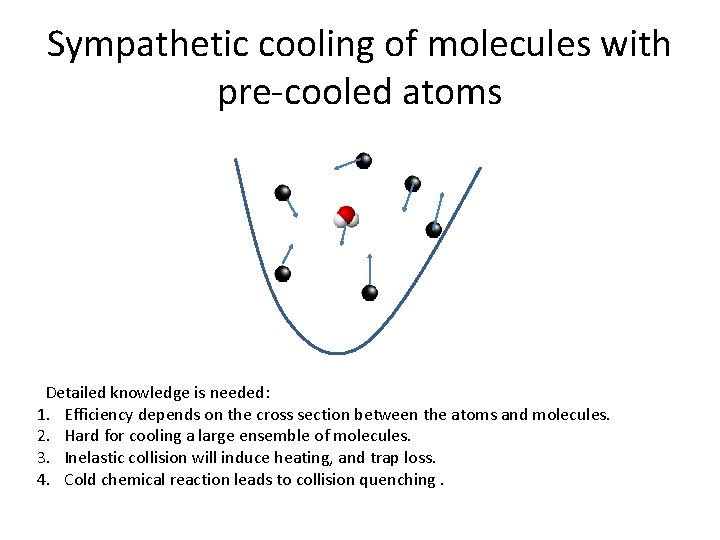
Sympathetic cooling of molecules with pre-cooled atoms Detailed knowledge is needed: 1. Efficiency depends on the cross section between the atoms and molecules. 2. Hard for cooling a large ensemble of molecules. 3. Inelastic collision will induce heating, and trap loss. 4. Cold chemical reaction leads to collision quenching.
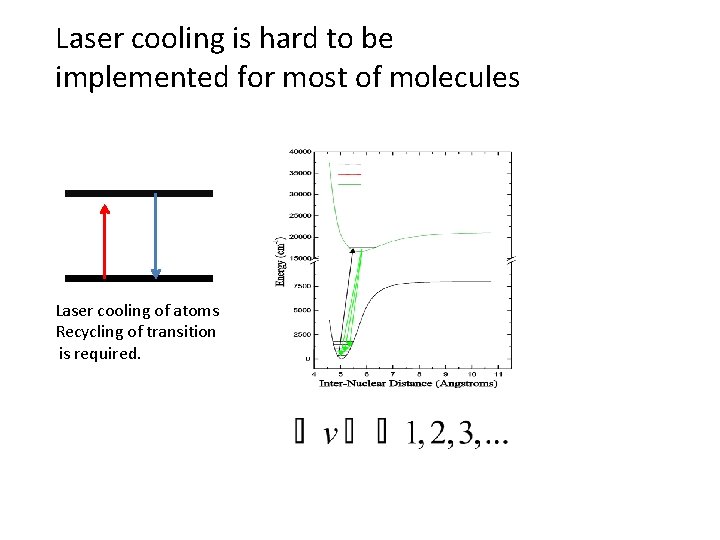
Laser cooling is hard to be implemented for most of molecules Laser cooling of atoms Recycling of transition is required.
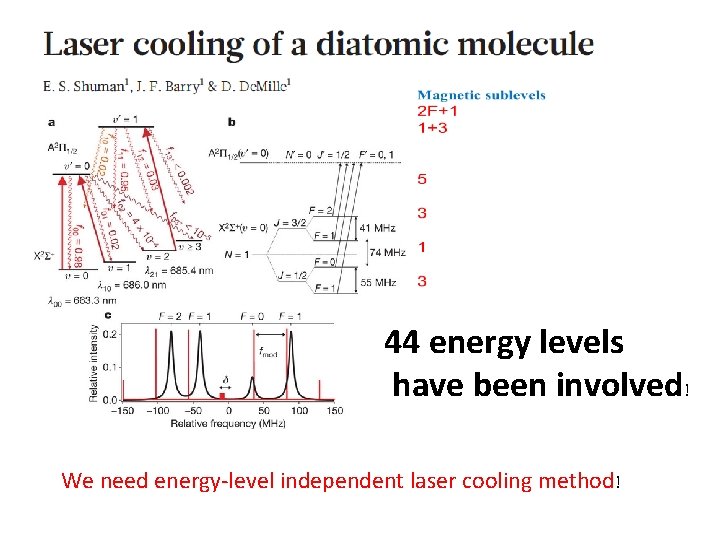
44 energy levels have been involved! We need energy-level independent laser cooling method!

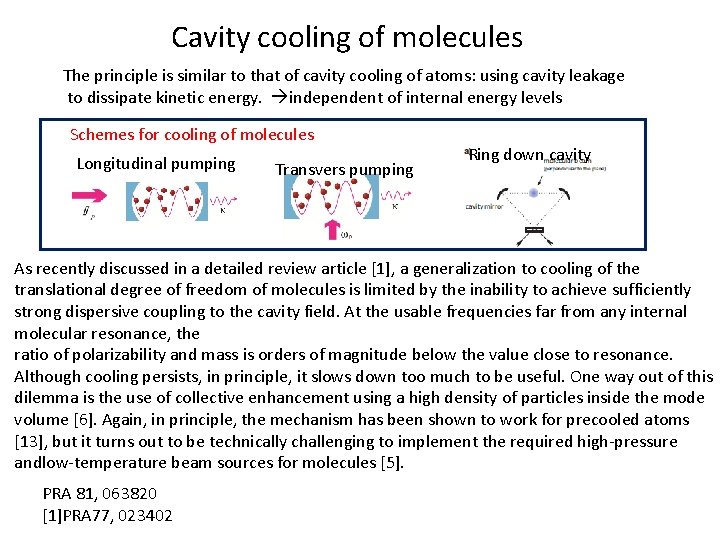
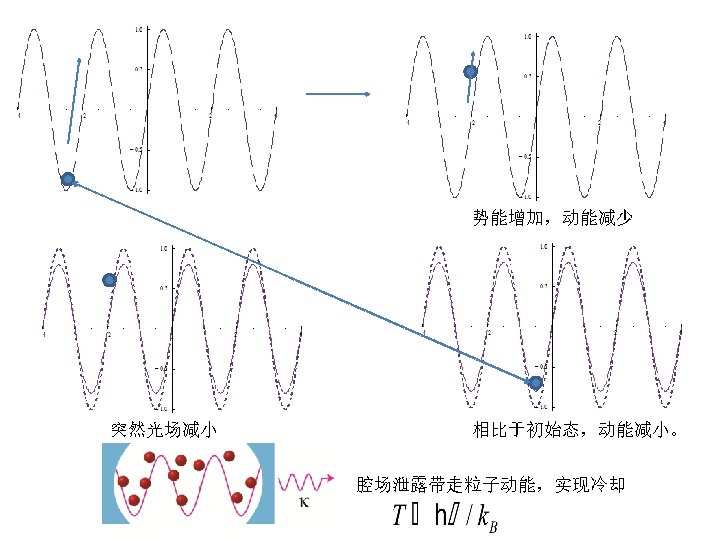
Cavity cooling of molecules The principle is similar to that of cavity cooling of atoms: using cavity leakage to dissipate kinetic energy. independent of internal energy levels Schemes for cooling of molecules Longitudinal pumping Transvers pumping Ring down cavity As recently discussed in a detailed review article [1], a generalization to cooling of the translational degree of freedom of molecules is limited by the inability to achieve sufficiently strong dispersive coupling to the cavity field. At the usable frequencies far from any internal molecular resonance, the ratio of polarizability and mass is orders of magnitude below the value close to resonance. Although cooling persists, in principle, it slows down too much to be useful. One way out of this dilemma is the use of collective enhancement using a high density of particles inside the mode volume [6]. Again, in principle, the mechanism has been shown to work for precooled atoms [13], but it turns out to be technically challenging to implement the required high-pressure andlow-temperature beam sources for molecules [5]. PRA 81, 063820 [1]PRA 77, 023402
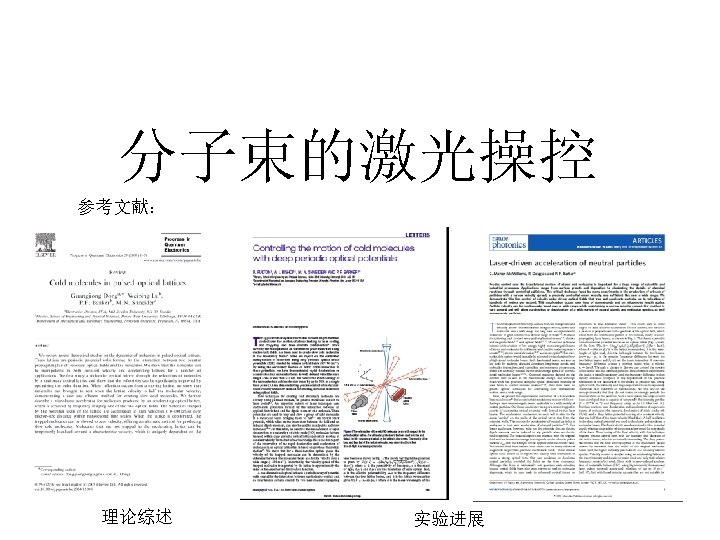
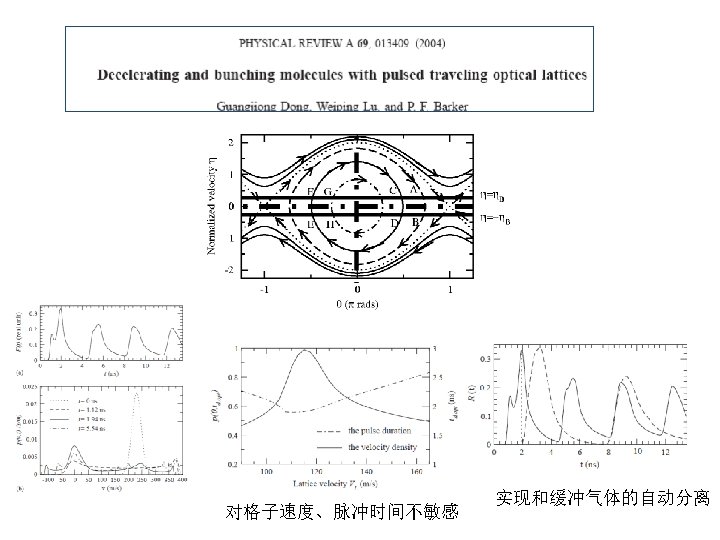
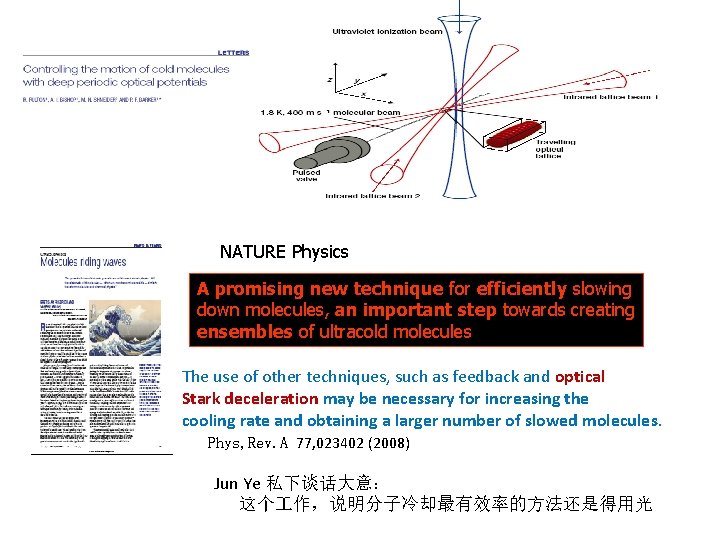
NATURE Physics A promising new technique for efficiently slowing down molecules, an important step towards creating ensembles of ultracold molecules The use of other techniques, such as feedback and optical Stark deceleration may be necessary for increasing the cooling rate and obtaining a larger number of slowed molecules. Phys, Rev. A 77, 023402 (2008) Jun Ye 私下谈话大意: 这个 作,说明分子冷却最有效率的方法还是得用光
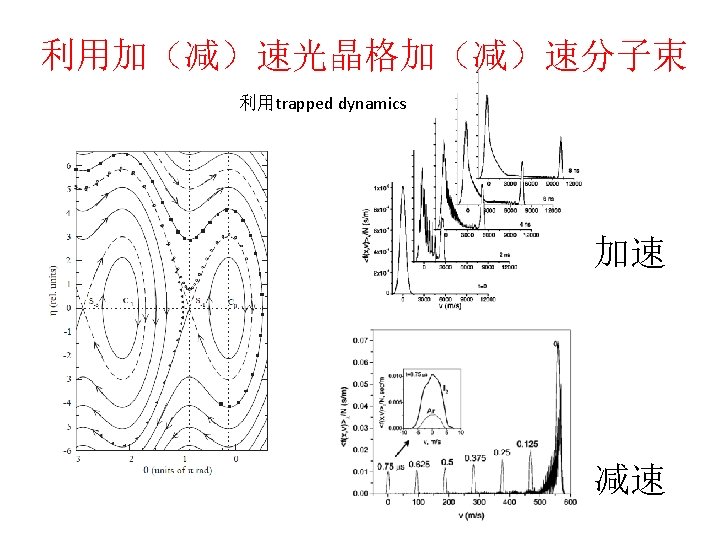
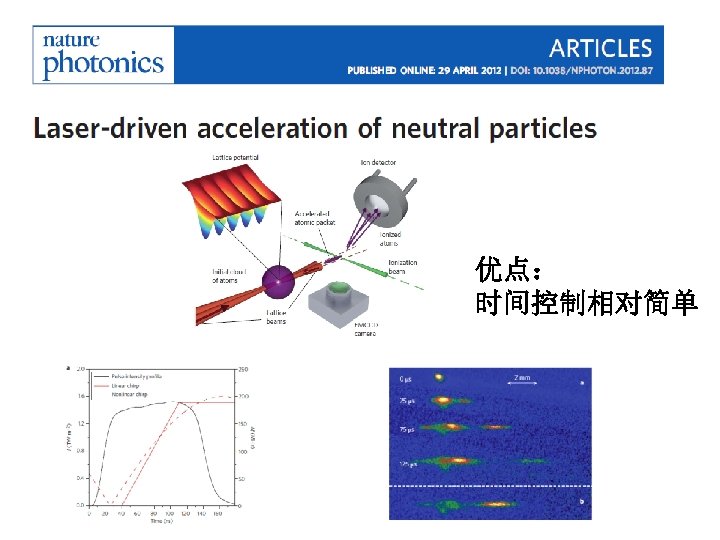

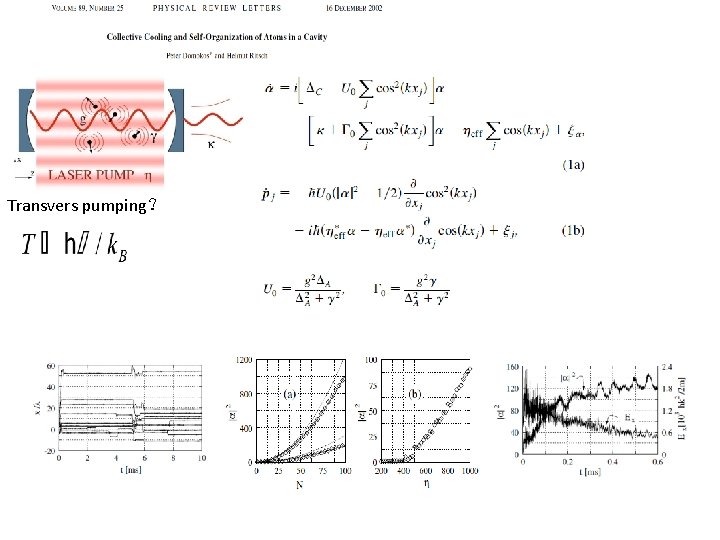
Transvers pumping?
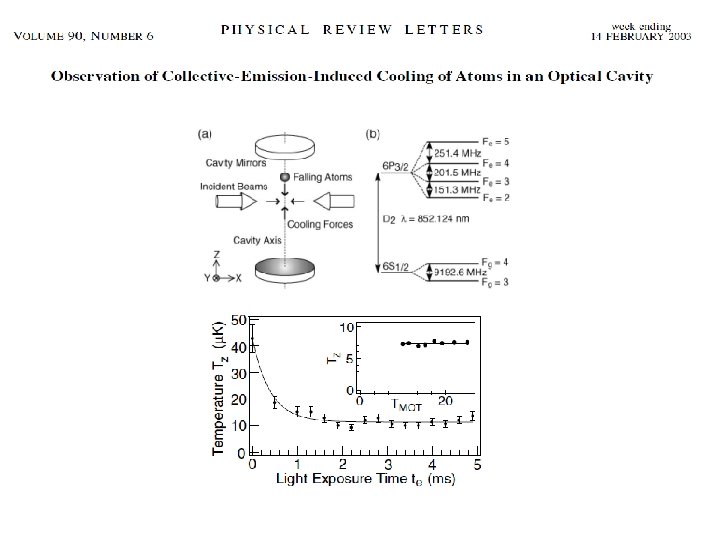
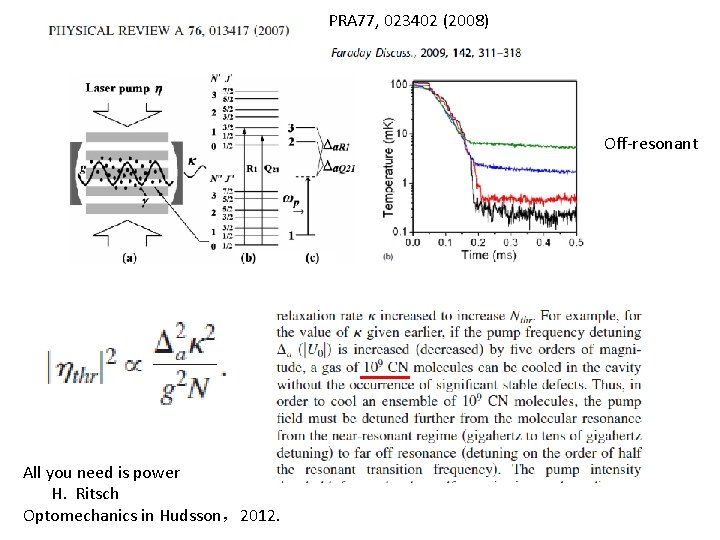
PRA 77, 023402 (2008) Off-resonant All you need is power H. Ritsch Optomechanics in Hudsson,2012.
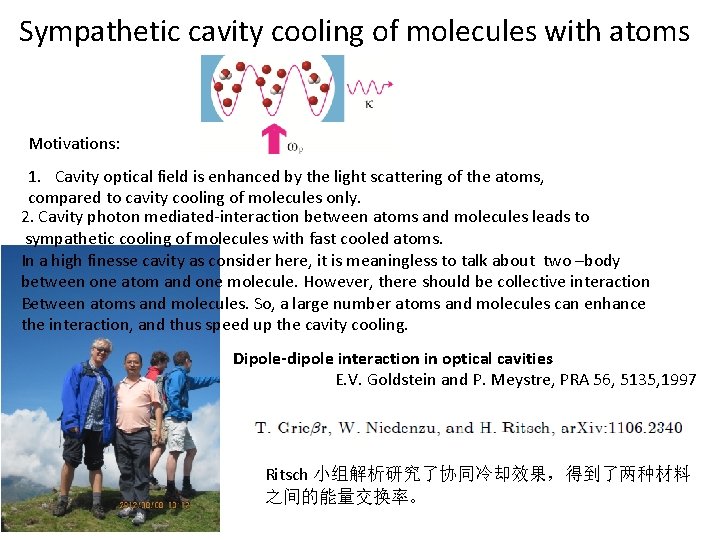
Sympathetic cavity cooling of molecules with atoms Motivations: 1. Cavity optical field is enhanced by the light scattering of the atoms, compared to cavity cooling of molecules only. 2. Cavity photon mediated-interaction between atoms and molecules leads to sympathetic cooling of molecules with fast cooled atoms. In a high finesse cavity as consider here, it is meaningless to talk about two –body between one atom and one molecule. However, there should be collective interaction Between atoms and molecules. So, a large number atoms and molecules can enhance the interaction, and thus speed up the cavity cooling. Dipole-dipole interaction in optical cavities E. V. Goldstein and P. Meystre, PRA 56, 5135, 1997 Ritsch 小组解析研究了协同冷却效果,得到了两种材料 之间的能量交换率。
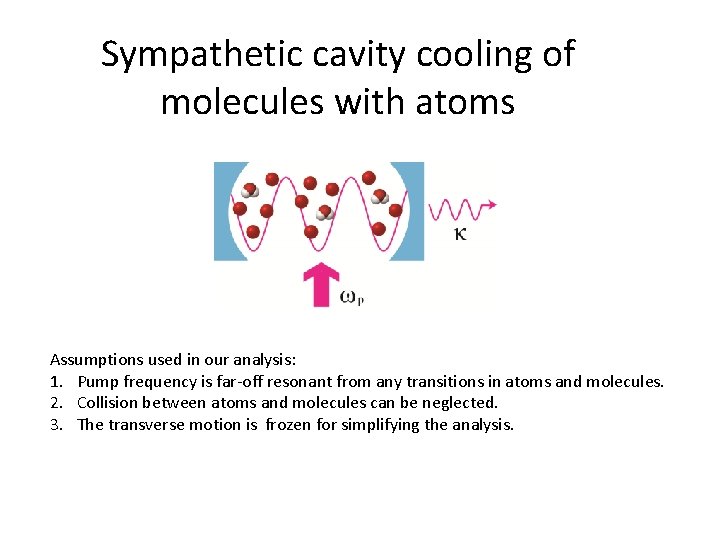
Sympathetic cavity cooling of molecules with atoms Assumptions used in our analysis: 1. Pump frequency is far-off resonant from any transitions in atoms and molecules. 2. Collision between atoms and molecules can be neglected. 3. The transverse motion is frozen for simplifying the analysis.
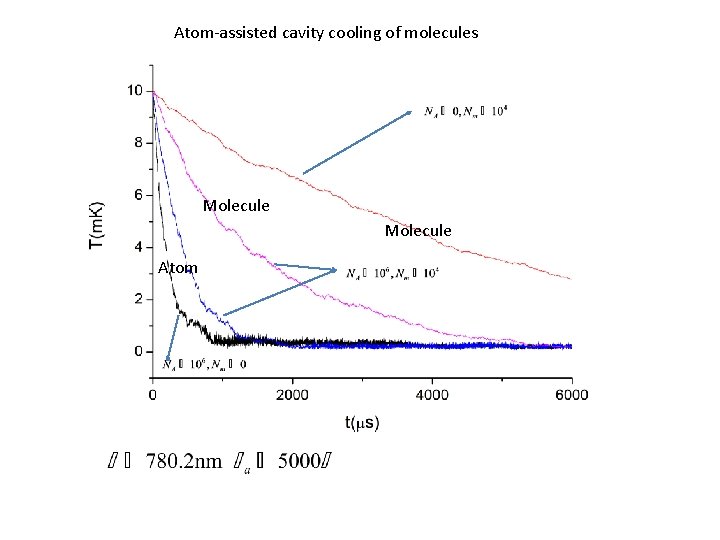
Atom-assisted cavity cooling of molecules Molecule Atom
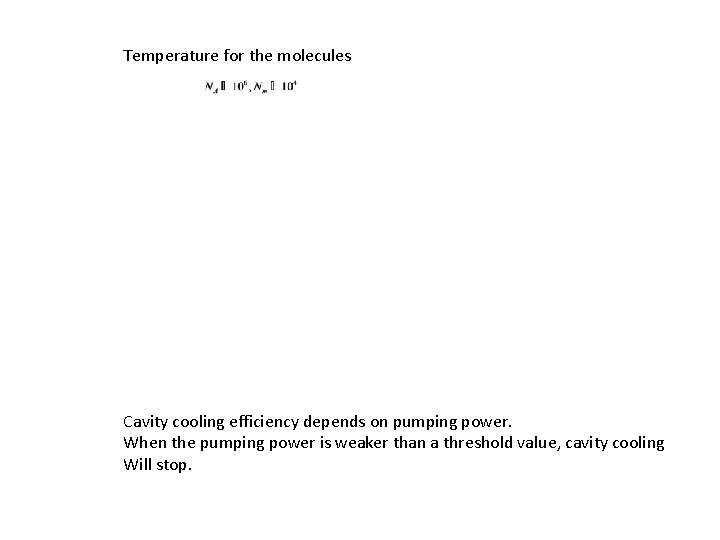
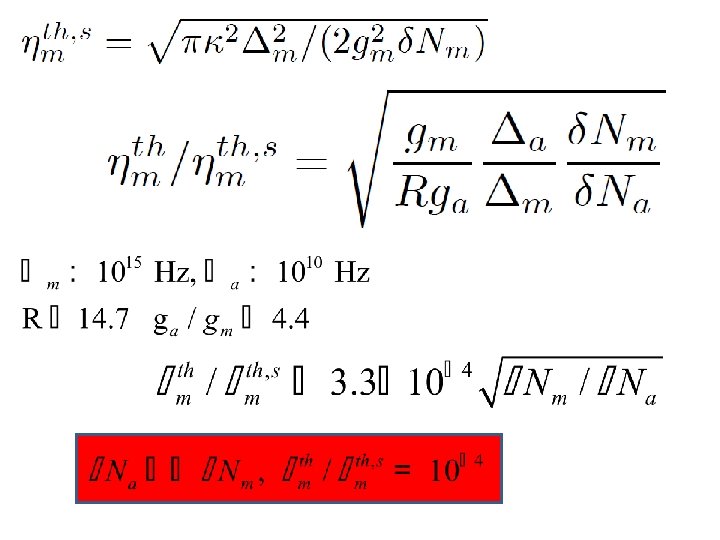
Temperature for the molecules Cavity cooling efficiency depends on pumping power. When the pumping power is weaker than a threshold value, cavity cooling Will stop.
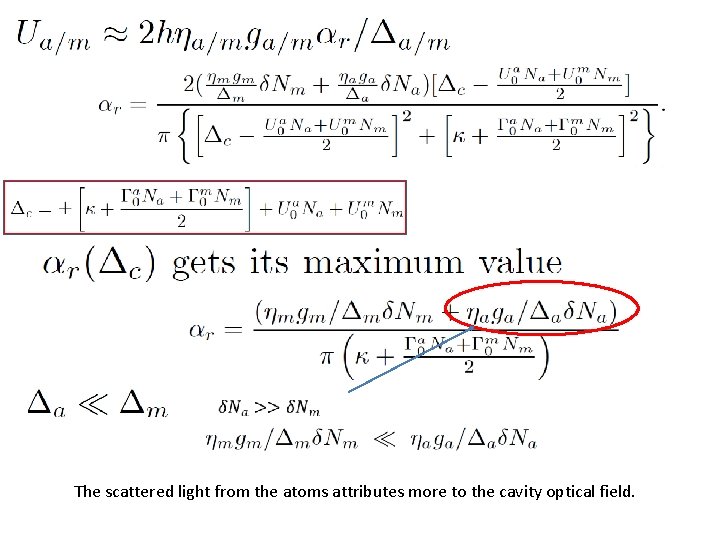
The scattered light from the atoms attributes more to the cavity optical field.
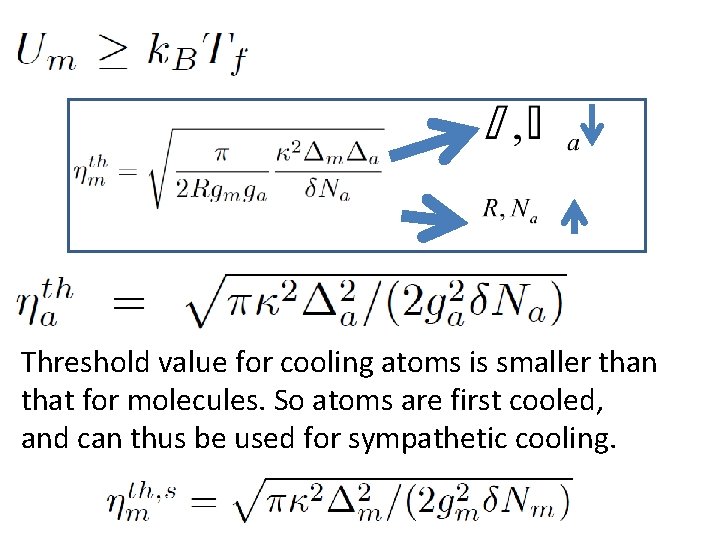
Threshold value for cooling atoms is smaller than that for molecules. So atoms are first cooled, and can thus be used for sympathetic cooling.
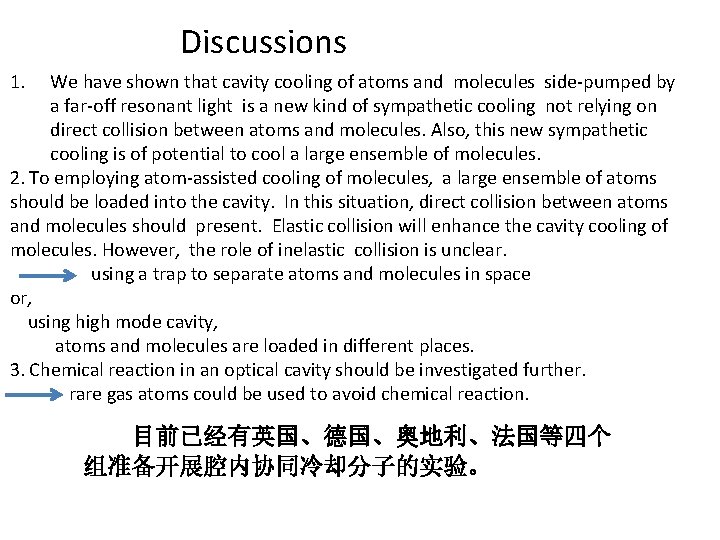
Discussions 1. We have shown that cavity cooling of atoms and molecules side-pumped by a far-off resonant light is a new kind of sympathetic cooling not relying on direct collision between atoms and molecules. Also, this new sympathetic cooling is of potential to cool a large ensemble of molecules. 2. To employing atom-assisted cooling of molecules, a large ensemble of atoms should be loaded into the cavity. In this situation, direct collision between atoms and molecules should present. Elastic collision will enhance the cavity cooling of molecules. However, the role of inelastic collision is unclear. using a trap to separate atoms and molecules in space or, using high mode cavity, atoms and molecules are loaded in different places. 3. Chemical reaction in an optical cavity should be investigated further. rare gas atoms could be used to avoid chemical reaction. 目前已经有英国、德国、奥地利、法国等四个 组准备开展腔内协同冷却分子的实验。

Thanks for your attention !
- Slides: 40