
Laser Assisted RObotic Surgery of the anterior Eye
Laser Assisted RObotic Surgery of the anterior Eye Segment D 6. 1 First release of integrated robotic platform Authors: Bernardo Magnani; Ekymed Srl Fabio Leoni; Fastenica Srl Francesca Rossi; IFAC-CNR Filippo Micheletti ; IFAC-CNR
Outline of the presentation �Introduction: �project objectives & overall description �physical constraints �system architecture �Current status of implemented modules: �handpiece / end-effector �Laser control system and robot control �tests & results at 25/07/2016
Objective of the project �to develop a “proof of concept” of a robotic platform for laser eye surgery, cornea transplantation �the aim of LA-ROSES project is to: �implement a robotic platform for assisting eye surgical operations. The robotic platform consists of a 6 degrees of freedom robotic arm system and a mounted vision system allowing the robotic arm to be driven using a visual servoing approach �implement a revised end-effector (partially developed in MILORDS project) sensorized with force feedback and distance and able to accommodate the applicator handpiece to fix the distance of the fiber tip of the diode laser �increase the precision of the laser-induced suture of the cornea from 1 -2 mm (laser manually handled) to 0, 01 mm
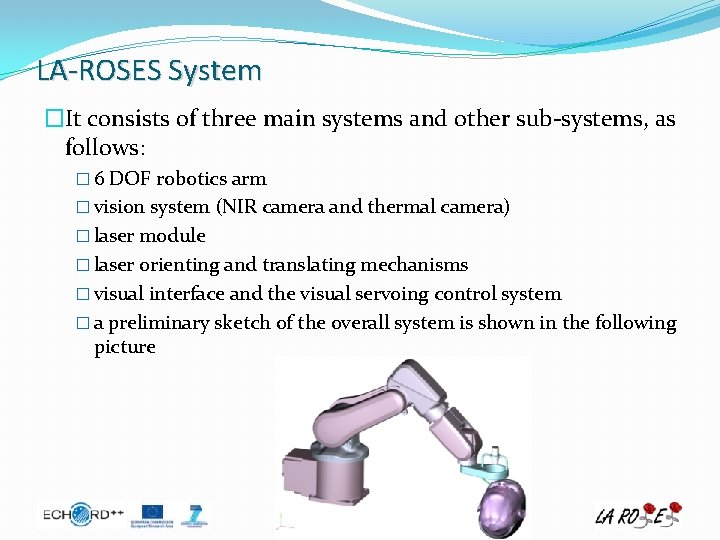
LA-ROSES System �It consists of three main systems and other sub-systems, as follows: � 6 DOF robotics arm � vision system (NIR camera and thermal camera) � laser module � laser orienting and translating mechanisms � visual interface and the visual servoing control system � a preliminary sketch of the overall system is shown in the following picture
Functional requirements �enabling circular movement of a laser module allowing a tracking of the circular path marked by the indocyanine solution �in order to ensure a perfect tissue welding result an accurate temperature control induced by the photothermal effect caused by the laser irradiation is required �enabling detection of the wound site with automatic tracking and handling of the laser spot �enabling changing laser orientation, altitude from the corneal external surface at the wound site, and tracking velocity during the welding procedure �enabling initial gross and accurate positioning of the laser probe above the patient’s eye �accurate laser probe positioning above the patient’s eye
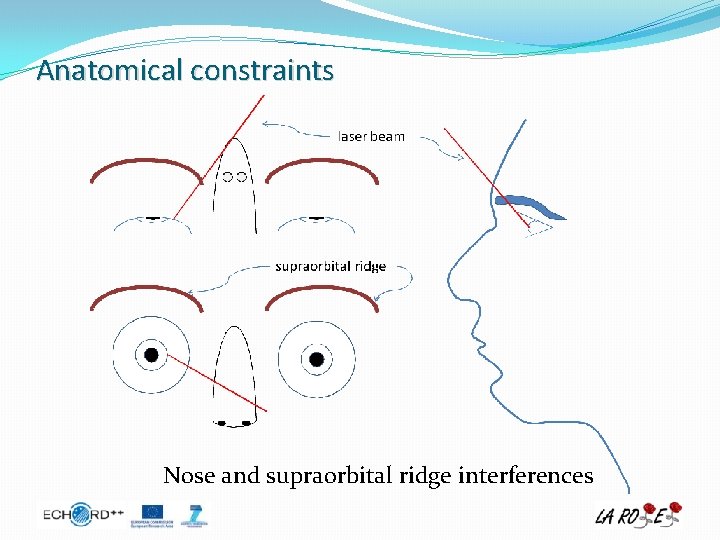
Anatomical constraints Nose and supraorbital ridge interferences
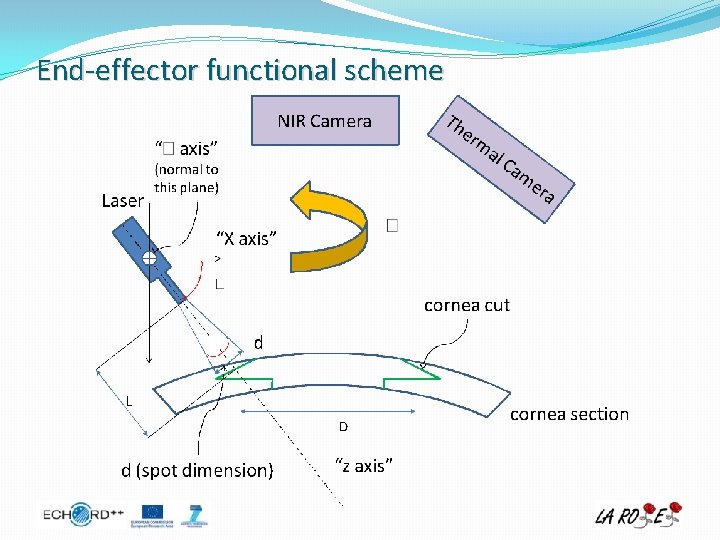
End-effector functional scheme
End-effector status �no force feedback implemented: with the new laser, there is no need to touch the cornea surface �the use of a laser distance system eliminates also the sterilisation issues �it is anyway necessary to know the distance (cameracornea), but this can be done directly with a calibration of the camera and the kinematics of the system �the end-effector was designed for a large set of configurations: �Laser working distance from 10 cm to 40 cm �Laser angle from 20° to 70° �the measured resolution of the motors is below 0, 1 m
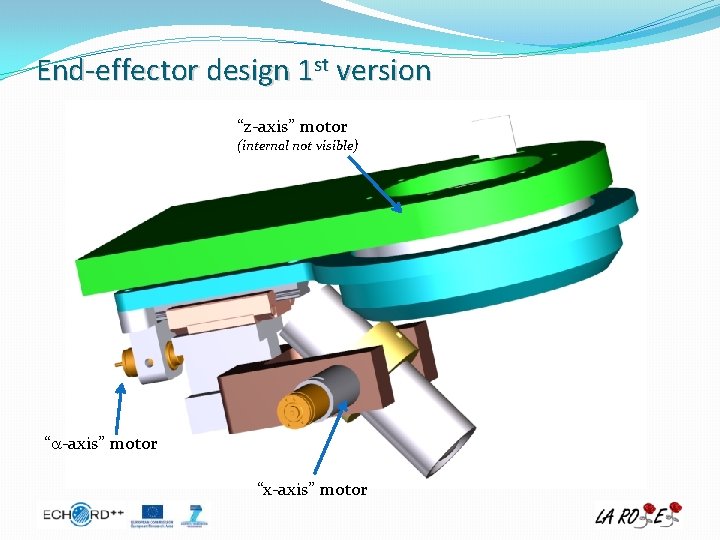
End-effector design 1 st version “z-axis” motor (internal not visible) “a-axis” motor “x-axis” motor
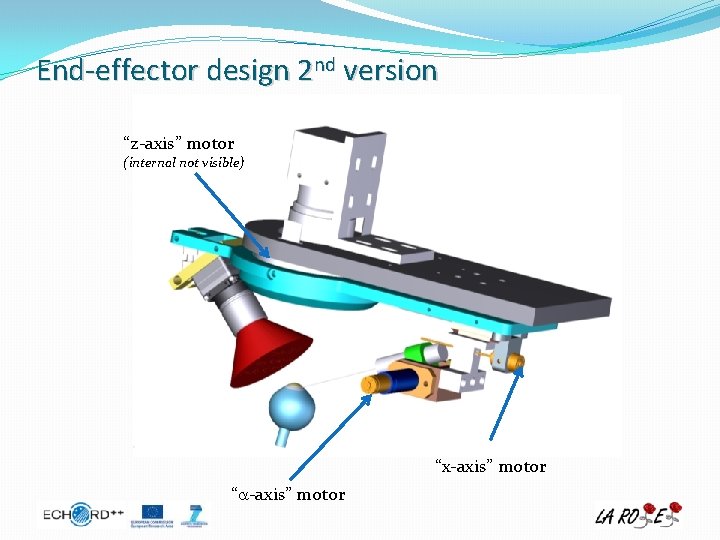
End-effector design 2 nd version “z-axis” motor (internal not visible) “x-axis” motor “a-axis” motor
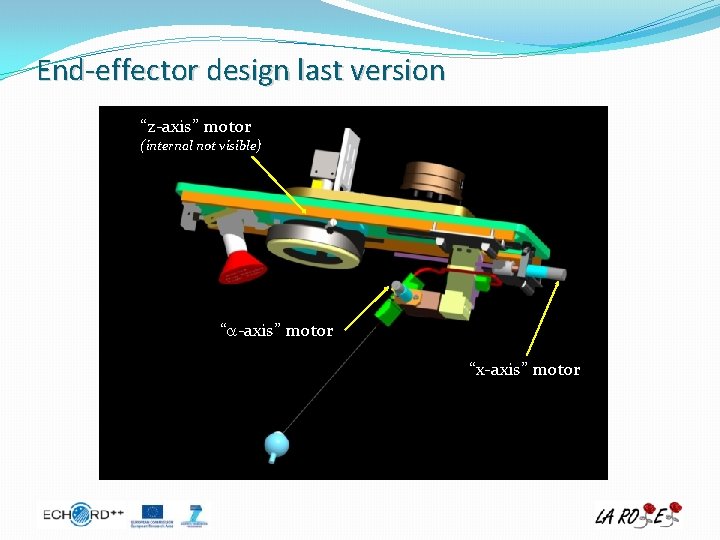
End-effector design last version “z-axis” motor (internal not visible) “a-axis” motor “x-axis” motor
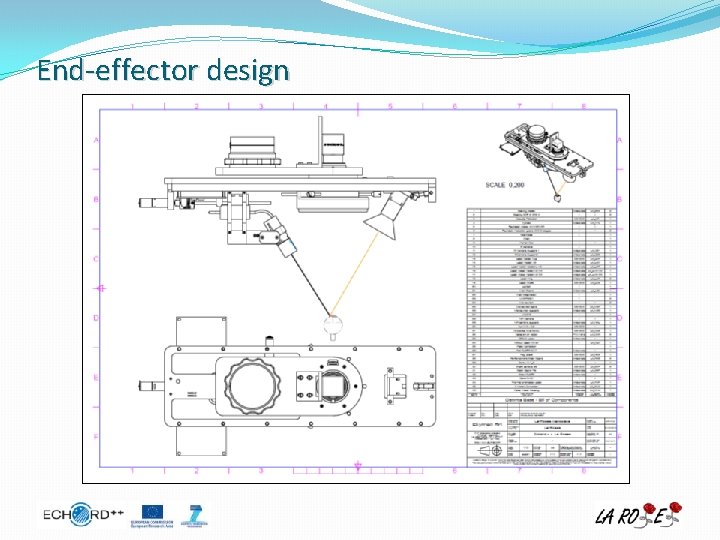
End-effector design
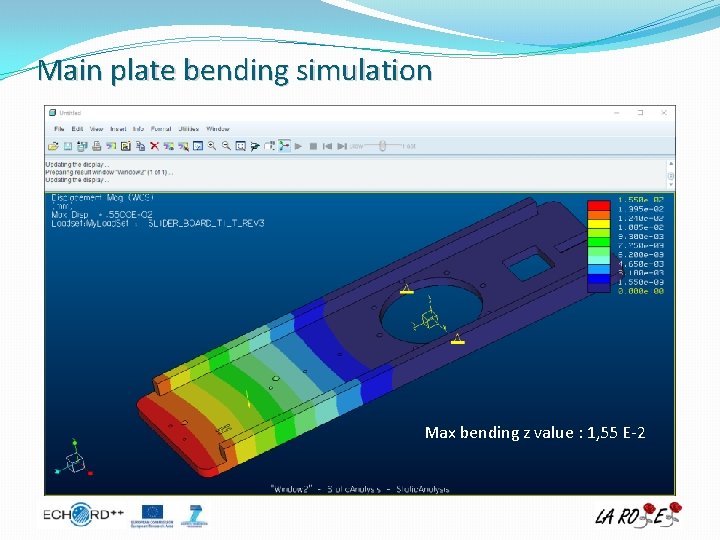
Main plate bending simulation Max bending z value : 1, 55 E-2
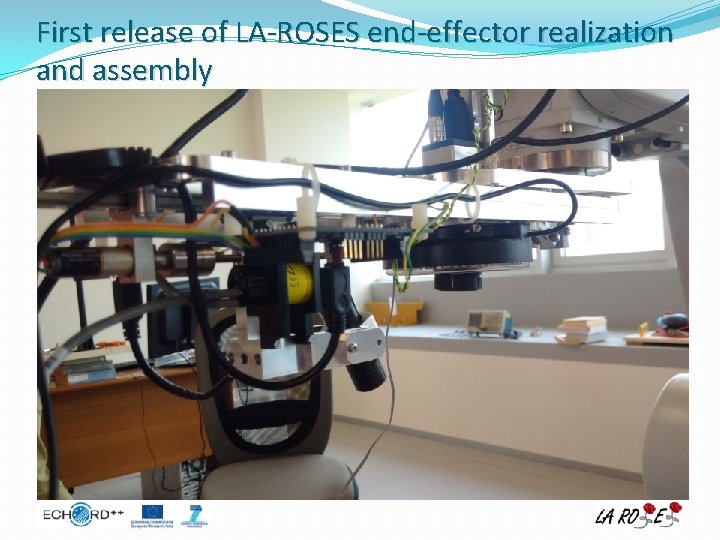
First release of LA-ROSES end-effector realization and assembly
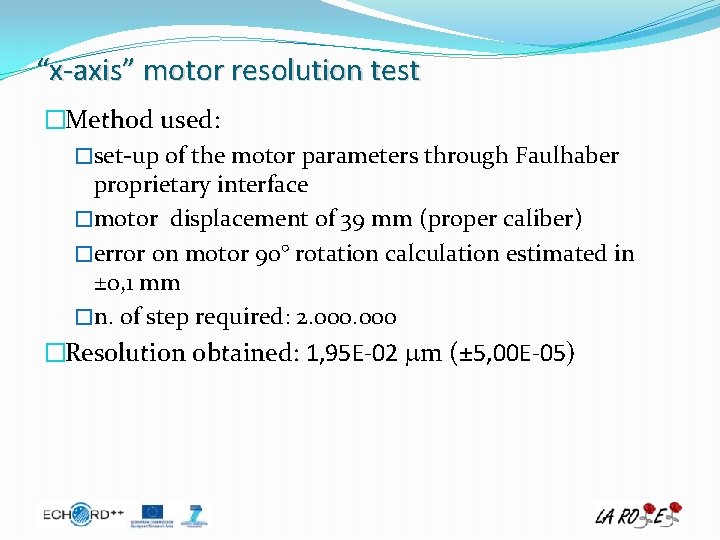
“x-axis” motor resolution test �Method used: �set-up of the motor parameters through Faulhaber proprietary interface �motor displacement of 39 mm (proper caliber) �error on motor 90° rotation calculation estimated in ± 0, 1 mm �n. of step required: 2. 000 �Resolution obtained: 1, 95 E-02 m (± 5, 00 E-05)
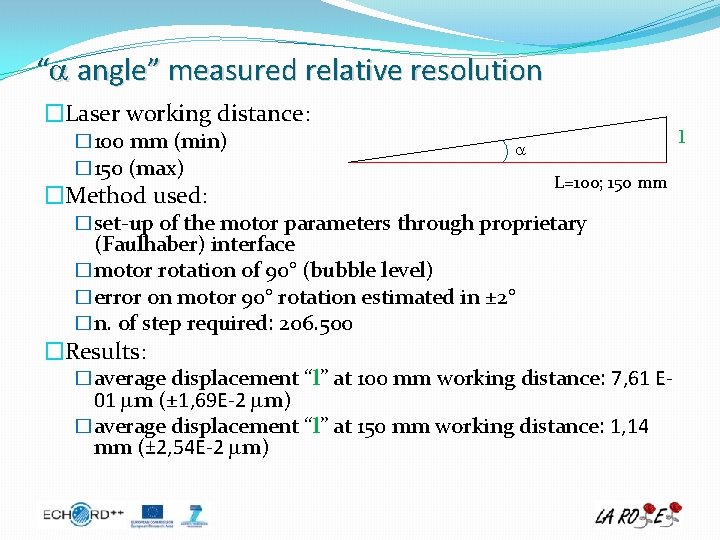
“a angle” measured relative resolution �Laser working distance: � 100 mm (min) � 150 (max) l a �Method used: L=100; 150 mm �set-up of the motor parameters through proprietary (Faulhaber) interface �motor rotation of 90° (bubble level) �error on motor 90° rotation estimated in ± 2° �n. of step required: 206. 500 �Results: �average displacement “l” at 100 mm working distance: 7, 61 E- 01 m (± 1, 69 E-2 m) �average displacement “l” at 150 mm working distance: 1, 14 mm (± 2, 54 E-2 m)
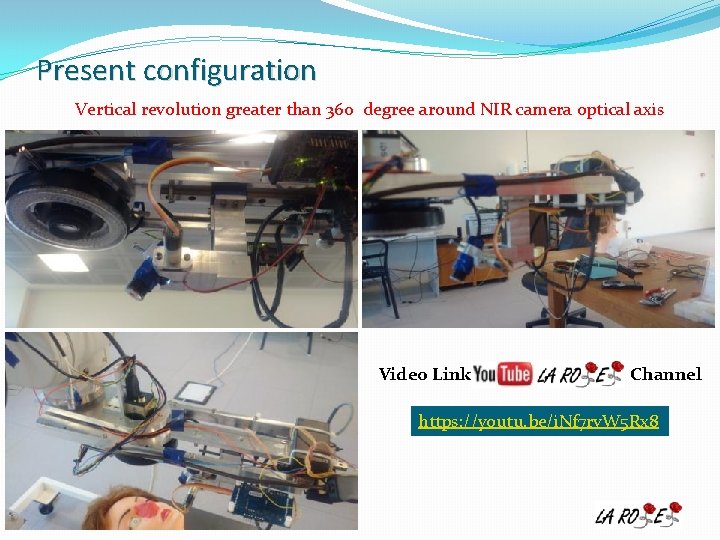
Present configuration Vertical revolution greater than 360 degree around NIR camera optical axis Video Link Channel https: //youtu. be/i. Nf 7 rv. W 5 Rx 8
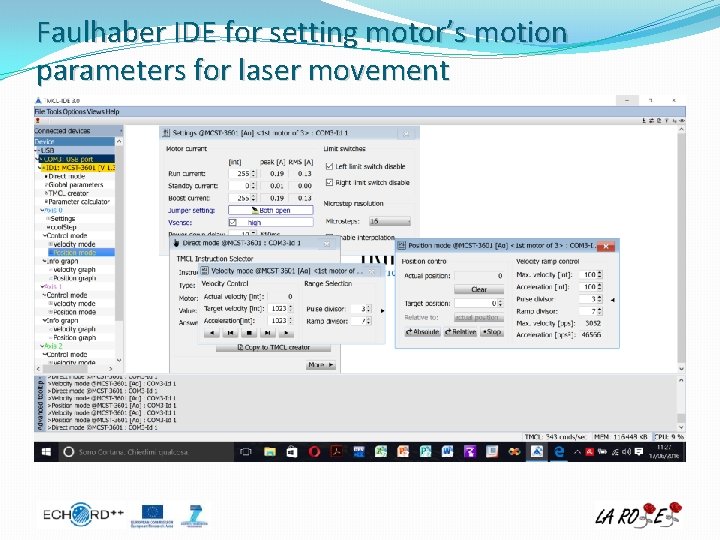
Faulhaber IDE for setting motor’s motion parameters for laser movement
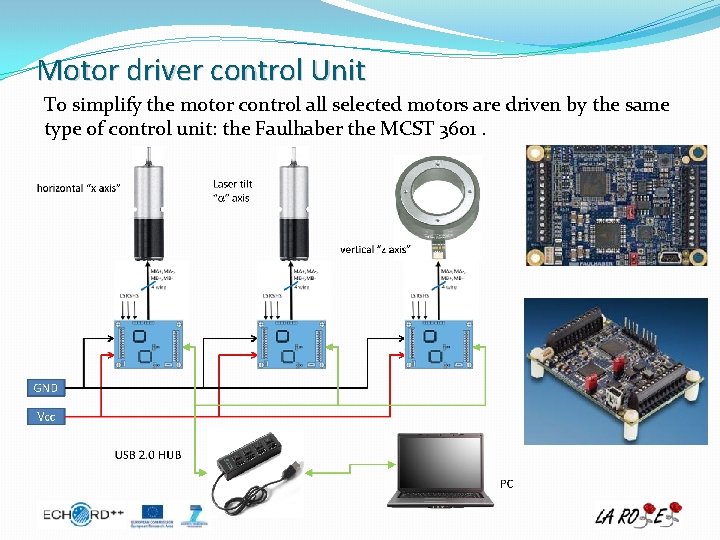
Motor driver control Unit To simplify the motor control all selected motors are driven by the same type of control unit: the Faulhaber the MCST 3601.
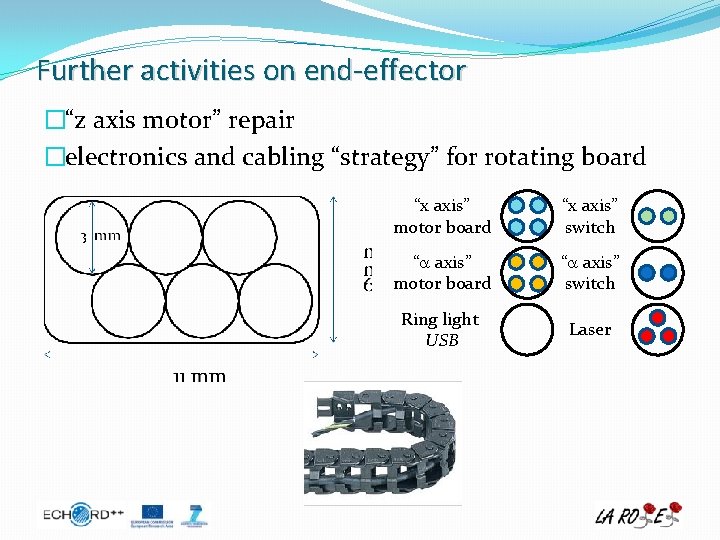
Further activities on end-effector �“z axis motor” repair �electronics and cabling “strategy” for rotating board “x axis” motor board “x axis” switch “a axis” motor board “a axis” switch Ring light USB Laser
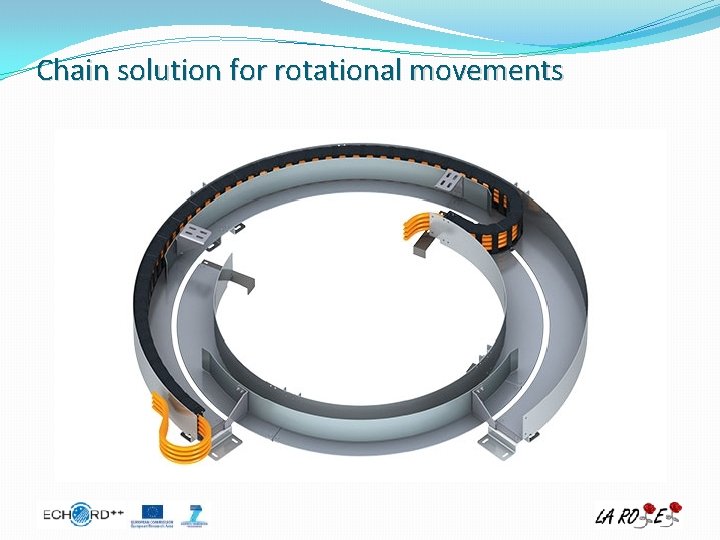
Chain solution for rotational movements
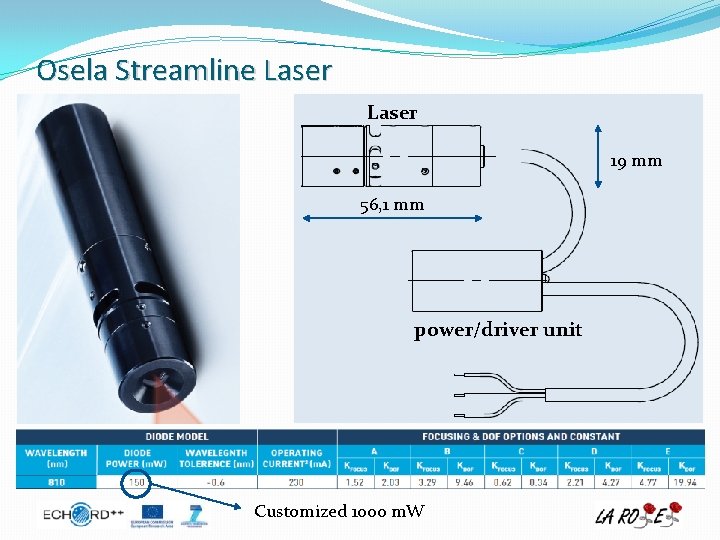
Osela Streamline Laser 19 mm 56, 1 mm power/driver unit Customized 1000 m. W
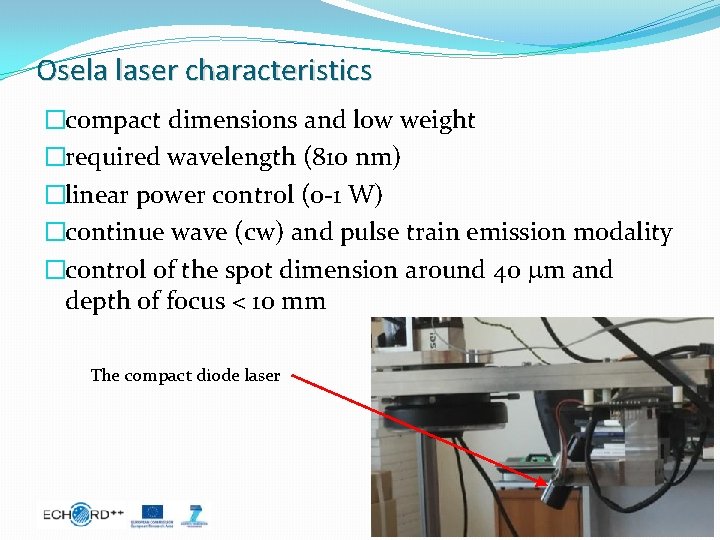
Osela laser characteristics �compact dimensions and low weight �required wavelength (810 nm) �linear power control (0 -1 W) �continue wave (cw) and pulse train emission modality �control of the spot dimension around 40 m and depth of focus < 10 mm The compact diode laser
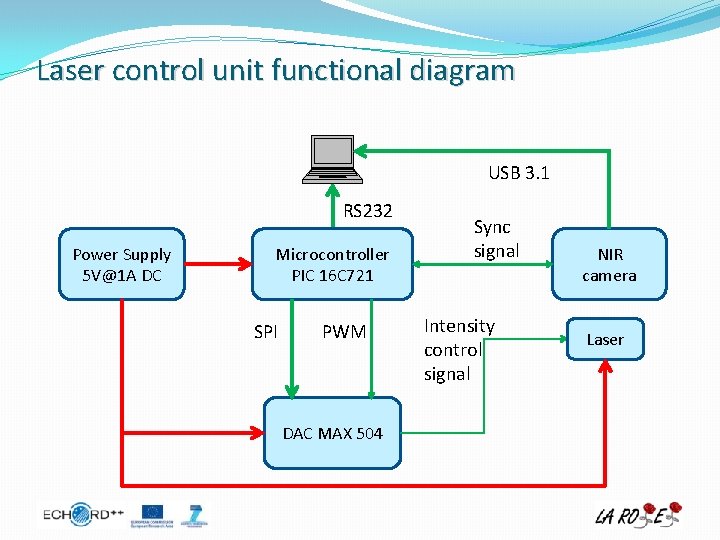
Laser control unit functional diagram USB 3. 1 RS 232 Power Supply 5 V@1 A DC Microcontroller PIC 16 C 721 SPI PWM DAC MAX 504 Sync signal Intensity control signal NIR camera Laser
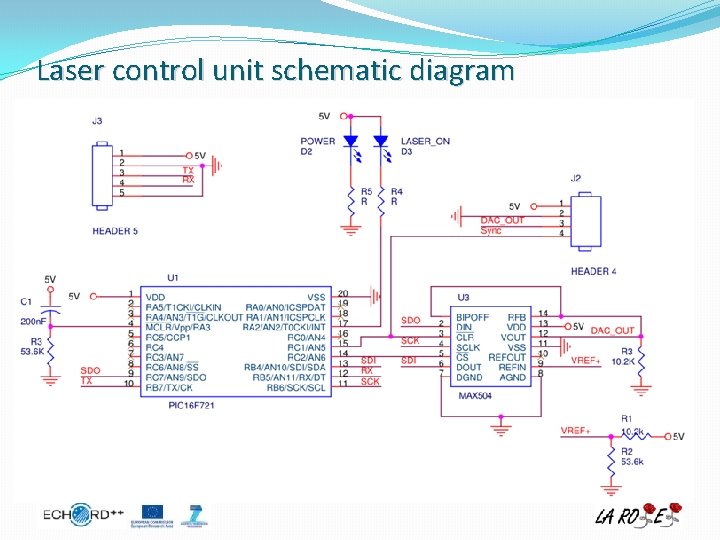
Laser control unit schematic diagram
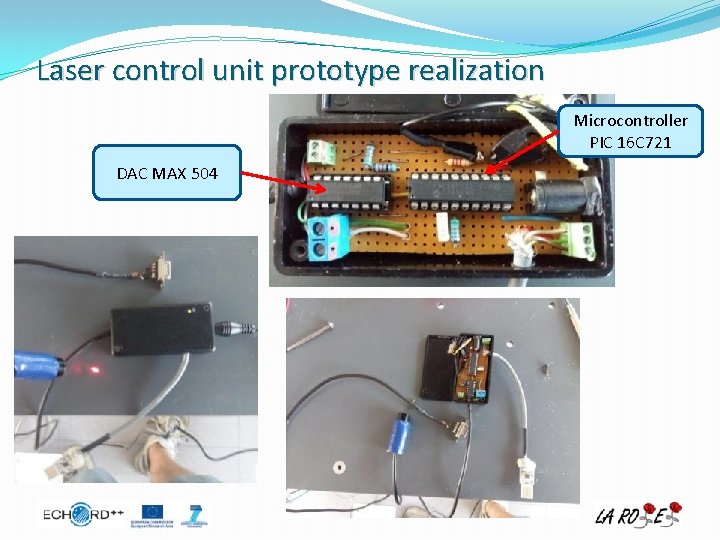
Laser control unit prototype realization Microcontroller PIC 16 C 721 DAC MAX 504
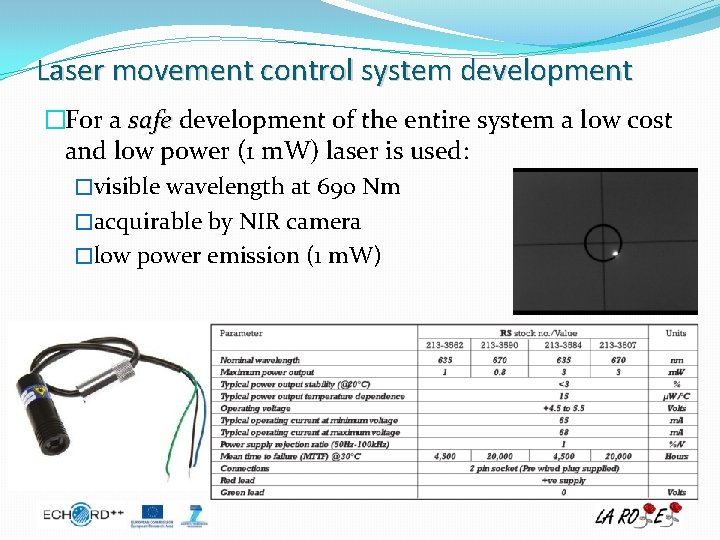
Laser movement control system development �For a safe development of the entire system a low cost and low power (1 m. W) laser is used: �visible wavelength at 690 Nm �acquirable by NIR camera �low power emission (1 m. W)
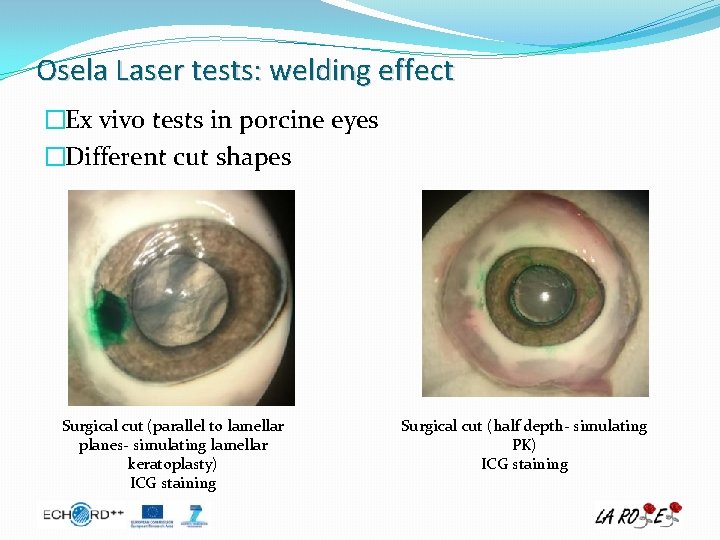
Osela Laser tests: welding effect �Ex vivo tests in porcine eyes �Different cut shapes Surgical cut (parallel to lamellar planes- simulating lamellar keratoplasty) ICG staining Surgical cut (half depth- simulating PK) ICG staining
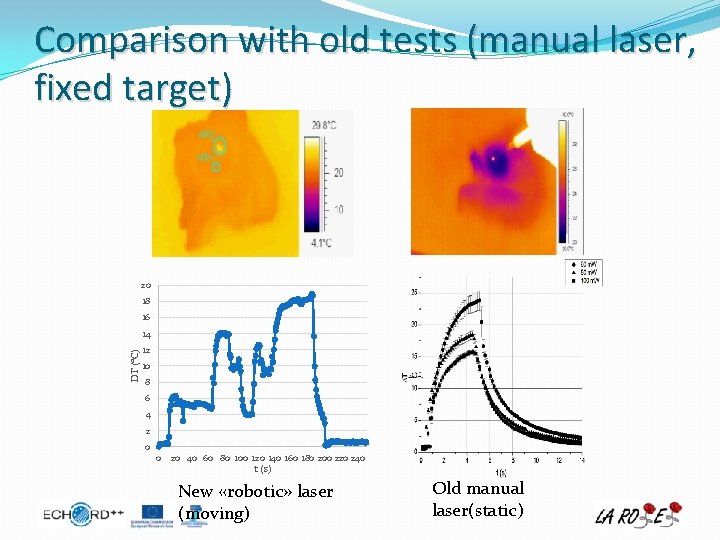
Comparison with old tests (manual laser, fixed target) 20 18 16 DT (°C) 14 12 10 8 6 4 2 0 0 20 40 60 80 100 120 140 160 180 200 220 240 t (s) New «robotic» laser (moving) Old manual laser(static)
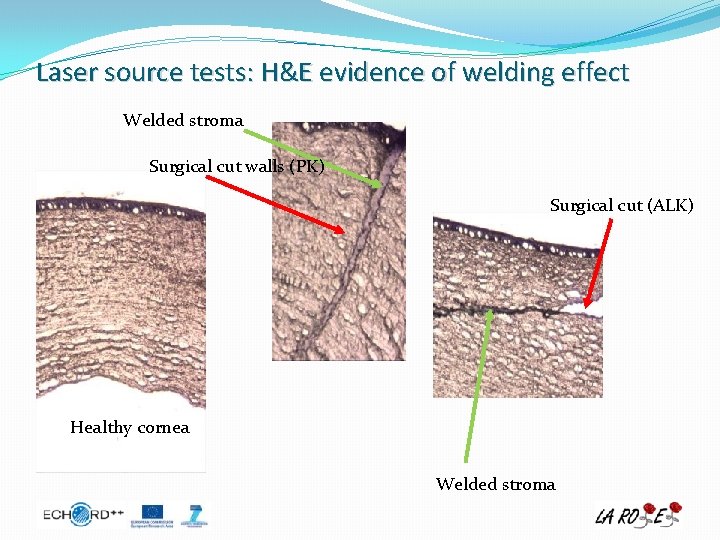
Laser source tests: H&E evidence of welding effect Welded stroma Surgical cut walls (PK) Surgical cut (ALK) Healthy cornea Welded stroma
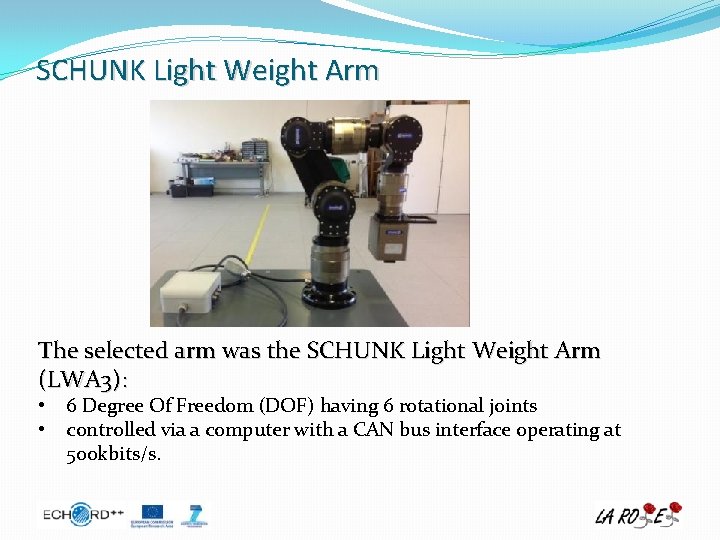
SCHUNK Light Weight Arm The selected arm was the SCHUNK Light Weight Arm (LWA 3): • • 6 Degree Of Freedom (DOF) having 6 rotational joints controlled via a computer with a CAN bus interface operating at 500 kbits/s.
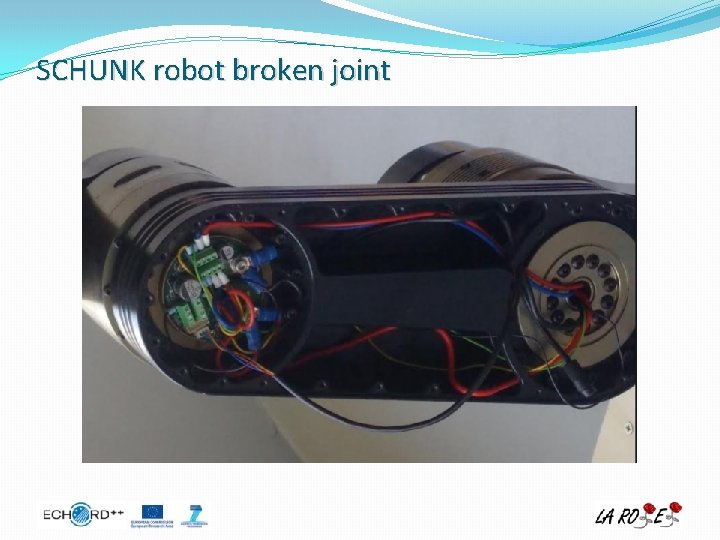
SCHUNK robot broken joint
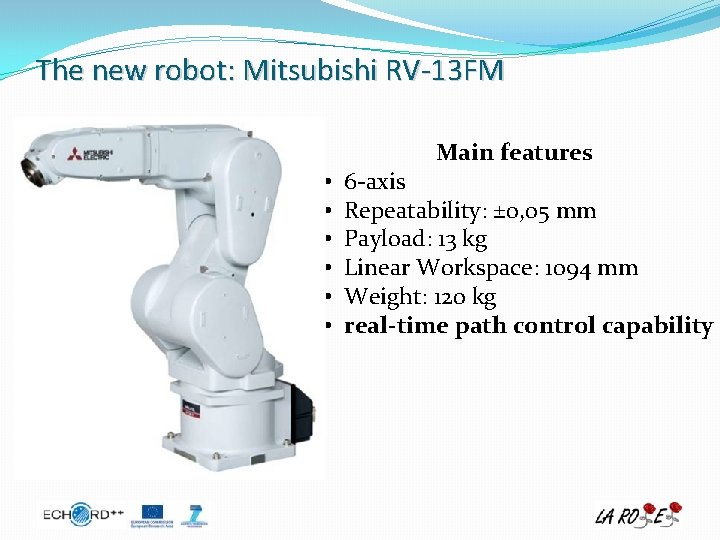
The new robot: Mitsubishi RV-13 FM Main features • • • 6 -axis Repeatability: ± 0, 05 mm Payload: 13 kg Linear Workspace: 1094 mm Weight: 120 kg real-time path control capability
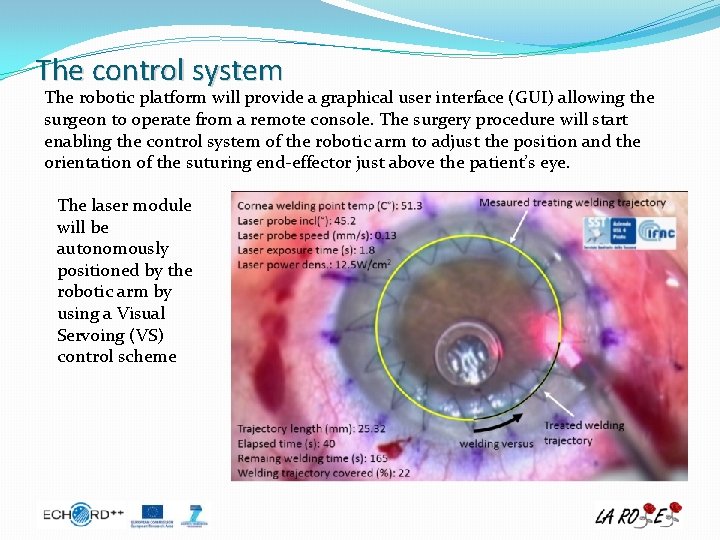
The control system The robotic platform will provide a graphical user interface (GUI) allowing the surgeon to operate from a remote console. The surgery procedure will start enabling the control system of the robotic arm to adjust the position and the orientation of the suturing end-effector just above the patient’s eye. The laser module will be autonomously positioned by the robotic arm by using a Visual Servoing (VS) control scheme
LA-ROSES robotic platform control strategy definition Welding trajectory detection The control system will detect and calculate the welding trajectory; then all the system parameters related to the welding process will be proposed to the surgeon check, before enabling the start command. Surgeon direct control However, the corneal welding task will not be fully autonomously executed by the robotic platform control system: the surgeon will have a direct control of the surgical procedure. “Collaborative” human-robot control paradigm � Surgeon robotic welding-task supervision: robot executes the welding task while the surgeon controls and adjusts (if needed) robot movements and laser parameters � Surgeon and robot can immediately stop the running welding-task. Human expert like a surgeon is, is more capable to handle unexpected scenarios, as opposed to an autonomous robot; at the same time, the robot control system could autonomously decide to stop the task in case of coming out about dangerous situations to preserve patients’ health.
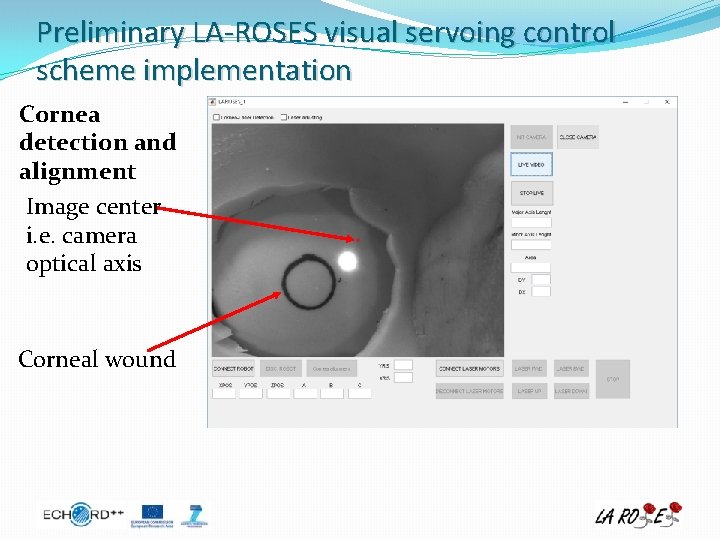
Preliminary LA-ROSES visual servoing control scheme implementation Cornea detection and alignment Image center i. e. camera optical axis Corneal wound
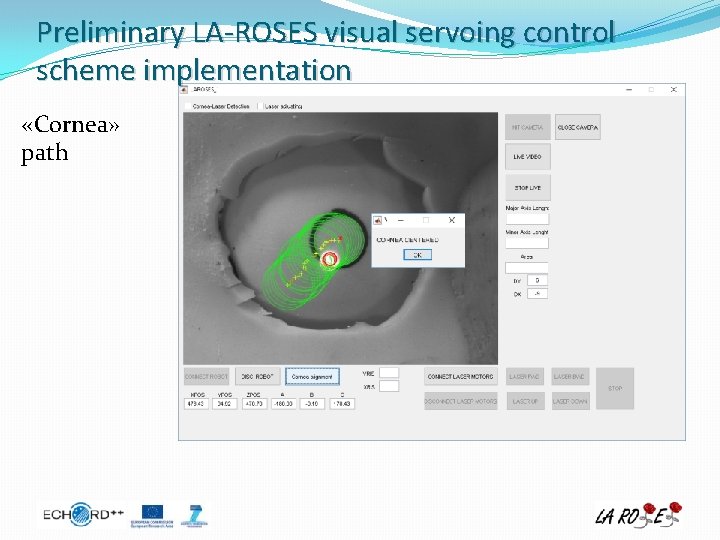
Preliminary LA-ROSES visual servoing control scheme implementation «Cornea» path
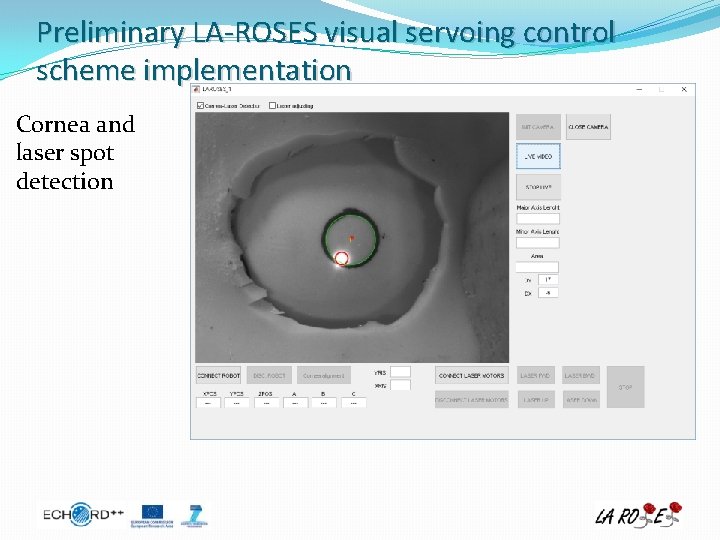
Preliminary LA-ROSES visual servoing control scheme implementation Cornea and laser spot detection
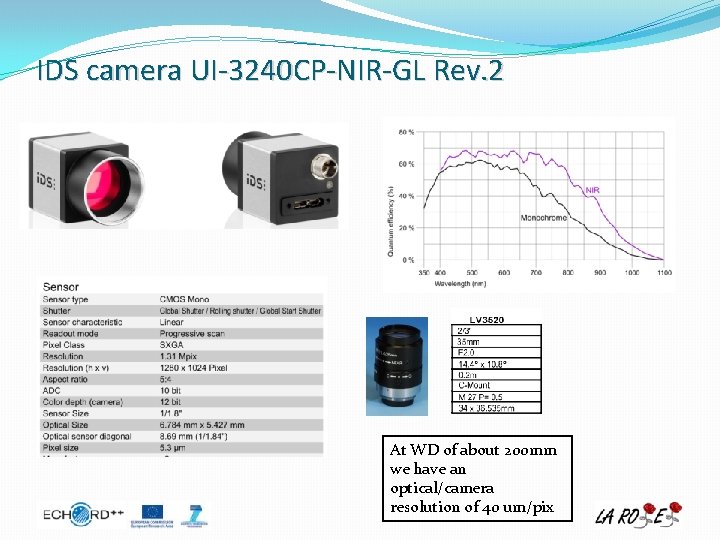
IDS camera UI-3240 CP-NIR-GL Rev. 2 At WD of about 200 mm we have an optical/camera resolution of 40 um/pix
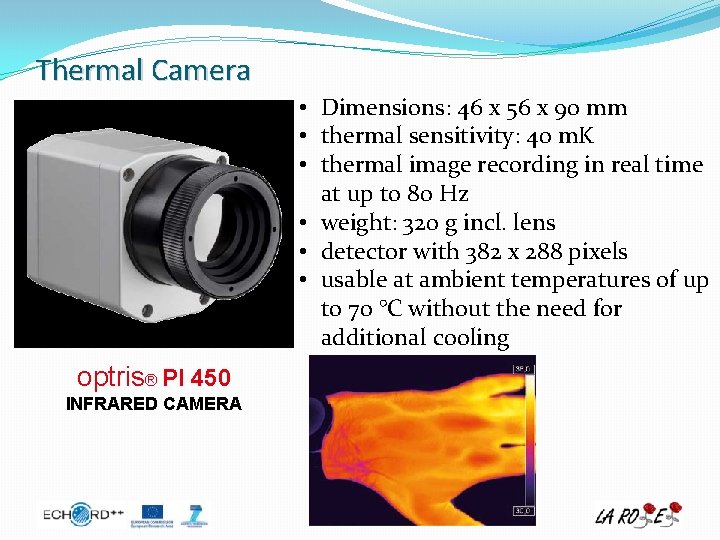
Thermal Camera • Dimensions: 46 x 56 x 90 mm • thermal sensitivity: 40 m. K • thermal image recording in real time at up to 80 Hz • weight: 320 g incl. lens • detector with 382 x 288 pixels • usable at ambient temperatures of up to 70 °C without the need for additional cooling optris® PI 450 INFRARED CAMERA
- Slides: 40