
Laser assisted bonding LADB thermal modeling with COMSOL
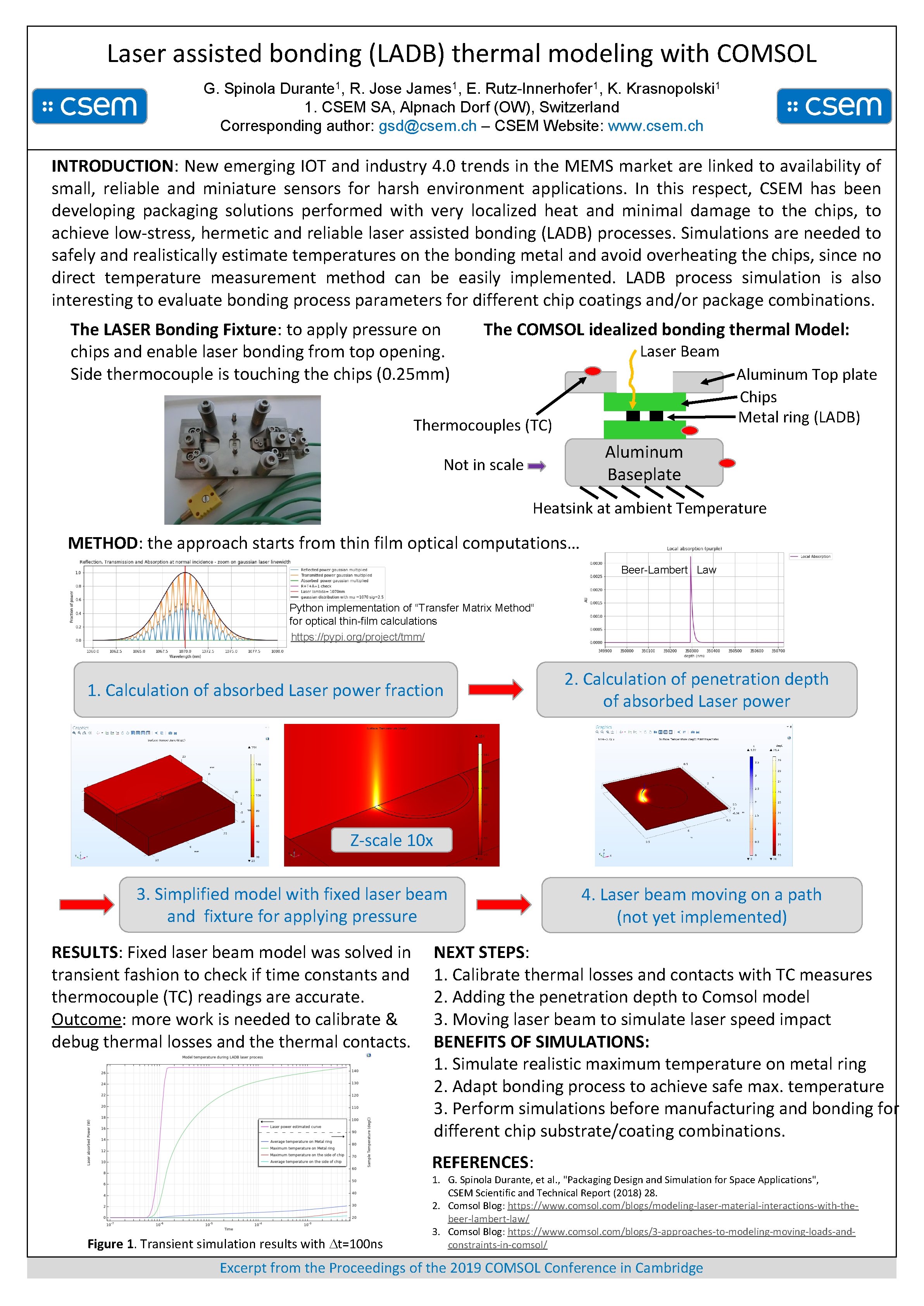
Laser assisted bonding (LADB) thermal modeling with COMSOL G. Spinola Durante 1, R. Jose James 1, E. Rutz-Innerhofer 1, K. Krasnopolski 1 1. CSEM SA, Alpnach Dorf (OW), Switzerland Corresponding author: gsd@csem. ch – CSEM Website: www. csem. ch INTRODUCTION: New emerging IOT and industry 4. 0 trends in the MEMS market are linked to availability of small, reliable and miniature sensors for harsh environment applications. In this respect, CSEM has been developing packaging solutions performed with very localized heat and minimal damage to the chips, to achieve low-stress, hermetic and reliable laser assisted bonding (LADB) processes. Simulations are needed to safely and realistically estimate temperatures on the bonding metal and avoid overheating the chips, since no direct temperature measurement method can be easily implemented. LADB process simulation is also interesting to evaluate bonding process parameters for different chip coatings and/or package combinations. The LASER Bonding Fixture: to apply pressure on chips and enable laser bonding from top opening. Side thermocouple is touching the chips (0. 25 mm) The COMSOL idealized bonding thermal Model: Laser Beam Aluminum Top plate Chips Metal ring (LADB) Thermocouples (TC) Aluminum Baseplate Not in scale Heatsink at ambient Temperature METHOD: the approach starts from thin film optical computations… Beer-Lambert Law Python implementation of “Transfer Matrix Method“ for optical thin-film calculations https: //pypi. org/project/tmm/ 1. Calculation of absorbed Laser power fraction 2. Calculation of penetration depth of absorbed Laser power Z-scale 10 x 3. Simplified model with fixed laser beam and fixture for applying pressure RESULTS: Fixed laser beam model was solved in transient fashion to check if time constants and thermocouple (TC) readings are accurate. Outcome: more work is needed to calibrate & debug thermal losses and thermal contacts. 4. Laser beam moving on a path (not yet implemented) NEXT STEPS: 1. Calibrate thermal losses and contacts with TC measures 2. Adding the penetration depth to Comsol model 3. Moving laser beam to simulate laser speed impact BENEFITS OF SIMULATIONS: 1. Simulate realistic maximum temperature on metal ring 2. Adapt bonding process to achieve safe max. temperature 3. Perform simulations before manufacturing and bonding for different chip substrate/coating combinations. REFERENCES: Figure 1. Transient simulation results with Dt=100 ns 1. G. Spinola Durante, et al. , "Packaging Design and Simulation for Space Applications", CSEM Scientific and Technical Report (2018) 28. 2. Comsol Blog: https: //www. comsol. com/blogs/modeling-laser-material-interactions-with-thebeer-lambert-law/ 3. Comsol Blog: https: //www. comsol. com/blogs/3 -approaches-to-modeling-moving-loads-andconstraints-in-comsol/ Excerpt from the Proceedings of the 2019 COMSOL Conference in Cambridge
- Slides: 1