
Laser and Penning Traps Richard Thompson Quantum Optics

- Slides: 40
Laser and Penning Traps Richard Thompson Quantum Optics and Laser Science Group Department of Physics Imperial College London www. imperial. ac. uk/ion-trapping
Richard Thompson AVA School 2020 Aims of the lecture I hope that at the end of this lecture you will: • Understand the principles of trapping atomic particles • Understand the basic physics of traps for neutral atoms • Know what a Penning trap is in more detail: • understand the mathematical description of the trapping mechanism • have an intuitive understanding of how the Penning trap works • know what features of the Penning trap make it attractive for certain types of applications • Have a sufficient understanding of trapping mechanisms and practicalities to give a suitable background to the work presented in this School Slide 2
Richard Thompson AVA School 2020 Outline of the lecture 1. The benefits of particle trapping 2. Atom and ion traps 3. The Penning Trap 1. 2. 3. 4. 5. Principles of Operation Properties of the trapped ions Design considerations Advantages and Disadvantages Practical Aspects 4. Conclusion Slide 3
Richard Thompson AVA School 2020 Trapping of atomic particles Why is it desirable to trap atomic particles for precision experiments? • Interaction time • Most precision studies involve a measurement of frequency • The relative precision of a frequency measurement is related to / so for high precision we need high and small • But is limited by the time taken by the measurement, T, and typically ~1/T so we need long T • Therefore we need a long interaction time, i. e. particle trapping • Absence of perturbations • For a precision measurement, the system must be isolated, stable and free of perturbations, e. g. collisions Slide 4
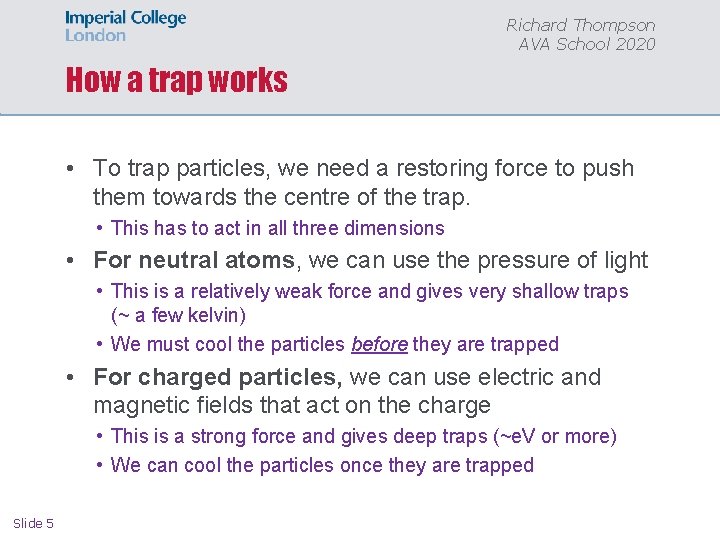
Richard Thompson AVA School 2020 How a trap works • To trap particles, we need a restoring force to push them towards the centre of the trap. • This has to act in all three dimensions • For neutral atoms, we can use the pressure of light • This is a relatively weak force and gives very shallow traps (~ a few kelvin) • We must cool the particles before they are trapped • For charged particles, we can use electric and magnetic fields that act on the charge • This is a strong force and gives deep traps (~e. V or more) • We can cool the particles once they are trapped Slide 5
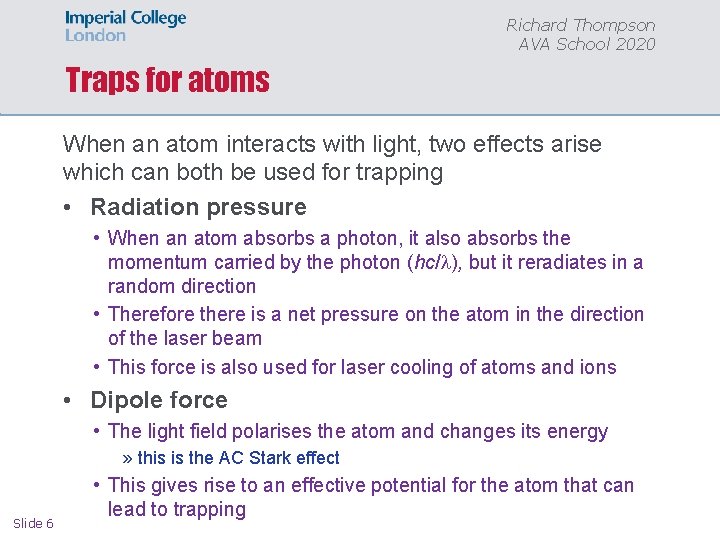
Richard Thompson AVA School 2020 Traps for atoms When an atom interacts with light, two effects arise which can both be used for trapping • Radiation pressure • When an atom absorbs a photon, it also absorbs the momentum carried by the photon (hc/ ), but it reradiates in a random direction • Therefore there is a net pressure on the atom in the direction of the laser beam • This force is also used for laser cooling of atoms and ions • Dipole force • The light field polarises the atom and changes its energy » this is the AC Stark effect Slide 6 • This gives rise to an effective potential for the atom that can lead to trapping
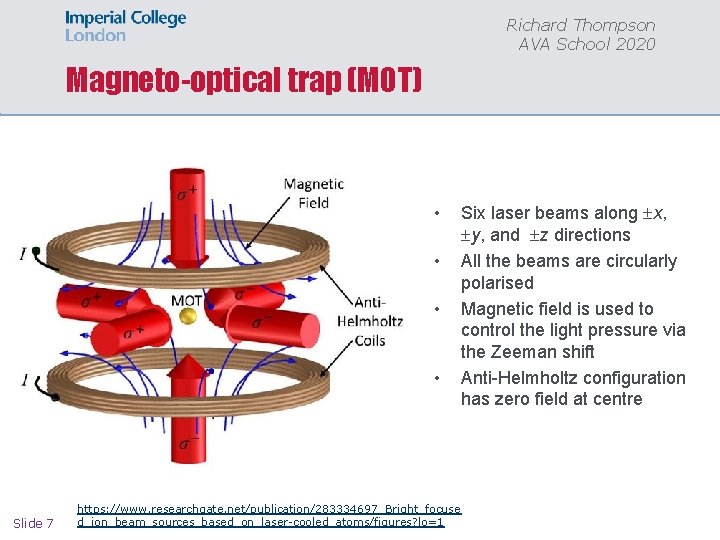
Richard Thompson AVA School 2020 Magneto-optical trap (MOT) • • Slide 7 https: //www. researchgate. net/publication/283334697_Bright_focuse d_ion_beam_sources_based_on_laser-cooled_atoms/figures? lo=1 Six laser beams along x, y, and z directions All the beams are circularly polarised Magnetic field is used to control the light pressure via the Zeeman shift Anti-Helmholtz configuration has zero field at centre
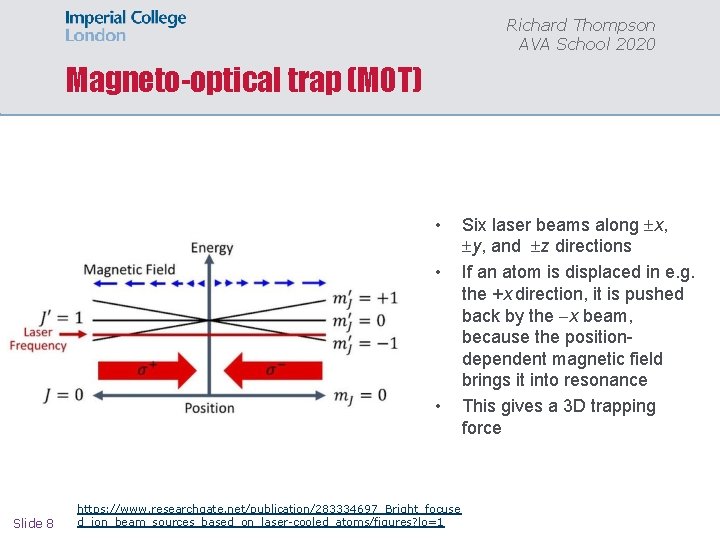
Richard Thompson AVA School 2020 Magneto-optical trap (MOT) • • • Slide 8 https: //www. researchgate. net/publication/283334697_Bright_focuse d_ion_beam_sources_based_on_laser-cooled_atoms/figures? lo=1 Six laser beams along x, y, and z directions If an atom is displaced in e. g. the +x direction, it is pushed back by the x beam, because the positiondependent magnetic field brings it into resonance This gives a 3 D trapping force
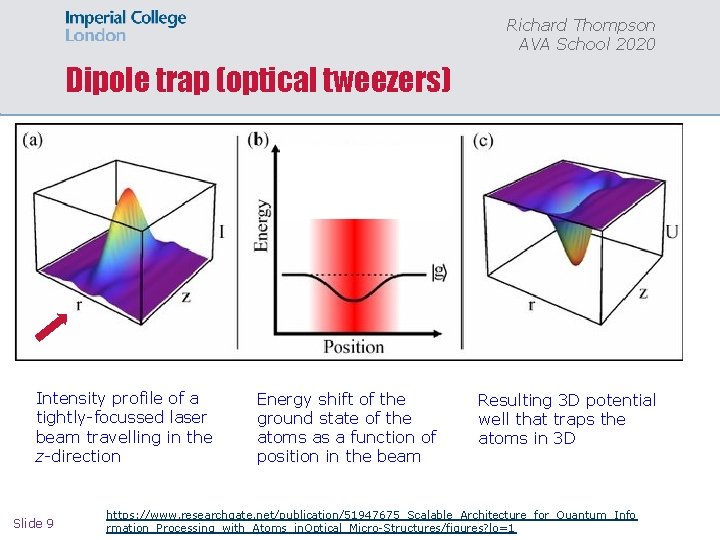
Richard Thompson AVA School 2020 Dipole trap (optical tweezers) • ff Intensity profile of a tightly-focussed laser beam travelling in the z-direction Slide 9 Energy shift of the ground state of the atoms as a function of position in the beam Resulting 3 D potential well that traps the atoms in 3 D https: //www. researchgate. net/publication/51947675_Scalable_Architecture_for_Quantum_Info rmation_Processing_with_Atoms_in. Optical_Micro-Structures/figures? lo=1
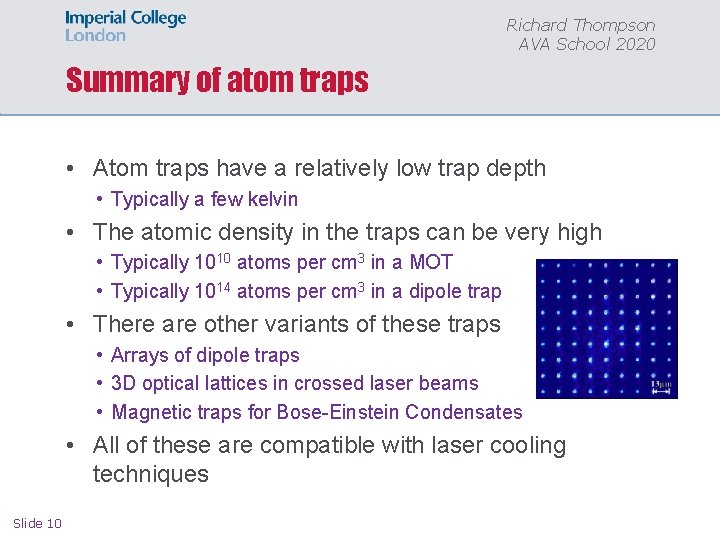
Richard Thompson AVA School 2020 Summary of atom traps • Atom traps have a relatively low trap depth • Typically a few kelvin • The atomic density in the traps can be very high • Typically 1010 atoms per cm 3 in a MOT • Typically 1014 atoms per cm 3 in a dipole trap • There are other variants of these traps • Arrays of dipole traps • 3 D optical lattices in crossed laser beams • Magnetic traps for Bose-Einstein Condensates • All of these are compatible with laser cooling techniques Slide 10
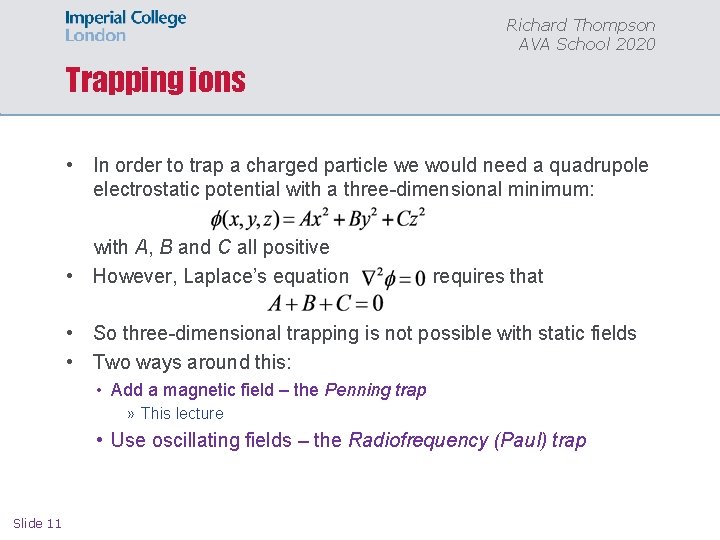
Richard Thompson AVA School 2020 Trapping ions • In order to trap a charged particle we would need a quadrupole electrostatic potential with a three-dimensional minimum: with A, B and C all positive • However, Laplace’s equation requires that • So three-dimensional trapping is not possible with static fields • Two ways around this: • Add a magnetic field – the Penning trap » This lecture • Use oscillating fields – the Radiofrequency (Paul) trap Slide 11
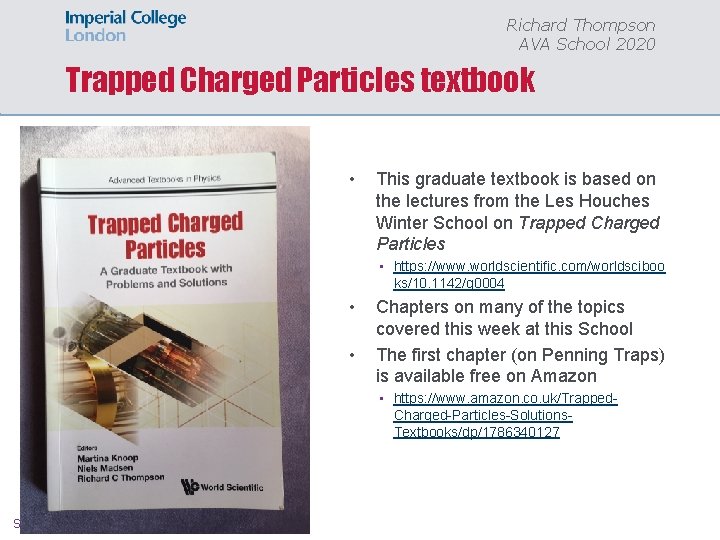
Richard Thompson AVA School 2020 Trapped Charged Particles textbook • This graduate textbook is based on the lectures from the Les Houches Winter School on Trapped Charged Particles • https: //www. worldscientific. com/worldsciboo ks/10. 1142/q 0004 • • Chapters on many of the topics covered this week at this School The first chapter (on Penning Traps) is available free on Amazon • https: //www. amazon. co. uk/Trapped. Charged-Particles-Solutions. Textbooks/dp/1786340127 Slide 12
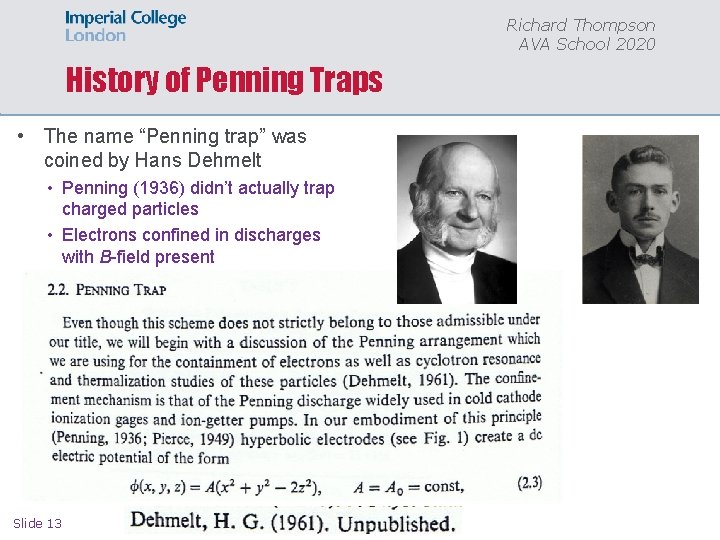
Richard Thompson AVA School 2020 History of Penning Traps • The name “Penning trap” was coined by Hans Dehmelt • Penning (1936) didn’t actually trap charged particles • Electrons confined in discharges with B-field present Slide 13
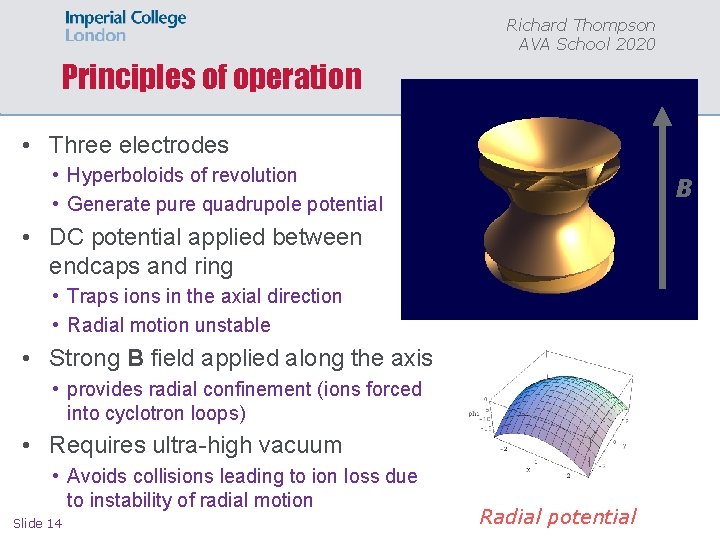
Richard Thompson AVA School 2020 Principles of operation • Three electrodes • Hyperboloids of revolution • Generate pure quadrupole potential B • DC potential applied between endcaps and ring • Traps ions in the axial direction • Radial motion unstable • Strong B field applied along the axis • provides radial confinement (ions forced into cyclotron loops) • Requires ultra-high vacuum • Avoids collisions leading to ion loss due to instability of radial motion Slide 14 Radial potential
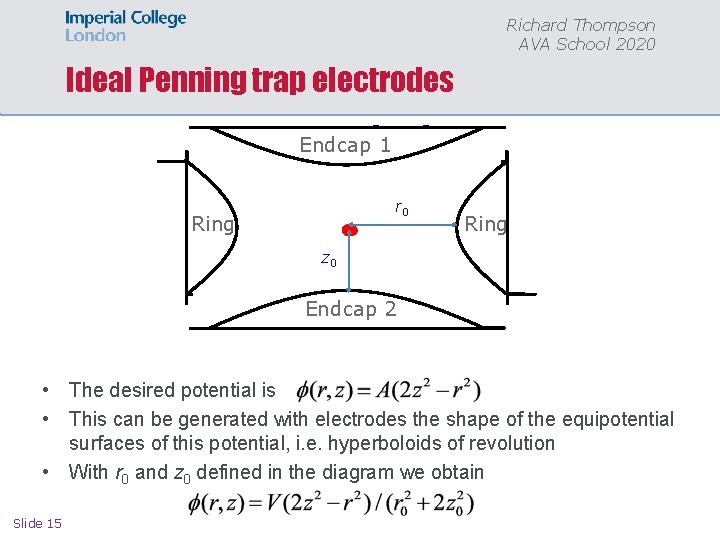
Richard Thompson AVA School 2020 Ideal Penning trap electrodes Endcap 1 r 0 Ring z 0 Endcap 2 • The desired potential is • This can be generated with electrodes the shape of the equipotential surfaces of this potential, i. e. hyperboloids of revolution • With r 0 and z 0 defined in the diagram we obtain Slide 15
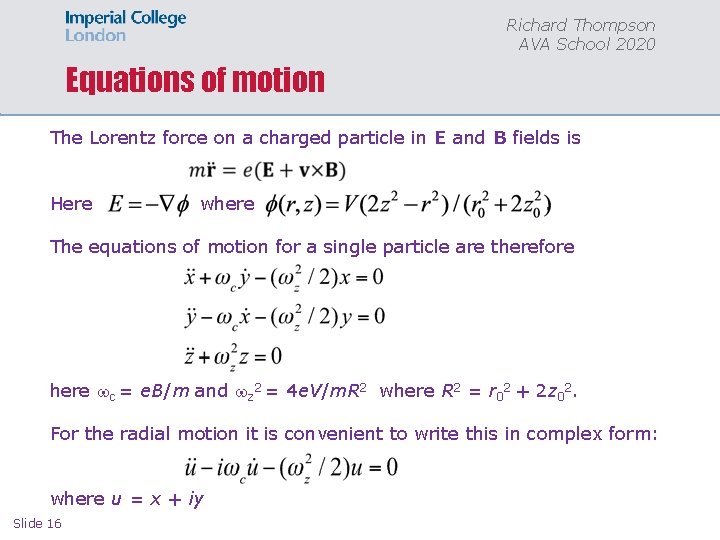
Richard Thompson AVA School 2020 Equations of motion The Lorentz force on a charged particle in E and B fields is Here where . The equations of motion for a single particle are therefore here c = e. B/m and z 2 = 4 e. V/m. R 2 where R 2 = r 02 + 2 z 02. For the radial motion it is convenient to write this in complex form: where u = x + iy Slide 16
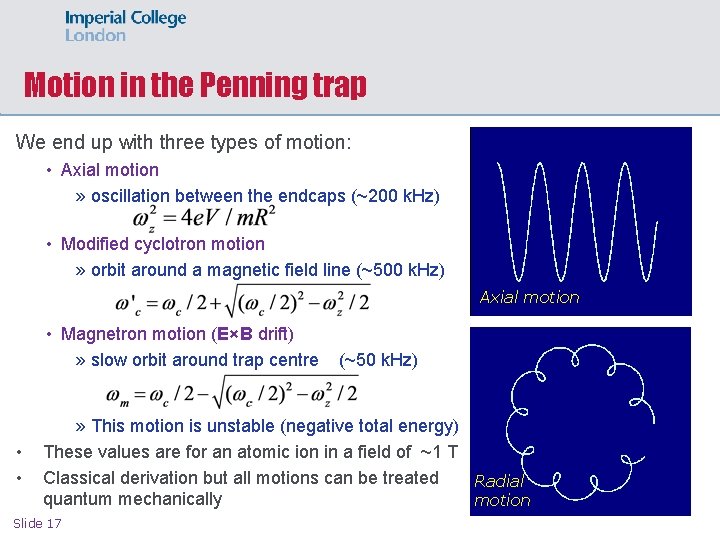
Motion in the Penning trap We end up with three types of motion: • Axial motion » oscillation between the endcaps (~200 k. Hz) • Modified cyclotron motion » orbit around a magnetic field line (~500 k. Hz) Axial motion • Magnetron motion (E×B drift) » slow orbit around trap centre • • (~50 k. Hz) » This motion is unstable (negative total energy) These values are for an atomic ion in a field of ~1 T Classical derivation but all motions can be treated Radial quantum mechanically motion Slide 17
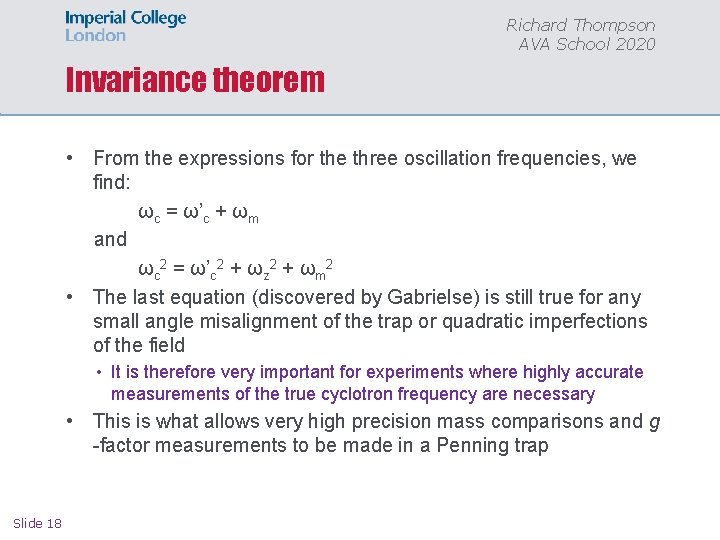
Richard Thompson AVA School 2020 Invariance theorem • From the expressions for the three oscillation frequencies, we find: ωc = ω’c + ωm and ωc 2 = ω’c 2 + ωz 2 + ωm 2 • The last equation (discovered by Gabrielse) is still true for any small angle misalignment of the trap or quadratic imperfections of the field • It is therefore very important for experiments where highly accurate measurements of the true cyclotron frequency are necessary • This is what allows very high precision mass comparisons and g -factor measurements to be made in a Penning trap Slide 18
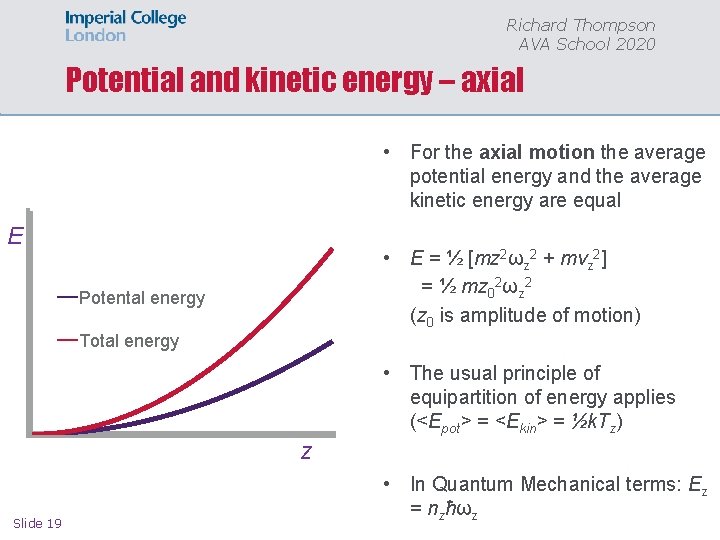
Richard Thompson AVA School 2020 Potential and kinetic energy – axial • For the axial motion the average potential energy and the average kinetic energy are equal E • E = ½ [mz 2ωz 2 + mvz 2] = ½ mz 02ωz 2 (z 0 is amplitude of motion) Potental energy Total energy • The usual principle of equipartition of energy applies (<Epot> = <Ekin> = ½k. Tz) z Slide 19 • In Quantum Mechanical terms: Ez = nzħωz
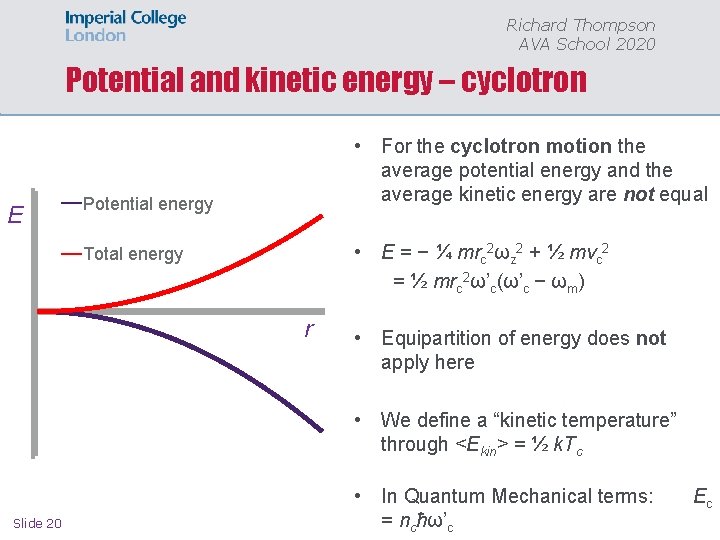
Richard Thompson AVA School 2020 Potential and kinetic energy – cyclotron E • For the cyclotron motion the average potential energy and the average kinetic energy are not equal Potential energy • E = − ¼ mrc 2ωz 2 + ½ mvc 2 = ½ mrc 2ω’c(ω’c − ωm) Total energy r • Equipartition of energy does not apply here • We define a “kinetic temperature” through <Ekin> = ½ k. Tc Slide 20 • In Quantum Mechanical terms: = ncħω’c Ec
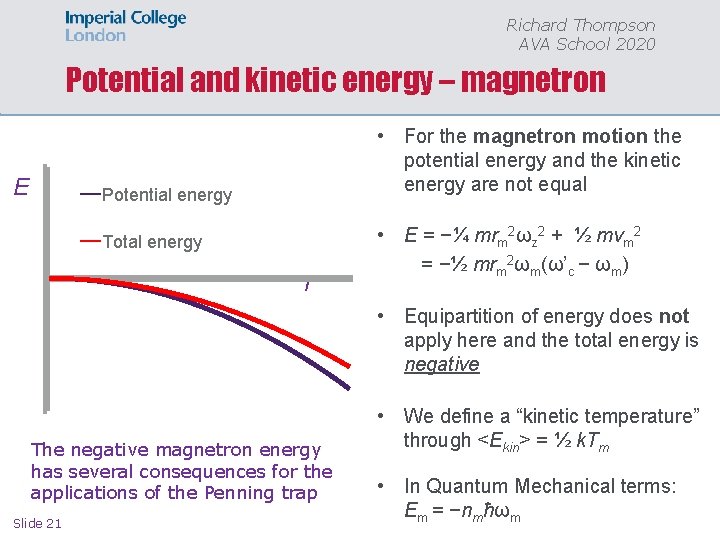
Richard Thompson AVA School 2020 Potential and kinetic energy – magnetron E • For the magnetron motion the potential energy and the kinetic energy are not equal Potential energy Total energy r • E = −¼ mrm 2ωz 2 + ½ mvm 2 = −½ mrm 2ωm(ω’c − ωm) • Equipartition of energy does not apply here and the total energy is negative The negative magnetron energy has several consequences for the applications of the Penning trap Slide 21 • We define a “kinetic temperature” through <Ekin> = ½ k. Tm • In Quantum Mechanical terms: Em = −nmħωm
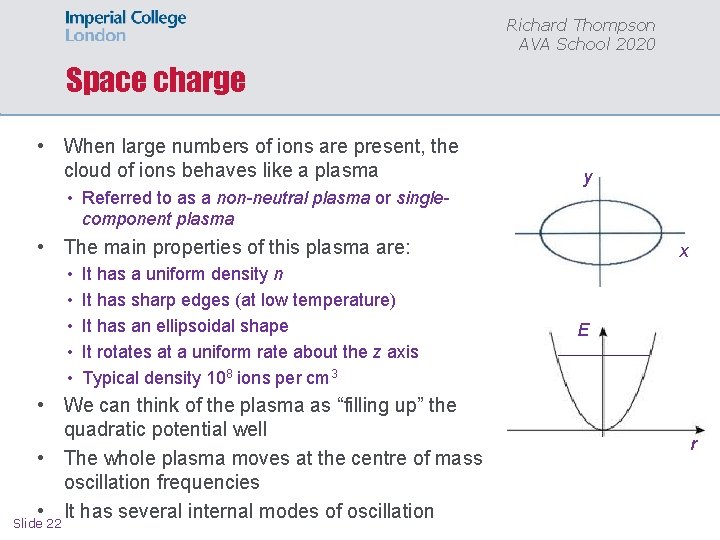
Richard Thompson AVA School 2020 Space charge • When large numbers of ions are present, the cloud of ions behaves like a plasma y • Referred to as a non-neutral plasma or singlecomponent plasma • The main properties of this plasma are: • • • It has a uniform density n It has sharp edges (at low temperature) It has an ellipsoidal shape It rotates at a uniform rate about the z axis Typical density 108 ions per cm 3 • We can think of the plasma as “filling up” the quadratic potential well • The whole plasma moves at the centre of mass oscillation frequencies • It has several internal modes of oscillation Slide 22 x E r
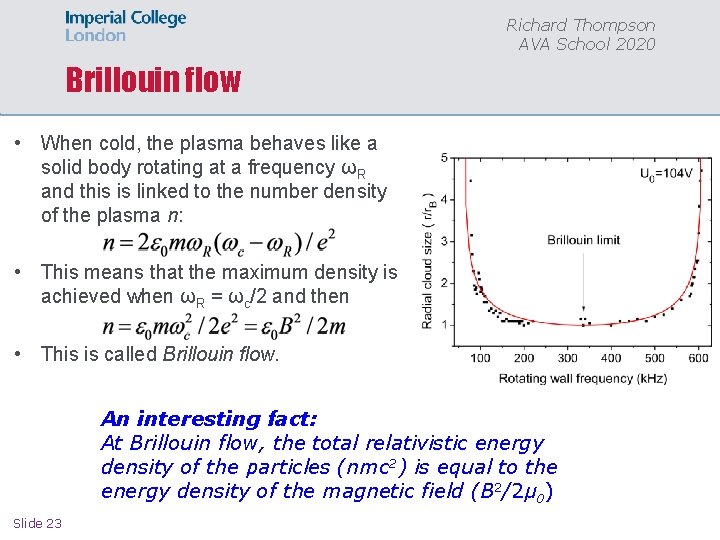
Richard Thompson AVA School 2020 Brillouin flow • When cold, the plasma behaves like a solid body rotating at a frequency ωR and this is linked to the number density of the plasma n: • This means that the maximum density is achieved when ωR = ωc/2 and then • This is called Brillouin flow. An interesting fact: At Brillouin flow, the total relativistic energy density of the particles (nmc 2) is equal to the energy density of the magnetic field (B 2/2μ 0) Slide 23
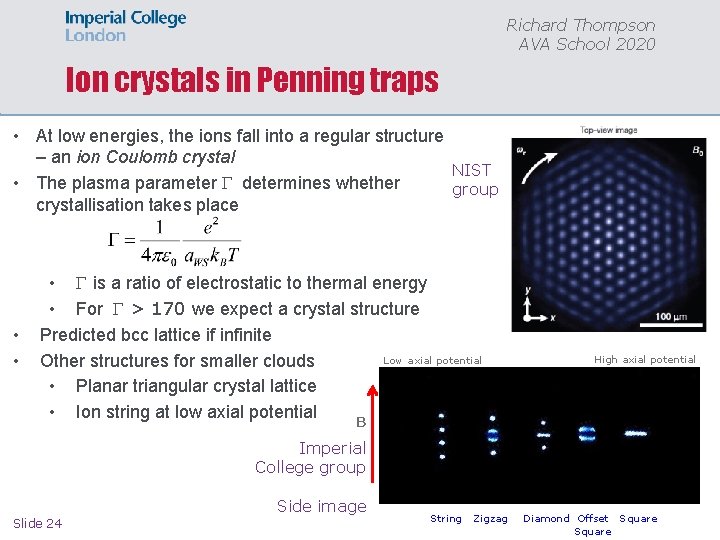
Richard Thompson AVA School 2020 Ion crystals in Penning traps • At low energies, the ions fall into a regular structure – an ion Coulomb crystal NIST • The plasma parameter determines whether group crystallisation takes place • • • is a ratio of electrostatic to thermal energy • For > 170 we expect a crystal structure Predicted bcc lattice if infinite Low axial potential Other structures for smaller clouds • Planar triangular crystal lattice • Ion string at low axial potential B High axial potential Imperial College group Side image Slide 24 String Zigzag Diamond Offset Square
Richard Thompson AVA School 2020 Design considerations The standard electrode design is hard to manufacture and has limited access for light and ion beams The design can be simplified for easier manufacture and better access Many groups now use a carefullydesigned stack of hollow cylindrical electrodes for easy access in a superconducting magnet Slide 25
Richard Thompson AVA School 2020 Experiments that use Penning traps • “Classical” • • Mass spectrometry Electron g− 2 Non-neutral plasmas Antihydrogen production • Laser cooling • • • Slide 26 Doppler cooling Sideband cooling Sympathetic cooling Spectroscopy Ion Coulomb crystals • “Quantum” • Quantum jumps • Quantum optics • Quantum information • Frequency standards • Ultra-high resolution spectroscopy • Microwave and optical frequency standards
Richard Thompson AVA School 2020 Advantages and disadvantages Penning traps offer a very unusual environment for experiments. They are well suited for experiments on fundamental particles or atomic ions, with one particle or many particles They allow some experiments to be performed that would be difficult or impossible in other systems. What are the particular advantages and disadvantages that they offer? Slide 27
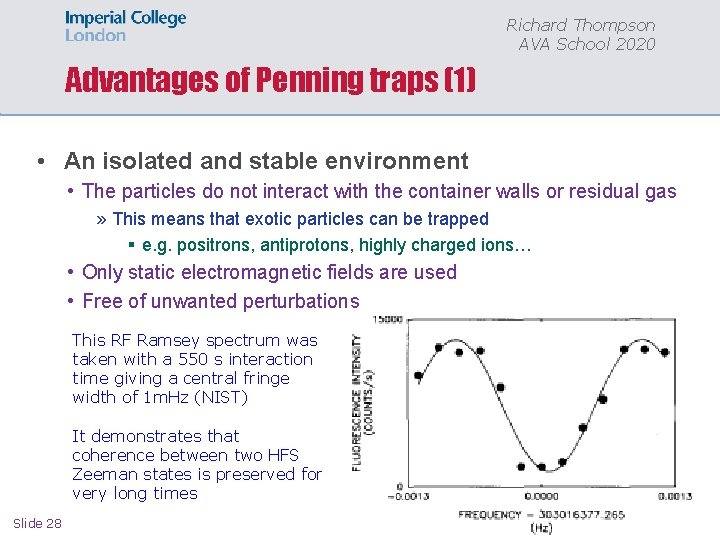
Richard Thompson AVA School 2020 Advantages of Penning traps (1) • An isolated and stable environment • The particles do not interact with the container walls or residual gas » This means that exotic particles can be trapped § e. g. positrons, antiprotons, highly charged ions… • Only static electromagnetic fields are used • Free of unwanted perturbations This RF Ramsey spectrum was taken with a 550 s interaction time giving a central fringe width of 1 m. Hz (NIST) It demonstrates that coherence between two HFS Zeeman states is preserved for very long times Slide 28
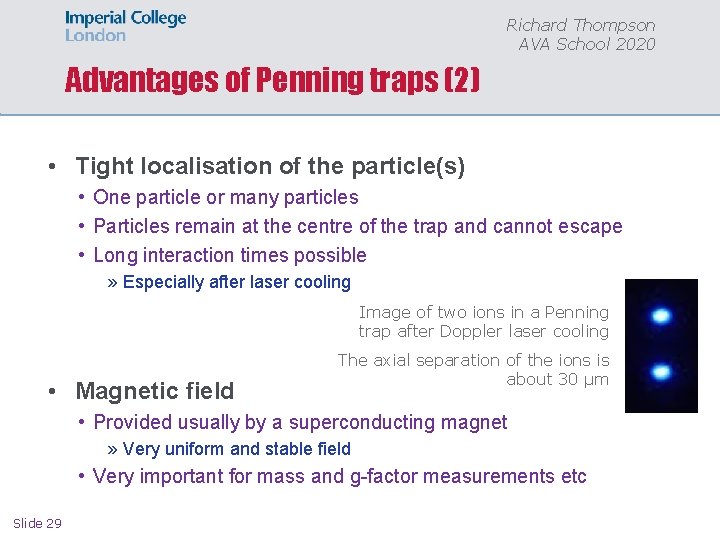
Richard Thompson AVA School 2020 Advantages of Penning traps (2) • Tight localisation of the particle(s) • One particle or many particles • Particles remain at the centre of the trap and cannot escape • Long interaction times possible » Especially after laser cooling Image of two ions in a Penning trap after Doppler laser cooling • Magnetic field The axial separation of the ions is about 30 μm • Provided usually by a superconducting magnet » Very uniform and stable field • Very important for mass and g-factor measurements etc Slide 29
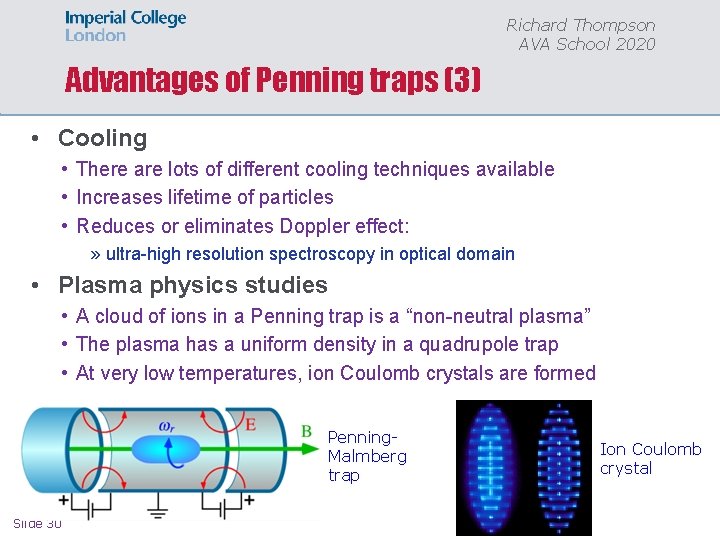
Richard Thompson AVA School 2020 Advantages of Penning traps (3) • Cooling • There are lots of different cooling techniques available • Increases lifetime of particles • Reduces or eliminates Doppler effect: » ultra-high resolution spectroscopy in optical domain • Plasma physics studies • A cloud of ions in a Penning trap is a “non-neutral plasma” • The plasma has a uniform density in a quadrupole trap • At very low temperatures, ion Coulomb crystals are formed Penning. Malmberg trap Slide 30 Ion Coulomb crystal
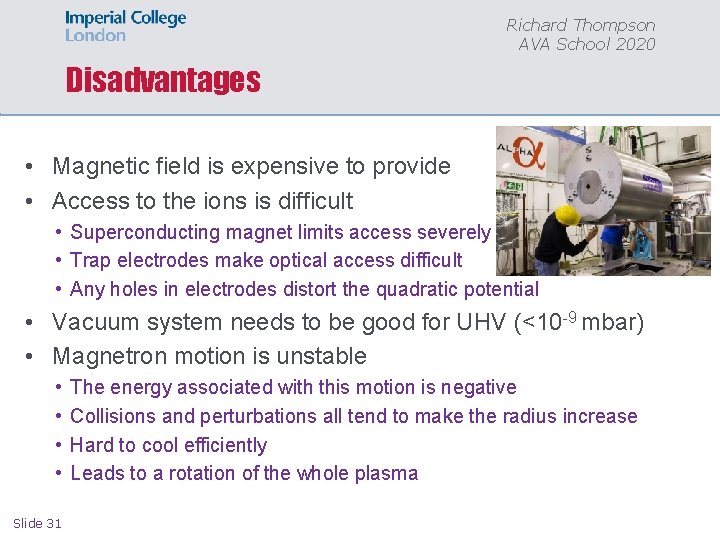
Richard Thompson AVA School 2020 Disadvantages • Magnetic field is expensive to provide • Access to the ions is difficult • Superconducting magnet limits access severely • Trap electrodes make optical access difficult • Any holes in electrodes distort the quadratic potential • Vacuum system needs to be good for UHV (<10 -9 mbar) • Magnetron motion is unstable • • Slide 31 The energy associated with this motion is negative Collisions and perturbations all tend to make the radius increase Hard to cool efficiently Leads to a rotation of the whole plasma
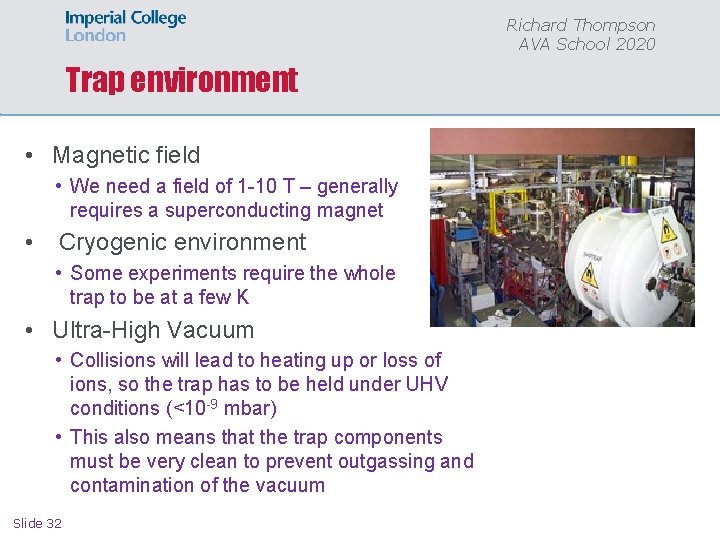
Richard Thompson AVA School 2020 Trap environment • Magnetic field • We need a field of 1 -10 T – generally requires a superconducting magnet • Cryogenic environment • Some experiments require the whole trap to be at a few K • Ultra-High Vacuum • Collisions will lead to heating up or loss of ions, so the trap has to be held under UHV conditions (<10 -9 mbar) • This also means that the trap components must be very clean to prevent outgassing and contamination of the vacuum Slide 32
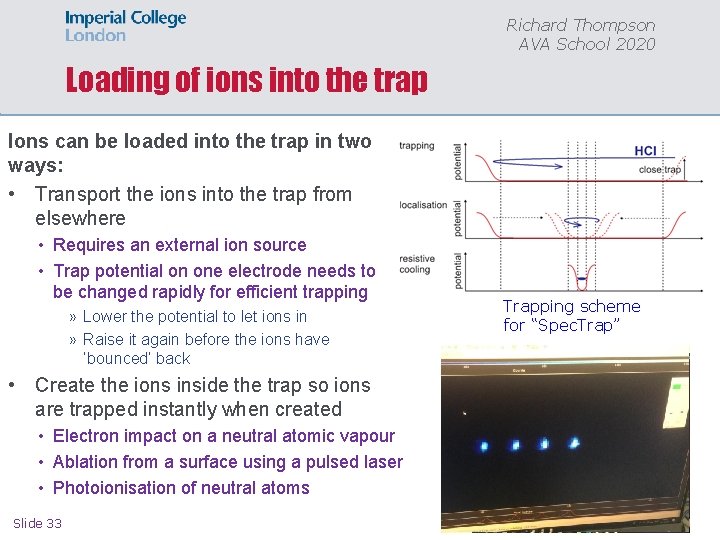
Richard Thompson AVA School 2020 Loading of ions into the trap Ions can be loaded into the trap in two ways: • Transport the ions into the trap from elsewhere • Requires an external ion source • Trap potential on one electrode needs to be changed rapidly for efficient trapping » Lower the potential to let ions in » Raise it again before the ions have ‘bounced’ back • Create the ions inside the trap so ions are trapped instantly when created • Electron impact on a neutral atomic vapour • Ablation from a surface using a pulsed laser • Photoionisation of neutral atoms Slide 33 Trapping scheme for “Spec. Trap”
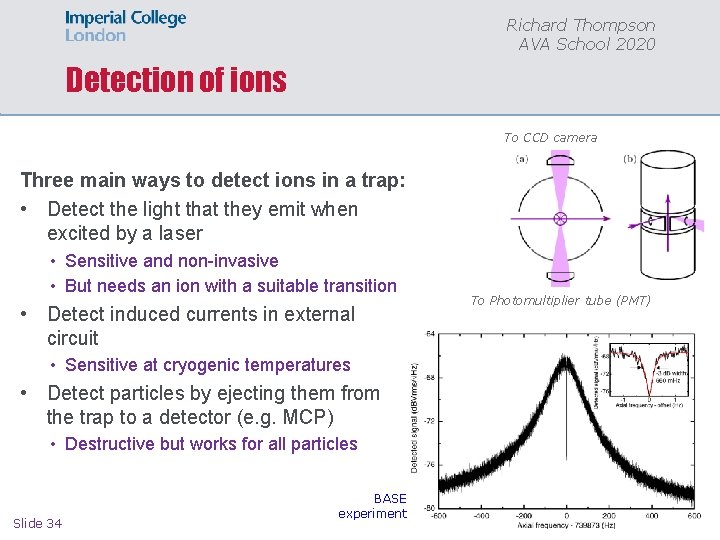
Richard Thompson AVA School 2020 Detection of ions To CCD camera Three main ways to detect ions in a trap: • Detect the light that they emit when excited by a laser • Sensitive and non-invasive • But needs an ion with a suitable transition • Detect induced currents in external circuit • Sensitive at cryogenic temperatures • Detect particles by ejecting them from the trap to a detector (e. g. MCP) • Destructive but works for all particles Slide 34 BASE experiment To Photomultiplier tube (PMT)
Richard Thompson AVA School 2020 Cooling Several ways to reduce the energy of trapped particles: • Buffer gas cooling • Allow the ions to interact with an inert buffer gas at room temp. • Works for cyclotron and axial but not magnetron motion • Radiative cooling • For electrons/positrons at high energy for the cyclotron motion • Resistive cooling • Extracts energy from the ions when they induce currents in an external circuit (mainly axial and cyclotron) • can cool to a few K if apparatus is at liquid helium temperature • Laser cooling • Very effective if suitable transition available • Can cool to ~1 m. K or lower • Sympathetic cooling Slide 35 • Ions mixed with a laser-cooled species are cooled through collisions
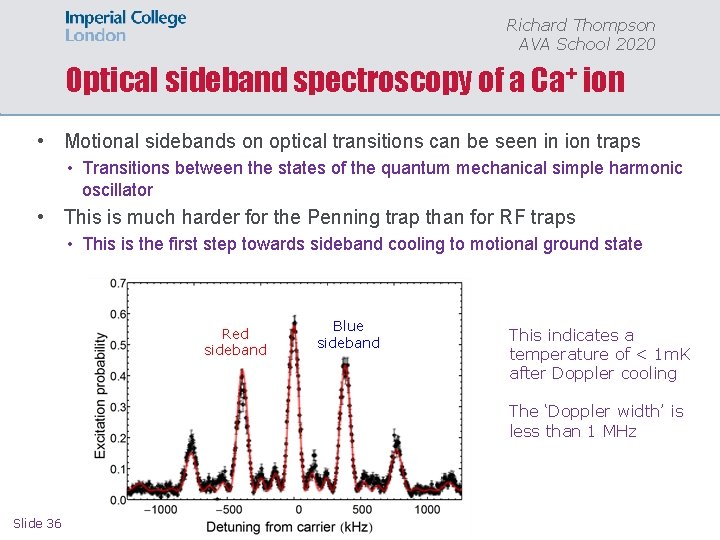
Richard Thompson AVA School 2020 Optical sideband spectroscopy of a Ca+ ion • Motional sidebands on optical transitions can be seen in ion traps • Transitions between the states of the quantum mechanical simple harmonic oscillator • This is much harder for the Penning trap than for RF traps • This is the first step towards sideband cooling to motional ground state Red sideband Blue sideband This indicates a temperature of < 1 m. K after Doppler cooling The ‘Doppler width’ is less than 1 MHz Slide 36
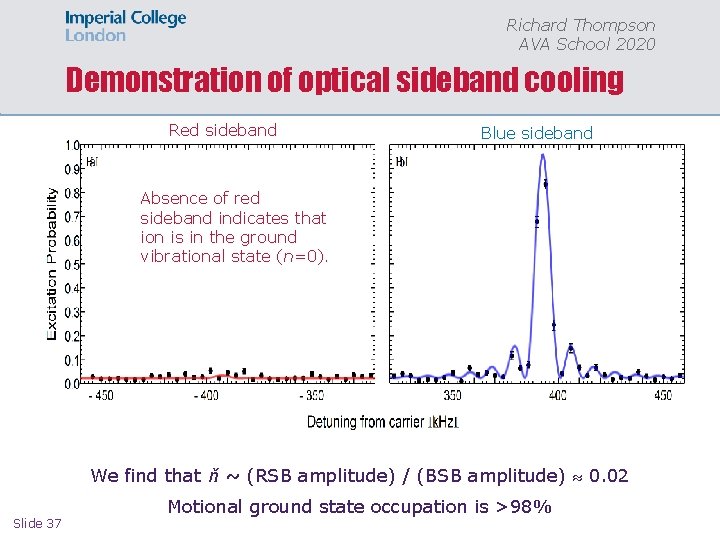
Richard Thompson AVA School 2020 Demonstration of optical sideband cooling Red sideband Blue sideband Absence of red sideband indicates that ion is in the ground vibrational state (n=0). We find that ň ~ (RSB amplitude) / (BSB amplitude) 0. 02 Slide 37 Motional ground state occupation is >98%
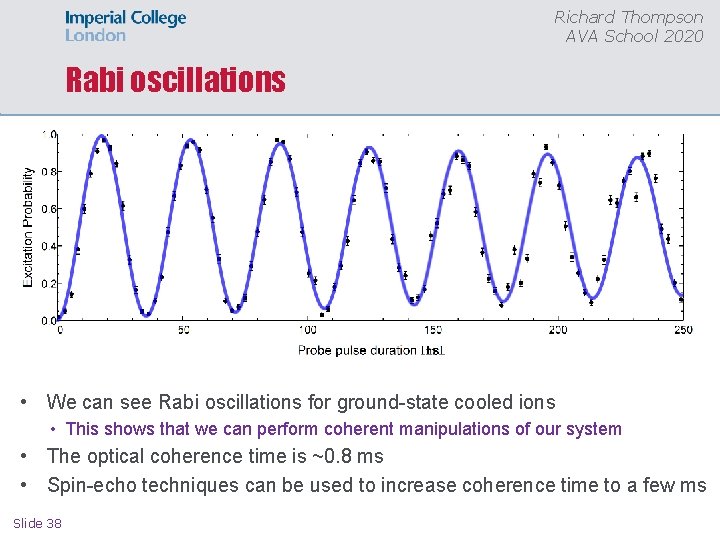
Richard Thompson AVA School 2020 Rabi oscillations • We can see Rabi oscillations for ground-state cooled ions • This shows that we can perform coherent manipulations of our system • The optical coherence time is ~0. 8 ms • Spin-echo techniques can be used to increase coherence time to a few ms Slide 38
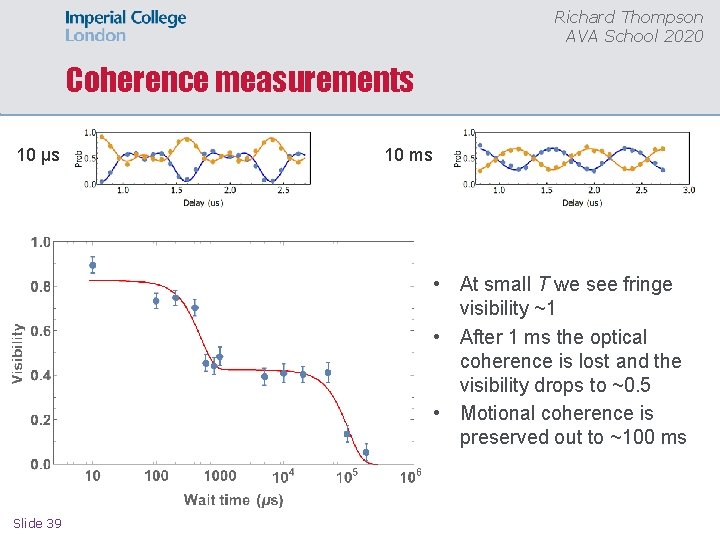
Richard Thompson AVA School 2020 Coherence measurements 10 μs 10 ms • At small T we see fringe visibility ~1 • After 1 ms the optical coherence is lost and the visibility drops to ~0. 5 • Motional coherence is preserved out to ~100 ms Slide 39
Richard Thompson AVA School 2020 Summary of the Lecture • Trapping techniques are very important for many precision measurements with fundamental particles, atoms and ions • In particular, the Penning trap is an elegant device with many excellent features for experiments in physics • Especially precision measurements, due to the extreme isolation • It makes possible experiments that would otherwise not be possible • Especially those involving delicate quantum effects • In the rest of the School you will see some of the different areas of physics where they are used. Slide 40