
Laser Alignment System for Lumi Cal and Beam

Laser Alignment System for Lumi. Cal and Beam. Cal Arkadiusz Moszczyński, Wojciech Wierba, Leszek Zawiejski Institute of Nuclear Physics PAN, Cracow 22 nd FCAL Workshop, 29 -30. 04. 2013, Cracow
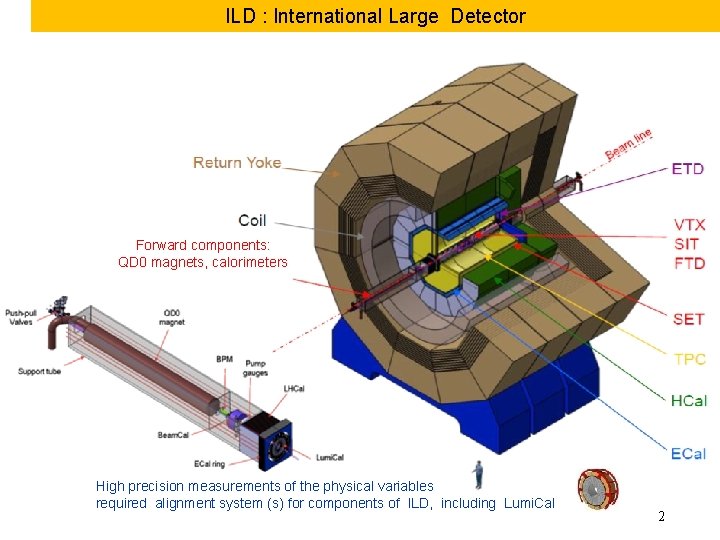
ILD : International Large Detector Forward components: QD 0 magnets, calorimeters High precision measurements of the physical variables required alignment system (s) for components of ILD, including Lumi. Cal 2
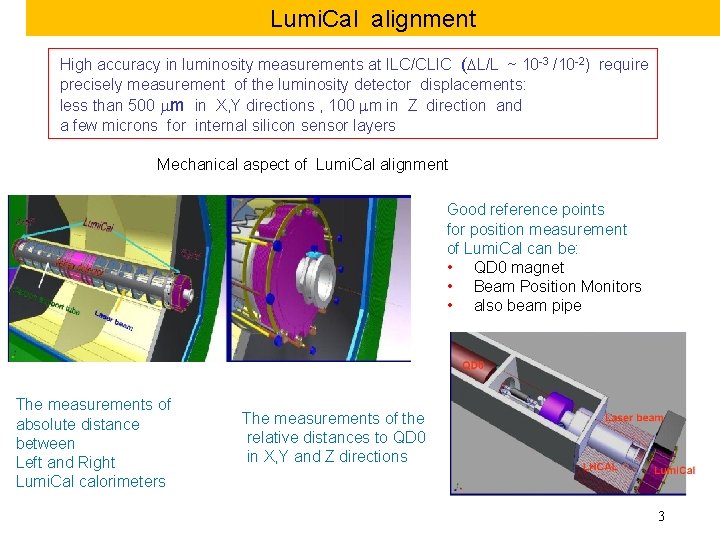
Lumi. Cal alignment High accuracy in luminosity measurements at ILC/CLIC ( L/L ~ 10 -3 /10 -2) require precisely measurement of the luminosity detector displacements: less than 500 m in X, Y directions , 100 m in Z direction and a few microns for internal silicon sensor layers Mechanical aspect of Lumi. Cal alignment Good reference points for position measurement of Lumi. Cal can be: • QD 0 magnet • Beam Position Monitors • also beam pipe The measurements of absolute distance between Left and Right Lumi. Cal calorimeters The measurements of the relative distances to QD 0 in X, Y and Z directions 3
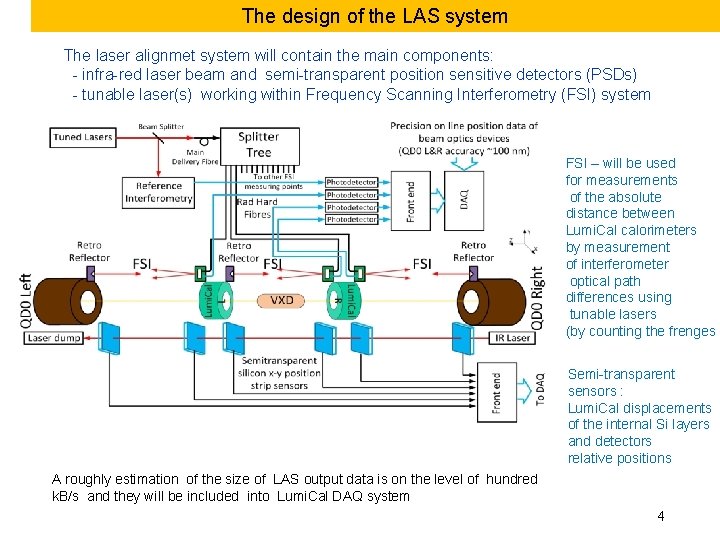
The design of the LAS system The laser alignmet system will contain the main components: - infra-red laser beam and semi-transparent position sensitive detectors (PSDs) - tunable laser(s) working within Frequency Scanning Interferometry (FSI) system FSI – will be used for measurements of the absolute distance between Lumi. Cal calorimeters by measurement of interferometer optical path differences using tunable lasers (by counting the frenges xxxxxxxxxxxxx Semi-transparent sensors : Lumi. Cal displacements of the internal Si layers and detectors relative positions A roughly estimation of the size of LAS output data is on the level of hundred k. B/s and they will be included into Lumi. Cal DAQ system 4

Semi-transparent sensors (PSD) Semi - transparent amorphous silicon strip sensors , DPSD-516 using laser with wavelength above ~ 780 nm, received from Oxford University, High precision (ZEUS MVD) position measurements in two coordinates X / Y : ~10 m Cathode strips Anode strips Quality testing of the sensors: microscope, probe station, and laser beam Proper shape of signals distributions from cathode and anode strips Problem with some of the sensors: no signals from X or Y strips 9 high-quality sensors were selected and they will be used to construct a prototype of the positioning system in laboratory 5
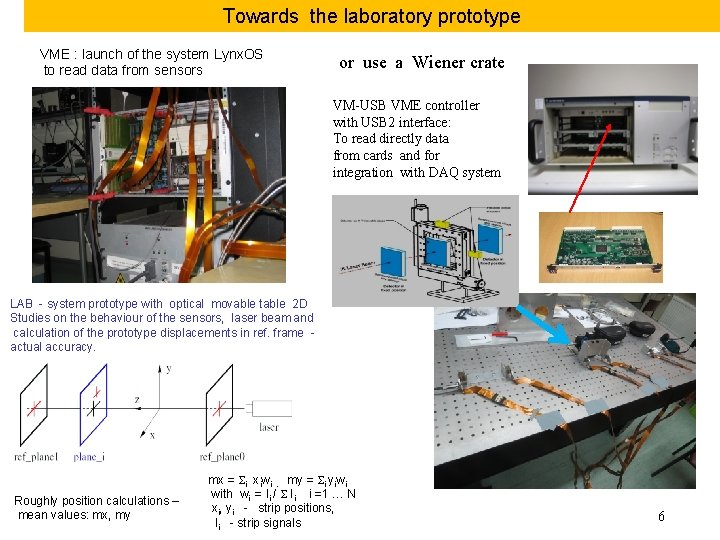
Towards the laboratory prototype VME : launch of the system Lynx. OS to read data from sensors or use a Wiener crate VM-USB VME controller with USB 2 interface: To read directly data from cards and for integration with DAQ system LAB - system prototype with optical movable table 2 D Studies on the behaviour of the sensors, laser beam and calculation of the prototype displacements in ref. frame actual accuracy. Roughly position calculations – mean values: mx, my mx = i xiwi , my = i yiwi with wi = Ii / Ii i =1 … N xi, yi - strip positions, Ii - strip signals 6
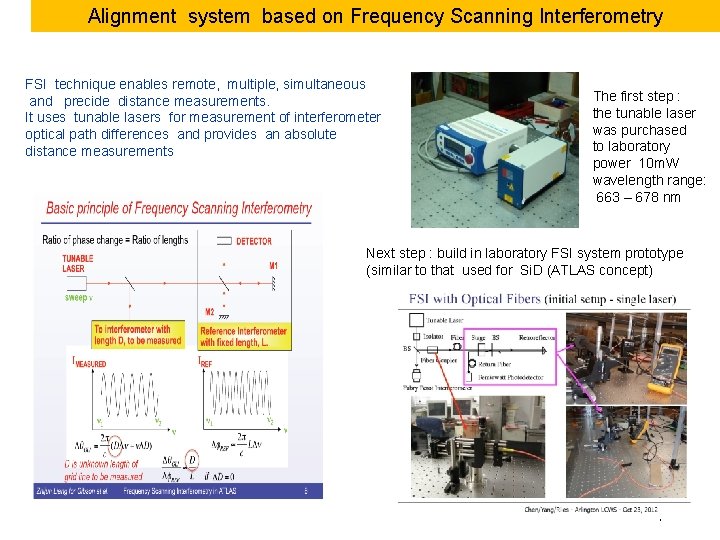
Alignment system based on Frequency Scanning Interferometry FSI technique enables remote, multiple, simultaneous and precide distance measurements. It uses tunable lasers for measurement of interferometer optical path differences and provides an absolute distance measurements The first step : the tunable laser was purchased to laboratory power 10 m. W wavelength range: 663 – 678 nm Next step : build in laboratory FSI system prototype (similar to that used for Si. D (ATLAS concept) 7
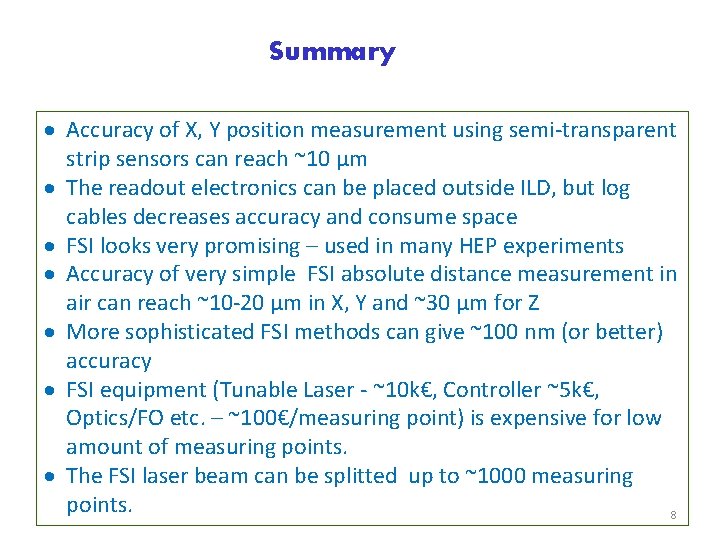
Summary · Accuracy of X, Y position measurement using semi-transparent strip sensors can reach ~10 µm · The readout electronics can be placed outside ILD, but log cables decreases accuracy and consume space · FSI looks very promising – used in many HEP experiments · Accuracy of very simple FSI absolute distance measurement in air can reach ~10 -20 µm in X, Y and ~30 µm for Z · More sophisticated FSI methods can give ~100 nm (or better) accuracy · FSI equipment (Tunable Laser - ~10 k€, Controller ~5 k€, Optics/FO etc. – ~100€/measuring point) is expensive for low amount of measuring points. · The FSI laser beam can be splitted up to ~1000 measuring points. 8
- Slides: 8