
Laser acceleration and transport of intense ion beams
Laser acceleration and transport of intense ion beams Zsolt Lécz, Vladimir Kornilov, Oliver Boine-Frankenheim Beam physics for FAIR Bastenhaus, 6 July 2010 28 February 2021 | TU Darmstadt | Fachbereich 18 | Institut Theorie Elektromagnetischer Felder | Prof. Dr. -Ing. Thomas Weiland | 1
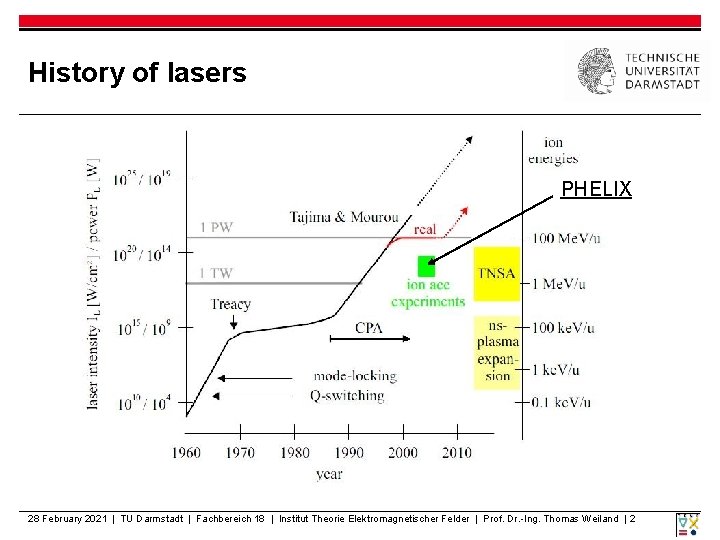
History of lasers PHELIX 28 February 2021 | TU Darmstadt | Fachbereich 18 | Institut Theorie Elektromagnetischer Felder | Prof. Dr. -Ing. Thomas Weiland | 2
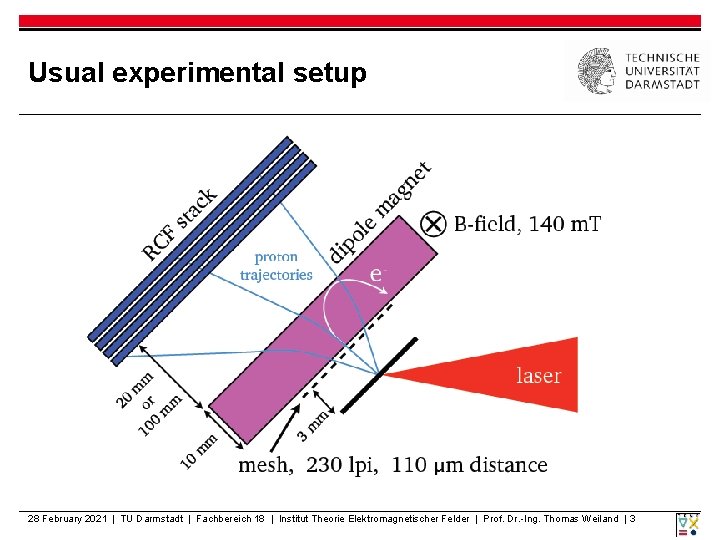
Usual experimental setup 28 February 2021 | TU Darmstadt | Fachbereich 18 | Institut Theorie Elektromagnetischer Felder | Prof. Dr. -Ing. Thomas Weiland | 3
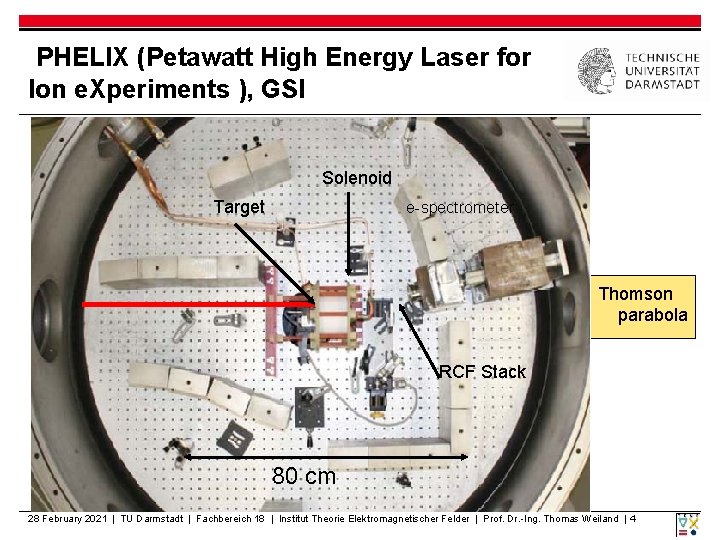
PHELIX (Petawatt High Energy Laser for Ion e. Xperiments ), GSI Solenoid Target e-spectrometer Thomson parabola RCF Stack 80 cm 28 February 2021 | TU Darmstadt | Fachbereich 18 | Institut Theorie Elektromagnetischer Felder | Prof. Dr. -Ing. Thomas Weiland | 4
Why do we do it? Applications ▪ Advantages of ion acceleration: - Table-top size, very high acceleration gradient, high energy 10… 100 Me. V ▪ Outstanding, unique features of the ion beam: - Small transverse emittance (1 e-2… 1 e-1 mm*mrad) -> high laminarity and focusability - Increasing the energy the opening angle is decreasing, due to the decreasing source size - High intensity (current) : 1 e 13 -1 e 18 ions (1 e 12 could be collimated) ▪ Possible applications: - Nuclear researches The beams can be used as tools in basic plasma diagnostic research Injection devices into conventional, large accelerators Ion therapy for tumor treatments Inertial fusion (energy research) 28 February 2021 | TU Darmstadt | Fachbereich 18 | Institut Theorie Elektromagnetischer Felder | Prof. Dr. -Ing. Thomas Weiland | 5
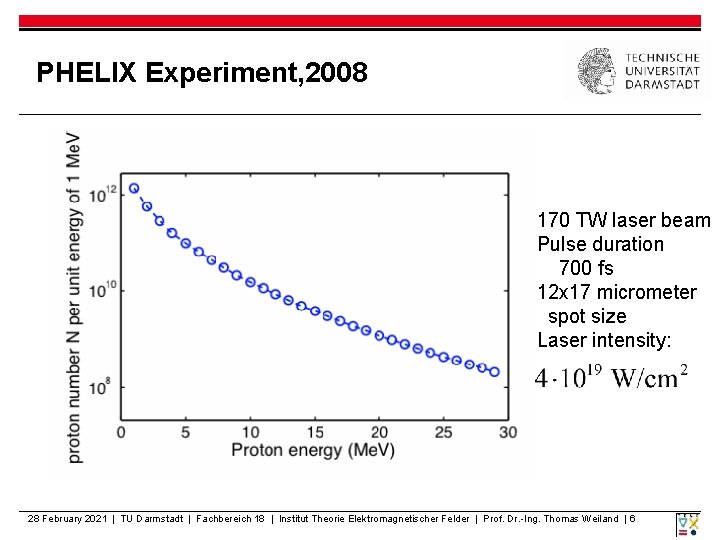
PHELIX Experiment, 2008 170 TW laser beam Pulse duration 700 fs 12 x 17 micrometer spot size Laser intensity: 28 February 2021 | TU Darmstadt | Fachbereich 18 | Institut Theorie Elektromagnetischer Felder | Prof. Dr. -Ing. Thomas Weiland | 6
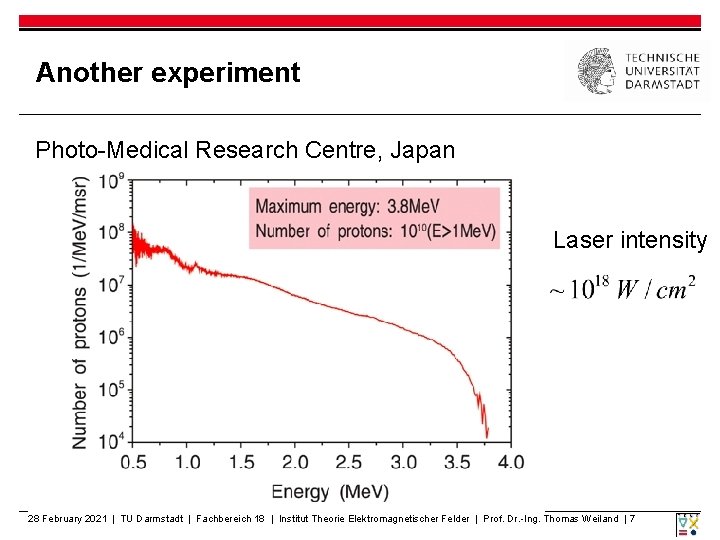
Another experiment Photo-Medical Research Centre, Japan Laser intensity 28 February 2021 | TU Darmstadt | Fachbereich 18 | Institut Theorie Elektromagnetischer Felder | Prof. Dr. -Ing. Thomas Weiland | 7
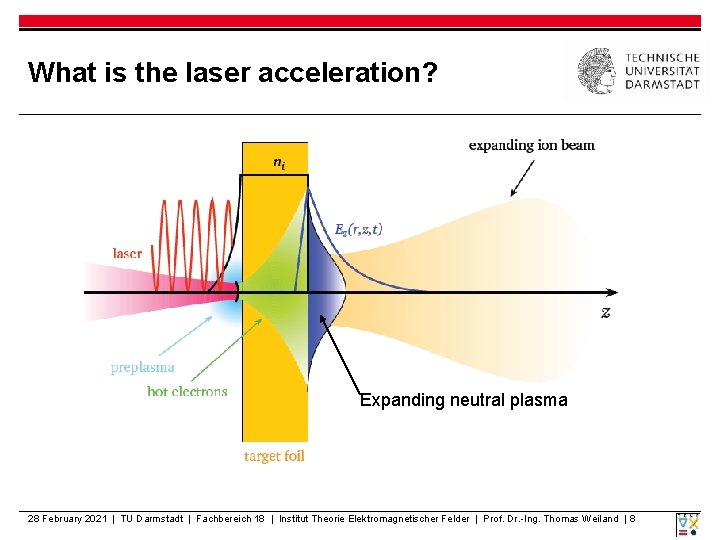
What is the laser acceleration? Expanding neutral plasma 28 February 2021 | TU Darmstadt | Fachbereich 18 | Institut Theorie Elektromagnetischer Felder | Prof. Dr. -Ing. Thomas Weiland | 8
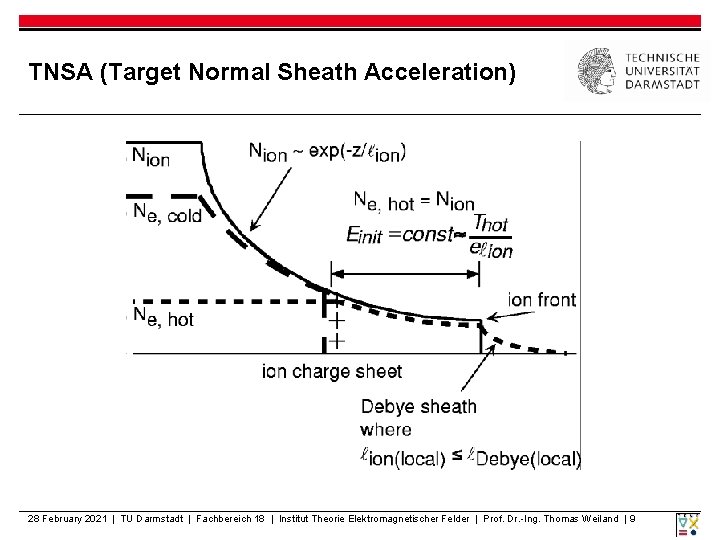
TNSA (Target Normal Sheath Acceleration) 28 February 2021 | TU Darmstadt | Fachbereich 18 | Institut Theorie Elektromagnetischer Felder | Prof. Dr. -Ing. Thomas Weiland | 9
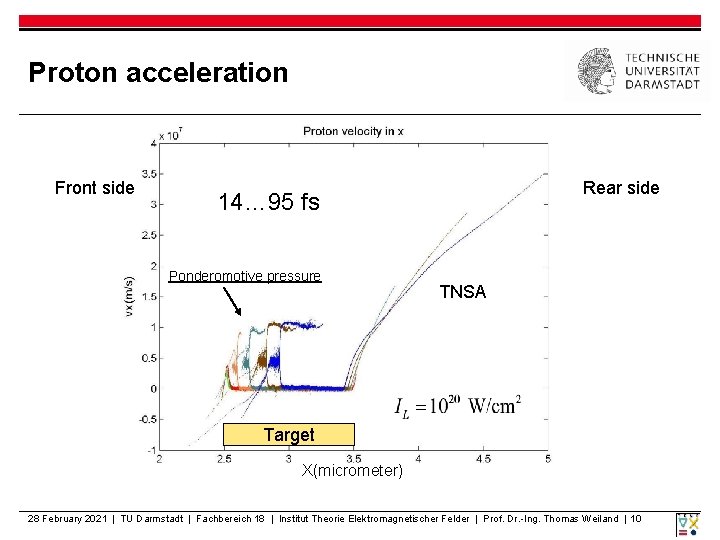
Proton acceleration Front side Rear side 14… 95 fs Ponderomotive pressure TNSA Target X(micrometer) 28 February 2021 | TU Darmstadt | Fachbereich 18 | Institut Theorie Elektromagnetischer Felder | Prof. Dr. -Ing. Thomas Weiland | 10
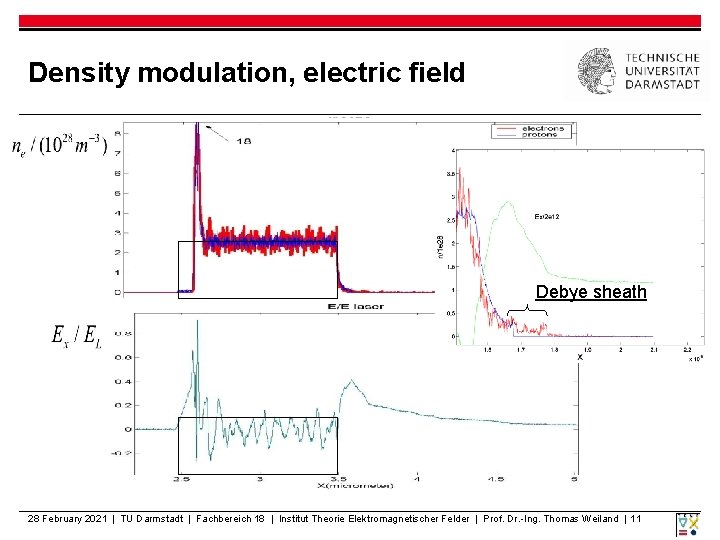
Density modulation, electric field Debye sheath 28 February 2021 | TU Darmstadt | Fachbereich 18 | Institut Theorie Elektromagnetischer Felder | Prof. Dr. -Ing. Thomas Weiland | 11
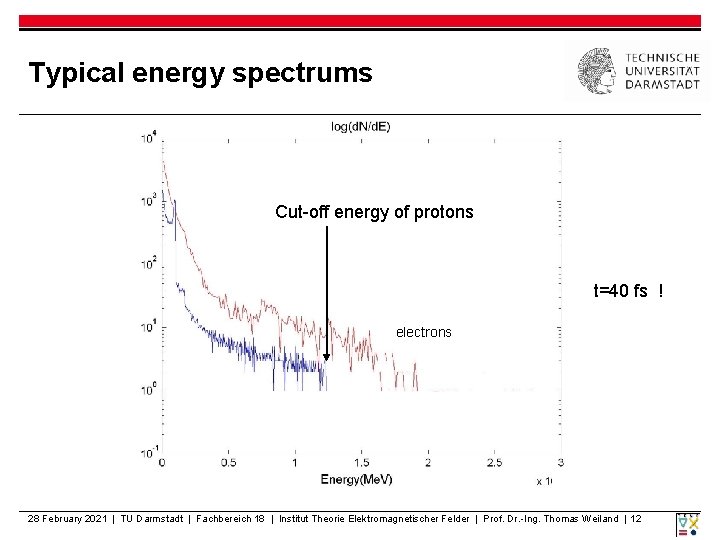
Typical energy spectrums Cut-off energy of protons t=40 fs ! electrons 28 February 2021 | TU Darmstadt | Fachbereich 18 | Institut Theorie Elektromagnetischer Felder | Prof. Dr. -Ing. Thomas Weiland | 12
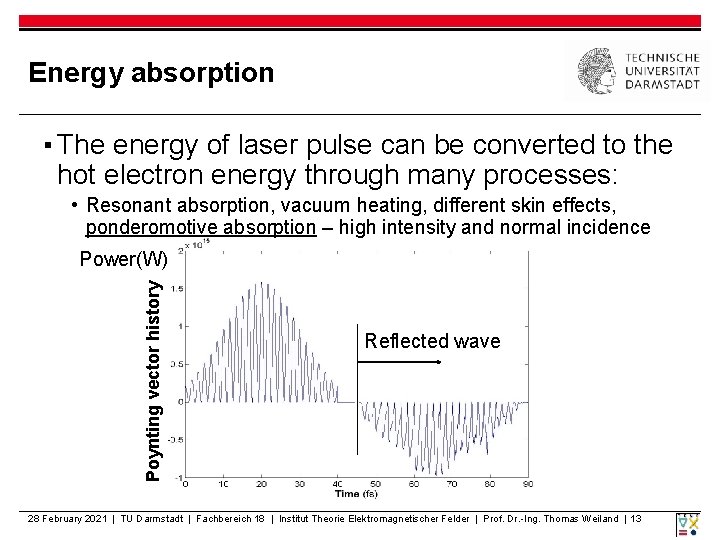
Energy absorption ▪ The energy of laser pulse can be converted to the hot electron energy through many processes: • Resonant absorption, vacuum heating, different skin effects, ponderomotive absorption – high intensity and normal incidence Poynting vector history Power(W) Reflected wave 28 February 2021 | TU Darmstadt | Fachbereich 18 | Institut Theorie Elektromagnetischer Felder | Prof. Dr. -Ing. Thomas Weiland | 13
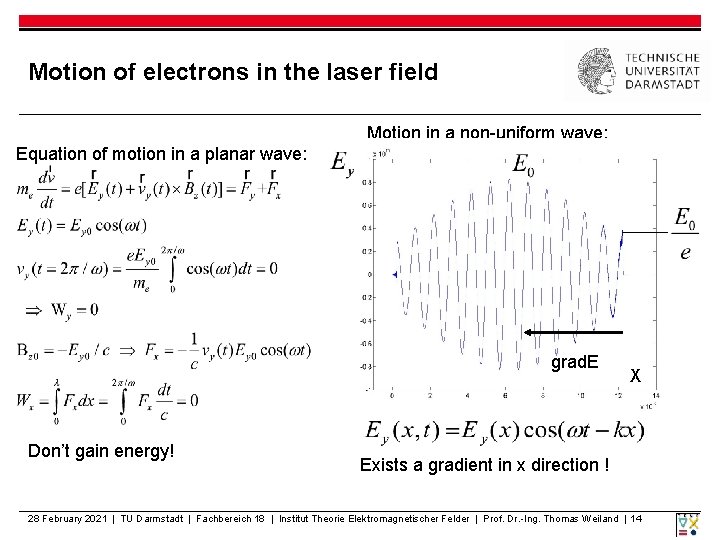
Motion of electrons in the laser field Motion in a non-uniform wave: Equation of motion in a planar wave: grad. E Don’t gain energy! X Exists a gradient in x direction ! 28 February 2021 | TU Darmstadt | Fachbereich 18 | Institut Theorie Elektromagnetischer Felder | Prof. Dr. -Ing. Thomas Weiland | 14
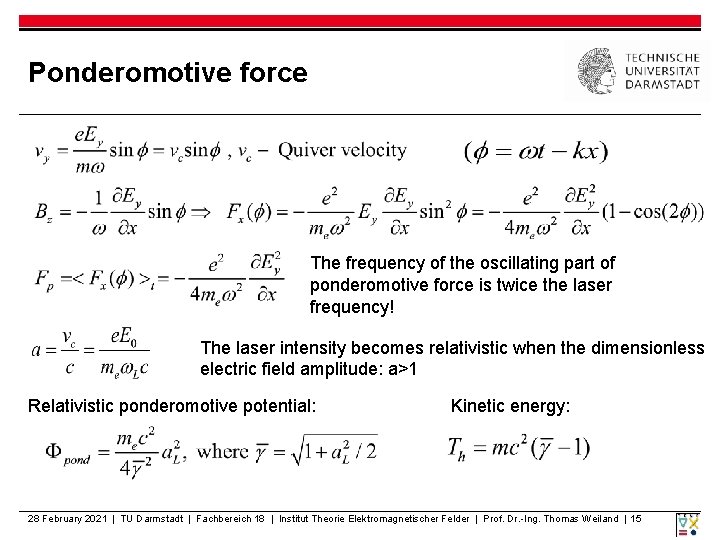
Ponderomotive force The frequency of the oscillating part of ponderomotive force is twice the laser frequency! The laser intensity becomes relativistic when the dimensionless electric field amplitude: a>1 Relativistic ponderomotive potential: Kinetic energy: 28 February 2021 | TU Darmstadt | Fachbereich 18 | Institut Theorie Elektromagnetischer Felder | Prof. Dr. -Ing. Thomas Weiland | 15
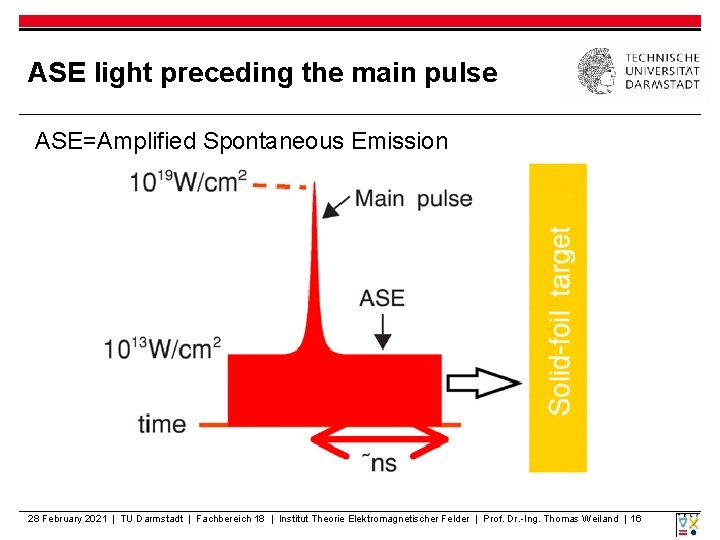
ASE light preceding the main pulse ASE=Amplified Spontaneous Emission 28 February 2021 | TU Darmstadt | Fachbereich 18 | Institut Theorie Elektromagnetischer Felder | Prof. Dr. -Ing. Thomas Weiland | 16
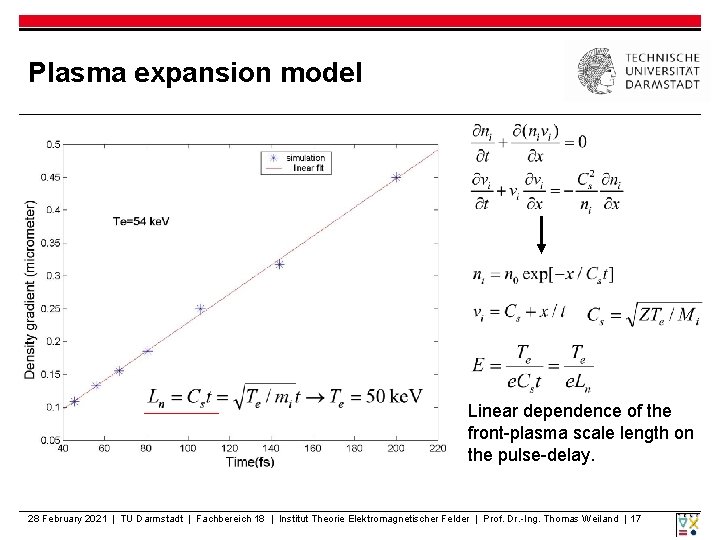
Plasma expansion model Linear dependence of the front-plasma scale length on the pulse-delay. 28 February 2021 | TU Darmstadt | Fachbereich 18 | Institut Theorie Elektromagnetischer Felder | Prof. Dr. -Ing. Thomas Weiland | 17
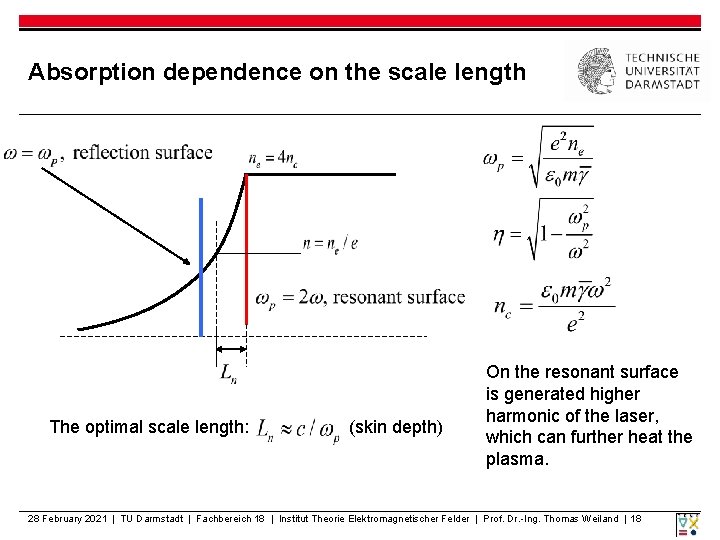
Absorption dependence on the scale length The optimal scale length: (skin depth) On the resonant surface is generated higher harmonic of the laser, which can further heat the plasma. 28 February 2021 | TU Darmstadt | Fachbereich 18 | Institut Theorie Elektromagnetischer Felder | Prof. Dr. -Ing. Thomas Weiland | 18
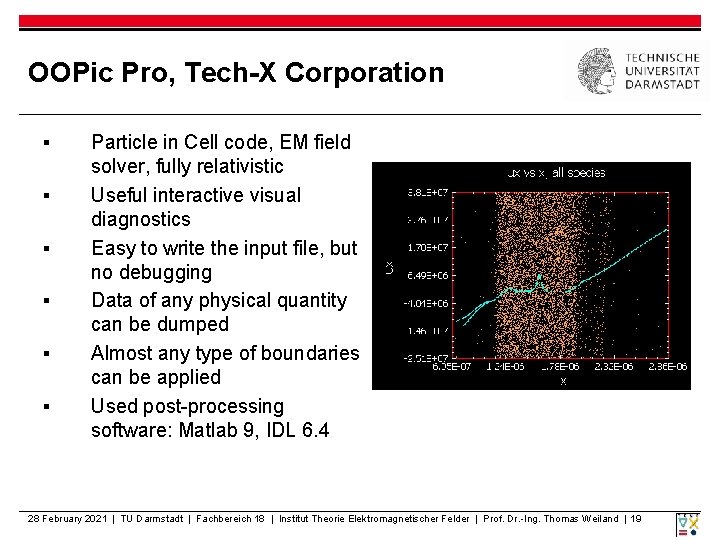
OOPic Pro, Tech-X Corporation ▪ ▪ ▪ Particle in Cell code, EM field solver, fully relativistic Useful interactive visual diagnostics Easy to write the input file, but no debugging Data of any physical quantity can be dumped Almost any type of boundaries can be applied Used post-processing software: Matlab 9, IDL 6. 4 28 February 2021 | TU Darmstadt | Fachbereich 18 | Institut Theorie Elektromagnetischer Felder | Prof. Dr. -Ing. Thomas Weiland | 19
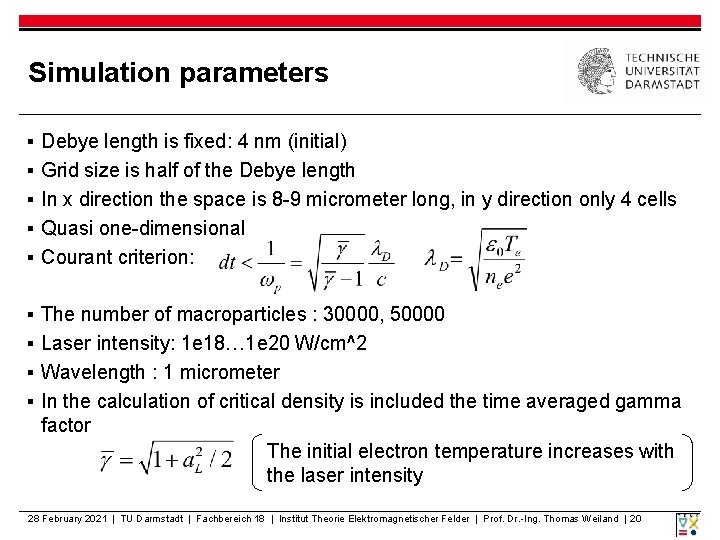
Simulation parameters ▪ ▪ ▪ Debye length is fixed: 4 nm (initial) Grid size is half of the Debye length In x direction the space is 8 -9 micrometer long, in y direction only 4 cells Quasi one-dimensional Courant criterion: ▪ ▪ The number of macroparticles : 30000, 50000 Laser intensity: 1 e 18… 1 e 20 W/cm^2 Wavelength : 1 micrometer In the calculation of critical density is included the time averaged gamma factor The initial electron temperature increases with the laser intensity 28 February 2021 | TU Darmstadt | Fachbereich 18 | Institut Theorie Elektromagnetischer Felder | Prof. Dr. -Ing. Thomas Weiland | 20
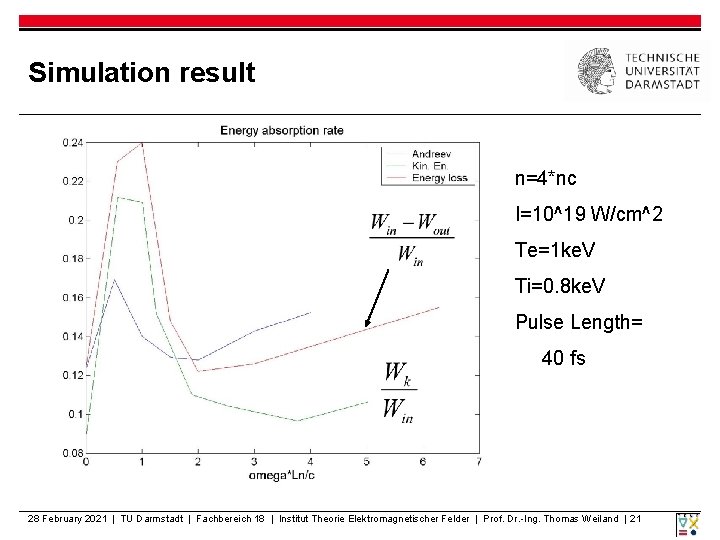
Simulation result n=4*nc I=10^19 W/cm^2 Te=1 ke. V Ti=0. 8 ke. V Pulse Length= 40 fs 28 February 2021 | TU Darmstadt | Fachbereich 18 | Institut Theorie Elektromagnetischer Felder | Prof. Dr. -Ing. Thomas Weiland | 21
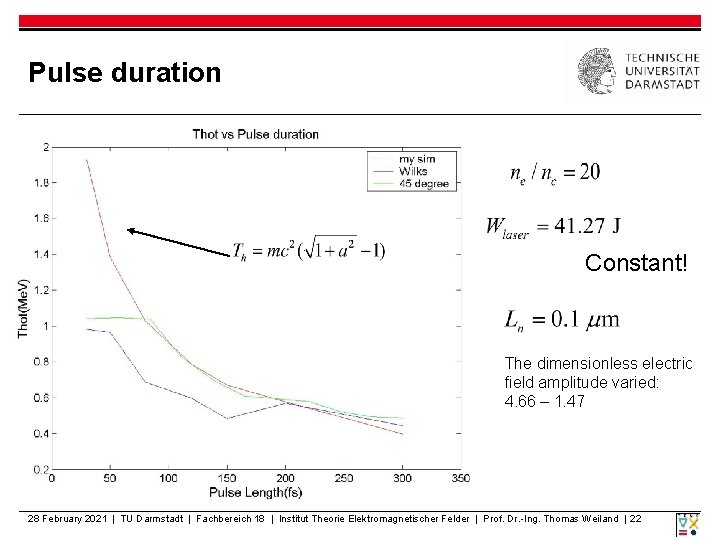
Pulse duration Constant! The dimensionless electric field amplitude varied: 4. 66 – 1. 47 28 February 2021 | TU Darmstadt | Fachbereich 18 | Institut Theorie Elektromagnetischer Felder | Prof. Dr. -Ing. Thomas Weiland | 22
Conclusions, next steps ▪ The OOPic Pro 2. 0 is a good mean for analyzing the laser acceleration processes ▪ The hot electron generation and energy absorption in case of normal incidence of intense laser pulses in 1 dimension is well understood ▪ The parallelized running of the program is needed in order to increase the precision and speed of the simulations and to extend the simulation space ▪ 2 D simulations are planed with different incidence angle ▪ The aim of the work is to provide spatial and energy distribution for the ions (and electrons), which can be used in other simulations (transport, collimation) 28 February 2021 | TU Darmstadt | Fachbereich 18 | Institut Theorie Elektromagnetischer Felder | Prof. Dr. -Ing. Thomas Weiland | 23
The End Thank you for Your attention!
Bibliography ▪ Nonlinear absorption of a short intense laser pulse in a nonuniform plasma, A. A. Andreev and K. Yu. Platonov, Physics of Plasmas volume 10, number 1, January 2003 ▪ Influence of subpicosecond laser pulse duration on proton acceleration, A. Flacco, PHYSICS OF PLASMAS 16, 053105 , 2009 ▪ Energetic proton generation in ultra-intense laser-solid interactions, S. C. Wilks, Physics of plasmas, 8(2), 2001 ▪ Short Pulse Laser Interaction with Matter, Paul Gibbon 28 February 2021 | TU Darmstadt | Fachbereich 18 | Institut Theorie Elektromagnetischer Felder | Prof. Dr. -Ing. Thomas Weiland | 25
- Slides: 25