
LARYNX TRACHEA BRONCHI Prof Saeed Abuel Makarem Dr
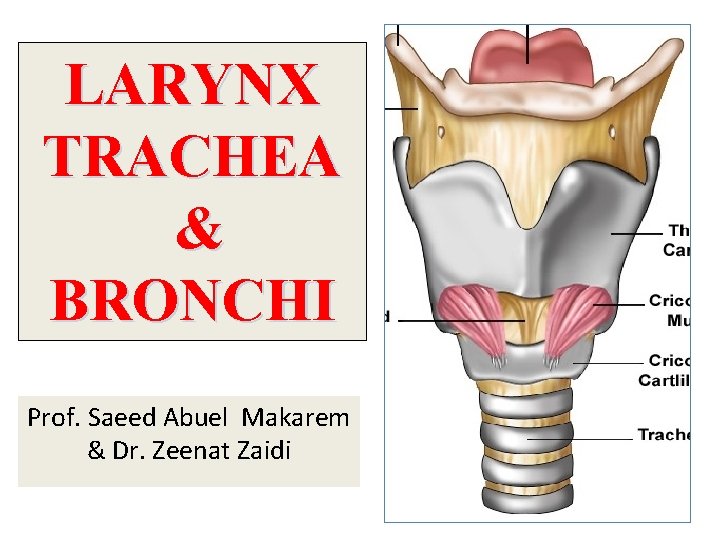
LARYNX TRACHEA & BRONCHI Prof. Saeed Abuel Makarem & Dr. Zeenat Zaidi
Objectives • At the end of the lecture, the students should be able to: • Describe the Extent, structure and functions of the larynx. • Describe the Extent, structure and functions of the Trachea. • Describe the bronchi and branching of the brochial tree. • Describe the functions of bronchi and their divisions.
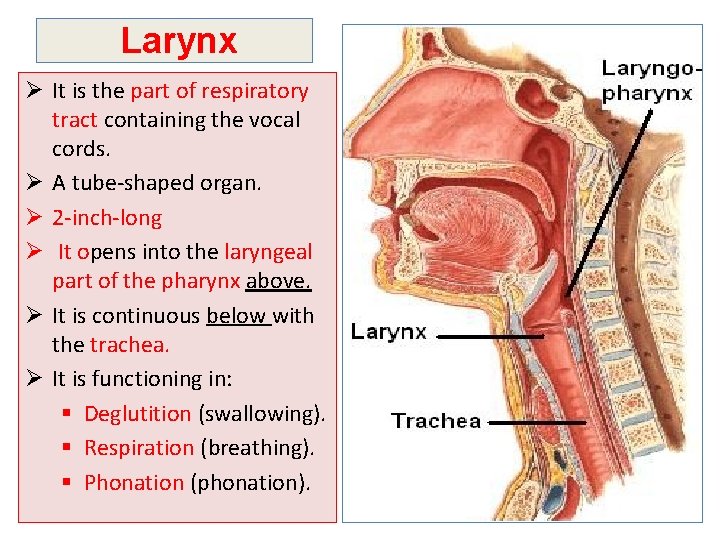
Larynx Ø It is the part of respiratory tract containing the vocal cords. Ø A tube-shaped organ. Ø 2 -inch-long Ø It opens into the laryngeal part of the pharynx above. Ø It is continuous below with the trachea. Ø It is functioning in: § Deglutition (swallowing). § Respiration (breathing). § Phonation (phonation).
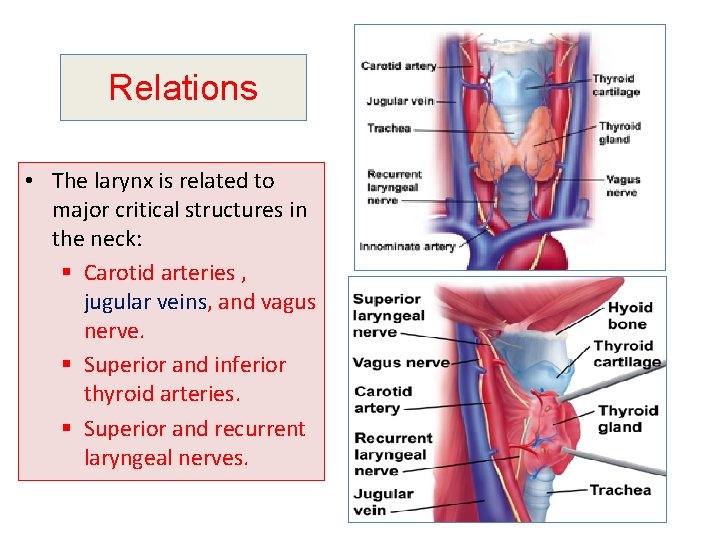
Relations • The larynx is related to major critical structures in the neck: § Carotid arteries , jugular veins, and vagus nerve. § Superior and inferior thyroid arteries. § Superior and recurrent laryngeal nerves.
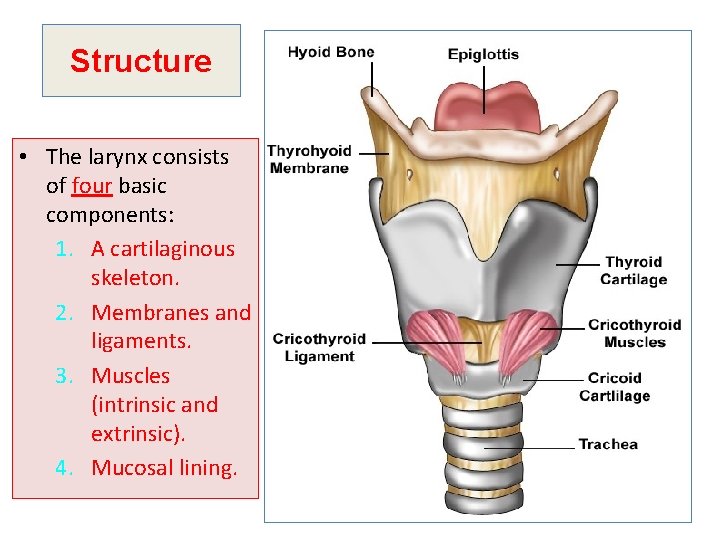
Structure • The larynx consists of four basic components: 1. A cartilaginous skeleton. 2. Membranes and ligaments. 3. Muscles (intrinsic and extrinsic). 4. Mucosal lining.
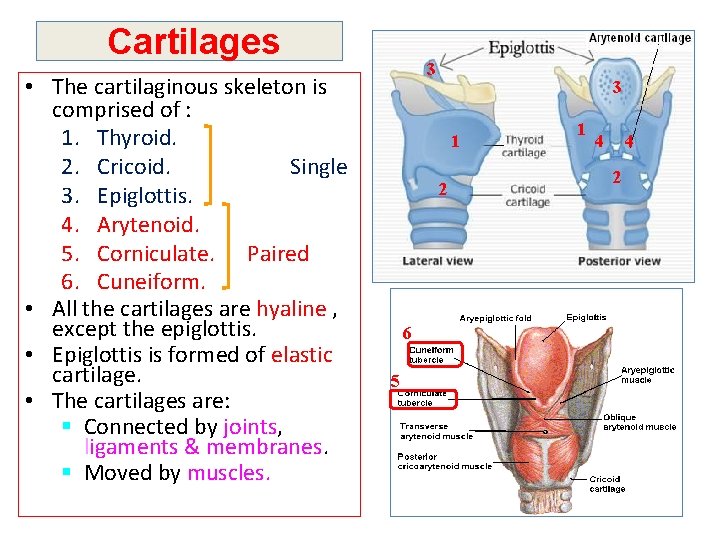
Cartilages • The cartilaginous skeleton is comprised of : 1. Thyroid. 2. Cricoid. Single 3. Epiglottis. 4. Arytenoid. 5. Corniculate. Paired 6. Cuneiform. • All the cartilages are hyaline , except the epiglottis. • Epiglottis is formed of elastic cartilage. • The cartilages are: § Connected by joints, ligaments & membranes. § Moved by muscles. 3 3 1 2 6 5 1 4 4 2
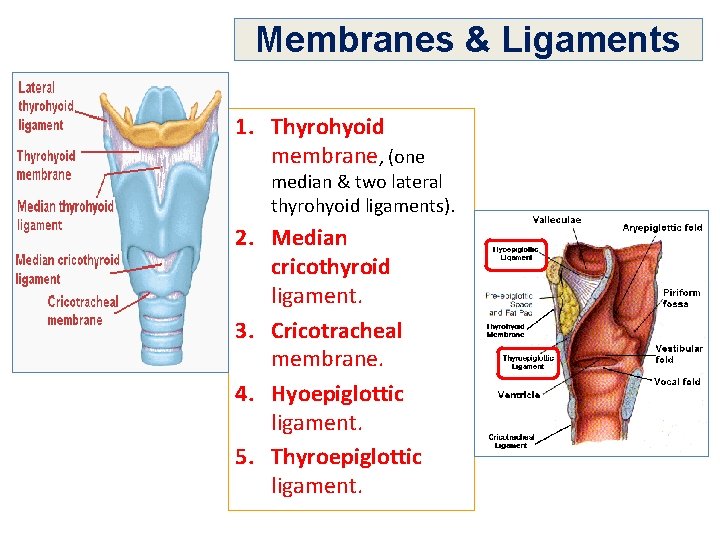
Membranes & Ligaments 1. Thyrohyoid membrane, (one median & two lateral thyrohyoid ligaments). 2. Median cricothyroid ligament. 3. Cricotracheal membrane. 4. Hyoepiglottic ligament. 5. Thyroepiglottic ligament.
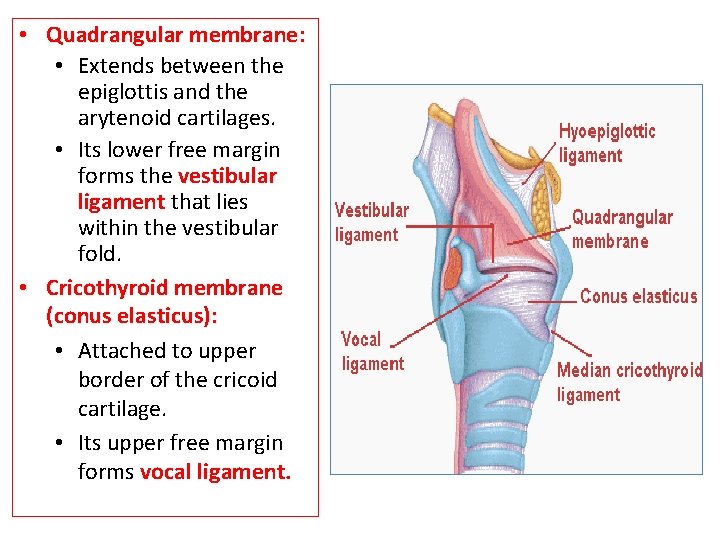
• Quadrangular membrane: • Extends between the epiglottis and the arytenoid cartilages. • Its lower free margin forms the vestibular ligament that lies within the vestibular fold. • Cricothyroid membrane (conus elasticus): • Attached to upper border of the cricoid cartilage. • Its upper free margin forms vocal ligament.
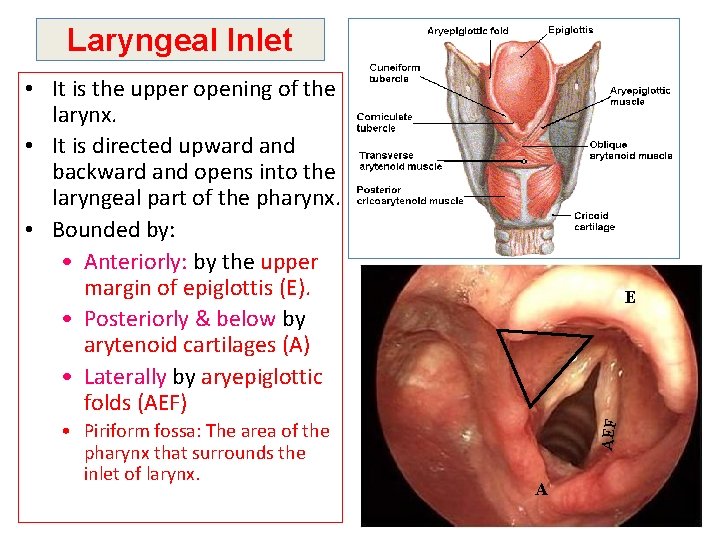
Laryngeal Inlet • It is the upper opening of the larynx. • It is directed upward and backward and opens into the laryngeal part of the pharynx. • Bounded by: • Anteriorly: by the upper margin of epiglottis (E). • Posteriorly & below by arytenoid cartilages (A) • Laterally by aryepiglottic folds (AEF) AEF • Piriform fossa: The area of the pharynx that surrounds the inlet of larynx. E A
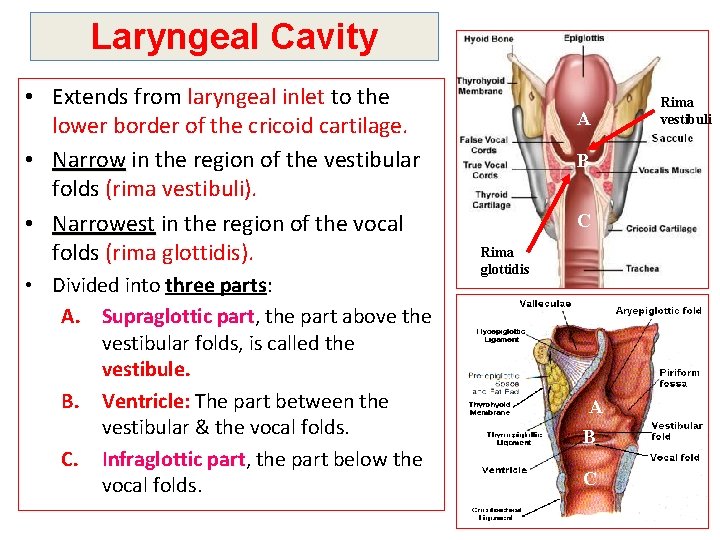
Laryngeal Cavity • Extends from laryngeal inlet to the lower border of the cricoid cartilage. • Narrow in the region of the vestibular folds (rima vestibuli). • Narrowest in the region of the vocal folds (rima glottidis). • Divided into three parts: A. Supraglottic part, the part above the vestibular folds, is called the vestibule. B. Ventricle: The part between the vestibular & the vocal folds. C. Infraglottic part, the part below the vocal folds. A B C Rima glottidis A B C Rima vestibuli
Mucous Membrane Muscles • The cavity is lined with ciliated columnar epithelium • The surface of vocal folds, is covered with stratified squamous epithelium because of exposure to continuous trauma during phonation, • Contains many mucous glands, more numerous in the saccule (for lubrication of vocal folds) Divided into two groups: • Extrinsic muscles: divided into two groups • Elevators of the larynx • Depressors of the larynx • Intrinsic muscles: divided into two groups • Muscles controlling the laryngeal inlet • Muscles controlling the movements of the vocal cords
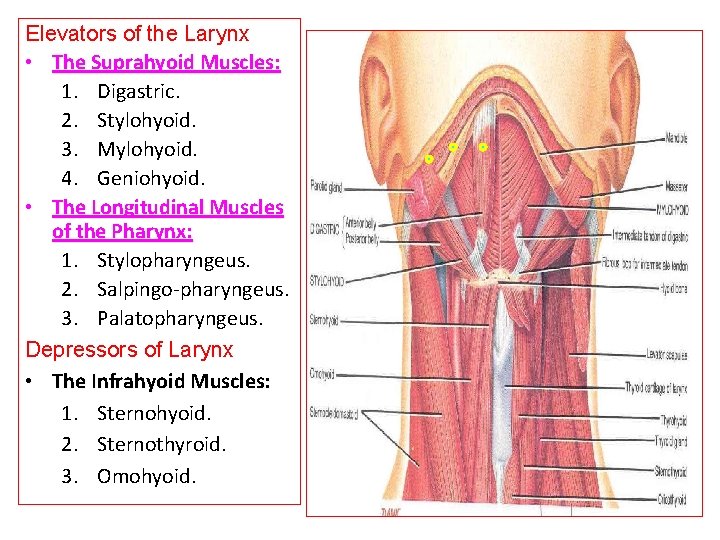
Elevators of the Larynx • The Suprahyoid Muscles: 1. Digastric. 2. Stylohyoid. 3. Mylohyoid. 4. Geniohyoid. • The Longitudinal Muscles of the Pharynx: 1. Stylopharyngeus. 2. Salpingo-pharyngeus. 3. Palatopharyngeus. Depressors of Larynx • The Infrahyoid Muscles: 1. Sternohyoid. 2. Sternothyroid. 3. Omohyoid.
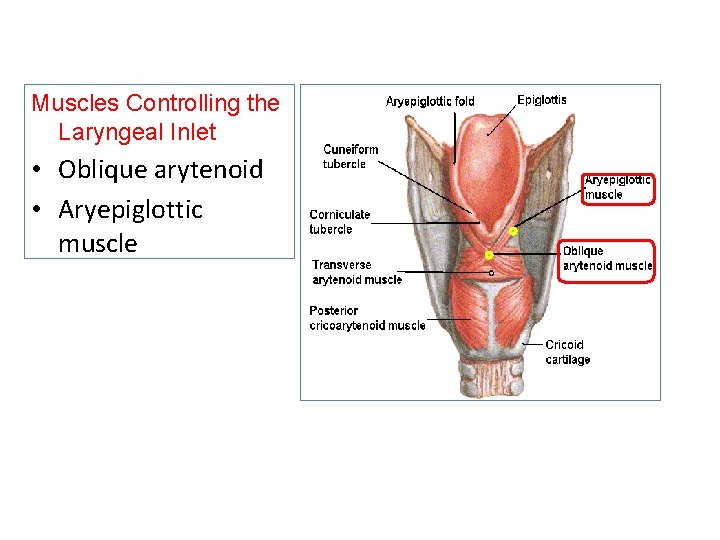
Muscles Controlling the Laryngeal Inlet • Oblique arytenoid • Aryepiglottic muscle
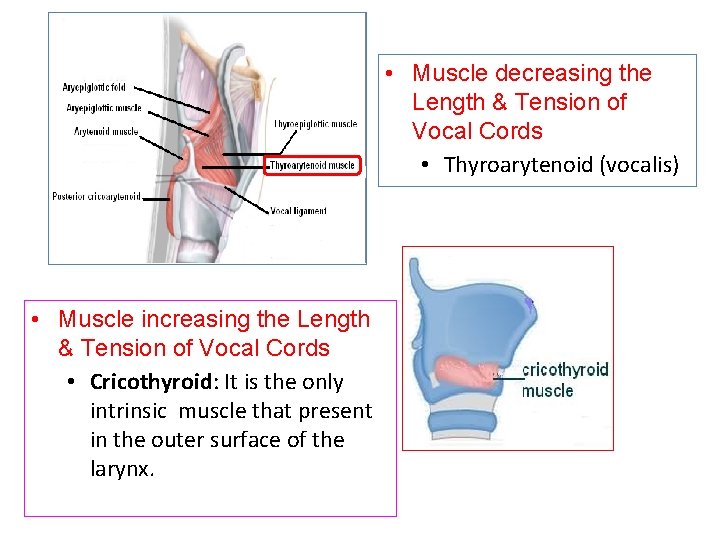
• Muscle decreasing the Length & Tension of Vocal Cords • Thyroarytenoid (vocalis) • Muscle increasing the Length & Tension of Vocal Cords • Cricothyroid: It is the only intrinsic muscle that present in the outer surface of the larynx.
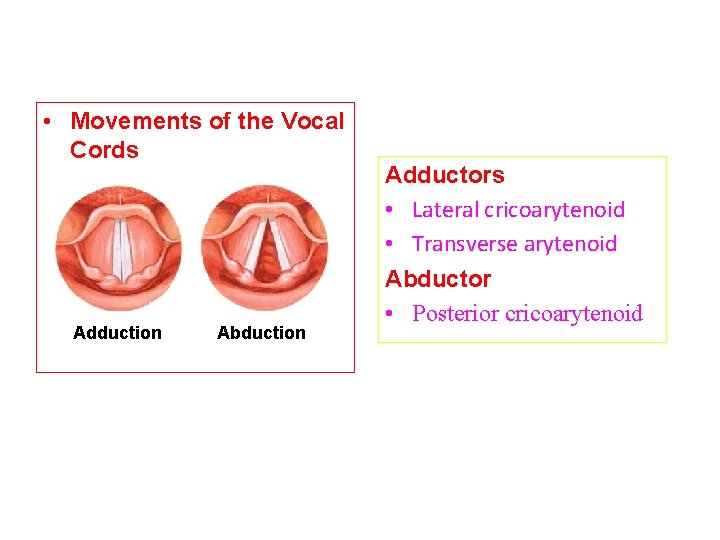
• Movements of the Vocal Cords Adduction Abduction Adductors • Lateral cricoarytenoid • Transverse arytenoid Abductor • Posterior cricoarytenoid
Blood Supply • Arteries: § Upper half: Superior laryngeal artery, branch of superior thyroid artery. § Lower half: Inferior laryngeal artery, branch of inferior thyroid artery. • Veins: § Accompany the corresponding arterie. s • Lymphatics: § The lymph vessels drain into the deep cervical lymph nodes. Nerve Supply • Sensory § Above the vocal cords: Internal laryngeal nerve, branch of the superior laryngeal of vagus. § Below the vocal cords: Recurrent laryngeal, of vagus. • Motor § All intrinsic muscles of the larynx are supplied by the recurrent laryngeal except cricothyroid, which is supplied by the external laryngeal of superior laryngeal of vagus.
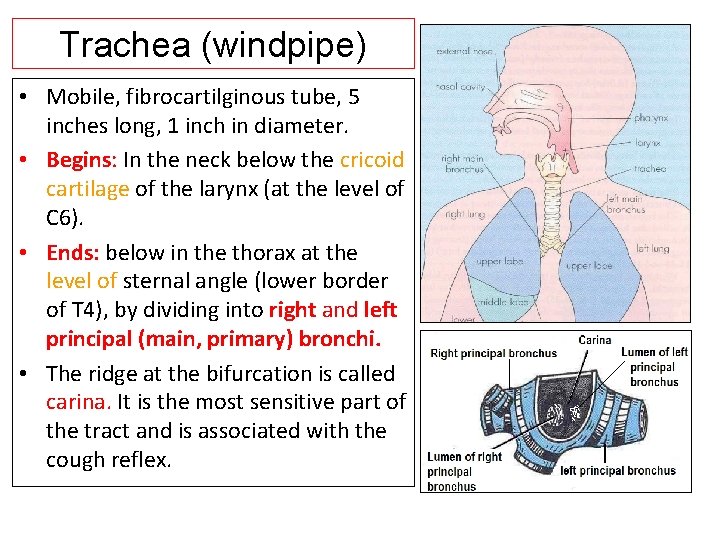
Trachea (windpipe) • Mobile, fibrocartilginous tube, 5 inches long, 1 inch in diameter. • Begins: In the neck below the cricoid cartilage of the larynx (at the level of C 6). • Ends: below in the thorax at the level of sternal angle (lower border of T 4), by dividing into right and left principal (main, primary) bronchi. • The ridge at the bifurcation is called carina. It is the most sensitive part of the tract and is associated with the cough reflex.
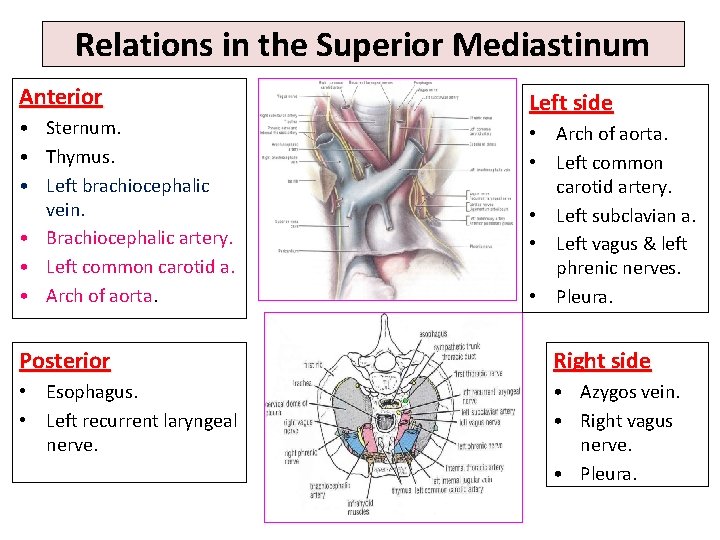
Relations in the Superior Mediastinum Anterior • Sternum. • Thymus. • Left brachiocephalic vein. • Brachiocephalic artery. • Left common carotid a. • Arch of aorta. Left side • Arch of aorta. • Left common carotid artery. • Left subclavian a. • Left vagus & left phrenic nerves. • Pleura. Posterior Right side • Esophagus. • Left recurrent laryngeal nerve. • Azygos vein. • Right vagus nerve. • Pleura.
Nerve Supply Blood Supply • Branches of vagus and the recurrent laryngeal nerves. (from vagus) supply sensory fibers to the mucous membrane. • Branches from the sympathetic trunks supply the trachealis muscle and the blood vessels. • Arteries: Branches from the inferior thyroid and bronchial arteries. • Veins: Drain to inferior thyroid veins. Lymphatic Drainage • Into the pre- & paratracheal lymph nodes.
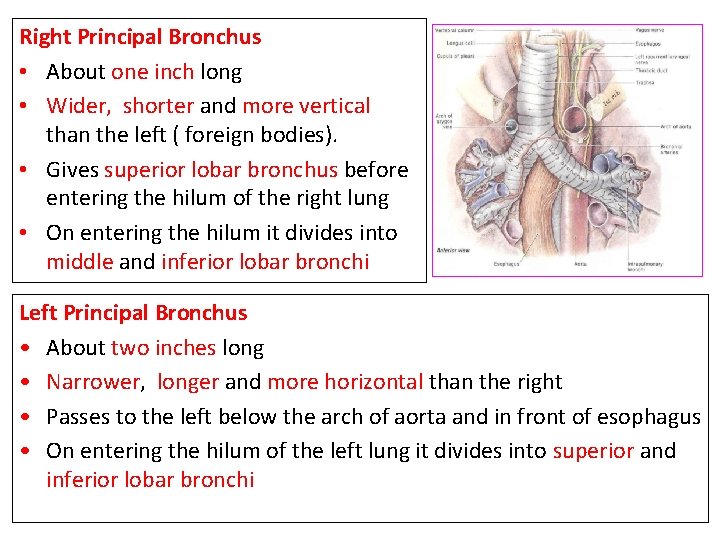
Right Principal Bronchus • About one inch long • Wider, shorter and more vertical than the left ( foreign bodies). • Gives superior lobar bronchus before entering the hilum of the right lung • On entering the hilum it divides into middle and inferior lobar bronchi Left Principal Bronchus • About two inches long • Narrower, longer and more horizontal than the right • Passes to the left below the arch of aorta and in front of esophagus • On entering the hilum of the left lung it divides into superior and inferior lobar bronchi
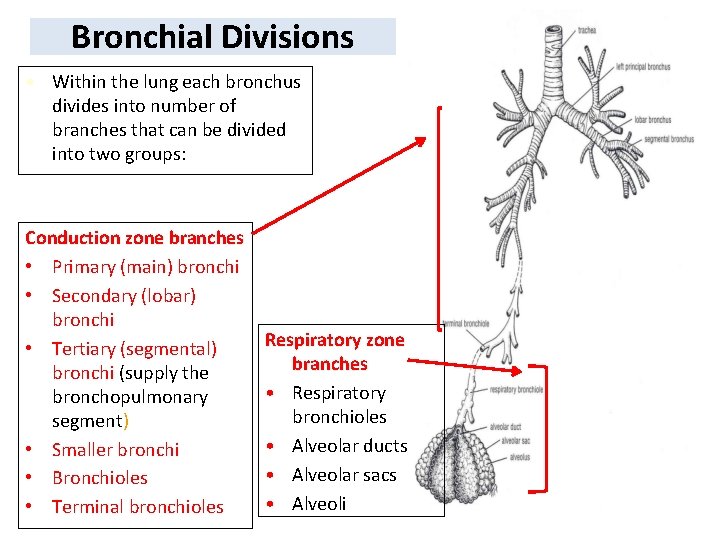
Bronchial Divisions • Within the lung each bronchus divides into number of branches that can be divided into two groups: Conduction zone branches • Primary (main) bronchi • Secondary (lobar) bronchi • Tertiary (segmental) bronchi (supply the bronchopulmonary segment) • Smaller bronchi • Bronchioles • Terminal bronchioles Respiratory zone branches • Respiratory bronchioles • Alveolar ducts • Alveolar sacs • Alveoli
Thank You & Good Luck
- Slides: 22