
Laryngoscope o principles of operation function use scientific

- Slides: 15
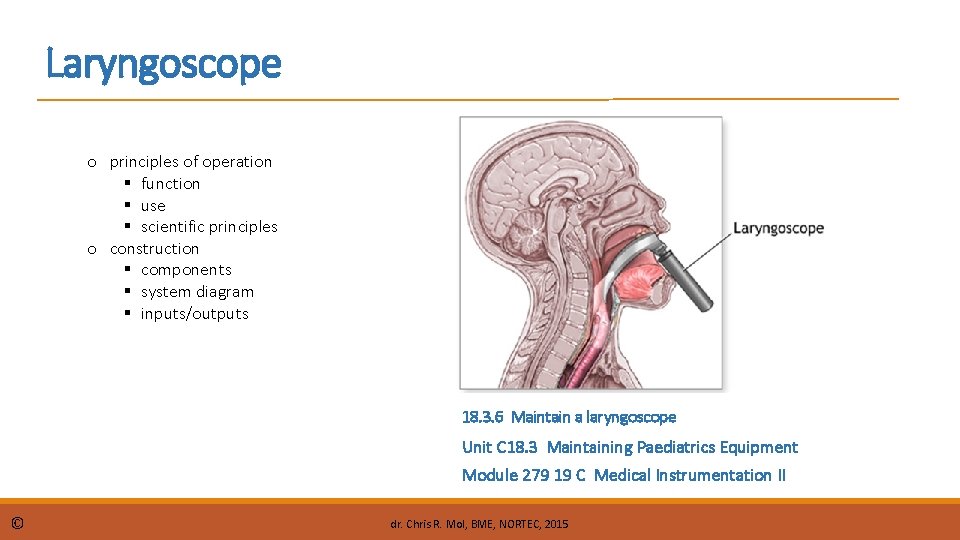
Laryngoscope o principles of operation function use scientific principles o construction components system diagram inputs/outputs 18. 3. 6 Maintain a laryngoscope Unit C 18. 3 Maintaining Paediatrics Equipment Module 279 19 C Medical Instrumentation II © dr. Chris R. Mol, BME, NORTEC, 2015
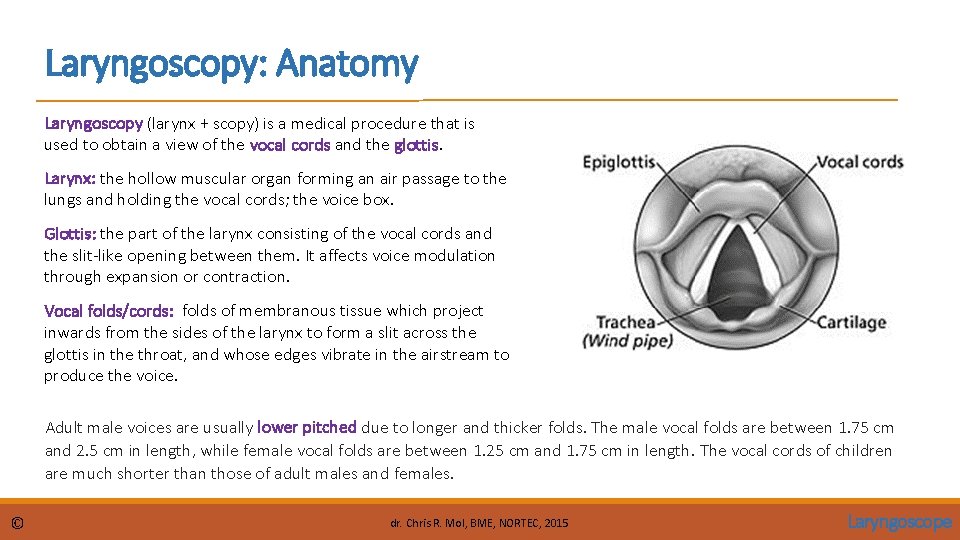
Laryngoscopy: Anatomy Laryngoscopy (larynx + scopy) is a medical procedure that is used to obtain a view of the vocal cords and the glottis. Larynx: the hollow muscular organ forming an air passage to the lungs and holding the vocal cords; the voice box. Glottis: the part of the larynx consisting of the vocal cords and the slit-like opening between them. It affects voice modulation through expansion or contraction. Vocal folds/cords: folds of membranous tissue which project inwards from the sides of the larynx to form a slit across the glottis in the throat, and whose edges vibrate in the airstream to produce the voice. Adult male voices are usually lower pitched due to longer and thicker folds. The male vocal folds are between 1. 75 cm and 2. 5 cm in length, while female vocal folds are between 1. 25 cm and 1. 75 cm in length. The vocal cords of children are much shorter than those of adult males and females. © dr. Chris R. Mol, BME, NORTEC, 2015 Laryngoscope
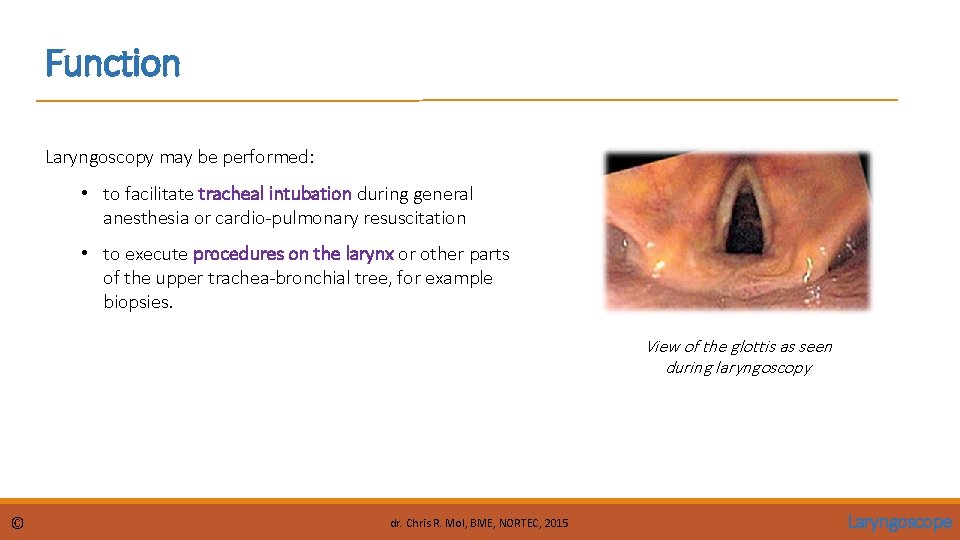
Function Laryngoscopy may be performed: • to facilitate tracheal intubation during general anesthesia or cardio-pulmonary resuscitation • to execute procedures on the larynx or other parts of the upper trachea-bronchial tree, for example biopsies. View of the glottis as seen during laryngoscopy © dr. Chris R. Mol, BME, NORTEC, 2015 Laryngoscope
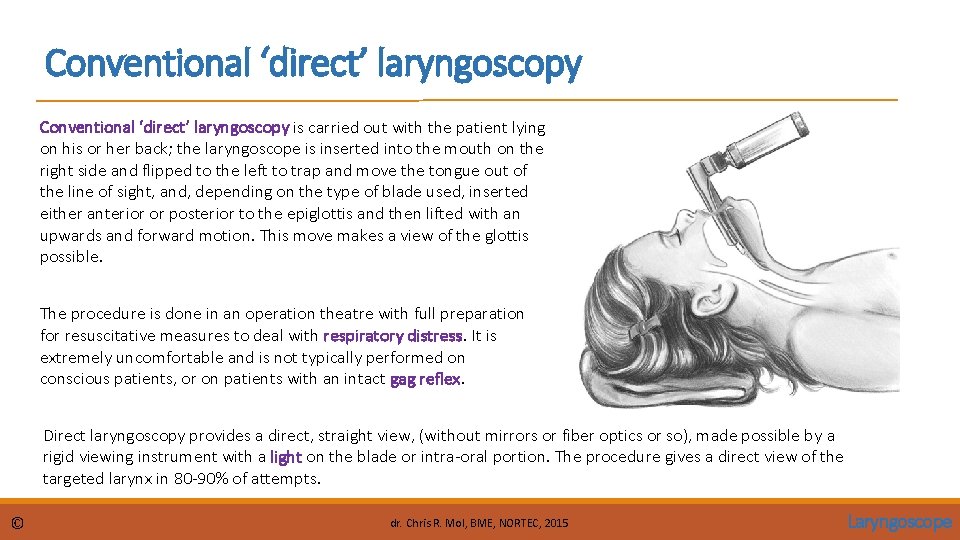
Conventional ‘direct’ laryngoscopy is carried out with the patient lying on his or her back; the laryngoscope is inserted into the mouth on the right side and flipped to the left to trap and move the tongue out of the line of sight, and, depending on the type of blade used, inserted either anterior or posterior to the epiglottis and then lifted with an upwards and forward motion. This move makes a view of the glottis possible. The procedure is done in an operation theatre with full preparation for resuscitative measures to deal with respiratory distress. It is extremely uncomfortable and is not typically performed on conscious patients, or on patients with an intact gag reflex. Direct laryngoscopy provides a direct, straight view, (without mirrors or fiber optics or so), made possible by a rigid viewing instrument with a light on the blade or intra-oral portion. The procedure gives a direct view of the targeted larynx in 80 -90% of attempts. © dr. Chris R. Mol, BME, NORTEC, 2015 Laryngoscope
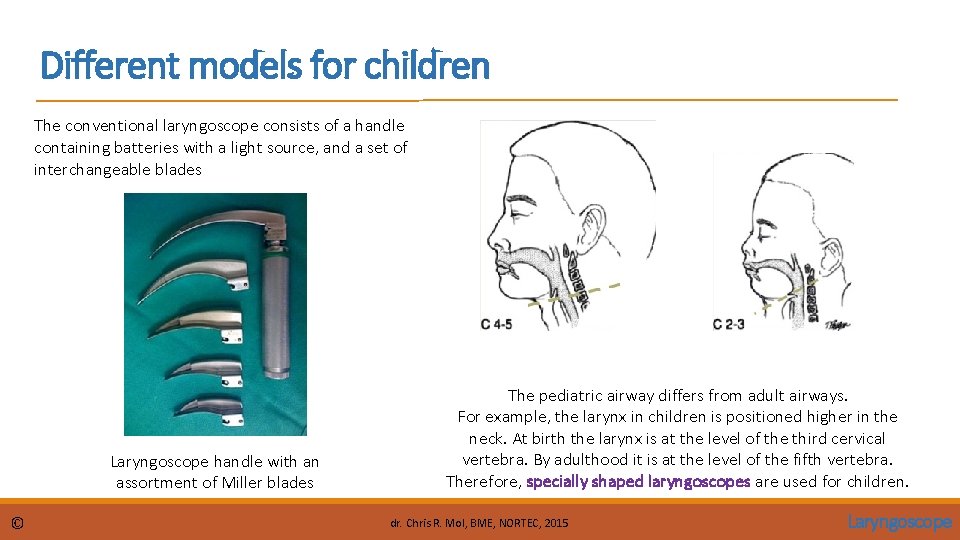
Different models for children The conventional laryngoscope consists of a handle containing batteries with a light source, and a set of interchangeable blades Laryngoscope handle with an assortment of Miller blades © The pediatric airway differs from adult airways. For example, the larynx in children is positioned higher in the neck. At birth the larynx is at the level of the third cervical vertebra. By adulthood it is at the level of the fifth vertebra. Therefore, specially shaped laryngoscopes are used for children. dr. Chris R. Mol, BME, NORTEC, 2015 Laryngoscope
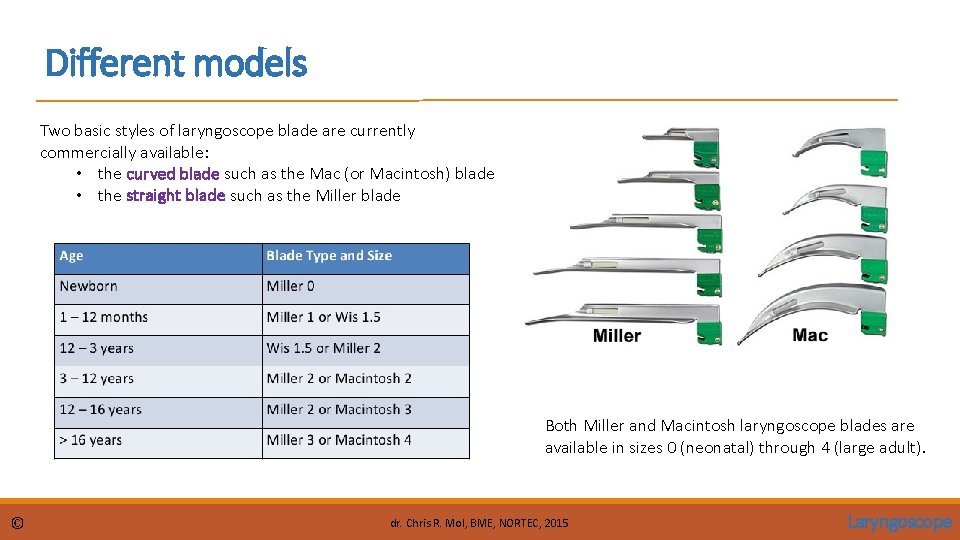
Different models Two basic styles of laryngoscope blade are currently commercially available: • the curved blade such as the Mac (or Macintosh) blade • the straight blade such as the Miller blade Both Miller and Macintosh laryngoscope blades are available in sizes 0 (neonatal) through 4 (large adult). © dr. Chris R. Mol, BME, NORTEC, 2015 Laryngoscope
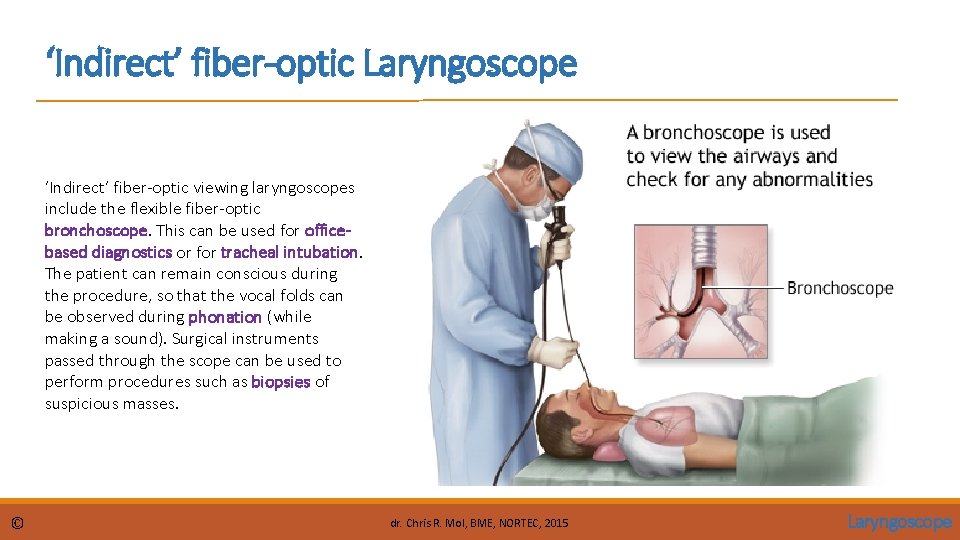
‘Indirect’ fiber-optic Laryngoscope ‘Indirect’ fiber-optic viewing laryngoscopes include the flexible fiber-optic bronchoscope. This can be used for officebased diagnostics or for tracheal intubation. The patient can remain conscious during the procedure, so that the vocal folds can be observed during phonation (while making a sound). Surgical instruments passed through the scope can be used to perform procedures such as biopsies of suspicious masses. © dr. Chris R. Mol, BME, NORTEC, 2015 Laryngoscope
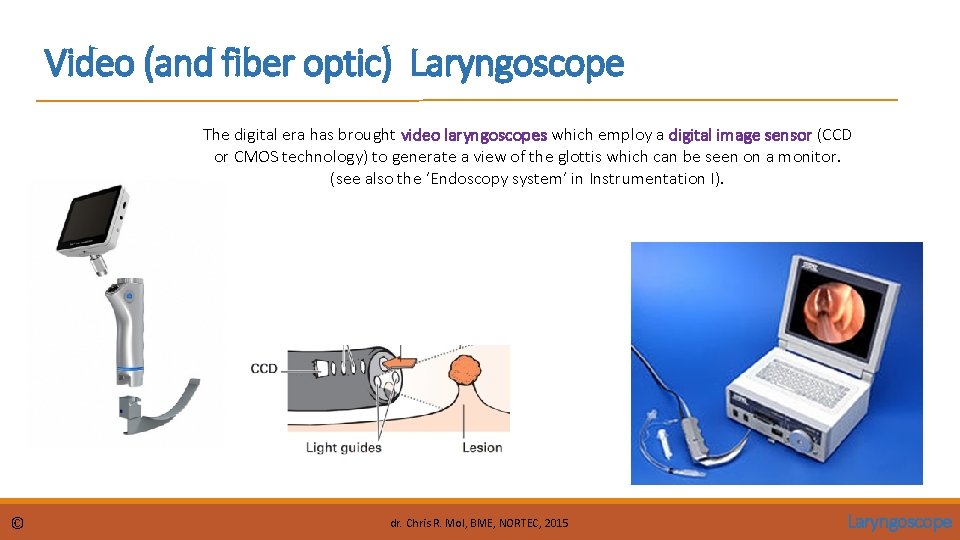
Video (and fiber optic) Laryngoscope The digital era has brought video laryngoscopes which employ a digital image sensor (CCD or CMOS technology) to generate a view of the glottis which can be seen on a monitor. (see also the ‘Endoscopy system’ in Instrumentation I). © dr. Chris R. Mol, BME, NORTEC, 2015 Laryngoscope
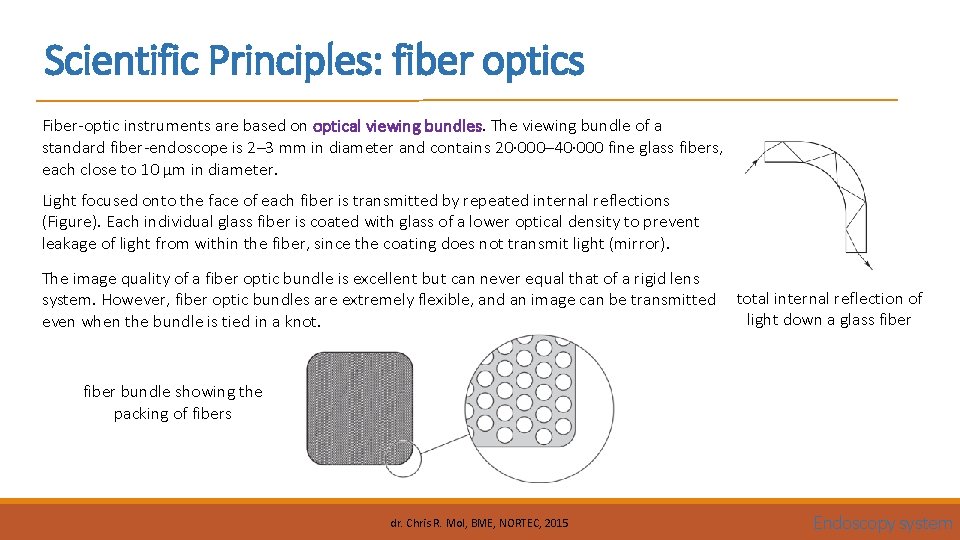
Scientific Principles: fiber optics Fiber-optic instruments are based on optical viewing bundles. The viewing bundle of a standard fiber-endoscope is 2– 3 mm in diameter and contains 20· 000– 40· 000 fine glass fibers, each close to 10 µm in diameter. Light focused onto the face of each fiber is transmitted by repeated internal reflections (Figure). Each individual glass fiber is coated with glass of a lower optical density to prevent leakage of light from within the fiber, since the coating does not transmit light (mirror). The image quality of a fiber optic bundle is excellent but can never equal that of a rigid lens system. However, fiber optic bundles are extremely flexible, and an image can be transmitted total internal reflection of light down a glass fiber even when the bundle is tied in a knot. fiber bundle showing the packing of fibers dr. Chris R. Mol, BME, NORTEC, 2015 Endoscopy system
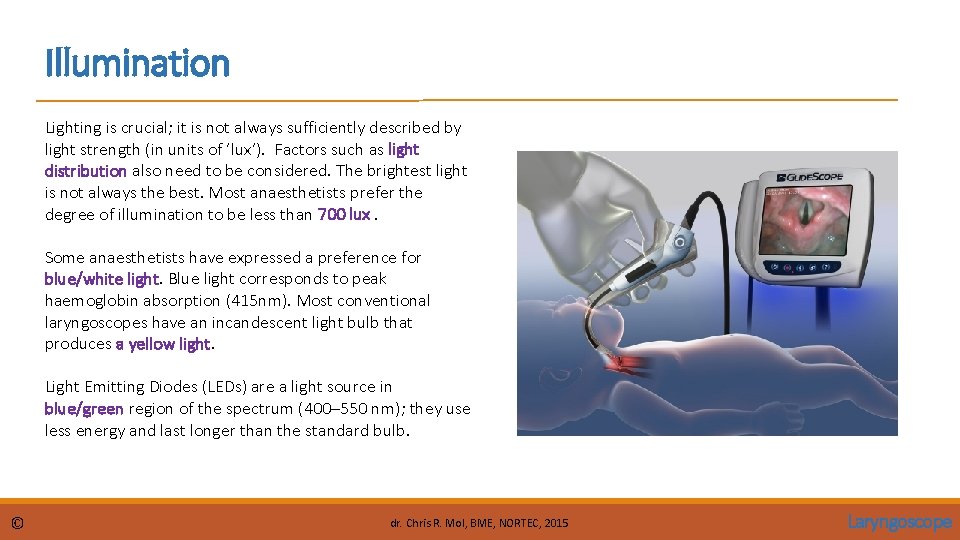
Illumination Lighting is crucial; it is not always sufficiently described by light strength (in units of ‘lux’). Factors such as light distribution also need to be considered. The brightest light is not always the best. Most anaesthetists prefer the degree of illumination to be less than 700 lux. Some anaesthetists have expressed a preference for blue/white light. Blue light corresponds to peak haemoglobin absorption (415 nm). Most conventional laryngoscopes have an incandescent light bulb that produces a yellow light. Light Emitting Diodes (LEDs) are a light source in blue/green region of the spectrum (400– 550 nm); they use less energy and last longer than the standard bulb. © dr. Chris R. Mol, BME, NORTEC, 2015 Laryngoscope
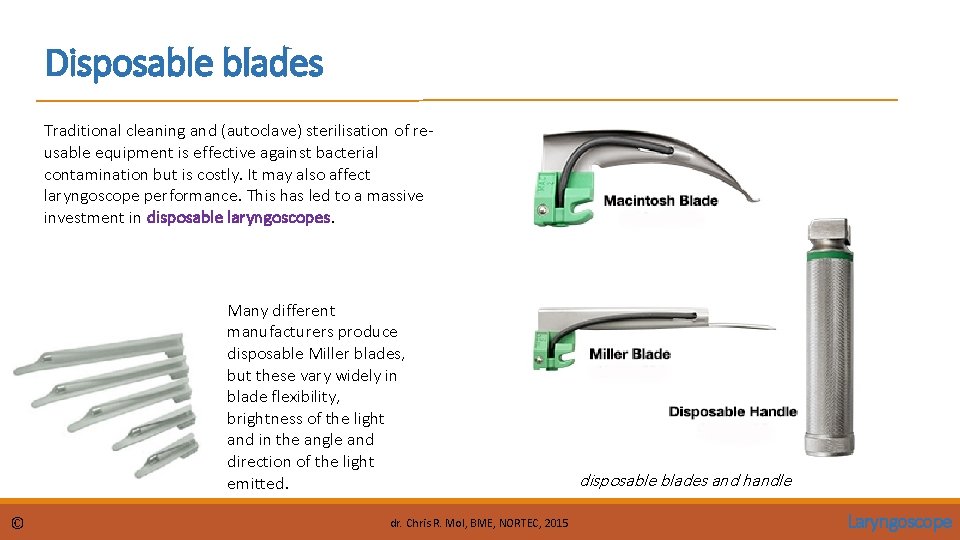
Disposable blades Traditional cleaning and (autoclave) sterilisation of reusable equipment is effective against bacterial contamination but is costly. It may also affect laryngoscope performance. This has led to a massive investment in disposable laryngoscopes. Many different manufacturers produce disposable Miller blades, but these vary widely in blade flexibility, brightness of the light and in the angle and direction of the light emitted. © dr. Chris R. Mol, BME, NORTEC, 2015 disposable blades and handle Laryngoscope
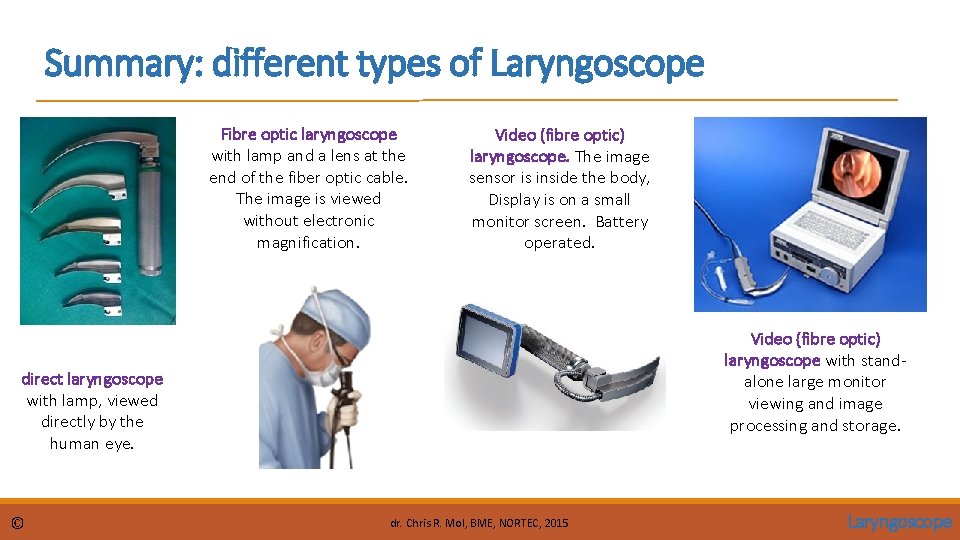
Summary: different types of Laryngoscope Fibre optic laryngoscope with lamp and a lens at the end of the fiber optic cable. The image is viewed without electronic magnification. Video (fibre optic) laryngoscope. The image sensor is inside the body, Display is on a small monitor screen. Battery operated. Video (fibre optic) laryngoscope with stand- alone large monitor viewing and image processing and storage. direct laryngoscope with lamp, viewed directly by the human eye. © dr. Chris R. Mol, BME, NORTEC, 2015 Laryngoscope
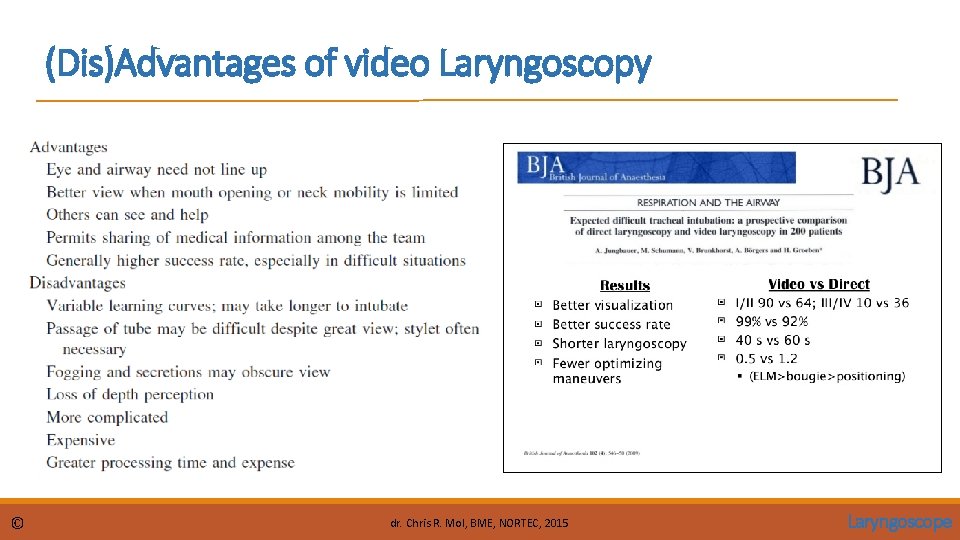
(Dis)Advantages of video Laryngoscopy © dr. Chris R. Mol, BME, NORTEC, 2015 Laryngoscope
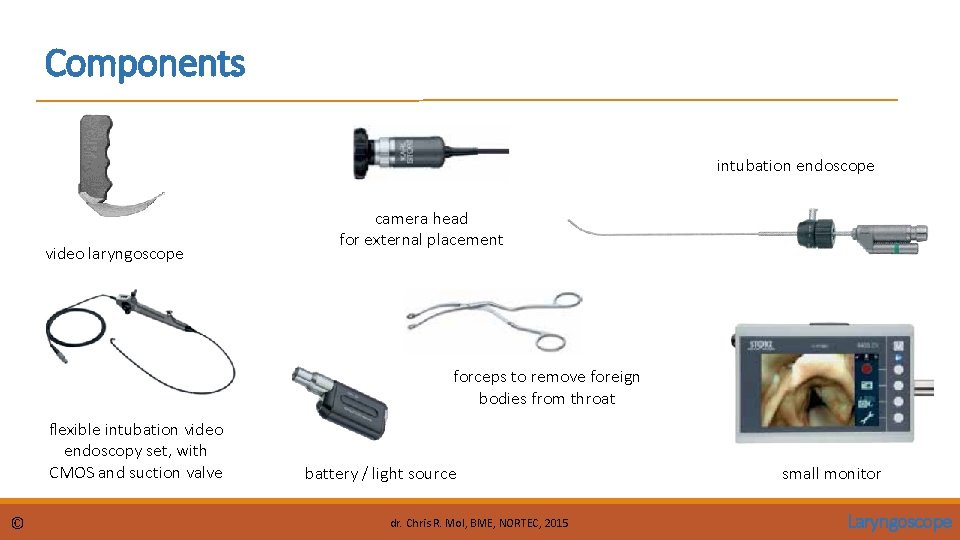
Components intubation endoscope video laryngoscope camera head for external placement forceps to remove foreign bodies from throat flexible intubation video endoscopy set, with CMOS and suction valve © battery / light source dr. Chris R. Mol, BME, NORTEC, 2015 small monitor Laryngoscope
END The creation of this presentation was supported by a grant from THET: see https: //www. thet. org/