
Laryngeal Cancer Clerk 2 Supervisor Anatomy Anatomy Vaezi


- Slides: 18
Laryngeal Cancer Clerk 2: 吳柏宣 陳昱潔 Supervisor: 李家和醫師
Anatomy
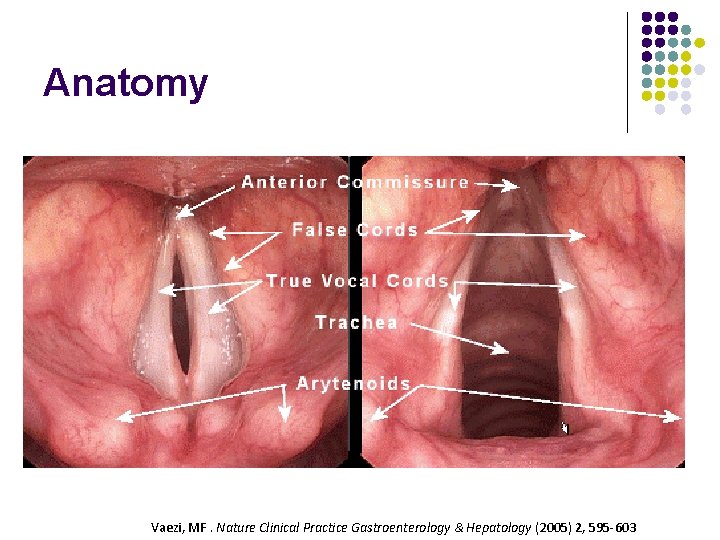
Anatomy Vaezi, MF. Nature Clinical Practice Gastroenterology & Hepatology (2005) 2, 595 -603
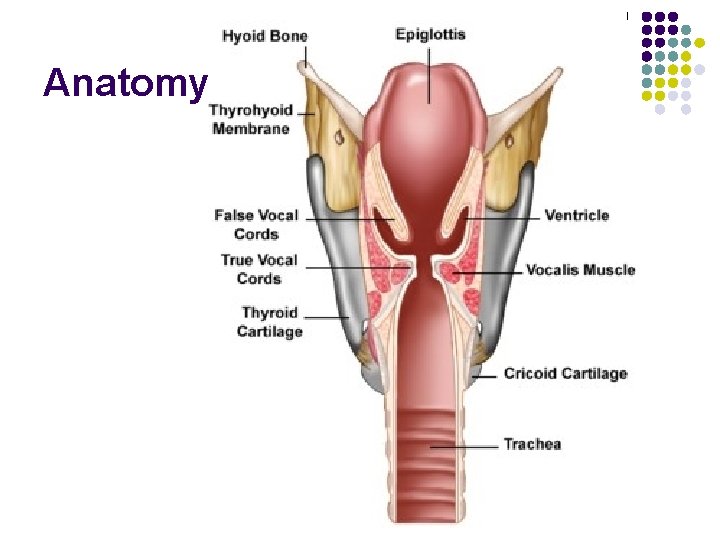
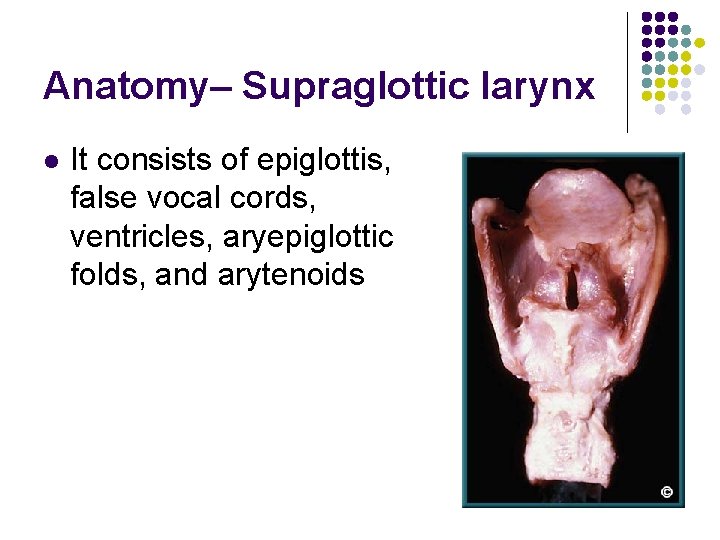
Anatomy– Supraglottic larynx l It consists of epiglottis, false vocal cords, ventricles, aryepiglottic folds, and arytenoids
Anatomy– Glottic larynx l It consists of the true vocal cords and anterior commissure and posterior commissure
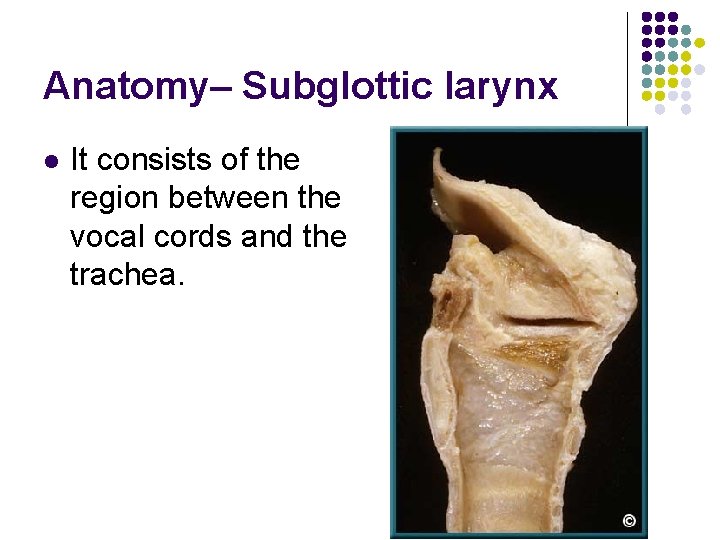
Anatomy– Subglottic larynx l It consists of the region between the vocal cords and the trachea.
Epidemiology l l Male : Female = 4 : 1 Age: 50~60 y/o > 90% squamous cell cancer 位置分類 ü ü ü Glottic cancer 80% Supraglottic cancer 20% Subglottic cancer 1%
Clinical Presentation l Mass effect: hoarseness, dysphagia, hemoptysis, neck mass, airway compromise (difficulty breathing), aspiration l Throat pain, ear pain (referred through CN X branch) l Suggests advanced stage l Hoarseness = allow for early detection of glottic cancer l Weight loss
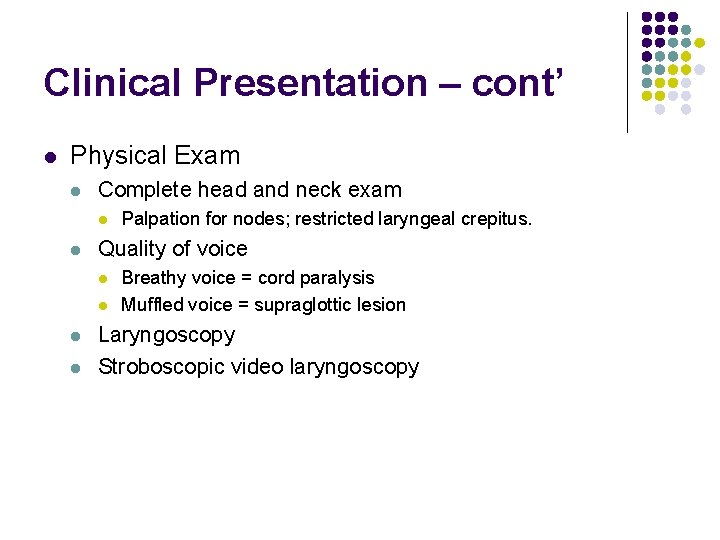
Clinical Presentation – cont’ l Physical Exam l Complete head and neck exam l l Quality of voice l l Palpation for nodes; restricted laryngeal crepitus. Breathy voice = cord paralysis Muffled voice = supraglottic lesion Laryngoscopy Stroboscopic video laryngoscopy
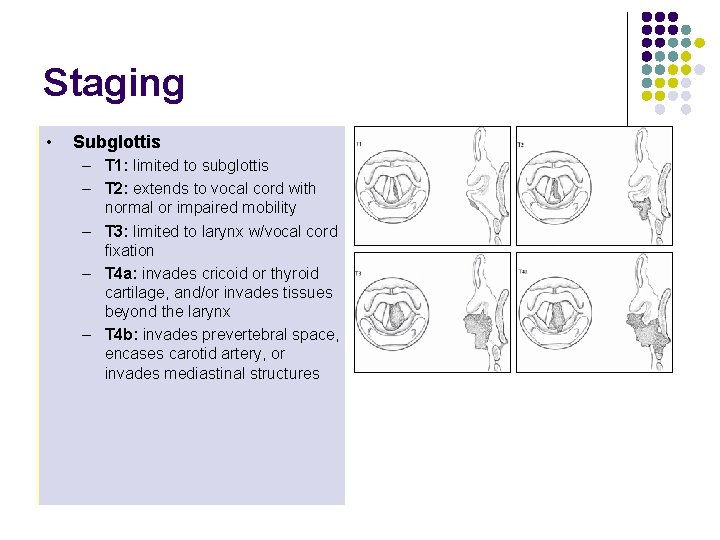
Staging l • Supraglottis Glottis Subglottis l– l – – – l – l – T 1: totosubsite of Tis: limited T 1: limited CA in-situ subglottis supraglots w/normal cord mobility T 1: extends T 2: limited totocord; vocal cord with T 2: invade mucosa of > 1 subsite normal or cord; impaired one T 1 b: mobility two cords of. T 1 a: supraglottis, or outside limited w/vocalofcord of. T 3: supraglottis w/out fixation T 2: extendstotolarynx supraglottis, fixation the larynx and/or subglottis, and/or T 3: limited tocord larynx w/vocal cord w/impaired T 4 a: invades cricoid mobility or thyroid fixation and/or invades cartilage, and/or invades tissues T 3: limited to larynx w/vocal cord postcricoid area, pre-epiglottic beyond the larynx fixation and/or invades tissues, paraglottic space, and/or paraglottic T 4 b: invades space, prevertebral and/or minor space, minor thyroid cartilage erosion thyroid cartilage encases carotid artery, erosionor T 4 a: invades thyroid cartilage invades mediastinal T 4 a: invades thyroid cartilage and/or tissues beyondstructures larynx and/or tissues beyond larynx T 4 b: invades prevertebral space, encases carotidprevertebral artery, or space, T 4 b: invades structures encasesmediastinal carotid artery, or invades mediastinal structures
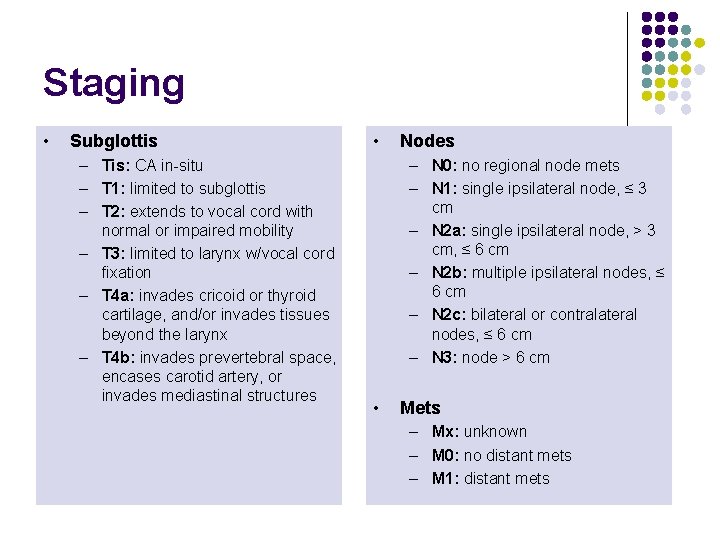
Staging • Subglottis – Tis: CA in-situ – T 1: limited to subglottis – T 2: extends to vocal cord with normal or impaired mobility – T 3: limited to larynx w/vocal cord fixation – T 4 a: invades cricoid or thyroid cartilage, and/or invades tissues beyond the larynx – T 4 b: invades prevertebral space, encases carotid artery, or invades mediastinal structures • Nodes – N 0: no regional node mets – N 1: single ipsilateral node, ≤ 3 cm – N 2 a: single ipsilateral node, > 3 cm, ≤ 6 cm – N 2 b: multiple ipsilateral nodes, ≤ 6 cm – N 2 c: bilateral or contralateral nodes, ≤ 6 cm – N 3: node > 6 cm • Mets – Mx: unknown – M 0: no distant mets – M 1: distant mets
Stage Grouping Stage 0 Tis N 0 M 0 Stage I T 1 N 0 M 0 Stage II T 2 N 0 M 0 T 3 N 0 M 0 T 1 -3 N 1 M 0 T 4 a N 0 -1 M 0 T 1 -4 a N 2 M 0 T 4 b any N M 0 any T N 3 M 0 any T any N M 1 Stage III Stage IVA Stage IVB Stage IVC Early stage Advanced stage
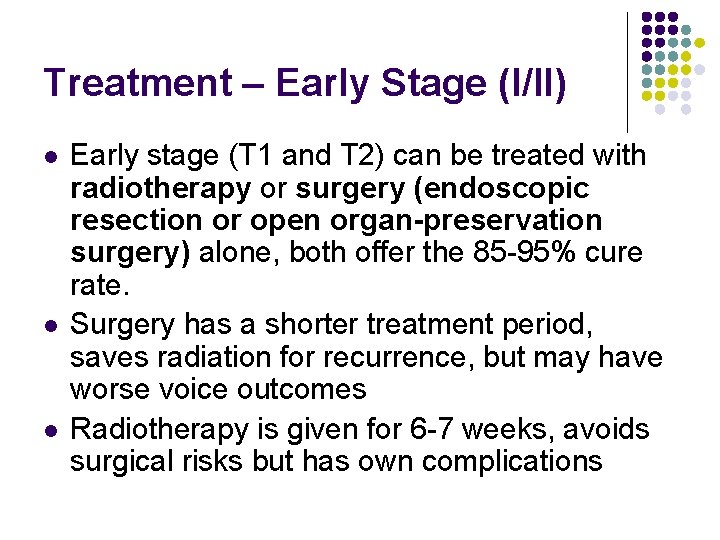
Treatment – Early Stage (I/II) l l l Early stage (T 1 and T 2) can be treated with radiotherapy or surgery (endoscopic resection or open organ-preservation surgery) alone, both offer the 85 -95% cure rate. Surgery has a shorter treatment period, saves radiation for recurrence, but may have worse voice outcomes Radiotherapy is given for 6 -7 weeks, avoids surgical risks but has own complications
Treatment – Early stage (I/II) l XRT complications include: ü ü ü ü Mucositis Odynophagia Laryngeal edema Xerostomia Stricture and fibrosis Radionecrosis Hypothyroidism
Treatment – Advanced Stage (III/IV) l l l Advanced stage lesions often receive surgery with adjuvant radiation Most T 3 and T 4 lesions require a total laryngectomy Some small T 3 and lesser sized tumors can be treated with partial larygectomy
Treatment – Advanced Stage (III/IV) l l l Chemotherapy can be used in addition to irradiation in advanced stage cancers Two agents used are Cisplatinum and 5 flourouracil (5 -FU) Cisplatin thought to sensitize cancer cells to XRT enhancing its effectiveness when used concurrently.
Treatment – Advanced Stage (III/IV) l l Modified or radical neck dissections are indicated in the presence of nodal disease Neck dissections may be performed in patients with supra or subglottic T 2 tumors even in the absence of nodal disease N 0 necks can have a selective dissection sparing the SCM, IJ, and XI N 1 necks usually have a modified dissection of levels II-IV