
LARP review 15 July 2010 CERN HFM program
- Slides: 19
LARP review, 15 July 2010: CERN HFM program The CERN High Field magnet program Gijs de Rijk 1
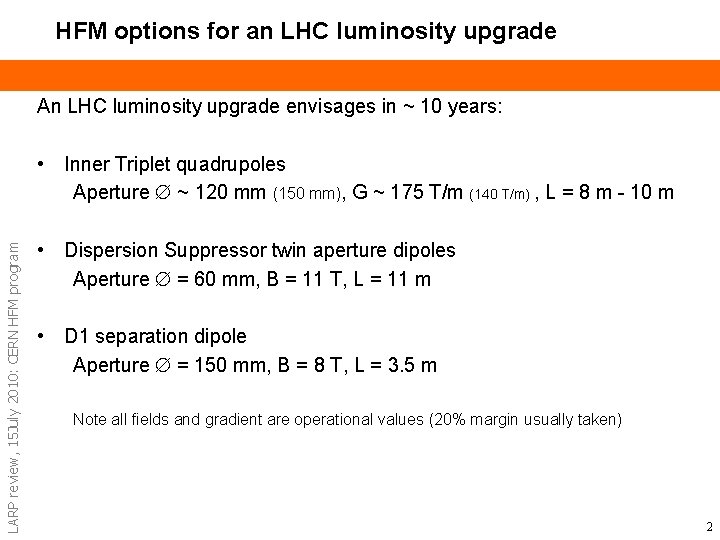
HFM options for an LHC luminosity upgrade An LHC luminosity upgrade envisages in ~ 10 years: LARP review, 15 July 2010: CERN HFM program • Inner Triplet quadrupoles Aperture Æ ~ 120 mm (150 mm), G ~ 175 T/m (140 T/m) , L = 8 m - 10 m • Dispersion Suppressor twin aperture dipoles Aperture Æ = 60 mm, B = 11 T, L = 11 m • D 1 separation dipole Aperture Æ = 150 mm, B = 8 T, L = 3. 5 m Note all fields and gradient are operational values (20% margin usually taken) 2
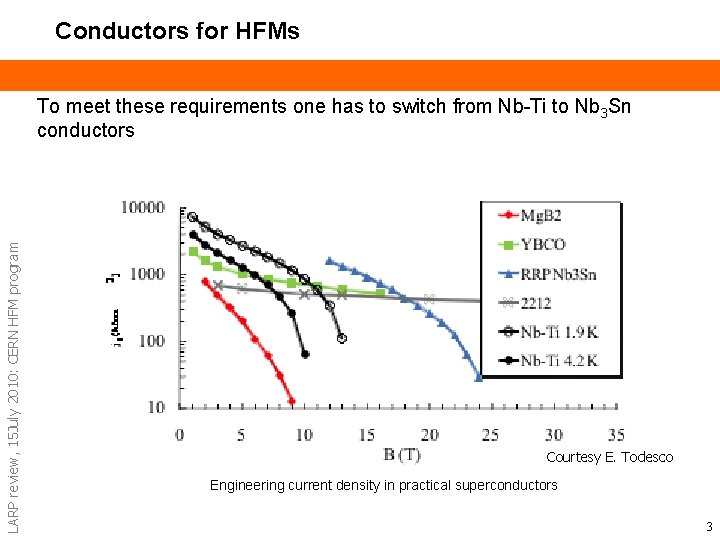
Conductors for HFMs LARP review, 15 July 2010: CERN HFM program To meet these requirements one has to switch from Nb-Ti to Nb 3 Sn conductors Courtesy E. Todesco Engineering current density in practical superconductors 3
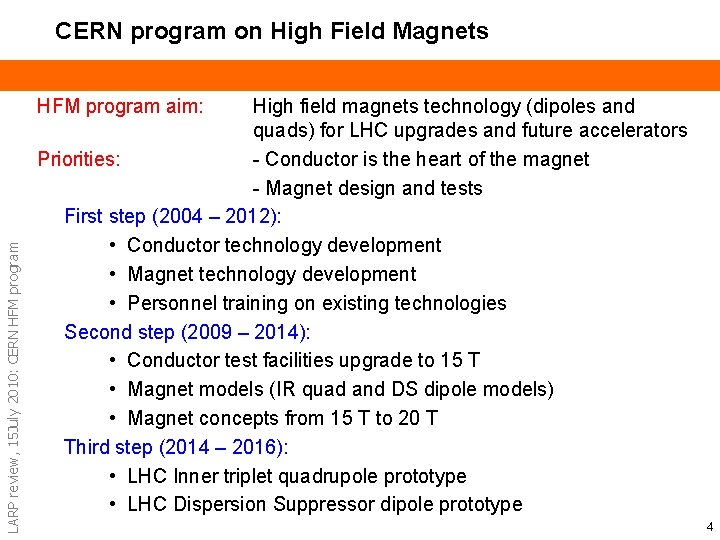
CERN program on High Field Magnets LARP review, 15 July 2010: CERN HFM program aim: High field magnets technology (dipoles and quads) for LHC upgrades and future accelerators Priorities: - Conductor is the heart of the magnet - Magnet design and tests First step (2004 – 2012): • Conductor technology development • Magnet technology development • Personnel training on existing technologies Second step (2009 – 2014): • Conductor test facilities upgrade to 15 T • Magnet models (IR quad and DS dipole models) • Magnet concepts from 15 T to 20 T Third step (2014 – 2016): • LHC Inner triplet quadrupole prototype • LHC Dispersion Suppressor dipole prototype 4
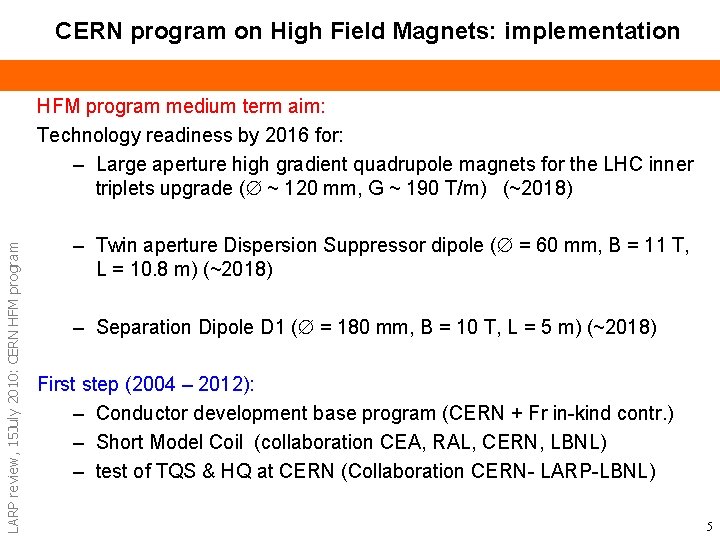
CERN program on High Field Magnets: implementation LARP review, 15 July 2010: CERN HFM program medium term aim: Technology readiness by 2016 for: – Large aperture high gradient quadrupole magnets for the LHC inner triplets upgrade (Æ ~ 120 mm, G ~ 190 T/m) (~2018) – Twin aperture Dispersion Suppressor dipole (Æ = 60 mm, B = 11 T, L = 10. 8 m) (~2018) – Separation Dipole D 1 (Æ = 180 mm, B = 10 T, L = 5 m) (~2018) First step (2004 – 2012): – Conductor development base program (CERN + Fr in-kind contr. ) – Short Model Coil (collaboration CEA, RAL, CERN, LBNL) – test of TQS & HQ at CERN (Collaboration CERN- LARP-LBNL) 5
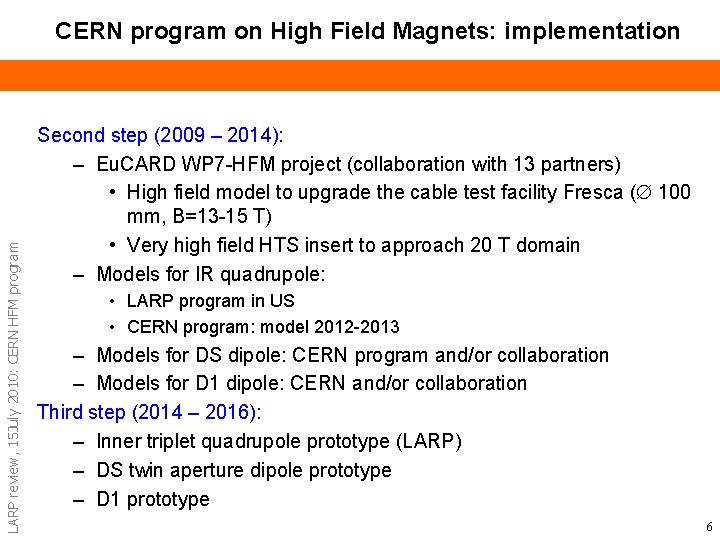
LARP review, 15 July 2010: CERN HFM program CERN program on High Field Magnets: implementation Second step (2009 – 2014): – Eu. CARD WP 7 -HFM project (collaboration with 13 partners) • High field model to upgrade the cable test facility Fresca (Æ 100 mm, B=13 -15 T) • Very high field HTS insert to approach 20 T domain – Models for IR quadrupole: • LARP program in US • CERN program: model 2012 -2013 – Models for DS dipole: CERN program and/or collaboration – Models for D 1 dipole: CERN and/or collaboration Third step (2014 – 2016): – Inner triplet quadrupole prototype (LARP) – DS twin aperture dipole prototype – D 1 prototype 6
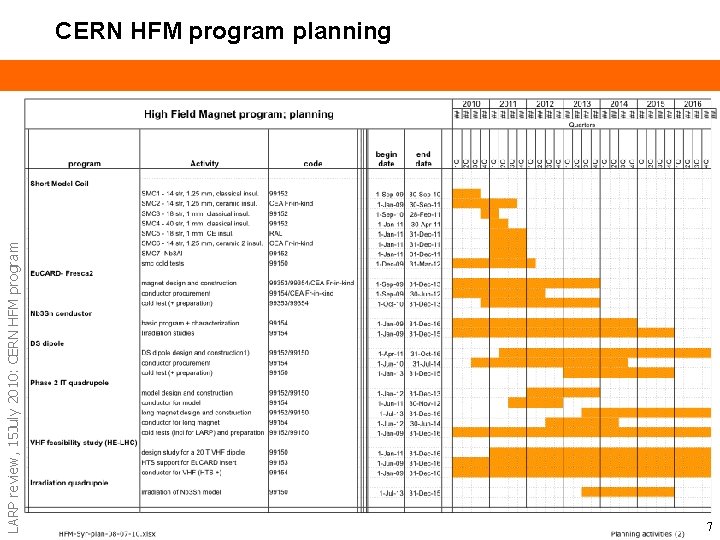
LARP review, 15 July 2010: CERN HFM program planning 7
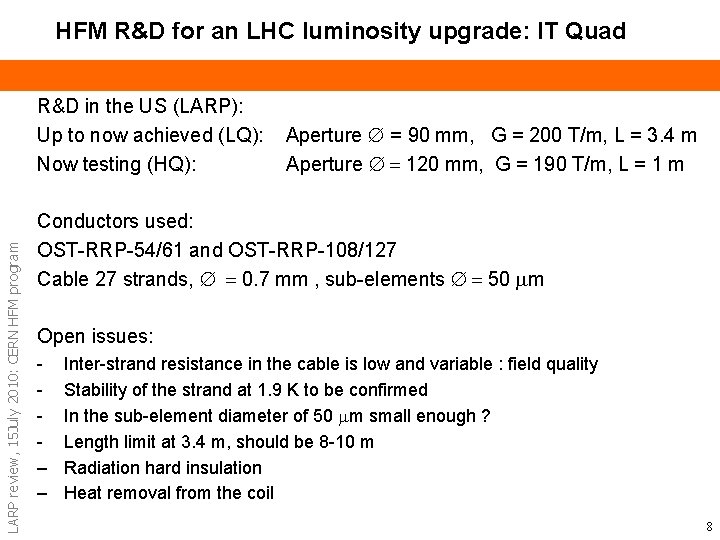
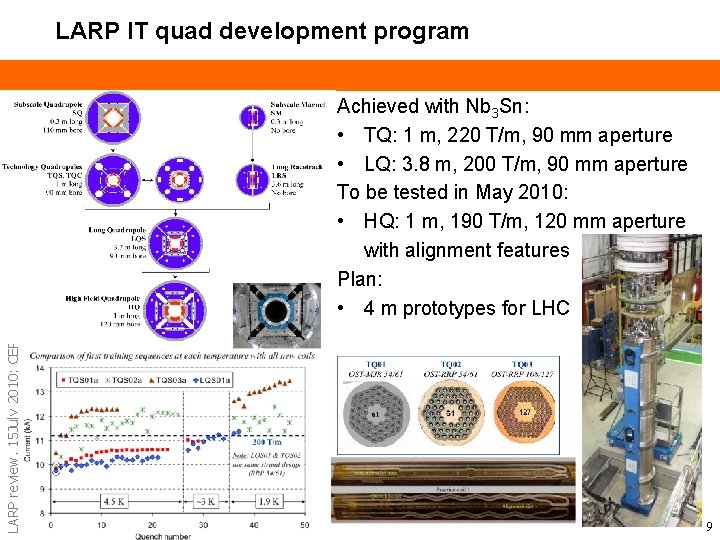
HFM R&D for an LHC luminosity upgrade: IT Quad LARP review, 15 July 2010: CERN HFM program R&D in the US (LARP): Up to now achieved (LQ): Now testing (HQ): Aperture Æ = 90 mm, G = 200 T/m, L = 3. 4 m Aperture Æ = 120 mm, G = 190 T/m, L = 1 m Conductors used: OST-RRP-54/61 and OST-RRP-108/127 Cable 27 strands, Æ = 0. 7 mm , sub-elements Æ = 50 m Open issues: – – Inter-strand resistance in the cable is low and variable : field quality Stability of the strand at 1. 9 K to be confirmed In the sub-element diameter of 50 m small enough ? Length limit at 3. 4 m, should be 8 -10 m Radiation hard insulation Heat removal from the coil 8
LARP review, 15 July 2010: CERN HFM program LARP IT quad development program Achieved with Nb 3 Sn: • TQ: 1 m, 220 T/m, 90 mm aperture • LQ: 3. 8 m, 200 T/m, 90 mm aperture To be tested in May 2010: • HQ: 1 m, 190 T/m, 120 mm aperture with alignment features Plan: • 4 m prototypes for LHC 9
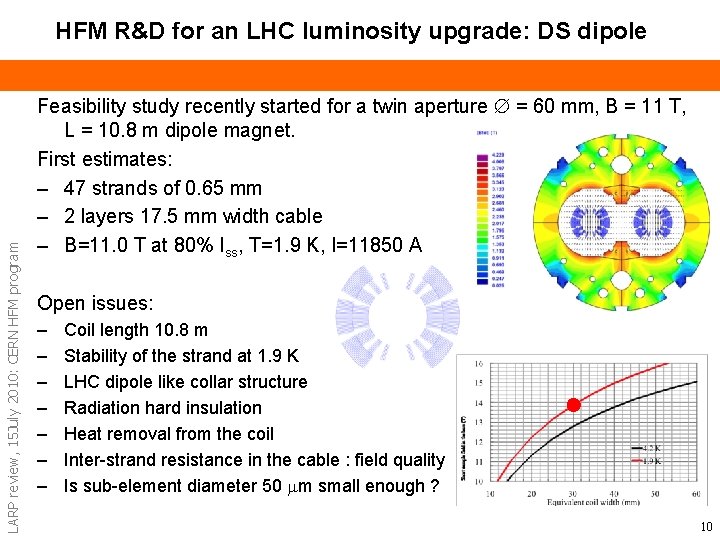
LARP review, 15 July 2010: CERN HFM program HFM R&D for an LHC luminosity upgrade: DS dipole Feasibility study recently started for a twin aperture Æ = 60 mm, B = 11 T, L = 10. 8 m dipole magnet. First estimates: – 47 strands of 0. 65 mm – 2 layers 17. 5 mm width cable – B=11. 0 T at 80% Iss, T=1. 9 K, I=11850 A Open issues: – – – – Coil length 10. 8 m Stability of the strand at 1. 9 K LHC dipole like collar structure Radiation hard insulation Heat removal from the coil Inter-strand resistance in the cable : field quality Is sub-element diameter 50 m small enough ? 10
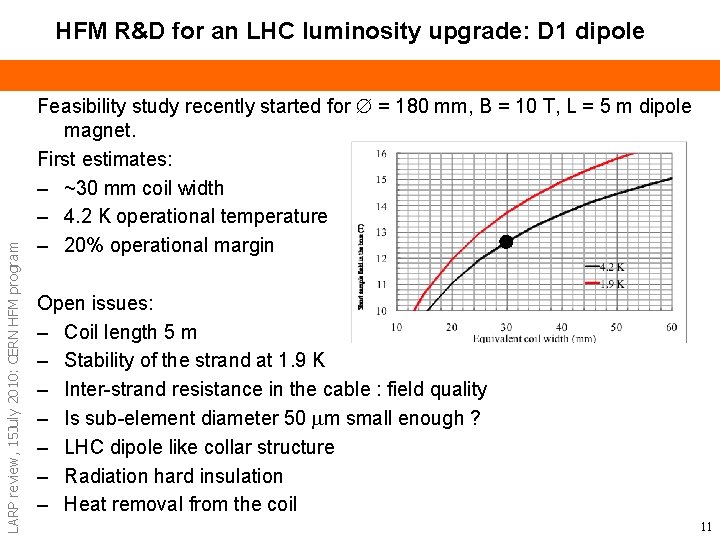
LARP review, 15 July 2010: CERN HFM program HFM R&D for an LHC luminosity upgrade: D 1 dipole Feasibility study recently started for Æ = 180 mm, B = 10 T, L = 5 m dipole magnet. First estimates: – ~30 mm coil width – 4. 2 K operational temperature – 20% operational margin Open issues: – Coil length 5 m – Stability of the strand at 1. 9 K – Inter-strand resistance in the cable : field quality – Is sub-element diameter 50 m small enough ? – LHC dipole like collar structure – Radiation hard insulation – Heat removal from the coil 11
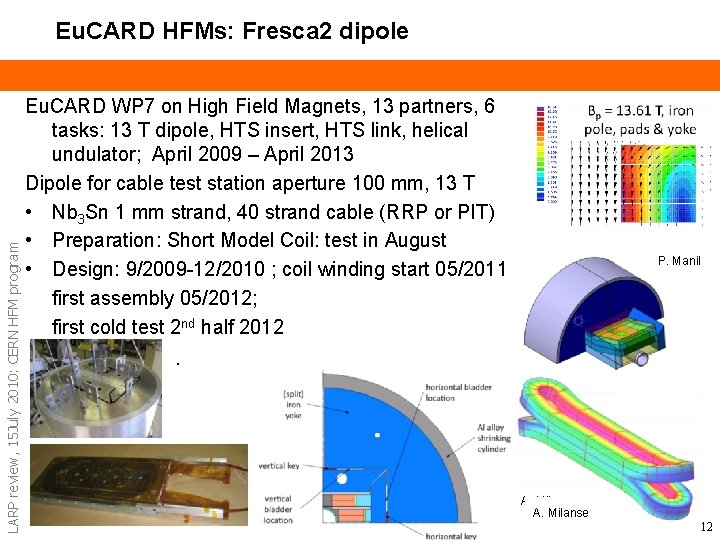
LARP review, 15 July 2010: CERN HFM program Eu. CARD HFMs: Fresca 2 dipole Eu. CARD WP 7 on High Field Magnets, 13 partners, 6 tasks: 13 T dipole, HTS insert, HTS link, helical undulator; April 2009 – April 2013 Dipole for cable test station aperture 100 mm, 13 T • Nb 3 Sn 1 mm strand, 40 strand cable (RRP or PIT) • Preparation: Short Model Coil: test in August • Design: 9/2009 -12/2010 ; coil winding start 05/2011; first assembly 05/2012; first cold test 2 nd half 2012 P. Manil . A. Milanse 12
Radiation resistance • The radiation resistance of the Nb 3 Sn magnets has to be fully proven • In the EUCARD program we have a task of the High Field Magnets work package dedicated to these issues – Radiation tests on Nb 3 Sn conductor carried out in Vienna, Russia [L. LARP review, 15 July 2010: CERN HFM program Oberli, R. Fluckiger, et al. ] – Radiation tests on Nb 3 Sn insulation carried out in Poland [J. Polinski, R. Fluckiger, et al. ] – Possible synergy with LARP • The validation of the radiation resistance of all material used in LARP Nb 3 Sn magnet should be assessed as soon as possible to avoid surprises and delays – If a material has to be replaced this can have an impact on magnet design and performance – This can considerably delay the project – Time is a relevant variable … our goal is integrated luminosity – For instance: e-glass not acceptable (large remnant radioactivity), sglass ok 13
LARP review, 15 July 2010: CERN HFM program HFM R&D items: Dynamic effects in conductors (1) For both the IR quad and the dipole, there are questions on the conductor performance : - Inter-strand resistance in the cable - Stability of the strand at 1. 9 K (10 % performance increase is not negligible) - In the sub-element diameter of 50 m small enough ? We do not yet know what the present 0. 6 – 1. 0 mm conductors will do. 3 options to measure these effects: - On the Strand: characterization: stability and magnetization § Program at the test stations at CERN up to 15 T (ongoing) - On the cable: stability and loss measurements § Program at CERN in Fresca up to 10 T (ongoing) - On magnets: loss measurements and fast magnetic measurements § On TQS at CERN (ongoing) § On HQ at CERN (summer 2010) 14
LARP review, 15 July 2010: CERN HFM program HFM R&D items: Dynamic effects in conductors (2) Based on measured losses and field decay effects in 2010 on the strand, cable and magnet level by the second half of 2010 we should be able to launch: - R&D on cable inter-strand resistance control, 2 options • Cored cable • Coated strands Based on the fast magnetic measurements to see persistent current effects on the magnets by the second half of 2010 we should be able to launch: - R&D contracts on strand with smaller sub-elements (towards 20 m) 15
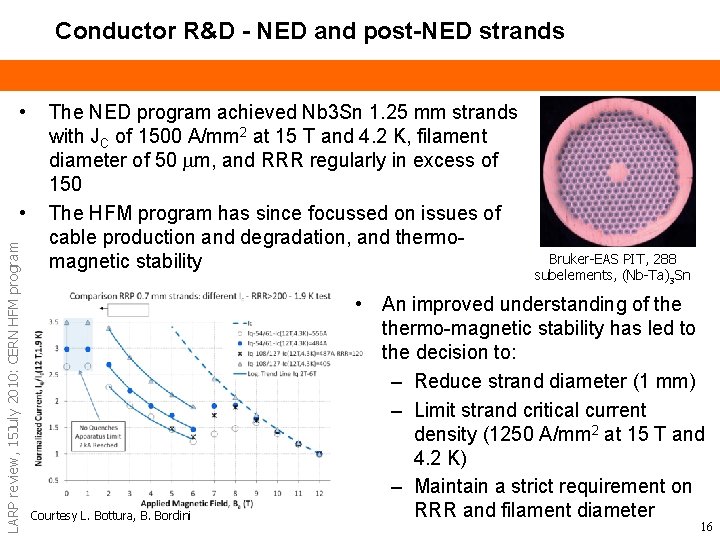
Conductor R&D - NED and post-NED strands • LARP review, 15 July 2010: CERN HFM program • The NED program achieved Nb 3 Sn 1. 25 mm strands with JC of 1500 A/mm 2 at 15 T and 4. 2 K, filament diameter of 50 m, and RRR regularly in excess of 150 The HFM program has since focussed on issues of cable production and degradation, and thermomagnetic stability Courtesy L. Bottura, B. Bordini Bruker-EAS PIT, 288 subelements, (Nb-Ta)3 Sn • An improved understanding of thermo-magnetic stability has led to the decision to: – Reduce strand diameter (1 mm) – Limit strand critical current density (1250 A/mm 2 at 15 T and 4. 2 K) – Maintain a strict requirement on RRR and filament diameter 16
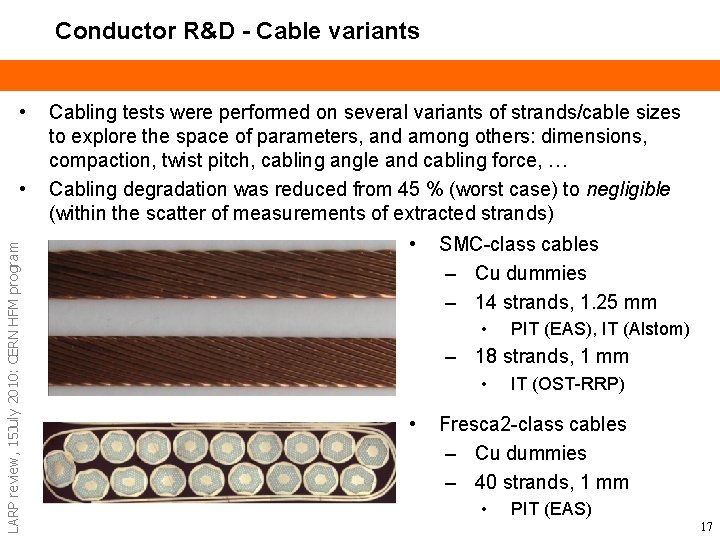
Conductor R&D - Cable variants • LARP review, 15 July 2010: CERN HFM program • Cabling tests were performed on several variants of strands/cable sizes to explore the space of parameters, and among others: dimensions, compaction, twist pitch, cabling angle and cabling force, … Cabling degradation was reduced from 45 % (worst case) to negligible (within the scatter of measurements of extracted strands) • SMC-class cables – Cu dummies – 14 strands, 1. 25 mm • PIT (EAS), IT (Alstom) – 18 strands, 1 mm • • IT (OST-RRP) Fresca 2 -class cables – Cu dummies – 40 strands, 1 mm • PIT (EAS) 17
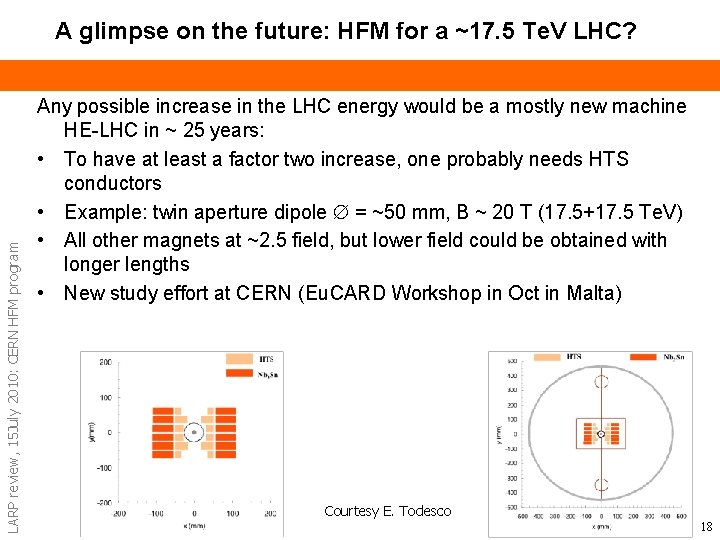
LARP review, 15 July 2010: CERN HFM program A glimpse on the future: HFM for a ~17. 5 Te. V LHC? Any possible increase in the LHC energy would be a mostly new machine HE-LHC in ~ 25 years: • To have at least a factor two increase, one probably needs HTS conductors • Example: twin aperture dipole Æ = ~50 mm, B ~ 20 T (17. 5+17. 5 Te. V) • All other magnets at ~2. 5 field, but lower field could be obtained with longer lengths • New study effort at CERN (Eu. CARD Workshop in Oct in Malta) Courtesy E. Todesco 18
Conclusions LARP review, 15 July 2010: CERN HFM program • CERN HFM program is preparing for HL-LHC and later HE-LHC • Collaboration oriented – LARP – Eu. CARD –. . . 19