
Largs Academy Department of Drama Sound Design Learning
- Slides: 23
Largs Academy Department of Drama Sound Design
Learning Intentions To understand how the use of sound can enhance a production of a script extract. To understand the paperwork that a sound engineer uses. To select appropriate sound.
Success Criteria I will explore the effects that sound has on a production. I will be able to apply sound to a production of Antigone I will practice creating sound cue sheets.
The purpose of sound design Supporting the style of a production Like all of the design elements, sound and music will help to support the overall style of a production. For example, a play in a naturalistic style would use realistic sound effects to create the impression of real life. Creating mood and atmosphere Sound and music can be an effective way to create mood on stage. Music can be used to heighten the mood of a scene, eg. the use of sad strings to underscore an emotional monologue. Music can also be contrasted to the action on stage for dramatic effect.
Conveying the time period Music is a particularly effective device for conveying a play’s historical context. For example, a play set in the 1940 s may use a style of music popular in that period, such as swing, to help transport the audience to that era. Sound effects can also reinforce a play’s period, eg. a horn from a steam train. Conveying setting Sound and music can help set the scene. For example, a play set in the Highlands of Scotland might utilise bagpipes, and the sound design could include wind and rain sound effects to give the impression of a cold, harsh climate. Conveying time of day Sound effects can be used to help establish the time of day. A scene set in the early morning might feature the sound of birdsong, while a scene at night could use the sound of crickets chirping.
Communicating themes or symbols Music and sound can be used to communicate thematic or symbolic ideas. For example, where power is the central theme of a play, strong and dramatic classical music with a heavy brass sound might be used. Influencing pace Music can influence pace on stage. For example, a fast piece of music with a pulsing drum and bass rhythm will energise a scene. Communicating a character’s personality Some plays use a musical theme or sound effect to represent a character on stage. This can be subtle but at times is very obvious, eg a thunder sound effect and tense music when a villain enters the stage in a pantomime.
Considerations when designing sound When designing sound, there are several aspects to consider, including: • • • sound effects diegetic or non-diegetic live or recorded sourcing underscoring mixing Sound effects are the artificial reproduction of sounds that help to create realism on stage, eg the sound of a window smashing.
Diegetic or non-diegetic Diegetic sound is sound that a character can hear within the world of the play. For example, when a character turns on the radio, the voices or music from it are heard by the character and the audience. Nondiegetic sound is sound that exists outside the world of the play. The audience can hear the sound but the characters cannot, eg a narration or underscore. Live or recorded A sound designer, in consultation with the director, will consider whether to include the use of live music and sound effects either instead of or in addition to pre-recorded sound. This decision will depend on the style of the show and the budget. Sourcing is the process of locating or producing an effect or a piece of music, eg. using online music libraries.
Underscoring is the use of music underneath dialogue to help create an atmosphere or to convey a theme. Mixing is the process of layering one sound with another. This can be done live or pre-recorded. For example, a soundscape could include a sound effect of rain on a window mixed with whispered voices. Considerations when designing sound When designing sound, there are several other aspects to consider, including: • • • amplification direction pre-set transitions volume
Amplification is the process of increasing the reach of the sound. In theatre this is usually achieved through the use of microphones, amplifiers and speakers. Direction Sound can travel in a variety of directions by positioning speakers in different parts of the auditorium. Altering the position of the speakers can create an effect that makes a piece more immersive, such as surround sound. Pre-set A sound designer may consider using sound or music as the audience enter the auditorium before the performance begins, to help establish the mood or setting of a piece. It can be as simple as the sound of waves crashing to suggest that the action takes place at the seaside.
Transitions A sound designer may use sound or music to help with the transition from one scene to the next. This can help to speed up or slow down the pace of the play and can help to establish the setting of a scene. For example, upbeat fast-paced music might be used with a train whistle sound effect to suggest a move from one location to another. Volume refers to how loud or quiet sound is within a production. While the volume needs to be loud enough for the audience to hear everything, it can be altered for dramatic effect.
Sound Engineer Responsibilities 1. Become very familiar with the script. 2. Make notes on the sound required any pieces of music you may need. 3. Carry out research.
Sound Engineer Responsibilities 4. Source the sound effects and the music required for the play. You may need to record sound effects or rehearse them so that they can be performed live. 5. Burn all of your music onto a CD or create a playlist on a phone or mp 3 player. Ideally they should be “burned” in the order they are used, however this is not always necessary. 6. Complete a Sound Cue Sheet. This will include when the sound is to be used, the volume of the sound effect/music, how long is going to last for and a brief description of what it is. (You will be shown how to create one of these in more detail later)
Completing a Sound Cue Sheet What paper work does a sound designer need to complete? The most important factor with sound and music is that you must come in at the right time. The director will run the production through from the beginning to end to make sure all sound cues work. Look at the sound cue sheet in your work booklet Cues should be listed in the order they are heard on a sound cue sheet. Next to each cue should be the dialogue or action during which you produce the sound.
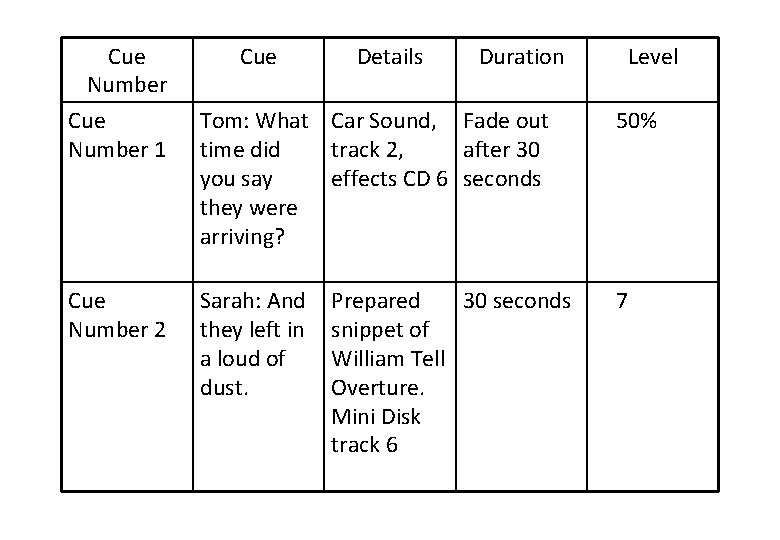
In the following column you must write down as many details as are needed to produce the sound cue effectively. This may also be notes about whether the sound is recorded or live. In the second last column you must record the duration (how long) the sound effect will take place. In the last column you should give details of the level (how loud) the sound will be. Look at the example on the following page. There also some examples on page 23 of your production skills information booklet.
Cue Number Cue Details Duration Level Cue Number 1 Tom: What Car Sound, Fade out time did track 2, after 30 you say effects CD 6 seconds they were arriving? 50% Cue Number 2 Sarah: And they left in a loud of dust. 7 Prepared 30 seconds snippet of William Tell Overture. Mini Disk track 6
The most important factor with sound and music is that you must come in at the right time. The director will run the production through from the beginning to end to make sure all sound cues work. There is an example of a sound cue sheet on the next page. Cues should be listed in the order they are heard on a sound cue sheet. Next to each cue should be the dialogue or action during which you produce the sound. In the following column you must write down as many details as are needed to produce the sound cue effectively. This may also be notes about whether the sound is recorded or live. In the second last column you must record the duration (how long) the sound effect will take place. In the last column you should give details of the level (how loud) the sound will be.
Task: Experiment with sound and music. With a partner discuss how sound and music may be used to enhance a performance of Antigone. Then complete the sound cue sheet(s) in your booklet
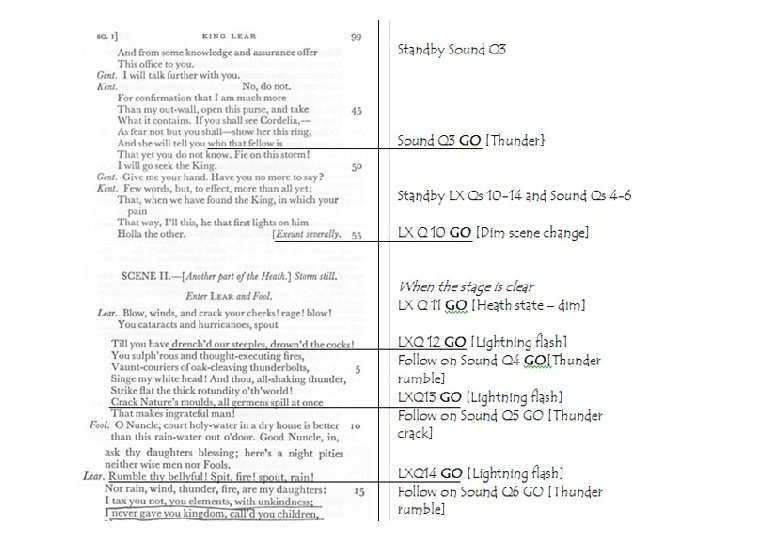
What is a Prompt Copy? The Prompt Book is the master copy of the script or score, containing all the actor moves and technical cues, and is used by the deputy stage manager to run rehearsals and later, control the performance. It’s sometimes known as the ‘book’, Prompt Copy or Prompt Script. The member of stage management (often the DSM) cueing the show is said to be ‘On the Book’. (e. g. ‘Clare’s on the book for the next show’). As well as the script and/or score of the show, the prompt book also contains contact lists for all concerned with the production, information about the venue(s), show reports, local amenities, emergency procedures and any other information that may be needed during the run of the show. It’s rightly known as the production ‘bible’. The book is usually laid out so that the script is on one side of a folder, and the cues are on the opposite side, with a line between the cue word / line, and the cue itself. Left-handed DSMs may prefer the cue page to be on the left of the folder.
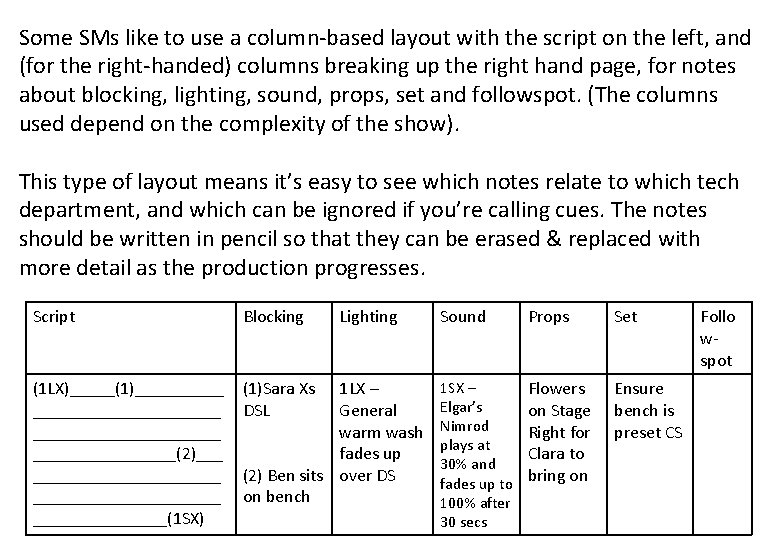
Some SMs like to use a column-based layout with the script on the left, and (for the right-handed) columns breaking up the right hand page, for notes about blocking, lighting, sound, props, set and followspot. (The columns used depend on the complexity of the show). This type of layout means it’s easy to see which notes relate to which tech department, and which can be ignored if you’re calling cues. The notes should be written in pencil so that they can be erased & replaced with more detail as the production progresses. Script Blocking (1 LX)_____(1)__________________(2)___ _____________________(1 SX) (1)Sara Xs DSL Lighting 1 LX – General warm wash fades up (2) Ben sits over DS on bench Sound Props Set 1 SX – Elgar’s Nimrod plays at 30% and fades up to 100% after 30 secs Flowers on Stage Right for Clara to bring on Ensure bench is preset CS Follo wspot
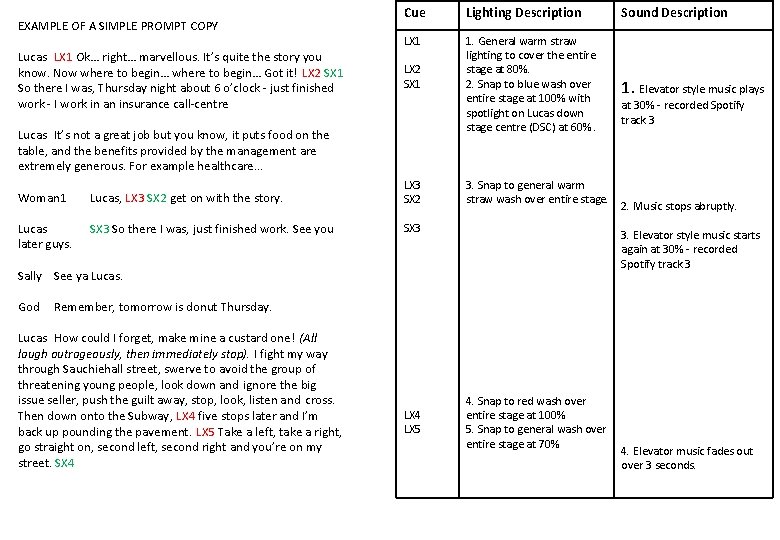
EXAMPLE OF A SIMPLE PROMPT COPY Lucas LX 1 Ok… right… marvellous. It’s quite the story you know. Now where to begin… Got it! LX 2 SX 1 So there I was, Thursday night about 6 o’clock - just finished work - I work in an insurance call-centre Cue Lighting Description Sound Description LX 1 1. General warm straw lighting to cover the entire stage at 80%. 2. Snap to blue wash over entire stage at 100% with spotlight on Lucas down stage centre (DSC) at 60%. 1. Elevator style music plays LX 2 SX 1 Lucas It’s not a great job but you know, it puts food on the table, and the benefits provided by the management are extremely generous. For example healthcare. . . Woman 1 Lucas, LX 3 SX 2 get on with the story. LX 3 SX 2 Lucas later guys. SX 3 So there I was, just finished work. See you SX 3 3. Snap to general warm straw wash over entire stage. 2. Music stops abruptly. 3. Elevator style music starts again at 30% - recorded Spotify track 3 Sally See ya Lucas. God at 30% - recorded Spotify track 3 Remember, tomorrow is donut Thursday. Lucas How could I forget, make mine a custard one! (All laugh outrageously, then immediately stop). I fight my way through Sauchiehall street, swerve to avoid the group of threatening young people, look down and ignore the big issue seller, push the guilt away, stop, look, listen and cross. Then down onto the Subway, LX 4 five stops later and I’m back up pounding the pavement. LX 5 Take a left, take a right, go straight on, second left, second right and you’re on my street. SX 4 LX 5 4. Snap to red wash over entire stage at 100% 5. Snap to general wash over entire stage at 70% 4. Elevator music fades out over 3 seconds.
Blocking Notation All actor movements should be noted in such a way that anyone can read and understand them. There’s a standard form of notation used in the prompt book. (You will find this in your information booklet) A plan view of the set can be incorporated onto each page in the book, so that positions can be marked on that too. In the absence of a Stage Manager the sound and lighting designers can be expected to create a prompt copy or at the very least have an input into the creation of the prompt copy. With that in mind, you will begin to create your very own prompt copy for Antigone. You should use the section of script that you did for your rehearsal.