
Largest Common Point Set LCP problem Given e0

Largest Common Point Set (LCP) problem Given e>0 and two point sets A and B find a transformation T and equally sized subsets A’ (a subset of A) and B’ (a subset of B) of maximal cardinality such that dist(A’, T(B’)) ≤ e. Bottleneck metric: optimal solution in O(n 32. 5) RMSD metric: open problem C. Ambuhl et al. 2000

“alignment” technique Accuracy of the result depends on 1. Generate 3 D transformations. For example: for each pair of triplets, one from each molecule which define e-congruent triangles compute the rigid transformation that superimposes them. 2. For each transformation compute the maximal matching (for the bottleneck metric apply the bipartite matching).
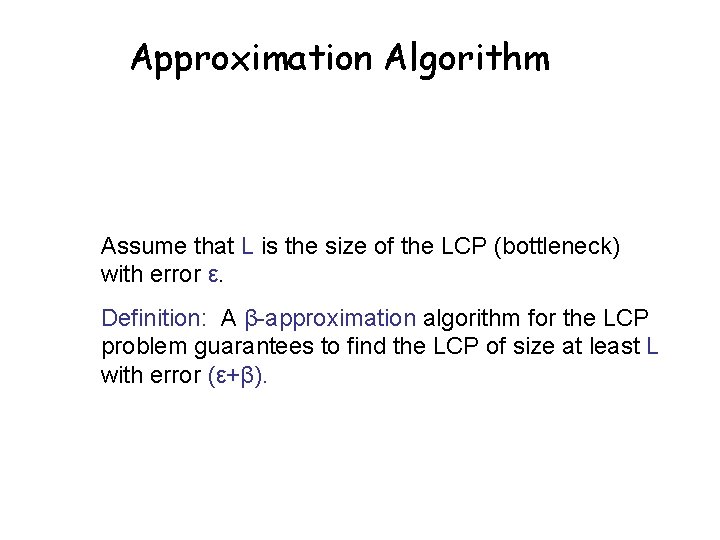
Approximation Algorithm Assume that L is the size of the LCP (bottleneck) with error ε. Definition: A β-approximation algorithm for the LCP problem guarantees to find the LCP of size at least L with error (ε+β).

R 2 Construct transformations between each point pair (a, b) and (p, q) in the following way: p’ q* p* q’ a Circle segment b <γ γ Let T(p)=p* , T(q)=q*. Let Topt be the optimal transformation and Topt(p)=p’ , Topt(q)=q’. Select the grid size to be: β/3 Select: γ= √ 2 β/3 -> d(p’, p*) ≤ SQRT((β/3)2 + (β/3)2)/2 = β/(3√ 2) -> min. T d(q’, T(q)) ≤ SQRT( (β/(3√ 2))2 + (γ/2)2) ≤ β/3
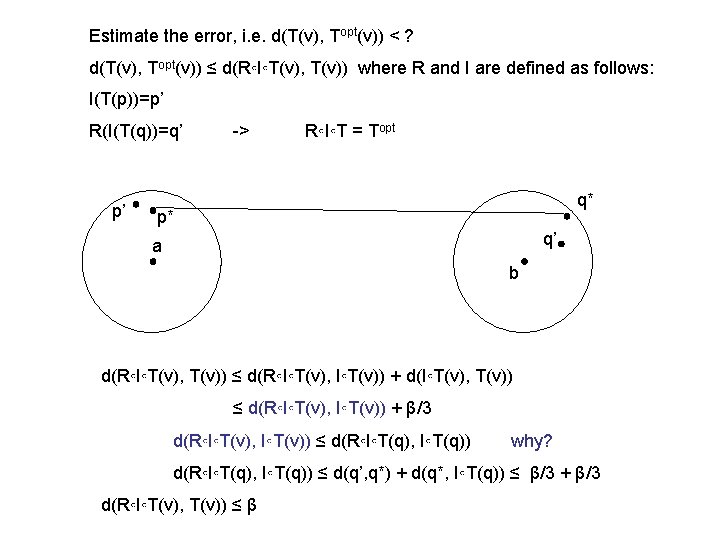
Estimate the error, i. e. d(T(v), Topt(v)) < ? d(T(v), Topt(v)) ≤ d(R◦I◦T(v), T(v)) where R and I are defined as follows: I(T(p))=p’ R(I(T(q))=q’ p’ -> R◦I◦T = Topt q* p* q’ a b d(R◦I◦T(v), T(v)) ≤ d(R◦I◦T(v), I◦T(v)) + d(I◦T(v), T(v)) ≤ d(R◦I◦T(v), I◦T(v)) + β/3 d(R◦I◦T(v), I◦T(v)) ≤ d(R◦I◦T(q), I◦T(q)) why? d(R◦I◦T(q), I◦T(q)) ≤ d(q’, q*) + d(q*, I◦T(q)) ≤ β/3 + β/3 d(R◦I◦T(v), T(v)) ≤ β
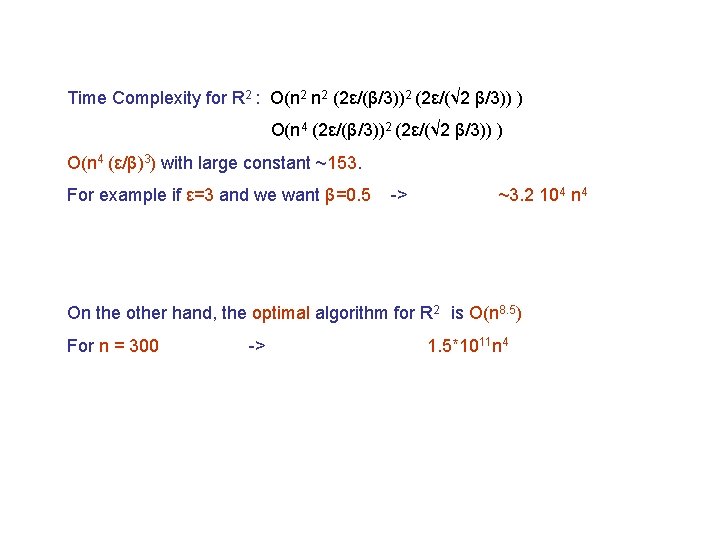
Time Complexity for R 2 : O(n 2 (2ε/(β/3))2 (2ε/(√ 2 β/3)) ) O(n 4 (ε/β)3) with large constant ~153. For example if ε=3 and we want β=0. 5 -> ~3. 2 104 n 4 On the other hand, the optimal algorithm for R 2 is O(n 8. 5) For n = 300 -> 1. 5*1011 n 4
- Slides: 6