
LargeScale Structure Derived from Go Amazon 20145 Experiment
- Slides: 1
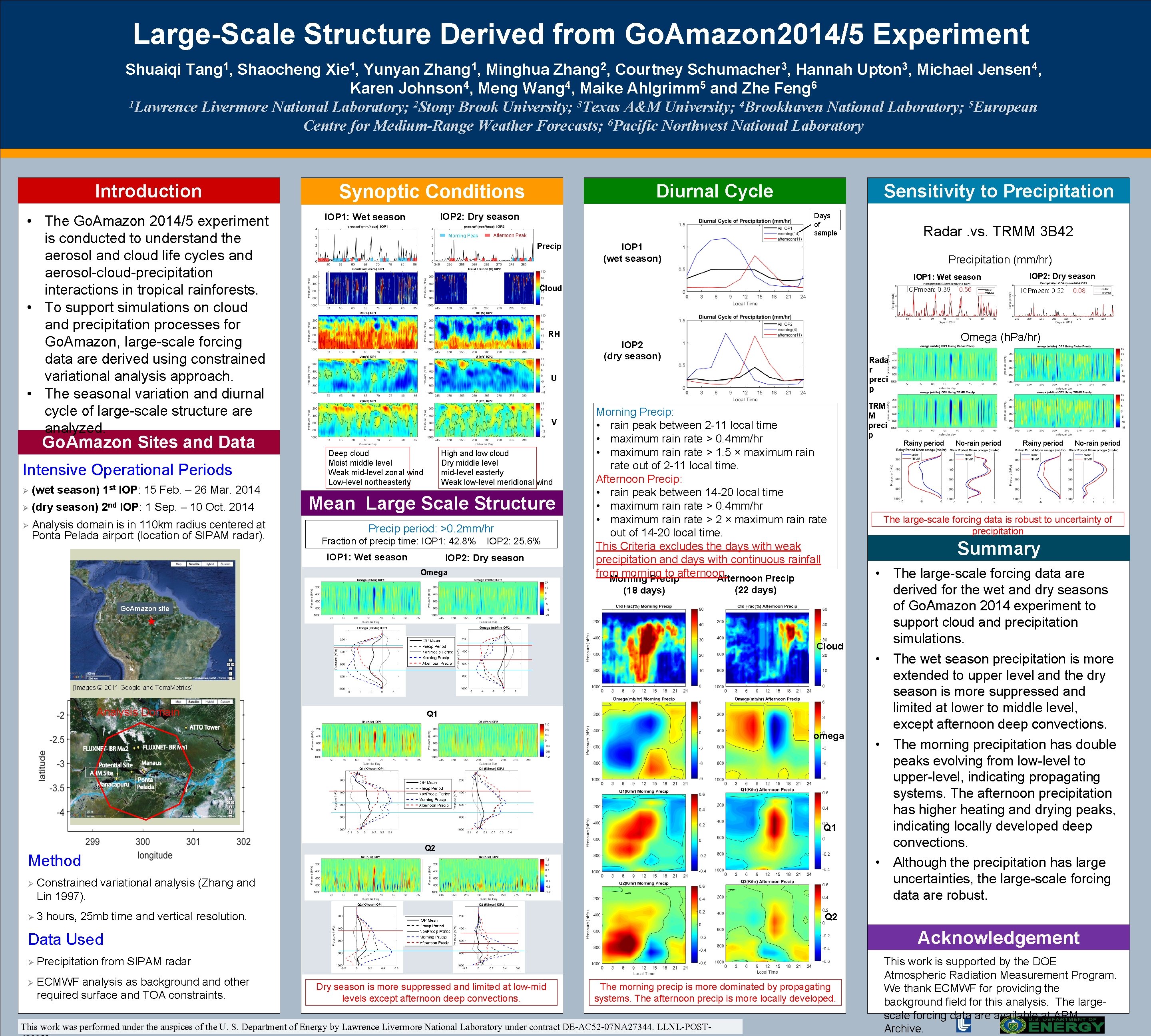
Large-Scale Structure Derived from Go. Amazon 2014/5 Experiment Shuaiqi Tang 1, Shaocheng Xie 1, Yunyan Zhang 1, Minghua Zhang 2, Courtney Schumacher 3, Hannah Upton 3, Michael Jensen 4, Karen Johnson 4, Meng Wang 4, Maike Ahlgrimm 5 and Zhe Feng 6 1 Lawrence Livermore National Laboratory; 2 Stony Brook University; 3 Texas A&M University; 4 Brookhaven National Laboratory; 5 European Centre for Medium-Range Weather Forecasts; 6 Pacific Northwest National Laboratory Introduction • The Go. Amazon 2014/5 experiment is conducted to understand the aerosol and cloud life cycles and aerosol-cloud-precipitation interactions in tropical rainforests. • To support simulations on cloud and precipitation processes for Go. Amazon, large-scale forcing data are derived using constrained variational analysis approach. • The seasonal variation and diurnal cycle of large-scale structure analyzed. Go. Amazon Sites and Data Intensive Operational Periods Ø (wet season) 1 st IOP: 15 Feb. – 26 Mar. 2014 Ø (dry season) 2 nd IOP: 1 Sep. – 10 Oct. 2014 Ø Analysis domain is in 110 km radius centered at Ponta Pelada airport (location of SIPAM radar). IOP 2: Dry season IOP 1: Wet season Morning Peak Sensitivity to Precipitation Diurnal Cycle Synoptic Conditions Days of sample Afternoon Peak Precip IOP 1 (wet season) Precipitation (mm/hr) IOP 1: Wet season Cloud IOPmean: 0. 39 0. 56 RH Deep cloud Moist middle level Weak mid-level zonal wind Low-level northeasterly U Rada r preci p V TRM M preci p High and low cloud Dry middle level mid-level easterly Weak low-level meridional wind Mean Large Scale Structure Precip period: >0. 2 mm/hr Fraction of precip time: IOP 1: 42. 8% IOP 2: 25. 6% IOP 2: Dry season Omega Morning Precip: • rain peak between 2 -11 local time • maximum rain rate > 0. 4 mm/hr • maximum rain rate > 1. 5 × maximum rain rate out of 2 -11 local time. Afternoon Precip: • rain peak between 14 -20 local time • maximum rain rate > 0. 4 mm/hr • maximum rain rate > 2 × maximum rain rate out of 14 -20 local time. This Criteria excludes the days with weak precipitation and days with continuous rainfall from morning to afternoon. Afternoon Precip Morning Precip (18 days) (22 days) Go. Amazon site Cloud [Images © 2011 Google and Terra. Metrics] Q 1 omega Q 1 Method Ø Constrained variational analysis (Zhang and Lin 1997). Ø 3 hours, 25 mb time and vertical resolution. Q 2 Precipitation from SIPAM radar Ø ECMWF analysis as background and other required surface and TOA constraints. www. Poster. Presentations. com Rainy period No-rain period The large-scale forcing data is robust to uncertainty of precipitation Summary • The large-scale forcing data are derived for the wet and dry seasons of Go. Amazon 2014 experiment to support cloud and precipitation simulations. • The wet season precipitation is more extended to upper level and the dry season is more suppressed and limited at lower to middle level, except afternoon deep convections. • The morning precipitation has double peaks evolving from low-level to upper-level, indicating propagating systems. The afternoon precipitation has higher heating and drying peaks, indicating locally developed deep convections. • Although the precipitation has large uncertainties, the large-scale forcing data are robust. Acknowledgement Dry season is more suppressed and limited at low-mid levels except afternoon deep convections. The morning precip is more dominated by propagating systems. The afternoon precip is more locally developed. This work was performed under the auspices of the U. S. Department of Energy by Lawrence Livermore National Laboratory under contract DE-AC 52 -07 NA 27344. LLNL-POST- TEMPLATE DESIGN © 2008 IOPmean: 0. 22 0. 08 Q 2 Data Used Ø IOP 2: Dry season Omega (h. Pa/hr) IOP 2 (dry season) IOP 1: Wet season Analysis Domain Radar. vs. TRMM 3 B 42 This work is supported by the DOE Atmospheric Radiation Measurement Program. We thank ECMWF for providing the background field for this analysis. The largescale forcing data are available at ARM Archive.