
LargeScale Path Loss Mobile Radio Propagation Large Scale
Large-Scale Path Loss Mobile Radio Propagation: Large. Scale Path Loss
o Last two lectures: n n n n Properties of cellular radio systems Frequency reuse by using cells Clustering and system capacity System components - Mobile switching centers, base stations, mobiles, PSTN Handoff strategies Handoff margin, guard channels Mobile Assisted Handoff Umbrella cells Hard and soft handoffs Co-Channel Interference Adjacent Channel Interference Trunking and grade of service (GOS) Cell splitting Sectoring 2
o This lecture: Electromagnetic propagation properties and hindrances. o What are reasons why wireless signals are hard to send and receive? 3
I. Problems Unique to Wireless (not wired) systems: o Paths can vary from simple line-of-sight to ones that are severely obstructed by buildings, mountains, and foliage. o Radio channels are extremely random and difficult to analyze. o Interference from other service providers n out-of-band non-linear Tx emissions 4
o Interference from other users (same network) n CCI due to frequency reuse n ACI due to Tx/Rx design limitations & large # users sharing finite BW o Shadowing n Obstructions to line-of-sight paths cause areas of weak received signal strength 5
o Fading n When no clear line-of-sight path exists, signals are received that are reflections off obstructions and diffractions around obstructions n Multipath signals can be received that interfere with each other n Fixed Wireless Channel → random & unpredictable o must be characterized in a statistical fashion o field measurements often needed to characterize radio channel performance 6
o ** The Mobile Radio Channel (MRC) has unique problems that limit performance ** n A mobile Rx in motion influences rates of fading o the faster a mobile moves, the more quickly characteristics change 7
II. Radio Signal Propagation 8
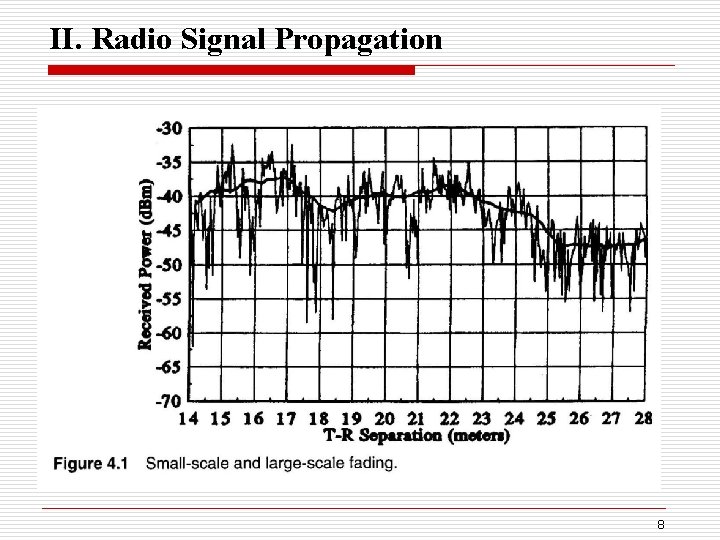
o The smoothed line is the average signal strength. The actual is the more jagged line. o Actual received signal strength can vary by more than 20 d. B over a few centimeters. o The average signal strength decays with distance from the transmitter, and depends on terrain and obstructions. 9
o Two basic goals of propagation modeling: 1) Predict magnitude and rate (speed) of received signal strength fluctuations over short distances/time durations n “short” → typically a few wavelengths (λ) or seconds n at 1 Ghz, λ = c/f = 3 x 10⁸ / 1 x 109 = 0. 3 meters n received signal strength can vary drastically by 30 to 40 d. B 10
n small-scale fluctuations → called _____ (Chapter 5) n caused by received signal coming from a sum of many signals coming together at a receiver n multiple signals come from reflections and scattering n these signals can destructively add together by being out-of-phase 11
2) Predict average received signal strength for given Tx/Rx separation n characterize received signal strength over distances from 20 m to 20 km n Large-scale radio wave propagation models n needed to estimate coverage area of base station n in general, large scale path loss decays gradually with distance from the transmitter n will also be affected by geographical features like hills and buildings 12
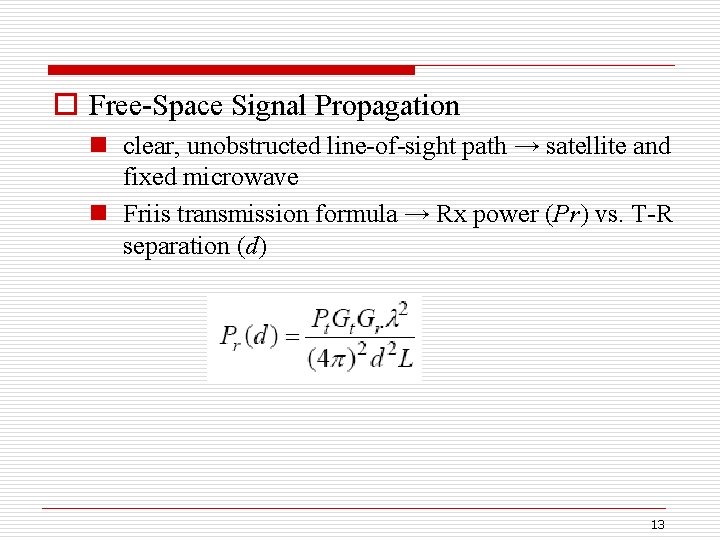
o Free-Space Signal Propagation n clear, unobstructed line-of-sight path → satellite and fixed microwave n Friis transmission formula → Rx power (Pr) vs. T-R separation (d) 13
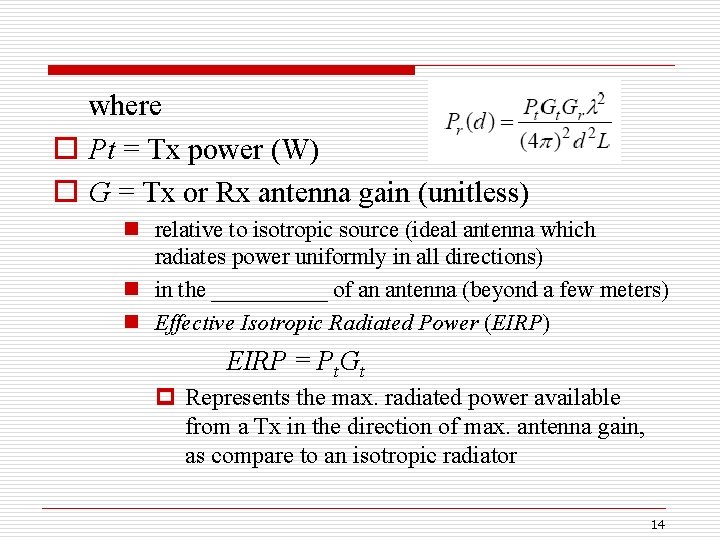
where o Pt = Tx power (W) o G = Tx or Rx antenna gain (unitless) n relative to isotropic source (ideal antenna which radiates power uniformly in all directions) n in the _____ of an antenna (beyond a few meters) n Effective Isotropic Radiated Power (EIRP) EIRP = Pt. Gt p Represents the max. radiated power available from a Tx in the direction of max. antenna gain, as compare to an isotropic radiator 14
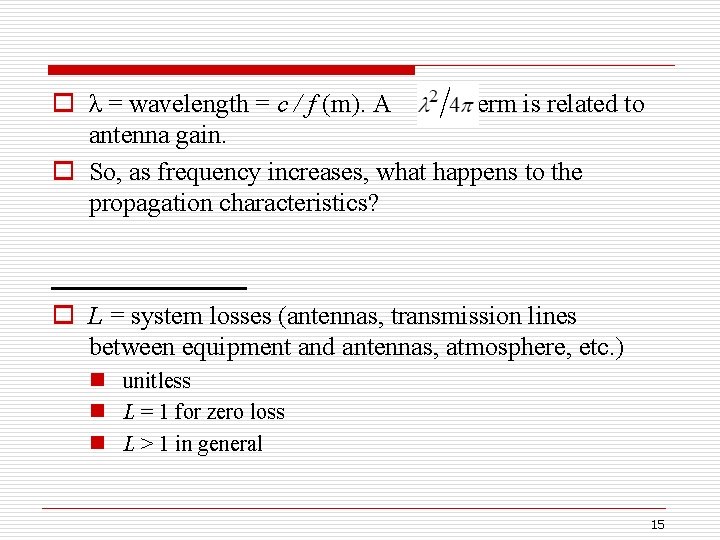
o λ = wavelength = c / f (m). A term is related to antenna gain. o So, as frequency increases, what happens to the propagation characteristics? o L = system losses (antennas, transmission lines between equipment and antennas, atmosphere, etc. ) n unitless n L = 1 for zero loss n L > 1 in general 15
o d = T-R separation distance (m) n Signal fades in proportion to d 2 n We can view signal strength as related to the density of the signal across a large sphere. n This is the surface area of a sphere with radius d. n So, a term in the denominator is related to distance and density of surface area across a sphere. 16
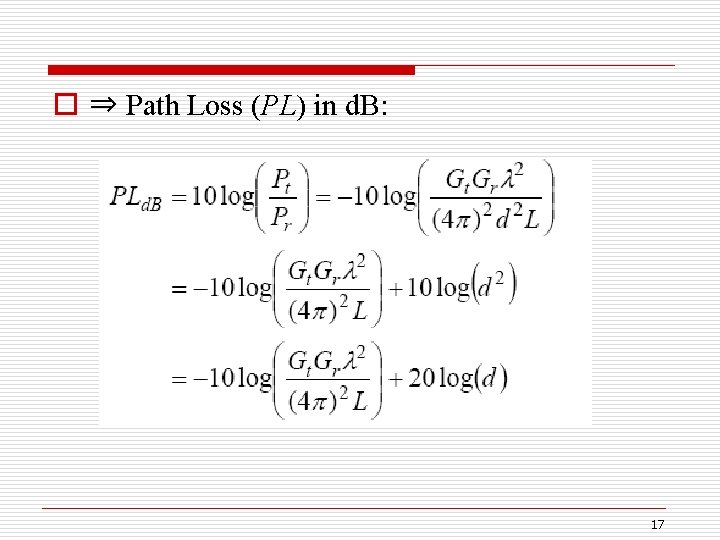
o ⇒ Path Loss (PL) in d. B: 17
o d 2 → power law relationship n Pr decreases at rate of proportional to d 2 n Pr decreases at rate of 20 d. B/decade (for line-ofsight, even worse for other cases) n For example, path loses 20 d. B from 100 m to 1 km n Comes from the d 2 relationship for surface area. o Note: Negative “loss” = “gain” 18
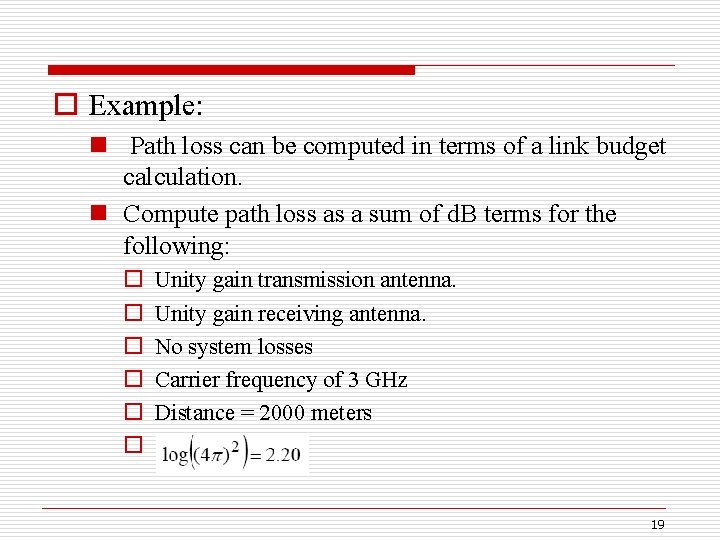
o Example: n Path loss can be computed in terms of a link budget calculation. n Compute path loss as a sum of d. B terms for the following: o o o Unity gain transmission antenna. Unity gain receiving antenna. No system losses Carrier frequency of 3 GHz Distance = 2000 meters 19
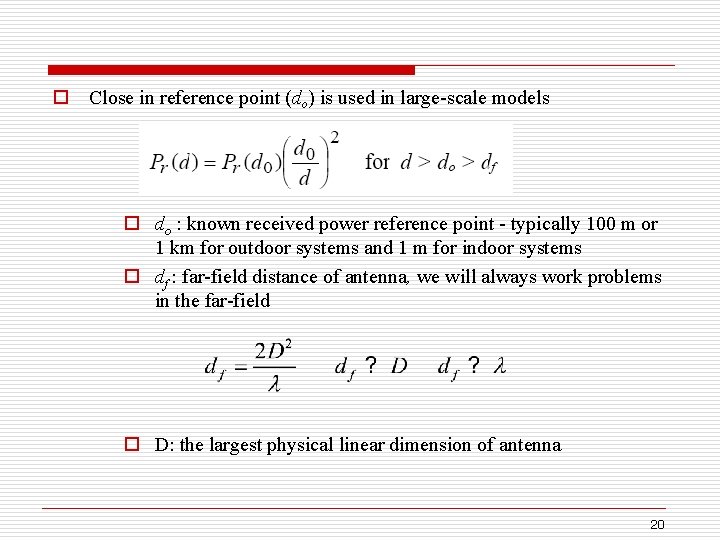
o Close in reference point (do) is used in large-scale models o do : known received power reference point - typically 100 m or 1 km for outdoor systems and 1 m for indoor systems o df : far-field distance of antenna, we will always work problems in the far-field o D: the largest physical linear dimension of antenna 20
o Reference Point Example: n Given the following system characteristics for largescale propagation, find the reference distance do. o Received power at do = 20 W o Received power at 5 km = 13 d. Bm n Using Watts: n Using d. Bm: 21
III. Reflections o There are three basic propagation mechanisms in addition to line-of-sight paths n Reflection - Waves bouncing off of objects of large dimensions n Diffraction - Waves bending around sharp edges of objects n Scattering - Waves traveling through a medium with small objects in it (foliage, street signs, lamp posts, etc. ) or reflecting off rough surfaces 22
n Reflection occurs when RF energy is incident upon a boundary between two materials (e. g air/ground) with different electrical characteristics o Permittivity µ o Permeability ε o Conductance σ n Reflecting surface must be large relative to λ of RF energy n Reflecting surface must be smooth relative to λ of RF energy o “specular” reflection 23
o What are important reflecting surfaces for mobile radio? o Fresnel reflection coefficient → Γ n describes the magnitude of reflected RF energy n depends upon material properties, polarization, & angle of incidence 24
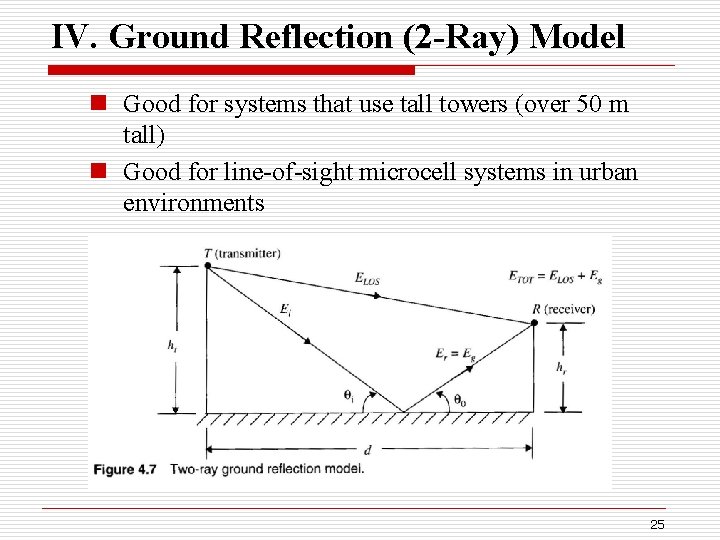
IV. Ground Reflection (2 -Ray) Model n Good for systems that use tall towers (over 50 m tall) n Good for line-of-sight microcell systems in urban environments 25
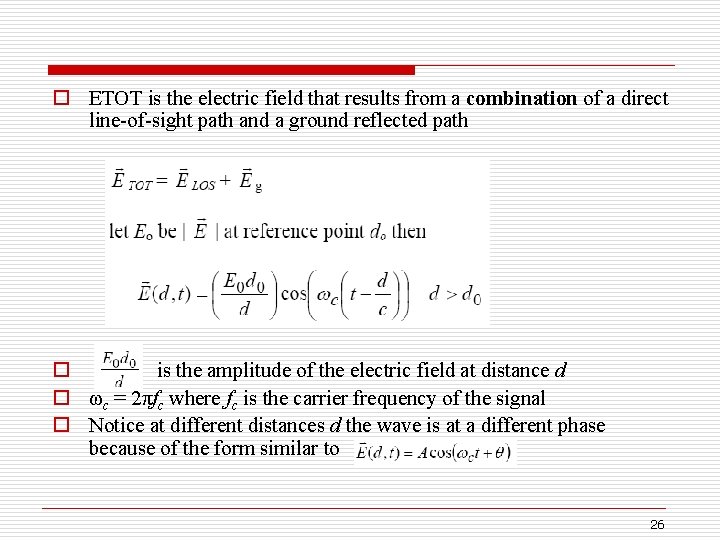
o ETOT is the electric field that results from a combination of a direct line-of-sight path and a ground reflected path o is the amplitude of the electric field at distance d o ωc = 2πfc where fc is the carrier frequency of the signal o Notice at different distances d the wave is at a different phase because of the form similar to 26
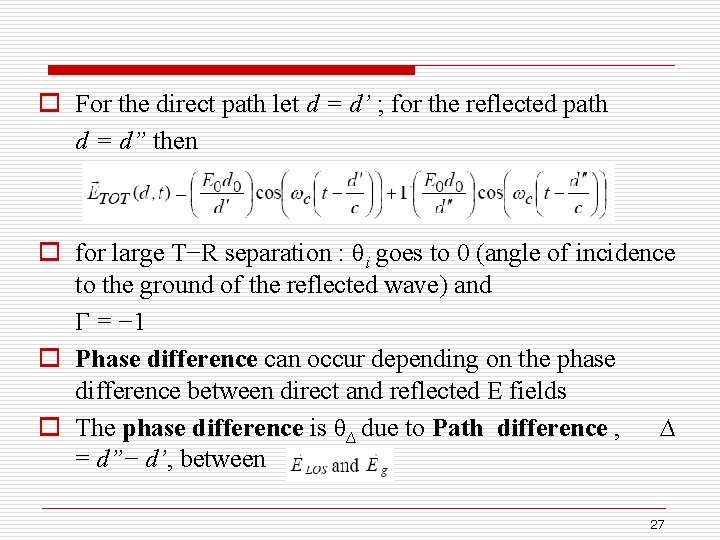
o For the direct path let d = d’ ; for the reflected path d = d” then o for large T−R separation : θi goes to 0 (angle of incidence to the ground of the reflected wave) and Γ = − 1 o Phase difference can occur depending on the phase difference between direct and reflected E fields o The phase difference is θ∆ due to Path difference , ∆ = d”− d’, between 27
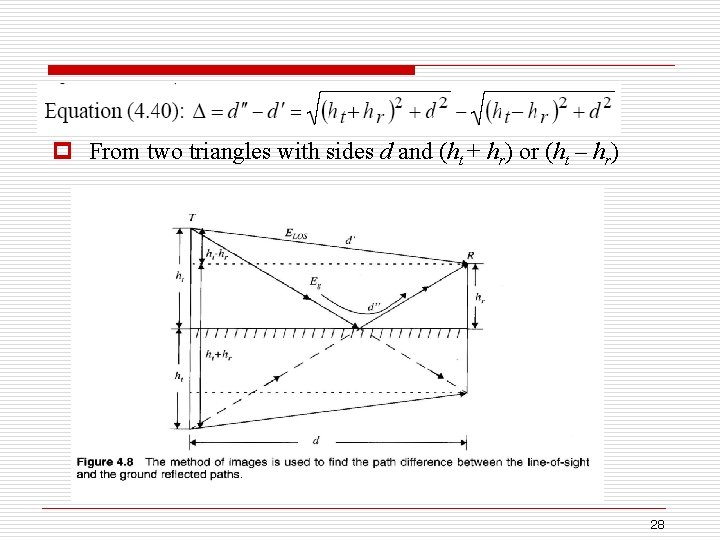
p From two triangles with sides d and (ht + hr) or (ht – hr) 28
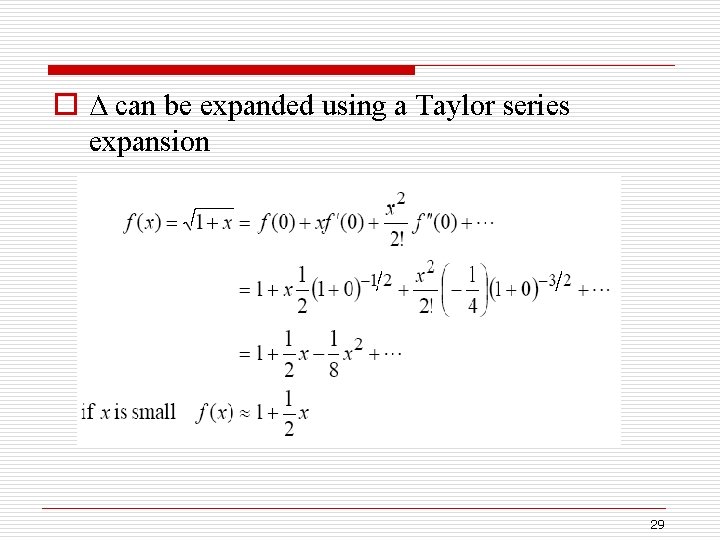
o ∆ can be expanded using a Taylor series expansion 29
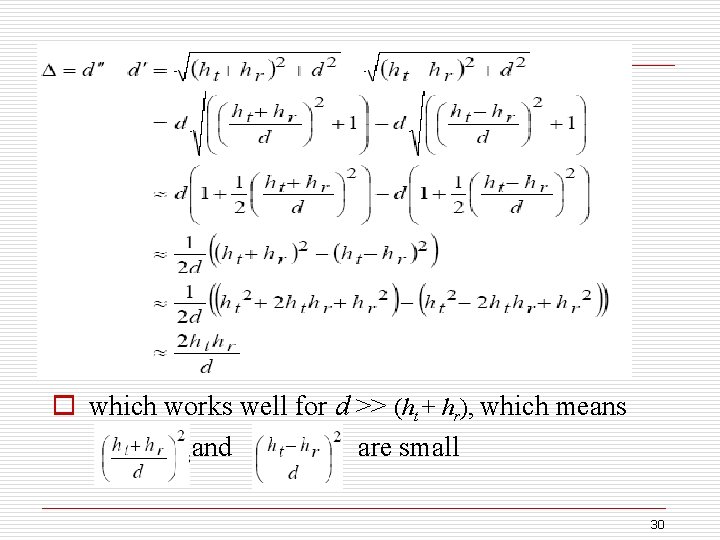
o which works well for d >> (ht + hr), which means and are small 30
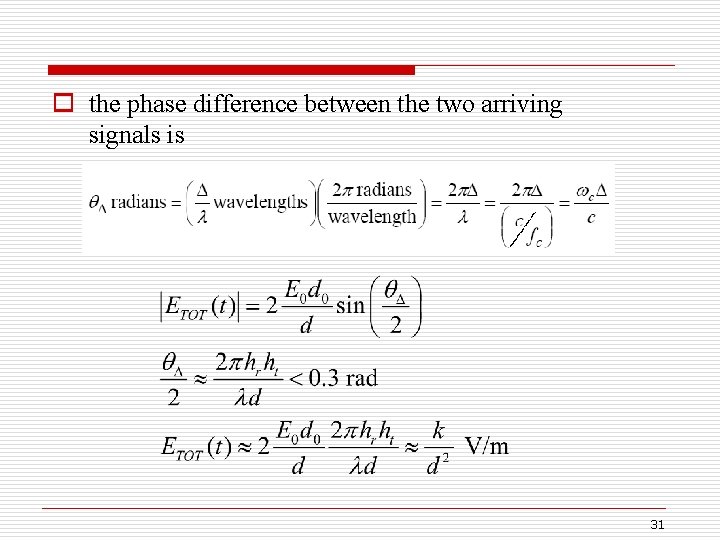
o the phase difference between the two arriving signals is 31
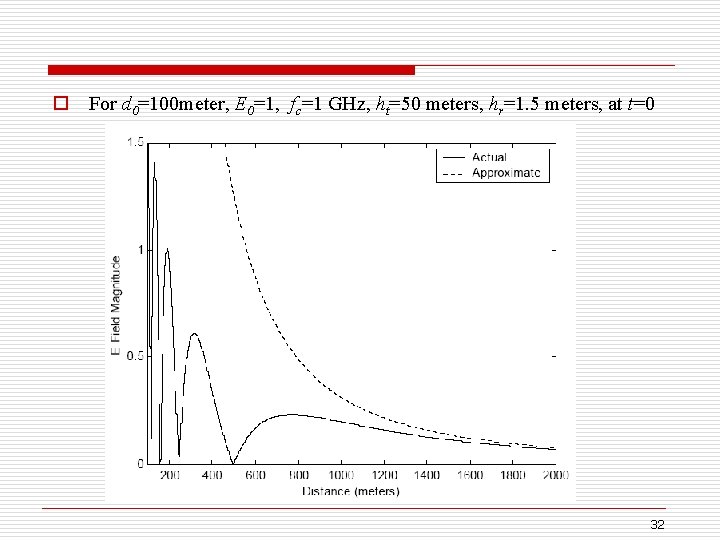
o For d 0=100 meter, E 0=1, fc=1 GHz, ht=50 meters, hr=1. 5 meters, at t=0 32
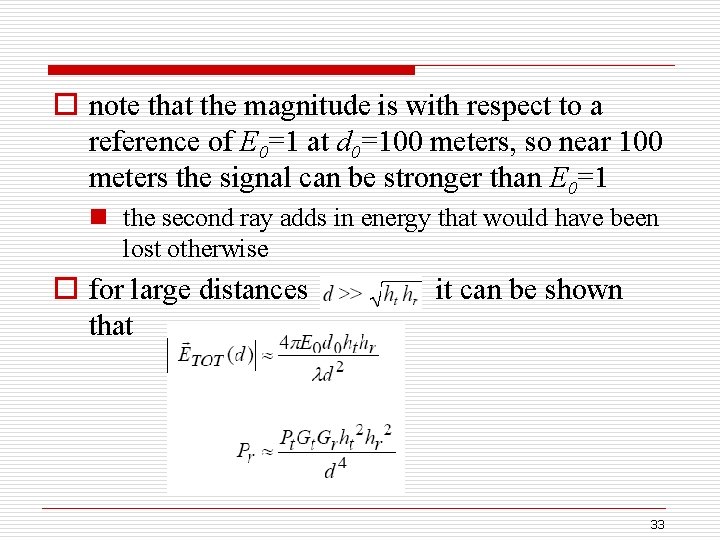
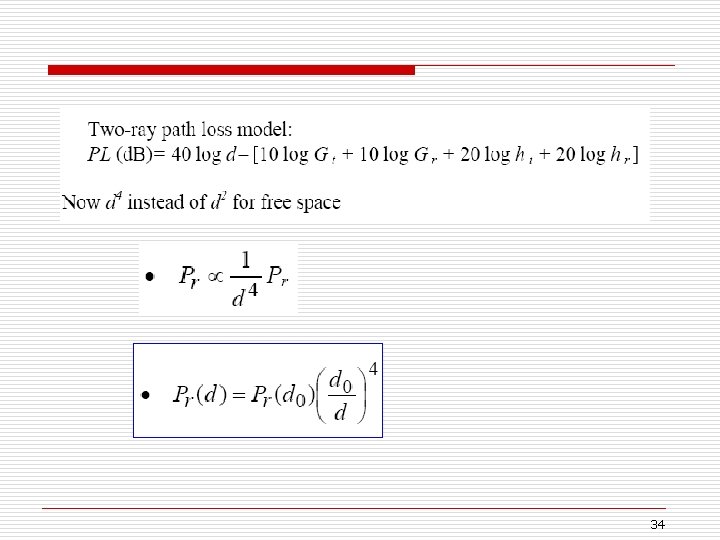
o note that the magnitude is with respect to a reference of E 0=1 at d 0=100 meters, so near 100 meters the signal can be stronger than E 0=1 n the second ray adds in energy that would have been lost otherwise o for large distances that it can be shown 33
34
V. Diffraction o RF energy can propagate: n around the curved surface of the Earth n beyond the line-of-sight horizon n Behind obstructions o Although EM field strength decays rapidly as Rx moves deeper into “shadowed” or obstructed (OBS) region o The diffraction field often has sufficient strength to produce a useful signal 35
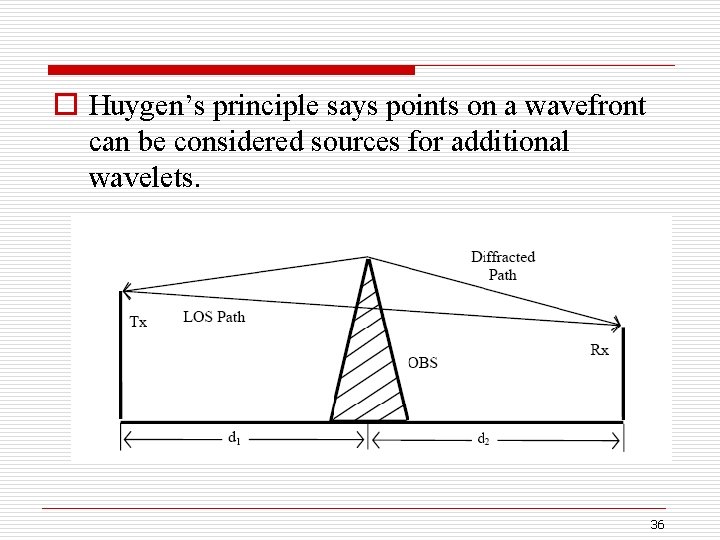
o Huygen’s principle says points on a wavefront can be considered sources for additional wavelets. 36
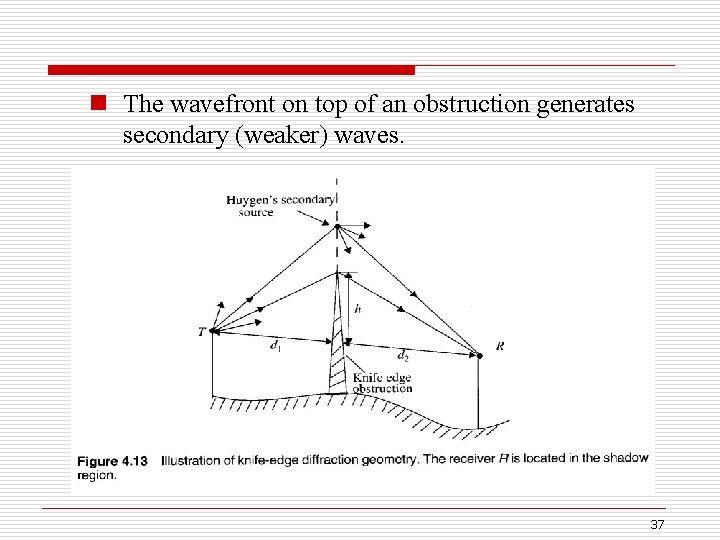
n The wavefront on top of an obstruction generates secondary (weaker) waves. 37
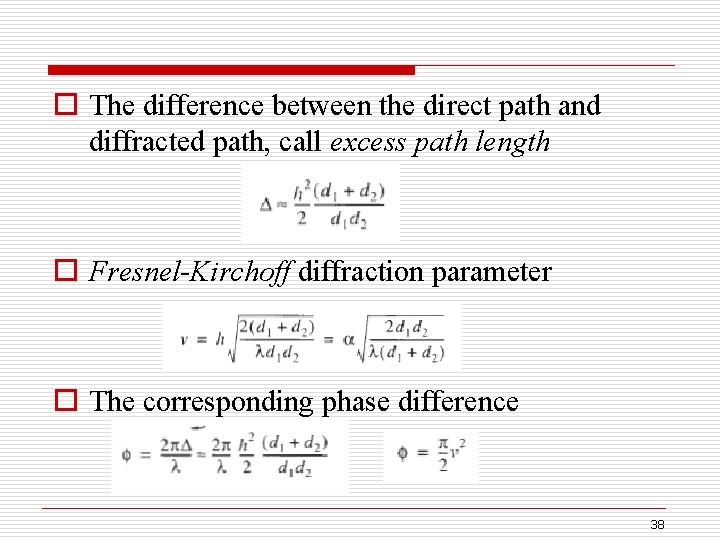
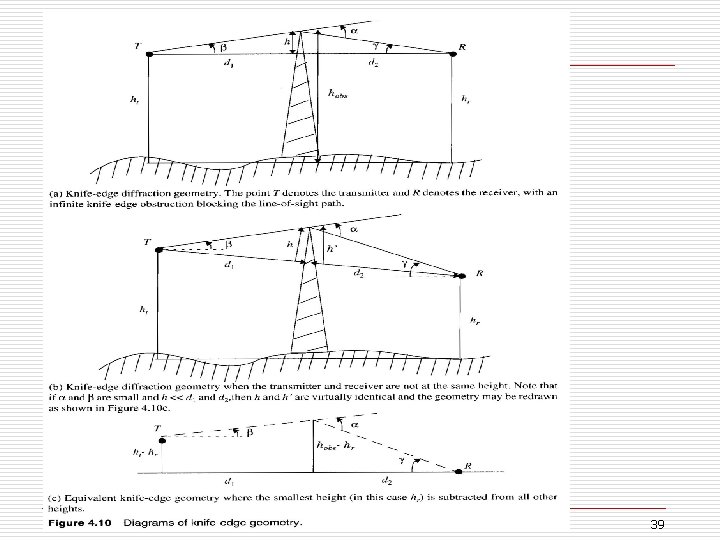
o The difference between the direct path and diffracted path, call excess path length o Fresnel-Kirchoff diffraction parameter o The corresponding phase difference 38
39
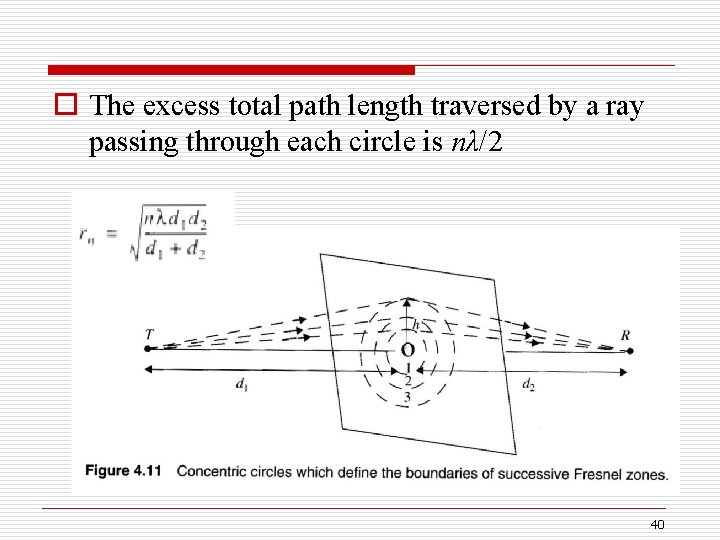
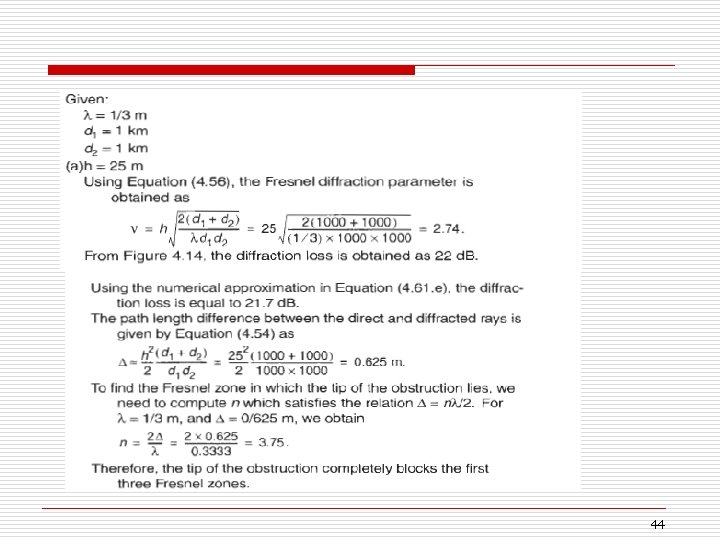
o The excess total path length traversed by a ray passing through each circle is nλ/2 40
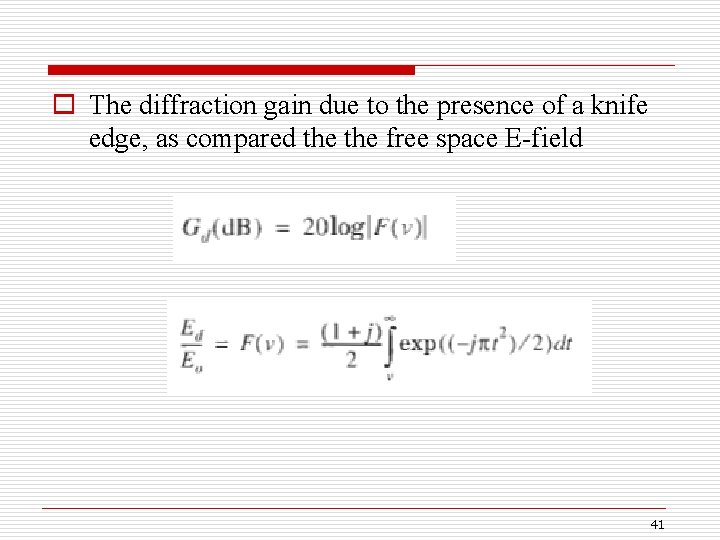
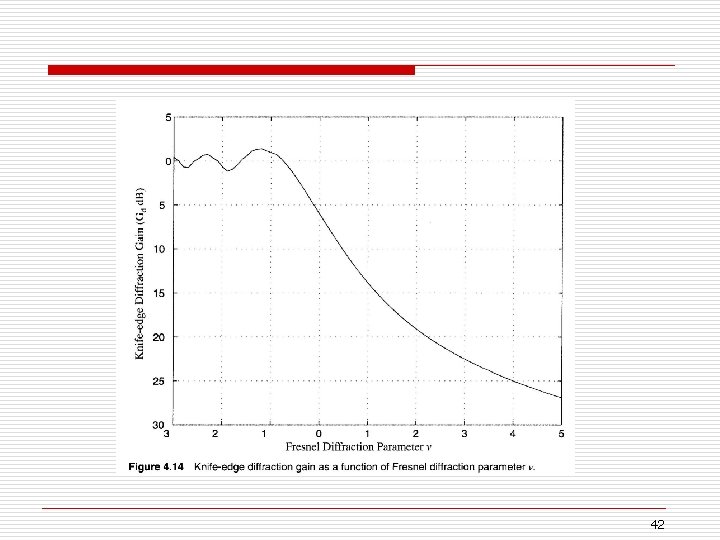
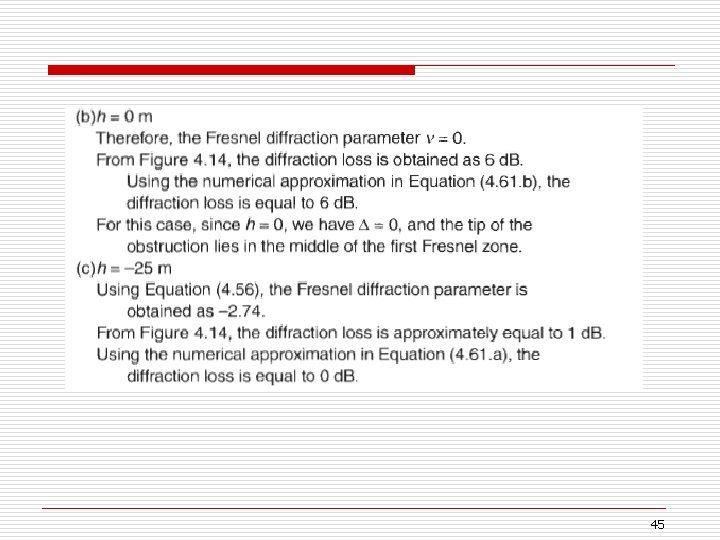
o The diffraction gain due to the presence of a knife edge, as compared the free space E-field 41
42
43
44
45
46
47
48
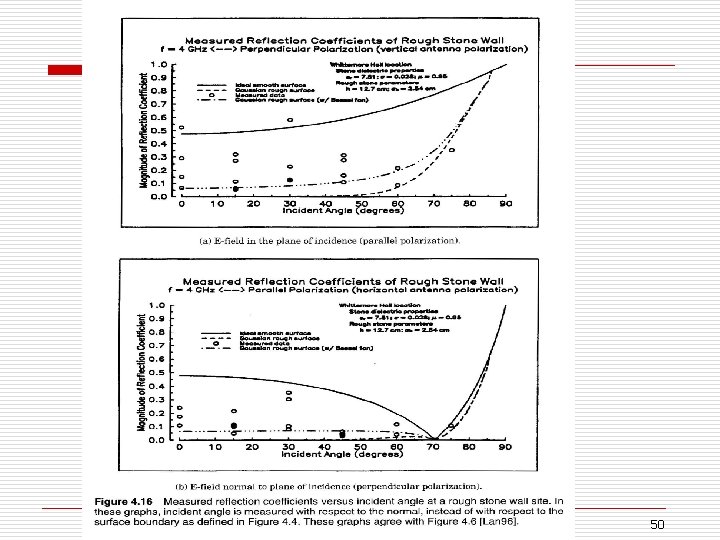
VI. Scattering o Received signal strength is often stronger than that predicted by reflection/diffraction models alone o The EM wave incident upon a rough or complex surface is scattered in many directions and provides more energy at a receiver n energy that would have been absorbed is instead reflected to the Rx. o Scattering is caused by trees, lamp posts, towers, etc. o flat surface → EM reflection (one direction) o rough surface → EM scattering (many directions) 49
50
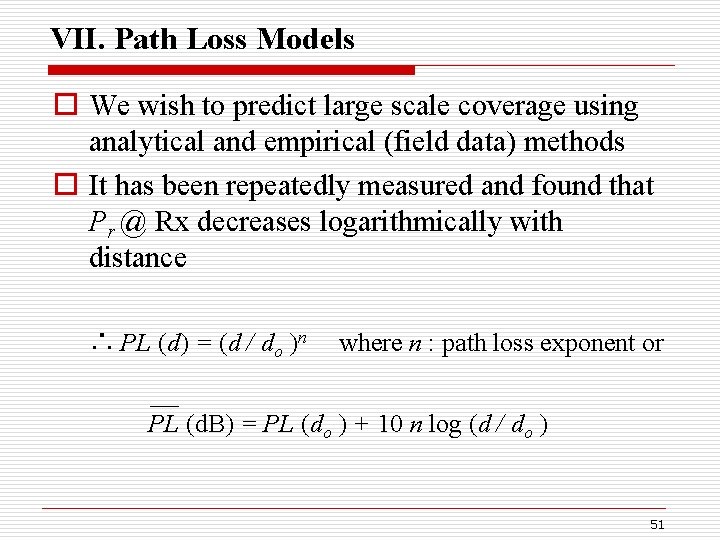
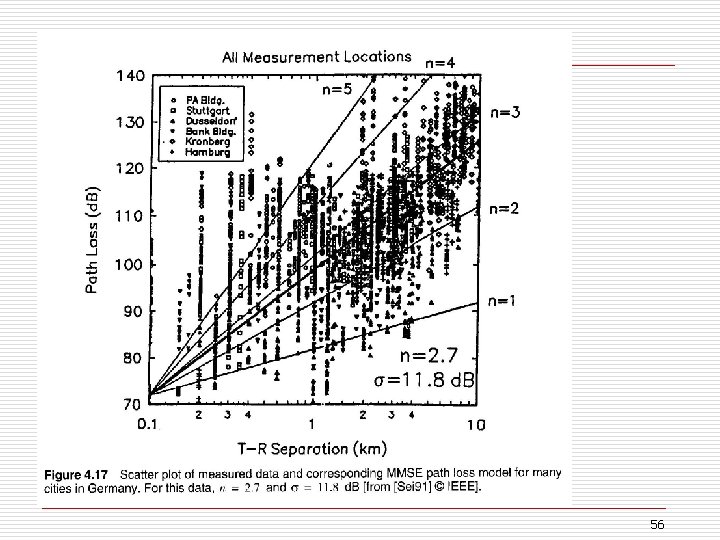
VII. Path Loss Models o We wish to predict large scale coverage using analytical and empirical (field data) methods o It has been repeatedly measured and found that Pr @ Rx decreases logarithmically with distance ∴ PL (d) = (d / do )n where n : path loss exponent or PL (d. B) = PL (do ) + 10 n log (d / do ) 51
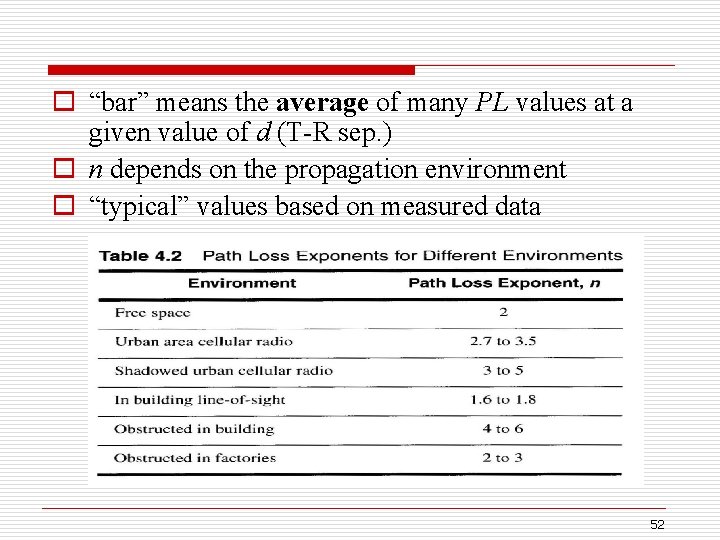
o “bar” means the average of many PL values at a given value of d (T-R sep. ) o n depends on the propagation environment o “typical” values based on measured data 52
o At any specific d the measured values vary drastically because of variations in the surrounding environment (obstructed vs. line-of -sight, scattering, reflections, etc. ) o Some models can be used to describe a situation generally, but specific circumstances may need to be considered with detailed analysis and measurements. 53
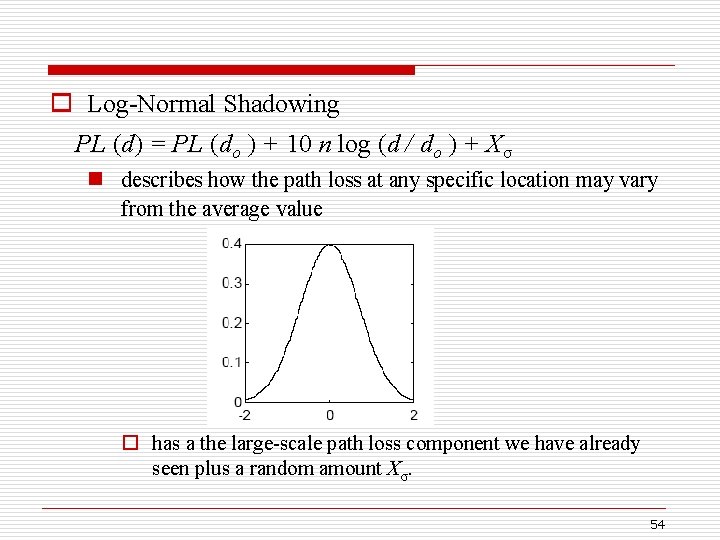
o Log-Normal Shadowing PL (d) = PL (do ) + 10 n log (d / do ) + Xσ n describes how the path loss at any specific location may vary from the average value o has a the large-scale path loss component we have already seen plus a random amount Xσ. 54
o Xσ : zero mean Gaussian random variable, a “bell curve” o σ is the standard deviation that provides the second parameter for the distribution o takes into account received signal strength variations due to shadowing n measurements verify this distribution o n & σ are computed from measured data for different area types o any other path loss models are given in your book. n That correlate field measurements with models for different types of environments. 55
56
o HW-3 3 -16, 3 -17, 4 -4, 4 -14, 4 -23(a)-(d) 57
- Slides: 57