
LARGESCALE INFERENCE IN GAUSSIAN PROCESS MODELS EDWIN V



- Slides: 24
LARGE-SCALE INFERENCE IN GAUSSIAN PROCESS MODELS EDWIN V. BONILLA SENIOR LECTURER, UNSW JULY 29 TH, 2015
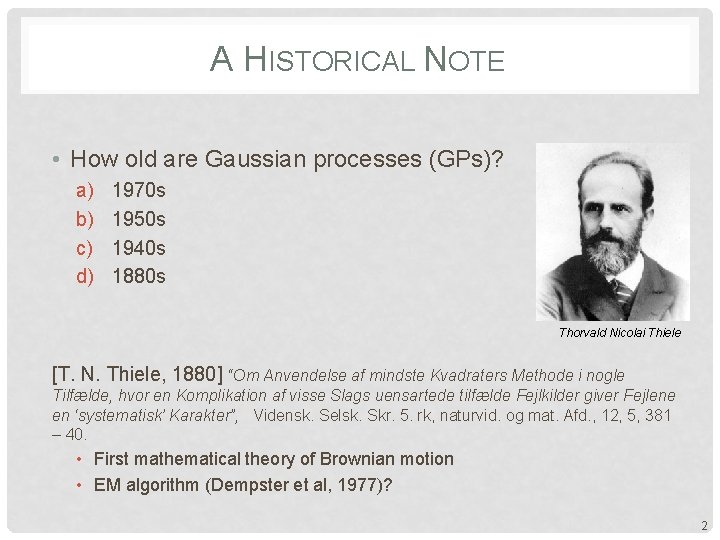
A HISTORICAL NOTE • How old are Gaussian processes (GPs)? a) b) c) d) 1970 s 1950 s 1940 s 1880 s Thorvald Nicolai Thiele [T. N. Thiele, 1880] “Om Anvendelse af mindste Kvadraters Methode i nogle Tilfælde, hvor en Komplikation af visse Slags uensartede tilfælde Fejlkilder giver Fejlene en ‘systematisk’ Karakter”, Vidensk. Selsk. Skr. 5. rk, naturvid. og mat. Afd. , 12, 5, 381 – 40. • First mathematical theory of Brownian motion • EM algorithm (Dempster et al, 1977)? 2
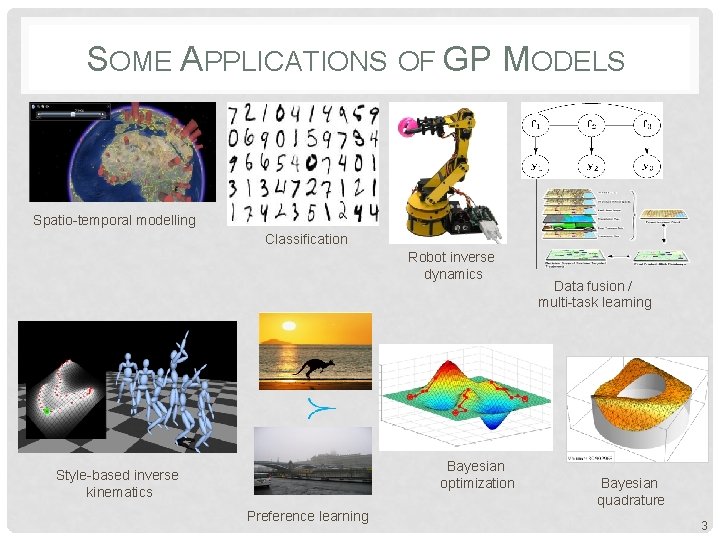
SOME APPLICATIONS OF GP MODELS Spatio-temporal modelling Classification Robot inverse dynamics Bayesian optimization Style-based inverse kinematics Preference learning Data fusion / multi-task learning Bayesian quadrature 3
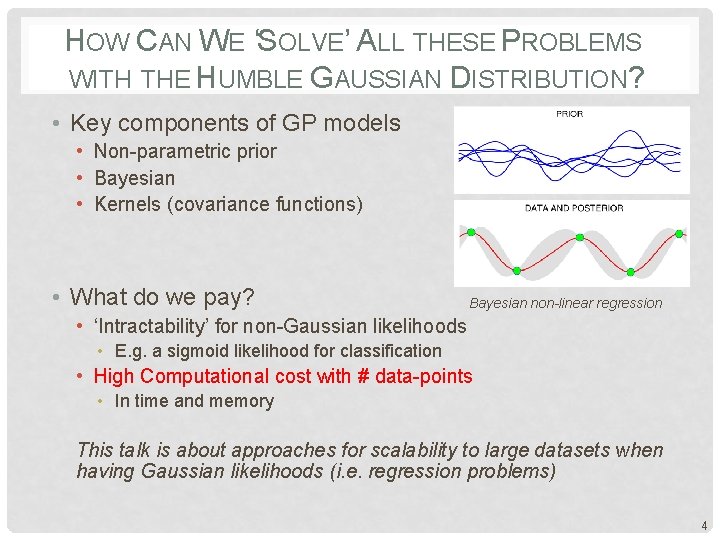
HOW CAN WE ‘SOLVE’ ALL THESE PROBLEMS WITH THE HUMBLE GAUSSIAN DISTRIBUTION? • Key components of GP models • Non-parametric prior • Bayesian • Kernels (covariance functions) • What do we pay? Bayesian non-linear regression • ‘Intractability’ for non-Gaussian likelihoods • E. g. a sigmoid likelihood for classification • High Computational cost with # data-points • In time and memory This talk is about approaches for scalability to large datasets when having Gaussian likelihoods (i. e. regression problems) 4
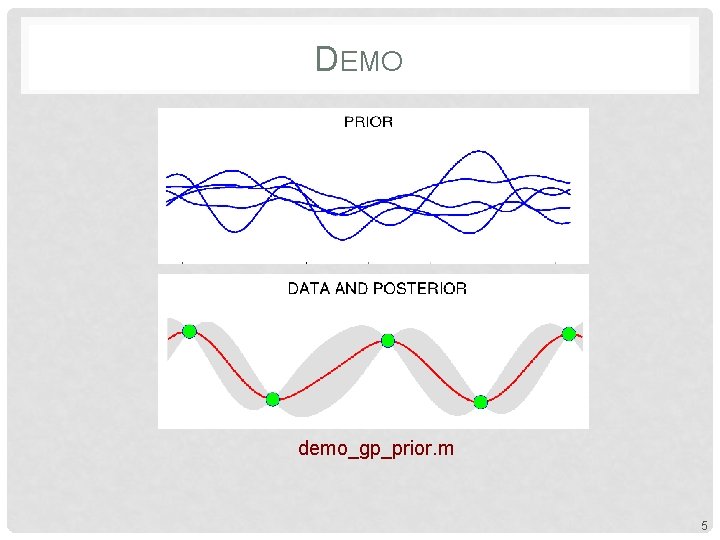
DEMO demo_gp_prior. m 5
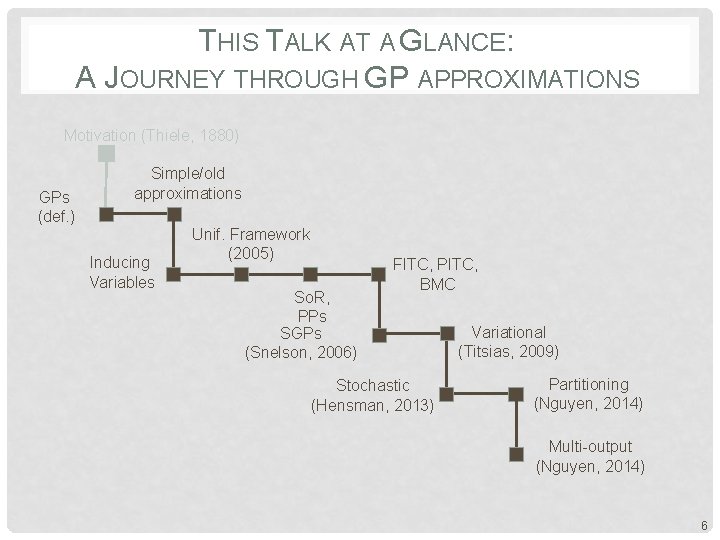
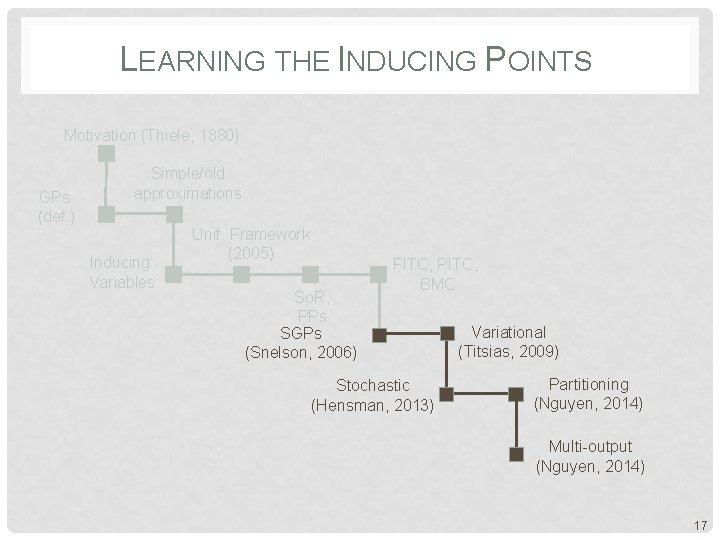
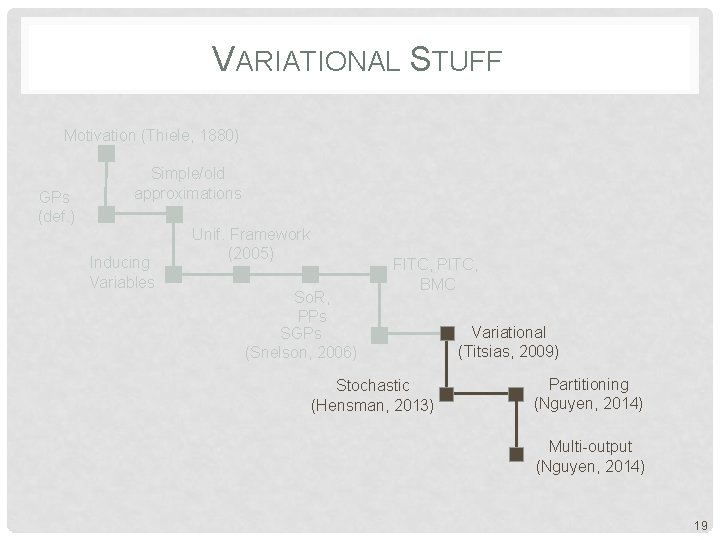
THIS TALK AT A GLANCE: A JOURNEY THROUGH GP APPROXIMATIONS Motivation (Thiele, 1880) GPs (def. ) Simple/old approximations Inducing Variables Unif. Framework (2005) So. R, PPs SGPs (Snelson, 2006) FITC, PITC, BMC Stochastic (Hensman, 2013) Variational (Titsias, 2009) Partitioning (Nguyen, 2014) Multi-output (Nguyen, 2014) 6
GAUSSIAN PROCESSES (GPS) Definition: Gaussian Process is a Gaussian process if for any subset of points , the function values follow a consistent Gaussian distribution. • Consistency: marginalization property • Notation Mean function Covariance function Hyper-parameters • A GP is a distribution over functions • There is not such a thing as the GP method 7
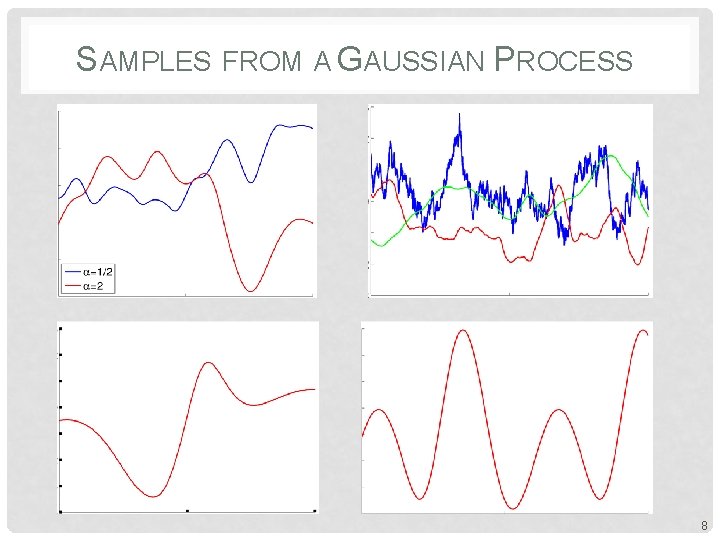
SAMPLES FROM A GAUSSIAN PROCESS 8
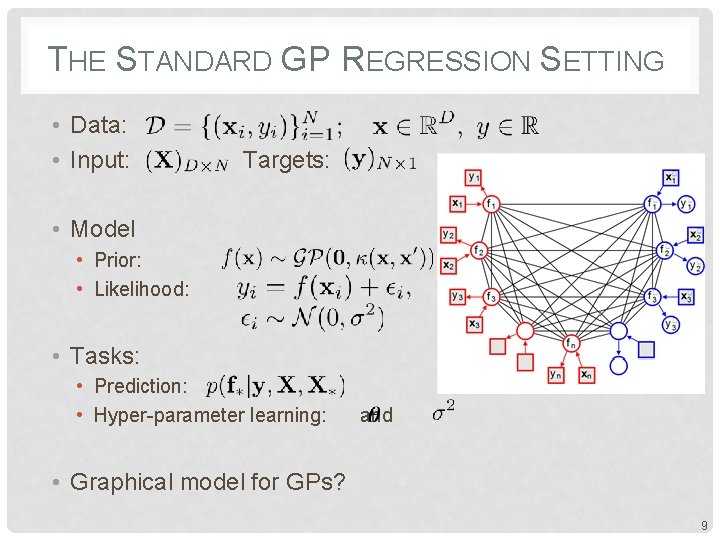
THE STANDARD GP REGRESSION SETTING • Data: • Input: Targets: • Model • Prior: • Likelihood: • Tasks: • Prediction: • Hyper-parameter learning: and • Graphical model for GPs? 9
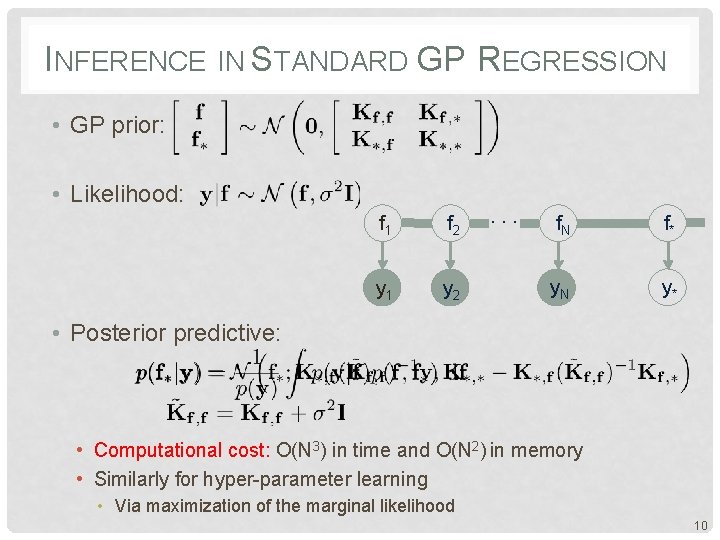
INFERENCE IN STANDARD GP REGRESSION • GP prior: • Likelihood: f 1 f 2 y 1 y 2 . . . f. N f* y. N y* • Posterior predictive: • Computational cost: O(N 3) in time and O(N 2) in memory • Similarly for hyper-parameter learning • Via maximization of the marginal likelihood 10
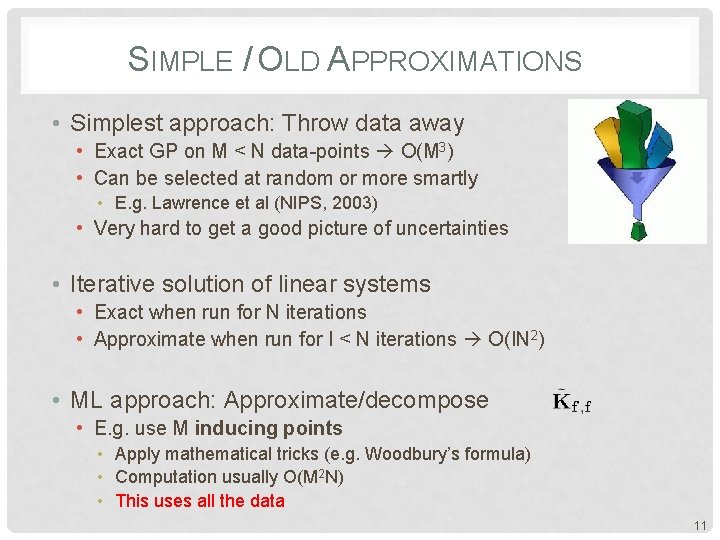
SIMPLE / OLD APPROXIMATIONS • Simplest approach: Throw data away • Exact GP on M < N data-points O(M 3) • Can be selected at random or more smartly • E. g. Lawrence et al (NIPS, 2003) • Very hard to get a good picture of uncertainties • Iterative solution of linear systems • Exact when run for N iterations • Approximate when run for I < N iterations O(IN 2) • ML approach: Approximate/decompose • E. g. use M inducing points • Apply mathematical tricks (e. g. Woodbury’s formula) • Computation usually O(M 2 N) • This uses all the data 11
INDUCING VARIABLES & UNIFYING FRAMEWORK Motivation (Thiele, 1880) GPs (def. ) Simple/old approximations Inducing Variables Unif. Framework (2005) So. R, PPs SGPs (Snelson, 2006) FITC, PITC, BMC Stochastic (Hensman, 2013) Variational (Titsias, 2009) Partitioning (Nguyen, 2014) Multi-output (Nguyen, 2014) 12
WHAT ARE THE INDUCING POINTS? Inducing variables u. M u 1 • Inducing variables u • Latent values of the GP (as f and f*) • Usually marginalized • Inducing inputs z u 2 • Corresponding input locations (as x) • Imprint on final solution z 1 z 2 z. M Inducing inputs • Generalization of “support points”, “active set”, “pseudo-inputs” • ‘Good’ summary statistics induce statistical dependencies • Can be a subset of the training set • Can be arbitrary inducing variables 13
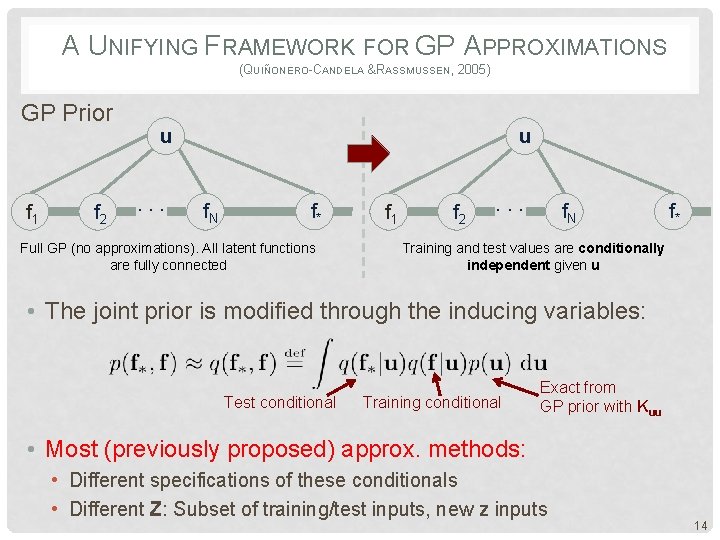
A UNIFYING FRAMEWORK FOR GP APPROXIMATIONS (QUIÑONERO-CANDELA &RASSMUSSEN, 2005) GP Prior f 1 f 2 u. . . u f. N f* Full GP (no approximations). All latent functions are fully connected f 1 f 2 . . . f. N f* Training and test values are conditionally independent given u • The joint prior is modified through the inducing variables: Test conditional Training conditional Exact from GP prior with Kuu • Most (previously proposed) approx. methods: • Different specifications of these conditionals • Different Z: Subset of training/test inputs, new z inputs 14
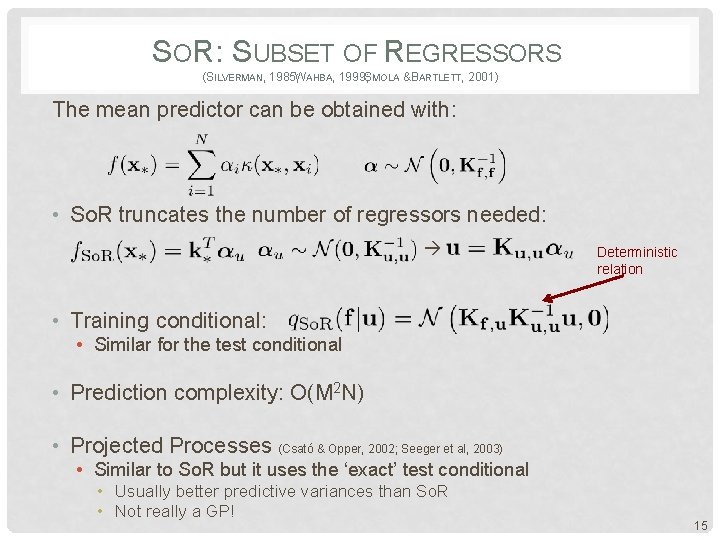
SOR: SUBSET OF REGRESSORS (SILVERMAN, 1985; WAHBA, 1999; SMOLA &BARTLETT, 2001) The mean predictor can be obtained with: • So. R truncates the number of regressors needed: Deterministic relation • Training conditional: • Similar for the test conditional • Prediction complexity: O(M 2 N) • Projected Processes (Csató & Opper, 2002; Seeger et al, 2003) • Similar to So. R but it uses the ‘exact’ test conditional • Usually better predictive variances than So. R • Not really a GP! 15
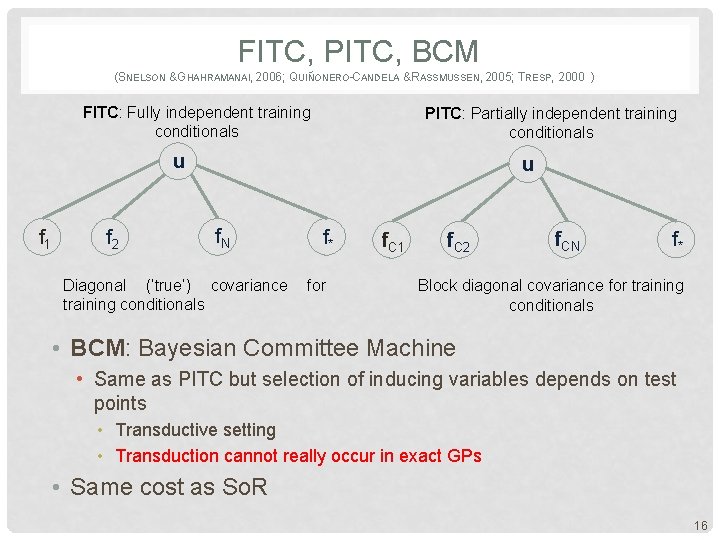
FITC, PITC, BCM (SNELSON &GHAHRAMANAI, 2006; QUIÑONERO-CANDELA &RASSMUSSEN, 2005; TRESP, 2000 ) FITC: Fully independent training conditionals PITC: Partially independent training conditionals u f 1 f 2 u f. N Diagonal (‘true’) covariance training conditionals f* for f. C 1 f. C 2 f. CN f* Block diagonal covariance for training conditionals • BCM: Bayesian Committee Machine • Same as PITC but selection of inducing variables depends on test points • Transductive setting • Transduction cannot really occur in exact GPs • Same cost as So. R 16
LEARNING THE INDUCING POINTS Motivation (Thiele, 1880) GPs (def. ) Simple/old approximations Inducing Variables Unif. Framework (2005) So. R, PPs SGPs (Snelson, 2006) FITC, PITC, BMC Stochastic (Hensman, 2013) Variational (Titsias, 2009) Partitioning (Nguyen, 2014) Multi-output (Nguyen, 2014) 17
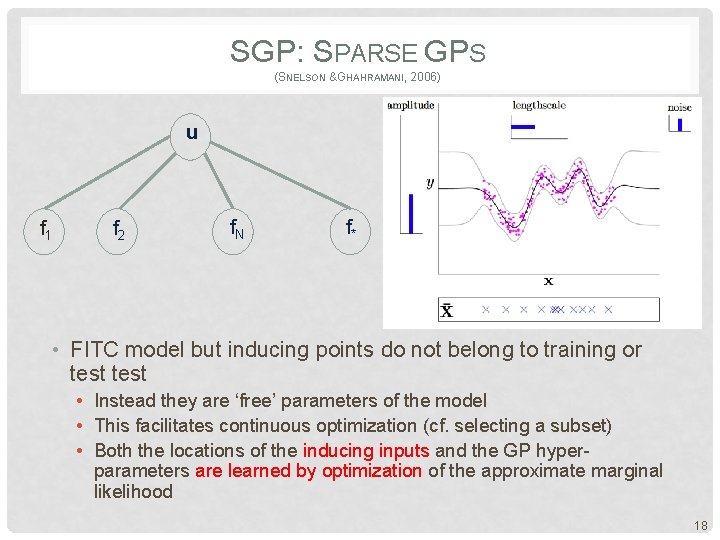
SGP: SPARSE GPS (SNELSON &GHAHRAMANI, 2006) u f 1 f 2 f. N f* • FITC model but inducing points do not belong to training or test • Instead they are ‘free’ parameters of the model • This facilitates continuous optimization (cf. selecting a subset) • Both the locations of the inducing inputs and the GP hyperparameters are learned by optimization of the approximate marginal likelihood 18
VARIATIONAL STUFF Motivation (Thiele, 1880) GPs (def. ) Simple/old approximations Inducing Variables Unif. Framework (2005) So. R, PPs SGPs (Snelson, 2006) FITC, PITC, BMC Stochastic (Hensman, 2013) Variational (Titsias, 2009) Partitioning (Nguyen, 2014) Multi-output (Nguyen, 2014) 19
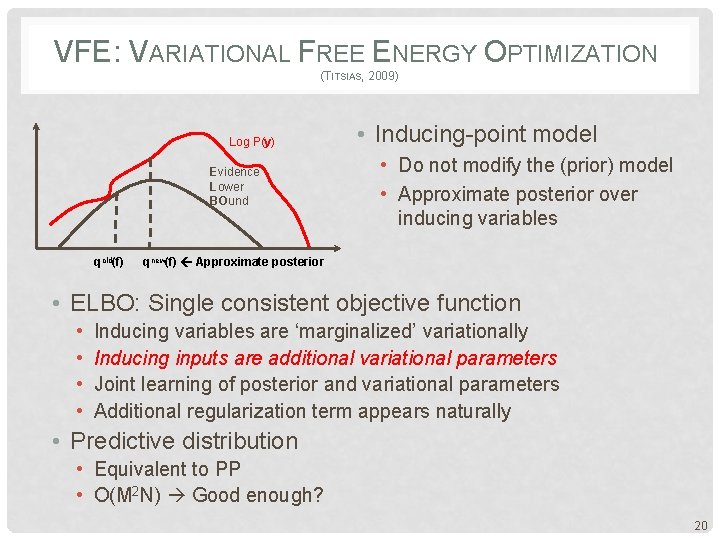
VFE: VARIATIONAL FREE ENERGY OPTIMIZATION (TITSIAS, 2009) Log P(y) Evidence Lower BOund qold(f) • Inducing-point model • Do not modify the (prior) model • Approximate posterior over inducing variables qnew(f) Approximate posterior • ELBO: Single consistent objective function • • Inducing variables are ‘marginalized’ variationally Inducing inputs are additional variational parameters Joint learning of posterior and variational parameters Additional regularization term appears naturally • Predictive distribution • Equivalent to PP • O(M 2 N) Good enough? 20
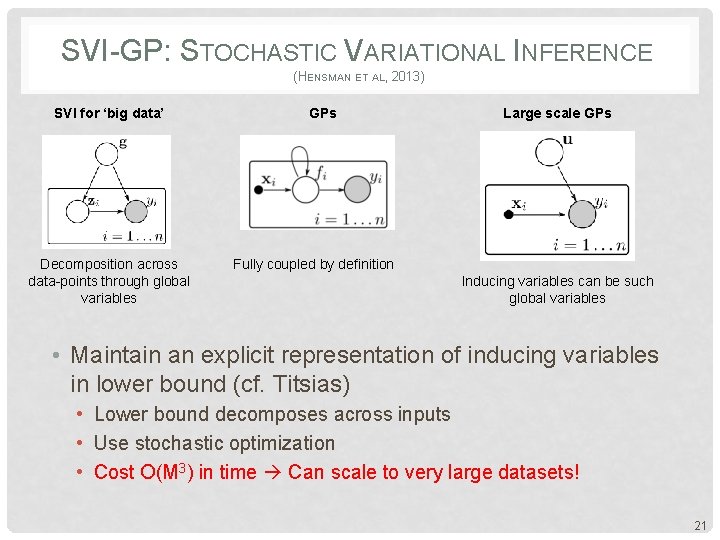
SVI-GP: STOCHASTIC VARIATIONAL INFERENCE (HENSMAN ET AL, 2013) SVI for ‘big data’ Decomposition across data-points through global variables GPs Large scale GPs Fully coupled by definition Inducing variables can be such global variables • Maintain an explicit representation of inducing variables in lower bound (cf. Titsias) • Lower bound decomposes across inputs • Use stochastic optimization • Cost O(M 3) in time Can scale to very large datasets! 21
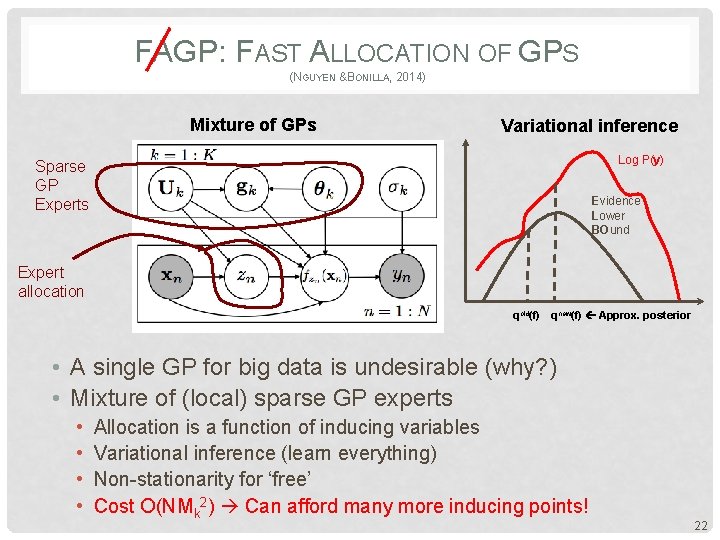
FAGP: FAST ALLOCATION OF GPS (NGUYEN &BONILLA, 2014) Mixture of GPs Variational inference Log P(y) Sparse GP Experts Evidence Lower BOund Expert allocation qold(f) qnew(f) Approx. posterior • A single GP for big data is undesirable (why? ) • Mixture of (local) sparse GP experts • • Allocation is a function of inducing variables Variational inference (learn everything) Non-stationarity for ‘free’ Cost O(NMk 2) Can afford many more inducing points! 22
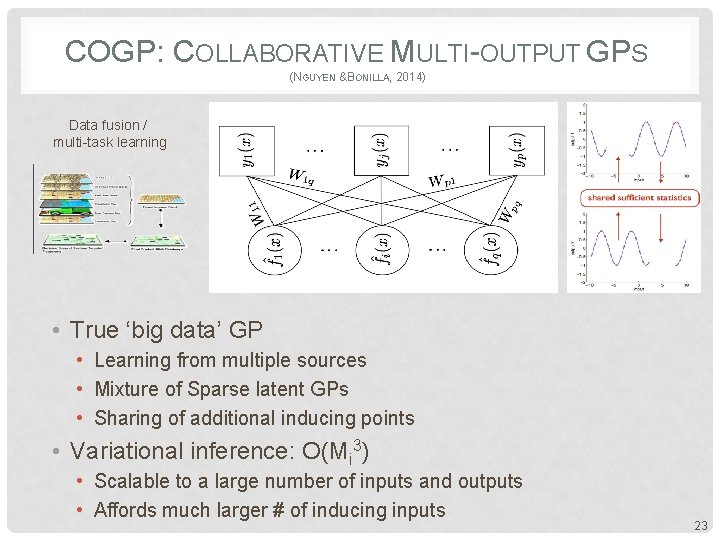
COGP: COLLABORATIVE MULTI-OUTPUT GPS (NGUYEN &BONILLA, 2014) Data fusion / multi-task learning • True ‘big data’ GP • Learning from multiple sources • Mixture of Sparse latent GPs • Sharing of additional inducing points • Variational inference: O(Mi 3) • Scalable to a large number of inputs and outputs • Affords much larger # of inducing inputs 23
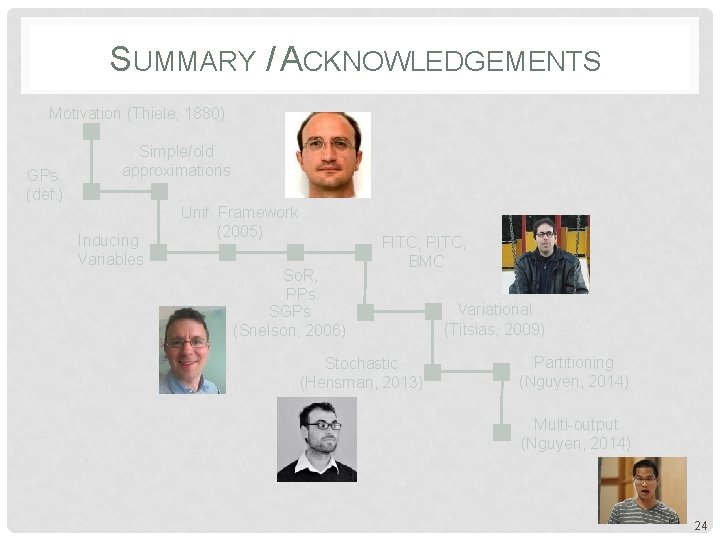
SUMMARY / ACKNOWLEDGEMENTS Motivation (Thiele, 1880) GPs (def. ) Simple/old approximations Inducing Variables Unif. Framework (2005) So. R, PPs SGPs (Snelson, 2006) FITC, PITC, BMC Stochastic (Hensman, 2013) Variational (Titsias, 2009) Partitioning (Nguyen, 2014) Multi-output (Nguyen, 2014) 24