
LargeScale Hydrogen Deflagration and Detonations M Groethe E
- Slides: 23
Large-Scale Hydrogen Deflagration and Detonations M. Groethe E. Merilo J. Colton S. Chiba Y. Sato H. Iwabuchi International Conference on Hydrogen Safety 8 -10 September 2005 Pisa, Italy MG 8/1/05 Poulter Laboratory
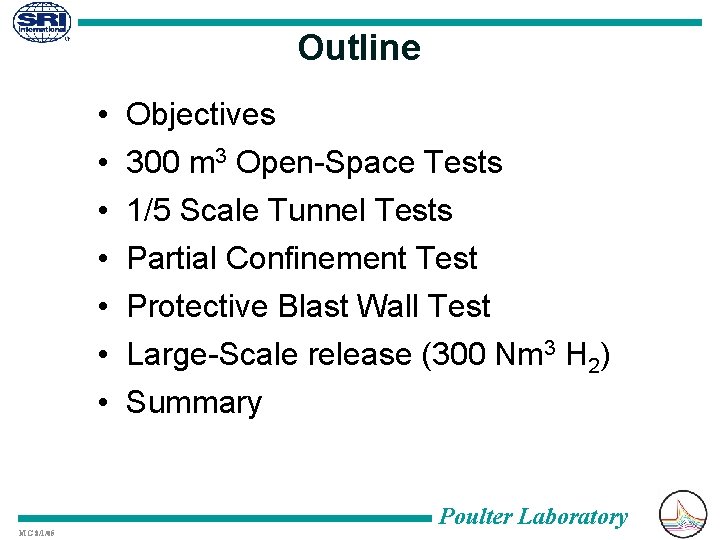
Outline • • MG 8/1/05 Objectives 300 m 3 Open-Space Tests 1/5 Scale Tunnel Tests Partial Confinement Test Protective Blast Wall Test Large-Scale release (300 Nm 3 H 2) Summary Poulter Laboratory
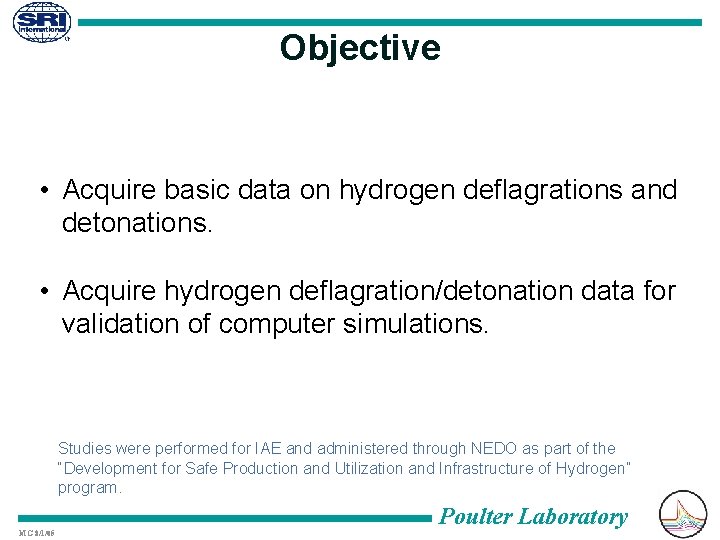
Objective • Acquire basic data on hydrogen deflagrations and detonations. • Acquire hydrogen deflagration/detonation data for validation of computer simulations. Studies were performed for IAE and administered through NEDO as part of the “Development for Safe Production and Utilization and Infrastructure of Hydrogen” program. MG 8/1/05 Poulter Laboratory
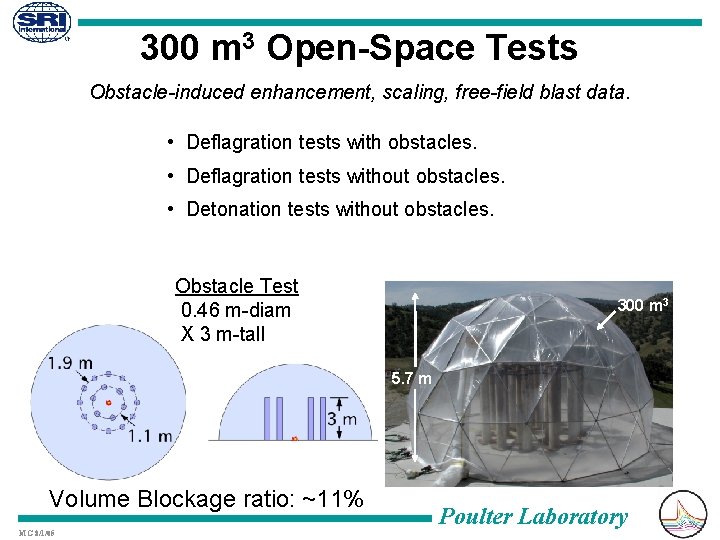
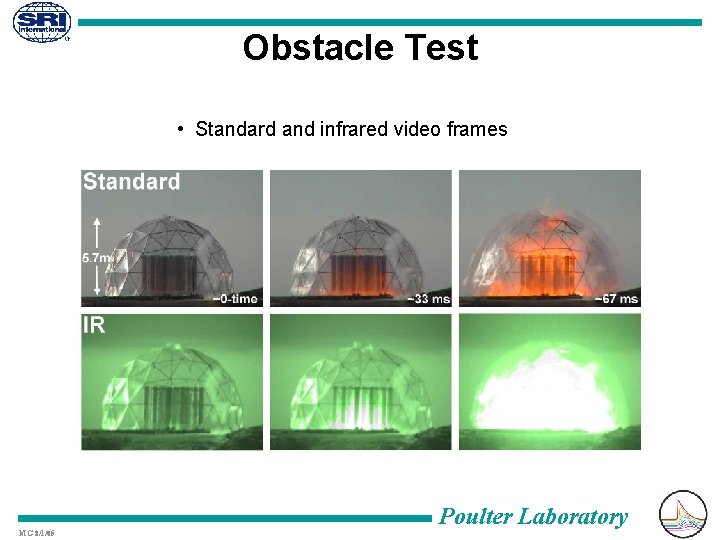
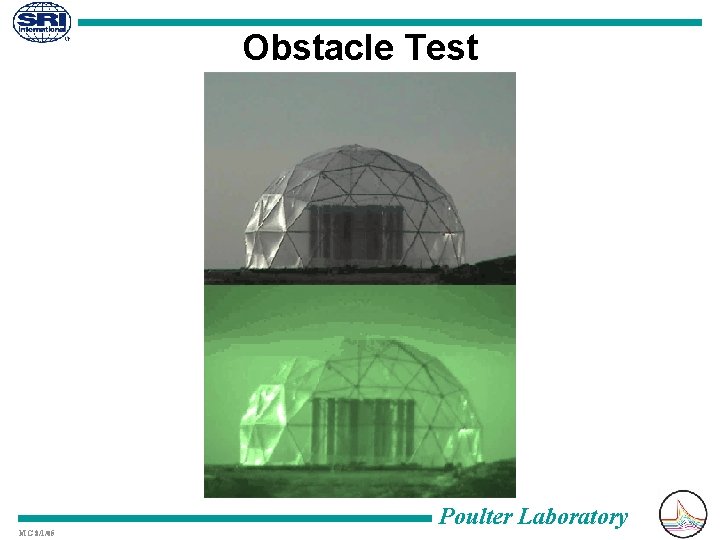
300 m 3 Open-Space Tests Obstacle-induced enhancement, scaling, free-field blast data. • Deflagration tests with obstacles. • Deflagration tests without obstacles. • Detonation tests without obstacles. Obstacle Test 0. 46 m-diam X 3 m-tall 300 m 3 5. 7 m Volume Blockage ratio: ~11% MG 8/1/05 Poulter Laboratory
Obstacle Test • Standard and infrared video frames ~67 ms ~100 ms MG 8/1/05 Poulter Laboratory
Obstacle Test MG 8/1/05 Poulter Laboratory
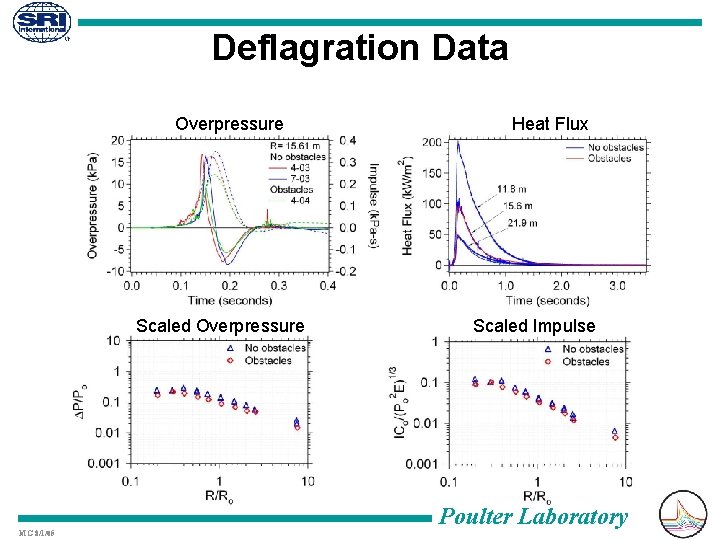
Deflagration Data Overpressure Scaled Overpressure MG 8/1/05 Heat Flux Scaled Impulse Poulter Laboratory
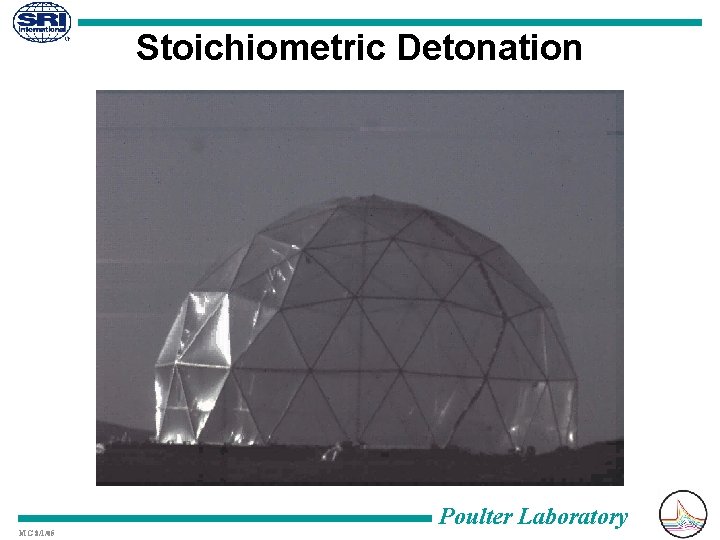
Stoichiometric Detonation • High-Speed Video Frames MG 8/1/05 Poulter Laboratory
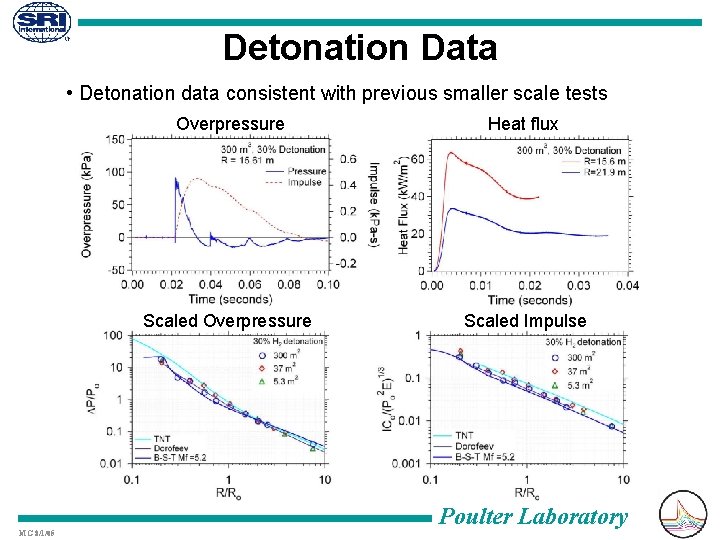
Detonation Data • Detonation data consistent with previous smaller scale tests MG 8/1/05 Overpressure Heat flux Scaled Overpressure Scaled Impulse Poulter Laboratory
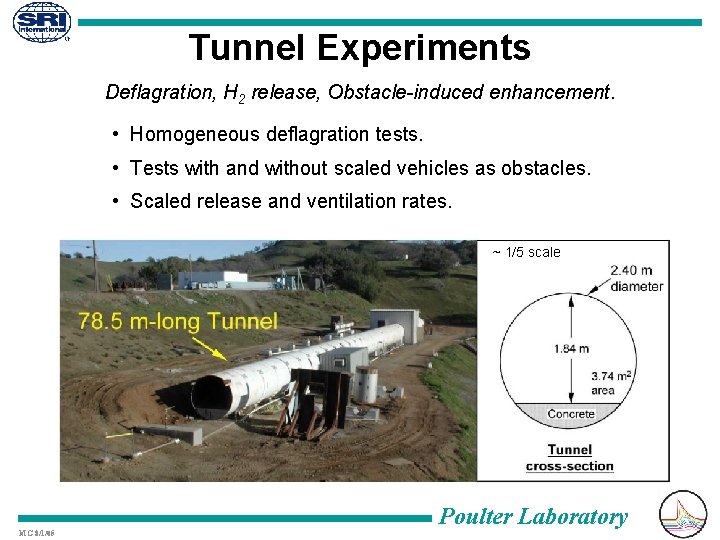
Tunnel Experiments Deflagration, H 2 release, Obstacle-induced enhancement. • Homogeneous deflagration tests. • Tests with and without scaled vehicles as obstacles. • Scaled release and ventilation rates. ~ 1/5 scale MG 8/1/05 Poulter Laboratory
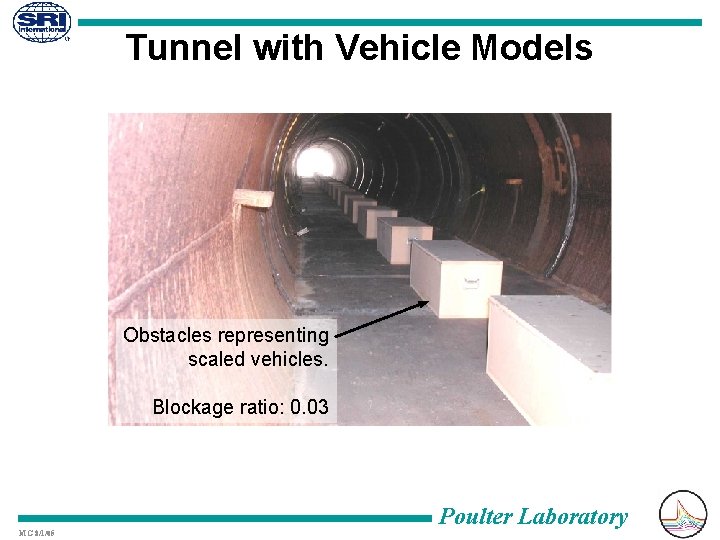
Tunnel with Vehicle Models Obstacles representing scaled vehicles. Blockage ratio: 0. 03 MG 8/1/05 Poulter Laboratory
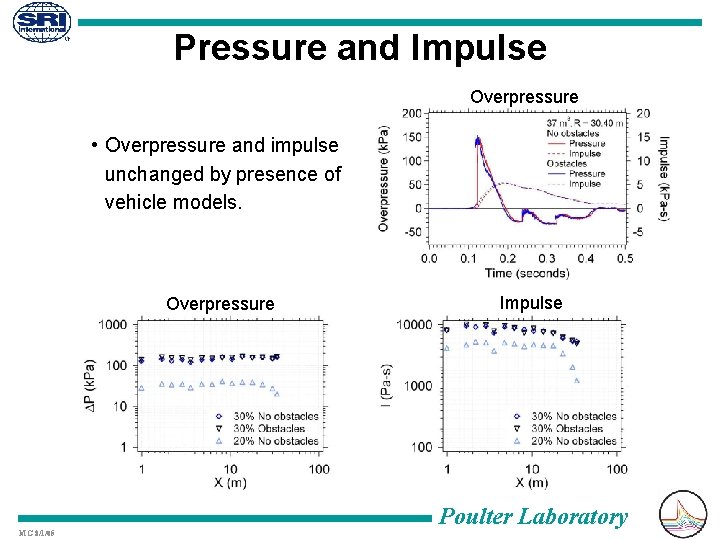
Pressure and Impulse Overpressure • Overpressure and impulse unchanged by presence of vehicle models. Overpressure MG 8/1/05 Impulse Poulter Laboratory
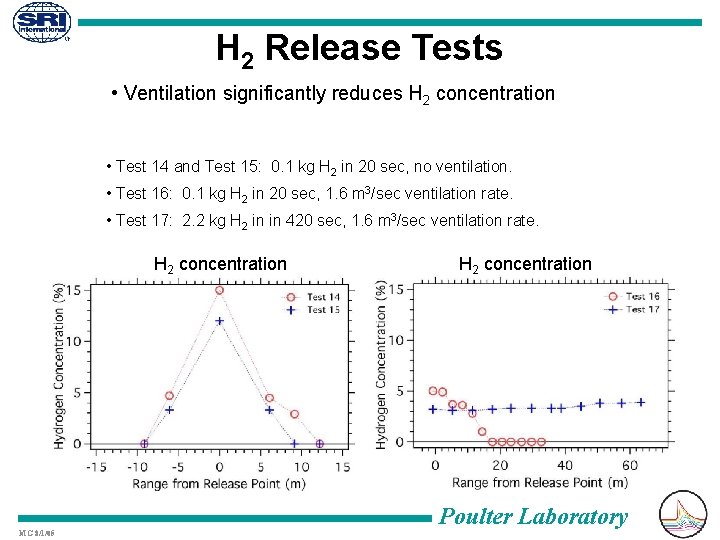
H 2 Release Tests • Ventilation significantly reduces H 2 concentration • Test 14 and Test 15: 0. 1 kg H 2 in 20 sec, no ventilation. • Test 16: 0. 1 kg H 2 in 20 sec, 1. 6 m 3/sec ventilation rate. • Test 17: 2. 2 kg H 2 in in 420 sec, 1. 6 m 3/sec ventilation rate. H 2 concentration MG 8/1/05 H 2 concentration Poulter Laboratory
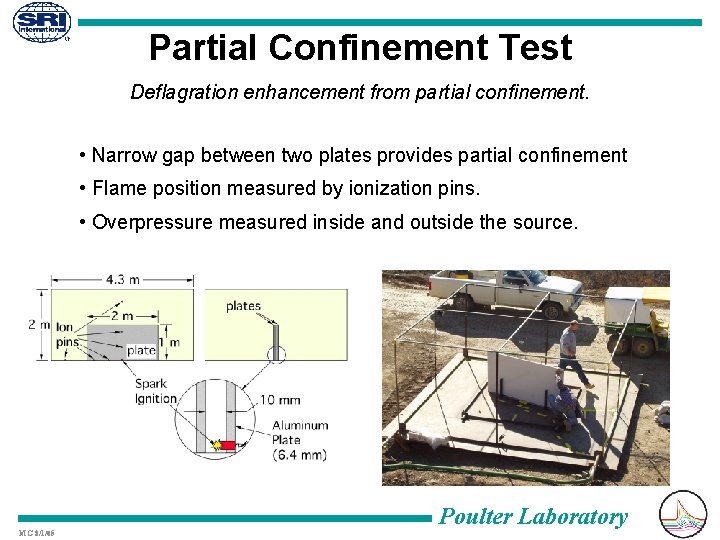
Partial Confinement Test Deflagration enhancement from partial confinement. • Narrow gap between two plates provides partial confinement • Flame position measured by ionization pins. • Overpressure measured inside and outside the source. MG 8/1/05 Poulter Laboratory
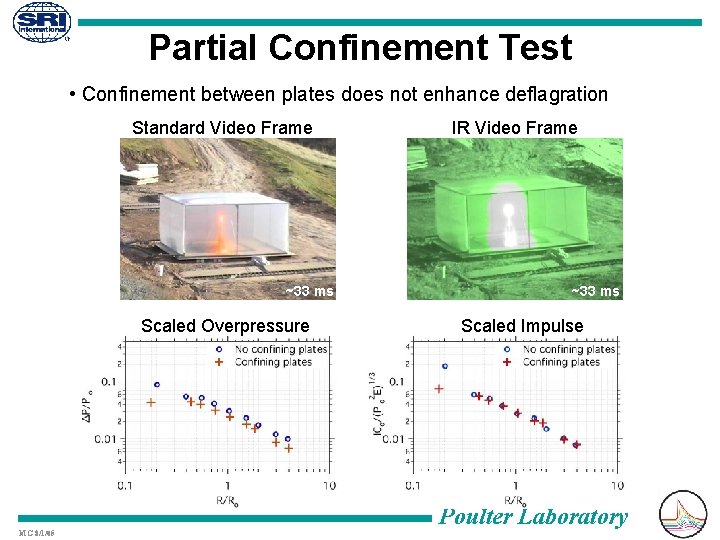
Partial Confinement Test • Confinement between plates does not enhance deflagration Standard Video Frame ~33 ms Scaled Overpressure MG 8/1/05 IR Video Frame ~33 ms Scaled Impulse Poulter Laboratory
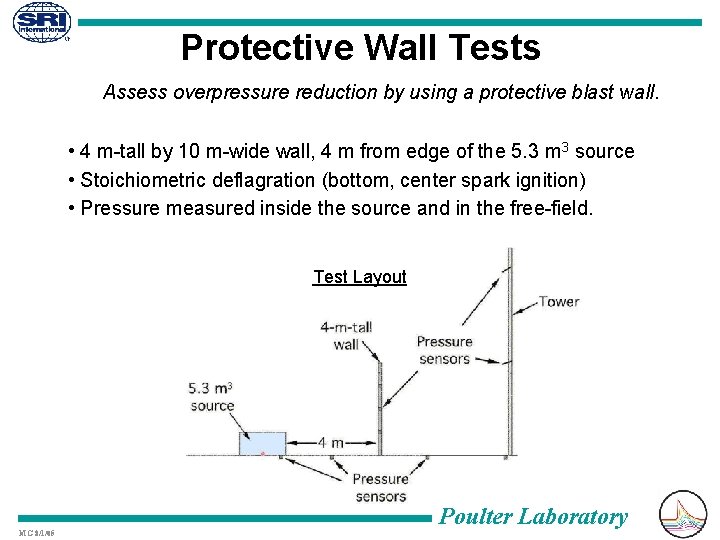
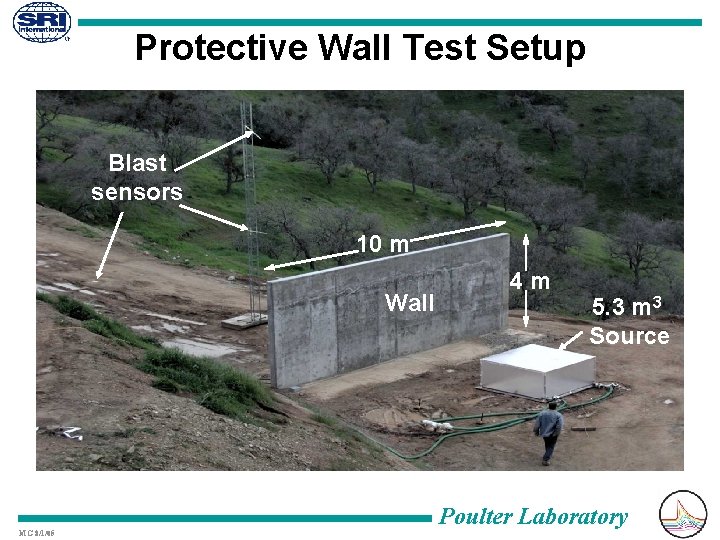
Protective Wall Tests Assess overpressure reduction by using a protective blast wall. • 4 m-tall by 10 m-wide wall, 4 m from edge of the 5. 3 m 3 source • Stoichiometric deflagration (bottom, center spark ignition) • Pressure measured inside the source and in the free-field. Test Layout MG 8/1/05 Poulter Laboratory
Protective Wall Test Setup Blast sensors 10 m Wall MG 8/1/05 4 m 5. 3 m 3 Source Poulter Laboratory
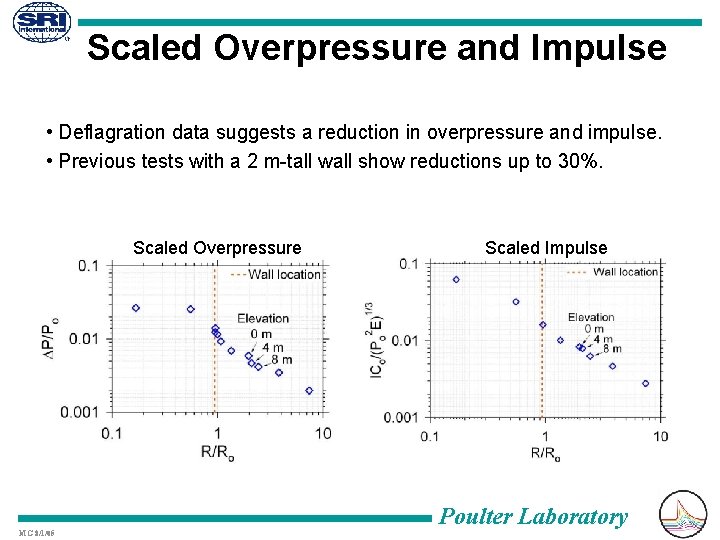
Scaled Overpressure and Impulse • Deflagration data suggests a reduction in overpressure and impulse. • Previous tests with a 2 m-tall wall show reductions up to 30%. Scaled Overpressure MG 8/1/05 Scaled Impulse Poulter Laboratory
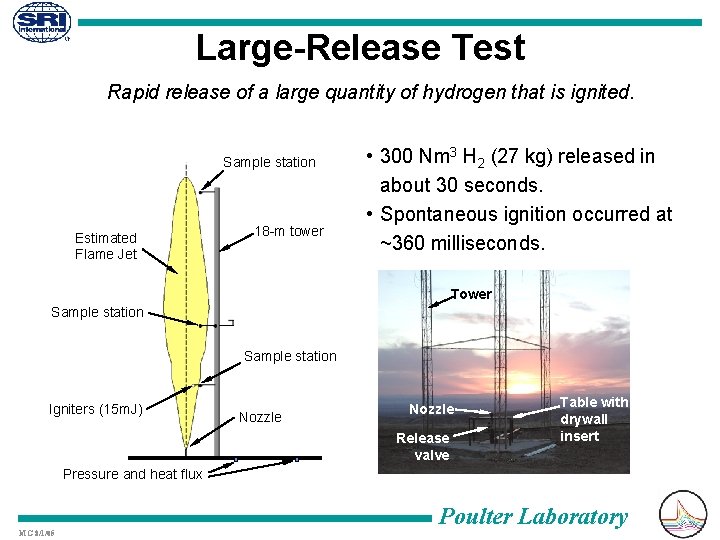
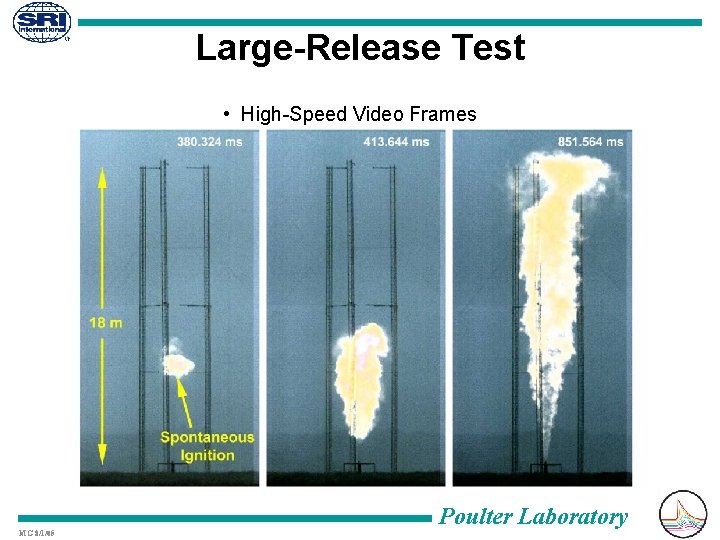
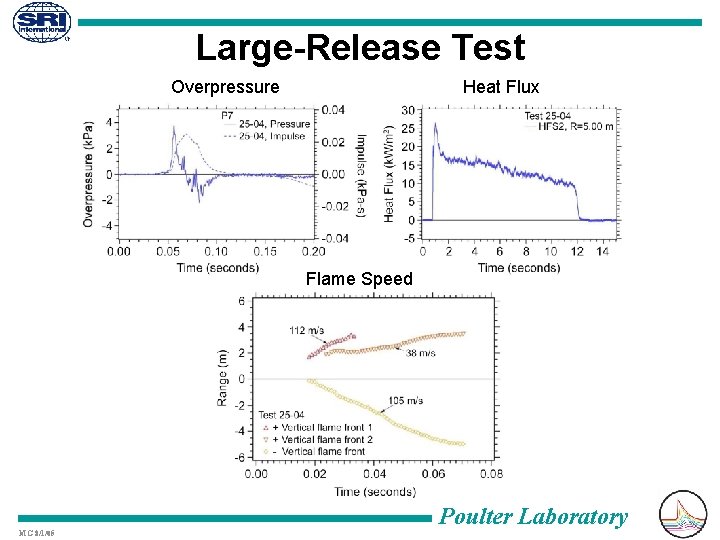
Large-Release Test Rapid release of a large quantity of hydrogen that is ignited. Sample station Estimated Flame Jet 18 -m tower • 300 Nm 3 H 2 (27 kg) released in about 30 seconds. • Spontaneous ignition occurred at ~360 milliseconds. Tower Sample station Igniters (15 m. J) Nozzle Release valve Table with drywall insert Pressure and heat flux MG 8/1/05 Poulter Laboratory
Large-Release Test • High-Speed Video Frames MG 8/1/05 Poulter Laboratory
Large-Release Test Overpressure Heat Flux Flame Speed MG 8/1/05 Poulter Laboratory
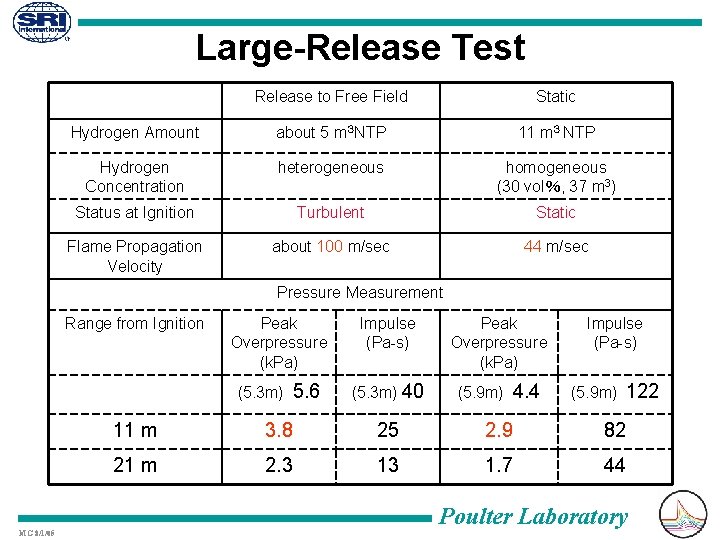
Large-Release Test Release to Free Field Static Hydrogen Amount about 5 m3 NTP 11 m3 NTP Hydrogen Concentration heterogeneous homogeneous (30 vol%, 37 m 3) Status at Ignition Turbulent Static Flame Propagation Velocity about 100 m/sec 44 m/sec Pressure Measurement Range from Ignition Peak Overpressure (k. Pa) (5. 3 m) MG 8/1/05 5. 6 Impulse (Pa-s) (5. 3 m) 40 Peak Overpressure (k. Pa) (5. 9 m) 4. 4 Impulse (Pa-s) (5. 9 m) 122 11 m 3. 8 25 2. 9 82 21 m 2. 3 13 1. 7 44 Poulter Laboratory
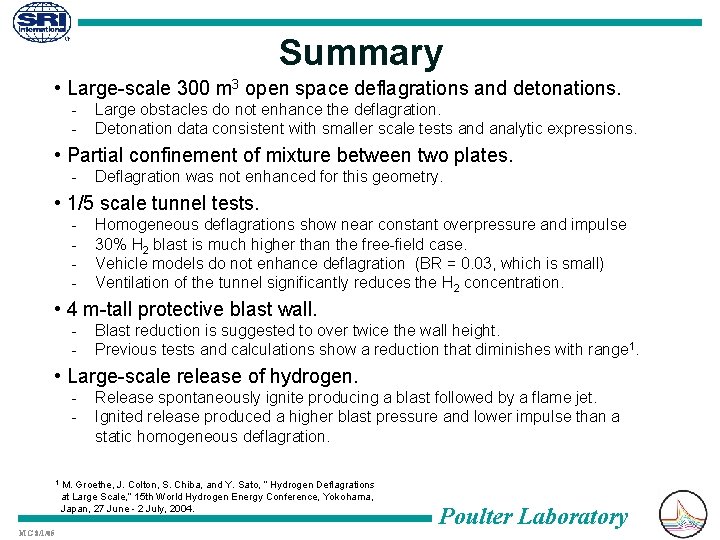
Summary • Large-scale 300 m 3 open space deflagrations and detonations. - Large obstacles do not enhance the deflagration. Detonation data consistent with smaller scale tests and analytic expressions. • Partial confinement of mixture between two plates. - Deflagration was not enhanced for this geometry. • 1/5 scale tunnel tests. - Homogeneous deflagrations show near constant overpressure and impulse 30% H 2 blast is much higher than the free-field case. Vehicle models do not enhance deflagration (BR = 0. 03, which is small) Ventilation of the tunnel significantly reduces the H 2 concentration. • 4 m-tall protective blast wall. - Blast reduction is suggested to over twice the wall height. Previous tests and calculations show a reduction that diminishes with range 1. • Large-scale release of hydrogen. - 1 MG 8/1/05 Release spontaneously ignite producing a blast followed by a flame jet. Ignited release produced a higher blast pressure and lower impulse than a static homogeneous deflagration. M. Groethe, J. Colton, S. Chiba, and Y. Sato, “ Hydrogen Deflagrations at Large Scale, ” 15 th World Hydrogen Energy Conference, Yokohama, Japan, 27 June - 2 July, 2004. Poulter Laboratory