
Largely by Chris Waterman And anyone who pipes
Largely by Chris Waterman And, anyone who pipes up during the session Searchography What is it good for?
What’s the recipe today Jim? * ● A quick look at what searchography is ● The basics of Google search ● Applying those things to assignments and projects *Kudos to the first person to find that quote source and who said it
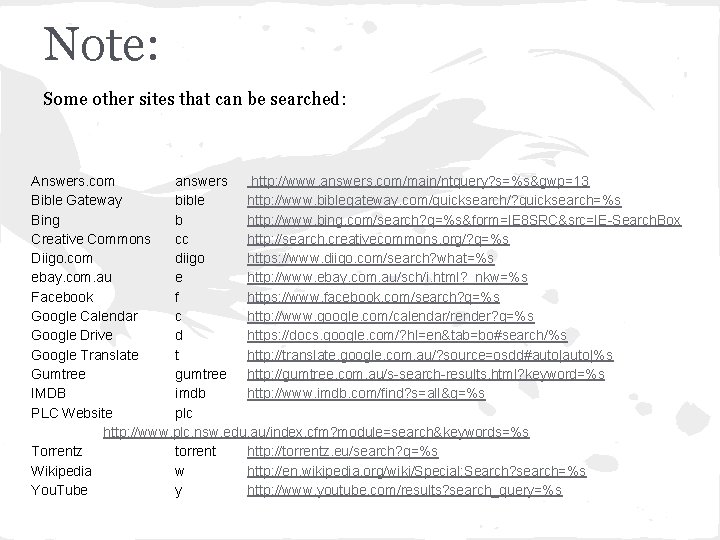
Note: Some other sites that can be searched: Answers. com answers http: //www. answers. com/main/ntquery? s=%s&gwp=13 Bible Gateway bible http: //www. biblegateway. com/quicksearch/? quicksearch=%s Bing b http: //www. bing. com/search? q=%s&form=IE 8 SRC&src=IE-Search. Box Creative Commons cc http: //search. creativecommons. org/? q=%s Diigo. com diigo https: //www. diigo. com/search? what=%s ebay. com. au e http: //www. ebay. com. au/sch/i. html? _nkw=%s Facebook f https: //www. facebook. com/search? q=%s Google Calendar c http: //www. google. com/calendar/render? q=%s Google Drive d https: //docs. google. com/? hl=en&tab=bo#search/%s Google Translate t http: //translate. google. com. au/? source=osdd#auto|%s Gumtree gumtree http: //gumtree. com. au/s-search-results. html? keyword=%s IMDB imdb http: //www. imdb. com/find? s=all&q=%s PLC Website plc http: //www. plc. nsw. edu. au/index. cfm? module=search&keywords=%s Torrentz torrent http: //torrentz. eu/search? q=%s Wikipedia w http: //en. wikipedia. org/wiki/Special: Search? search=%s You. Tube y http: //www. youtube. com/results? search_query=%s
Activity Q. Every national flag in the world shares a common geometric characteristic - except for one country. Which one? Q. There is a particular kind of bird that is often used to go fishing. It typically perches with it’s wings spread out wide. What is it and why does it do that?
Words- Order matters o o o WHO a WHO the WHO ● Capitalisation still doesn’t matter ● Special characters are still ignored ¶ § © £ ∑ ● Except in specialist situations C+ C++ #tag Google+ $100 ● Google automatically corrects spelling (but it does know about British spelling)
Activity ● How much of the web contains material about One. Direction-boy band, that's at an advanced level? ● What do l 33 t and pwned mean?
Let’s try some searching: Q. You visit the ‘Palace of the Light of Faith”. Sleep one night in each room (exclude the bathrooms). How long do you stay there? Q. I can grow my body back in about two days if cut in half. Many scientists believe I do not undergo senescence. What am I? Where did I get my name? Q. One of the most famous photos of the 20 th century was taken at a memorial service for victims of La Coubre. On the original print, what’s stamped on the lower left corner?
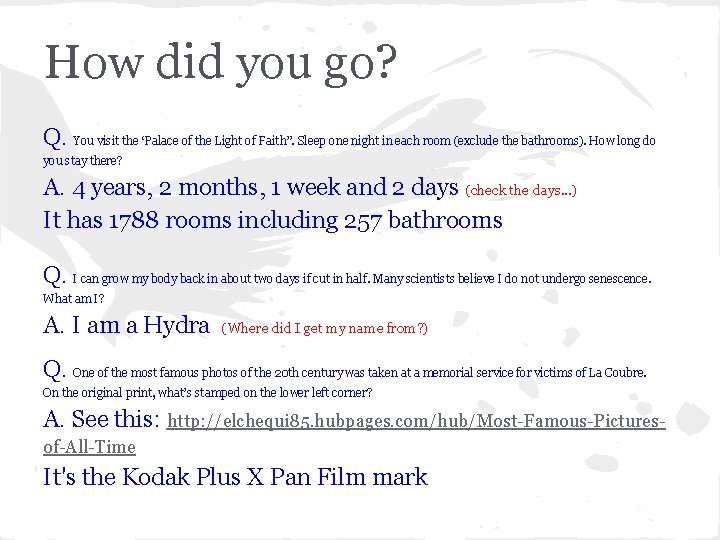
How did you go? Q. You visit the ‘Palace of the Light of Faith”. Sleep one night in each room (exclude the bathrooms). How long do you stay there? A. 4 years, 2 months, 1 week and 2 days (check the days. . . ) It has 1788 rooms including 257 bathrooms Q. I can grow my body back in about two days if cut in half. Many scientists believe I do not undergo senescence. What am I? A. I am a Hydra (Where did I get my name from? ) Q. One of the most famous photos of the 20 th century was taken at a memorial service for victims of La Coubre. On the original print, what’s stamped on the lower left corner? A. See this: http: //elchequi 85. hubpages. com/hub/Most-Famous-Picturesof-All-Time It's the Kodak Plus X Pan Film mark
sirchris's Law of Searching: It's 100 time easier to find it, than find it again. A tag is a non-hierarchical keyword or term assigned to a piece of information (such as an internet bookmark, digital image, or computer file). This kind of metadata helps describe an item and allows it to be found again by browsing or searching. Tags are chosen informally and personally by the item's creator or by its viewer, depending on the system. On a website in which many users tag many items, this collection of tags becomes a folksonomy. Wikipedia
Hot tip: <ctrl><f> Who is the highest scoring celebrity on the American, “Dancing with the Stars”?
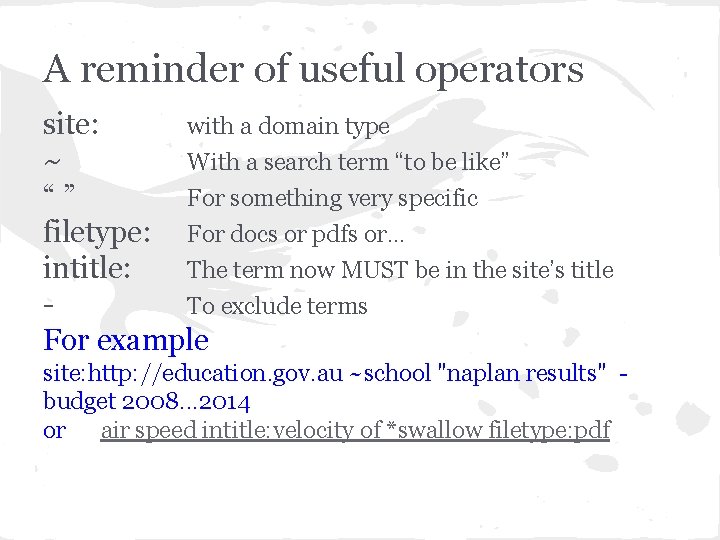
A reminder of useful operators site: with a domain type ~ With a search term “to be like” “” For something very specific filetype: For docs or pdfs or. . . intitle: The term now MUST be in the site’s title To exclude terms For example site: http: //education. gov. au ~school "naplan results" budget 2008. . . 2014 or air speed intitle: velocity of *swallow filetype: pdf
Some others: How many of you stuck to Google as the source? What about: ● Duckduckgo. com ● wolframalpha. com ● Wikipedia. com ● Ask. com Who took a divergent path? Who put it in as a mind map?
How did you do? Thanks to Chris Betcher for the next 3 slides. 1: Start with the Wikipedia article. For whatever potential concerns that people might have about the public edit-ability of Wikipedia, the fact is that for the VAST majority of topics it will be the most current, most accurate and most well researched summary of the topic. Start there. 2: Read the article”s citations list. Scroll all the way to the bottom of the page. One of the requirements of Wikipedia articles is that they have a citation for every claim made, and uncited statements are usually removed. So for many topics, looking at the citation list (and links) will provide a treasure trove of further research ideas. 3: Go to Google Scholar at scholar. google. com and search for your topic there. These articles are all reviewed academic papers and usually provide excellent reading on most topics. Not only that, but each article in Scholar shows a link to the downstream papers that cited them, which provides further reading. If an article has dozens, or hundreds of papers citing it as a source, then you can assume that other researched have found it valuable.
How did you do? 4: Set up a bookmarking system where you keep a collection of relevant links in one place. I HIGHLY recommend Diigo, not just because it is by far the best online bookmarking service around, but it also allows group collaboration on shared bookmarks and online markup of webpages. Using Diigo, a student can make comments and leave sticky notes directly ON a webpage, share those annotations with their partners, keep an organised list of relevant research articles and much more. Diigo is probably the number one tool that students should be using with web research. 5: While in Diigo, do a search for the obvious tags being used by others. This will reveal another rich resource of ideas and research on a topic that others have already found useful. It's often a much better way to narrow in on relevant study resources than a regular Internet search because it has already been through a kind of social approval process. As more people tag a resource it gains social credibility and value, making it more likely to be the kind of resource that others will find valuable.
How did you do? 6: Set up some tool to curate content. I recommend Flipboard, but there are many others like Zite, Scoop. It or even Pinterest. By curating relevant content into one place it builds a go-to resource for more reading on a topic. Curation like this should be a key digital information strategy. 7: Finally, there is the use of Internet search in general, such as Google or Bing. But too often students take a very limited approach to search because they simply don't know any better. As well as using a rich array of search strategies (there is way more to it than just typing a couple of words into Google!) there is also Book Search, Map search, Image search, etc, each with their own nuances and advantages.
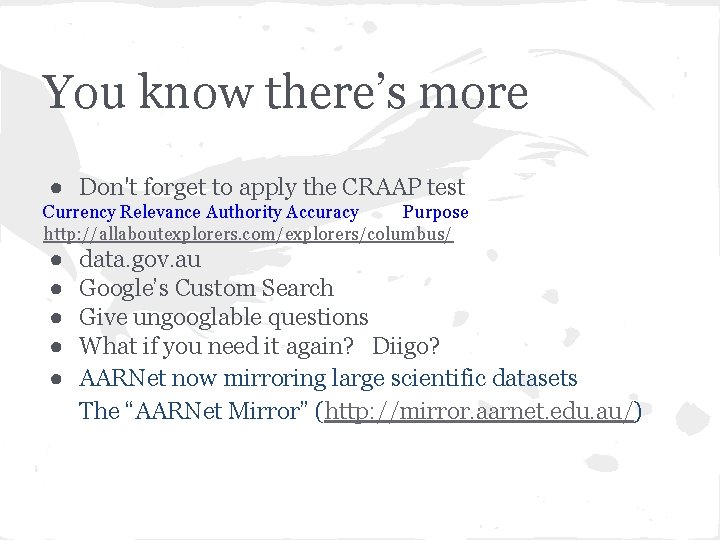
You know there’s more ● Don't forget to apply the CRAAP test Currency Relevance Authority Accuracy Purpose http: //allaboutexplorers. com/explorers/columbus/ ● ● ● data. gov. au Google’s Custom Search Give ungooglable questions What if you need it again? Diigo? AARNet now mirroring large scientific datasets The “AARNet Mirror” (http: //mirror. aarnet. edu. au/)
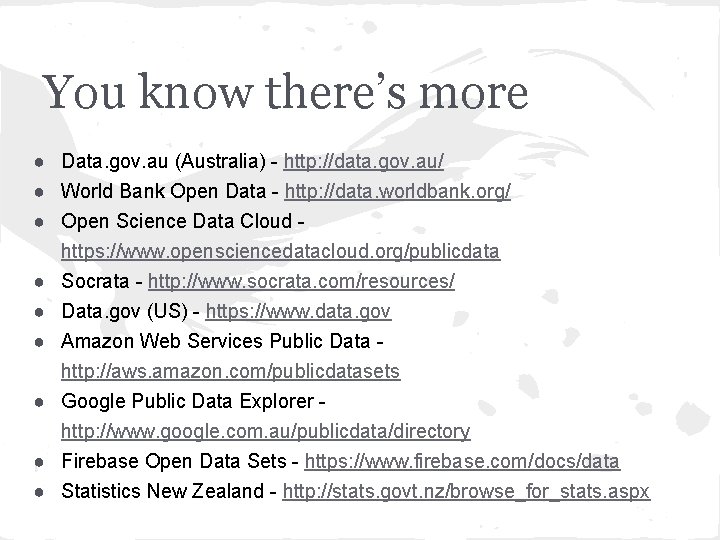
You know there’s more ● Data. gov. au (Australia) - http: //data. gov. au/ ● World Bank Open Data - http: //data. worldbank. org/ ● Open Science Data Cloud https: //www. opensciencedatacloud. org/publicdata ● Socrata - http: //www. socrata. com/resources/ ● Data. gov (US) - https: //www. data. gov ● Amazon Web Services Public Data http: //aws. amazon. com/publicdatasets ● Google Public Data Explorer http: //www. google. com. au/publicdata/directory ● Firebase Open Data Sets - https: //www. firebase. com/docs/data ● Statistics New Zealand - http: //stats. govt. nz/browse_for_stats. aspx
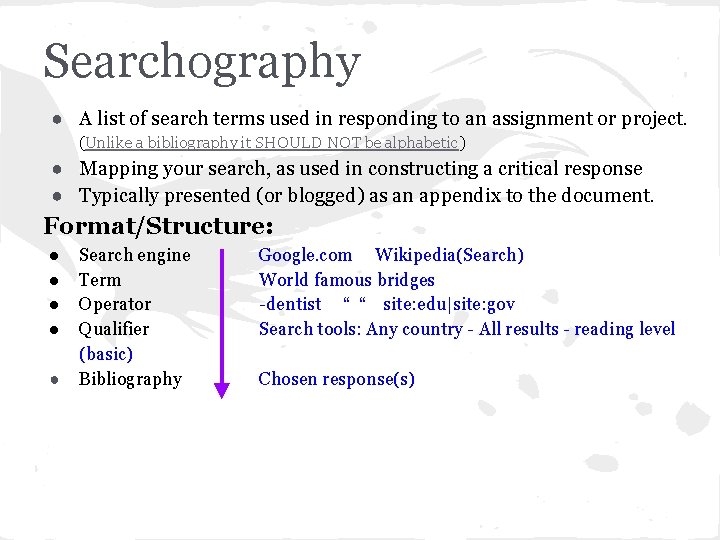
Searchography ● A list of search terms used in responding to an assignment or project. (Unlike a bibliography it SHOULD NOT be alphabetic) ● Mapping your search, as used in constructing a critical response ● Typically presented (or blogged) as an appendix to the document. Format/Structure: ● ● ● Search engine Term Operator Qualifier (basic) Bibliography Google. com Wikipedia(Search) World famous bridges -dentist “ “ site: edu|site: gov Search tools: Any country - All results - reading level Chosen response(s)
Re-structure the assignment Include a search for each relevant section Make it age/level appropriate Model good search structures Add a blank section in the instructions for their Searchography Tell them how to construct one
Note: A critical searchography traces the following moments, experiences or events of student research; ● questioning / defining search strategies ● search and encounter (entering the discourse) ● reformulating the topic (focussing) ● discovering (forming conclusions) Marsh, Bill. 2000 "Critical Searchography - Remodeling Research & Authorship. " 06 Apr. 2014 http: //www. factoryschool. com/btheater/works/essays/comp/CS/searchog. html
Still having fun? Q. If a man has two swallows tattooed on his chest - how many inches has he sailed? Q. During his circumnavigation of the globe in 1519 -1522, this expedition leader spent more money on this liquid than on weapons. What is it? Q. In one of my most famous works, five people die by suicide and in another the title character and 13 others are killed. I am the son of a glovemaker. Who am I? Q. The second wife of King Henry the 8 th is said to haunt the grounds where she was executed. What does she supposedly have tucked underneath her arm? Who was she? Why does she have it tucked underneath her arm? Sing the song. . .
Was it possible for William Shakespeare to gaze at the stars through a telescope ? Was it possible for Soviet astronaut Yuri Gagarin to have witnessed one of Houdini’s famous escapes ? Was it possible for Queen Victoria to fasten her gown with a zipper ? Was it possible for Mark Twain to watch the film version of Huckleberry Finn on television ? Was it possible for Christopher Columbus to fire a cannon ? Was it possible for the novelist Charlotte Bronte to type her novels on a typewriter ?

Ten Steps to Better Web Research http: //www. sweetsearch. com/Ten. Steps
Stop Here
Purpose (What’s in it for you? ) ● To validate student responses in assignments ● To view (visible thinking) student thought processes and approaches to assignment answering ● To allow teachers to scaffold their student's skill development, knowledge development and generation of responses ● Reduce the likelihood of plagiarism To construct and develop a basic digital skill
Purpose (What’s in it for you? ) ● Formalise the experience or performance of finding information ● Like a bibliography it serves as a companion to the research paper, authenticating and tracking references ● Allows you a chance to worry less about the identity of the author of found material and more about the skill with which the student appropriates it, and how it affects their path of enquiry ● Flows naturally into a bibliography ● Displays patterns, paths and events of encounter
How do we develop these skills in our students? Grab an assignment. Your own or one of the examples: Analytical Essay: Ethics (Yr 11). Year 12 Modern History Task 1 2014. Choose a world-wide natural disaster. Year 6 HSIE INDIA – An Asian Neighbour. Choose a world famous bridge. Year 5 Gallipoli Assignment Term 2. Year 6 Global Alternative Energy Debate
Sample assignment 1 Analytical Essay: Ethics (Yr 11) click to see original The current government & opposition policies on stopping the boats raise a number of ethical issues for Australians. Explore these issues, with reference to: 1. The facts of the situation 2. The three categories of normative ethics 3. Your own personal response to the Ethical Issues. The language [register] of your response must be formal and technical
Keywords ● Think about how you would provide information if you already had the answer ● Don't use colloquialisms, busted arm - stuffed arm; use broken arm ● Don't ask long winded questions (that’s another search engine) ● Choose words that you'd expect to find on the answer page ● Try getting into the author’s mind set ● Start with your keywords and develop from there ● Cast a wide-ish net for the first run - hone your search next time
Sample assignment 2 Year 12 Modern History Task 1 2014 click to see original What was the decisive turning point of World War I?
Sample assignment 3 Choose a world-wide natural disaster to research. Yr 6 click to see original Your writing should cover the following questions. • Explain the natural process of your disaster. What was it? What caused it? This is the introduction to your • When and where did your chosen natural disaster occur? Identify the location on a world map. • How did this disaster damage the landscape and affect people in this area? • Include an eyewitness account if possible. • Find a current affairs article or Youtube clip to share with the class. • What were some special challenges that the emergency services and volunteers faced? How did they overcome these challenges? • How long did it take to clean up and rebuild the affected area? • Did you find any interesting stories about this disaster? Any other facts?
Sample assignment 4 Yr 6 HSIE INDIA – An Asian Neighbour click to see original For the next twelve HSIE lessons, you must complete one activity from each of the six categories below. There are two lessons allocated for each activity. FOOD FESTIVALS MUSIC DANCE ART CLOTHING Complete an activity for each topic. You may not complete more than two activities under the same vertical heading. Whilst working on the six topics, you aim to achieve at least 25 points. The maximum number of points available for each activity is shown. Present all of your written work neatly and accurately.
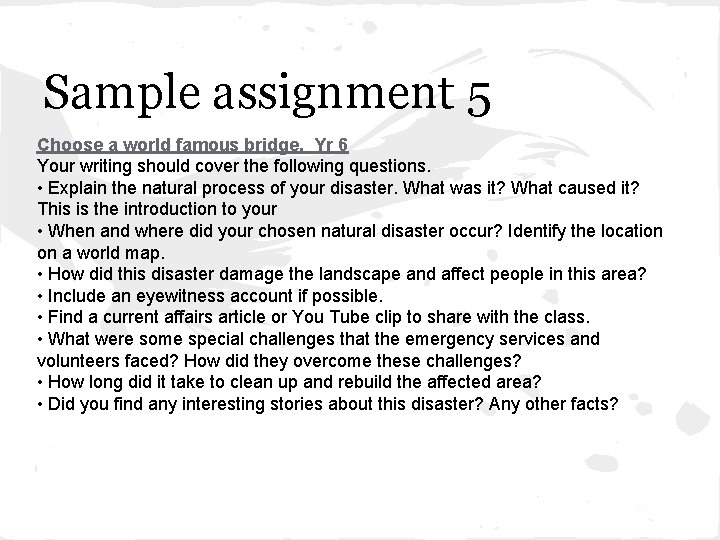
Sample assignment 5 Choose a world famous bridge. Yr 6 Your writing should cover the following questions. • Explain the natural process of your disaster. What was it? What caused it? This is the introduction to your • When and where did your chosen natural disaster occur? Identify the location on a world map. • How did this disaster damage the landscape and affect people in this area? • Include an eyewitness account if possible. • Find a current affairs article or You Tube clip to share with the class. • What were some special challenges that the emergency services and volunteers faced? How did they overcome these challenges? • How long did it take to clean up and rebuild the affected area? • Did you find any interesting stories about this disaster? Any other facts?
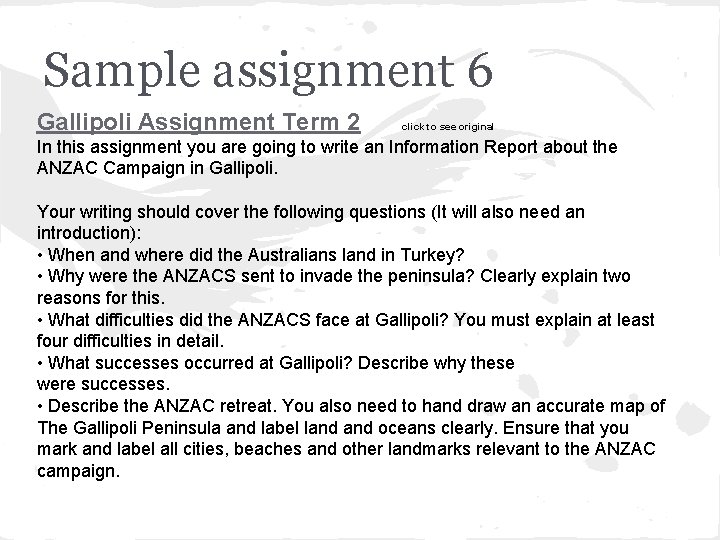
Sample assignment 6 Gallipoli Assignment Term 2 click to see original In this assignment you are going to write an Information Report about the ANZAC Campaign in Gallipoli. Your writing should cover the following questions (It will also need an introduction): • When and where did the Australians land in Turkey? • Why were the ANZACS sent to invade the peninsula? Clearly explain two reasons for this. • What difficulties did the ANZACS face at Gallipoli? You must explain at least four difficulties in detail. • What successes occurred at Gallipoli? Describe why these were successes. • Describe the ANZAC retreat. You also need to hand draw an accurate map of The Gallipoli Peninsula and label land oceans clearly. Ensure that you mark and label all cities, beaches and other landmarks relevant to the ANZAC campaign.
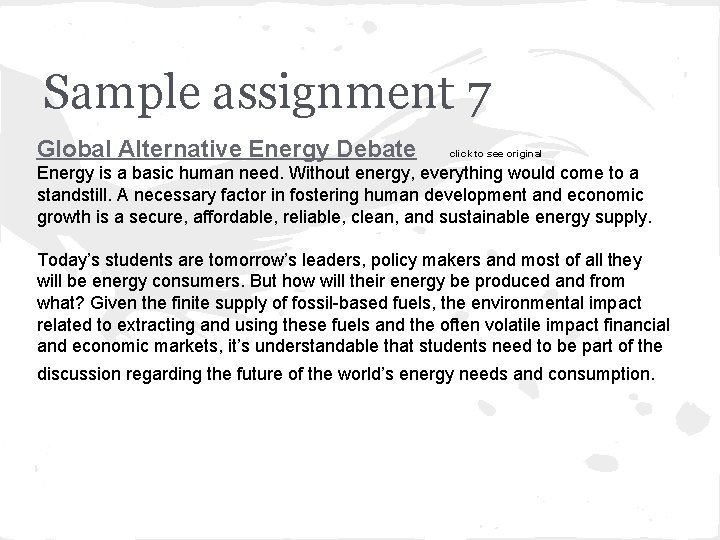
Sample assignment 7 Global Alternative Energy Debate click to see original Energy is a basic human need. Without energy, everything would come to a standstill. A necessary factor in fostering human development and economic growth is a secure, affordable, reliable, clean, and sustainable energy supply. Today’s students are tomorrow’s leaders, policy makers and most of all they will be energy consumers. But how will their energy be produced and from what? Given the finite supply of fossil-based fuels, the environmental impact related to extracting and using these fuels and the often volatile impact financial and economic markets, it’s understandable that students need to be part of the discussion regarding the future of the world’s energy needs and consumption.
- Slides: 36