
LargeClass Strategies David E Meltzer Department of Physics



- Slides: 99
Large-Class Strategies David E. Meltzer Department of Physics and Astronomy ISU
Outline • Motivation and description of active-engagement teaching strategy. • Watch video (18 minutes): pauses for comments and questions • Describe details of questioning strategies • Group work: Work with others in your (or related) discipline to create question sequences.
Outline • Motivation and description of active-engagement teaching strategy. • Watch video (18 minutes): pauses for comments and questions • Describe details of questioning strategies • Group work: Work with others in your (or related) discipline to create question sequences.
Outline • Motivation and description of active-engagement teaching strategy. • Watch video (18 minutes): pauses for comments and questions • Describe details of questioning strategies • Group work: Work with others in your (or related) discipline to create question sequences.
Outline • Motivation and description of active-engagement teaching strategy. • Watch video (18 minutes): pauses for comments and questions • Describe details of questioning strategies • Group work: Work with others in your (or related) discipline to create question sequences.
Outline • Motivation and description of active-engagement teaching strategy. • Watch video (18 minutes): pauses for comments and questions • Describe details of questioning strategies • Group work: Work with others in your (or related) discipline to create question sequences.
Research in physics education and other scientific and technical fields suggests that: • “Teaching by telling” has only limited effectiveness – listening and note-taking have relatively little impact • Problem-solving activities with rapid feedback yield improved learning gains – student group work – frequent question-and-answer exchanges with instructor Goal: Guide students to “figure things out for themselves” as much as possible
Research in physics education and other scientific and technical fields suggests that: • “Teaching by telling” has only limited effectiveness – listening and note-taking have relatively little impact • Problem-solving activities with rapid feedback yield improved learning gains – student group work – frequent question-and-answer exchanges with instructor Goal: Guide students to “figure things out for themselves” as much as possible
Research in physics education and other scientific and technical fields suggests that: • “Teaching by telling” has only limited effectiveness – listening and note-taking have relatively little impact • Problem-solving activities with rapid feedback yield improved learning gains – student group work – frequent question-and-answer exchanges with instructor Goal: Guide students to “figure things out for themselves” as much as possible
Research in physics education and other scientific and technical fields suggests that: • “Teaching by telling” has only limited effectiveness – listening and note-taking have relatively little impact • Problem-solving activities with rapid feedback yield improved learning gains – student group work – frequent question-and-answer exchanges with instructor Goal: Guide students to “figure things out for themselves” as much as possible
Research in physics education and other scientific and technical fields suggests that: • “Teaching by telling” has only limited effectiveness – listening and note-taking have relatively little impact • Problem-solving activities with rapid feedback yield improved learning gains – student group work – frequent question-and-answer exchanges with instructor Goal: Guide students to “figure things out for themselves” as much as possible
Research in physics education and other scientific and technical fields suggests that: • “Teaching by telling” has only limited effectiveness – listening and note-taking have relatively little impact • Problem-solving activities with rapid feedback yield improved learning gains – student group work – frequent question-and-answer exchanges with instructor Goal: Guide students to “figure things out for themselves” as much as possible
What needs to go on in class? • Clear and organized presentation by instructor is not at all sufficient • Must find ways to guide students to synthesize concepts in their own minds • Instructor’s role becomes that of guiding students to ask and answer useful questions – aid students to work their way through complex chains of thought
What needs to go on in class? • Clear and organized presentation by instructor is not at all sufficient • Must find ways to guide students to synthesize concepts in their own minds • Instructor’s role becomes that of guiding students to ask and answer useful questions – aid students to work their way through complex chains of thought
What needs to go on in class? • Clear and organized presentation by instructor is not at all sufficient • Must find ways to guide students to synthesize concepts in their own minds • Instructor’s role becomes that of guiding students to ask and answer useful questions – aid students to work their way through complex chains of thought
What needs to go on in class? • Clear and organized presentation by instructor is not at all sufficient • Must find ways to guide students to synthesize concepts in their own minds • Instructor’s role becomes that of guiding students to ask and answer useful questions – aid students to work their way through complex chains of thought
What needs to go on in class? • Clear and organized presentation by instructor is not at all sufficient • Must find ways to guide students to synthesize concepts in their own minds • Instructor’s role becomes that of guiding students to ask and answer useful questions – aid students to work their way through complex chains of thought
The Biggest Challenge: Large Lecture Classes • Very difficult to sustain active learning in large classroom environments • Two-way communication between students and instructor becomes paramount obstacle • Curriculum development must be matched to innovative instructional methods Example: Curriculum and Instruction in Algebra-based Physics
The Biggest Challenge: Large Lecture Classes • Very difficult to sustain active learning in large classroom environments • Two-way communication between students and instructor becomes paramount obstacle • Curriculum development must be matched to innovative instructional methods Example: Curriculum and Instruction in Algebra-based Physics
The Biggest Challenge: Large Lecture Classes • Very difficult to sustain active learning in large classroom environments • Two-way communication between students and instructor becomes paramount obstacle • Curriculum development must be matched to innovative instructional methods Example: Curriculum and Instruction in Algebra-based Physics
The Biggest Challenge: Large Lecture Classes • Very difficult to sustain active learning in large classroom environments • Two-way communication between students and instructor becomes paramount obstacle • Curriculum development must be matched to innovative instructional methods Example: Curriculum and Instruction in Algebra-based Physics
Active Learning in Large Physics Classes • De-emphasis of lecturing; Instead, ask students to respond to many questions. • Use of classroom communication systems to obtain instantaneous feedback from entire class. • Cooperative group work using carefully structured free -response worksheets Goal: Transform large-class learning environment into “office” learning environment (i. e. , instructor + one or two students)
Active Learning in Large Physics Classes • De-emphasis of lecturing; Instead, ask students to respond to many questions. • Use of classroom communication systems to obtain instantaneous feedback from entire class. • Cooperative group work using carefully structured free -response worksheets Goal: Transform large-class learning environment into “office” learning environment (i. e. , instructor + one or two students)
Active Learning in Large Physics Classes • De-emphasis of lecturing; Instead, ask students to respond to many questions. • Use of classroom communication systems to obtain instantaneous feedback from entire class. • Cooperative group work using carefully structured free -response worksheets Goal: Transform large-class learning environment into “office” learning environment (i. e. , instructor + one or two students)
Active Learning in Large Physics Classes • De-emphasis of lecturing; Instead, ask students to respond to many questions. • Use of classroom communication systems to obtain instantaneous feedback from entire class. • Cooperative group work using carefully structured free -response worksheets Goal: Transform large-class learning environment into “office” learning environment (i. e. , instructor + one or two students)
Active Learning in Large Physics Classes • De-emphasis of lecturing; Instead, ask students to respond to many questions. • Use of classroom communication systems to obtain instantaneous feedback from entire class. • Cooperative group work using carefully structured free -response worksheets Goal: Transform large-class learning environment into “office” learning environment (i. e. , instructor + one or two students)
Active Learning in Large Physics Classes • De-emphasis of lecturing; Instead, ask students to respond to many questions. • Use of classroom communication systems to obtain instantaneous feedback from entire class. • Cooperative group work using carefully structured free -response worksheets Goal: Transform large-class learning environment into “office” learning environment (i. e. , instructor + one or two students)
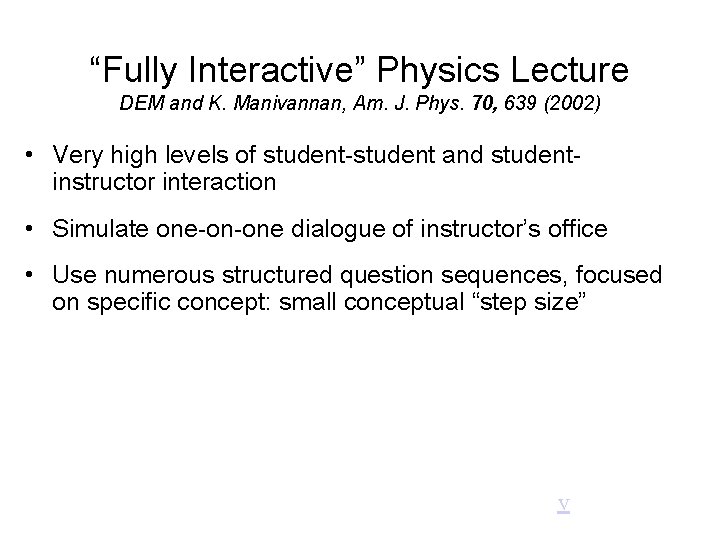
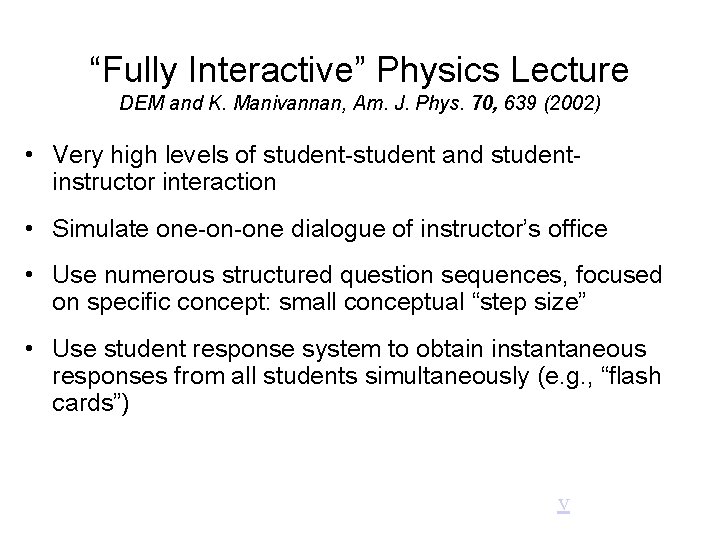
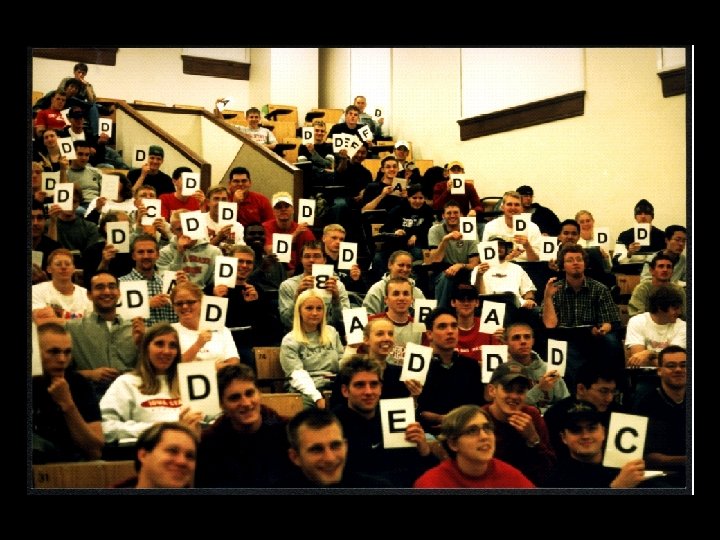
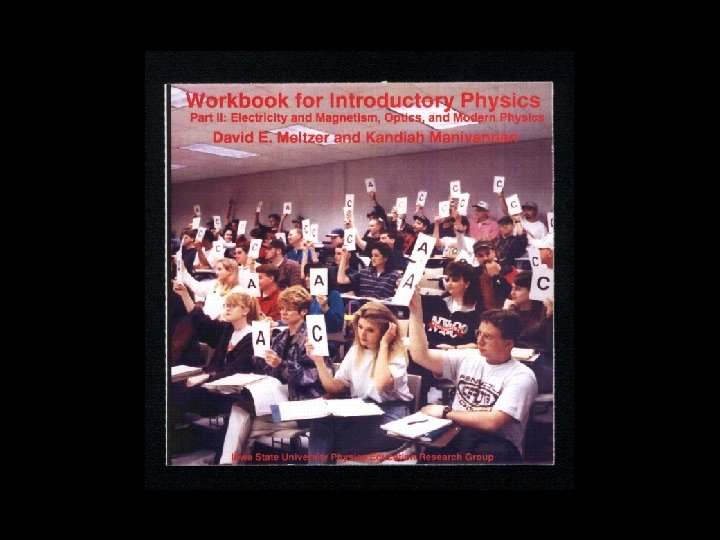
“Fully Interactive” Physics Lecture DEM and K. Manivannan, Am. J. Phys. 70, 639 (2002) • Very high levels of student-student and studentinstructor interaction • Simulate one-on-one dialogue of instructor’s office • Use numerous structured question sequences, focused on specific concept: small conceptual “step size” • Use student response system to obtain instantaneous responses from all students simultaneously (e. g. , “flash cards”) – Extension to highly interactive physics demonstrations (K. Manivannan and DEM, Proc. of PER Conf. 2001) v
“Fully Interactive” Physics Lecture DEM and K. Manivannan, Am. J. Phys. 70, 639 (2002) • Very high levels of student-student and studentinstructor interaction • Simulate one-on-one dialogue of instructor’s office • Use numerous structured question sequences, focused on specific concept: small conceptual “step size” • Use student response system to obtain instantaneous responses from all students simultaneously (e. g. , “flash cards”) – Extension to highly interactive physics demonstrations (K. Manivannan and DEM, Proc. of PER Conf. 2001) v
“Fully Interactive” Physics Lecture DEM and K. Manivannan, Am. J. Phys. 70, 639 (2002) • Very high levels of student-student and studentinstructor interaction • Simulate one-on-one dialogue of instructor’s office • Use numerous structured question sequences, focused on specific concept: small conceptual “step size” • Use student response system to obtain instantaneous responses from all students simultaneously (e. g. , “flash cards”) – Extension to highly interactive physics demonstrations (K. Manivannan and DEM, Proc. of PER Conf. 2001) v
“Fully Interactive” Physics Lecture DEM and K. Manivannan, Am. J. Phys. 70, 639 (2002) • Very high levels of student-student and studentinstructor interaction • Simulate one-on-one dialogue of instructor’s office • Use numerous structured question sequences, focused on specific concept: small conceptual “step size” • Use student response system to obtain instantaneous responses from all students simultaneously (e. g. , “flash cards”) – Extension to highly interactive physics demonstrations (K. Manivannan and DEM, Proc. of PER Conf. 2001) v
“Fully Interactive” Physics Lecture DEM and K. Manivannan, Am. J. Phys. 70, 639 (2002) • Very high levels of student-student and studentinstructor interaction • Simulate one-on-one dialogue of instructor’s office • Use numerous structured question sequences, focused on specific concept: small conceptual “step size” • Use student response system to obtain instantaneous responses from all students simultaneously (e. g. , “flash cards”) – Extension to highly interactive physics demonstrations (K. Manivannan and DEM, Proc. of PER Conf. 2001) v
Features of the Interactive Lecture • High frequency of questioning • Must often create unscripted questions • Easy questions used to maintain flow • Many question variants are possible • Instructor must be prepared to use diverse questioning strategies
Features of the Interactive Lecture • High frequency of questioning • Must often create unscripted questions • Easy questions used to maintain flow • Many question variants are possible • Instructor must be prepared to use diverse questioning strategies
Features of the Interactive Lecture • High frequency of questioning • Must often create unscripted questions • Easy questions used to maintain flow • Many question variants are possible • Instructor must be prepared to use diverse questioning strategies
Features of the Interactive Lecture • High frequency of questioning • Must often create unscripted questions • Easy questions used to maintain flow • Many question variants are possible • Instructor must be prepared to use diverse questioning strategies
Features of the Interactive Lecture • High frequency of questioning • Must often create unscripted questions • Easy questions used to maintain flow • Many question variants are possible • Instructor must be prepared to use diverse questioning strategies
Features of the Interactive Lecture • High frequency of questioning • Must often create unscripted questions • Easy questions used to maintain flow • Many question variants are possible • Instructor must be prepared to use diverse questioning strategies
Video (18 minutes) • Excerpt from class taught at Southeastern Louisiana University in 1997 • Algebra-based general physics course • First Part: Students respond to questions written on blackboard. • Second Part: Students respond to questions printed in their workbook.
Video (18 minutes) • Excerpt from class taught at Southeastern Louisiana University in 1997 • Algebra-based general physics course • First Part: Students respond to questions written on blackboard. • Second Part: Students respond to questions printed in their workbook.
Video (18 minutes) • Excerpt from class taught at Southeastern Louisiana University in 1997 • Algebra-based general physics course • First Part: Students respond to questions written on blackboard. • Second Part: Students respond to questions printed in their workbook.
Video (18 minutes) • Excerpt from class taught at Southeastern Louisiana University in 1997 • Algebra-based general physics course • First Part: Students respond to questions written on blackboard. • Second Part: Students respond to questions printed in their workbook.
Video (18 minutes) • Excerpt from class taught at Southeastern Louisiana University in 1997 • Algebra-based general physics course • First Part: Students respond to questions written on blackboard. • Second Part: Students respond to questions printed in their workbook.
Features of the Interactive Lecture • High frequency of questioning • Must often create unscripted questions • Easy questions used to maintain flow • Many question variants are possible • Instructor must be prepared to use diverse questioning strategies
High frequency of questioning • Time per question can be as little as 15 seconds, as much as several minutes. – similar to rhythm of one-on-one tutoring • Maintain small conceptual “step size” between questions for high-precision feedback on student understanding.
High frequency of questioning • Time per question can be as little as 15 seconds, as much as several minutes. – similar to rhythm of one-on-one tutoring • Maintain small conceptual “step size” between questions for high-precision feedback on student understanding.
High frequency of questioning • Time per question can be as little as 15 seconds, as much as several minutes. – similar to rhythm of one-on-one tutoring • Maintain small conceptual “step size” between questions for high-precision feedback on student understanding.
High frequency of questioning • Time per question can be as little as 15 seconds, as much as several minutes. – similar to rhythm of one-on-one tutoring • Maintain small conceptual “step size” between questions for high-precision feedback on student understanding.
Must often create unscripted questions • Not possible to pre-determine all possible discussion paths • Knowledge of probable conceptual sticking points is important • Make use of standard question variants • Write question and answer options on board (but can delay writing answers, give time for thought)
Must often create unscripted questions • Not possible to pre-determine all possible discussion paths • Knowledge of probable conceptual sticking points is important • Make use of standard question variants • Write question and answer options on board (but can delay writing answers, give time for thought)
Must often create unscripted questions • Not possible to pre-determine all possible discussion paths • Knowledge of probable conceptual sticking points is important • Make use of standard question variants • Write question and answer options on board (but can delay writing answers, give time for thought)
Must often create unscripted questions • Not possible to pre-determine all possible discussion paths • Knowledge of probable conceptual sticking points is important • Make use of standard question variants • Write question and answer options on board (but can delay writing answers, give time for thought)
Must often create unscripted questions • Not possible to pre-determine all possible discussion paths • Knowledge of probable conceptual sticking points is important • Make use of standard question variants • Write question and answer options on board (but can delay writing answers, give time for thought)
Easy questions used to maintain flow • Easy questions (> 90% correct responses) build confidence and encourage student participation. • If discussion bogs down due to confusion, can jump start with easier questions. • Goal is to maintain continuous and productive discussion with and among students.
Easy questions used to maintain flow • Easy questions (> 90% correct responses) build confidence and encourage student participation. • If discussion bogs down due to confusion, can jump start with easier questions. • Goal is to maintain continuous and productive discussion with and among students.
Easy questions used to maintain flow • Easy questions (> 90% correct responses) build confidence and encourage student participation. • If discussion bogs down due to confusion, can jump start with easier questions. • Goal is to maintain continuous and productive discussion with and among students.
Easy questions used to maintain flow • Easy questions (> 90% correct responses) build confidence and encourage student participation. • If discussion bogs down due to confusion, can jump start with easier questions. • Goal is to maintain continuous and productive discussion with and among students.
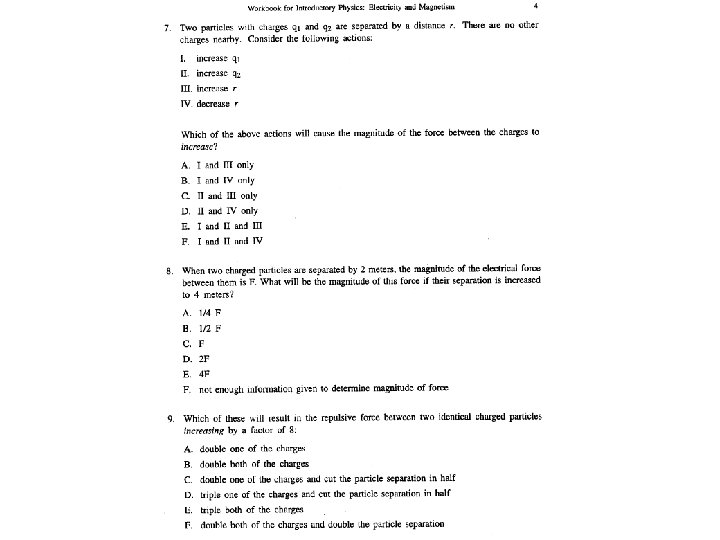
Many question variants are possible • Minor alterations to question can generate provocative change in context – add/subtract/change system elements (force, resistance, etc. ) • Use standard questioning paradigms: – greater than, less than, equal to – increase, decrease, remain the same – left, right, up, down, in, out
Many question variants are possible • Minor alterations to question can generate provocative change in context. – add/subtract/change system elements (force, resistance, etc. ) • Use standard questioning paradigms: – greater than, less than, equal to – increase, decrease, remain the same – left, right, up, down, in, out
Many question variants are possible • Minor alterations to question can generate provocative change in context. – add/subtract/change system elements (force, resistance, etc. ) • Use standard questioning paradigms: – greater than, less than, equal to – increase, decrease, remain the same – left, right, up, down, in, out
Many question variants are possible • Minor alterations to question can generate provocative change in context. – add/subtract/change system elements (force, resistance, etc. ) • Use standard questioning paradigms: – greater than, less than, equal to – increase, decrease, remain the same – left, right, up, down, in, out
Many question variants are possible • Minor alterations to question can generate provocative change in context. – add/subtract/change system elements (force, resistance, etc. ) • Use standard questioning paradigms: – greater than, less than, equal to – increase, decrease, remain the same – left, right, up, down, in, out
Many question variants are possible • Minor alterations to question can generate provocative change in context. – add/subtract/change system elements (force, resistance, etc. ) • Use standard questioning paradigms: – greater than, less than, equal to – increase, decrease, remain the same – left, right, up, down, in, out
Many question variants are possible • Minor alterations to question can generate provocative change in context. – add/subtract/change system elements (force, resistance, etc. ) • Use standard questioning paradigms: – greater than, less than, equal to – increase, decrease, remain the same – left, right, up, down, in, out
Instructor must be prepared to use diverse questioning strategies • If discussion dead-ends due to student confusion, might need to backtrack to material already covered. • If one questioning sequence is not successful, an alternate sequence may be helpful. • Instructor can solicit suggested answers from students and build discussion on those.
Instructor must be prepared to use diverse questioning strategies • If discussion dead-ends due to student confusion, might need to backtrack to material already covered. • If one questioning sequence is not successful, an alternate sequence may be helpful. • Instructor can solicit suggested answers from students and build discussion on those.
Instructor must be prepared to use diverse questioning strategies • If discussion dead-ends due to student confusion, might need to backtrack to material already covered. • If one questioning sequence is not successful, an alternate sequence may be helpful. • Instructor can solicit suggested answers from students and build discussion on those.
Instructor must be prepared to use diverse questioning strategies • If discussion dead-ends due to student confusion, might need to backtrack to material already covered. • If one questioning sequence is not successful, an alternate sequence may be helpful. • Instructor can solicit suggested answers from students and build discussion on those.
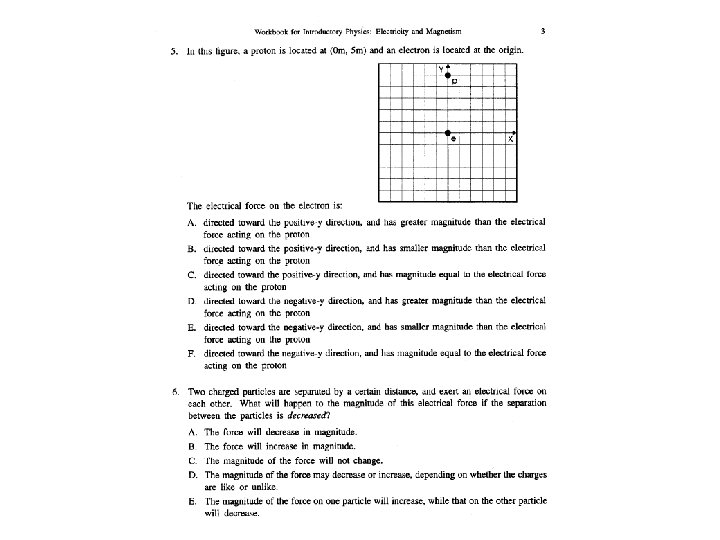
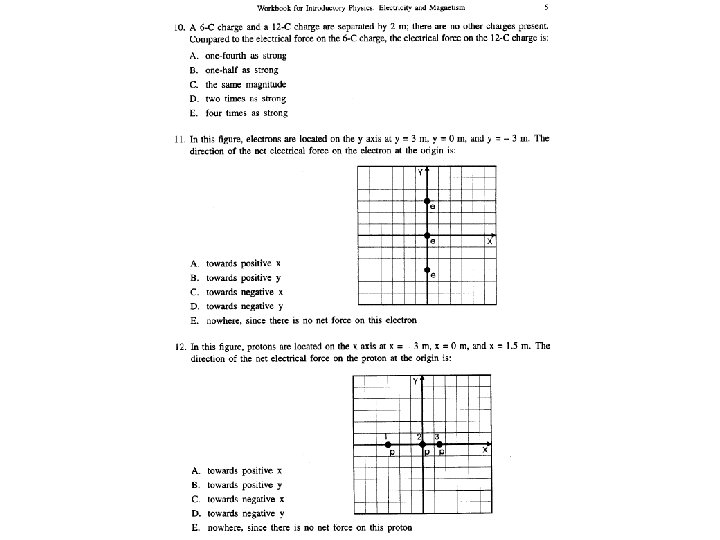
Interactive Question Sequence • Set of closely related questions addressing diverse aspects of single concept • Progression from easy to hard questions • Use multiple representations (diagrams, words, equations, graphs, etc. ) • Emphasis on qualitative, not quantitative questions, to reduce “equation-matching” behavior and promote deeper thinking
Interactive Question Sequence • Set of closely related questions addressing diverse aspects of single concept • Progression from easy to hard questions • Use multiple representations (diagrams, words, equations, graphs, etc. ) • Emphasis on qualitative, not quantitative questions, to reduce “equation-matching” behavior and promote deeper thinking
Interactive Question Sequence • Set of closely related questions addressing diverse aspects of single concept • Progression from easy to hard questions • Use multiple representations (diagrams, words, equations, graphs, etc. ) • Emphasis on qualitative, not quantitative questions, to reduce “equation-matching” behavior and promote deeper thinking
Interactive Question Sequence • Set of closely related questions addressing diverse aspects of single concept • Progression from easy to hard questions • Use multiple representations (diagrams, words, equations, graphs, etc. ) • Emphasis on qualitative, not quantitative questions, to reduce “equation-matching” behavior and promote deeper thinking
Interactive Question Sequence • Set of closely related questions addressing diverse aspects of single concept • Progression from easy to hard questions • Use multiple representations (diagrams, words, equations, graphs, etc. ) • Emphasis on qualitative, not quantitative questions, to reduce “equation-matching” behavior and promote deeper thinking
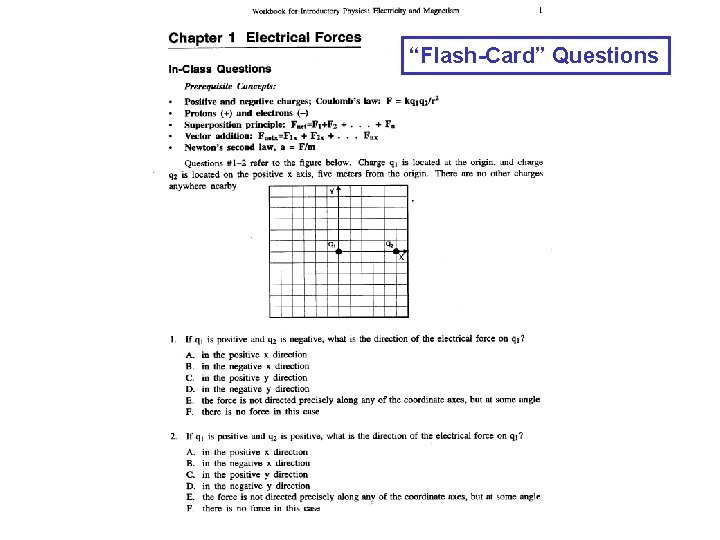
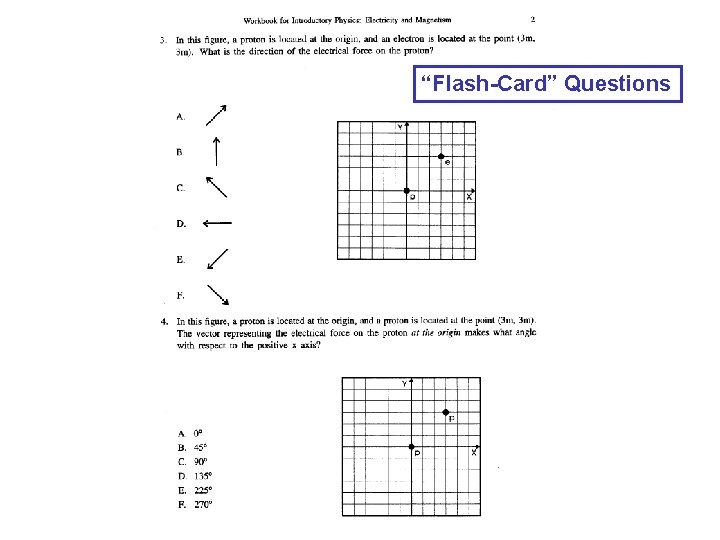
“Flash-Card” Questions
“Flash-Card” Questions
Problem “Dissection” Technique • Decompose complicated problem into conceptual elements • Work through problem step by step, with continual feedback from and interaction with the students • May be applied to both qualitative and quantitative problems Example: Electrostatic Forces
Problem “Dissection” Technique • Decompose complicated problem into conceptual elements • Work through problem step by step, with continual feedback from and interaction with the students • May be applied to both qualitative and quantitative problems Example: Electrostatic Forces
Problem “Dissection” Technique • Decompose complicated problem into conceptual elements • Work through problem step by step, with continual feedback from and interaction with the students • May be applied to both qualitative and quantitative problems Example: Electrostatic Forces
Problem “Dissection” Technique • Decompose complicated problem into conceptual elements • Work through problem step by step, with continual feedback from and interaction with the students • May be applied to both qualitative and quantitative problems Example: Electrostatic Forces
Problem “Dissection” Technique • Decompose complicated problem into conceptual elements • Work through problem step by step, with continual feedback from and interaction with the students • May be applied to both qualitative and quantitative problems Example: Electrostatic Forces
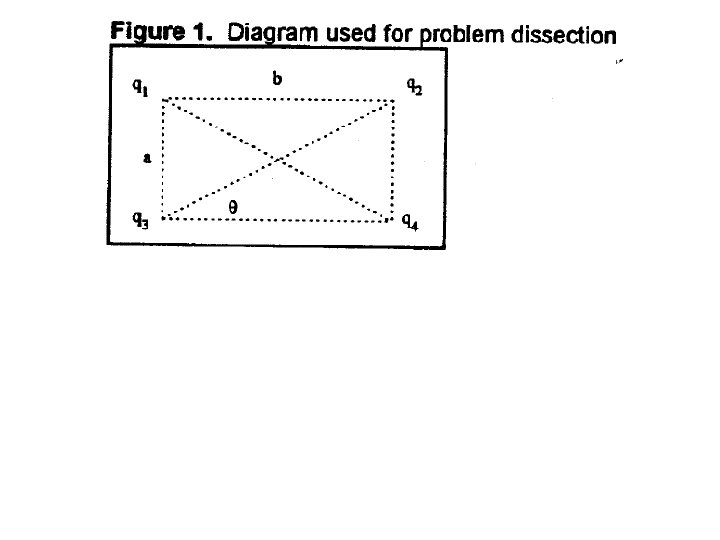
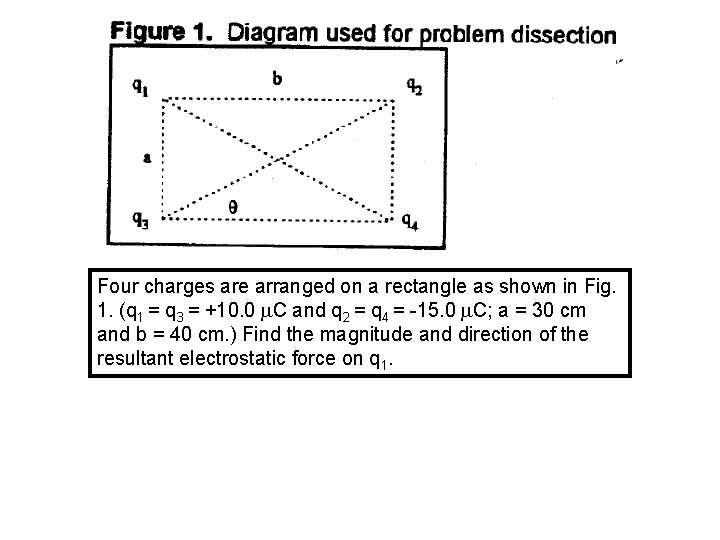
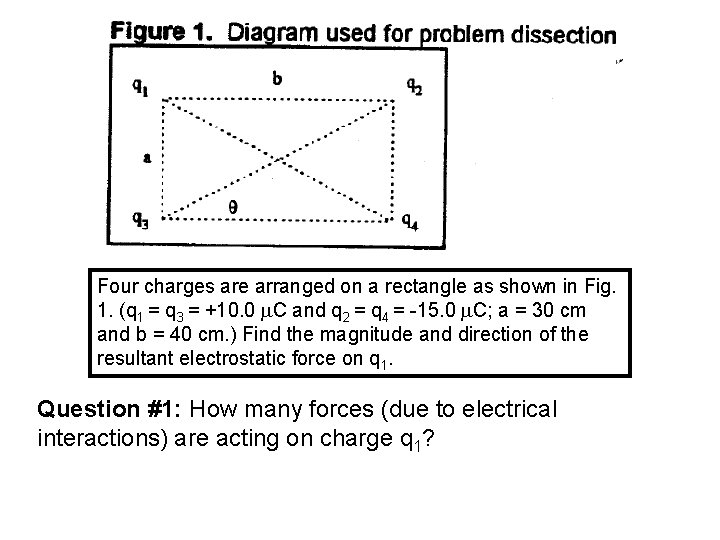
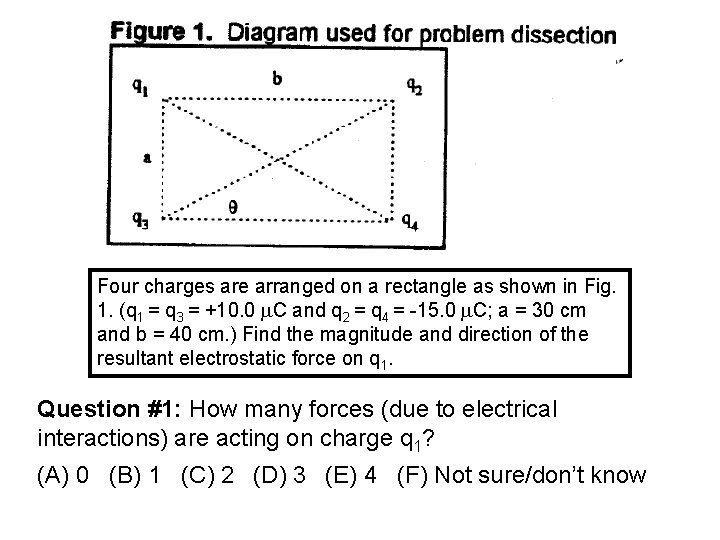
Four charges are arranged on a rectangle as shown in Fig. 1. (q 1 = q 3 = +10. 0 C and q 2 = q 4 = -15. 0 C; a = 30 cm and b = 40 cm. ) Find the magnitude and direction of the resultant electrostatic force on q 1. Question #1: How many forces (due to electrical ff interactions) are acting on charge q 1? (A) 0 (B) 1 (C) 2 (D) 3 (E) 4 (F) Not sure/don’t know
Four charges are arranged on a rectangle as shown in Fig. 1. (q 1 = q 3 = +10. 0 C and q 2 = q 4 = -15. 0 C; a = 30 cm and b = 40 cm. ) Find the magnitude and direction of the resultant electrostatic force on q 1. Question #1: How many forces (due to electrical ff interactions) are acting on charge q 1? (A) 0 (B) 1 (C) 2 (D) 3 (E) 4 (F) Not sure/don’t know
Four charges are arranged on a rectangle as shown in Fig. 1. (q 1 = q 3 = +10. 0 C and q 2 = q 4 = -15. 0 C; a = 30 cm and b = 40 cm. ) Find the magnitude and direction of the resultant electrostatic force on q 1. Question #1: How many forces (due to electrical ff interactions) are acting on charge q 1? (A) 0 (B) 1 (C) 2 (D) 3 (E) 4 (F) Not sure/don’t know
Four charges are arranged on a rectangle as shown in Fig. 1. (q 1 = q 3 = +10. 0 C and q 2 = q 4 = -15. 0 C; a = 30 cm and b = 40 cm. ) Find the magnitude and direction of the resultant electrostatic force on q 1. Question #1: How many forces (due to electrical ff interactions) are acting on charge q 1? (A) 0 (B) 1 (C) 2 (D) 3 (E) 4 (F) Not sure/don’t know
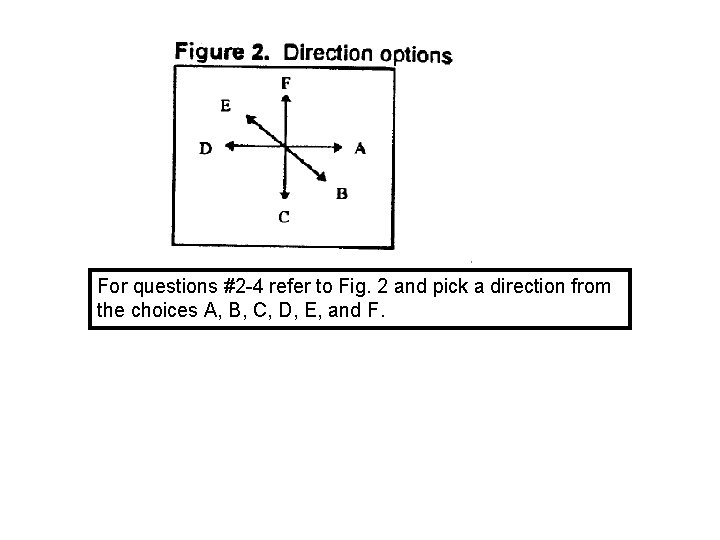
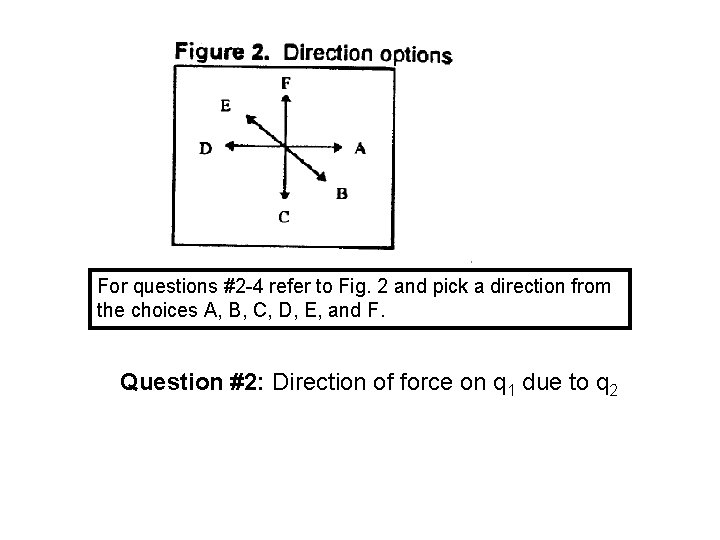
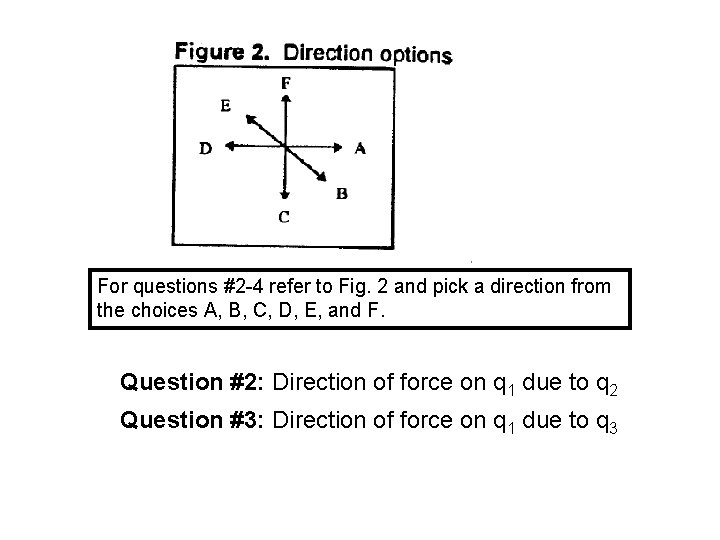
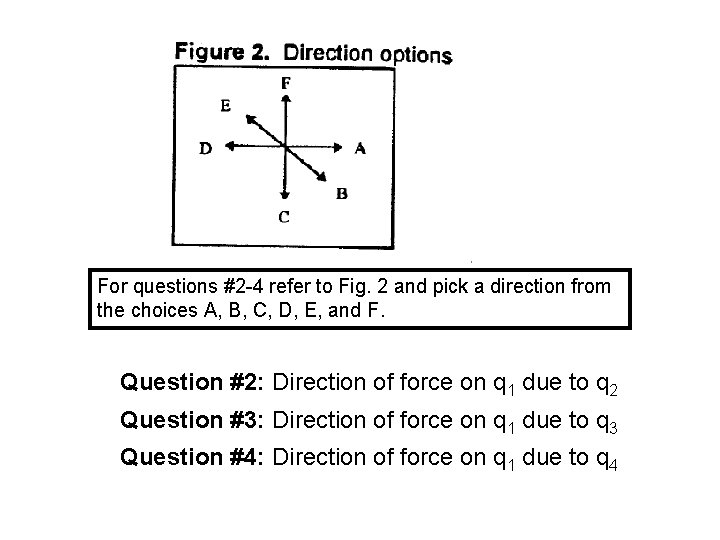
For questions #2 -4 refer to Fig. 2 and pick a direction from the choices A, B, C, D, E, and F. Question #2: Direction of force on q 1 due to q 2 Question #3: Direction of force on q 1 due to q 3 Question #4: Direction of force on q 1 due to q 4
For questions #2 -4 refer to Fig. 2 and pick a direction from the choices A, B, C, D, E, and F. Question #2: Direction of force on q 1 due to q 2 Question #3: Direction of force on q 1 due to q 3 Question #4: Direction of force on q 1 due to q 4
For questions #2 -4 refer to Fig. 2 and pick a direction from the choices A, B, C, D, E, and F. Question #2: Direction of force on q 1 due to q 2 Question #3: Direction of force on q 1 due to q 3 Question #4: Direction of force on q 1 due to q 4
For questions #2 -4 refer to Fig. 2 and pick a direction from the choices A, B, C, D, E, and F. Question #2: Direction of force on q 1 due to q 2 Question #3: Direction of force on q 1 due to q 3 Question #4: Direction of force on q 1 due to q 4
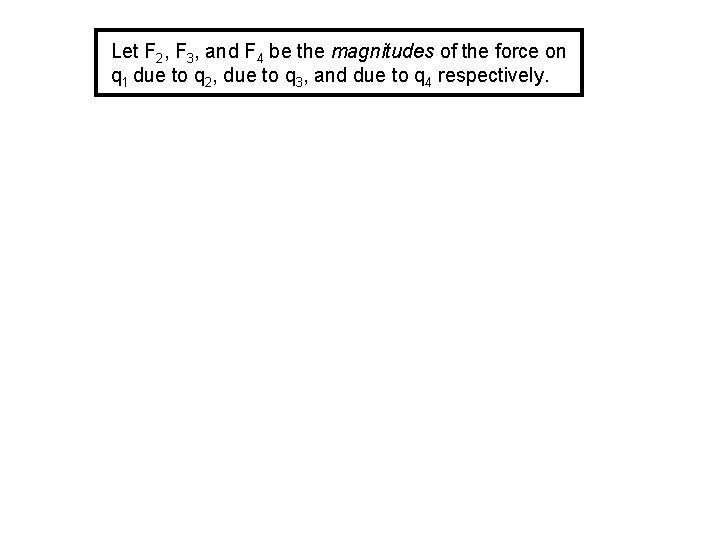
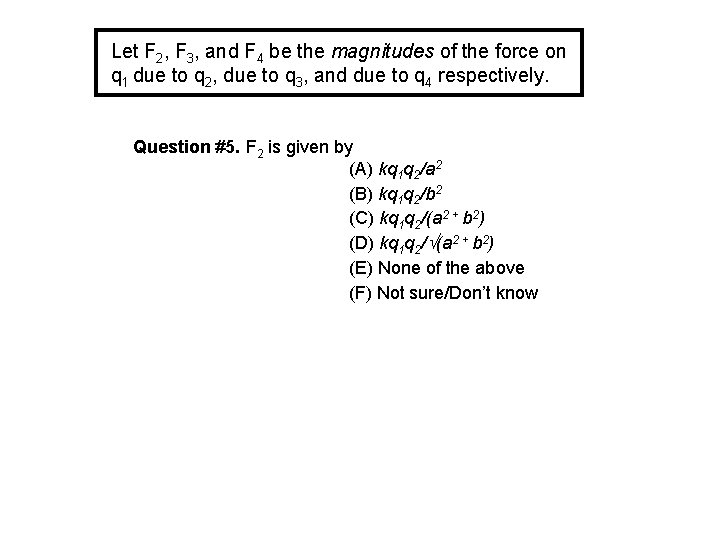
Let F 2, F 3, and F 4 be the magnitudes of the force on q 1 due to q 2, due to q 3, and due to q 4 respectively. Question #5. F 2 is given by (A) kq 1 q 2/a 2 (B) kq 1 q 2/b 2 (C) kq 1 q 2/(a 2 + b 2) (D) kq 1 q 2/ (a 2 + b 2) (E) None of the above (F) Not sure/Don’t know Question #6. F 3 is given by (A) kq 1 q 3/a 2 (B) kq 1 q 3/b 2 (C) kq 1 q 3/(a 2 + b 2) (D) kq 1 q 3/ (a 2 + b 2) (E) None of the above (F) Not sure/Don’t know
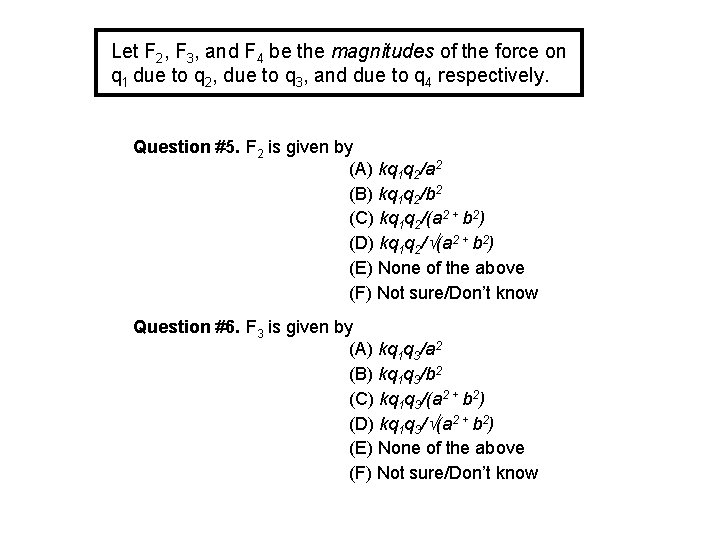
Let F 2, F 3, and F 4 be the magnitudes of the force on q 1 due to q 2, due to q 3, and due to q 4 respectively. Question #5. F 2 is given by (A) kq 1 q 2/a 2 (B) kq 1 q 2/b 2 (C) kq 1 q 2/(a 2 + b 2) (D) kq 1 q 2/ (a 2 + b 2) (E) None of the above (F) Not sure/Don’t know Question #6. F 3 is given by (A) kq 1 q 3/a 2 (B) kq 1 q 3/b 2 (C) kq 1 q 3/(a 2 + b 2) (D) kq 1 q 3/ (a 2 + b 2) (E) None of the above (F) Not sure/Don’t know
Let F 2, F 3, and F 4 be the magnitudes of the force on q 1 due to q 2, due to q 3, and due to q 4 respectively. Question #5. F 2 is given by (A) kq 1 q 2/a 2 (B) kq 1 q 2/b 2 (C) kq 1 q 2/(a 2 + b 2) (D) kq 1 q 2/ (a 2 + b 2) (E) None of the above (F) Not sure/Don’t know Question #6. F 3 is given by (A) kq 1 q 3/a 2 (B) kq 1 q 3/b 2 (C) kq 1 q 3/(a 2 + b 2) (D) kq 1 q 3/ (a 2 + b 2) (E) None of the above (F) Not sure/Don’t know
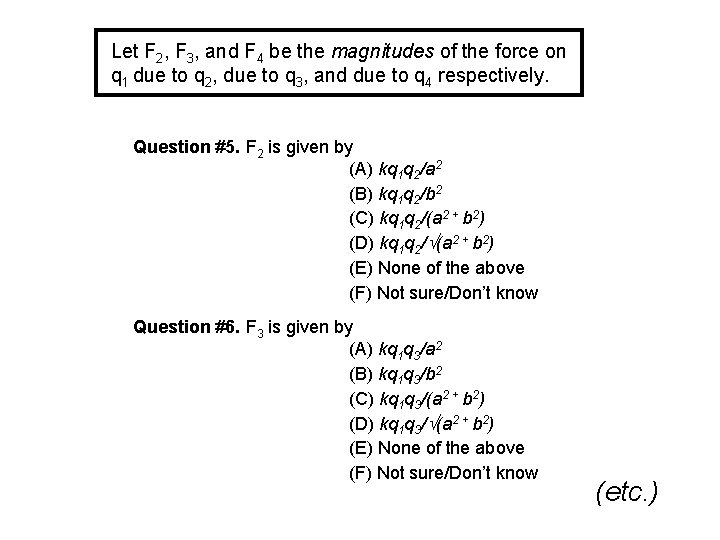
Let F 2, F 3, and F 4 be the magnitudes of the force on q 1 due to q 2, due to q 3, and due to q 4 respectively. Question #5. F 2 is given by (A) kq 1 q 2/a 2 (B) kq 1 q 2/b 2 (C) kq 1 q 2/(a 2 + b 2) (D) kq 1 q 2/ (a 2 + b 2) (E) None of the above (F) Not sure/Don’t know Question #6. F 3 is given by (A) kq 1 q 3/a 2 (B) kq 1 q 3/b 2 (C) kq 1 q 3/(a 2 + b 2) (D) kq 1 q 3/ (a 2 + b 2) (E) None of the above (F) Not sure/Don’t know (etc. )