
Large Scale Sky Computing Applications with Nimbus Pierre
Large Scale Sky Computing Applications with Nimbus Pierre Riteau Université de Rennes 1, IRISA INRIA Rennes – Bretagne Atlantique Rennes, France Pierre. Riteau@irisa. fr
INTRODUCTION TO SKY COMPUTING
Iaa. S clouds • On demand/elastic model • Pay as you go • Access to virtual machines with administrator privileges – Portable execution stack • Commercial providers – Amazon EC 2 => “infinite” resource pool (e. g. 10 K cores) • Scientific clouds => limited number of resources – Science Clouds – Future. Grid Nimbus clouds UMR IRISA
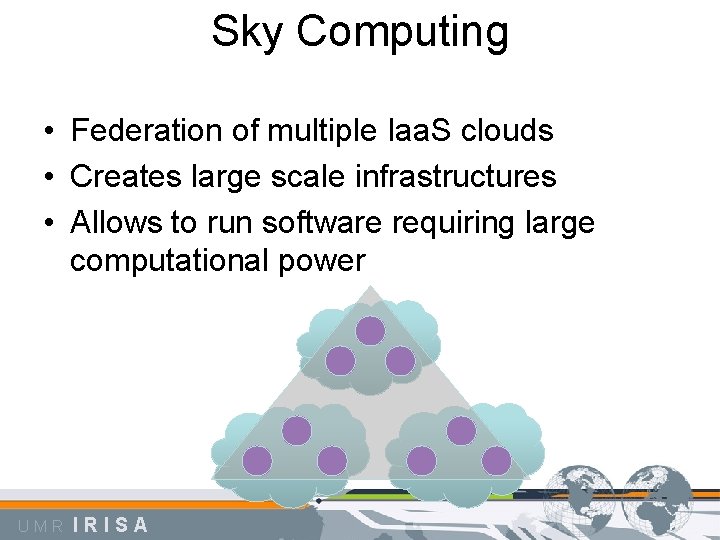
Sky Computing • Federation of multiple Iaa. S clouds • Creates large scale infrastructures • Allows to run software requiring large computational power UMR IRISA
Sky Computing Benefits • Single networking context – All-to-all connectivity • Single security context – Trust between all entities • Equivalent to local cluster – Compatible with legacy code UMR IRISA
LARGE-SCALE SKY COMPUTING EXPERIMENTS
Sky Computing Toolkit • Nimbus – Resource management – Contextualization (Context Broker) • Vi. Ne – All-to-all connectivity • Hadoop – Task distribution – Fault tolerance – Resource dynamicity UMR IRISA
Context Broker • Service to configure a complete cluster with different roles • Supports clusters distributed on multiple clouds (e. g. Nimbus and Amazon EC 2) • VMs contact the context broker to – Learn their role – Learn about other VMs in the cluster • Ex. : Hadoop master + Hadoop slaves • Hadoop slaves configured to contact the master • Hadoop master configured to know the slaves UMR IRISA
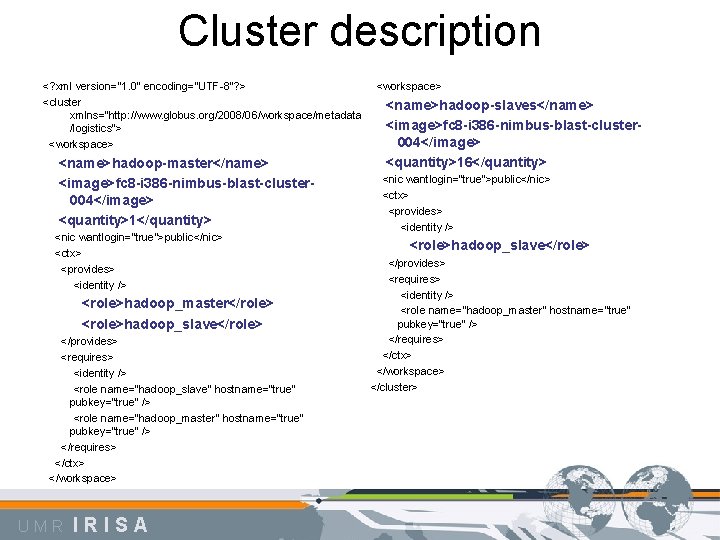
Cluster description <? xml version="1. 0" encoding="UTF-8"? > <cluster xmlns="http: //www. globus. org/2008/06/workspace/metadata /logistics"> <workspace> <name>hadoop-master</name> <image>fc 8 -i 386 -nimbus-blast-cluster 004</image> <quantity>1</quantity> <nic wantlogin="true">public</nic> <ctx> <provides> <identity /> <role>hadoop_master</role> <role>hadoop_slave</role> </provides> <requires> <identity /> <role name="hadoop_slave" hostname="true" pubkey="true" /> <role name="hadoop_master" hostname="true" pubkey="true" /> </requires> </ctx> </workspace> UMR IRISA <workspace> <name>hadoop-slaves</name> <image>fc 8 -i 386 -nimbus-blast-cluster 004</image> <quantity>16</quantity> <nic wantlogin="true">public</nic> <ctx> <provides> <identity /> <role>hadoop_slave</role> </provides> <requires> <identity /> <role name="hadoop_master" hostname="true" pubkey="true" /> </requires> </ctx> </workspace> </cluster>
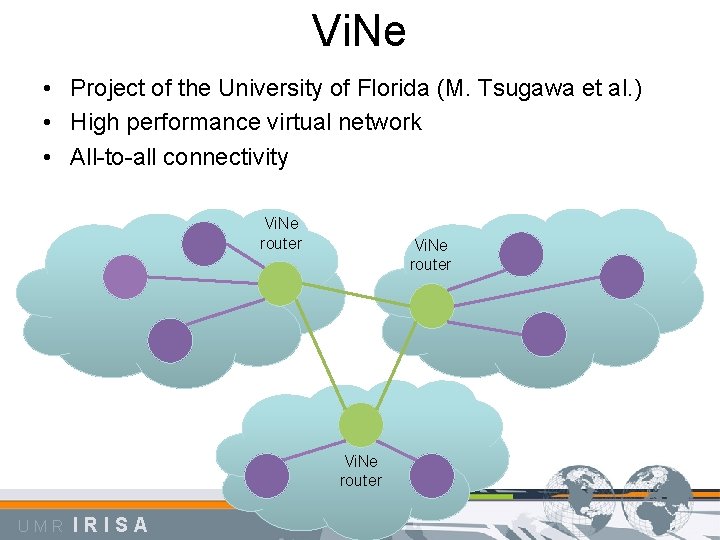
Vi. Ne • Project of the University of Florida (M. Tsugawa et al. ) • High performance virtual network • All-to-all connectivity Vi. Ne router UMR IRISA
Hadoop • • • UMR Open-source Map. Reduce implementation Heavy industrial use (Yahoo, Facebook…) Efficient framework for distribution of tasks Built-in fault-tolerance Distributed file system (HDFS) IRISA
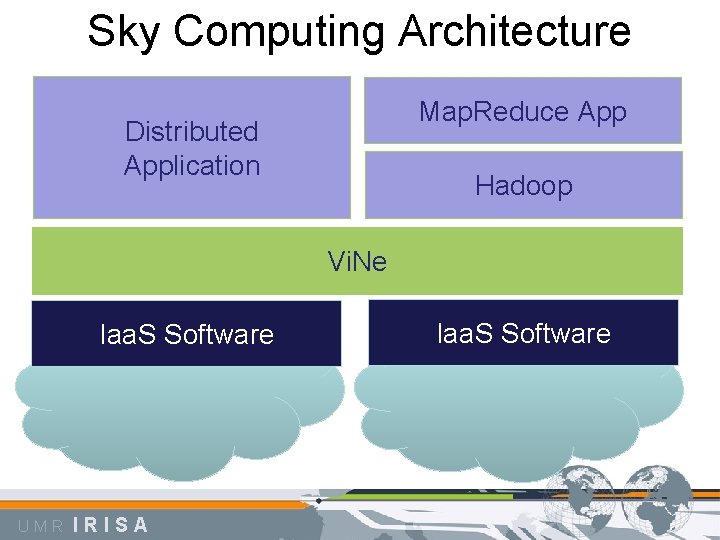
Sky Computing Architecture Map. Reduce App Distributed Application Hadoop Vi. Ne Iaa. S Software UMR IRISA Iaa. S Software
Grid’ 5000 Overview • • Distributed over 9 sites in France ~1500 nodes, ~5500 CPUs Study of large scale parallel/distributed systems Features – Highly reconfigurable • Environment deployment over bare hardware • Can deploy many different Linux distributions • Even other OS such as Free. BSD – Controlable – Monitorable (metrics access) • Experiments on all layers – network, OS, middleware, applications UMR IRISA
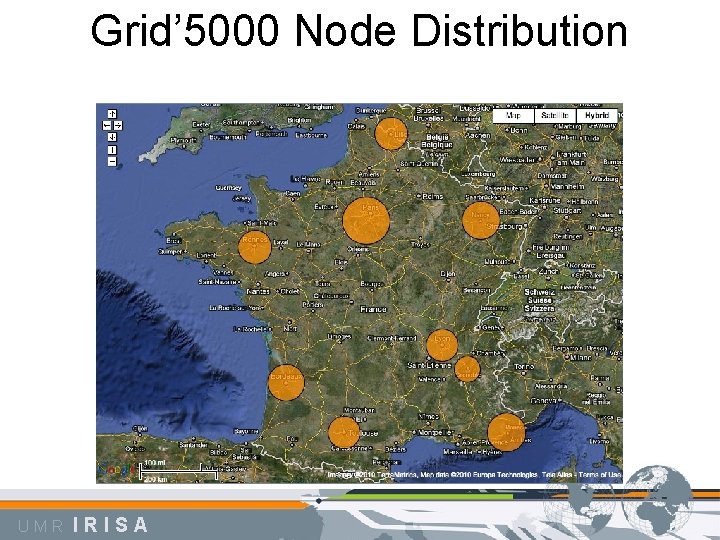
Grid’ 5000 Node Distribution UMR IRISA
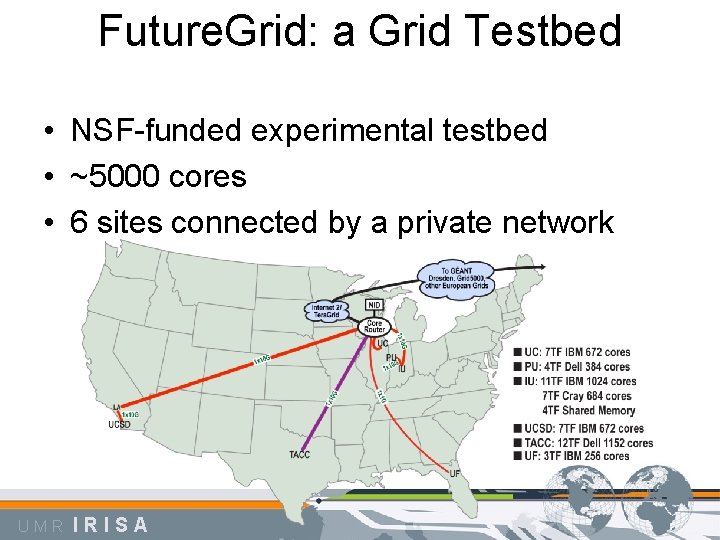
Future. Grid: a Grid Testbed • NSF-funded experimental testbed • ~5000 cores • 6 sites connected by a private network UMR IRISA
Resources used in Sky Computing Experiments • 3 Future. Grid sites (US) with Nimbus installations – UCSD (San Diego) – UF (Florida) – UC (Chicago) • Grid’ 5000 sites (France) – Lille (contains a white-listed gateway to Future. Grid) – Rennes, Sophia, Nancy, etc. • Grid’ 5000 is fully isolated from the Internet – One machine white-listed to access Future. Grid – Vi. Ne queue VR (Virtual Router) for other sites UMR IRISA
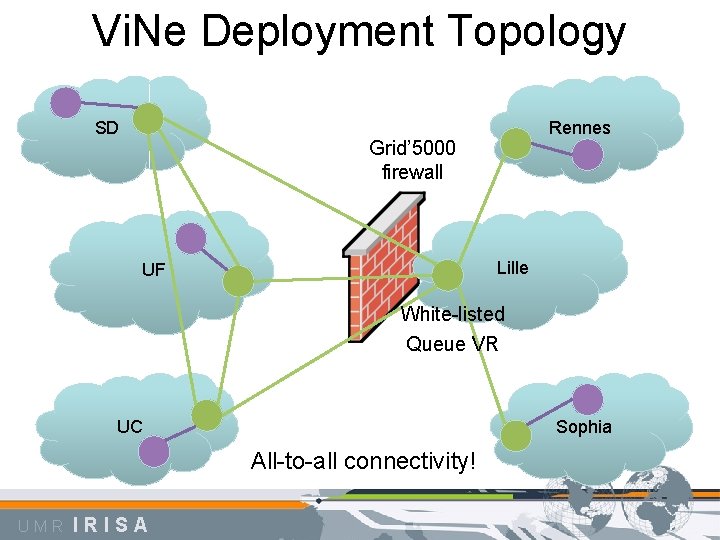
Vi. Ne Deployment Topology SD Rennes Grid’ 5000 firewall Lille UF White-listed Queue VR UC Sophia All-to-all connectivity! UMR IRISA
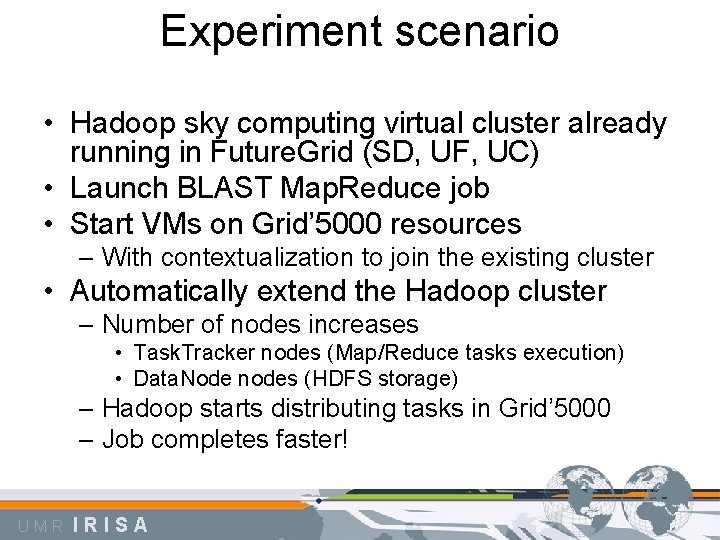
Experiment scenario • Hadoop sky computing virtual cluster already running in Future. Grid (SD, UF, UC) • Launch BLAST Map. Reduce job • Start VMs on Grid’ 5000 resources – With contextualization to join the existing cluster • Automatically extend the Hadoop cluster – Number of nodes increases • Task. Tracker nodes (Map/Reduce tasks execution) • Data. Node nodes (HDFS storage) – Hadoop starts distributing tasks in Grid’ 5000 – Job completes faster! UMR IRISA
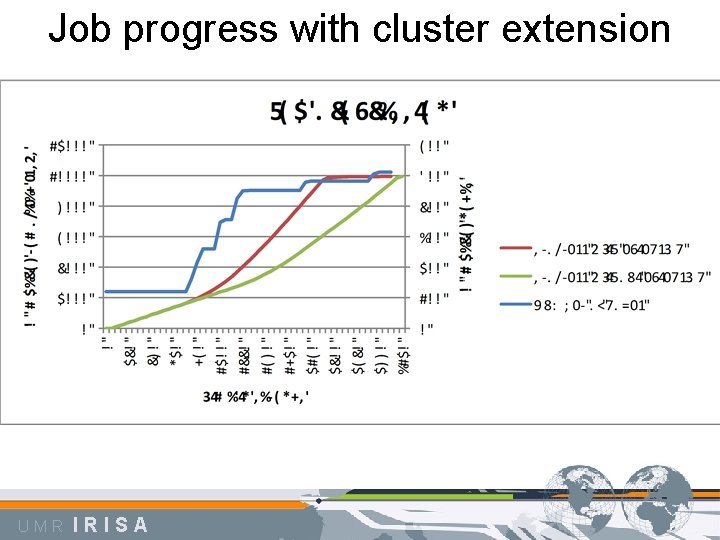
Job progress with cluster extension UMR IRISA
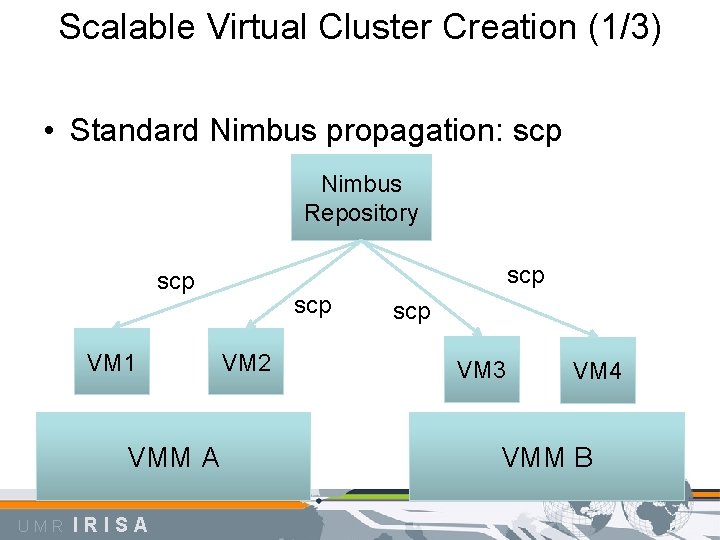
Scalable Virtual Cluster Creation (1/3) • Standard Nimbus propagation: scp Nimbus Repository scp VM 1 VMM A UMR IRISA scp VM 2 scp VM 3 VM 4 VMM B
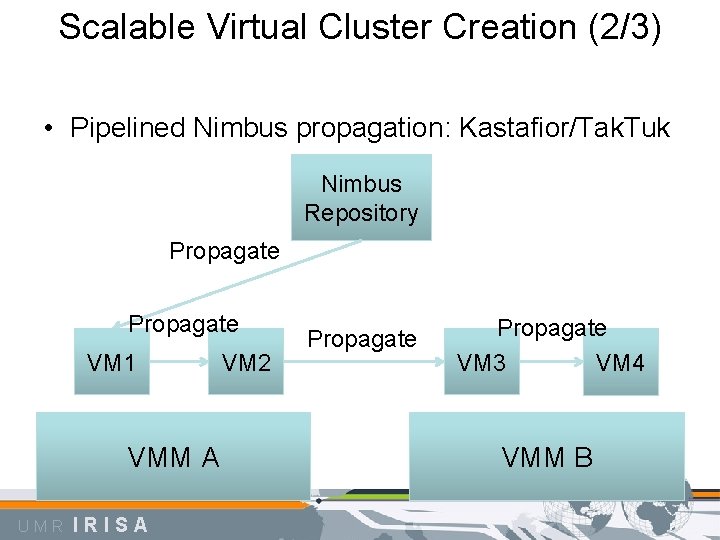
Scalable Virtual Cluster Creation (2/3) • Pipelined Nimbus propagation: Kastafior/Tak. Tuk Nimbus Repository Propagate VM 1 VMM A UMR IRISA VM 2 Propagate VM 3 VM 4 VMM B
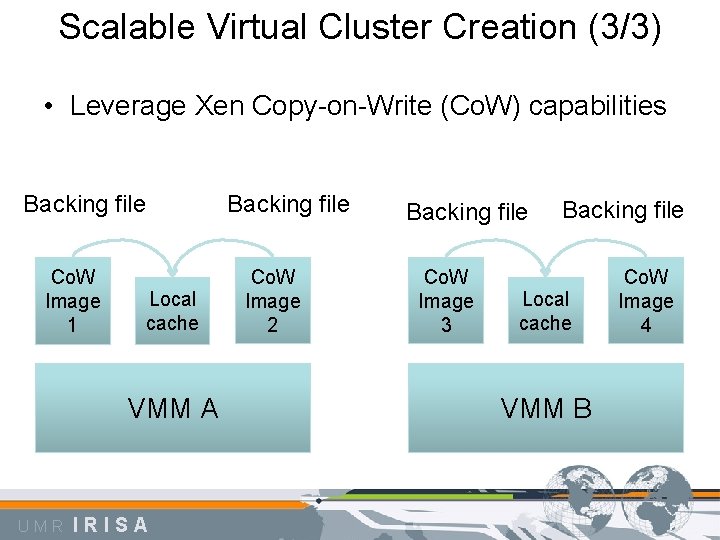
Scalable Virtual Cluster Creation (3/3) • Leverage Xen Copy-on-Write (Co. W) capabilities Backing file Co. W Image 1 Local cache VMM A UMR IRISA Backing file Co. W Image 2 Backing file Co. W Image 3 Backing file Local cache VMM B Co. W Image 4
UMR IRISA

CONCLUSION
Conclusion • Sky Computing to create large scale distributed infrastructures • Our approach relies on – Nimbus for resource management, contextualization and fast cluster instantiation – Vi. Ne for all-to-all connectivity – Hadoop for dynamic cluster extension • Provides both infrastructure and application elasticity UMR IRISA
Ongoing & Future Works • Elastic Map. Reduce implementation leveraging Sky Computing infrastructures (presented at CCA ‘ 11) • Migration support in Nimbus – Leverage spot instances in Nimbus UMR IRISA
Acknowledgments • Tim Freeman, John Bresnahan, Kate Keahey, David La. Bissoniere (Argonne/University of Chicago) • Maurício Tsugawa, Andréa Matsunaga, José Fortes (University of Florida) • Thierry Priol, Christine Morin (INRIA) UMR IRISA

THANK YOU! QUESTIONS?
- Slides: 28