
Large scale objectscene recognition Image dataset 1 million
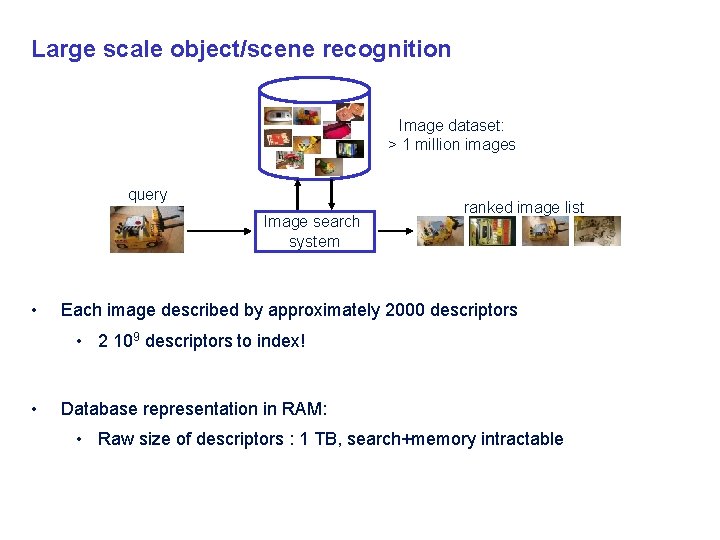
Large scale object/scene recognition Image dataset: > 1 million images query Image search system • ranked image list Each image described by approximately 2000 descriptors • 2 109 descriptors to index! • Database representation in RAM: • Raw size of descriptors : 1 TB, search+memory intractable
![State-of-the-art: Bag-of-words [Sivic & Zisserman’ 03] Query image Set of SIFT descriptors centroids (visual](http://slidetodoc.com/presentation_image_h/b398f5fae72cb8e7f72b9c6c794687e9/image-2.jpg "State-of-the-art: Bag-of-words [Sivic & Zisserman’ 03] Query image Set of SIFT descriptors centroids (visual")
State-of-the-art: Bag-of-words [Sivic & Zisserman’ 03] Query image Set of SIFT descriptors centroids (visual words) [Nister & al 04, Chum & al 07] sparse frequency vector Bag-of-features processing +tf-idf weighting Hessian-Affine regions + SIFT descriptors [Mikolajezyk & Schmid 04] [Lowe 04] Two issues: Inverted file querying - Matching approximation by visual words - Still limited number of images Re-ranked list Geometric verification [Lowe 04, Chum & al 2007] ranked image short-list

Bag-of-features as an ANN search algorithm • Matching function of descriptors : k-nearest neighbors • Bag-of-features matching function where q(x) is a quantizer, i. e. , assignment to visual word and δa, b is the Kronecker operator (δa, b=1 iff a=b)

Approximate nearest neighbor search evaluation • ANN algorithms usually returns a short-list of nearest neighbors • this short-list is supposed to contain the NN with high probability • exact search may be performed to re-order this short-list • Proposed quality evaluation of ANN search: trade-off between • Accuracy: NN recall = probability that the NN is in this list against • Ambiguity removal = proportion of vectors in the short-list • the lower this proportion, the more information we have about the vector • the lower this proportion, the lower the complexity if we perform exact search on the short-list • ANN search algorithms usually have some parameters to handle this trade-off

ANN evaluation of bag-of-features 0. 7 ANN algorithms returns a list of potential neighbors k=100 0. 6 200 0. 5 Accuracy: NN recall = probability that the NN is in this list 500 NN recall 1000 0. 4 2000 Ambiguity removal: = proportion of vectors in the short-list 5000 0. 3 10000 20000 30000 50000 0. 2 In BOF, this trade-off is managed by the number of clusters k 0. 1 0 1 e-07 BOW 1 e-06 1 e-05 0. 0001 0. 001 rate of points retrieved 0. 01 0. 1
Problem with bag-of-features • • The intrinsic matching scheme performed by BOF is weak • for a “small” visual dictionary: too many false matches • for a “large” visual dictionary: many true matches are missed No good trade-off between “small” and “large” ! • either the Voronoi cells are too big • or these cells can’t absorb the descriptor noise intrinsic approximate nearest neighbor search of BOF is not sufficient

20 K visual word: false matchs
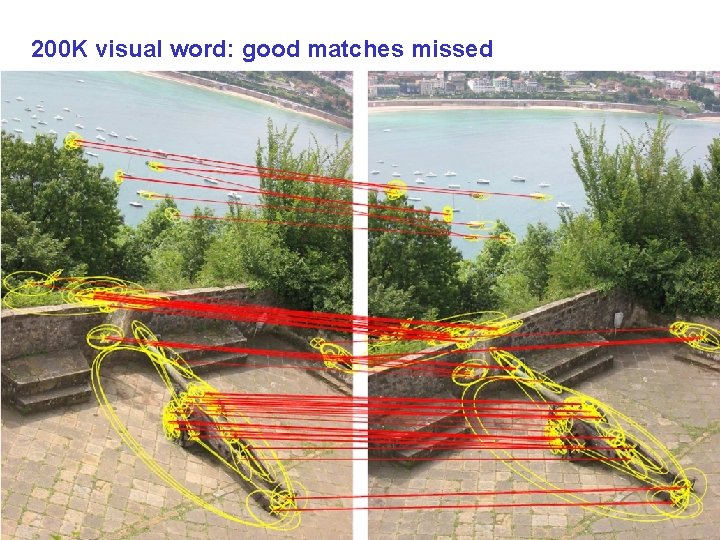
200 K visual word: good matches missed
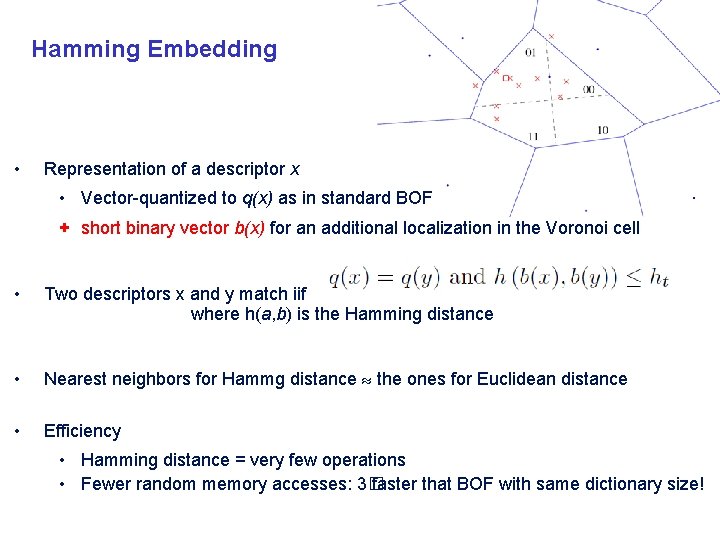
Hamming Embedding • Representation of a descriptor x • Vector-quantized to q(x) as in standard BOF + short binary vector b(x) for an additional localization in the Voronoi cell • Two descriptors x and y match iif where h(a, b) is the Hamming distance • Nearest neighbors for Hammg distance the ones for Euclidean distance • Efficiency • Hamming distance = very few operations • Fewer random memory accesses: 3� faster that BOF with same dictionary size!

Hamming Embedding • Off-line (given a quantizer) • draw an orthogonal projection matrix P of size db × d this defines db random projection directions • for each Voronoi cell and projection direction, compute the median value from a learning set • On-line: compute the binary signature b(x) of a given descriptor • project x onto the projection directions as z(x) = (z 1, …zdb) • bi(x) = 1 if zi(x) is above the learned median value, otherwise 0 [H. Jegou et al. , Improving bag of features for large scale image search, ICJV’ 10]

Hamming and Euclidean neighborhood • 0. 8 trade-off between memory usage and accuracy in g (r a nd om ) more bits yield higher accuracy fil t er 0. 6 de sc r ip to r We used 64 bits (8 bytes) itr ar y 0. 4 ar b rate of 5 -NN retrieved (recall) 1 0. 2 0 8 bits 16 bits 32 bits 64 bits 128 bits 0 0. 2 0. 4 0. 6 0. 8 rate of cell points retrieved 1

ANN evaluation of Hamming Embedding 0. 7 28 32 24 0. 6 22 200 compared to BOW: at least 10 times less points in the short-list for the same level of accuracy 20 0. 5 500 1000 18 NN recall k=100 0. 4 2000 ht=16 0. 3 Hamming Embedding provides a much better trade-off between recall and ambiguity removal 5000 10000 20000 30000 50000 0. 2 0. 1 0 1 e-08 HE+BOW 1 e-07 1 e-06 1 e-05 0. 0001 0. 001 rate of points retrieved 0. 01 0. 1

Matching points - 20 k word vocabulary 201 matches Many matches with the non-corresponding image! 240 matches
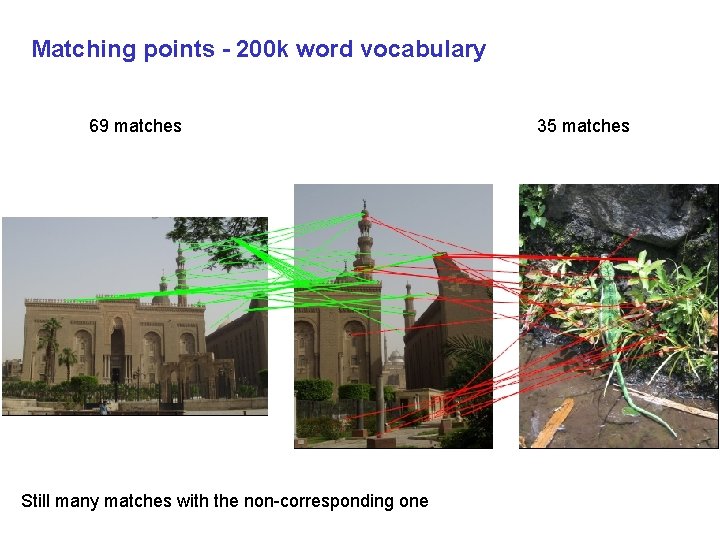
Matching points - 200 k word vocabulary 69 matches Still many matches with the non-corresponding one 35 matches

Matching points - 20 k word vocabulary + HE 83 matches 10 x more matches with the corresponding image! 8 matches

Weak geometry consistency Re-ranking based on full geometric verification [Lowe 04, Chum & al 2007] • works very well • but performed on a short-list only (typically, 100 images) for very large datasets, the number of distracting images is so high that relevant images are not even short-listed! 1 rate of relevant images short-listed • short-list size: 0. 9 20 images 100 images 0. 8 1000 images 0. 7 0. 6 0. 5 0. 4 0. 3 0. 2 0. 1 0 10000 dataset size 1000000
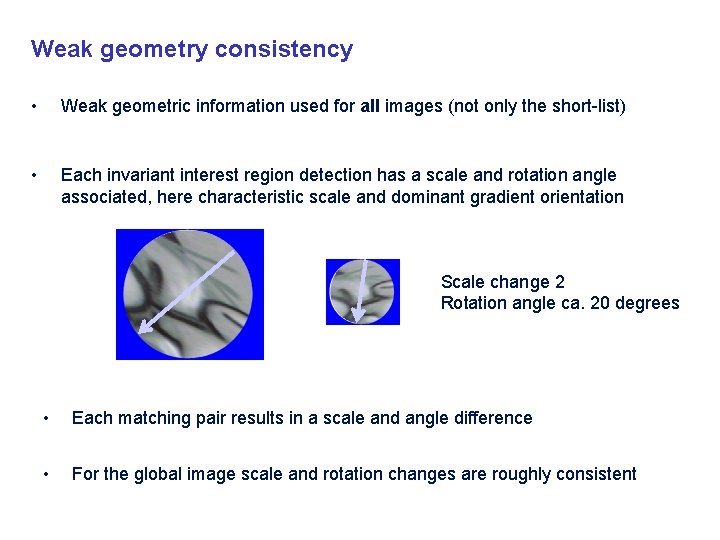
Weak geometry consistency • Weak geometric information used for all images (not only the short-list) • Each invariant interest region detection has a scale and rotation angle associated, here characteristic scale and dominant gradient orientation Scale change 2 Rotation angle ca. 20 degrees • Each matching pair results in a scale and angle difference • For the global image scale and rotation changes are roughly consistent

WGC: orientation consistency Max = rotation angle between images

WGC: scale consistency
Weak geometry consistency • Integrate the geometric verification into the BOF representation • votes for an image projected onto two quantized subspaces, that is vote for an image at a given angle & scale • these subspace are show to be independent • a score sj for all quantized angle and scale differences for each image • final score: filtering for each parameter (angle and scale) and min selection • Only matches that do agree with the main difference of orientation and scale will be taken into account in the final score • Re-ranking using full geometric transformation still adds information in a final stage
Experimental results • Evaluation for the INRIA holidays dataset, 1491 images • 500 query images + 991 annotated true positives • Most images are holiday photos of friends and family • 1 million & 10 million distractor images from Flickr • Vocabulary construction on a different Flickr set • Almost real-time search speed • Evaluation metric: mean average precision (in [0, 1], bigger = better) • Average over precision/recall curve

Holiday dataset – example queries

Dataset : Venice Channel Query Base 1 Base 3 Base 2 Base 4

Dataset : San Marco square Query Base 1 Base 4 Base 5 Base 8 Base 9 Base 2 Base 6 Base 3 Base 7

Example distractors - Flickr

Experimental evaluation • Evaluation on our holidays dataset, 500 query images, 1 million distracter images • Metric: mean average precision (in [0, 1], bigger = better) 1 baseline 0. 9 0. 8 HE +re-ranking 0. 7 m. AP 0. 6 0. 5 0. 4 0. 3 0. 2 0. 1 0 100000 database size 1000000

Query BOF 2 Ours 1 BOF 5890 Ours 4 BOF 43064 Ours 5
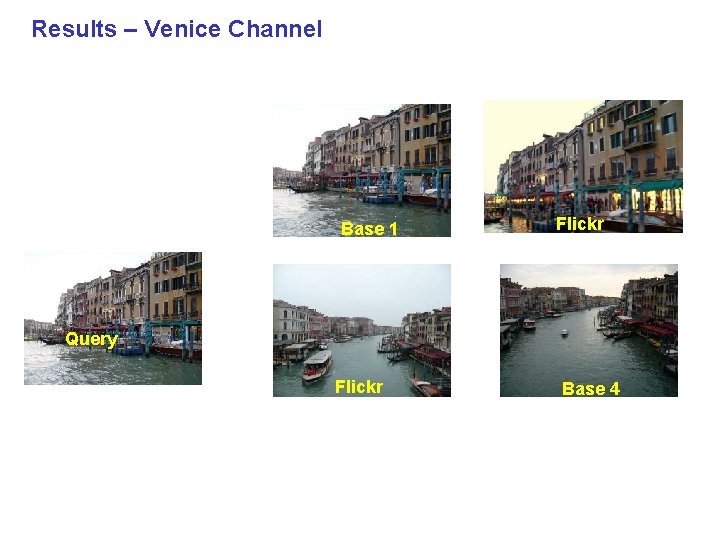
Results – Venice Channel Base 1 Flickr Query Flickr Base 4
![Comparison with the state of the art: Oxford dataset [Philbin et al. CVPR’ 07]](http://slidetodoc.com/presentation_image_h/b398f5fae72cb8e7f72b9c6c794687e9/image-29.jpg "Comparison with the state of the art: Oxford dataset [Philbin et al. CVPR’ 07]")
Comparison with the state of the art: Oxford dataset [Philbin et al. CVPR’ 07] Evaluation measure: Mean average precision (m. AP)
![Comparison with the state of the art: Kentucky dataset [Nister et al. CVPR’ 06]](http://slidetodoc.com/presentation_image_h/b398f5fae72cb8e7f72b9c6c794687e9/image-30.jpg "Comparison with the state of the art: Kentucky dataset [Nister et al. CVPR’ 06]")
Comparison with the state of the art: Kentucky dataset [Nister et al. CVPR’ 06] 4 images per object Evaluation measure: among the 4 best retrieval results how many are correct (ranges from 1 to 4)
![Comparison with the state of the art [14] Philbin et al. , CVPR’ 08;](http://slidetodoc.com/presentation_image_h/b398f5fae72cb8e7f72b9c6c794687e9/image-31.jpg "Comparison with the state of the art [14] Philbin et al. , CVPR’ 08;")
Comparison with the state of the art [14] Philbin et al. , CVPR’ 08; [6] Nister et al. , CVPR’ 06; [10] Harzallah et al. , CVPR’ 07

Demo at http: //bigimbaz. inrialpes. fr

Extension to videos: video copy detection Recognized “attacked” videos (distortion, blur, editing, mix up, . . . ) • a few seconds • 1000 of hours Video = image sequence: use image indexing ► index frames / keyframes of video, query frames of video query ► verify temporal consistency Several tradeoffs in search quality vs. database size
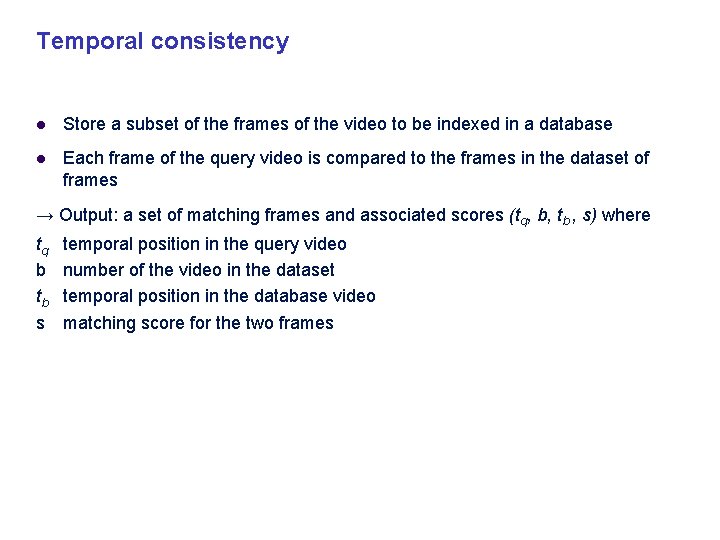
Temporal consistency Store a subset of the frames of the video to be indexed in a database Each frame of the query video is compared to the frames in the dataset of frames → Output: a set of matching frames and associated scores (tq, b, tb , s) where tq b tb s temporal position in the query video number of the video in the dataset temporal position in the database video matching score for the two frames
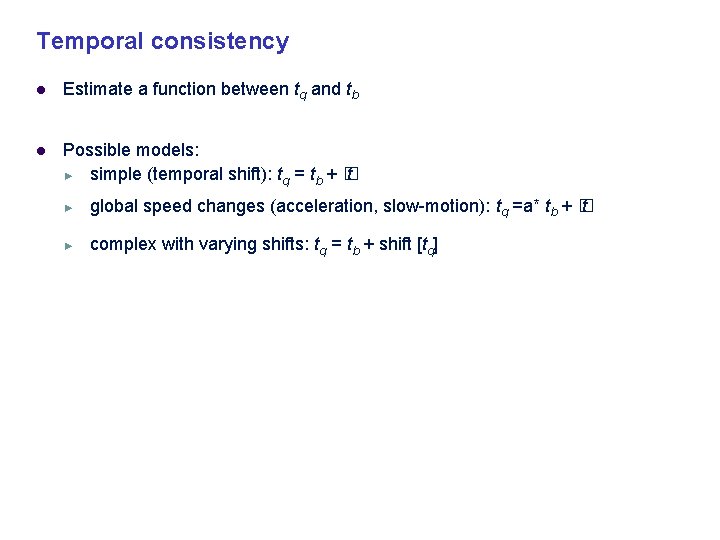
Temporal consistency Estimate a function between tq and tb Possible models: ► simple (temporal shift): tq = tb + � t ► global speed changes (acceleration, slow-motion): tq =a* tb + � t ► complex with varying shifts: tq = tb + shift [tq]
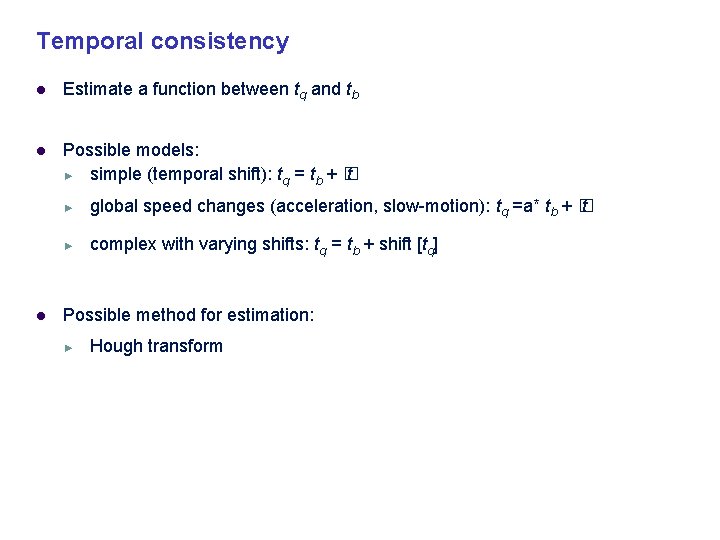
Temporal consistency Estimate a function between tq and tb Possible models: ► simple (temporal shift): tq = tb + � t ► global speed changes (acceleration, slow-motion): tq =a* tb + � t ► complex with varying shifts: tq = tb + shift [tq] Possible method for estimation: ► Hough transform

Trec. Vid’ 08 copyright detection competition precision Precision-recall: combined transformation (10) 0. 6 0. 4 0. 2 INRIA-LEAR. Strict INRIA-LEAR. Soft INRIA-LEAR. Keys. Ads Others 0 0 0. 2 0. 4 0. 6 recall

Sample result

Sample result

Towards larger databases? BOF can handle up to ~10 M d’images ► with a limited number of descriptors per image ► 40 GB of RAM ► search = 2 s Web-scale = billions of images ► With 100 M per machine → search = 20 s, RAM = 400 GB → not tractable!
![State-of-the-art: Bag-of-words [Sivic & Zisserman’ 03] Query image Set of SIFT descriptors centroids (visual](http://slidetodoc.com/presentation_image_h/b398f5fae72cb8e7f72b9c6c794687e9/image-41.jpg "State-of-the-art: Bag-of-words [Sivic & Zisserman’ 03] Query image Set of SIFT descriptors centroids (visual")
State-of-the-art: Bag-of-words [Sivic & Zisserman’ 03] Query image Set of SIFT descriptors centroids (visual words) [Nister & al 04, Chum & al 07] sparse frequency vector Bag-of-features processing +tf-idf weighting Hessian-Affine regions + SIFT descriptors [Mikolajezyk & Schmid 04] [Lowe 04] “visual words”: ► 1 “word” (index) per local descriptor ► only images ids in inverted file Re-ranked list Inverted file Geometric verification [Lowe 04, Chum & al 2007] querying ranked image short-list
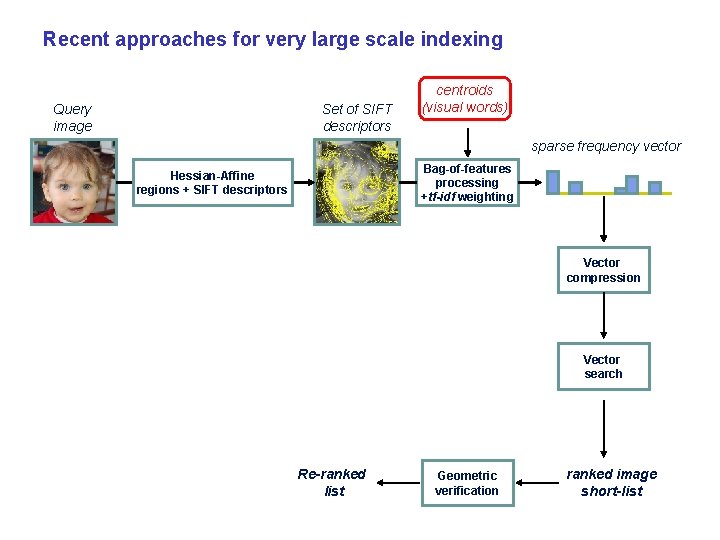
Recent approaches for very large scale indexing Query image Set of SIFT descriptors centroids (visual words) sparse frequency vector Bag-of-features processing +tf-idf weighting Hessian-Affine regions + SIFT descriptors Vector compression Vector search Re-ranked list Geometric verification ranked image short-list

Related work on very large scale image search Min-hash and geometrical min-hash [Chum et al. 07 -09] Compressing the Bo. F representation (mini. Bof) [ Jegou et al. 09] require hundreds of bytes are required to obtain a “reasonable quality” GIST descriptors with Spectral Hashing [Weiss et al. ’ 08] very limited invariance to scale/rotation/crop

Global scene context – GIST descriptor The “gist” of a scene: Oliva & Torralba (2001) 5 frequency bands and 6 orientations for each image location PCA or tiling of the image (windowing) to reduce the dimension
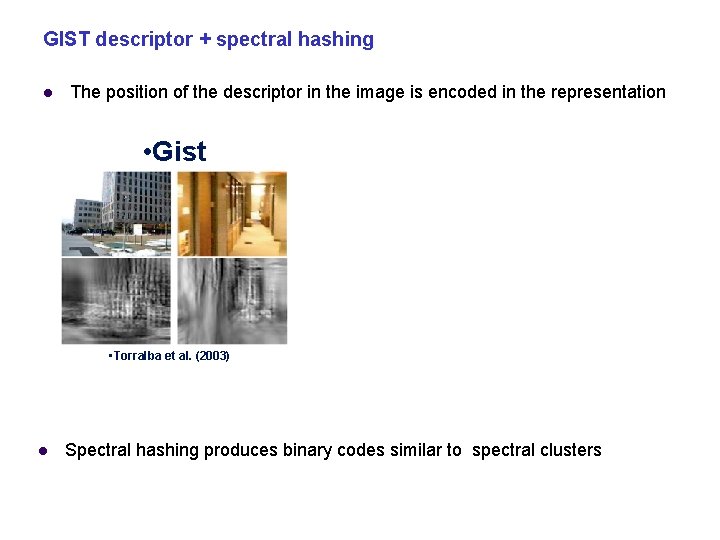
GIST descriptor + spectral hashing The position of the descriptor in the image is encoded in the representation • Gist • Torralba et al. (2003) Spectral hashing produces binary codes similar to spectral clusters
Related work on very large scale image search Min-hash and geometrical min-hash [Chum et al. 07 -09] Compressing the Bo. F representation (mini. Bof) [ Jegou et al. 09] require hundreds of bytes are required to obtain a “reasonable quality” GIST descriptors with Spectral Hashing [Weiss et al. ’ 08] very limited invariance to scale/rotation/crop Aggregating local descriptors into a compact image representation [Jegou et al. ‘ 10] Efficient object category recognition using classemes [Torresani et al. ’ 10]
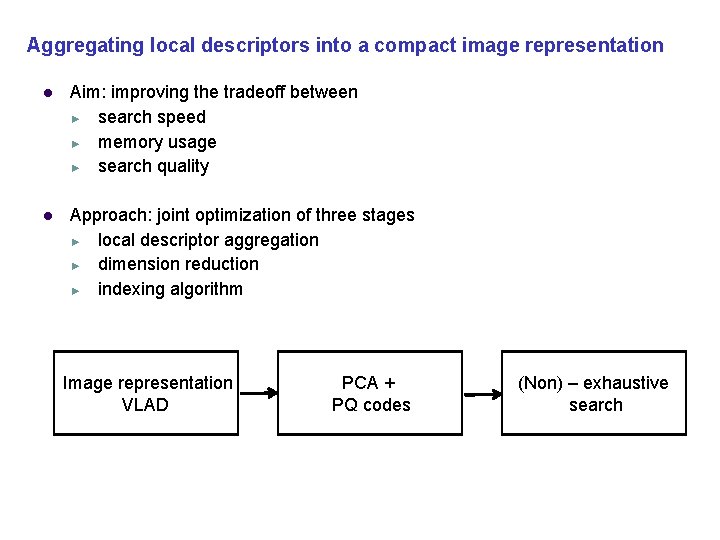
Aggregating local descriptors into a compact image representation Aim: improving the tradeoff between ► search speed ► memory usage ► search quality Approach: joint optimization of three stages ► local descriptor aggregation ► dimension reduction ► indexing algorithm Image representation VLAD PCA + PQ codes (Non) – exhaustive search

Aggregation of local descriptors Problem: represent an image by a single fixed-size vector: set of n local descriptors → 1 vector Most popular idea: Bo. F representation [Sivic & Zisserman 03] ► sparse vector ► highly dimensional → high dimensionality reduction/compression introduces loss Alternative : vector of locally aggregated descriptors (VLAD) ► non sparse vector ► excellent results with a small vector dimensionality
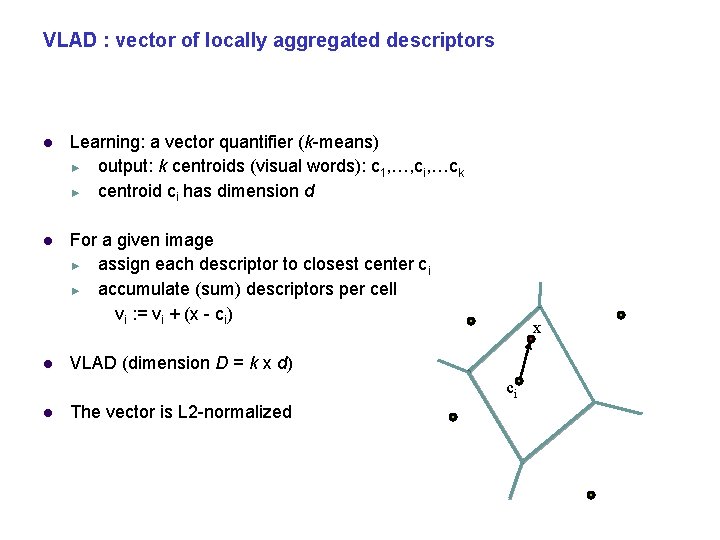
VLAD : vector of locally aggregated descriptors Learning: a vector quantifier (k-means) ► output: k centroids (visual words): c 1, …, ci, …ck ► centroid ci has dimension d For a given image ► assign each descriptor to closest center ci ► accumulate (sum) descriptors per cell vi : = vi + (x - ci) x VLAD (dimension D = k x d) ci The vector is L 2 -normalized

VLADs for corresponding images v 1 v 2 v 3. . . SIFT-like representation per centroid (+ components: blue, - components: red) good coincidence of energy & orientations
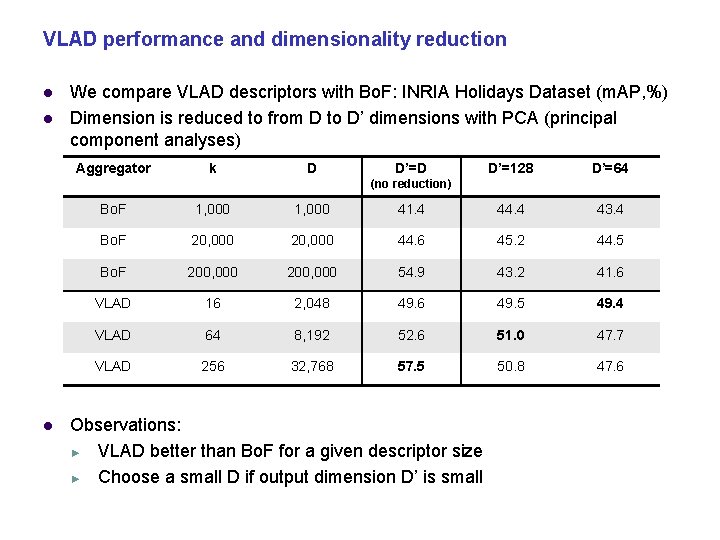
VLAD performance and dimensionality reduction We compare VLAD descriptors with Bo. F: INRIA Holidays Dataset (m. AP, %) Dimension is reduced to from D to D’ dimensions with PCA (principal component analyses) Aggregator k D D’=128 D’=64 (no reduction) Bo. F 1, 000 41. 4 44. 4 43. 4 Bo. F 20, 000 44. 6 45. 2 44. 5 Bo. F 200, 000 54. 9 43. 2 41. 6 VLAD 16 2, 048 49. 6 49. 5 49. 4 VLAD 64 8, 192 52. 6 51. 0 47. 7 VLAD 256 32, 768 57. 5 50. 8 47. 6 Observations: ► VLAD better than Bo. F for a given descriptor size ► Choose a small D if output dimension D’ is small

Compact image representation Approach: joint optimization of three stages ► local descriptor aggregation ► dimension reduction ► indexing algorithm Image representation VLAD ► PCA + PQ codes (Non) – exhaustive search Dimensionality reduction with ► Principal component analysis (PCA) ► Compact encoding: product quantizer ► very compact descriptor, fast nearest neighbor search, little storage requirements

Product quantization Vector split into m subvectors: Subvectors are quantized separately by quantizers where each is learned by k-means with a limited number of centroids Example: y = 128 -dim vector split in 8 subvectors of dimension 16 ► each subvector is quantized with 256 centroids -> 8 bit ► very large codebook 256^8 ~ 1. 8 x 10^19 16 components y 1 y 2 y 3 y 4 y 5 y 6 y 7 y 8 256 q centroids 1 q 2 q 3 q 4 q 5 q 6 q 7 q 8 q 2(y 2) q 3(y 3) q 4(y 4) q 5(y 5) q 6(y 6) q 7(y 7) q 8(y 8) q 1(y 1) 8 bits ⇒ 8 subvectors x 8 bits = 64 -bit quantization index
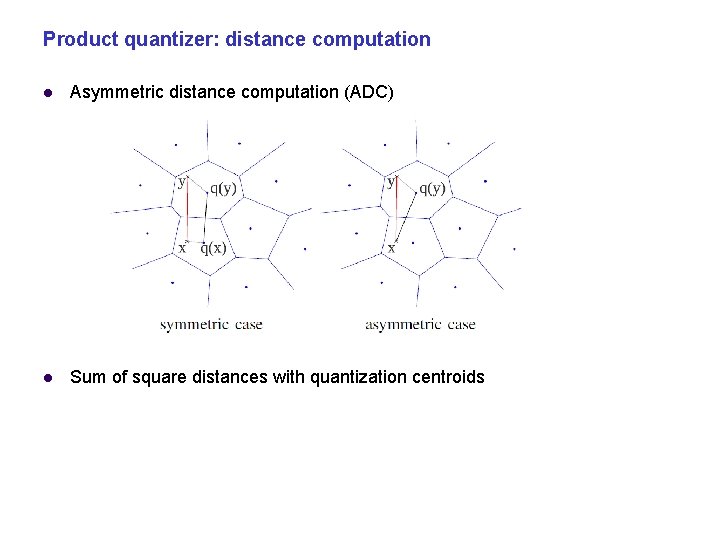
Product quantizer: distance computation Asymmetric distance computation (ADC) Sum of square distances with quantization centroids
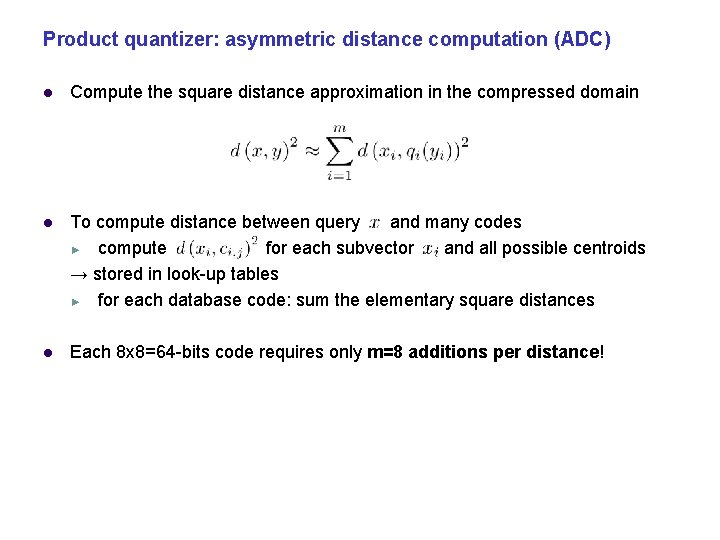
Product quantizer: asymmetric distance computation (ADC) Compute the square distance approximation in the compressed domain To compute distance between query and many codes ► compute for each subvector and all possible centroids → stored in look-up tables ► for each database code: sum the elementary square distances Each 8 x 8=64 -bits code requires only m=8 additions per distance!

Optimizing the dimension reduction and quantization together VLAD vectors suffer two approximations ► mean square error from PCA projection: ► mean square error from quantization: ep(D’) eq(D’) Given k and bytes/image, choose D’ minimizing their sum Ex, k=16, 16 B: D’ ep(D’) eq(D’) ep(D’)+eq(D’) 32 0. 0632 0. 0164 0. 0796 48 0. 0508 0. 0248 0. 0757 64 0. 0434 0. 0321 0. 0755 80 0. 0386 0. 0458 0. 0844

Joint optimization of VLAD and dimension reduction-indexing For VLAD ► The larger k, the better the raw search performance ► But large k produce large vectors, that are harder to index Optimization of the vocabulary size ► Fixed output size (in bytes) ► D’ computed from k via the joint optimization of reduction/indexing ► Only k has to be set end-to-end parameter optimization

Results on the Holidays dataset with various quantization parameters

Results on standard datasets Datasets ► University of Kentucky benchmark ► INRIA Holidays dataset Method score: nb relevant images, max: 4 score: m. AP (%) bytes UKB Holidays Bo. F, k=20, 000 10 K 2. 92 44. 6 Bo. F, k=200, 000 12 K 3. 06 54. 9 mini. BOF 20 2. 07 25. 5 mini. BOF 160 2. 72 40. 3 VLAD k=16, ADC 16 x 8 16 2. 88 46. 0 VLAD k=64, ADC 32 x 10 40 3. 10 49. 5 D’ =64 for k=16 and D’ =96 for k=64 ADC (subvectors) x (bits to encode each subvector) mini. BOF: “Packing Bag-of-Features”, ICCV’ 09

Comparison BOF / VLAD + ADC Datasets ► INRIA Holidays dataset , score: m. AP (%) Method Holidays BOF, k=2048, D’= 64, ADC 16 x 8 42. 5 VLAD k=16, D=2048, D’ = 64, ADC 16 x 8 46. 0 BOF, k=8192, D’= 128, AD 16 x 8 41. 9 VLAD k=64, D= 8192, D’=128, ADC 16 X 8 45. 8 ► ► VLAD improves results over BOF Product quantizer gives excellent results for BOF!
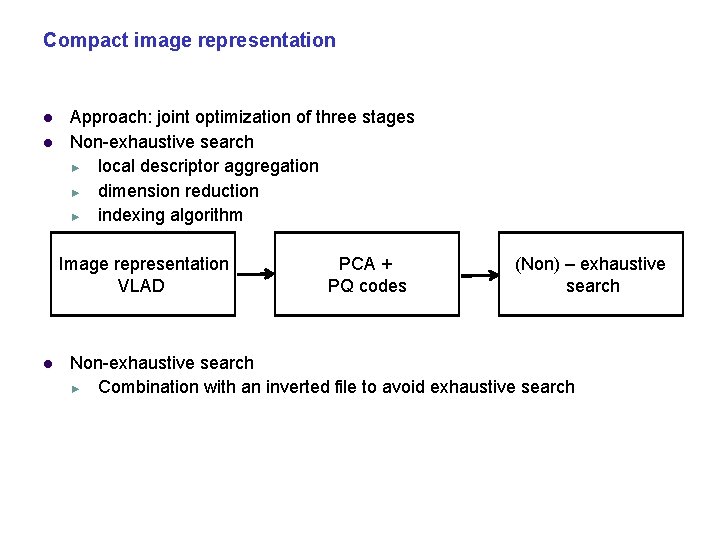
Compact image representation Approach: joint optimization of three stages Non-exhaustive search ► local descriptor aggregation ► dimension reduction ► indexing algorithm Image representation VLAD PCA + PQ codes (Non) – exhaustive search Non-exhaustive search ► Combination with an inverted file to avoid exhaustive search
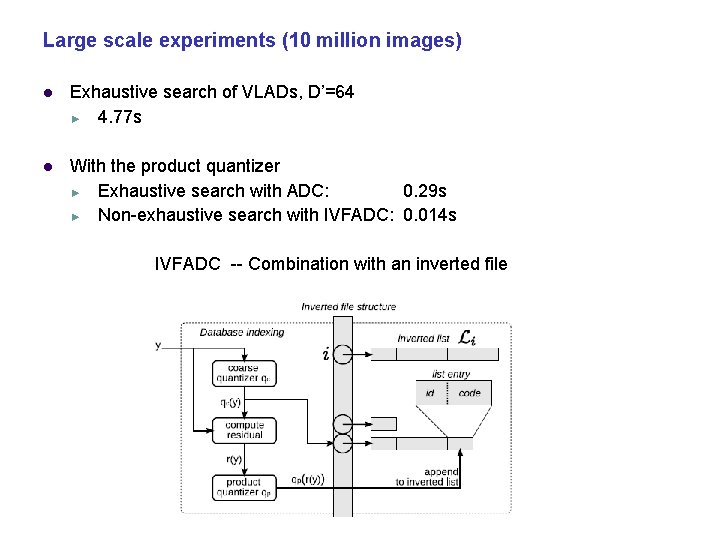
Large scale experiments (10 million images) Exhaustive search of VLADs, D’=64 ► 4. 77 s With the product quantizer ► Exhaustive search with ADC: 0. 29 s ► Non-exhaustive search with IVFADC: 0. 014 s IVFADC -- Combination with an inverted file
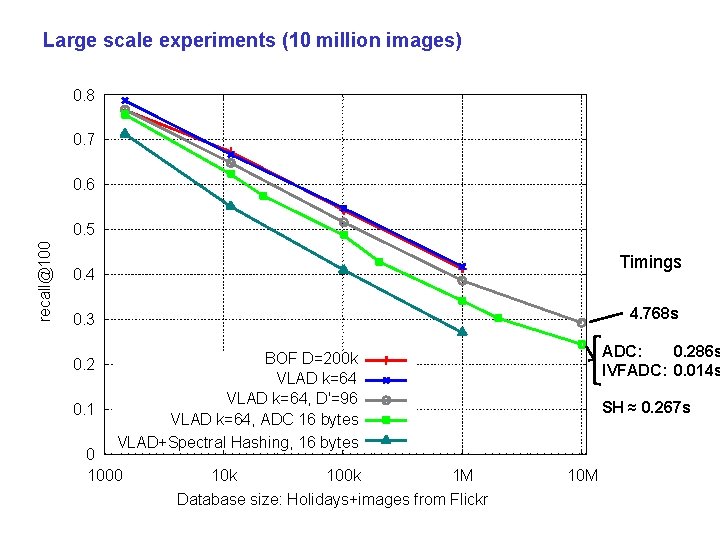
Large scale experiments (10 million images) 0. 8 0. 7 0. 6 recall@100 0. 5 Timings 0. 4 4. 768 s 0. 3 0. 2 0. 1 ADC: 0. 286 s IVFADC: 0. 014 s BOF D=200 k VLAD k=64, D'=96 VLAD k=64, ADC 16 bytes VLAD+Spectral Hashing, 16 bytes 0 1000 10 k 100 k 1 M Database size: Holidays+images from Flickr SH ≈ 0. 267 s 10 M

Searching with quantization: comparison with spectral Hashing *** Put Only ADC ***

VLAD + PQ codes Excellent search accuracy and speed in 10 million of images Each image is represented by very few bytes (20 – 40 bytes) Tested on up to 220 million video frame ► extrapolation for 1 billion images: 20 GB RAM, query < 1 s on 8 cores On-line available: ► Matlab source code of ADC Alternative: using Fisher vectors instead of VLAD descriptors [Perronnin’ 10]
- Slides: 65