
Large Scale Numerical Modeling of Laser Ablation Center
Large Scale Numerical Modeling of Laser Ablation Center for Laser Micro-Fabrication School of Mechanical Engineering Purdue University
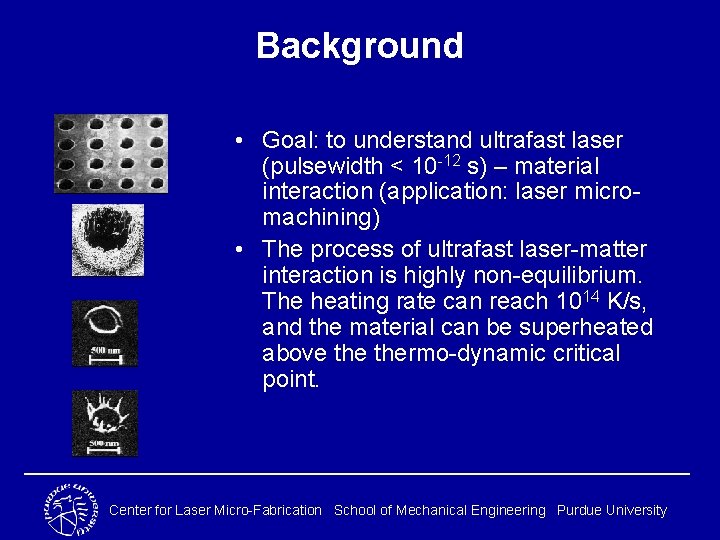
Background • Goal: to understand ultrafast laser (pulsewidth < 10 -12 s) – material interaction (application: laser micromachining) • The process of ultrafast laser-matter interaction is highly non-equilibrium. The heating rate can reach 1014 K/s, and the material can be superheated above thermo-dynamic critical point. Center for Laser Micro-Fabrication School of Mechanical Engineering Purdue University

Fundamental Processes and Time Scales Involved in Ultrafast (fs) Pulsed Laser Ablation of Metal – Heating of electrons (before lattice being heated) ~ fs – Transfer of energy from electrons to the lattice and heating of the lattice to temperatures above the melting point ~ 1 - 10 ps – the temperature of elections could be much higher than the lattice temperature – Liquid – vapor phase change, phase explosion ~ 10 – 100 ps – Melting duration ~ 100 ps – 1 ns – Cooling of the lattice ~ ms Center for Laser Micro-Fabrication School of Mechanical Engineering Purdue University
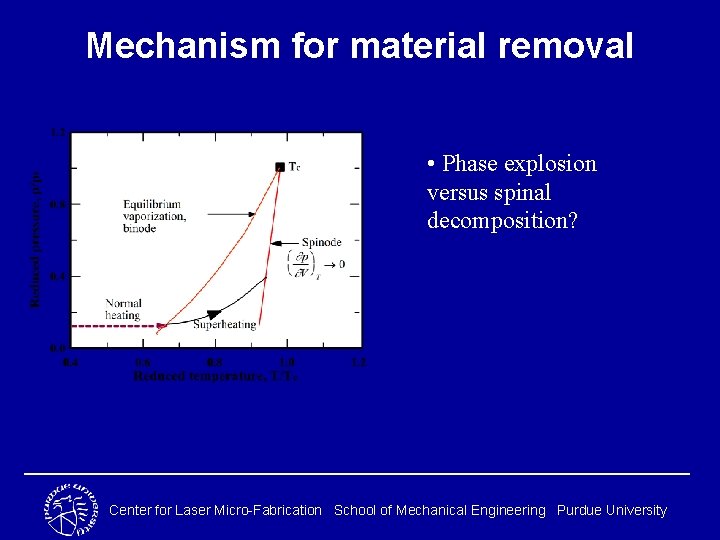
Mechanism for material removal • Phase explosion versus spinal decomposition? Center for Laser Micro-Fabrication School of Mechanical Engineering Purdue University
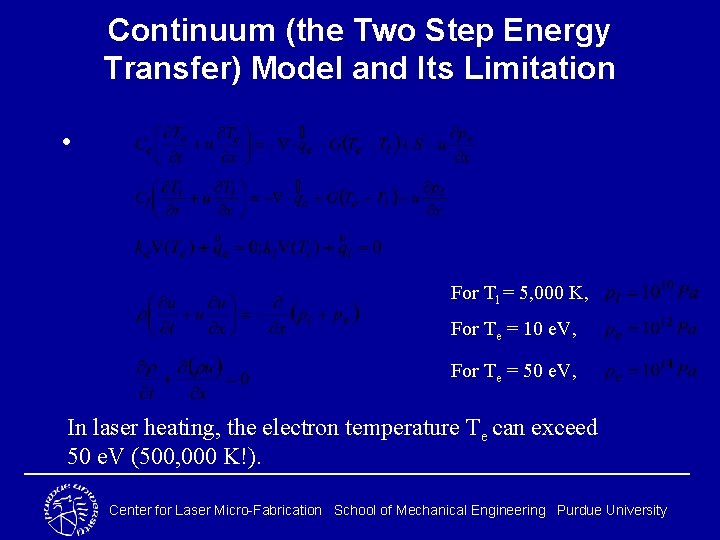
Continuum (the Two Step Energy Transfer) Model and Its Limitation • For Tl = 5, 000 K, For Te = 10 e. V, For Te = 50 e. V, In laser heating, the electron temperature Te can exceed 50 e. V (500, 000 K!). Center for Laser Micro-Fabrication School of Mechanical Engineering Purdue University
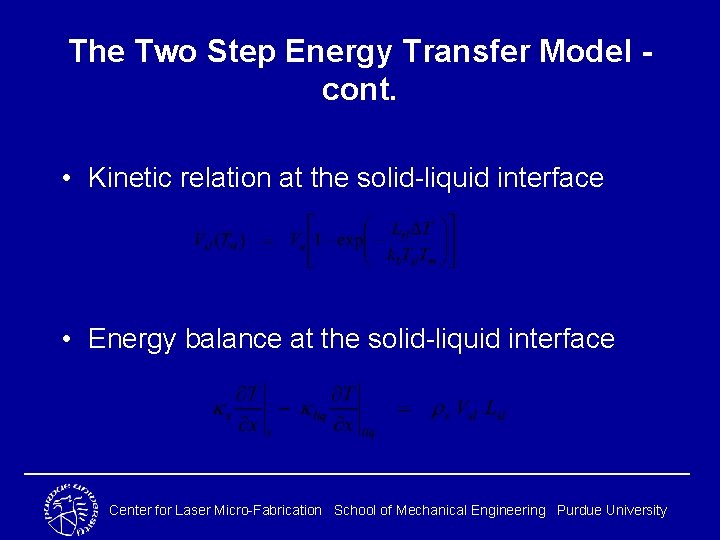
The Two Step Energy Transfer Model cont. • Kinetic relation at the solid-liquid interface • Energy balance at the solid-liquid interface Center for Laser Micro-Fabrication School of Mechanical Engineering Purdue University
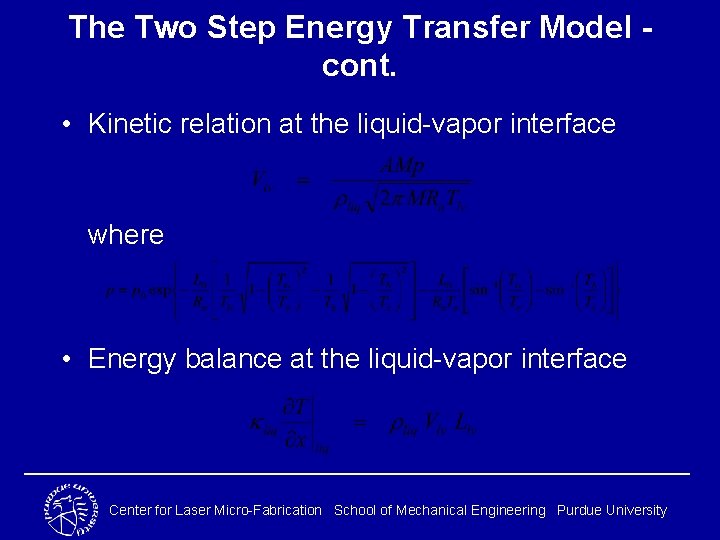
The Two Step Energy Transfer Model cont. • Kinetic relation at the liquid-vapor interface where • Energy balance at the liquid-vapor interface Center for Laser Micro-Fabrication School of Mechanical Engineering Purdue University
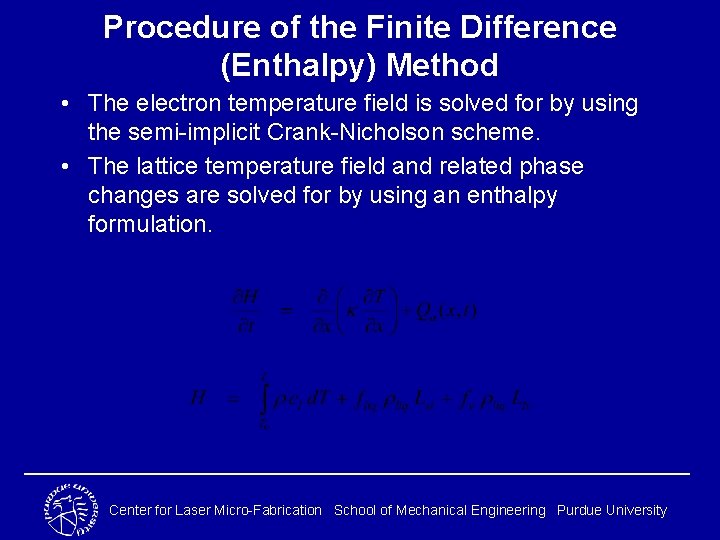
Procedure of the Finite Difference (Enthalpy) Method • The electron temperature field is solved for by using the semi-implicit Crank-Nicholson scheme. • The lattice temperature field and related phase changes are solved for by using an enthalpy formulation. Center for Laser Micro-Fabrication School of Mechanical Engineering Purdue University
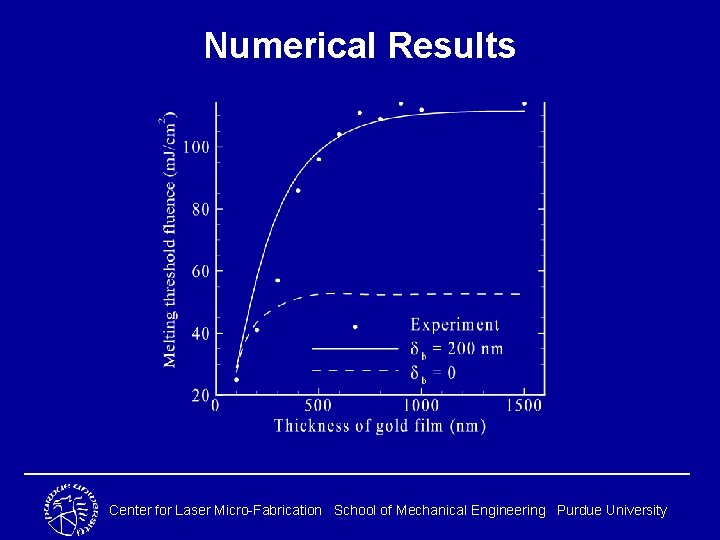
Numerical Results Center for Laser Micro-Fabrication School of Mechanical Engineering Purdue University
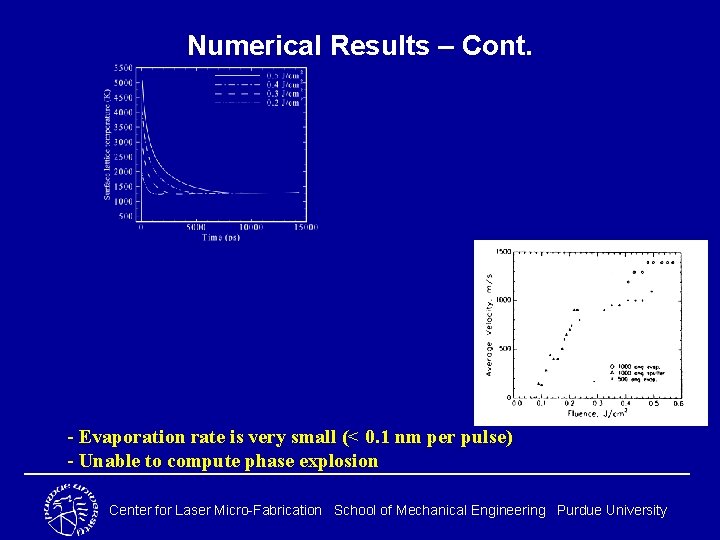
Numerical Results – Cont. - Evaporation rate is very small (< 0. 1 nm per pulse) - Unable to compute phase explosion Center for Laser Micro-Fabrication School of Mechanical Engineering Purdue University
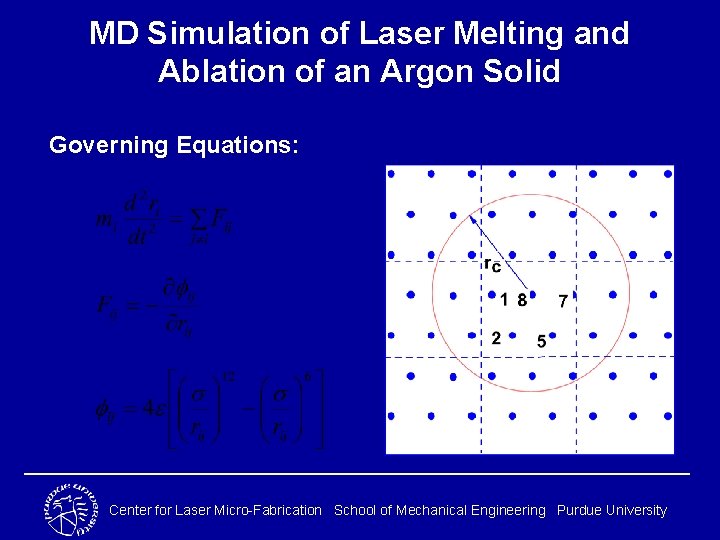
MD Simulation of Laser Melting and Ablation of an Argon Solid Governing Equations: Center for Laser Micro-Fabrication School of Mechanical Engineering Purdue University
Snapshots of Atomic Positions (laser irradiates from the right hand side) (a) t=5 ps (b) t=10 ps (c) t=15 ps (d) t=20 ps (e) t=25 ps (f) t=30 ps Center for Laser Micro-Fabrication School of Mechanical Engineering Purdue University
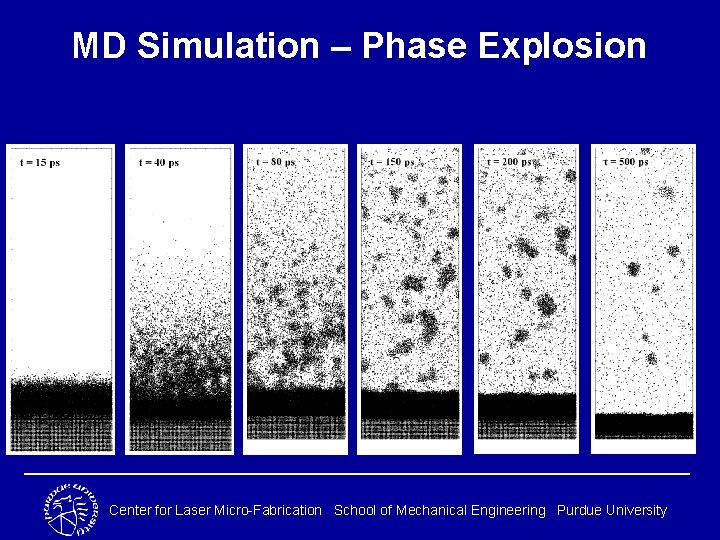
MD Simulation – Phase Explosion Center for Laser Micro-Fabrication School of Mechanical Engineering Purdue University
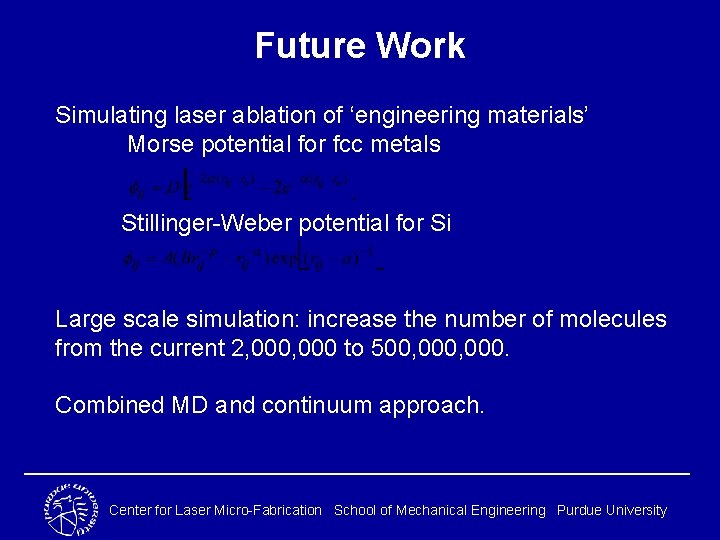
Future Work Simulating laser ablation of ‘engineering materials’ Morse potential for fcc metals Stillinger-Weber potential for Si Large scale simulation: increase the number of molecules from the current 2, 000 to 500, 000. Combined MD and continuum approach. Center for Laser Micro-Fabrication School of Mechanical Engineering Purdue University
- Slides: 14