
Large Scale Complex Network Analysis using the Hybrid
Large Scale Complex Network Analysis using the Hybrid Combination of a Map. Reduce Cluster and a Highly Multithreaded System Seunghwa Kang David A. Bader 1

Various Complex Networks Source: http: //www. facebook. com • Friendship network • Citation network • Web-link graph • Collaboration network => Need to extract graphs from large volumes of raw data. => Extracted graphs are highly irregular. Source: http: //academic. research. microsoft. com 2
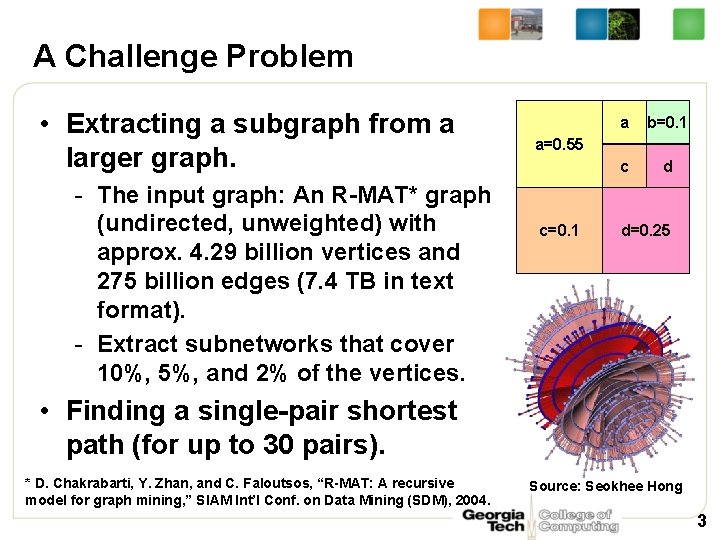
A Challenge Problem • Extracting a subgraph from a larger graph. - The input graph: An R-MAT* graph (undirected, unweighted) with approx. 4. 29 billion vertices and 275 billion edges (7. 4 TB in text format). - Extract subnetworks that cover 10%, 5%, and 2% of the vertices. a b=0. 1 c d a=0. 55 c=0. 1 d=0. 25 • Finding a single-pair shortest path (for up to 30 pairs). * D. Chakrabarti, Y. Zhan, and C. Faloutsos, “R-MAT: A recursive model for graph mining, ” SIAM Int’l Conf. on Data Mining (SDM), 2004. Source: Seokhee Hong 3
Presentation Outline • Present the hybrid system. • Solve the problem using three different systems: A Map. Reduce cluster, a highly multithreaded system, and the hybrid system. • Show the effectiveness of the hybrid system by - Algorithm level analyses - System level analyses - Experimental results 4
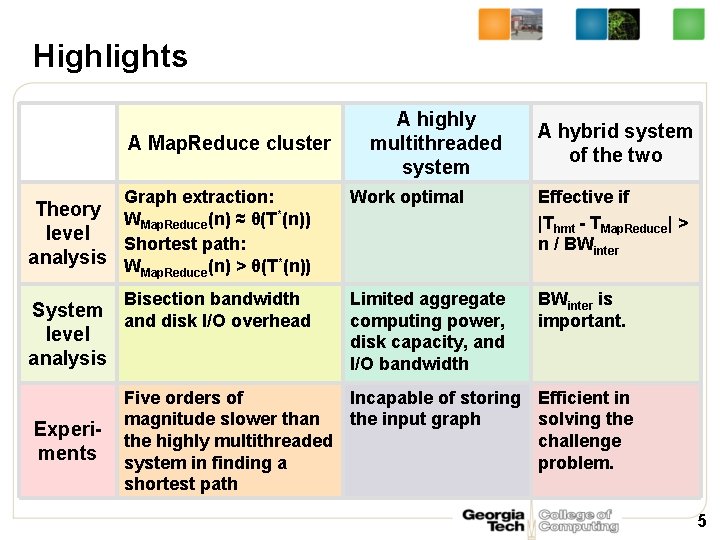
Highlights A Map. Reduce cluster Graph extraction: Theory W * Map. Reduce(n) ≈ θ(T (n)) level Shortest path: analysis W * Map. Reduce(n) > θ(T (n)) Bisection bandwidth System and disk I/O overhead level analysis Experiments A highly multithreaded system A hybrid system of the two Work optimal Effective if |Thmt - TMap. Reduce| > n / BWinter Limited aggregate computing power, disk capacity, and I/O bandwidth BWinter is important. Five orders of Incapable of storing magnitude slower than the input graph the highly multithreaded system in finding a shortest path Efficient in solving the challenge problem. 5
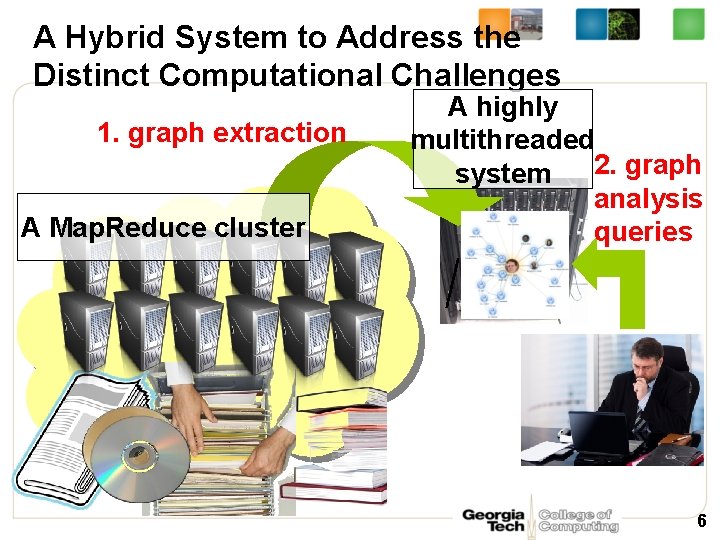
A Hybrid System to Address the Distinct Computational Challenges 1. graph extraction A Map. Reduce cluster A highly multithreaded 2. graph system analysis queries 6

The Map. Reduce Programming Model • Scans the entire input data in the map sort reduce map phase. map sort reduce • # Map. Reduce map sort reduce iterations = the Intermediate Output Input Sorted depth of a directed data intermediate data acyclic graph Depth A[0] A[1] A[2] A[3] A[4] A[5] A[6] A[7] (DAG) for 1 Map. Reduce computation 2 A’[0] A’[1] A’[2] A’[3] A’[4] map 3 sort reduce A’’[0] A’’[1] A’’[2] A’’[3] A’’[4] 7

Evaluating the efficiency of Map. Reduce Algorithms • WMap. Reduce = Σi = 1 to k (O(ni • (1 + fi • (1 + ri)) + pr • Sort(nifi / pr)) - k: # Map. Reduce iterations. ni: the input data size for the ith iteration. fi: map output size / map input size ri: reduce output size / reduce input size. pr: # reducers • Extracting a subgraph - k = 1 and fi << 1 WMap. Reduce(n) ≈ θ(T*(n)), T*(n): the time complexity of the best sequential algorithm • Finding a single-pair shortest path - k =┌ d/2 ┐, fi ≈ 1 WMap. Reduce(n) > θ(T*(n)) 8
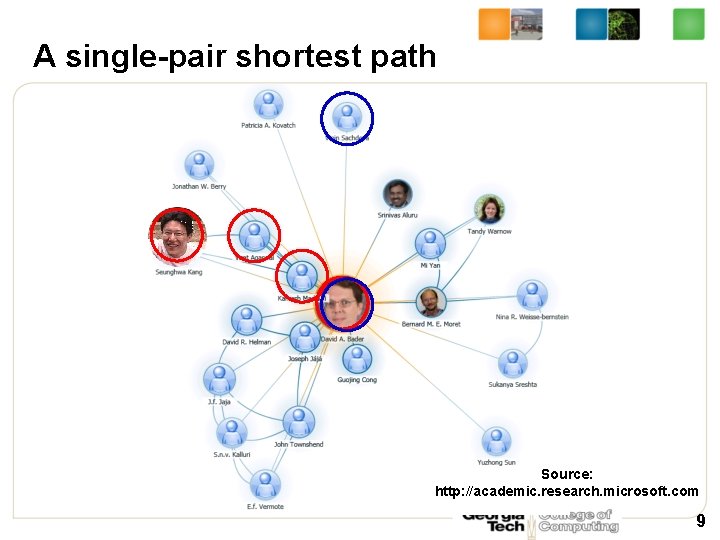
A single-pair shortest path Source: http: //academic. research. microsoft. com 9
Bisection Bandwidth Requirements for a Map. Reduce Cluster • The shuffle phase, which requires inter-node communication, can be overlapped with the map phase. • If Tmap > Tshuffle, Tshuffle does not affect the overall execution time. - Tmap scales trivially. - To scale Tshuffle linearly, bisection bandwidth also needs to scale in proportion to a number of nodes. Yet, the cost to linearly scale bisection bandwidth increases super-linearly. - If f << 1, the sub-linear scaling of Tshuffle does not increase the overall execution time. - If f ≈ 1, it increases the overall execution time. 10
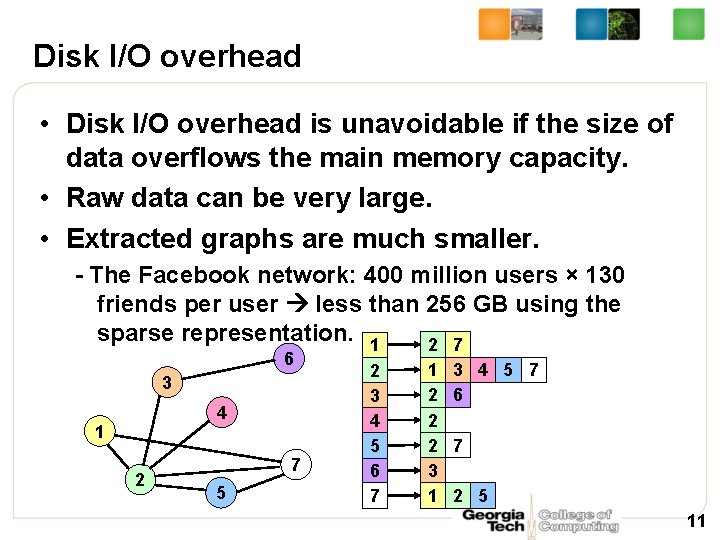
Disk I/O overhead • Disk I/O overhead is unavoidable if the size of data overflows the main memory capacity. • Raw data can be very large. • Extracted graphs are much smaller. - The Facebook network: 400 million users × 130 friends per user less than 256 GB using the sparse representation. 1 2 7 6 3 4 1 2 7 5 2 3 4 5 6 7 1 2 2 2 3 1 3 4 5 7 6 7 2 5 11

A Highly Multithreaded System w/ the Shared Memory Programming Model • Provide a random access mechanism. • In SMPs, non-contiguous accesses are expensive. * • Multithreading tolerates memory access latency. + • There is a work optimal parallel algorithm to find a single-pair shortest path. Sun Fire T 2000 (Niagara) Source: Sun Microsystems Cray XMT Source: Cray * D. R. Helman and J. Ja’Ja’, “Prefix computations on symmetric multiprocessors, ” J. of parallel and distributed computing, 61(2), 2001. + D. A. Bader, V. Kanade, and K. Madduri, “SWARM: A parallel programming framework for multicore processors, ” Workshop on Multithreaded Architectures and Applications, 2007. 12
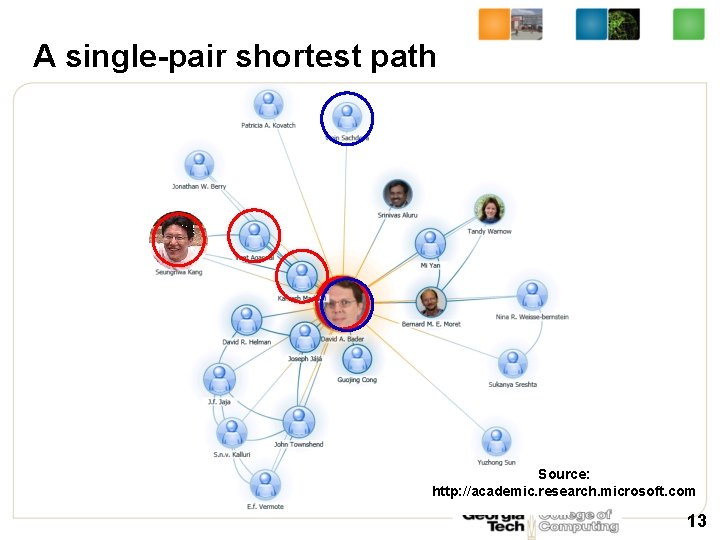
A single-pair shortest path Source: http: //academic. research. microsoft. com 13
Low Latency High Bisection Bandwidth Interconnection Network • Latency increases as the size of a system increases. - A larger number of threads and additional parallelism are required as latency increases. • Network cost to linearly scale bisection bandwidth increases super-linearly. - But not too expensive for a small number of nodes. • These limit the size of a system. - Reveal limitations in extracting a subgraph from a very large graph. 14
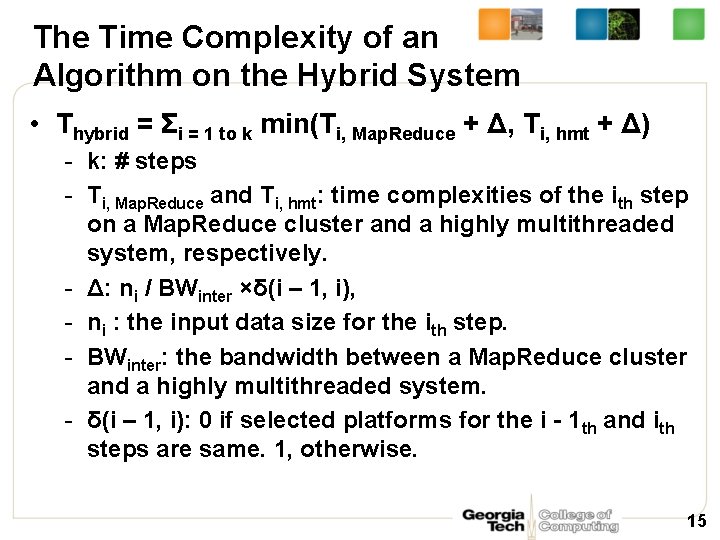
The Time Complexity of an Algorithm on the Hybrid System • Thybrid = Σi = 1 to k min(Ti, Map. Reduce + Δ, Ti, hmt + Δ) - k: # steps - Ti, Map. Reduce and Ti, hmt: time complexities of the ith step on a Map. Reduce cluster and a highly multithreaded system, respectively. - Δ: ni / BWinter ×δ(i – 1, i), - ni : the input data size for the ith step. - BWinter: the bandwidth between a Map. Reduce cluster and a highly multithreaded system. - δ(i – 1, i): 0 if selected platforms for the i - 1 th and ith steps are same. 1, otherwise. 15
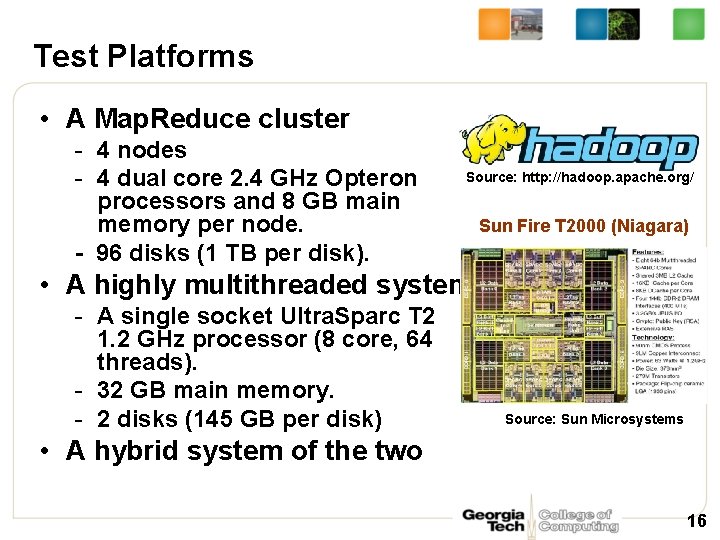
Test Platforms • A Map. Reduce cluster - 4 nodes - 4 dual core 2. 4 GHz Opteron processors and 8 GB main memory per node. - 96 disks (1 TB per disk). Source: http: //hadoop. apache. org/ Sun Fire T 2000 (Niagara) • A highly multithreaded system - A single socket Ultra. Sparc T 2 1. 2 GHz processor (8 core, 64 threads). - 32 GB main memory. - 2 disks (145 GB per disk) Source: Sun Microsystems • A hybrid system of the two 16
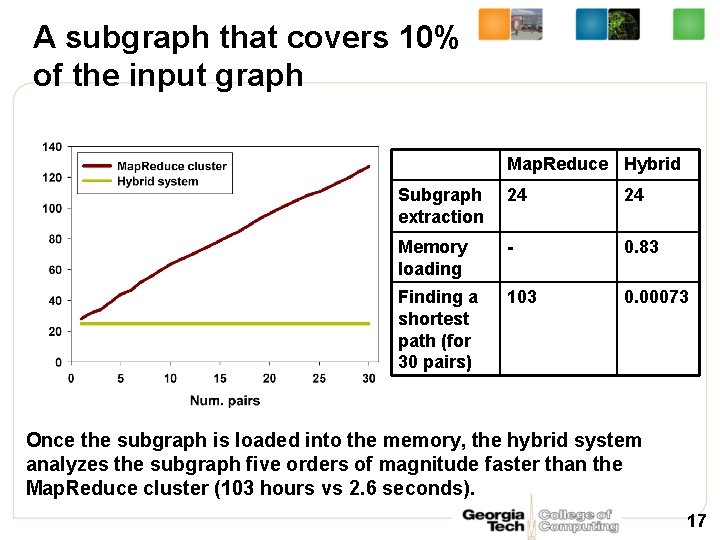
A subgraph that covers 10% of the input graph Map. Reduce Hybrid Subgraph extraction 24 24 Memory loading - 0. 83 Finding a shortest path (for 30 pairs) 103 0. 00073 Once the subgraph is loaded into the memory, the hybrid system analyzes the subgraph five orders of magnitude faster than the Map. Reduce cluster (103 hours vs 2. 6 seconds). 17
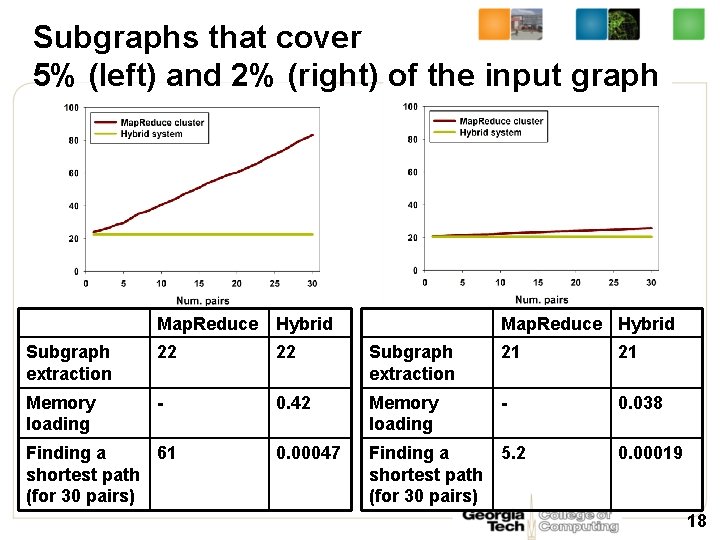
Subgraphs that cover 5% (left) and 2% (right) of the input graph Map. Reduce Hybrid Subgraph extraction 22 22 Subgraph extraction 21 21 Memory loading - 0. 42 Memory loading - 0. 038 0. 00047 Finding a 5. 2 shortest path (for 30 pairs) Finding a 61 shortest path (for 30 pairs) Map. Reduce Hybrid 0. 00019 18
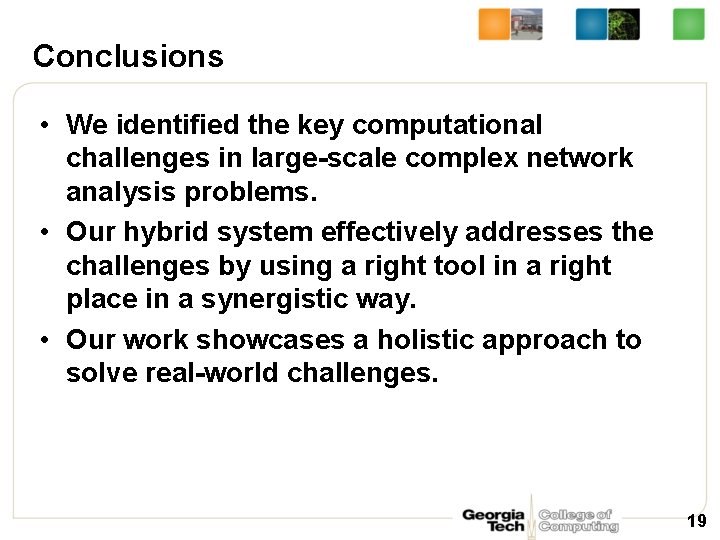
Conclusions • We identified the key computational challenges in large-scale complex network analysis problems. • Our hybrid system effectively addresses the challenges by using a right tool in a right place in a synergistic way. • Our work showcases a holistic approach to solve real-world challenges. 19

Acknowledgment of Support 20
- Slides: 20