
Large Expression Differences in Genes for Iron and
- Slides: 38
Large Expression Differences in Genes for Iron and Zinc Homeostasis, Stress Response, and Lignin Biosynthesis Distinguish Roots of Arabidopsis thaliana and the Related Metal Hyperaccumulator Thlaspi caerulescens Judith E. van de Mortel, Laia Almar Villanueva, Henk Schat, Jeroen Kwekkeboom, Sean Coughlan, Perry D. Moerland, Emiel Ver Loren van Themaat, Maarten Koornneef, and Mark G. M. Aarts Plant Physiology (2006) November; 142(1) 1127– 1147 Bio. Informatics Lab Tuesday, April 13, 2010 Kristoffer Chin Salomon Garcia Michael Piña
Outline • Introduction – Micronutrient Zinc – Arabidopsis thaliana and Thlaspi caerulescens – Lignin Biosynthesis • Materials and Methods – Microarray Experiment – RT-PCR • Results – Between A. thaliana and T. caerulescens, 2, 200+ genes were significantly differentially expressed • Discussion – High expression of lignin biosynthesis genes corresponds to lignin deposits in the endodermis • Future studies • References
Micronutrients are essential for humans, plants, and animals • Zinc plays an important role in plants’ biological processes (co-factor for 300+ enzymes) • Toxic in high amounts – Plants keep tight regulation over zinc homeostasis • Zinc homeostasis mechanism is generally universal within plants with a few exceptions
Zinc hyperaccumulators can accumulate large amounts of zinc • More than 1% of their dry weight • 10, 000 µg zinc g⁻¹ in hyperaccumulators • 30 -100 µg zinc g⁻¹ in most other plants – Over 300 is usually toxic • T. caeulescens is a zinc hyperaccumulator – Very closely related to A. thaliana • Zinc conc. in shoots is often higher than in roots in hyperaccumulators
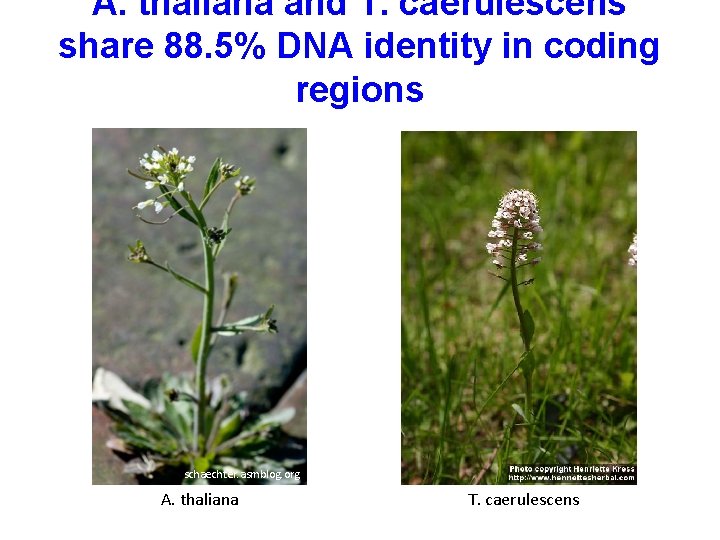
A. thaliana and T. caerulescens share 88. 5% DNA identity in coding regions schaechter. asmblog. org A. thaliana T. caerulescens
A complex network of homeostatic mechanisms has evolved in plants • These mechanisms control the uptake, accumulation, trafficking, and detoxification of metals – This also applies for hyperaccumulators • The physiology of metal hyperaccumulation is well understood, but the molecular genetics have not been explored in detail
Which genes are most likely relevant for adaptation to high zinc exposure in T. caerulescens? • Examine the response of roots to zinc deficiency, sufficiency, and excess • DNA microarray covering nearly the entire transcriptome of A. thaliana – All available annotated genes – ~10, 000 non-annotated genes • Comparison of A. thaliana to T. caerulescens
Plants were prepared for a root and shoot metal accumulation assay • Arabidopsis thaliana Columbia-0 • Thlaspi caerulescens J. & C. Presl accession La Calamine • Germinated on garden peat soil • 3 week old seedlings transferred to pots containing half strength Hoagland solution • p. H buffer was added and the p. H was set at 5. 5 • After 3 weeks, both species were transferred to the modified Hoagland solution containing: – Deficient (0 µM) Zn. SO₄ – Sufficient (100 µM) Zn. SO₄ – Excess (1, 000 µM) Zn. SO₄
After 4 weeks of growth, plants were harvested • Root system was desorbed with cold 5 m. M Pb. NO₃ • Roots and shoots were dried overnight • Wet-ashed – Mixture of HNO₃ and HCL • Analyzed for zinc, iron, and manganese using flame atomic absorption spectrometry
c. DNA from T. caerulescens roots exposed to sufficient (100 µM) zinc was used as the common reference for the microarray • The common reference was labeled with Cy 3, treatment samples were labeled with Cy 5 – Dye-swap used for quality control (QC) • Roots of one pot were pooled and homogenized in liquid nitrogen • Each pool (3 plants of either species) was considered as 1 biological replicate – 2 biological replicates were used
RNA was extracted, purified, and hybridized on slides for the microarray • 27, 000+ annotated genes & 10, 000+ nonannotated genes • After hybridization, slides were scanned, analyzed, normalized – Agilent Feature Extraction software • Moderated t test to find differentially expressed genes – P values were considered to be significant if they were <0. 05 • Significantly differentiated genes were clustered in a tree diagram • Dye-swap hybridization was performed for QC
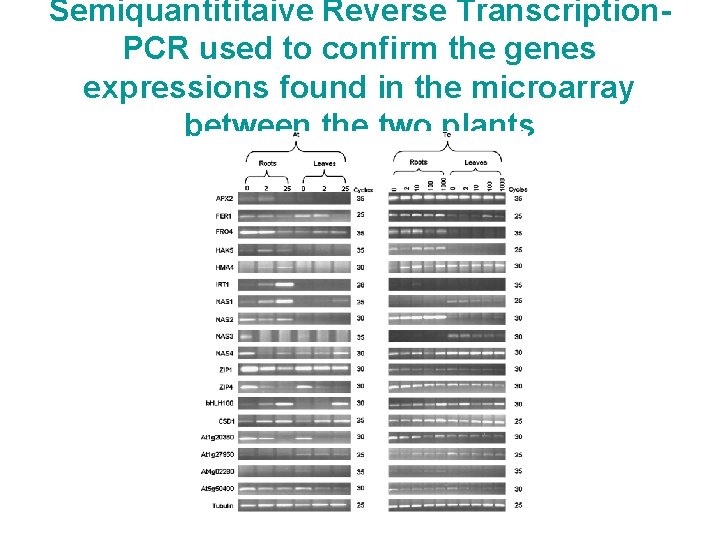
RNA for both species was extracted for semiquantitative RT -PCR • New primers were created to ensure the correct amplification for T. caerulescens genes – MMLV reverse transcriptase • Care was taken in creating primers for Arabidopsis to ensure comparable positions and lengths as T. caerulescens • 25 -35 PCR cycles
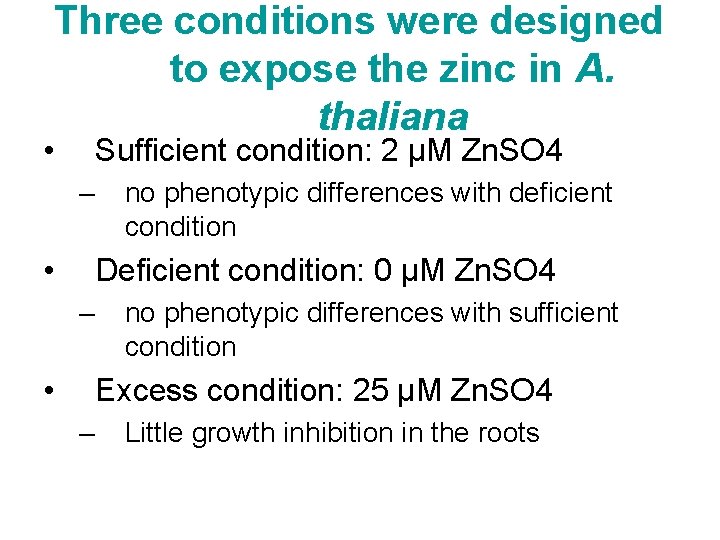
Three conditions were designed to expose the zinc in A. thaliana • Sufficient condition: 2 µM Zn. SO 4 – • no phenotypic differences with deficient condition Deficient condition: 0 µM Zn. SO 4 – • no phenotypic differences with sufficient condition Excess condition: 25 µM Zn. SO 4 – Little growth inhibition in the roots
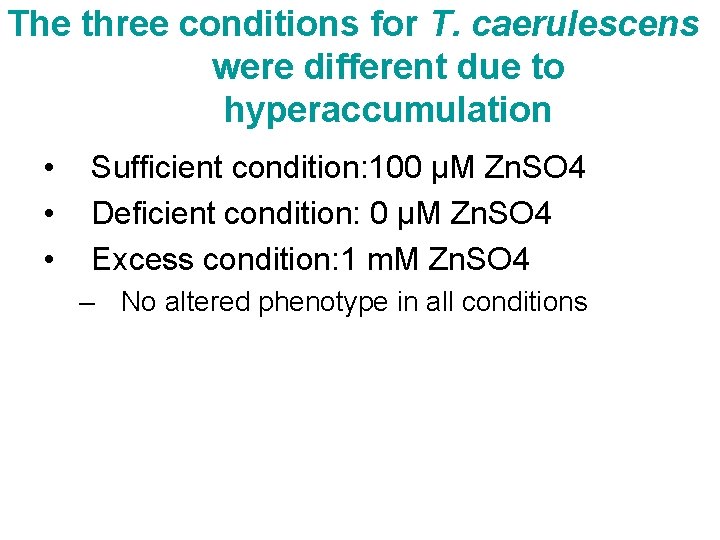
The three conditions for T. caerulescens were different due to hyperaccumulation • • • Sufficient condition: 100 µM Zn. SO 4 Deficient condition: 0 µM Zn. SO 4 Excess condition: 1 m. M Zn. SO 4 – No altered phenotype in all conditions
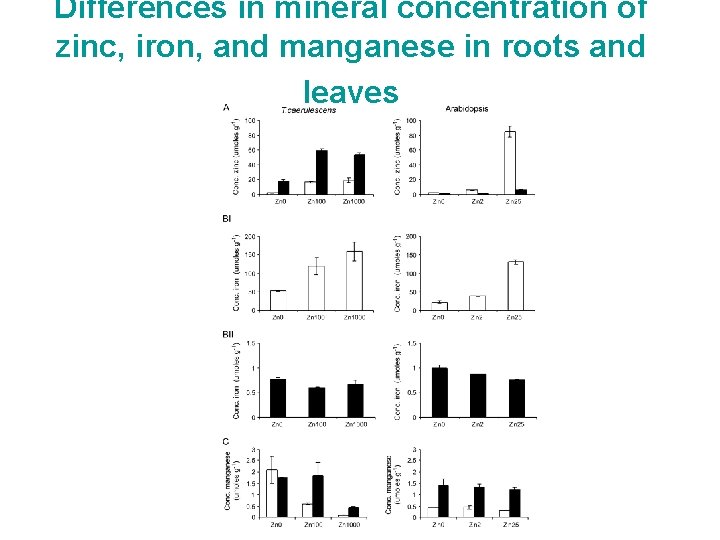
Differences in mineral concentration of zinc, iron, and manganese in roots and leaves
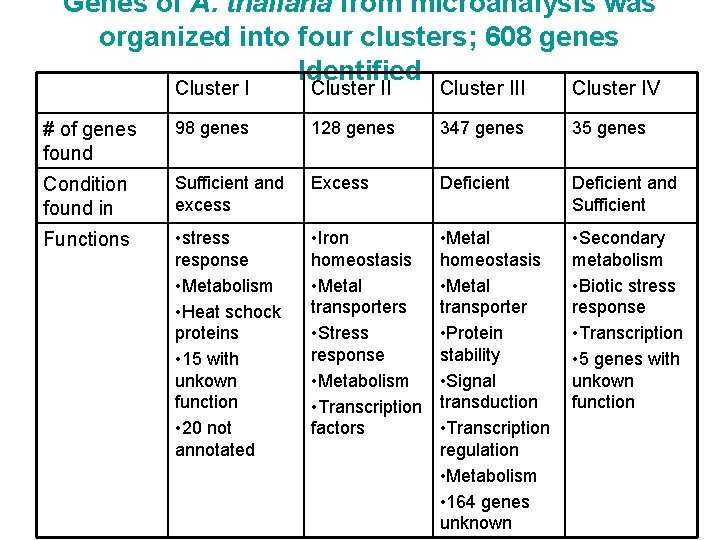
Genes of A. thaliana from microanalysis was organized into four clusters; 608 genes Identified Cluster III Cluster IV # of genes found 98 genes 128 genes 347 genes 35 genes Condition found in Sufficient and excess Excess Deficient and Sufficient Functions • stress response • Metabolism • Heat schock proteins • 15 with unkown function • 20 not annotated • Iron homeostasis • Metal transporters • Stress response • Metabolism • Transcription factors • Metal homeostasis • Metal transporter • Protein stability • Signal transduction • Transcription regulation • Metabolism • 164 genes unknown • Secondary metabolism • Biotic stress response • Transcription • 5 genes with unkown function
220 genes did not hybridize with T. caerulescens DNA • 85% - 90% DNA similarity in A. thaliana and T. caerulescens • Verified hybridization first with the use of sufficient conditions on both plants • Spot intensities were better in A. thaliana than T. caerulescens • The 220 genes were excluded from data
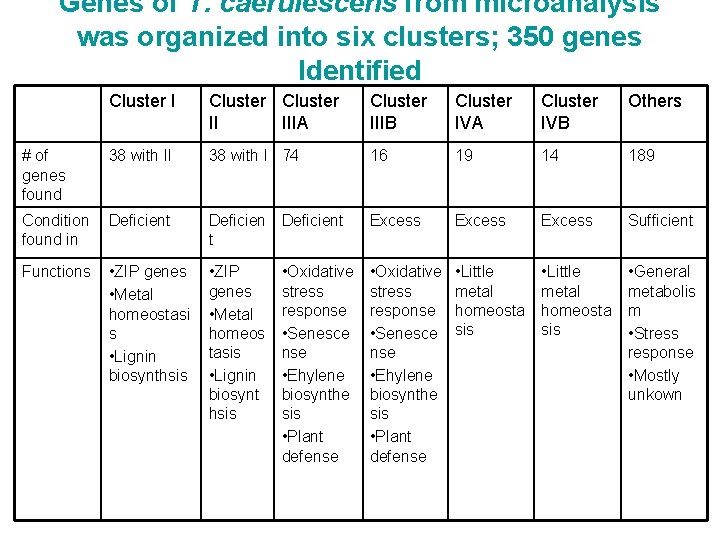
Genes of T. caerulescens from microanalysis was organized into six clusters; 350 genes Identified # of genes found Cluster II IIIA Cluster IIIB Cluster IVA Cluster IVB Others 38 with II 38 with I 74 16 19 14 189 Deficient t Excess Sufficient • ZIP genes • Metal homeos tasis • Lignin biosynt hsis • Oxidative stress response • Senesce nse • Ehylene biosynthe sis • Plant defense • Little metal homeosta sis • General metabolis m • Stress response • Mostly unkown Condition Deficient found in Functions • ZIP genes • Metal homeostasi s • Lignin biosynthsis • Oxidative stress response • Senesce nse • Ehylene biosynthe sis • Plant defense
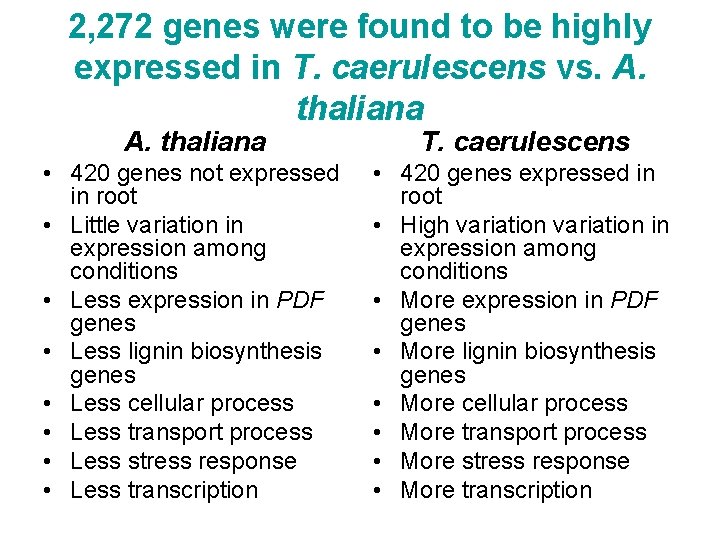
2, 272 genes were found to be highly expressed in T. caerulescens vs. A. thaliana T. caerulescens • 420 genes not expressed in root • Little variation in expression among conditions • Less expression in PDF genes • Less lignin biosynthesis genes • Less cellular process • Less transport process • Less stress response • Less transcription • 420 genes expressed in root • High variation in expression among conditions • More expression in PDF genes • More lignin biosynthesis genes • More cellular process • More transport process • More stress response • More transcription
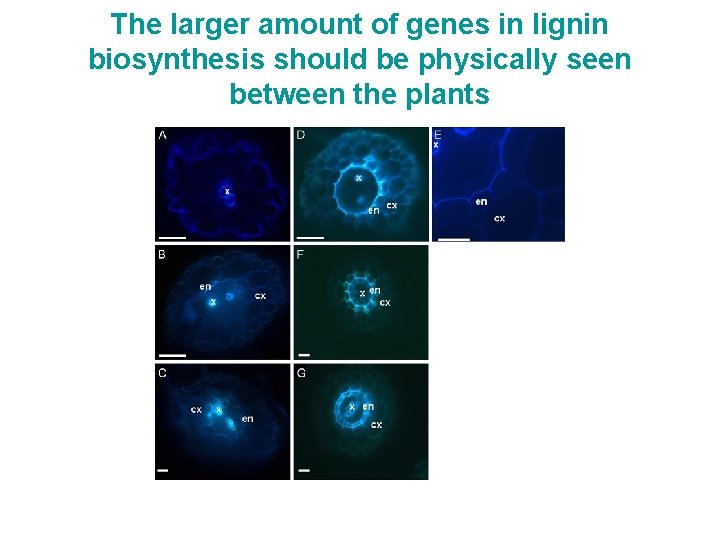
The larger amount of genes in lignin biosynthesis should be physically seen between the plants
Semiquantititaive Reverse Transcription. PCR used to confirm the genes expressions found in the microarray between the two plants
Zinc homeostasis found differential along with iron accumulation • T. caerulescens is able to maintain nontoxic zinc levels while translocating high amounts of zinc to the leaves • An unexpected event occurs and that is that iron accumulates in the roots of Arabidopsis and T. caerulescens at increasing zinc concentrations • The effect found in both species suggests that the increase in iron uptake is due to prevent possible risks of iron deficiency in leaves
Genes involved in zinc homeostasis are highly expressed in deficiency than other conditions • Some genes known to be involved in zinc homeostasis are ZIP 2, 4, 5 and 9, NAS 2 and HMA 2 genes • Highly expressed in zinc deficiency include ZIP 1, 3, and 10, IRT 3, MTP 2, and NAS 4 • These transporters are involved in the transport of cations across plasma membrane. Not all of them are involved in the uptake of zinc in the same tissue • It is likely that these transporters do similar functions in different parts of the roots or are found in intracellular membrane
NAS and YSL genes and their ability to be induced by zinc deficiency • NAS 2 and NAS 4 genes are highly expressed in roots under deficiency rather than sufficiency • YSL genes are also induced by zinc deficiency • YSL genes are implicated in the transport of NA metal chelates within the plant and the entry of metals to the phloem and xylem • YSL 2 and YSL 3 are slightly affected by different zinc treatments, which in turn lead them to find that genes were slightly induced by lower zinc concentrations
High zinc deficiency-induced expression of FRD 3, FRO 4, and FRO 5 • Arabidopsis was grown under zinc deficient conditions • This was a significant observation because FRD 3 has been known to be implicated for the most part with iron homeostasis • FRO 4 and FRO 5 approximate the ferric chelate reductase gene FRO 2, in the contrary to FRO 2 their expression was not induced in the root of Arabidopsis upon iron deficiency
128 genes of Arabidopsis was more highly expressed in excess • The expression of these genes is related to a defense against oxidative stress caused by the treatment of zinc • Large fraction of these genes was found to have an expressed comparison between wild type Arabidopsis and fit 1 mutant
T. caerulescens has a smaller differential in genes • For this species the response to zinc deficiency and zinc excess is quite different from Arabidopsis • Unlike Arabidopsis, T. caerulescens expresses the ZIP family (ZIP 3, 4, and 9) under zinc sufficient conditions • Similar to Arabidopsis, T. caerulescens also expresses a cluster of genes in zinc deficient conditions, but this cluster is quite smaller. The probable cause for this is differences in hybridization efficiency
NAS genes and their importance to T. caerulescens • The expression of these three NAS genes in T. caerulescens suggest that they are a major function for metal adaptation • The presence of these genes indicates that there will be flexibility when it comes to NAS gene expression
Genes expressed differently from T. caerulescens and Arabidopsis • There are more than 2200 genes which are quite significant and differentially expressed in the three zinc treatments • 50% of the genes found in T. caerulescens are of unknown function • Stress respond genes expressed in T. caerulescens are different from Arabidopsis
Expressed genes that were found and biological role is unclear • Several expressed genes were 100 -fold on T. caerulescens. These genes were defensin genes or PDF genes • These genes included 15 genes which 4 were PDF genes. One of these PDF genes included one that was close to being 1000 fold which was expressed in both deficient and excess zinc (PDF 1. 1) • The biological role of defensin is unclear
Arabidopsis had low expression of PDF genes • Jasmonic acid (stress hormone) is responsible for the expression of PDF 1. 2 in Arabidopsis • Heavy metal stress is involved in the accumulation of jasmonic acid – PDF 1. 2 a, 1. 2 b, 1, 2 c, and 1. 3 are induced upon potassium starvation. These genes suggest a relation between jasmonic signaling and potassium starvation • 46 genes were found to be more highly expressed in T. caerulescens than in Arabidopsis – Potassium transporter genes HAK 5, KUP 3, and KAT, were found to be highly expressed in T.
Zinc hyperaccumulation trait in T. caerulescens and the required expression of metal hyperaccumulation genes • Considered 16 highly expressed genes at 100 micrometer Zn. SO 4, of which 4 were known to be Zinc transporters HMA 4, MTP 1, ZIP 1, and IRT 3 – In the study conducted by Papoyan and Kochian HMA 4 was identified to being involved in zinc hyperaccumulation, particular loading of zinc into the xylem • Other Zinc transporters that were highly expressed in T. caerulescens included HMA 3, MTP 8, and NRAMP 3 – HMA 3 is similar to HMA 4, and in Arabidopsis the expression of this gene is not affected by exposure to
Genes found to contribute in the movement of zinc • The MTP 8 gene is a member of the cation diffusion facilitator family – This gene was found to be highly expressed in T. caerulescens at sufficient and deficient conditions compared to Arabidopsis • At. NRAMP 2 is a vacuolar transporter is able to transport cadmium and iron. The induction of Tc. NRAMP 3 gene expression by deficiency of zinc suggests it has an important role in the movement of zinc and iron in T. caerulescens and Arabidopsis
Iron homeostasis genes and the unexpected outcome that resulted between T. caerulescens and Arabidopsis • IRT 1, IRT 2, and FRO 2 (iron homeostasis genes) were not induced in T. caerulescens upon excess treatment of zinc • Testing with RT-PCR did not detect the expression of TCIRT 1 except in roots at lower levels of zinc • This suggests that T. caerulescens is able to regulate its iron and zinc homeostasis independently, unlike Arabidopsis, or that continued expression of zinc transporters enables low efficiency but enough iron uptake in T. caerulescens
Expression of similar genes and the different outcome between T. caerulescens and Arabidopsis • High expression of 24 genes suggested a function in lignin biosynthesis, and 13 genes are involved in suberin biosynthesis in T. caerulescens • These genes included (CER 3, CER 6, and 11 LTP genes) • CER 3 is known to be expressed in the roots of Arabidopsis, but the expression of similar gene CER 6 in the roots of T. caerulescens is quite different • High expression of lignin and suberin biosynthesis concurs well with the U-shaped lignification and suberinization of the endodermis cells and the occasional presence of second endodermal layer found in the roots of T. caerulescens • This U-shape appearance is uncommon in plants, this usually occurs at older sections of the root hairs when they are no longer active • Suggesting that this layer helps to prevent the eflux of metals from the vascular cylinder
Genes differentially expressed certain alterations in transcript levels may occur • 131 transcriptional regulators with more than 5 -fold higher expression were found in T. caerulescens • Of the 19 genes that were more than 10 -fold higher expressed in zinc deficient conditions 2 genes (INO and SPL) are said to be involved with the development of flowers in Arabidopsis but expression is irregular • Similar to this irregular expression it was also found that FIS 2 gene is more highly expressed in the roots of T. caerulescens – In Arabidopsis, this gene is expressed in the development of seeds – This gene is found in A. halleri and is induced in the response to the exposure of zinc
Comparative analyses show T. caerulescens and Arabidopsis show role in zinc homeostasis genes and there adaptation to high zinc exposure • The analysis also suggests that there are many uncharacterized genes with similar functions and that there are many that are unaccounted for and their functions are unknown • While some of the genes were differentially expressed between A. halleri and Arabidopsis: – Many of them were not at different levels – Thus, suggesting an overlap in mechanisms of metal accumulation and tolerance
References • van de Mortel JE, Almar Villanueva L, Schat H, Kwekkeboom J, Coughlan S, Moerland PD, Ver Loren van Themaat E, Koornneef M, and Aarts MG. Large expression differences in genes for iron and zinc homeostasis, stress response, and lignin biosynthesis distinguish roots of Arabidopsis thaliana and the related metal hyperaccumulator Thlaspi caerulescens. Plant Physiol 2006 Nov; 142(3) 1127 -47.