
Large bolometer arrays on radio telescopes Simon Dicker
Large bolometer arrays on radio telescopes. Simon Dicker
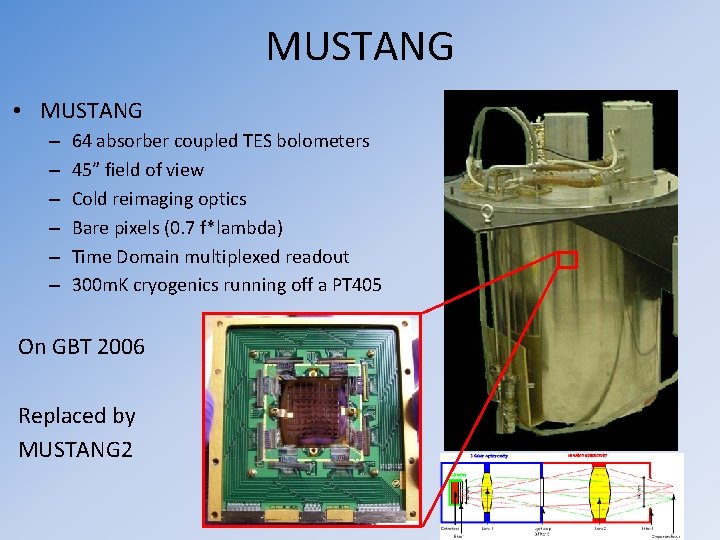
MUSTANG • MUSTANG – – – 64 absorber coupled TES bolometers 45” field of view Cold reimaging optics Bare pixels (0. 7 f*lambda) Time Domain multiplexed readout 300 m. K cryogenics running off a PT 405 On GBT 2006 Replaced by MUSTANG 2
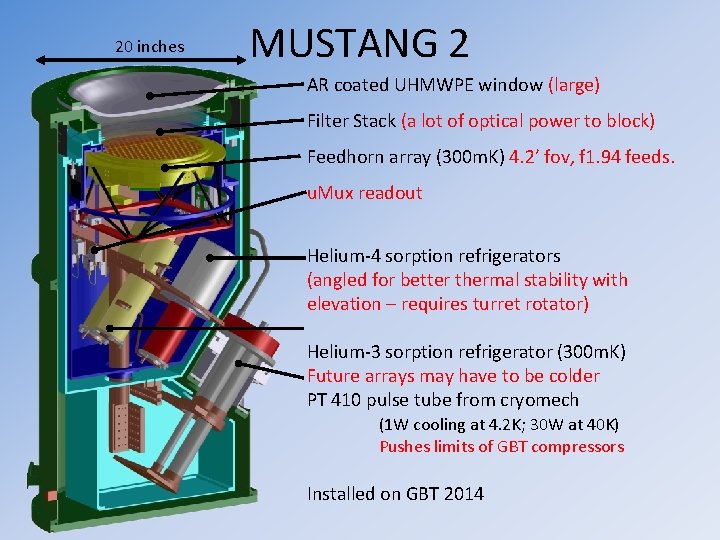
20 inches MUSTANG 2 AR coated UHMWPE window (large) Filter Stack (a lot of optical power to block) Feedhorn array (300 m. K) 4. 2’ fov, f 1. 94 feeds. u. Mux readout Helium-4 sorption refrigerators (angled for better thermal stability with elevation – requires turret rotator) Helium-3 sorption refrigerator (300 m. K) Future arrays may have to be colder PT 410 pulse tube from cryomech (1 W cooling at 4. 2 K; 30 W at 40 K) Pushes limits of GBT compressors Installed on GBT 2014
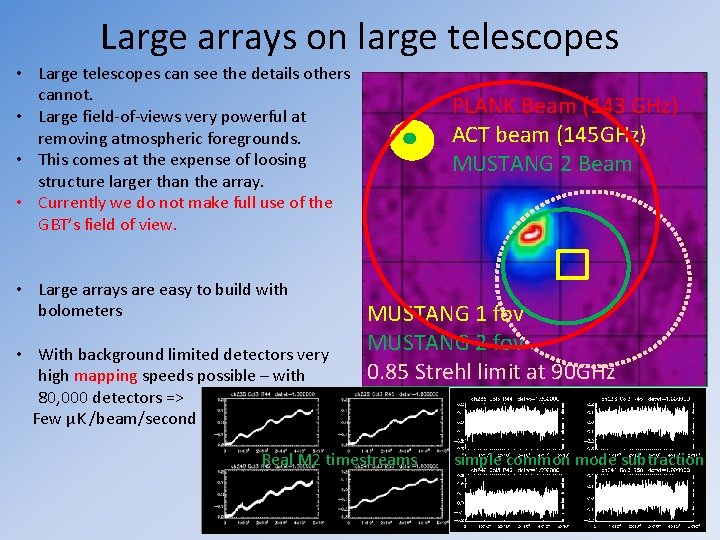
Large arrays on large telescopes • Large telescopes can see the details others cannot. • Large field-of-views very powerful at removing atmospheric foregrounds. • This comes at the expense of loosing structure larger than the array. • Currently we do not make full use of the GBT’s field of view. • Large arrays are easy to build with bolometers • With background limited detectors very high mapping speeds possible – with 80, 000 detectors => Few µK /beam/second PLANK Beam (143 GHz) ACT beam (145 GHz) MUSTANG 2 Beam MUSTANG 1 fov MUSTANG 2 fov 0. 85 Strehl limit at 90 GHz Real M 2 timestreams simple common mode subtraction

Bolometers TES sensors = voltage biased superconductor • Simple operation – absorb the power, measure the temperature • Absorbs all wavelengths, need filters to define band • Use Heat sinks from 4 K to 100 m. K • Originally used NTD thermometers • Currently nearly all mm and submm bolometers use Transition Edge Sensors (TES) • Can be made in large quantities • Electrothermal feedback => fast time constants Bi covered 1µm thick absorbing membrane 10µm thick legs TES sensor 3. 3 mm Silicon frame MUSTANG bolometers (original design)
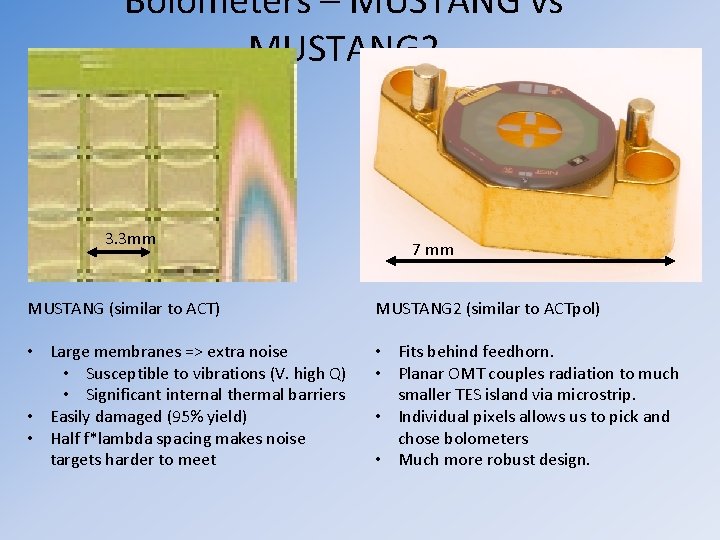
Bolometers – MUSTANG vs MUSTANG 2 3. 3 mm 7 mm MUSTANG (similar to ACT) MUSTANG 2 (similar to ACTpol) • Large membranes => extra noise • Susceptible to vibrations (V. high Q) • Significant internal thermal barriers • Easily damaged (95% yield) • Half f*lambda spacing makes noise targets harder to meet • Fits behind feedhorn. • Planar OMT couples radiation to much smaller TES island via microstrip. • Individual pixels allows us to pick and chose bolometers • Much more robust design.
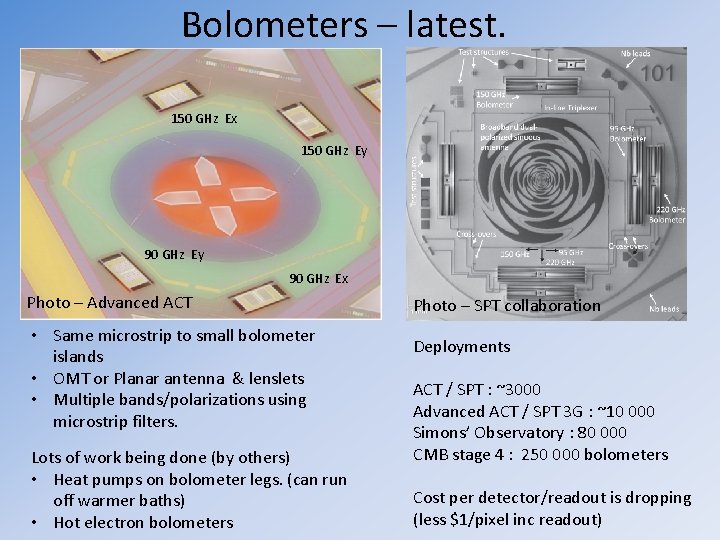
Bolometers – latest. 150 GHz Ex 150 GHz Ey 90 GHz Ex Photo – Advanced ACT • Same microstrip to small bolometer islands • OMT or Planar antenna & lenslets • Multiple bands/polarizations using microstrip filters. Lots of work being done (by others) • Heat pumps on bolometer legs. (can run off warmer baths) • Hot electron bolometers Photo – SPT collaboration Deployments ACT / SPT : ~3000 Advanced ACT / SPT 3 G : ~10 000 Simons’ Observatory : 80 000 CMB stage 4 : 250 000 bolometers Cost per detector/readout is dropping (less $1/pixel inc readout)
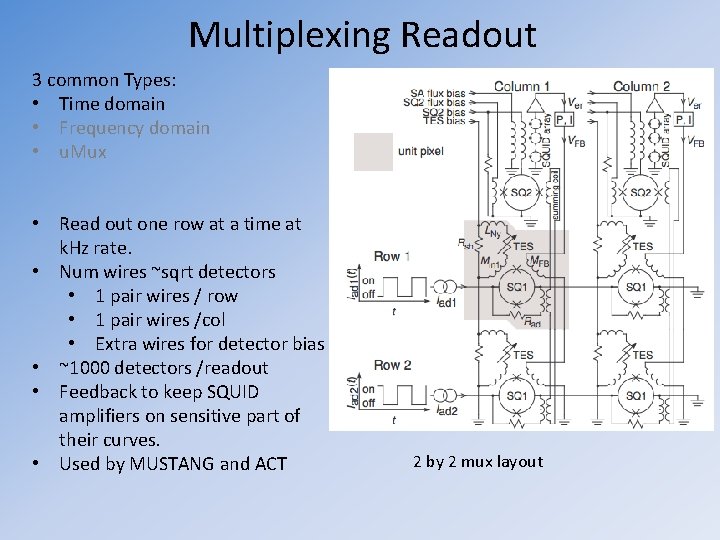
Multiplexing Readout 3 common Types: • Time domain • Frequency domain • u. Mux • Read out one row at a time at k. Hz rate. • Num wires ~sqrt detectors • 1 pair wires / row • 1 pair wires /col • Extra wires for detector bias • ~1000 detectors /readout • Feedback to keep SQUID amplifiers on sensitive part of their curves. • Used by MUSTANG and ACT 2 by 2 mux layout
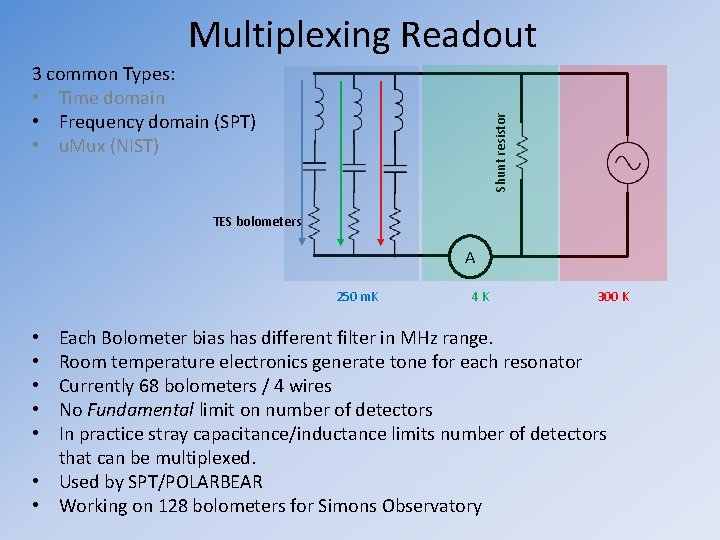
Multiplexing Readout Shunt resistor 3 common Types: • Time domain • Frequency domain (SPT) • u. Mux (NIST) TES bolometers A 250 m. K 4 K 300 K Each Bolometer bias has different filter in MHz range. Room temperature electronics generate tone for each resonator Currently 68 bolometers / 4 wires No Fundamental limit on number of detectors In practice stray capacitance/inductance limits number of detectors that can be multiplexed. • Used by SPT/POLARBEAR • Working on 128 bolometers for Simons Observatory • • •
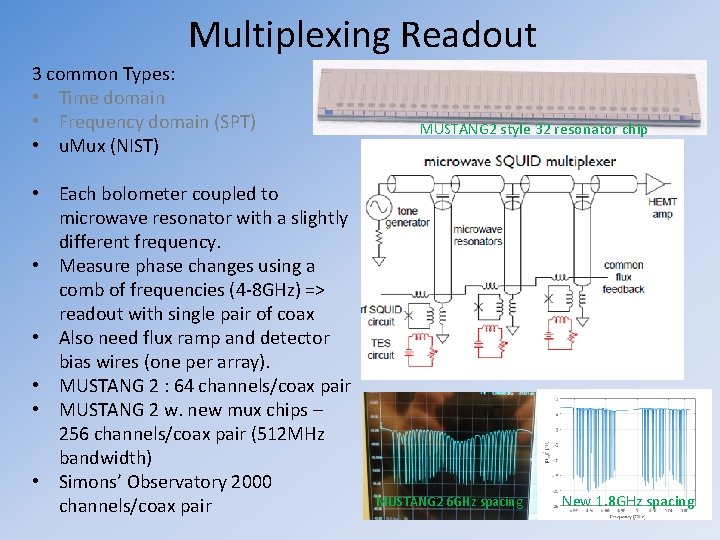
Multiplexing Readout 3 common Types: • Time domain • Frequency domain (SPT) • u. Mux (NIST) • Each bolometer coupled to microwave resonator with a slightly different frequency. • Measure phase changes using a comb of frequencies (4 -8 GHz) => readout with single pair of coax • Also need flux ramp and detector bias wires (one per array). • MUSTANG 2 : 64 channels/coax pair • MUSTANG 2 w. new mux chips – 256 channels/coax pair (512 MHz bandwidth) • Simons’ Observatory 2000 channels/coax pair MUSTANG 2 style 32 resonator chip MUSTANG 2 6 GHz spacing New 1. 8 GHz spacing
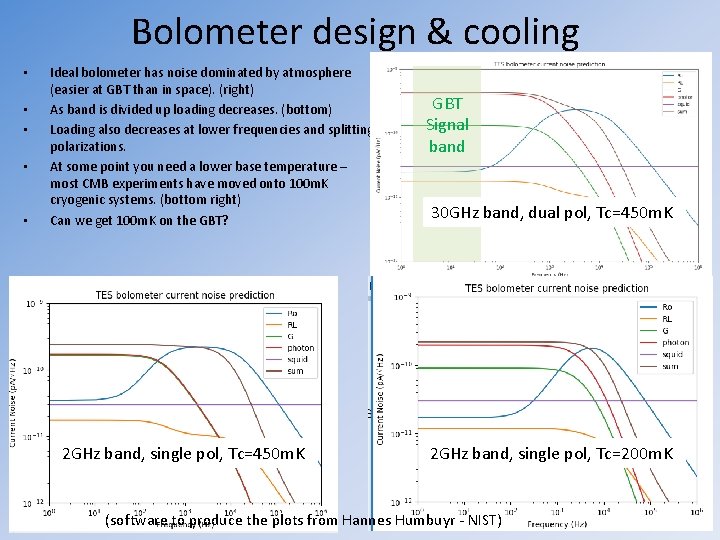
Bolometer design & cooling • • • Ideal bolometer has noise dominated by atmosphere (easier at GBT than in space). (right) As band is divided up loading decreases. (bottom) Loading also decreases at lower frequencies and splitting polarizations. At some point you need a lower base temperature – most CMB experiments have moved onto 100 m. K cryogenic systems. (bottom right) Can we get 100 m. K on the GBT? 2 GHz band, single pol, Tc=450 m. K GBT Signal band 30 GHz band, dual pol, Tc=450 m. K 2 GHz band, single pol, Tc=200 m. K (software to produce the plots from Hannes Humbuyr - NIST)
Possible ideas • K-band MUSTANG 2 – Replace the array, & filters. Rest of hardware stays the same. – Can swap arrays for summer/winter. • R=few “spectrometer” array – Splitting the bands would give you a spectral index map as well as intensity with no noise penalty. – Current backend could readout 1024 bolometers. – Band variation could be an issue. • Polarization – Calibration angle could be tricky – how well do we need to know this? • Use the full field of view (~10’ would require ~24” window) – Would have to “overflow” the 24” turret slot
- Slides: 12