
Large Area Tracking Systems Based on Scintillating Fibres
Large Area Tracking Systems Based on Scintillating Fibres Read Out by Si. PMs The new Fibre Tracker for LHCb Christian Joram, CERN / PH INFIERI Summer School 2014 Christian Joram CERN PH/DT 2014 18 July 1
Outline • Basics of scintillating fibres • Tracking with scintillating fibres. Pros and cons. • A bit of history • Short recap of Si. PM technology • The LHCb Sci. Fi Tracker • LHCb Sci. Fi R&D: Challenges, strategies, status Christian Joram CERN PH/DT 18 July 2014 2
Basics of scintillating fibres Christian Joram CERN PH/DT 18 July 2014 3
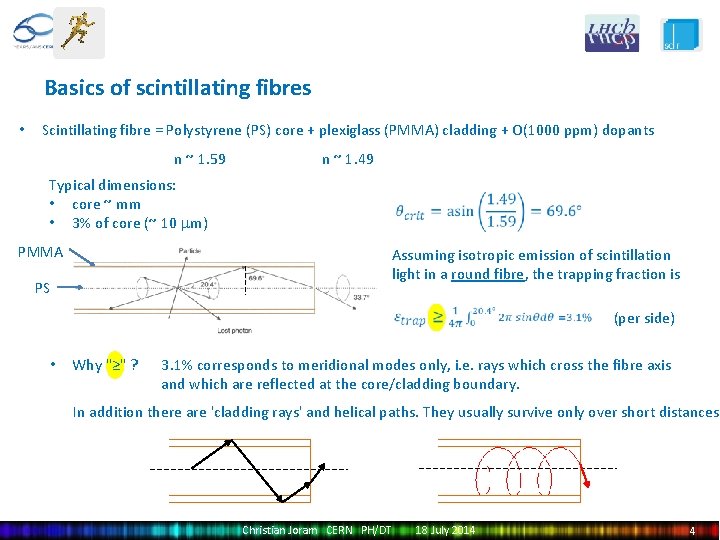
Basics of scintillating fibres • Scintillating fibre = Polystyrene (PS) core + plexiglass (PMMA) cladding + O(1000 ppm) dopants n ~ 1. 59 n ~ 1. 49 Typical dimensions: • core ~ mm • 3% of core (~ 10 mm) PMMA Assuming isotropic emission of scintillation light in a round fibre, the trapping fraction is PS (per side) • Why "≥" ? 3. 1% corresponds to meridional modes only, i. e. rays which cross the fibre axis and which are reflected at the core/cladding boundary. In addition there are 'cladding rays' and helical paths. They usually survive only over short distances. Christian Joram CERN PH/DT 18 July 2014 4
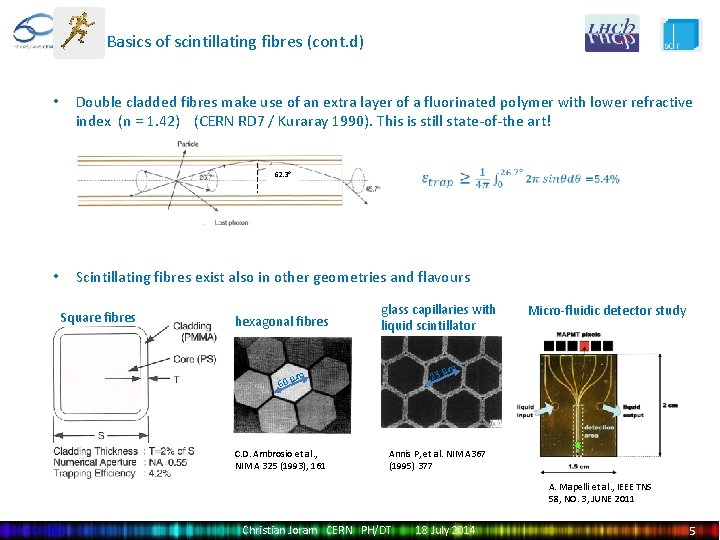
Basics of scintillating fibres (cont. d) • Double cladded fibres make use of an extra layer of a fluorinated polymer with lower refractive index (n = 1. 42) (CERN RD 7 / Kuraray 1990). This is still state-of-the art! 62. 3° • Scintillating fibres exist also in other geometries and flavours Square fibres hexagonal fibres m 60 glass capillaries with liquid scintillator m 23 m C. D. Ambrosio et al. , NIM A 325 (1993), 161 Micro-fluidic detector study m Annis P, et al. NIM A 367 (1995) 377 A. Mapelli et al. , IEEE TNS 58, NO. 3, JUNE 2011 Christian Joram CERN PH/DT 18 July 2014 5
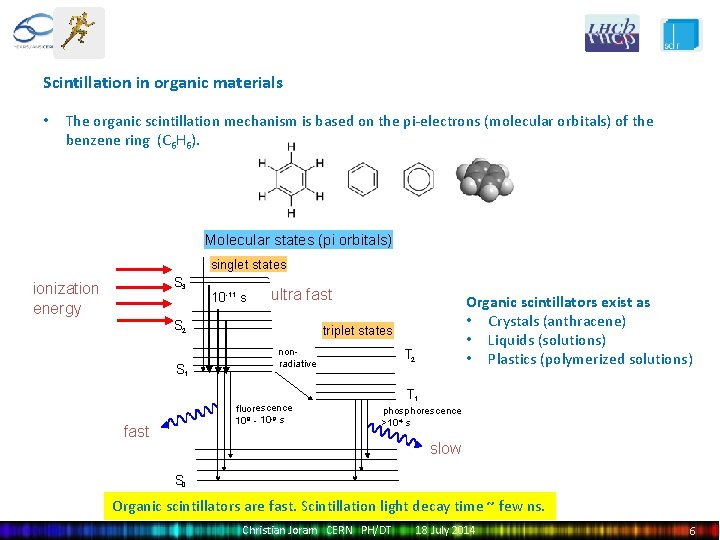
Scintillation in organic materials • The organic scintillation mechanism is based on the pi-electrons (molecular orbitals) of the benzene ring (C 6 H 6). Molecular states (pi orbitals) singlet states S 3 ionization energy 10 -11 s ultra fast S 2 S 1 triplet states nonradiative fluorescence 10 -8 - 10 -9 s fast Organic scintillators exist as • Crystals (anthracene) • Liquids (solutions) • Plastics (polymerized solutions) T 2 T 1 phosphorescence >10 -4 s slow S 0 Organic scintillators are fast. Scintillation light decay time ~ few ns. Christian Joram CERN PH/DT 18 July 2014 6
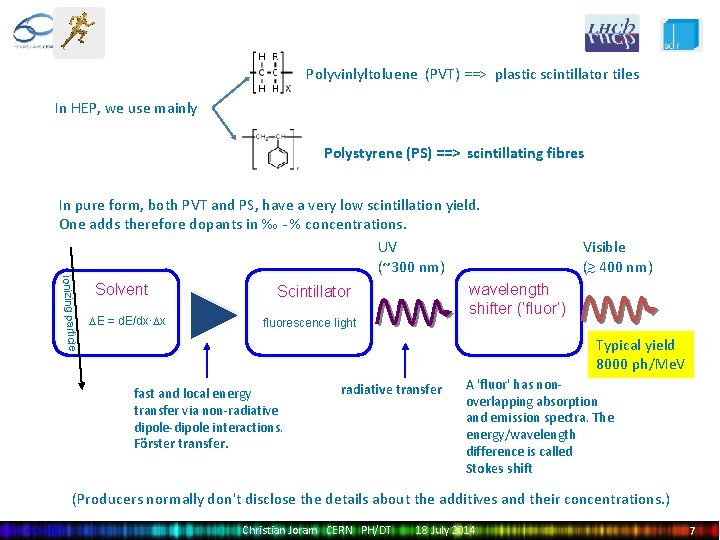
Polyvinlyltoluene (PVT) ==> plastic scintillator tiles In HEP, we use mainly Polystyrene (PS) ==> scintillating fibres ionizing particle In pure form, both PVT and PS, have a very low scintillation yield. One adds therefore dopants in ‰ - % concentrations. UV (~300 nm) Solvent wavelength Scintillator shifter (‘fluor’) E = d. E/dx· x Visible (> ~ 400 nm) fluorescence light Typical yield 8000 ph/Me. V fast and local energy transfer via non-radiative dipole-dipole interactions. Förster transfer. radiative transfer A 'fluor' has nonoverlapping absorption and emission spectra. The energy/wavelength difference is called Stokes shift (Producers normally don't disclose the details about the additives and their concentrations. ) Christian Joram CERN PH/DT 18 July 2014 7
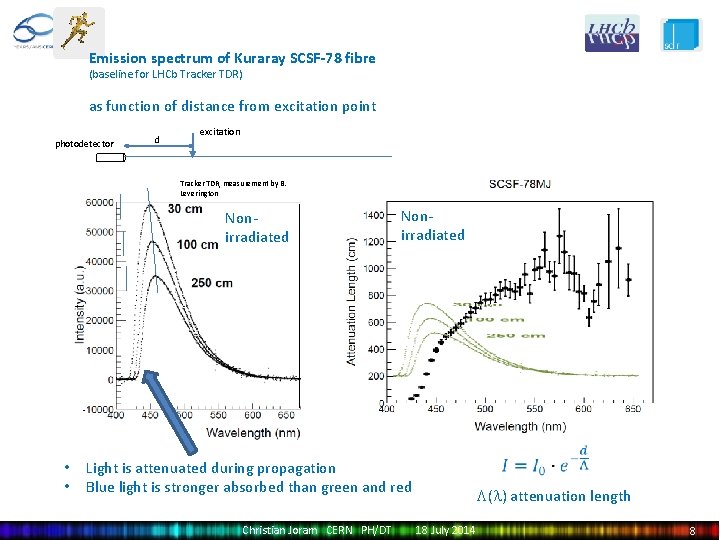
Emission spectrum of Kuraray SCSF-78 fibre (baseline for LHCb Tracker TDR) as function of distance from excitation point photodetector d excitation Tracker TDR, measurement by B. Leverington Nonirradiated • • Nonirradiated Light is attenuated during propagation Blue light is stronger absorbed than green and red Christian Joram CERN PH/DT L(l) attenuation length 18 July 2014 8
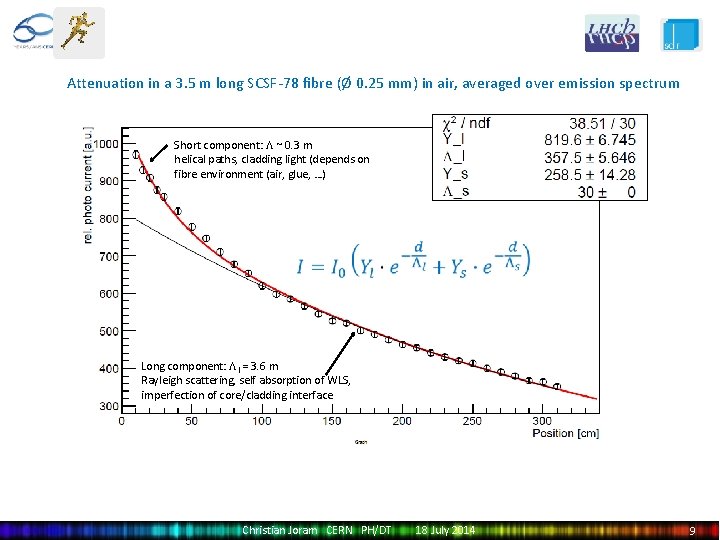
Attenuation in a 3. 5 m long SCSF-78 fibre (Ø 0. 25 mm) in air, averaged over emission spectrum Short component: L ~ 0. 3 m helical paths, cladding light (depends on fibre environment (air, glue, …) Long component: Ll = 3. 6 m Rayleigh scattering, self absorption of WLS, imperfection of core/cladding interface Christian Joram CERN PH/DT 18 July 2014 9
Radiation damage of scintillating plastic fibres C. Zorn, A pedestrian's guide to radiation damage in plastic scintillators, Nuclear Physics B - Proceedings Supplements 32 (1993), no. 0 377 • Mainly studied in the 1990 ies, but often poor dosimetry and not very well documented. • Literature gives partly contradictory results / interpretations (impact of radiation type, dose rate, environment). • Agreement that the main effect of ionizing radiation is a degradation of the transparency of the core material (PS), while scintillation yield and spectrum are unaffected. • Radiation leads to the formation of radicals in the fibre which act as colour centres. Those can in principle react with oxygen and anneal. Environmental parameters may therefore play a role. • Viability of a fibre depends crucially on its length and the dose distribution along the fibre in the specific application. Irradiation tests should therefore be performed under conditions which resemble as much as possible the ones met in the experiment. Christian Joram CERN PH/DT 18 July 2014 10
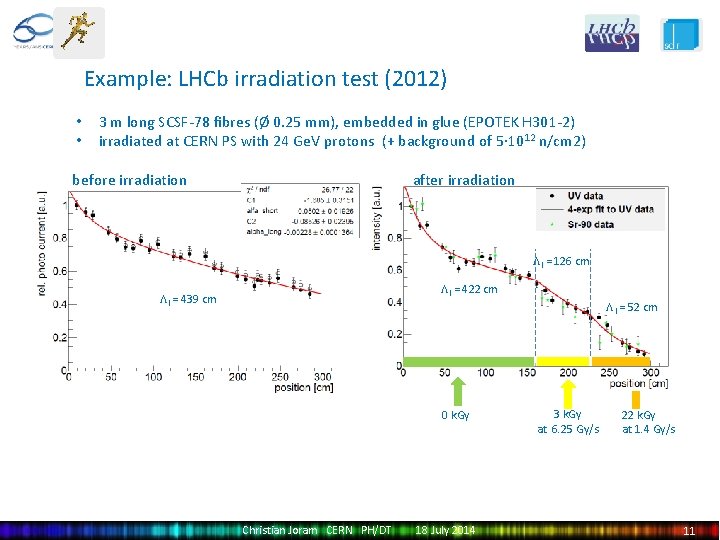
Example: LHCb irradiation test (2012) • • 3 m long SCSF-78 fibres (Ø 0. 25 mm), embedded in glue (EPOTEK H 301 -2) irradiated at CERN PS with 24 Ge. V protons (+ background of 5· 1012 n/cm 2) before irradiation after irradiation Ll = 126 cm Ll = 422 cm Ll = 439 cm Ll = 52 cm 0 k. Gy Christian Joram CERN PH/DT 18 July 2014 3 k. Gy at 6. 25 Gy/s 22 k. Gy at 1. 4 Gy/s 11
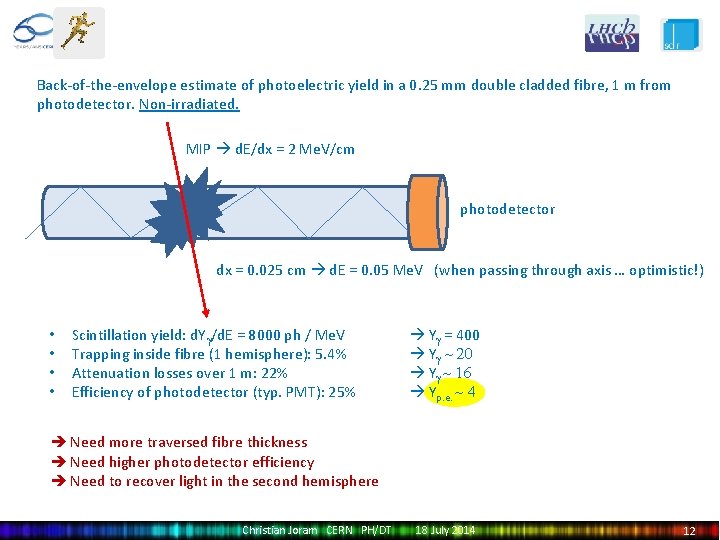
Back-of-the-envelope estimate of photoelectric yield in a 0. 25 mm double cladded fibre, 1 m from photodetector. Non-irradiated. MIP d. E/dx = 2 Me. V/cm photodetector dx = 0. 025 cm d. E = 0. 05 Me. V (when passing through axis … optimistic!) • • Scintillation yield: d. Yg/d. E = 8000 ph / Me. V Trapping inside fibre (1 hemisphere): 5. 4% Attenuation losses over 1 m: 22% Efficiency of photodetector (typ. PMT): 25% Yg = 400 Yg ~ 20 Yg ~ 16 Yp. e. ~ 4 Need more traversed fibre thickness Need higher photodetector efficiency Need to recover light in the second hemisphere Christian Joram CERN PH/DT 18 July 2014 12
A tracker serves to detect particles with • high efficiency enough light, low threshold • good spatial resolution fibre diameter, readout geometry, mechanical precision In addition… • it should give no/few false hits (ghosts) low noise • It should have low mass • It should survive the radiation damage • It should be affordable • LHCb specific: it should allow for fast readout rate (40 MHz) Christian Joram CERN PH/DT 18 July 2014 13
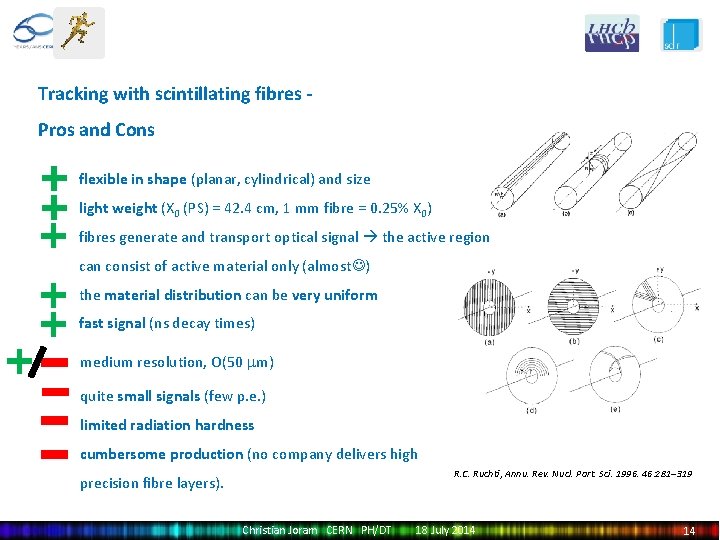
Tracking with scintillating fibres Pros and Cons flexible in shape (planar, cylindrical) and size light weight (X 0 (PS) = 42. 4 cm, 1 mm fibre = 0. 25% X 0) fibres generate and transport optical signal the active region can consist of active material only (almost ) the material distribution can be very uniform fast signal (ns decay times) medium resolution, O(50 mm) quite small signals (few p. e. ) limited radiation hardness cumbersome production (no company delivers high R. C. Ruchti, Annu. Rev. Nucl. Part. Sci. 1996. 46: 281– 319 precision fibre layers). Christian Joram CERN PH/DT 18 July 2014 14

A bit of history Christian Joram CERN PH/DT 18 July 2014 15
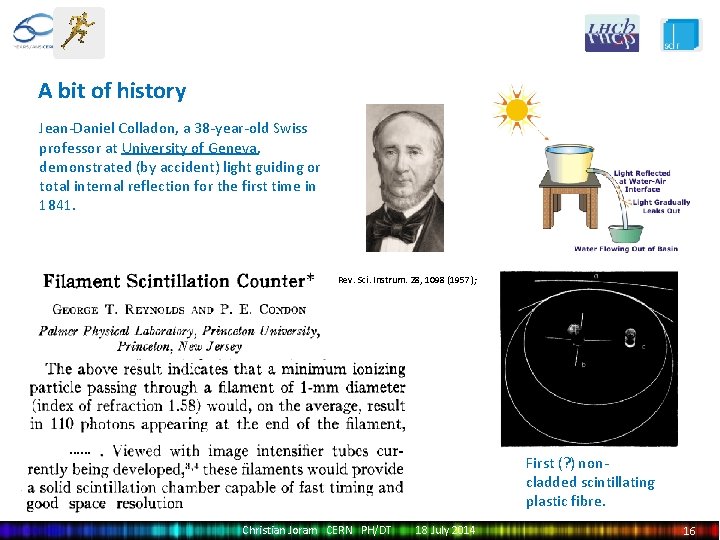
A bit of history Jean-Daniel Colladon, a 38 -year-old Swiss professor at University of Geneva, demonstrated (by accident) light guiding or total internal reflection for the first time in 1841. Rev. Sci. Instrum. 28, 1098 (1957); …… First (? ) noncladded scintillating plastic fibre. Christian Joram CERN PH/DT 18 July 2014 16
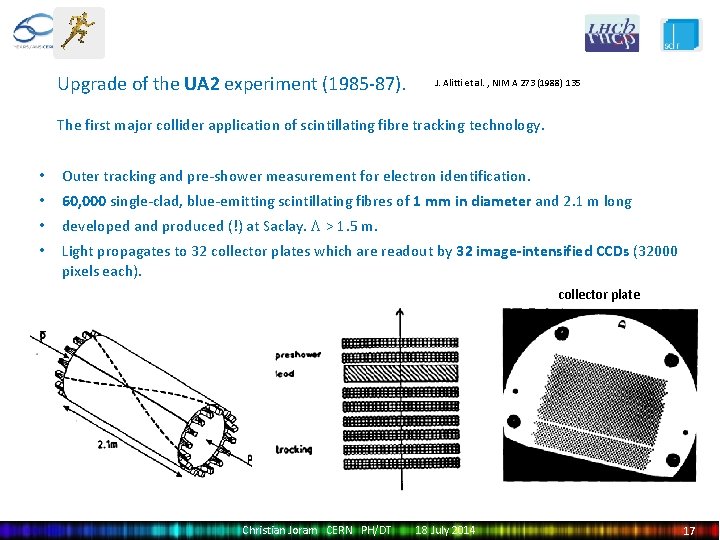
Upgrade of the UA 2 experiment (1985 -87). J. Alitti et al. , NIM A 273 (1988) 135 The first major collider application of scintillating fibre tracking technology. • Outer tracking and pre-shower measurement for electron identification. • 60, 000 single-clad, blue-emitting scintillating fibres of 1 mm in diameter and 2. 1 m long • developed and produced (!) at Saclay. L > 1. 5 m. • Light propagates to 32 collector plates which are readout by 32 image-intensified CCDs (32000 pixels each). collector plate Christian Joram CERN PH/DT 18 July 2014 17
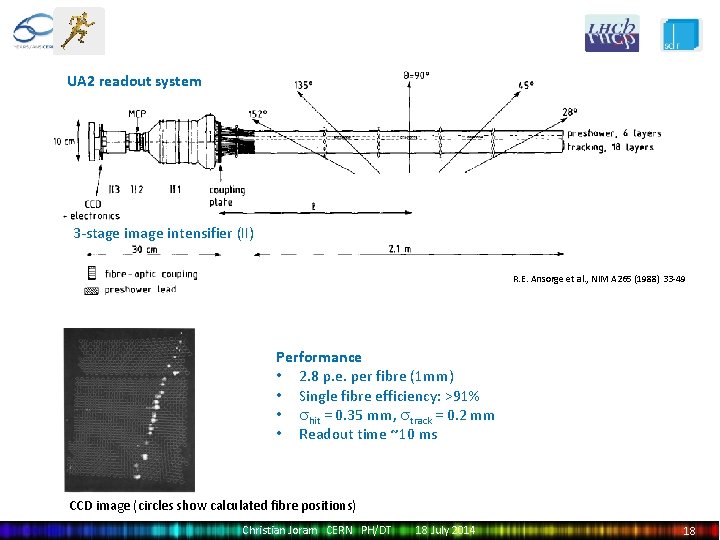
UA 2 readout system 3 -stage image intensifier (II) R. E. Ansorge et al. , NIM A 265 (1988) 33 -49 Performance • 2. 8 p. e. per fibre (1 mm) • Single fibre efficiency: >91% • shit = 0. 35 mm, strack = 0. 2 mm • Readout time ~10 ms CCD image (circles show calculated fibre positions) Christian Joram CERN PH/DT 18 July 2014 18
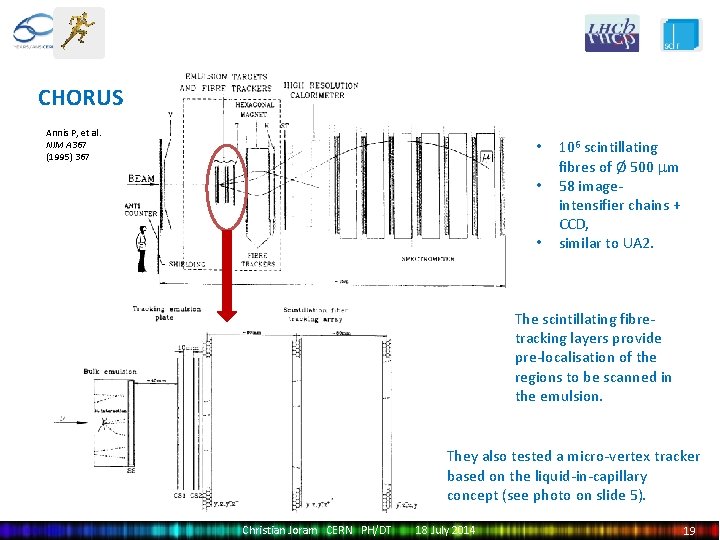
CHORUS Annis P, et al. NIM A 367 (1995) 367 • • • 106 scintillating fibres of Ø 500 mm 58 imageintensifier chains + CCD, similar to UA 2. The scintillating fibretracking layers provide pre-localisation of the regions to be scanned in the emulsion. They also tested a micro-vertex tracker based on the liquid-in-capillary concept (see photo on slide 5). Christian Joram CERN PH/DT 18 July 2014 19
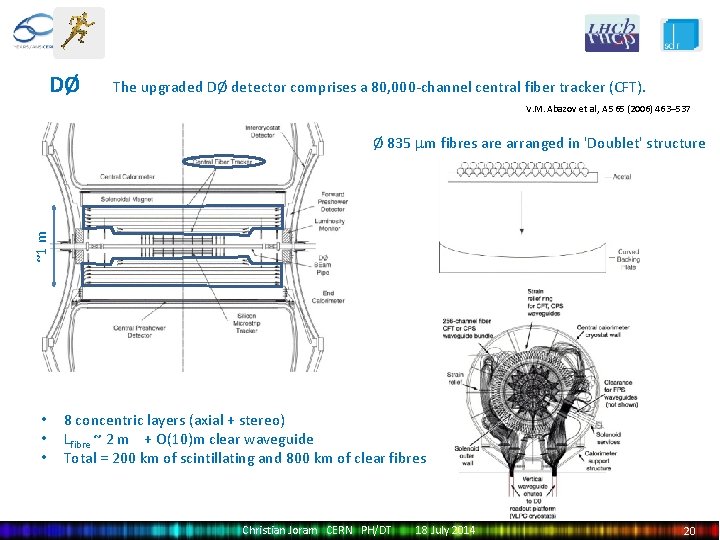
DØ The upgraded DØ detector comprises a 80, 000 -channel central fiber tracker (CFT). V. M. Abazov et al, A 565 (2006) 463– 537 ~1 m Ø 835 mm fibres are arranged in 'Doublet' structure • • • 8 concentric layers (axial + stereo) Lfibre ~ 2 m + O(10)m clear waveguide Total = 200 km of scintillating and 800 km of clear fibres Christian Joram CERN PH/DT 18 July 2014 20
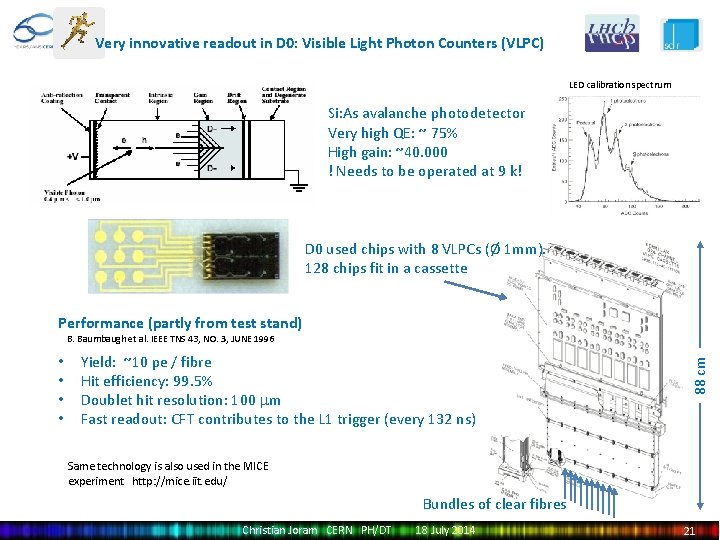
Very innovative readout in D 0: Visible Light Photon Counters (VLPC) LED calibration spectrum Si: As avalanche photodetector Very high QE: ~ 75% High gain: ~40. 000 ! Needs to be operated at 9 k! D 0 used chips with 8 VLPCs (Ø 1 mm). 128 chips fit in a cassette Performance (partly from test stand) • • Yield: ~10 pe / fibre Hit efficiency: 99. 5% Doublet hit resolution: 100 mm Fast readout: CFT contributes to the L 1 trigger (every 132 ns) 88 cm B. Baumbaugh et al. IEEE TNS 43, NO. 3, JUNE 1996 Same technology is also used in the MICE experiment http: //mice. iit. edu/ Bundles of clear fibres Christian Joram CERN PH/DT 18 July 2014 21
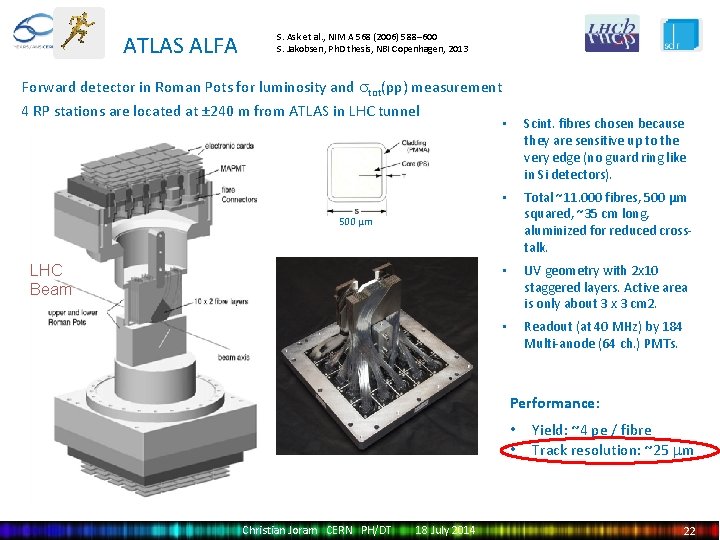
ATLAS ALFA S. Ask et al. , NIM A 568 (2006) 588– 600 S. Jakobsen, Ph. D thesis, NBI Copenhagen, 2013 Forward detector in Roman Pots for luminosity and stot(pp) measurement 4 RP stations are located at ± 240 m from ATLAS in LHC tunnel • Scint. fibres chosen because they are sensitive up to the very edge (no guard ring like in Si detectors). • Total ~11. 000 fibres, 500 µm squared, ~35 cm long, aluminized for reduced crosstalk. • UV geometry with 2 x 10 staggered layers. Active area is only about 3 x 3 cm 2. • Readout (at 40 MHz) by 184 Multi-anode (64 ch. ) PMTs. 500 µm LHC Beam Performance: • • Christian Joram CERN PH/DT 18 July 2014 Yield: ~4 pe / fibre Track resolution: ~25 mm 22
A short recap of Si. PM technology Christian Joram CERN PH/DT 18 July 2014 23
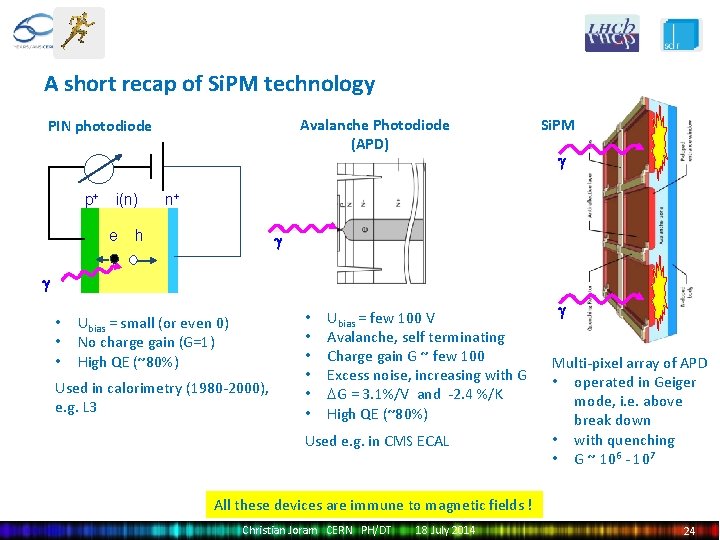
A short recap of Si. PM technology Avalanche Photodiode (APD) PIN photodiode p+ i(n) e Si. PM g n+ h g g • • • Ubias = small (or even 0) No charge gain (G=1) High QE (~80%) Used in calorimetry (1980 -2000), e. g. L 3 • • • Ubias = few 100 V Avalanche, self terminating Charge gain G ~ few 100 Excess noise, increasing with G G = 3. 1%/V and -2. 4 %/K High QE (~80%) Used e. g. in CMS ECAL g Multi-pixel array of APD • operated in Geiger mode, i. e. above break down • with quenching • G ~ 106 - 107 All these devices are immune to magnetic fields ! Christian Joram CERN PH/DT 18 July 2014 24
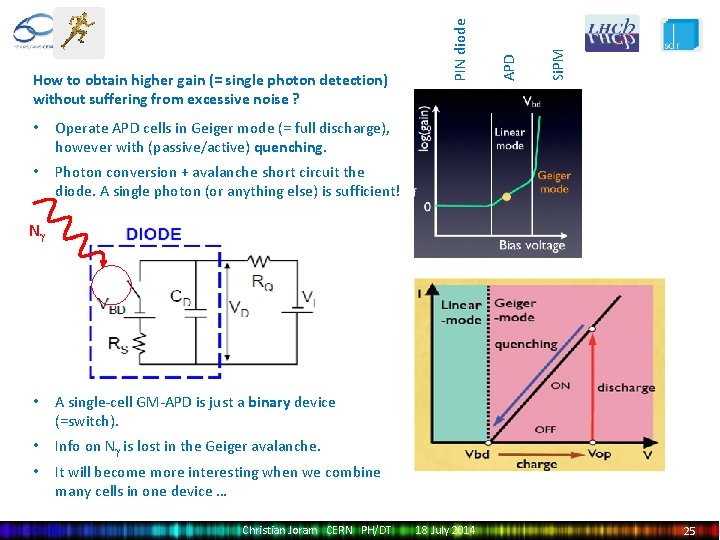
• Operate APD cells in Geiger mode (= full discharge), however with (passive/active) quenching. • Photon conversion + avalanche short circuit the diode. A single photon (or anything else) is sufficient! Si. PM APD PIN diode How to obtain higher gain (= single photon detection) without suffering from excessive noise ? Ng • A single-cell GM-APD is just a binary device (=switch). • Info on Ng is lost in the Geiger avalanche. • It will become more interesting when we combine many cells in one device … Christian Joram CERN PH/DT 18 July 2014 25
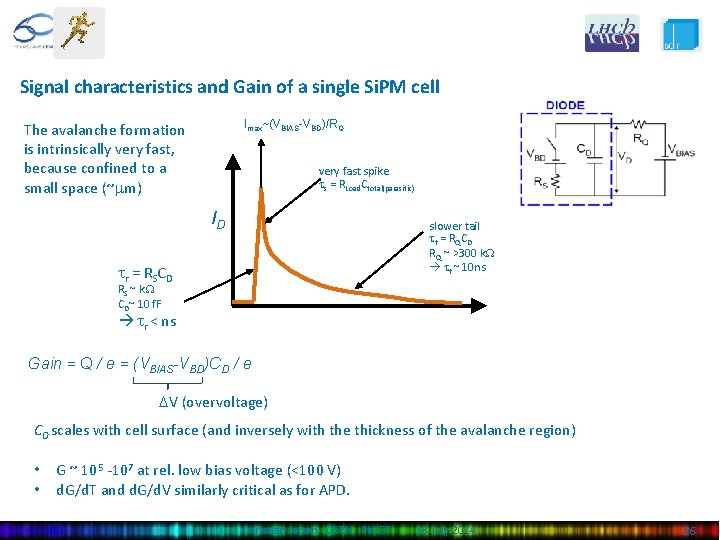
Signal characteristics and Gain of a single Si. PM cell Imax~(VBIAS-VBD)/RQ The avalanche formation is intrinsically very fast, because confined to a small space (~mm) very fast spike ts = RLoad. Ctotal(parasitic) ID slower tail tf = RQCD RQ ~ >300 k. W tf ~ 10 ns tr = RSCD RS ~ k. W CD~ 10 f. F tr < ns Gain = Q / e = (VBIAS-VBD)CD / e V (overvoltage) CD scales with cell surface (and inversely with the thickness of the avalanche region) • • G ~ 105 -107 at rel. low bias voltage (<100 V) d. G/d. T and d. G/d. V similarly critical as for APD. Christian Joram CERN PH/DT 18 July 2014 26
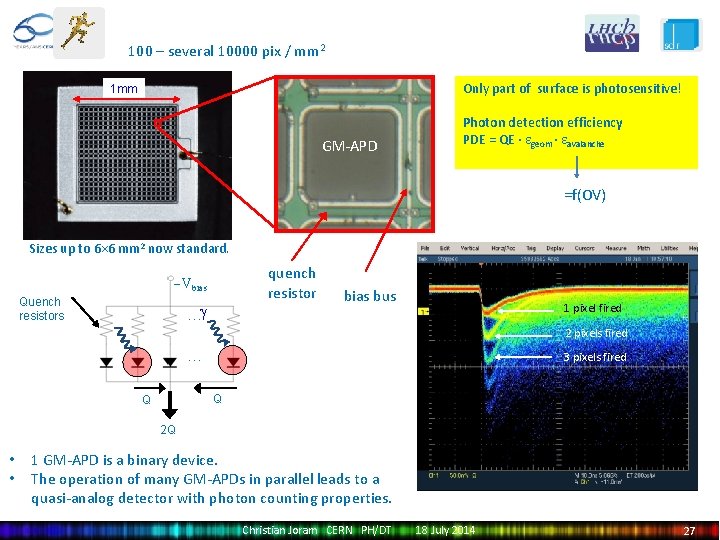
100 – several 10000 pix / mm 2 Only part of surface is photosensitive! 1 mm GM-APD Photon detection efficiency PDE = QE · egeom · eavalanche =f(OV) Sizes up to 6× 6 mm 2 now standard. quench resistor -Vbias Quench resistors g bias bus 1 pixel fired 2 pixels fired 20 x 20 pix 3 pixels fired Q Q 2 Q • • 1 GM-APD is a binary device. The operation of many GM-APDs in parallel leads to a quasi-analog detector with photon counting properties. Christian Joram CERN PH/DT 18 July 2014 27
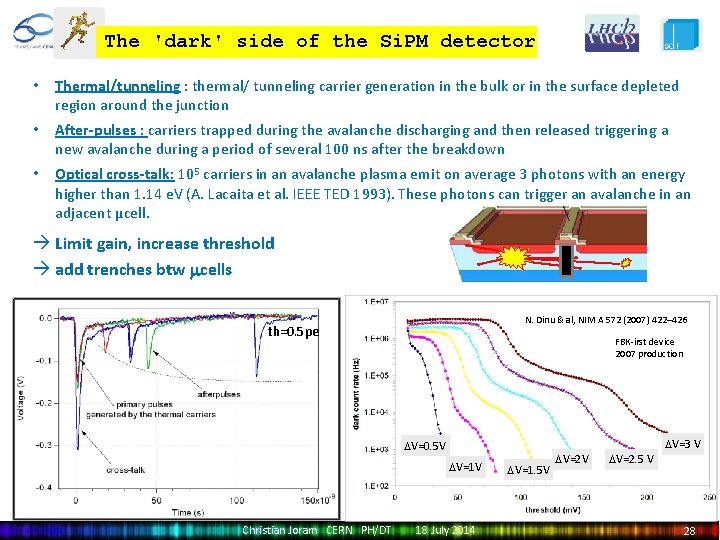
The 'dark' side of the Si. PM detector • Thermal/tunneling : thermal/ tunneling carrier generation in the bulk or in the surface depleted region around the junction • After-pulses : carriers trapped during the avalanche discharging and then released triggering a new avalanche during a period of several 100 ns after the breakdown • Optical cross-talk: 105 carriers in an avalanche plasma emit on average 3 photons with an energy higher than 1. 14 e. V (A. Lacaita et al. IEEE TED 1993). These photons can trigger an avalanche in an adjacent µcell. Limit gain, increase threshold add trenches btw mcells N. Dinu & al, NIM A 572 (2007) 422– 426 th=0. 5 pe FBK-irst device 2007 production V=0. 5 V V=1 V Christian Joram CERN PH/DT 18 July 2014 V=1. 5 V V=2. 5 V V=3 V 28
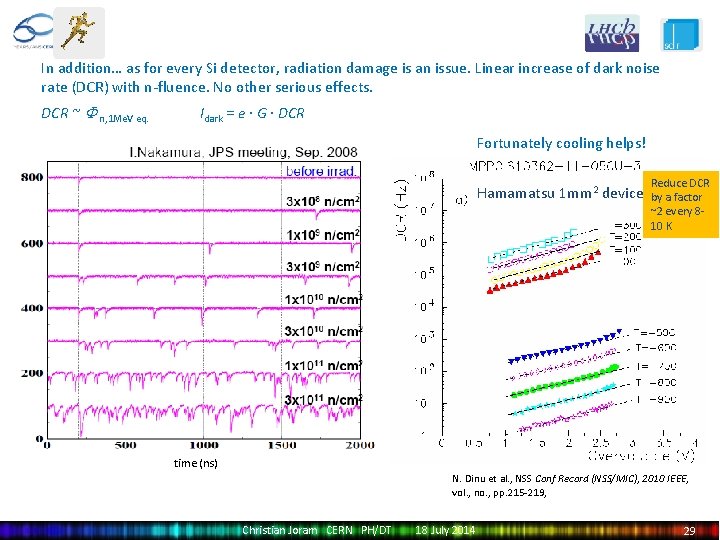
In addition… as for every Si detector, radiation damage is an issue. Linear increase of dark noise rate (DCR) with n-fluence. No other serious effects. DCR ~ F n, 1 Me. V eq. Idark = e · G · DCR Fortunately cooling helps! Hamamatsu 1 mm 2 device Reduce DCR by a factor ~2 every 810 K time (ns) N. Dinu et al. , NSS Conf Record (NSS/MIC), 2010 IEEE, vol. , no. , pp. 215 -219, Christian Joram CERN PH/DT 18 July 2014 29
The LHCb Sci. Fi Tracker Christian Joram CERN PH/DT 18 July 2014 30
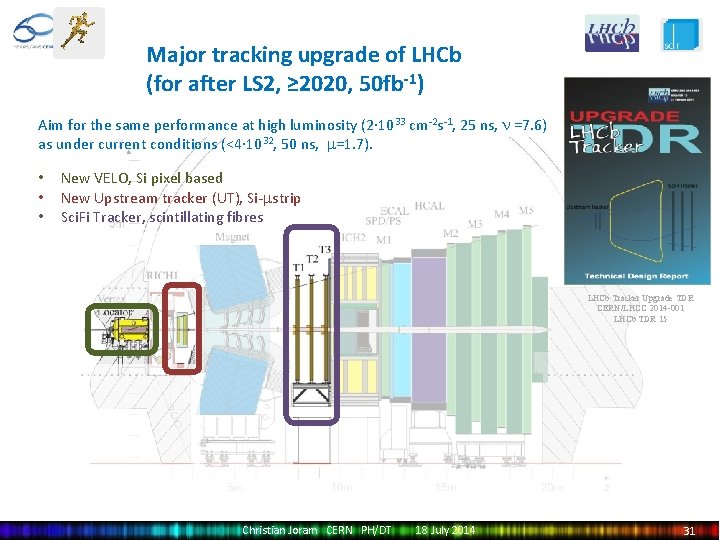
Major tracking upgrade of LHCb (for after LS 2, ≥ 2020, 50 fb-1) Aim for the same performance at high luminosity (2· 1033 cm-2 s-1, 25 ns, n =7. 6) as under current conditions (<4· 1032, 50 ns, m=1. 7). • • • New VELO, Si pixel based New Upstream tracker (UT), Si-mstrip Sci. Fi Tracker, scintillating fibres LHCb Tracker Upgrade TDR CERN/LHCC 2014 -001 LHCb TDR 15 Christian Joram CERN PH/DT 18 July 2014 31
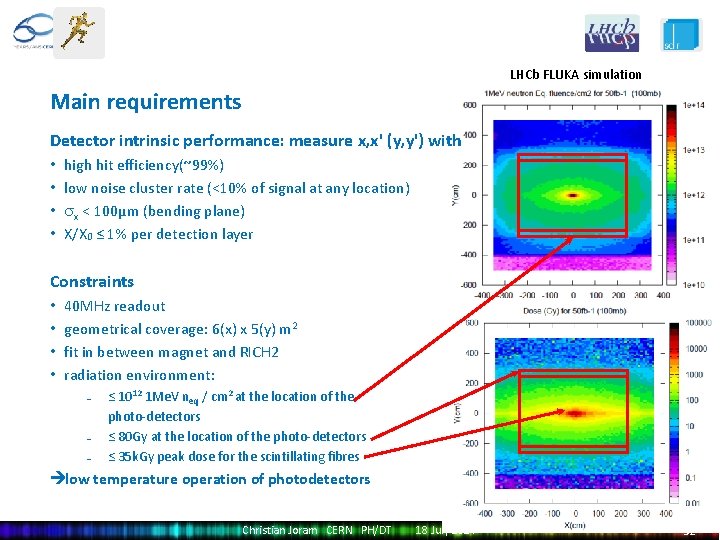
LHCb FLUKA simulation Main requirements Detector intrinsic performance: measure x, x' (y, y') with • • high hit efficiency(~99%) low noise cluster rate (<10% of signal at any location) sx < 100μm (bending plane) X/X 0 ≤ 1% per detection layer Constraints • • 40 MHz readout geometrical coverage: 6(x) x 5(y) m 2 fit in between magnet and RICH 2 radiation environment: ₋ ₋ ₋ ≤ 1012 1 Me. V neq / cm 2 at the location of the photo-detectors ≤ 80 Gy at the location of the photo-detectors ≤ 35 k. Gy peak dose for the scintillating fibres low temperature operation of photodetectors Christian Joram CERN PH/DT 18 July 2014 32
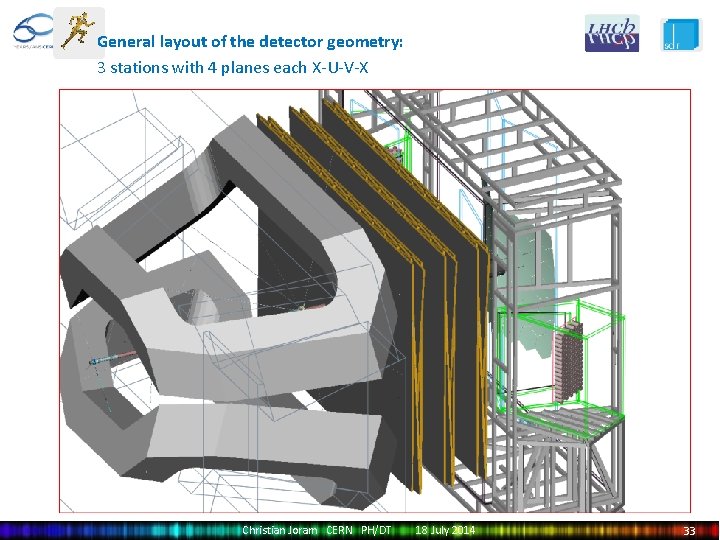
General layout of the detector geometry: 3 stations with 4 planes each X-U-V-X Christian Joram CERN PH/DT 18 July 2014 33
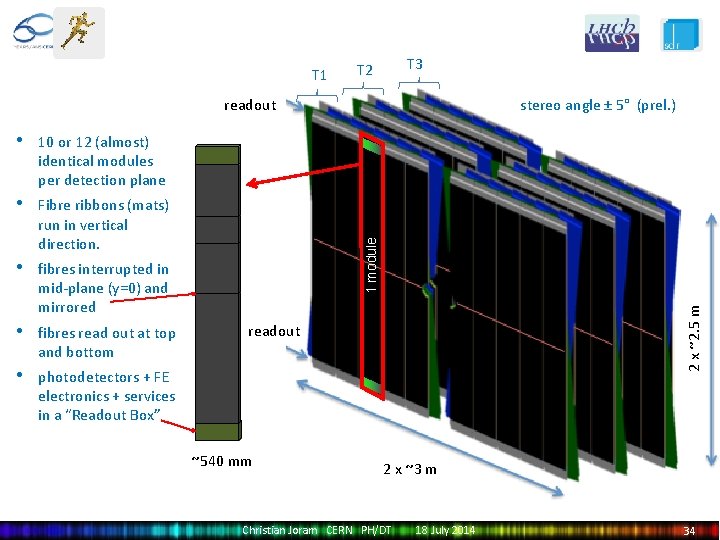
T 1 T 3 T 2 10 or 12 (almost) identical modules per detection plane • Fibre ribbons (mats) run in vertical direction. • fibres interrupted in mid-plane (y=0) and mirrored • fibres read out at top and bottom • photodetectors + FE electronics + services in a “Readout Box” 2 x ~2. 5 m • stereo angle ± 5° (prel. ) 1 module readout ~540 mm 2 x ~3 m Christian Joram CERN PH/DT 18 July 2014 34
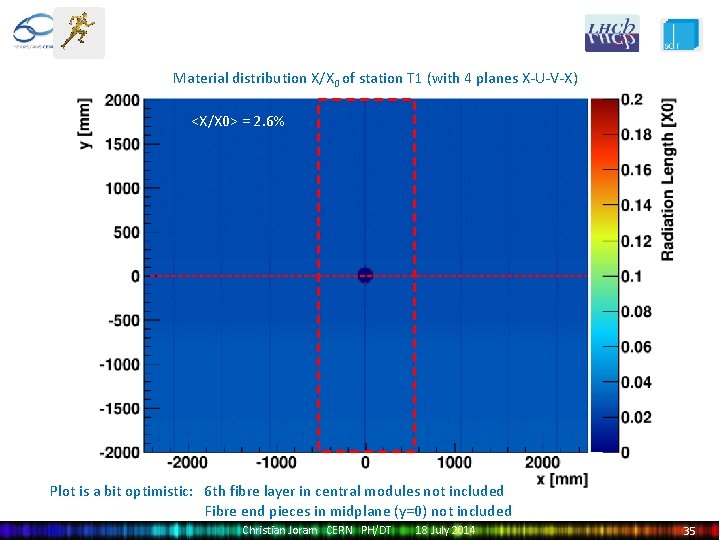
Material distribution X/X 0 of station T 1 (with 4 planes X-U-V-X) <X/X 0> = 2. 6% Plot is a bit optimistic: 6 th fibre layer in central modules not included Fibre end pieces in midplane (y=0) not included Christian Joram CERN PH/DT 18 July 2014 35
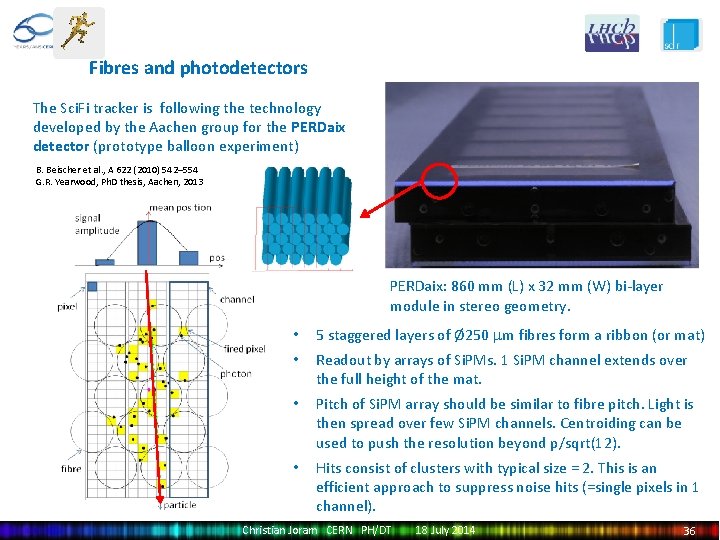
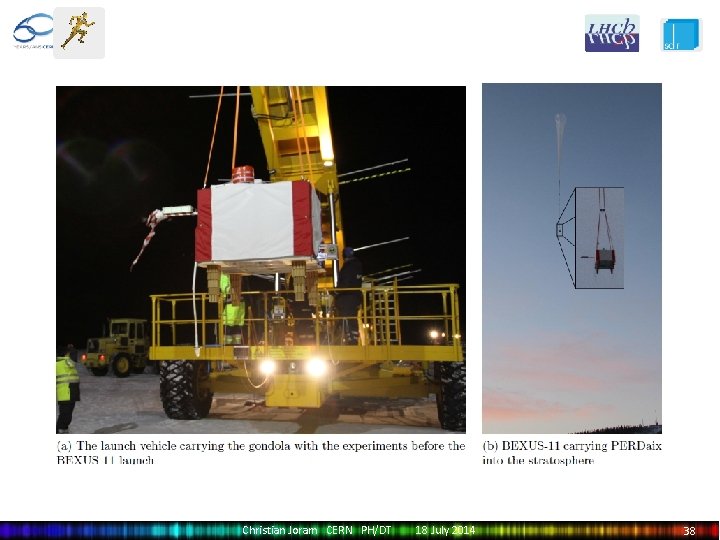
Fibres and photodetectors The Sci. Fi tracker is following the technology developed by the Aachen group for the PERDaix detector (prototype balloon experiment) B. Beischer et al. , A 622 (2010) 542– 554 G. R. Yearwood, Ph. D thesis, Aachen, 2013 PERDaix: 860 mm (L) x 32 mm (W) bi-layer module in stereo geometry. • 5 staggered layers of Ø 250 mm fibres form a ribbon (or mat) • Readout by arrays of Si. PMs. 1 Si. PM channel extends over the full height of the mat. • Pitch of Si. PM array should be similar to fibre pitch. Light is then spread over few Si. PM channels. Centroiding can be used to push the resolution beyond p/sqrt(12). • Hits consist of clusters with typical size = 2. This is an efficient approach to suppress noise hits (=single pixels in 1 channel). Christian Joram CERN PH/DT 18 July 2014 36
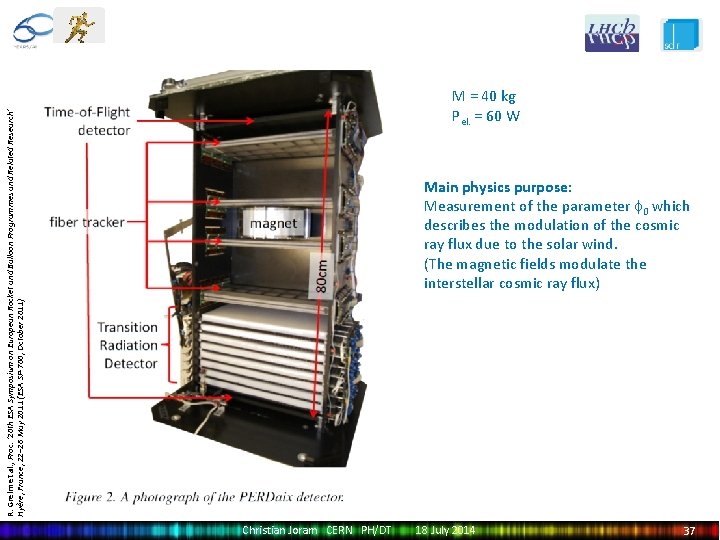
R. Greim et al. , Proc. ‘ 20 th ESA Symposium on European Rocket and Balloon Programmes and Related Research’ Hyère, France, 22– 26 May 2011 (ESA SP-700, October 2011) M = 40 kg Pel. = 60 W Main physics purpose: Measurement of the parameter f 0 which describes the modulation of the cosmic ray flux due to the solar wind. (The magnetic fields modulate the interstellar cosmic ray flux) Christian Joram CERN PH/DT 18 July 2014 37
Christian Joram CERN PH/DT 18 July 2014 38
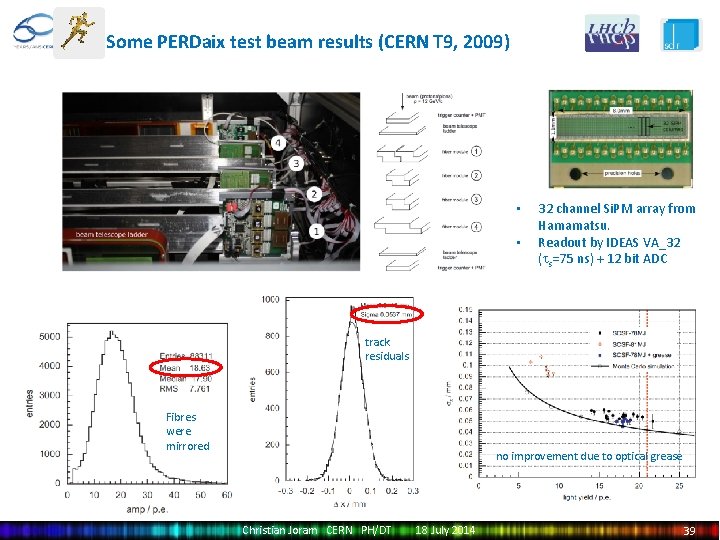
Some PERDaix test beam results (CERN T 9, 2009) • • 32 channel Si. PM array from Hamamatsu. Readout by IDEAS VA_32 (ts=75 ns) + 12 bit ADC track residuals Fibres were mirrored no improvement due to optical grease Christian Joram CERN PH/DT 18 July 2014 39
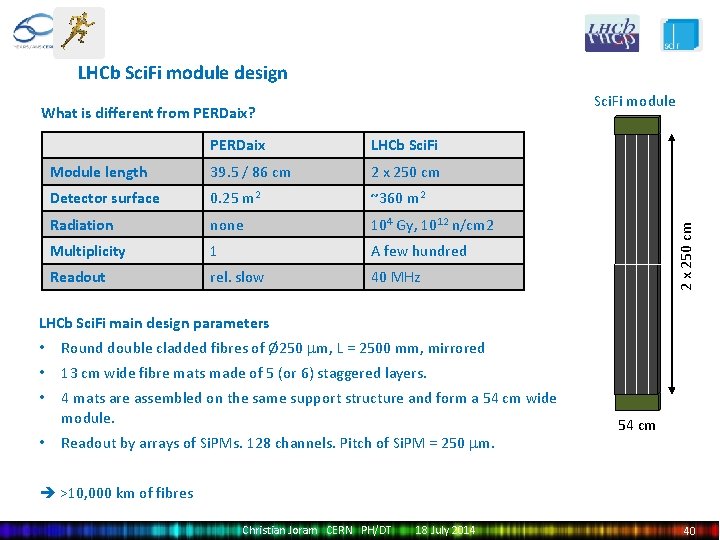
LHCb Sci. Fi module design PERDaix LHCb Sci. Fi Module length 39. 5 / 86 cm 2 x 250 cm Detector surface 0. 25 m 2 ~360 m 2 Radiation none 104 Gy, 1012 n/cm 2 Multiplicity 1 A few hundred Readout rel. slow 40 MHz 2 x 250 cm Sci. Fi module What is different from PERDaix? LHCb Sci. Fi main design parameters • Round double cladded fibres of Ø 250 mm, L = 2500 mm, mirrored • 13 cm wide fibre mats made of 5 (or 6) staggered layers. • 4 mats are assembled on the same support structure and form a 54 cm wide module. • Readout by arrays of Si. PMs. 128 channels. Pitch of Si. PM = 250 mm. 54 cm >10, 000 km of fibres Christian Joram CERN PH/DT 18 July 2014 40
Christian Joram CERN PH/DT 18 July 2014 41
Sci. Fi Tracker: ~20 participating institutes – – – – – Brasil (CBPF) China (Tsinghua) France (LPC, LAL, LPNHE) Germany (Aachen, Dortmund, Heidelberg, Rostock) Netherlands (Nikhef) Poland (Warsaw) Russia (PNPI, ITEP, INR, IHEP, NRC KI) Spain (Barcelona, Valencia) Switzerland (CERN, EPFL) UK (Imperial College) Christian Joram CERN PH/DT 18 July 2014 42
LHCb Sci. Fi R&D: Challenges, strategies, status • Geometrical precision • Get enough light • Fast readout with manageable data volume • Survive the radiation • Optimize detection efficiency vs ghost rate Christian Joram CERN PH/DT 18 July 2014 43
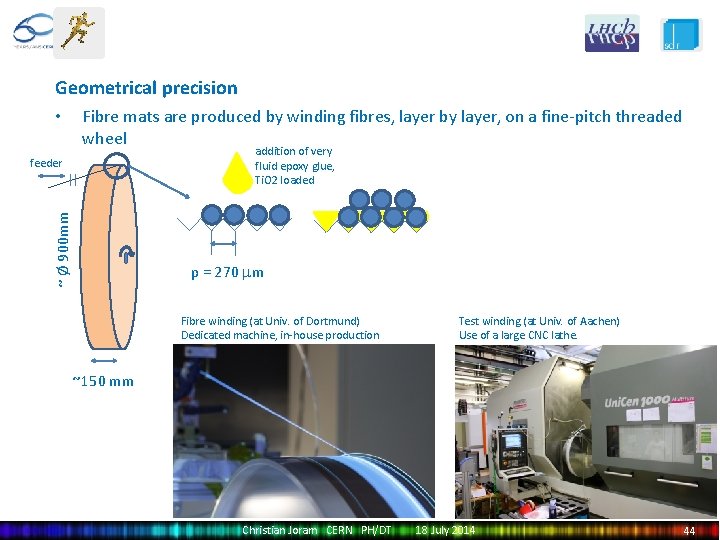
Geometrical precision • Fibre mats are produced by winding fibres, layer by layer, on a fine-pitch threaded wheel addition of very fluid epoxy glue, Ti. O 2 loaded ~ Ø 900 mm feeder p = 270 mm Fibre winding (at Univ. of Dortmund) Dedicated machine, in-house production Test winding (at Univ. of Aachen) Use of a large CNC lathe. ~150 mm Christian Joram CERN PH/DT 18 July 2014 44
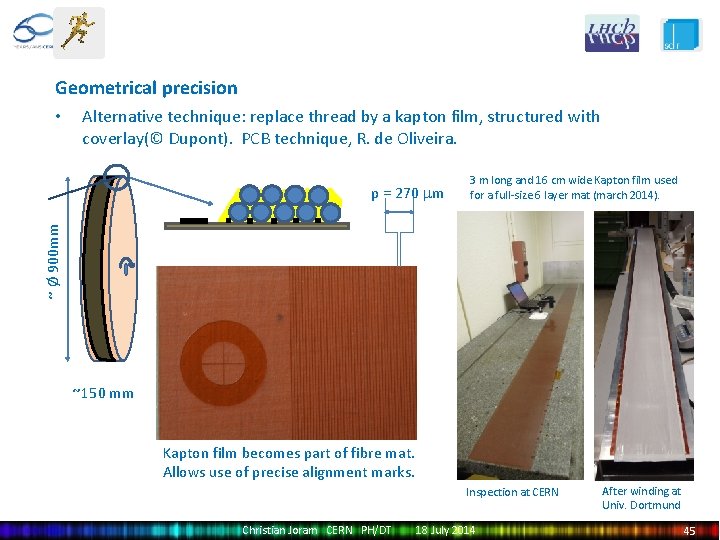
Geometrical precision • Alternative technique: replace thread by a kapton film, structured with coverlay(© Dupont). PCB technique, R. de Oliveira. 3 m long and 16 cm wide Kapton film used for a full-size 6 layer mat (march 2014). ~ Ø 900 mm p = 270 mm ~150 mm Kapton film becomes part of fibre mat. Allows use of precise alignment marks. Inspection at CERN Christian Joram CERN PH/DT 18 July 2014 After winding at Univ. Dortmund 45
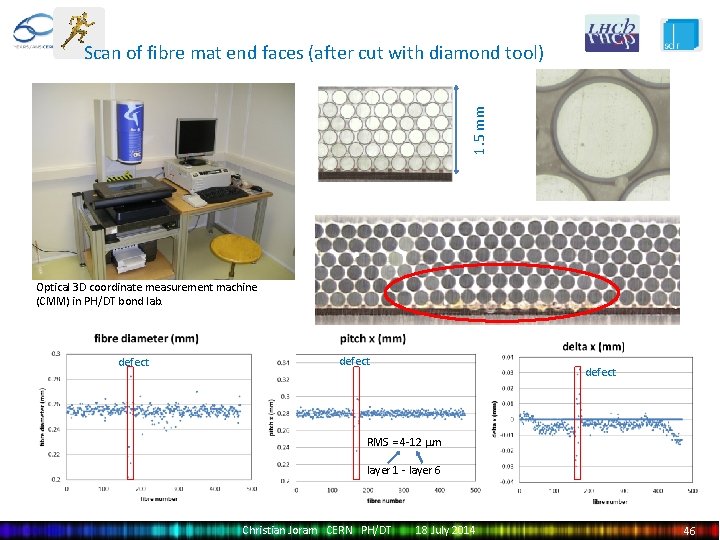
1. 5 mm Scan of fibre mat end faces (after cut with diamond tool) Optical 3 D coordinate measurement machine (CMM) in PH/DT bond lab. defect RMS = 4 -12 mm layer 1 - layer 6 Christian Joram CERN PH/DT 18 July 2014 46
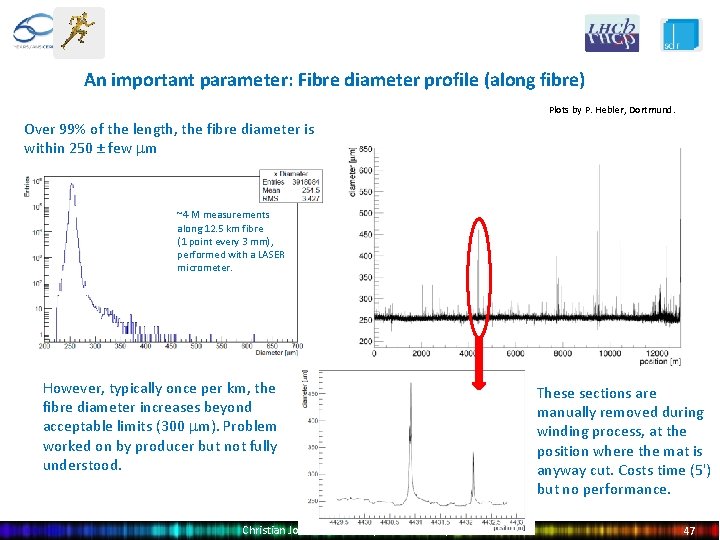
An important parameter: Fibre diameter profile (along fibre) Plots by P. Hebler, Dortmund. Over 99% of the length, the fibre diameter is within 250 ± few mm ~4 M measurements along 12. 5 km fibre (1 point every 3 mm), performed with a LASER micrometer. However, typically once per km, the fibre diameter increases beyond acceptable limits (300 mm). Problem worked on by producer but not fully understood. Christian Joram CERN PH/DT These sections are manually removed during winding process, at the position where the mat is anyway cut. Costs time (5') but no performance. 18 July 2014 47
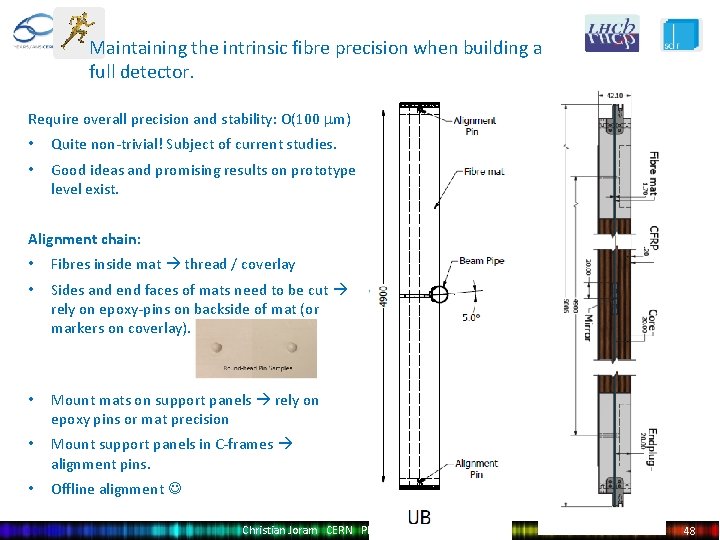
Maintaining the intrinsic fibre precision when building a full detector. Require overall precision and stability: O(100 mm) • Quite non-trivial! Subject of current studies. • Good ideas and promising results on prototype level exist. Alignment chain: • Fibres inside mat thread / coverlay • Sides and end faces of mats need to be cut rely on epoxy-pins on backside of mat (or markers on coverlay). • Mount mats on support panels rely on epoxy pins or mat precision • Mount support panels in C-frames alignment pins. • Offline alignment Christian Joram CERN PH/DT 18 July 2014 48
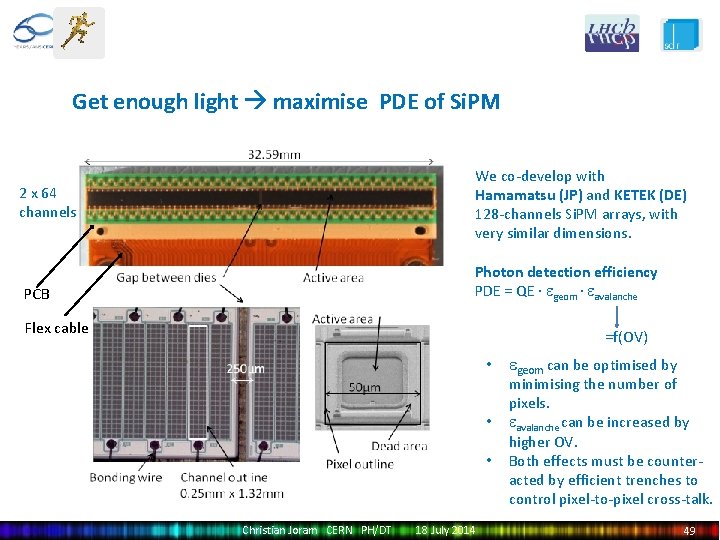
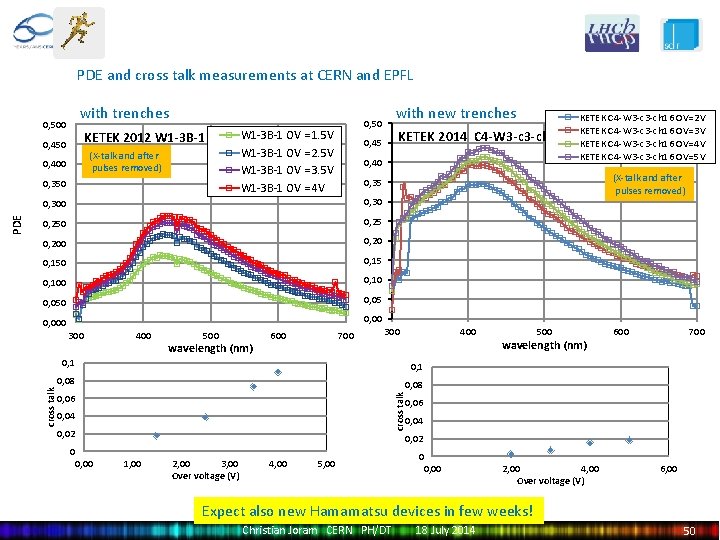
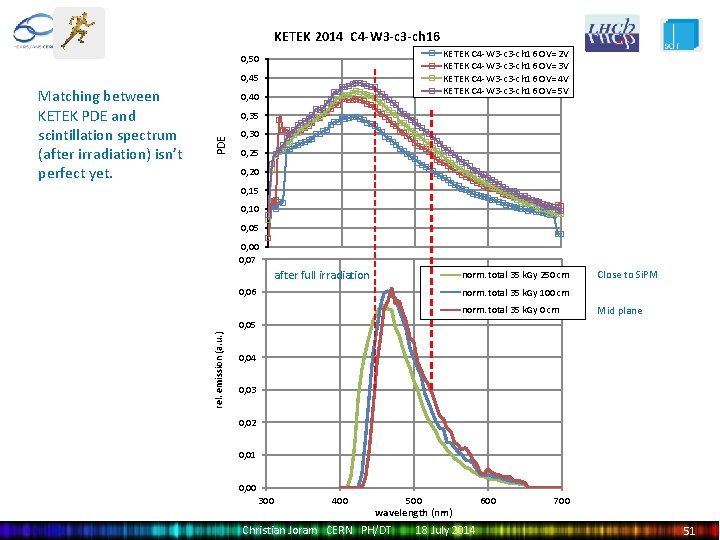
Get enough light maximise PDE of Si. PM We co-develop with Hamamatsu (JP) and KETEK (DE) 128 -channels Si. PM arrays, with very similar dimensions. 2 x 64 channels Photon detection efficiency PDE = QE · egeom · eavalanche PCB Flex cable =f(OV) • egeom can be optimised by • • Christian Joram CERN PH/DT 18 July 2014 minimising the number of pixels. eavalanche can be increased by higher OV. Both effects must be counteracted by efficient trenches to control pixel-to-pixel cross-talk. 49
PDE and cross talk measurements at CERN and EPFL with trenches 0, 500 KETEK 2012 W 1 -3 B-1 0, 450 (X-talk and after pulses removed) 0, 400 W 1 -3 B-1 OV = 1. 5 V W 1 -3 B-1 OV = 2. 5 V W 1 -3 B-1 OV = 3. 5 V W 1 -3 B-1 OV = 4 V 0, 40 0, 25 0, 200 0, 20 0, 15 0, 100 0, 10 0, 05 0, 000 0, 00 400 500 wavelength (nm) 600 KETEK C 4 -W 3 -ch 16 OV=2 V KETEK C 4 -W 3 -ch 16 OV=3 V KETEK C 4 -W 3 -ch 16 OV=4 V KETEK C 4 -W 3 -ch 16 OV=5 V (X-talk and after pulses removed) 0, 35 0, 30 300 KETEK 2014 C 4 -W 3 -ch 16 0, 45 0, 300 700 300 400 0, 1 0, 08 0, 06 cross talk PDE 0, 350 with new trenches 0, 50 0, 04 0, 02 500 wavelength (nm) 600 700 0, 06 0, 04 0, 02 0 0, 00 1, 00 2, 00 3, 00 Over voltage (V) 4, 00 5, 00 0 0, 00 2, 00 4, 00 Over voltage (V) 6, 00 Expect also new Hamamatsu devices in few weeks! Christian Joram CERN PH/DT 18 July 2014 50
KETEK 2014 C 4 -W 3 -ch 16 KETEK C 4 -W 3 -ch 16 OV=2 V KETEK C 4 -W 3 -ch 16 OV=3 V KETEK C 4 -W 3 -ch 16 OV=4 V KETEK C 4 -W 3 -ch 16 OV=5 V 0, 50 0, 45 0, 40 PDE 0, 35 0, 30 0, 25 0, 20 0, 15 0, 10 0, 05 0, 00 0, 07 after full irradiation norm. total 35 k. Gy 250 cm 0, 06 Close to Si. PM norm. total 35 k. Gy 100 cm norm. total 35 k. Gy 0 cm Mid plane 0, 05 rel. emission (a. u. ) Matching between KETEK PDE and scintillation spectrum (after irradiation) isn’t perfect yet. 0, 04 0, 03 0, 02 0, 01 0, 00 300 400 500 wavelength (nm) Christian Joram CERN PH/DT 18 July 2014 600 700 51
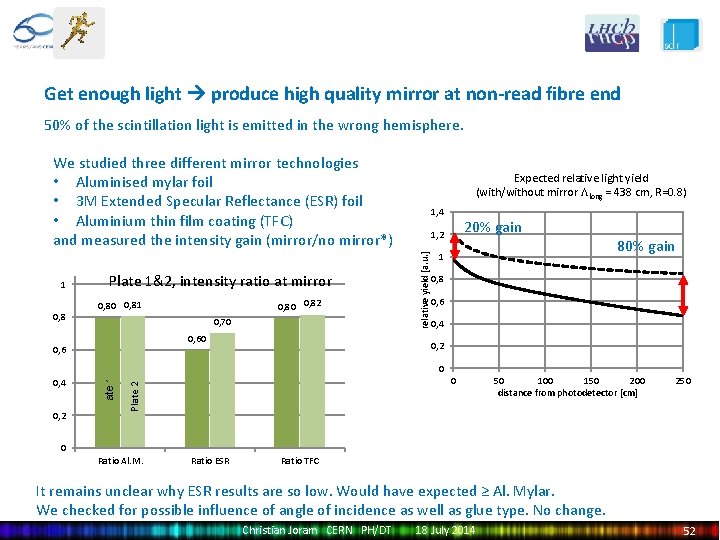
Get enough light produce high quality mirror at non-read fibre end 50% of the scintillation light is emitted in the wrong hemisphere. We studied three different mirror technologies • Aluminised mylar foil • 3 M Extended Specular Reflectance (ESR) foil • Aluminium thin film coating (TFC) and measured the intensity gain (mirror/no mirror*) 0, 8 Plate 1&2, intensity ratio at mirror 0, 80 0, 82 0, 80 0, 81 0, 70 0, 6 1, 4 20% gain 1, 2 relative yield [a. u. ] 1 Expected relative light yield (with/without mirror Llong = 438 cm, R=0. 8) 1 80% gain 0, 8 0, 6 0, 4 0, 2 0 Plate 2 0, 4 Plate 1 0 50 100 150 200 distance from photodetector [cm] 250 0 Ratio Al. M. Ratio ESR Ratio TFC It remains unclear why ESR results are so low. Would have expected ≥ Al. Mylar. We checked for possible influence of angle of incidence as well as glue type. No change. Christian Joram CERN PH/DT 18 July 2014 52
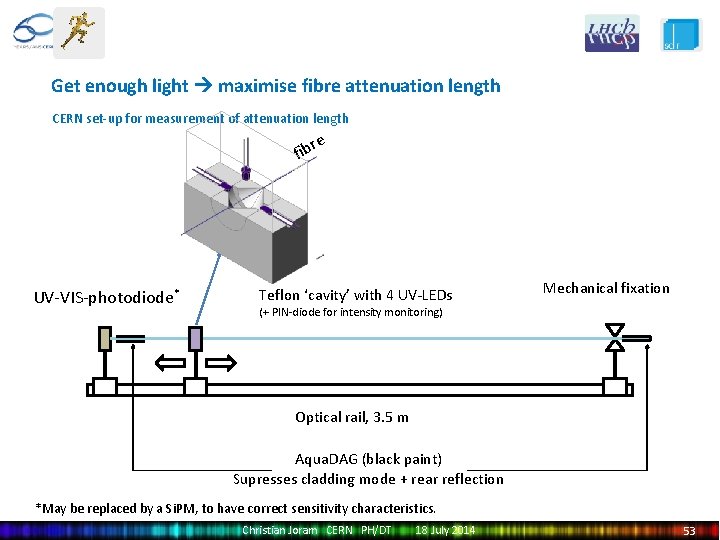
Get enough light maximise fibre attenuation length CERN set-up for measurement of attenuation length re fib UV-VIS-photodiode* Teflon ‘cavity’ with 4 UV-LEDs Mechanical fixation (+ PIN-diode for intensity monitoring) Optical rail, 3. 5 m Aqua. DAG (black paint) Supresses cladding mode + rear reflection *May be replaced by a Si. PM, to have correct sensitivity characteristics. Christian Joram CERN PH/DT 18 July 2014 53
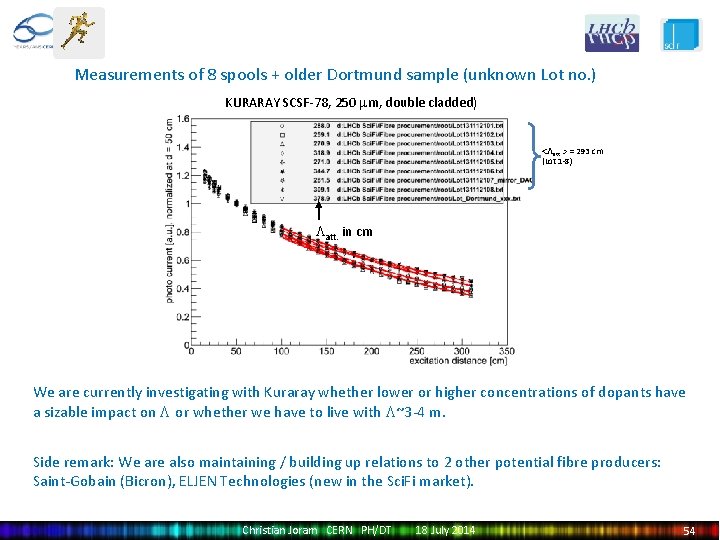
Measurements of 8 spools + older Dortmund sample (unknown Lot no. ) KURARAY SCSF-78, 250 mm, double cladded) <Latt. > = 293 cm (Lot 1 -8) Latt. in cm We are currently investigating with Kuraray whether lower or higher concentrations of dopants have a sizable impact on L or whether we have to live with L~3 -4 m. Side remark: We are also maintaining / building up relations to 2 other potential fibre producers: Saint-Gobain (Bicron), ELJEN Technologies (new in the Sci. Fi market). Christian Joram CERN PH/DT 18 July 2014 54
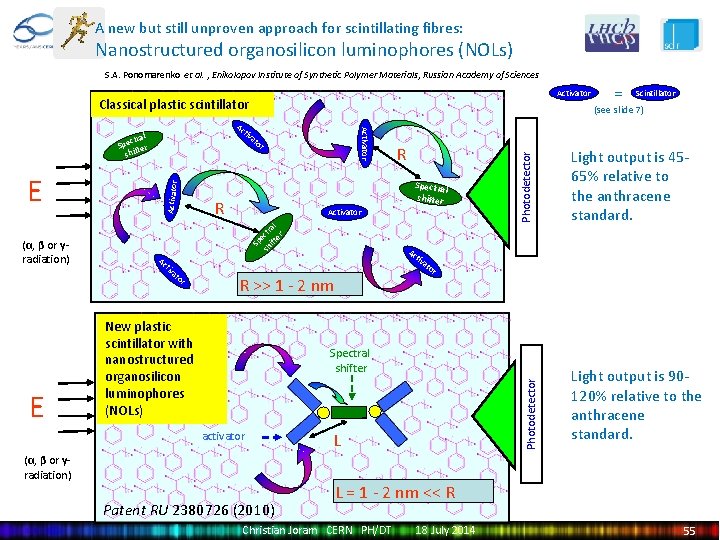
A new but still unproven approach for scintillating fibres: Nanostructured organosilicon luminophores (NOLs) S. A. Ponomarenko et al. , Enikolopov Institute of Synthetic Polymer Materials, Russian Academy of Sciences Activator Classical plastic scintillator or R Activator tiv R >> 1 - 2 nm New plastic scintillator with nanostructured organosilicon luminophores (NOLs) Spectra l shifter Ac Ac tiv at or R Photodetector at or Spectral shifter activator (α, β or γradiation) Patent RU 2380726 (2010) Light output is 4565% relative to the anthracene standard. at Photodetector Е tiv Sp sh ectr ift al er (α, β or γradiation) Activator Е Scintillator (see slide 7) Activator Ac l ctra Spe ter shif = L Light output is 90120% relative to the anthracene standard. L = 1 - 2 nm << R Christian Joram CERN PH/DT 18 July 2014 55
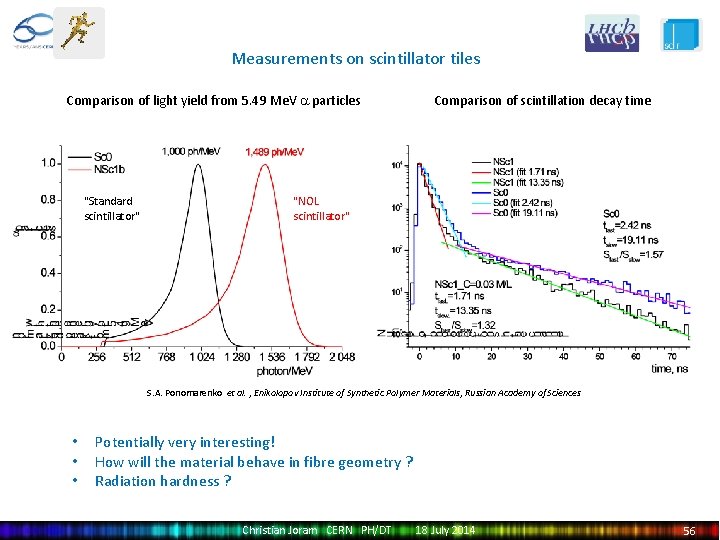
Measurements on scintillator tiles Comparison of light yield from 5. 49 Me. V a particles "Standard scintillator" Comparison of scintillation decay time "NOL scintillator" S. A. Ponomarenko et al. , Enikolopov Institute of Synthetic Polymer Materials, Russian Academy of Sciences • • • Potentially very interesting! How will the material behave in fibre geometry ? Radiation hardness ? Christian Joram CERN PH/DT 18 July 2014 56
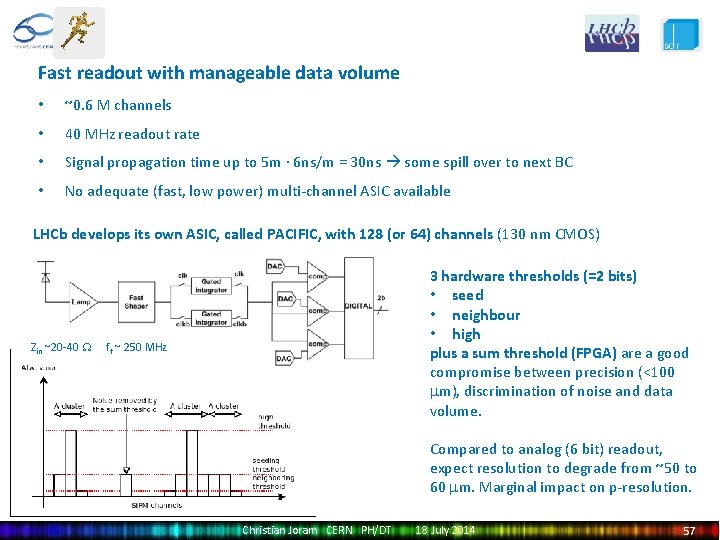
Fast readout with manageable data volume • ~0. 6 M channels • 40 MHz readout rate • Signal propagation time up to 5 m · 6 ns/m = 30 ns some spill over to next BC • No adequate (fast, low power) multi-channel ASIC available LHCb develops its own ASIC, called PACIFIC, with 128 (or 64) channels (130 nm CMOS) P ~ 8 m. W/channel Zin ~20 -40 W 3 hardware thresholds (=2 bits) • seed • neighbour • high plus a sum threshold (FPGA) are a good compromise between precision (<100 mm), discrimination of noise and data volume. ff ~ 250 MHz Compared to analog (6 bit) readout, expect resolution to degrade from ~50 to 60 mm. Marginal impact on p-resolution. Christian Joram CERN PH/DT 18 July 2014 57
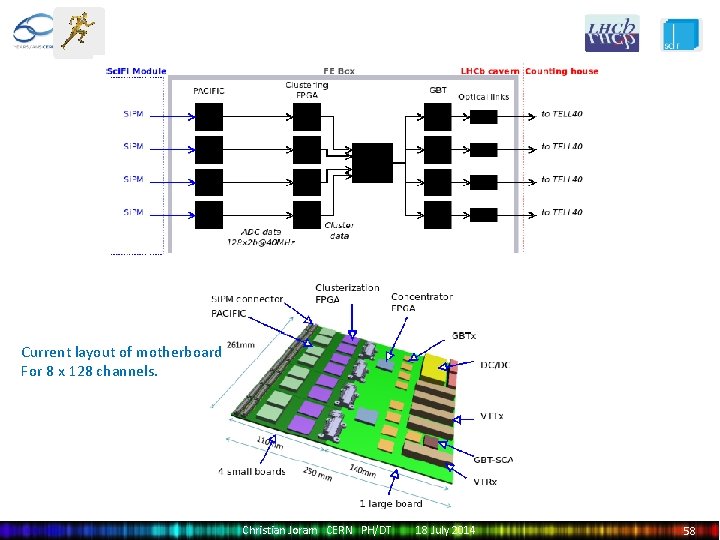
Current layout of motherboard For 8 x 128 channels. Christian Joram CERN PH/DT 18 July 2014 58
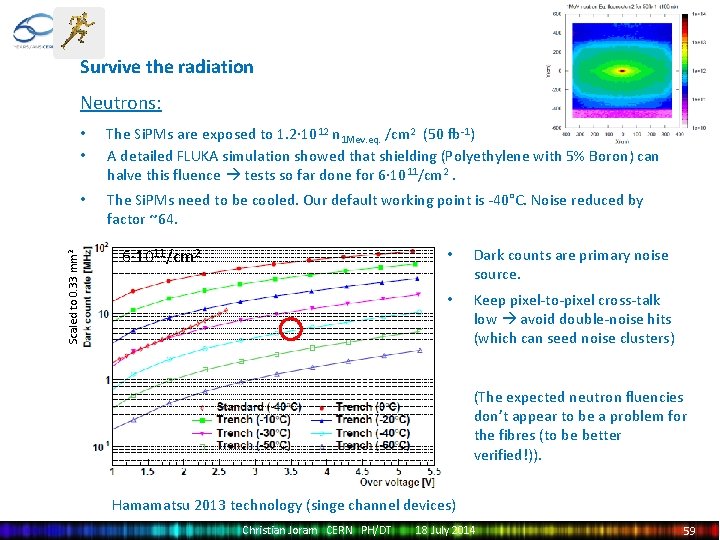
Survive the radiation Scaled to 0. 33 mm 2 Neutrons: • • The Si. PMs are exposed to 1. 2· 1012 n 1 Mev. eq. /cm 2 (50 fb-1) A detailed FLUKA simulation showed that shielding (Polyethylene with 5% Boron) can halve this fluence tests so far done for 6· 1011/cm 2. • The Si. PMs need to be cooled. Our default working point is -40°C. Noise reduced by factor ~64. 6· 1011/cm 2 • Dark counts are primary noise source. • Keep pixel-to-pixel cross-talk low avoid double-noise hits (which can seed noise clusters) (The expected neutron fluencies don’t appear to be a problem for the fibres (to be better verified!)). Hamamatsu 2013 technology (singe channel devices) Christian Joram CERN PH/DT 18 July 2014 59
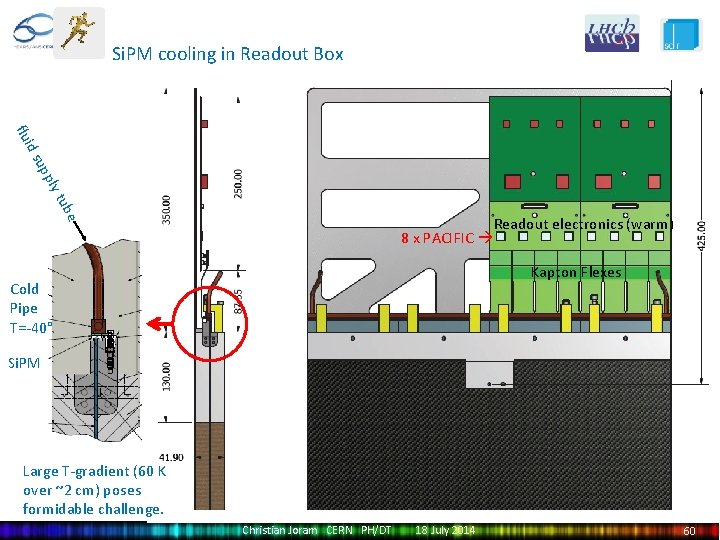
Si. PM cooling in Readout Box ply up id s flu e tub 8 x PACIFIC Readout electronics (warm) Kapton Flexes Cold Pipe T=-40° Si. PM Large T-gradient (60 K over ~2 cm) poses formidable challenge. Christian Joram CERN PH/DT 18 July 2014 60
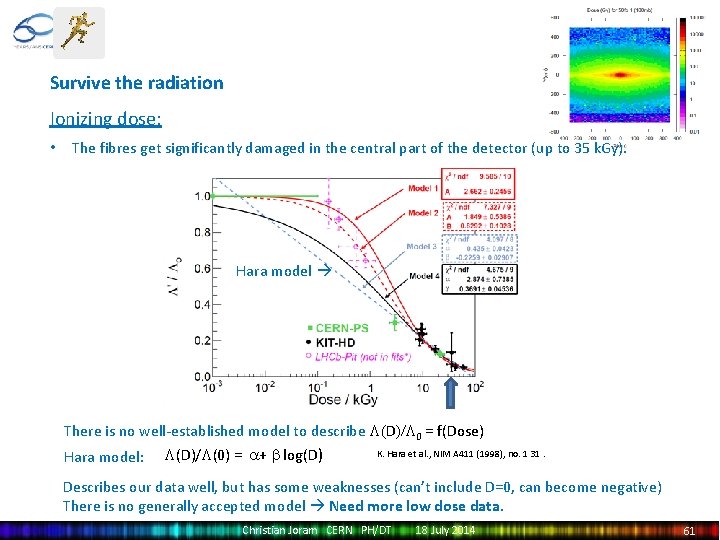
Survive the radiation Ionizing dose: • The fibres get significantly damaged in the central part of the detector (up to 35 k. Gy). Hara model There is no well-established model to describe L(D)/L 0 = f(Dose) K. Hara et al. , NIM A 411 (1998), no. 1 31. Hara model: L(D)/L(0) = a+ b log(D) Describes our data well, but has some weaknesses (can’t include D=0, can become negative) There is no generally accepted model Need more low dose data. Christian Joram CERN PH/DT 18 July 2014 61
Survive the radiation Fibre annealing? • Can we hope for some annealing effects ? Controversially discussed in literature. But also non -agreeing observations in Heidelberg (yes) and at CERN (no). • 6 fibre layers in the central part will provide safety margin. • Ultima ratio: be prepared to replace some central detector modules after n fb -1. Christian Joram CERN PH/DT 18 July 2014 62
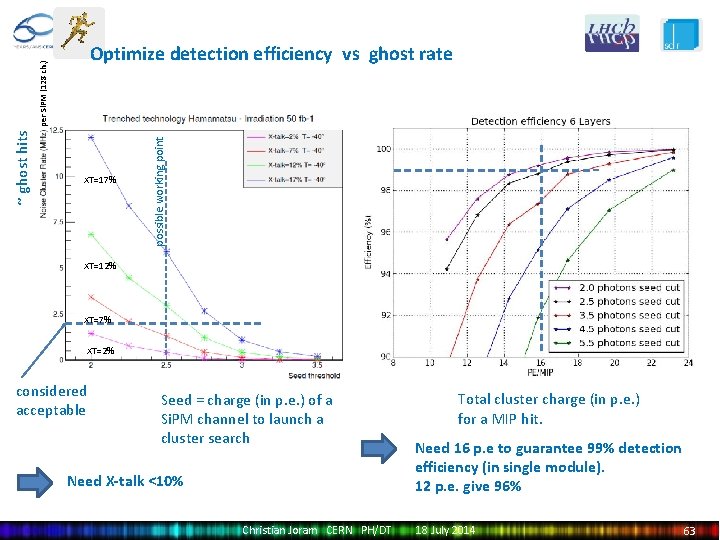
XT=17% possible working point ~ ghost hits per Si. PM (128 ch. ) Optimize detection efficiency vs ghost rate XT=12% XT=7% XT=2% considered acceptable Seed = charge (in p. e. ) of a Si. PM channel to launch a cluster search Need X-talk <10% Christian Joram CERN PH/DT Total cluster charge (in p. e. ) for a MIP hit. Need 16 p. e to guarantee 99% detection efficiency (in single module). 12 p. e. give 96% 18 July 2014 63
Where do we stand ? • Fibre modules Learned how to make 13 cm wide and >2. 5 m long fibre mats. Current focus: machining and precision assembly of mats on panels. Aim to test them in SPS beam in autumn. • Si. PMs 64 -ch. Si. PM arrays from Hamamatsu and KETEK successfully tested. First 128 -ch. arrays from KETEK look promising. Expect new arrays from Hamamatsu soon. Increased PDE and(!) reduced XT. • RO electronics Single channel of PACIFIC being tested. 8 -channel version submitted a few days ago. Full scale prototype ASIC in 2015. • Design Efforts for overall detector design, Readout Box, mechanics getting in full swing. Lots of challenges like beam pipe hole, cooling (insulation, condensation). • Production Starting to think of tooling, logistics and QA. Mass production of fibre mats and modules will require sustained efforts and tight quality control. Christian Joram CERN PH/DT 18 July 2014 64
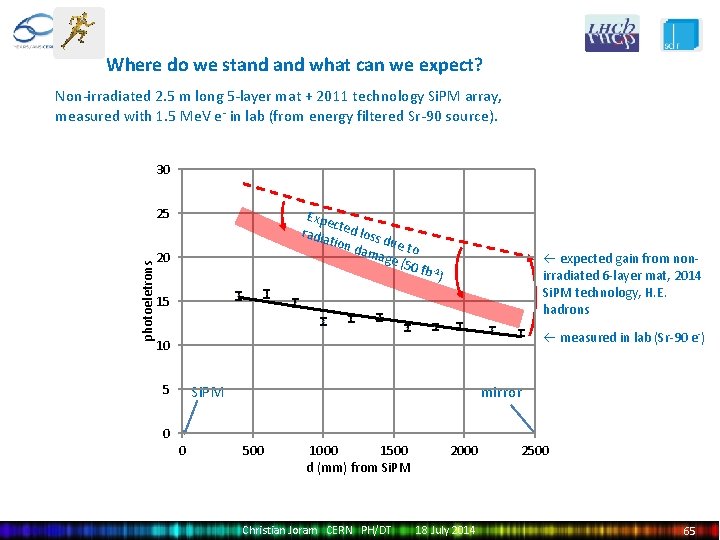
Where do we stand what can we expect? Non-irradiated 2. 5 m long 5 -layer mat + 2011 technology Si. PM array, measured with 1. 5 Me. V e- in lab (from energy filtered Sr-90 source). 30 photoeletrons 25 Expe c radia ted loss d tion dam ue to age (50 f -1 b ) 20 expected gain from nonirradiated 6 -layer mat, 2014 Si. PM technology, H. E. hadrons 15 measured in lab (Sr-90 e-) 10 5 Si. PM mirror 0 0 500 1000 1500 d (mm) from Si. PM Christian Joram CERN PH/DT 2000 18 July 2014 2500 65
Summary and Outlook • Scintillating fibre technology in combination with Si. PM arrays allow building large-area and low-mass tracking detectors with good spatial resolution. • As in every light based detector, lots of effort is spent in producing enough photons and loosing only few of them. • Radiation is the main enemy, both for the fibres (ionizing radiation) and the Si. PMs (NIEL = neutrons). The radiation environment of LHCb is already pretty challenging. • There was relatively little activity in scintillating fibres during the last two decades. Compared to e. g. silicon, the fibre technology hasn't evolved very much in terms of e. g. light yield, radiation hardness, attenuation length, …. NOL technology could have a large impact. • Building a precise large-area fibre trackers is a labour intensive endeavour with lots of in-house production. Industrial partners producing high quality fibre mats would be welcome. Christian Joram CERN PH/DT 18 July 2014 66
Back-up slides Christian Joram CERN PH/DT 18 July 2014 67
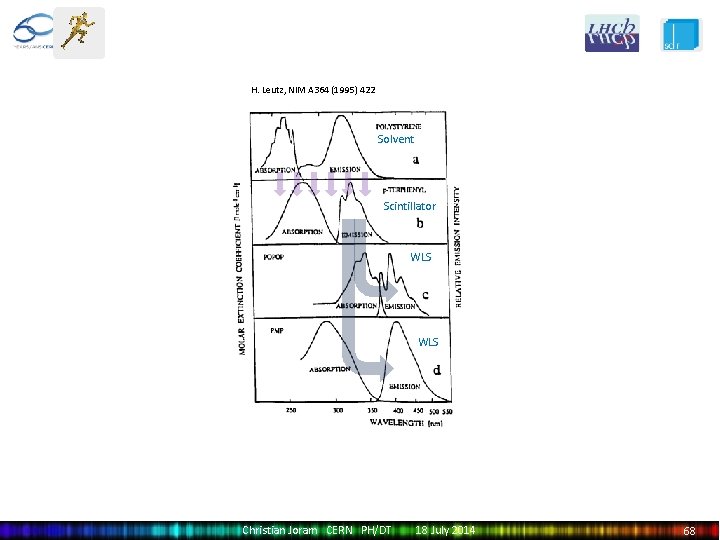
H. Leutz, NIM A 364 (1995) 422 Solvent Scintillator WLS Christian Joram CERN PH/DT 18 July 2014 68
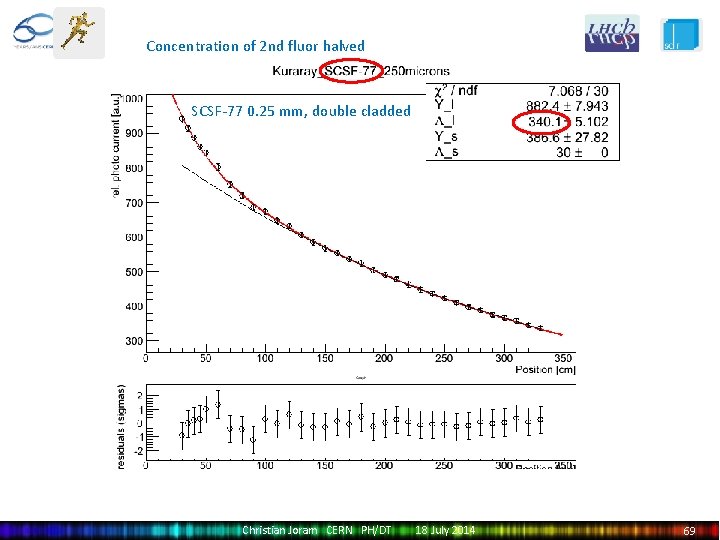
Concentration of 2 nd fluor halved SCSF-77 0. 25 mm, double cladded Christian Joram CERN PH/DT 18 July 2014 69
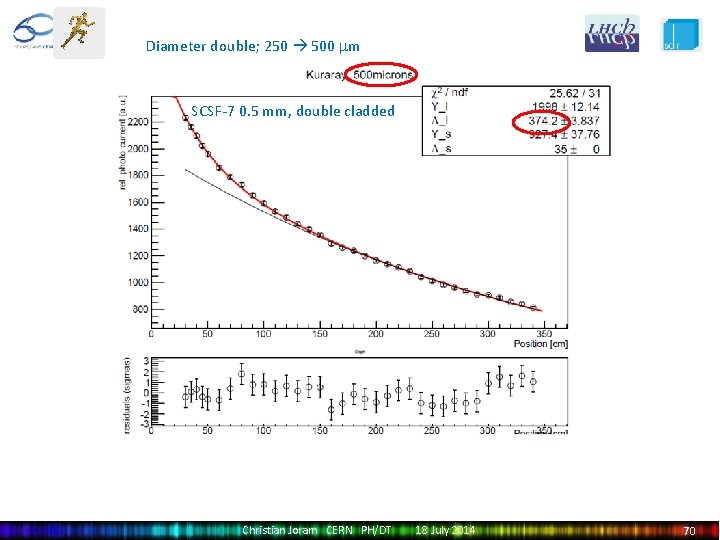
Diameter double; 250 500 mm SCSF-7 0. 5 mm, double cladded Christian Joram CERN PH/DT 18 July 2014 70
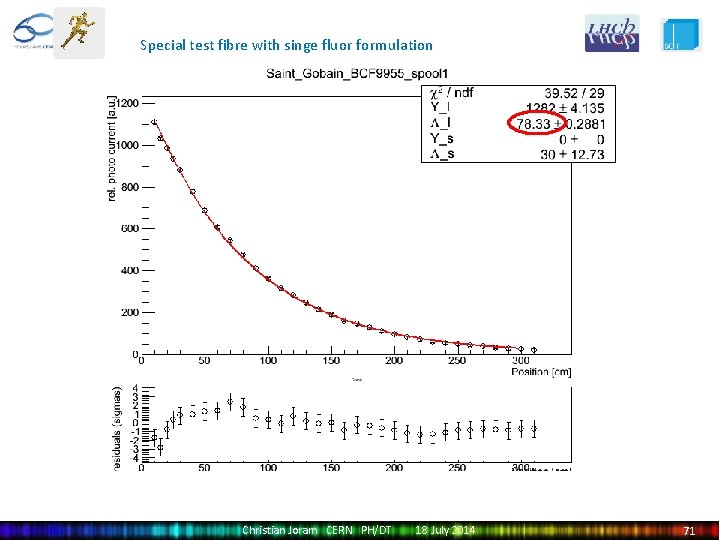
Special test fibre with singe fluor formulation Christian Joram CERN PH/DT 18 July 2014 71
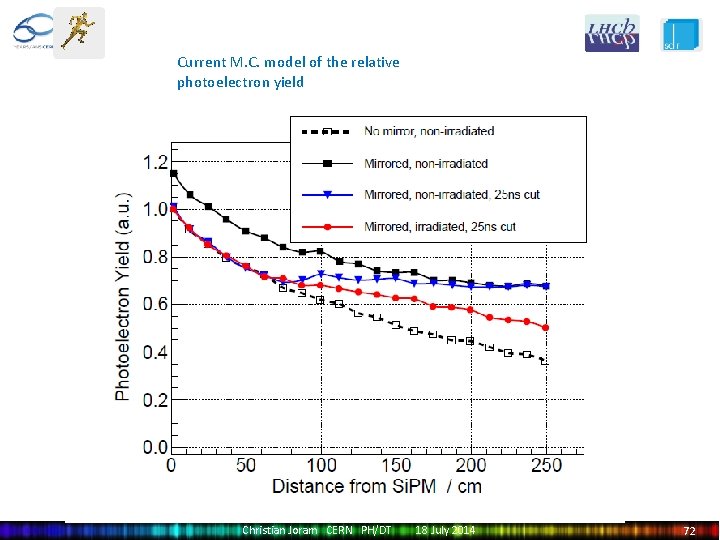
Current M. C. model of the relative photoelectron yield Christian Joram CERN PH/DT 18 July 2014 72
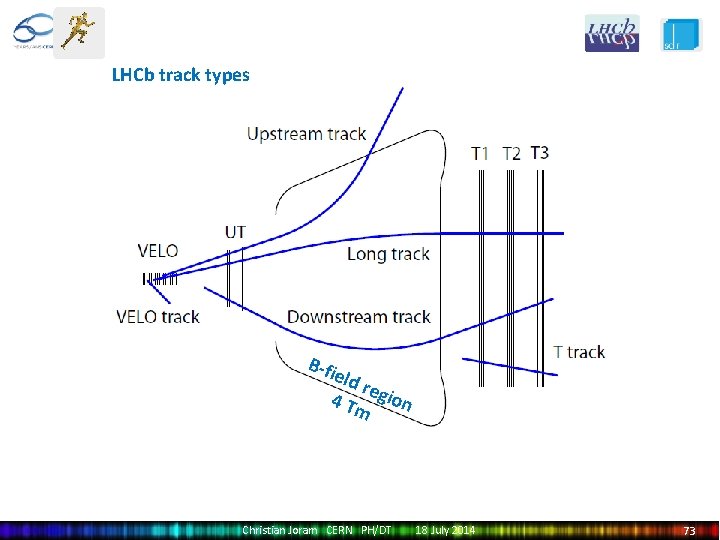
LHCb track types B-fi e ld r e 4 Tm gion Christian Joram CERN PH/DT 18 July 2014 73
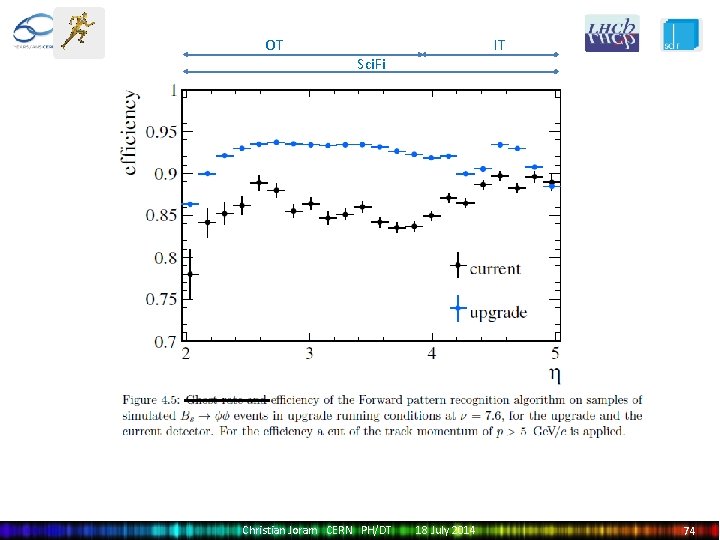
OT IT Sci. Fi Christian Joram CERN PH/DT 18 July 2014 74
- Slides: 74