
Large and small UNIT 4 INFANT PHYSICAL DEVELOPMENT

- Slides: 25
Large and small UNIT 4: INFANT PHYSICAL DEVELOPMENT Children develop most rapidly during their first 3 of life. years
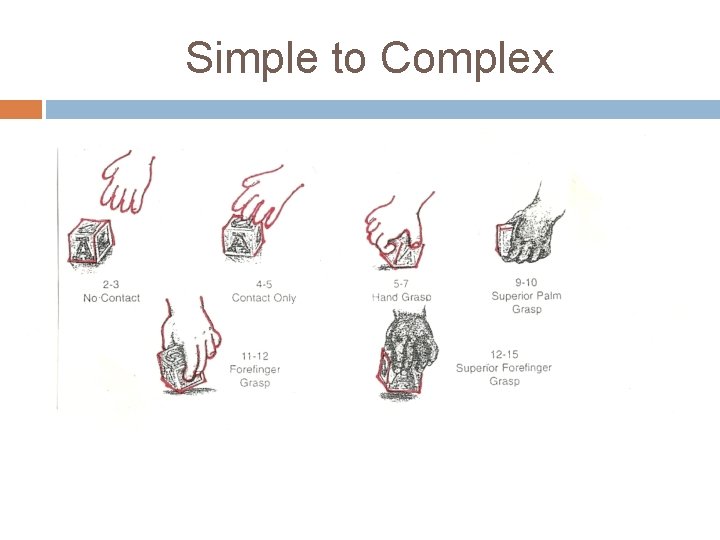
2. Unit 1 Review of Laws of Growth and Development Head (caudal) to Foot (cephalo) Near (proximal) to Far (distal) � � � 1 st, Babies lift their head to see an object. 2 nd , they Use their arms and hands to pick up objects. 3 rd, they will move their body towards the object. 4 th they use their legs and feet to walk to the object First the child moves their whole body towards the object, then the baby moves outward to their arms, their hands, and then their fingers. Waving “Hi” = First they learn to wave with arms, then wave with their hand wrist, and then wave with fingers. Learning to eat follows the same Laws of Growth and Development. Growth proceeds from simple to complex � � Basic actions of Sleeping, eating, pooping, peeing. Later they will learn more complicated tasks Babbling leads to talking Eating with fingers leads to using utensils First a child waves “Hi” and then they say it
Simple to Complex
3. Weight A healthy baby gains 1 -2 pounds per month during the first year. � They triple their birth weight in the first year. � The average weight of a 1 year old is 20 -22 pounds Pillowcase game
4. Height The average height by one year of age is about 30 inches. They increase their birth length by half.
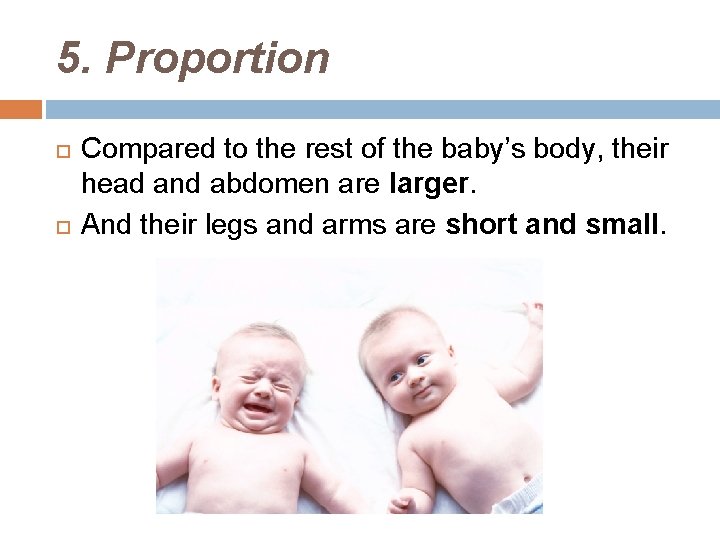
5. Proportion Compared to the rest of the baby’s body, their head and abdomen are larger. And their legs and arms are short and small.
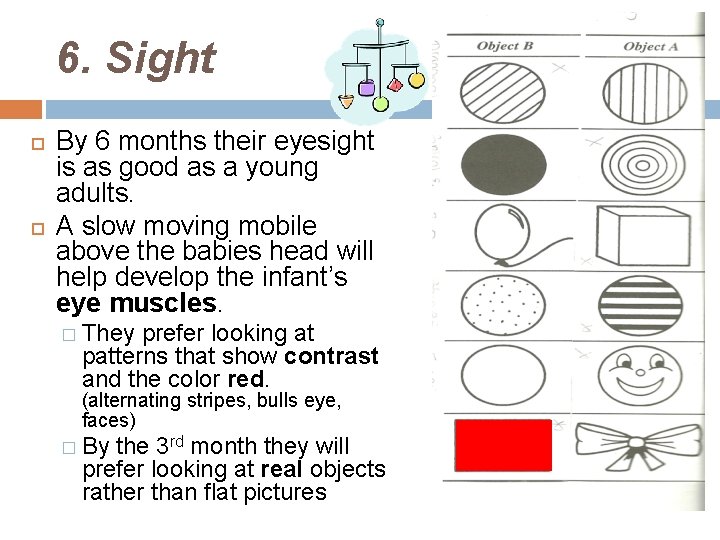
6. Sight By 6 months their eyesight is as good as a young adults. A slow moving mobile above the babies head will help develop the infant’s eye muscles. � They prefer looking at patterns that show contrast and the color red. (alternating stripes, bulls eye, faces) � By the 3 rd month they will prefer looking at real objects rather than flat pictures
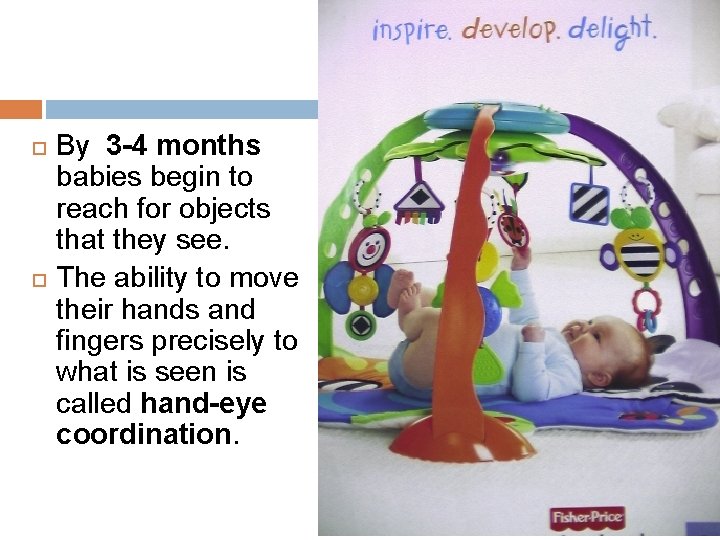
By 3 -4 months babies begin to reach for objects that they see. The ability to move their hands and fingers precisely to what is seen is called hand-eye coordination.
7. Hearing Babies still respond to the tone / sound of your voice rather than the words that are said. � An angry tone vs. a friendly or happy tone
8. Teeth At 6 -7 months the primary or “baby” teeth begin to come in. Although it is a normal process, teething can be uncomfortable for 2 -10 days per tooth. Common teething symptoms include: � Cranky, restless, drooling, refusal to eat, desire for liquid � Ear-ache, fever, runny nose, coughing Help sooth the discomforts of teething by: � Teething biscuits or teething ring to bite on � Something cold (ice cube, frozen teething ring) to numb it � Teething medication can be rubbed on the gums
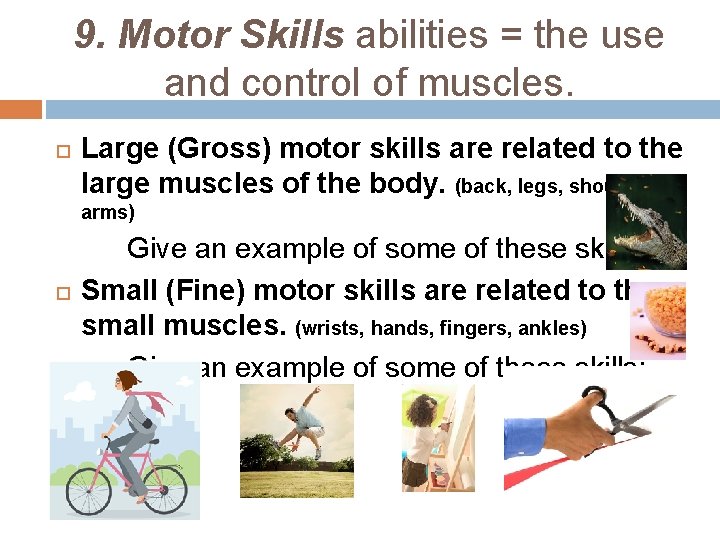
9. Motor Skills abilities = the use and control of muscles. Large (Gross) motor skills are related to the large muscles of the body. (back, legs, shoulders, arms) Give an example of some of these skills: Small (Fine) motor skills are related to the small muscles. (wrists, hands, fingers, ankles) Give an example of some of these skills:
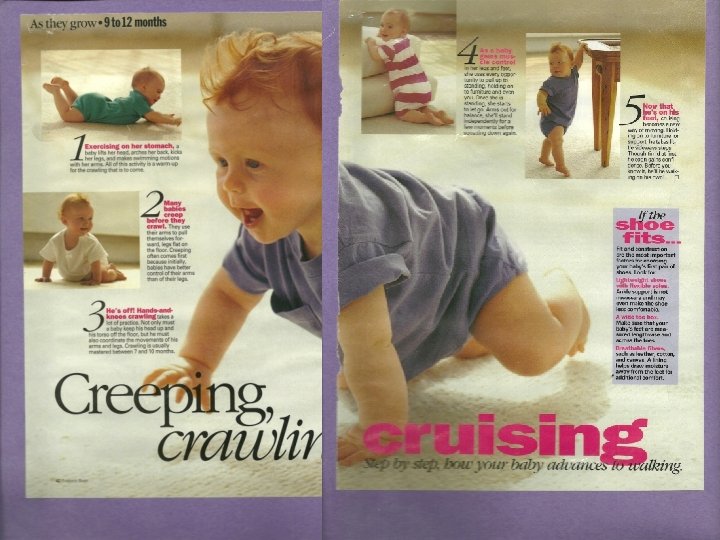
10. Physical Development Arnold Gesell – Physical Development Theor Milestones lift heads while on their stomach, 2. roll front to back, 3. sit up, 4. crawl, 11. When lifting, or moving a 5. stand on handling, own newborn, remember to support their 6. walk 1. head and neck.
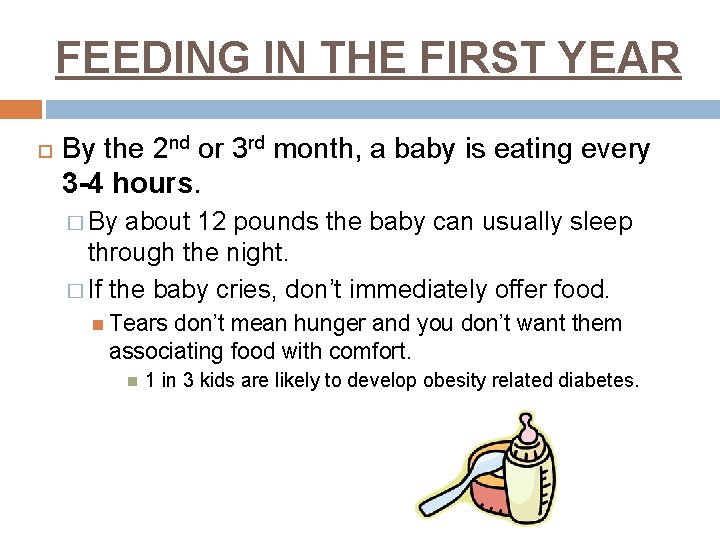
FEEDING IN THE FIRST YEAR By the 2 nd or 3 rd month, a baby is eating every 3 -4 hours. � By about 12 pounds the baby can usually sleep through the night. � If the baby cries, don’t immediately offer food. Tears don’t mean hunger and you don’t want them associating food with comfort. 1 in 3 kids are likely to develop obesity related diabetes.
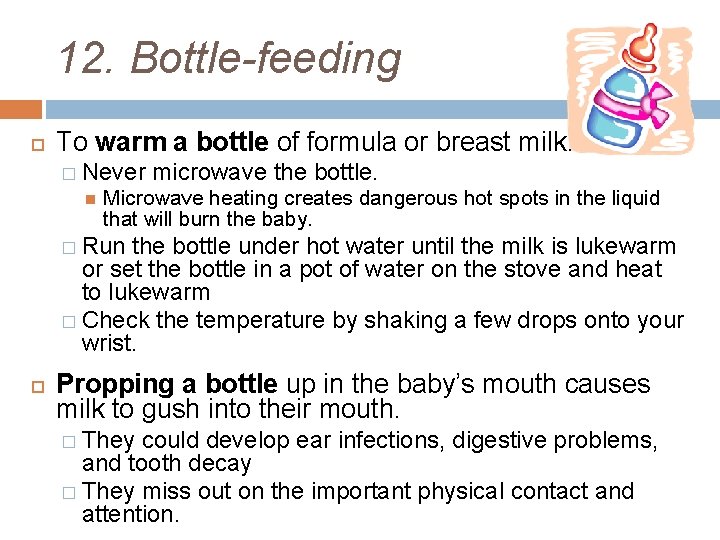
12. Bottle-feeding To warm a bottle of formula or breast milk: � Never microwave the bottle. Microwave heating creates dangerous hot spots in the liquid that will burn the baby. � Run the bottle under hot water until the milk is lukewarm or set the bottle in a pot of water on the stove and heat to lukewarm � Check the temperature by shaking a few drops onto your wrist. Propping a bottle up in the baby’s mouth causes milk to gush into their mouth. � They could develop ear infections, digestive problems, and tooth decay � They miss out on the important physical contact and attention.
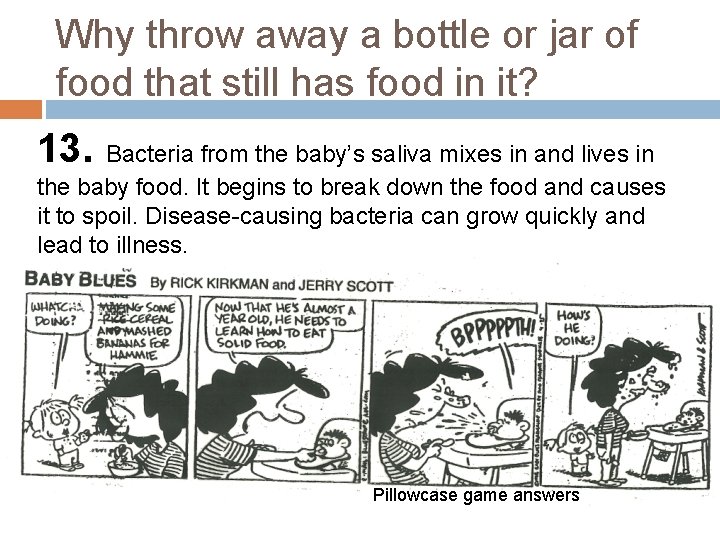
Why throw away a bottle or jar of food that still has food in it? 13. Bacteria from the baby’s saliva mixes in and lives in the baby food. It begins to break down the food and causes it to spoil. Disease-causing bacteria can grow quickly and lead to illness. Pillowcase game answers
14. Bottle fed babies are at risk for overfeeding because the caregiver may urge the baby to finish the milk left in the bottle, even if the child is full. FINISHED?
15. FEEDING IN THE FIRST YEAR At 4 -6 months of age the infant is able to digest solid foods and ready to begin eating these foods. A. Introduce one new food at a time to be able to identify allergic reactions to food. B. First foods you should introduce to a baby: 1. 2. 3. 4. 5. cereal and breads vegetables (yellow than green) fruits protein (7 mths)- poultry before beef, dairy- (7 mths)yogurt, cottage cheese, egg yolks - NOT cows milk -
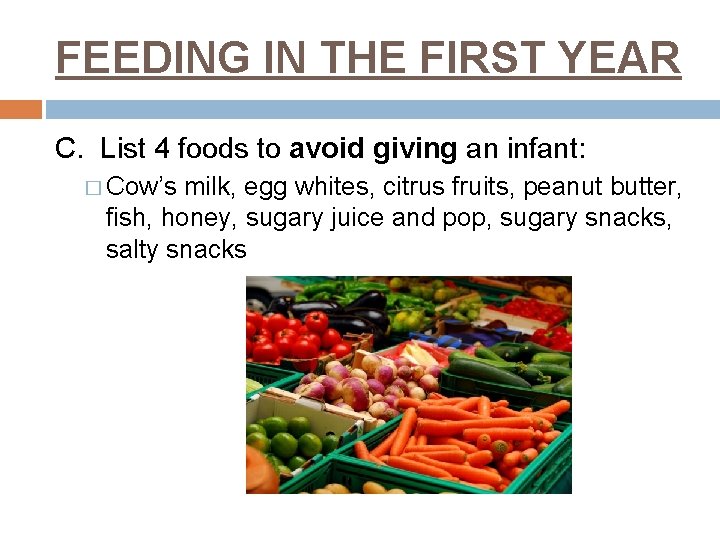
FEEDING IN THE FIRST YEAR C. List 4 foods to avoid giving an infant: � Cow’s milk, egg whites, citrus fruits, peanut butter, fish, honey, sugary juice and pop, sugary snacks, salty snacks
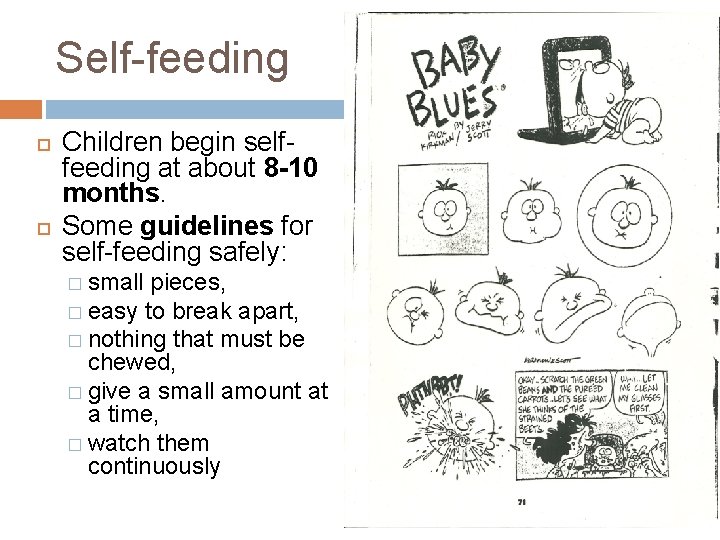
Self-feeding Children begin selffeeding at about 8 -10 months. Some guidelines for self-feeding safely: � small pieces, � easy to break apart, � nothing that must be chewed, � give a small amount at a time, � watch them continuously
16. Healthy eating habits and adequate nutrition: (3) Follow the food guide pyramid Give smaller serving sizes/portions � Use their hand as a guide for their portion Help children to enjoy fresh fruits and vegetables Limit salty, sweet, and fatty foods. Provide enough calories for rapid growth Provide foods rich in necessary nutrients � Protein, vitamins iron, calcium, B vitamins, C vitamins, and D Foods that are easy to digest Adequate amount of liquid – Mostly WATER � Use 100% juices
17. CHOOSING AN INFANT’S CLOTHING Safety � Comfort � Soft-knit fabrics, not bulky, no fuzzy trims that tickle, neck openings large enough to go over the baby’s head, not tight and binding, roomy for active body movements, anti-static, absorbent, right weight for warmth Easy to Care For � Fire retardant, not tight and binding, no loose buttons or fasteners, no loose strings or trims Machine washable, lighter fabrics stain easier, little or no ironing, shrinkage control (sanforized on the label), no dry cleaning, easy to mend Advance for Growth � 1 piece without obvious waistlines, fabrics that stretch, elastic waistbands, 2 piece outfits, adjustable straps
18. When it comes to caring for a baby: Develop a routine that the baby can count on. Remain consistent.
INFANT LABS Each day complete 1 of them � Total of 3 � Can do as many as you want Complete a DAPLA Analysis for 2 of the activities � Developmentally Appropriate Learning Activity � Turn it in in your next unit notebook Complete the ‘MUST DO’ as 1 of the 3 station choices. � Turn this in in your next unit notebook