
Languages with Context A Block Structured Language SE
Languages with Context A Block Structured Language SE 424
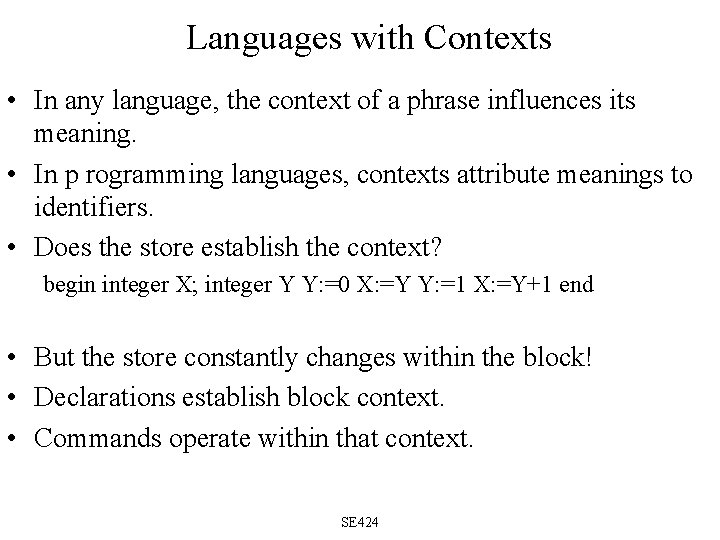
Languages with Contexts • In any language, the context of a phrase influences its meaning. • In p rogramming languages, contexts attribute meanings to identifiers. • Does the store establish the context? begin integer X; integer Y Y: =0 X: =Y Y: =1 X: =Y+1 end • But the store constantly changes within the block! • Declarations establish block context. • Commands operate within that context. SE 424
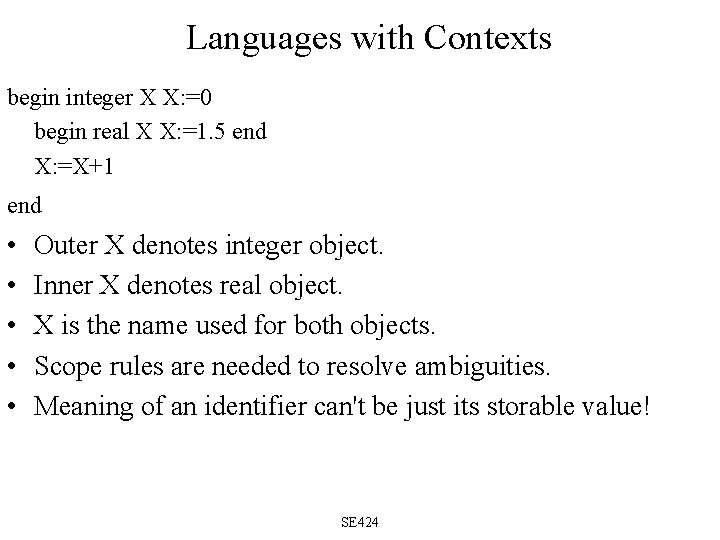
Languages with Contexts begin integer X X: =0 begin real X X: =1. 5 end X: =X+1 end • • • Outer X denotes integer object. Inner X denotes real object. X is the name used for both objects. Scope rules are needed to resolve ambiguities. Meaning of an identifier can't be just its storable value! SE 424
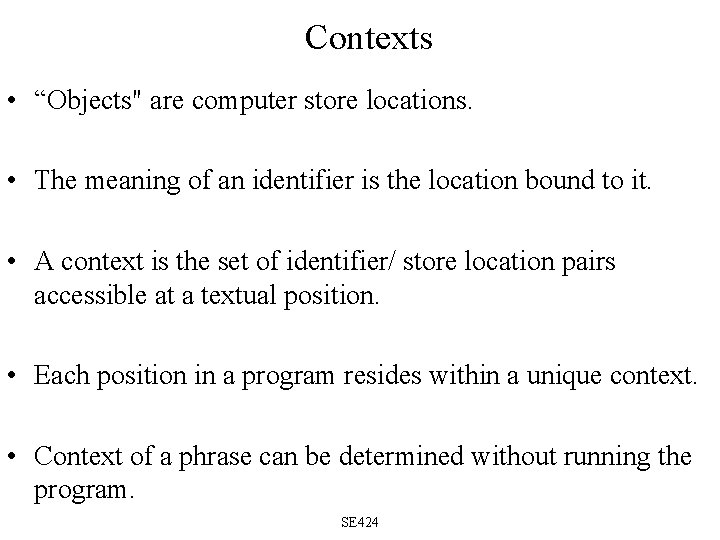
Contexts • “Objects" are computer store locations. • The meaning of an identifier is the location bound to it. • A context is the set of identifier/ store location pairs accessible at a textual position. • Each position in a program resides within a unique context. • Context of a phrase can be determined without running the program. SE 424
Environments Mathematical value that models context. • Environment establishes context for syntactic phrase – Resolution of ambiguities concerning meaning of identifiers. • As many environment values as distinct program contexts. – Multiple environments are maintained during program evaluation. • Environment is a static object. – Phrase uses the same environment each time it is evaluated. SE 424
Environment Models • Simple model: store = environment – Only one environment. – Used in previous program examples. • Complex model: store plus environments. – One store – Multiple environments SE 424
Compiler's Symbol Table • An example of an environment • Used for translation of source program into compiled code. • One entry for each identifier in the program – Data type. – Mode of usage(variable, constant, parameter). – Relative location in run-time store. • Resolution of name conflicts – Different symbol table for each block. – Build table as single stack • Incremented and decremented upon block entry and exit. • Compile-time object (Pascal, C, C++), • Run-time object (Lisp, Smalltalk). SE 424
Static and Dynamic Semantics • Static semantics – Part of semantics definition that use environment to resolve context questions. – Type-checking, scope resolution, storage calculations. • Dynamic semantics – “Real" production of meanings. – Code generation and execution. No clear separation! SE 424
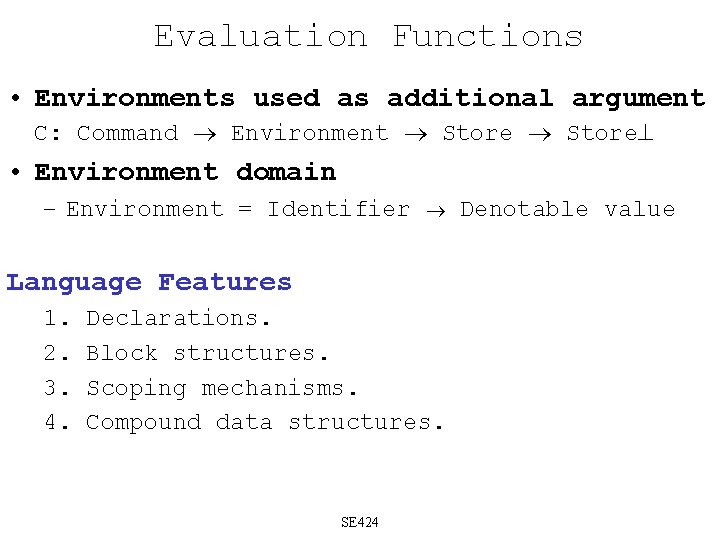
Evaluation Functions • Environments used as additional argument C: Command Environment Store • Environment domain – Environment = Identifier Denotable value Language Features 1. 2. 3. 4. Declarations. Block structures. Scoping mechanisms. Compound data structures. SE 424
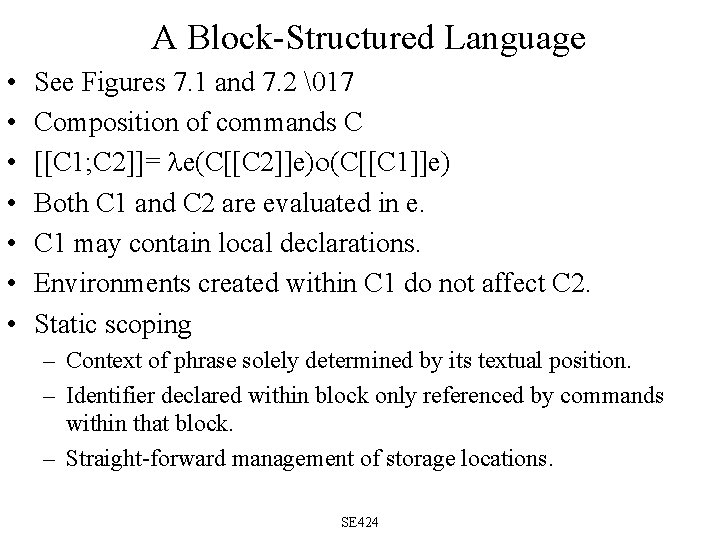
A Block-Structured Language • • See Figures 7. 1 and 7. 2 17 Composition of commands C [[C 1; C 2]]= e(C[[C 2]]e) (C[[C 1]]e) Both C 1 and C 2 are evaluated in e. C 1 may contain local declarations. Environments created within C 1 do not affect C 2. Static scoping – Context of phrase solely determined by its textual position. – Identifier declared within block only referenced by commands within that block. – Straight-forward management of storage locations. SE 424
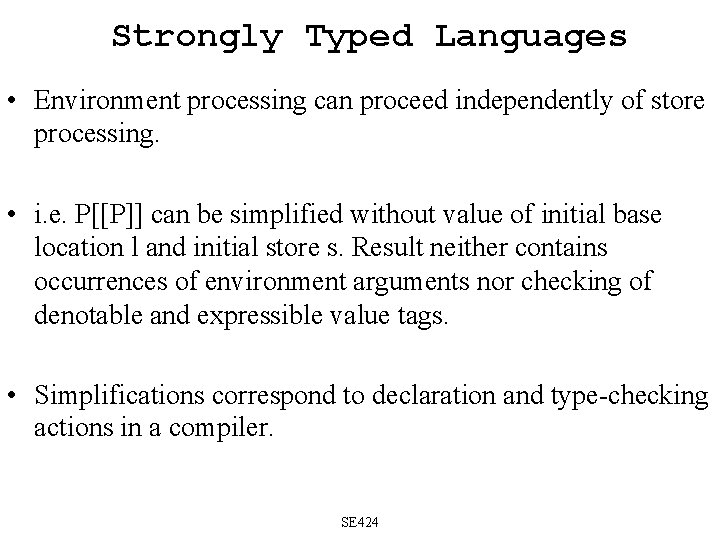
Strongly Typed Languages • Environment processing can proceed independently of store processing. • i. e. P[[P]] can be simplified without value of initial base location l and initial store s. Result neither contains occurrences of environment arguments nor checking of denotable and expressible value tags. • Simplifications correspond to declaration and type-checking actions in a compiler. SE 424
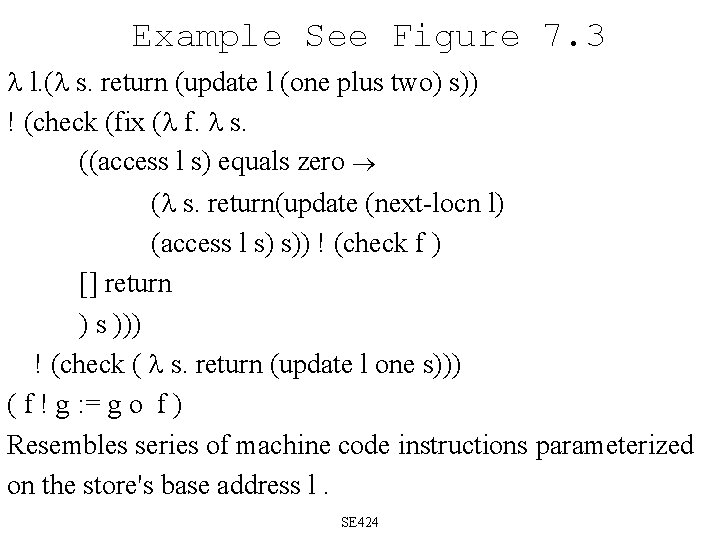
Example See Figure 7. 3 l. ( s. return (update l (one plus two) s)) ! (check (fix ( f. s. ((access l s) equals zero ( s. return(update (next-locn l) (access l s) s)) ! (check f ) [] return ) s ))) ! (check ( s. return (update l one s))) ( f ! g : = g o f ) Resembles series of machine code instructions parameterized on the store's base address l. SE 424
Stack-Managed Storage • Store of block-structured languages always used in a stacklike fashion – Locations are bound to identifiers sequentially using 'nextlocn'. – Location bound to identifier in local block are freed for re-use when block is exited. • Storage reuse automatically in C[[C 1; C 2]] – Locations bound to identifiers in [[C 1]] are re- served by environment built from e for C [[C 1 ]]. – C [[C 2 ]] uses original e (and original location marker) effectively deallocating these locations. • Significant characteristic of block-structured languages! SE 424
Stack-Managed Storage • Make storage calculations explicit in Store algebra – – Store = (Location Storable-value) x Location { First component is data space of the stack Second component indicates “top of stack" 'allocate-locn' becomes the run-time version of 'reserve-locn' • Environment domain is freed from storage management – Environment = Id Denotable-value – 'reserve-locn' is dropped. • Processing of declarations requires store as well as environment. SE 424
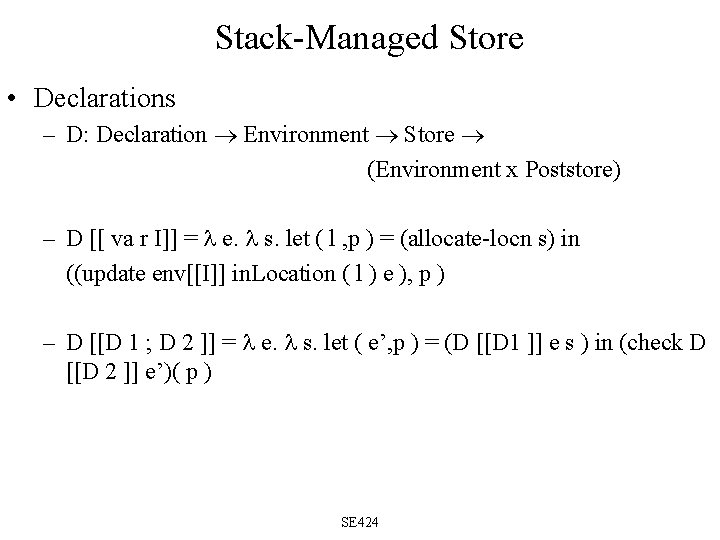
Stack-Managed Store • Declarations – D: Declaration Environment Store (Environment x Poststore) – D [[ va r I]] = e. s. let ( l , p ) = (allocate-locn s) in ((update env[[I]] in. Location ( l ) e ), p ) – D [[D 1 ; D 2 ]] = e. s. let ( e’, p ) = (D [[D 1 ]] e s ) in (check D [[D 2 ]] e’)( p ) SE 424
![• Blocks – K [[ begin D; C end ]] = e. s.](http://slidetodoc.com/presentation_image_h2/f3cf76fa673a3ed39dab430c28dbab45/image-16.jpg "• Blocks – K [[ begin D; C end ]] = e. s.")
• Blocks – K [[ begin D; C end ]] = e. s. let l = mark-locn in let ( e’, p ) = D[[D]] e s in let p’= (check ( C [[C]] e’))( p ) in (check (deallocate-locn s l ))( p 0 ) • Environment becomes run-time object because binding of location values to identifiers depends on run-time store. SE 424
The Meaning of Identifiers • Assignment X : = X+1 – Left-hand side value of X is location, – Right-hand side value is storable value associated to location. • Context problem occurs even at primitive command level! • Variable identifier denotes pair of values – I[[I]] = (L-value, R-value ) – L-value is kept in environment. – R-value is kept in store. SE 424
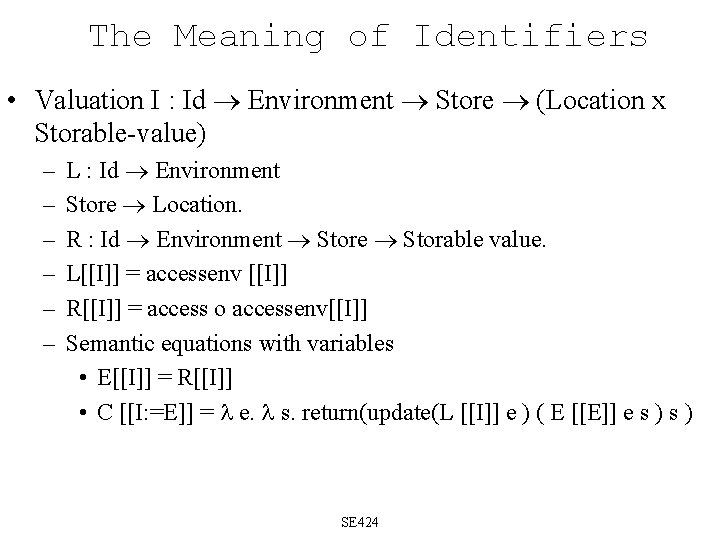
The Meaning of Identifiers • Valuation I : Id Environment Store (Location x Storable-value) – – – L : Id Environment Store Location. R : Id Environment Store Storable value. L[[I]] = accessenv [[I]] R[[I]] = access o accessenv[[I]] Semantic equations with variables • E[[I]] = R[[I]] • C [[I: =E]] = e. s. return(update(L [[I]] e ) ( E [[E]] e s ) SE 424
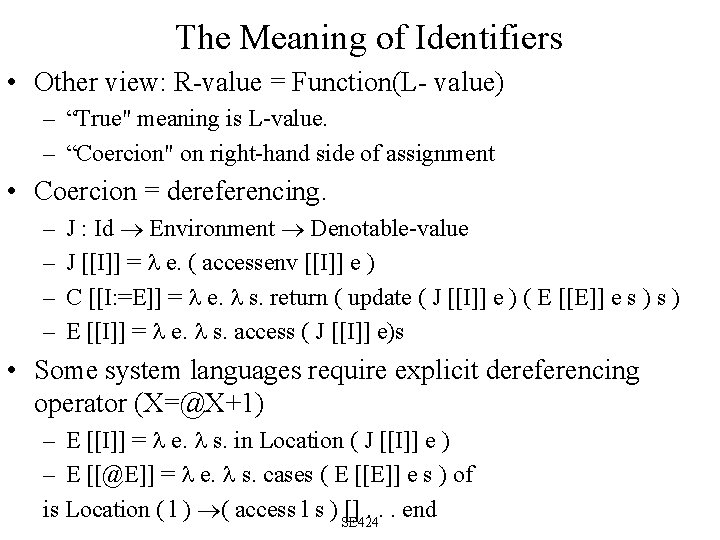
The Meaning of Identifiers • Other view: R-value = Function(L- value) – “True" meaning is L-value. – “Coercion" on right-hand side of assignment • Coercion = dereferencing. – – J : Id Environment Denotable-value J [[I]] = e. ( accessenv [[I]] e ) C [[I: =E]] = e. s. return ( update ( J [[I]] e ) ( E [[E]] e s ) E [[I]] = e. s. access ( J [[I]] e)s • Some system languages require explicit dereferencing operator (X=@X+1) – E [[I]] = e. s. in Location ( J [[I]] e ) – E [[@E]] = e. s. cases ( E [[E]] e s ) of is Location ( l ) ( access l s ) SE 424 []. . . end
- Slides: 19