
Language Thought and Culture by Claire Kramsch CHAPTER

“Language, Thought and Culture”, by Claire Kramsch CHAPTER 9 IN HANDBOOK OF APPLIED LINGUISTICS Gustavo Takashi Moraes Assano (5929231) Tópicos de Linguística Aplicada – Prof. Marília Ferreira
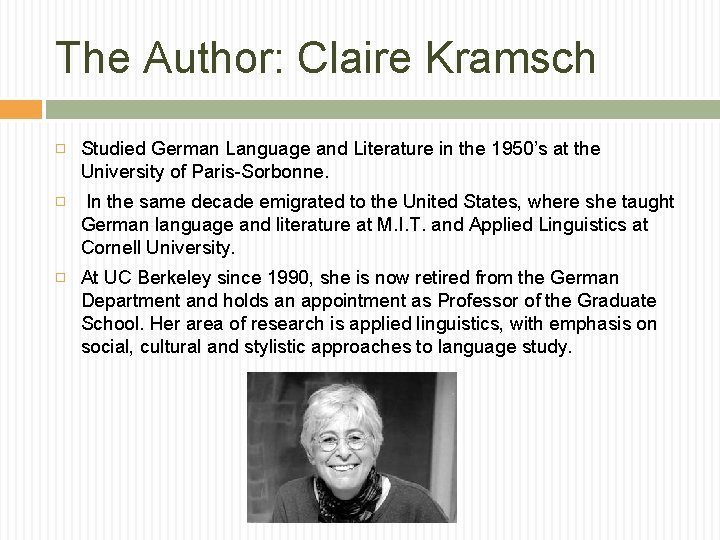
The Author: Claire Kramsch Studied German Language and Literature in the 1950’s at the University of Paris-Sorbonne. In the same decade emigrated to the United States, where she taught German language and literature at M. I. T. and Applied Linguistics at Cornell University. At UC Berkeley since 1990, she is now retired from the German Department and holds an appointment as Professor of the Graduate School. Her area of research is applied linguistics, with emphasis on social, cultural and stylistic approaches to language study.
Introduction Basic premises: Language both expresses and creates categories of thought that are shared by members of a social group. Language is, in part, responsible for the attitudes and beliefs that constitute what we call “culture”.
1) History of theory “Applied linguistics was at first primarily interested in the psycholinguistic processes at work in language acquisition and testing, and in the cognitive dimensions of language pedagogy” (p. 235). 1980’s ascendancy of sociology and anthropology created a favorable climate for applied linguists to explore the following fields: 1) the relation of language and social structure (Example: Language as social semiotic, by M. A. K. Halliday, 1978). 2) the social psychological aspects of language acquisition (Example: Understanding second language acquisition, 1986). 3) the multiple discursive aspects of language in use in a variety of social contexts (Examples: Discourse strategies, by J. J. Gumperz, 1982; Culture and language development, by E. Ochs, 1988).

2) Relative Linguistics Precursors to Linguistic Relativity: J. Herder (1744– 1803) “If it be true that we. . . learn to think through words, then language is what defines and delineates the whole of human knowledge. . . In everyday life, it is clear that to think is almost nothing else but to speak. Every nation speaks. . . according to the way it thinks and thinks according to the way it speaks”. (Herder, [1772] 1960, pp. 99– 100, Kramsch’s tanslation) Kramsch’s understanding of Herder: “a nation’s language reflected the way its people thought according to the equation: one language = one folk = one nation” (p. 236).
Wilhelm von Humboldt (1762– 1835) “. . . there resides in every language a characteristic world-view. . . By the same act whereby [man] spins language out of himself, he spins himself into it, and every language draws about the people that possesses it a circle whence it is possible to exit only by stepping over at once into the circle of another one”. (von Humboldt, [1836] 1988, p. 60) Kramsch: In this passage, Humboldt “expressed the link between language and worldview (or cultural mindset”. What makes them precursors to Linguistic Relativism? The relativisation of the Cartesian subject.
3) The Sapir-Whorf hypothesis Edward Sapir (1884 -1939). Culture, language and personality: selected essays. 1962. Benjamin Whorf (1897 -1941). Language, thought, and reality. 1940. What did they discover? An implicit agreement in a speech community to organize impressions in linguistic systems separated from codified patterns of our language. A second nature that becomes normative. Users of different grammars: similar acts of observation produce different types of observations and evaluations. Different linguistic systems produce different world views regarding a similar act of observation.
4) Semiotic Relativity Terrence Deacon (1950 -). The symbolic species: the co-evolution of language and the brain. 1950. According to Kramsch, a phylogenetic perspective (the development of the human species)
Lev Vygotsky (1896 – 1934). Thought and language. 1934 According to Kramsch, a ontogenetic perspective (the development of the individual human organism) How does language as a social activity influences thought? Kramsch: “He argues that the language the child hears and experiences on the social plane becomes internalized in the form of inner speech on the psychological plane, thus leading to both language acquisition and language socialization. Vygotsky’s theory turns on its head the traditional, Cartesian, view of the pre-eminence of thought over language. For him, symbolic activity derives from social interaction, according to his “general genetic law of cultural development” (p. 241) Kramsch’s question: is this not a rather strong form of linguistic relativity?
5) How Speakers of Different Languages Think Differently When Speaking Revision of the linguistic relativity hypothesis in a different form on the typological/grammatical and on the lexical/semantic levels. - Dan Slobin (“in a large-scale cross-cultural project in cognitive linguistics”): Evidence for linguistic relativity. 2000. Example: Satellite-framed languages (S-languages) in opposition to verb-framed languages (Vlanguages)
6) Discursive Relativity or, How Speakers of Different Discourses (across Languages or in the Same Language) Have Different Cultural Worldviews Main source: John Gumperz. Rethinking linguistic relativity. 1996. Research in linguistic anthropology, language socialization studies, and cultural psychology; “This kind of research draws not on rationalist theories of mind, but on theories that account for the interaction of mind, language, and social/cultural action in communicative practices of everyday life”. “[…] language as communicative practice is tied to a person’s position in time, space, social and historical relations, and his/her social and emotional identity”. p. 249.
7) Language Relativity in Applied Linguistic Research Structural linguistics + behavioral psychology = contrastive analysis approaches in language acquisition study and behavioristic methods of language teaching (repetition, habit formation, translation). The first “cognitive revolution” in educational psychology: Jerome Bruner. A study of thinking. 1956. According to Kramsch: “Bruner and his colleagues in the fifties reinstated the autonomy of the thinking subject” p. 249. The “linguistic revolution” brought about by Noam Chomsky: Syntactic Structures. 1957. According Kramsch: “reinstated the autonomy of the speaking-hearing subject, thus liberating the learner from behavioral conditioning and political manipulation”. p. 250. Kramsch’s critique: “Both western psychology and linguistics have implicitly adopted the rationalist, Cartesian view that language reflects thought and thought is expressed through language, but also that psychological processes exist independently of language and of the social activities in which language is used”. p. 250.
All forms of language relativity had been carried out independently of research of second language acquisition (SLA) Through the 1980’s, SLA research was out of the agenda. Formal linguistic tradition’s priority: Discover universal aspects of second language (L 2) acquisition based on the principles of Universal Grammar, or on universally vaid psycholinguistic processes of L 2 development. Kramsch’s critique: “[the SLA research] viewed the social as a stable, pre-existing fixture, existing outside the individual, not constructed by an individual’s psychological and linguistic processes. By relying on the standard (national) native speaker as a benchmark for language acquisition, it seemed to equate, like Herder and von Humboldt, one language with one national community and one national culture”. p. 250.
8) Language Relativity in Educational Practice The problem: The conflict between the desire of the practitioner vs. The constraints of the institutions; between culture of teaching vs. Culture of testing; The culture of students vs. The culture of native speakers.
Three questions: 1) isn’t applied linguistic theory itself subjected to the principle of language relativity? 2) isn’t educational culture inherently inhospitable to the principle of language relativity, since its ultimate goal is to discriminate between educated and non-educated segments of the population through the imposition of the same formal norms to everyone? 3) can language relativity be taught directly or can it only be modelled?
What does Language Relativity suggests? Reorienting the focus of language teachers from what they do to who they are. “Whether the language they teach is the language they grew up with, or a foreign language, they themselves have had to grapple with language relativity. It has, no doubt, put into question their own worldview, it has made them conscious of what got lost in translation. They have to resonate to the foreign words with the sensibility of both a native speaker and a non-native speaker. Most of all, now fluent as they are in the language they teach, they have to remember what it felt like to learn a new language, the linguistic and culture shocks experienced, the challenges and rewards encountered along the way. This sensitivity to language relativity, this sense of wonder at the mysteries of the untranslatable, cannot be taught directly. It has to be modelled by the language teacher herself”. p. 255.
- Slides: 16