
LANGUAGE THE GREAT EQUALIZER EDUCATION NEUROSCIENCE INTRODUCTION LANGUAGE


- Slides: 35
LANGUAGE THE GREAT EQUALIZER EDUCATION NEUROSCIENCE INTRODUCTION LANGUAGE DEVELOPMENT THE EDUCATION NEUROSCIENCE FOUNDATION
EDUCATION NEUROSCIENCE Education Neuroscience and Language Learning NEW PATHWAYS TO LEARNING FOR ALL
BRILLIANT THINKERS
EDUCATION NEUROSCIENCE New Field of Study Education and Language How the Brain Thinks Key to Learning is Language
DISCOVERY Key to Learning is Language The Global Institute for Language & Literacy Development, LLC.
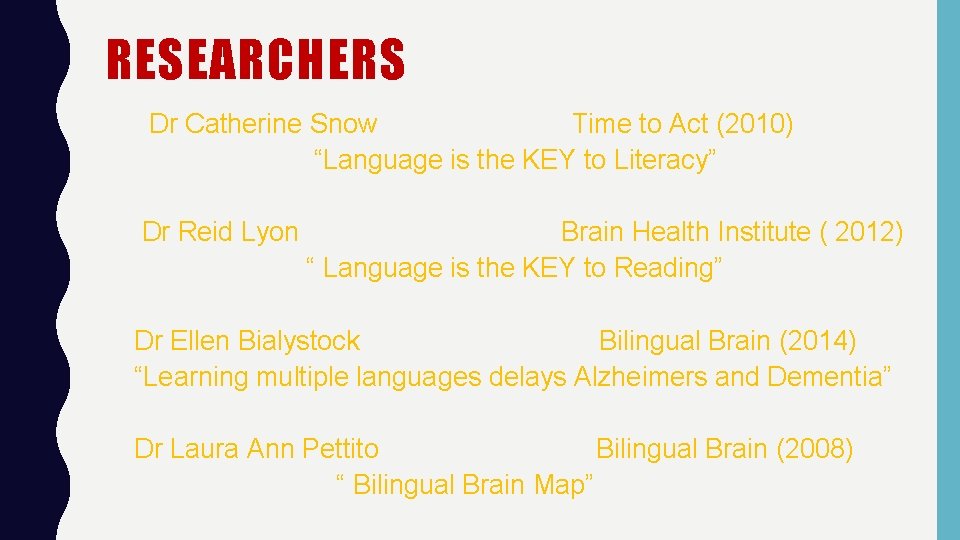
RESEARCHERS Dr Catherine Snow Time to Act (2010) “Language is the KEY to Literacy” Dr Reid Lyon Brain Health Institute ( 2012) “ Language is the KEY to Reading” Dr Ellen Bialystock Bilingual Brain (2014) “Learning multiple languages delays Alzheimers and Dementia” Dr Laura Ann Pettito Bilingual Brain (2008) “ Bilingual Brain Map”
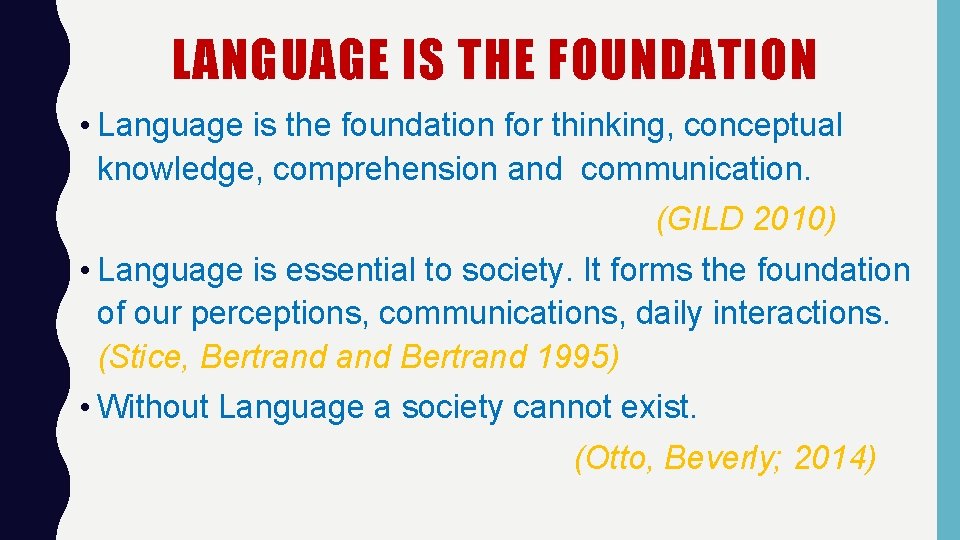
LANGUAGE IS THE FOUNDATION • Language is the foundation for thinking, conceptual knowledge, comprehension and communication. (GILD 2010) • Language is essential to society. It forms the foundation of our perceptions, communications, daily interactions. (Stice, Bertrand 1995) • Without Language a society cannot exist. (Otto, Beverly; 2014)
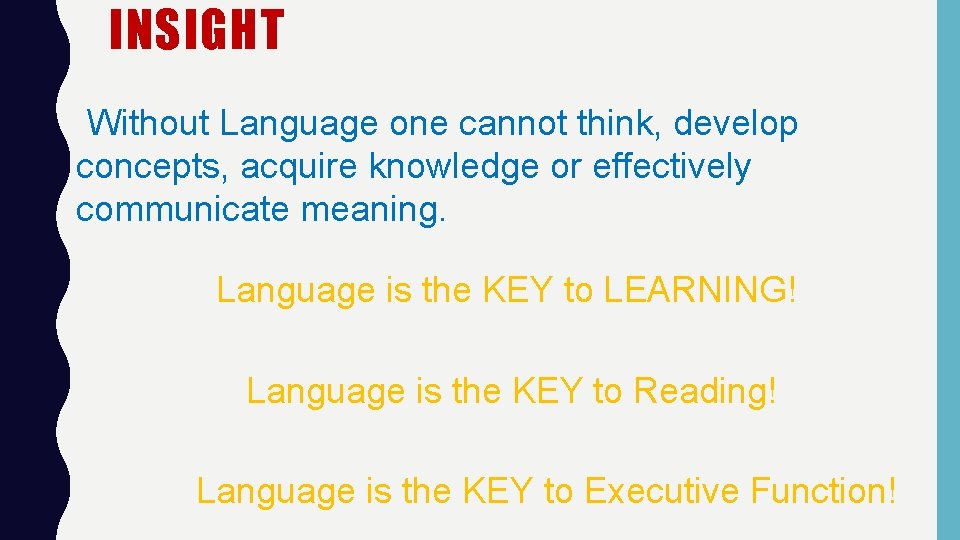
INSIGHT Without Language one cannot think, develop concepts, acquire knowledge or effectively communicate meaning. Language is the KEY to LEARNING! Language is the KEY to Reading! Language is the KEY to Executive Function!
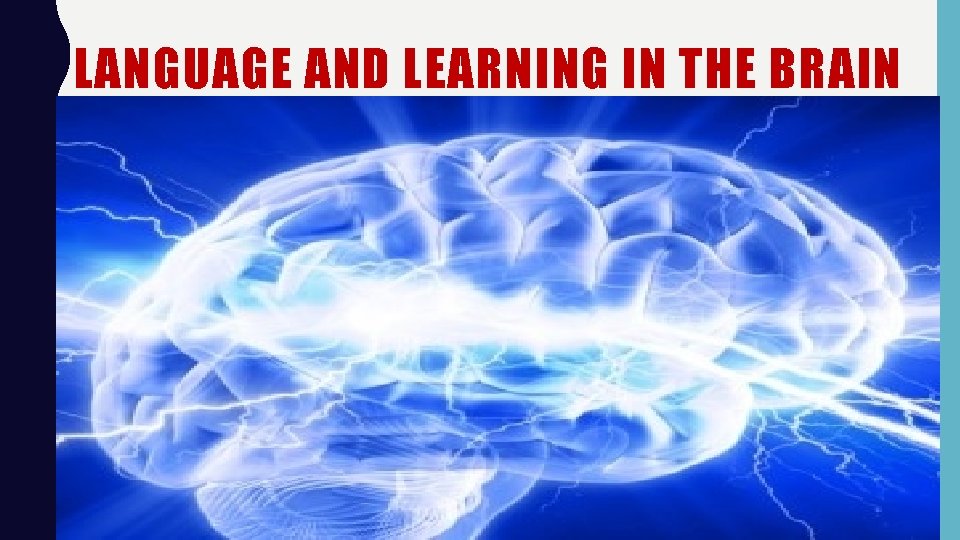
LANGUAGE AND LEARNING IN THE BRAIN
WHAT IS LANGUAGE? • Language is the specific capacity “internal brain neural networking system” (nature) and external intentional interactive development (nurture) for developing, acquiring and using complex systems of communication. • The scope and dimension of language development include linguistic skills in speaking, listening, reading and writing. • Language uses logical structures and real-world references to process, convey and assign meaning to thought and manage and resolve obscurity.
LEARNING. . . PAST, PRESENT, FUTURE In the past, LEARNING was a means of acquiring knowledge. WHAT TO THINK Now, LEARNING must foster cognitive abilities to construct knowledge in meaningful ways in order to develop higher order thinking, executive function and problem-solving skills. HOW TO THINK
EXECUTIVE FUNCTION • how the brain receives, interprets, organizes, delivers and processes information (input) to select, retrieve, choose and deliver accurate information (output) that corresponds to each complex demand in a given task. • ‘executive function’, or ‘higher order thinking’, is the highest form of brain activity of the human mind. This aspect of the brain neurological process which produces complex thinking, occurs in the upper portion of the brain (Prefrontal Cortex) between the ages of 8 -25, and is the last neurological area to mature.
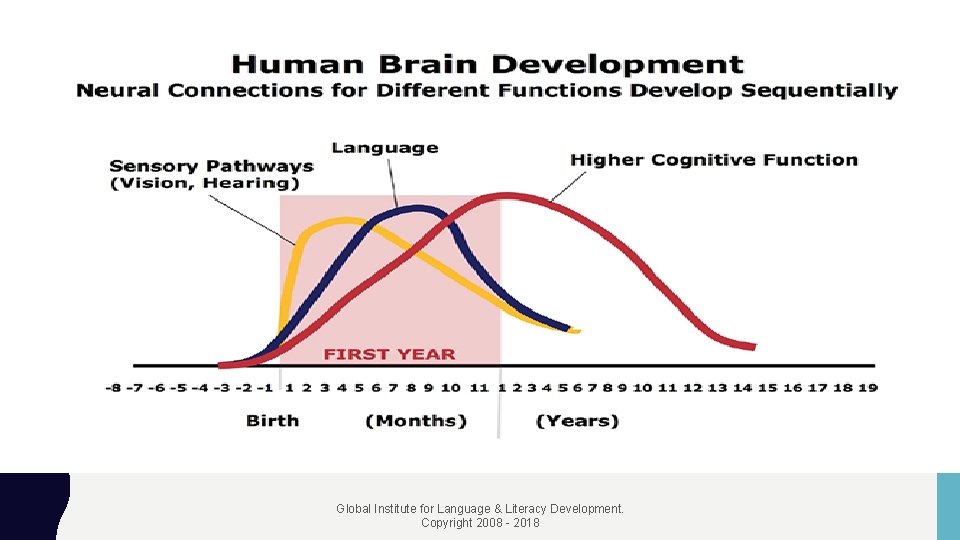
Global Institute for Language & Literacy Development. Copyright 2008 - 2018
EXECUTIVE FUNCTION AND LANGUAGE GOAL Develop thinkers, creative leaders with strong executive function skills including; planning, flexibility, tolerance, risk assessment, informed decision-making, reasoning, analysis, effective communication & delay immediate gratification to achieve long-term goals. ”
LANGUAGE DEVELOPMENT Knowledge and comprehension is developed through interaction with language! Adults Peers Environment Experiences Materials, Books, Technology, Media Stimulate cognitive, social, emotional, physical and behavior
LANGUAGE AND LEARNING IN THE BRAIN
HOW Students become 21 st century’s creative thinkers and problem-solvers by developing foundational skills in: critical analysis, induction, deduction, relational thinking with prior knowledge activation, inference, prediction and communication.
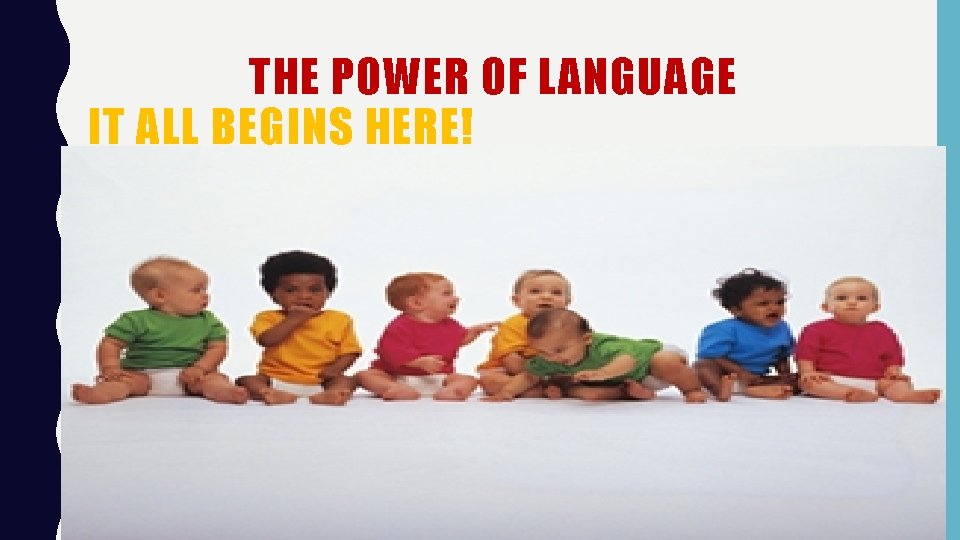
THE POWER OF LANGUAGE IT ALL BEGINS HERE!
THE BABY HUMAN The process begins here …… http: //www. dailymotion. com/video/x 77 gfp_thebaby-human-3 -to-talk-babbling_lifestyle BRAIN RESEARCH The Global Institute for Language & Literacy Development, LLC.
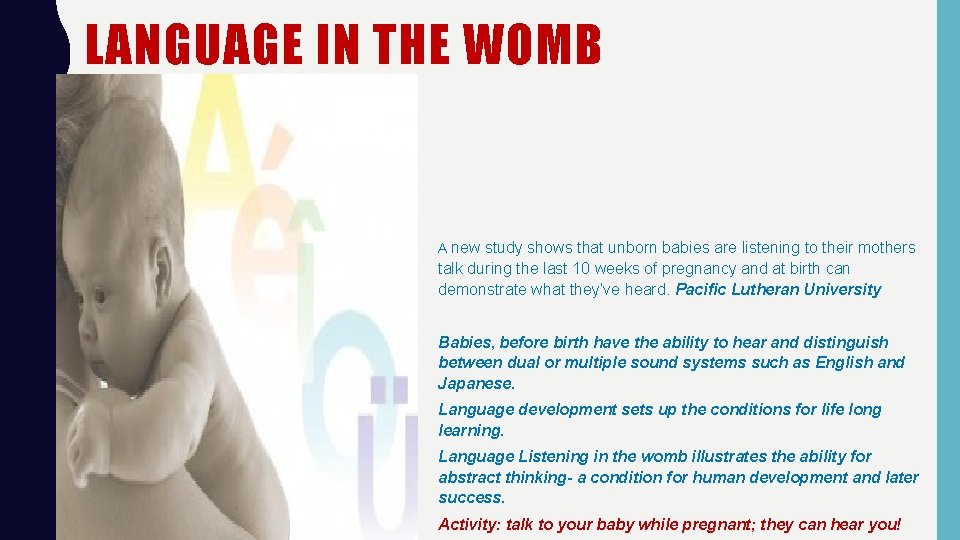
LANGUAGE IN THE WOMB A new study shows that unborn babies are listening to their mothers talk during the last 10 weeks of pregnancy and at birth can demonstrate what they’ve heard. Pacific Lutheran University Babies, before birth have the ability to hear and distinguish between dual or multiple sound systems such as English and Japanese. Language development sets up the conditions for life long learning. Language Listening in the womb illustrates the ability for abstract thinking- a condition for human development and later success. Activity: talk to your baby while pregnant; they can hear you!
THE LANGUAGE STORY • Babies are born Universal Linguists • Hear every sound in any language regardless of language or country. • Every child is born with the ability to process any and all languages from birth to 1 yr. old. • Babies begin to discriminate language sounds beginning 6 mos to 1 yr. • Babies respond to language/s of primary caregiver early in language process. (motherese)
OPTIMAL WINDOW OF LEARNING • Children hearing 2 -more languages from birth learn both languages equally. • Learning 2 -more languages does NOT delay the language development process in either. • There are optimal “windows of time” for language/s learning. Birth to 8 is the first window. • Children who do not develop ANY language by 1213 yrs window of language learning CLOSES!
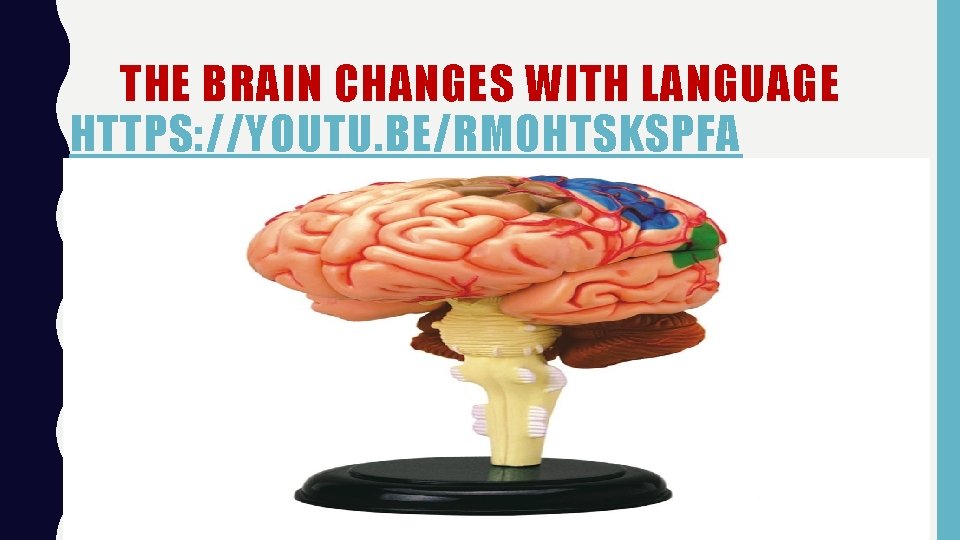
THE BRAIN CHANGES WITH LANGUAGE HTTPS: //YOUTU. BE/RMOHTSKSPFA
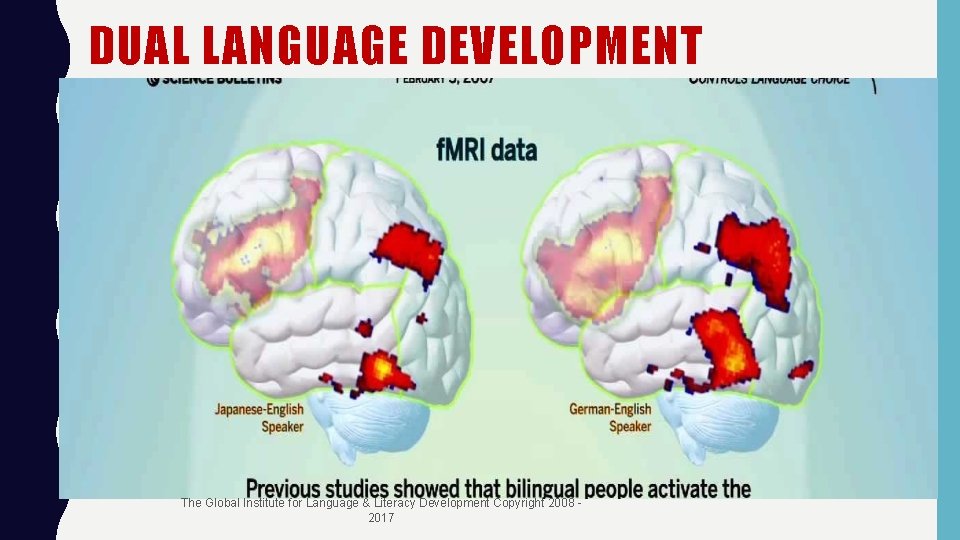
NATURE V NURTURE Bilingual Brain Map • Children born with ability to hear and discriminate all sound/s. • BUT discreet sound articulation/discrimination must be taught EXPLICTLY. (Pettito) • Language must be taught by age 12 -14 or lose ability to develop language. ( Indiana U) • Dual language Brain Imprint: 2 sides of brain.
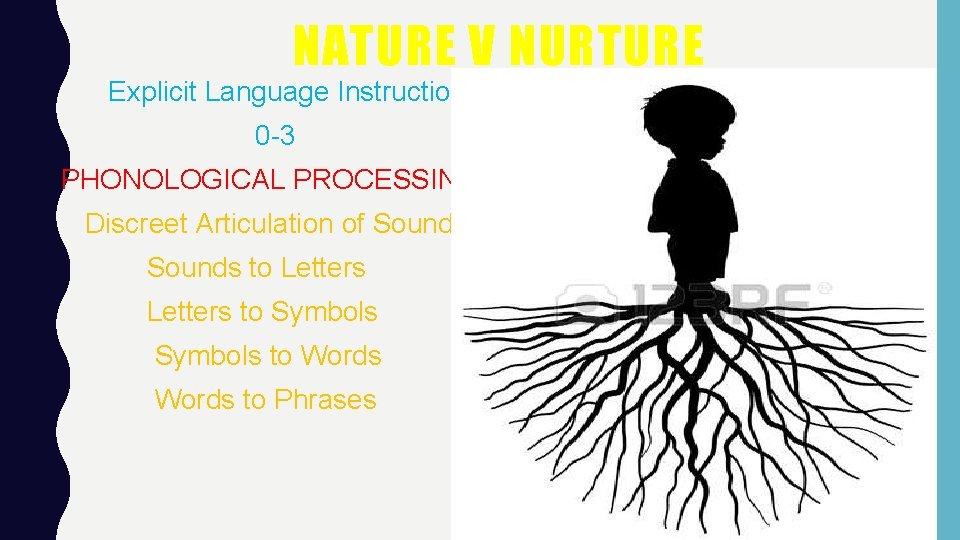
NATURE V NURTURE Explicit Language Instruction 0 -3 PHONOLOGICAL PROCESSING Discreet Articulation of Sound Sounds to Letters Letters to Symbols Symbols to Words Words to Phrases
DUAL LANGUAGE DEVELOPMENT The Global Institute for Language & Literacy Development Copyright 2008 - 2017
BILINGUAL BRAIN MAP • Children learning to read in 2 Languages have a ‘Bilingual Brain Map’ equal development on 2 sides of the brain. 3 yrs-3 rd grade. • Students who read in 2 languages outperform ALL students who read in 1 language. • Students and Adults who learn multiple languages and read in more than 1 delay onset of Alzheimers and aging brain maladies
BRAIN MYTH BUSTERS
MYTH BUSTERS • No right-left brain distinction in learning • No specific time allocated to learn language/s • No silent period in language development • No preferred learning style • Children born with ability to hear all language • 6 -9 months begin discriminating sounds • ALL CHILDREN UNIVERSAL LINGUISTS • ALL LEARNERS PROCESS LANGUAGE THE SAME
NEW EDUCATION LANDSCAPE • Whole brain engaged in learning. • Optimal “windows of learning language. ” • Whole Brain is engaged in language development using the 4 language domains and social, emotional learning. • Children hear all sounds in every language. • ALL learners process language/s the same way regardless of race, ethnicity, economic status, country, culture or number and type of language/s spoken.
NEW LANGUAGE DISCOVERIES • There is no ‘silent period’ in language development or acquisition; brain is active. • No specific amount of time allocated to language development or acquisition including complex higher order language skills. • There are 3 pathways to language learning: what, where and how!
3 BRAIN PATHWAYS • WHAT you hear- discriminate sounds • WHERE where sound originates and travels • HOW you hear scramble and organize from sound to visual imagery and concept
CHALLENGE NAEP 2017 What Happens When you Don’t HEAR Language/s clearly? 91% 4 th grade English Learners (ELS) READ below Proficient. 86% 8 th grade ELs perform BELOW PROFICIENT in Math 70% 4 th grade Els READ BELOW BASIC!
WHERE TO BEGIN
EDUCATION NEUROSCIENCE FOUNDATION Since 2005, education neuroscientists have used f. MRI’s to study the inner workings of the brain related to language development, dual language development and it’s impact on reading, thinking, comprehension and developing executive function skills. ENF’s purpose is to share these findings in a ‘Theory to Practice Model’ with educators, parents, advocates, policy makers, Congress and companies involved with curriculum and product development to transform education for the 21 st century to TEACH THE WAY THE BRAIN LEARNS!