
Language Techniques Definition Example Paper 1 Sentence Types
- Slides: 1
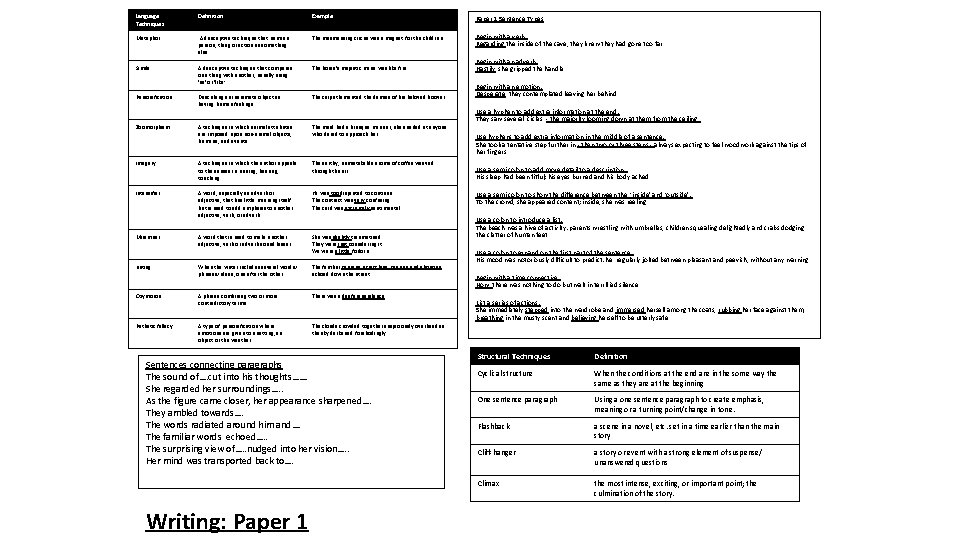
Language Techniques Definition Example Paper 1 Sentence Types Metaphor A descriptive technique that names a person, thing or action as something else. The mesmerising circus was a magnet for the children. Begin with a verb: Regarding the inside of the cave, they knew they had gone too far. Simile A descriptive technique that compares one thing with another, usually using 'as' or 'like‘. The horse’s majestic mane was like fire. Begin with an adverb: Hastily, she gripped the handle. Personification Describing an inanimate object as having human feelings. The carpet lamented the demise of his beloved hoover. Begin with an emotion: Desperate, they contemplated leaving her behind. A technique in which animal attributes are imposed upon non-animal objects, humans, and events. The maid had a brusque manner; she snarled at anyone who dared to approach her. Imagery A technique in which the author appeals to the senses i. e. seeing, hearing, touching. The earthy, unmistakable aroma of coffee weaved through the air. Intensifier A word, especially an adverb or adjective, that has little meaning itself but is used to add emphasis to another adjective, verb, or adverb. He was too dispirited to continue. The contract was very confusing. The card was extremely sentimental. A word that is used to make another adjective, verb or adverb sound lesser. She was slightly traumatised. They were just considering it. We were a little forlorn. Zoomorphism Minimiser Listing When the writer includes several words/ phrases/ ideas, one after the other. The familiar tapping, scratching, tearing and shouting echoed down the street. Oxymoron A phrase combining two or more contradictory terms. There was a deafening silence. Pathetic fallacy A type of personification where emotions are given to a setting, an object or the weather. The clouds crowded together suspiciously overhead as the sky darkened forebodingly. Sentences connecting paragraphs The sound of…. cut into his thoughts……. She regarded her surroundings…. . As the figure came closer, her appearance sharpened…. They ambled towards…. The words radiated around him and…. The familiar words echoed…. . The surprising view of…. . nudged into her vision…. . Her mind was transported back to…. Writing: Paper 1 Use a hyphen to add extra information at the end: They saw several icicles - the majority looming down at them from the ceiling. Use hyphens to add extra information in the middle of a sentence: She took a tentative step further in - then two or three steps - always expecting to feel woodwork against the tips of her fingers. Use a semi colon to add more detail to a description: His sleep had been fitful; his eyes burned and his body ached. Use a semi colon to show the difference between the ‘inside’ and ‘outside’: To the crowd, she appeared content; inside, she was reeling. Use a colon to introduce a list: The beach was a hive of activity: parents wrestling with umbrellas, children squealing delightedly and crabs dodging the clatter of human feet. Use a colon to expand on the first part of the sentence: His mood was notoriously difficult to predict: he regularly jolted between pleasant and peevish, without any warning. Begin with a time connective: Now, there was nothing to do but wait in terrified silence. List a series of actions: She immediately stepped into the wardrobe and immersed herself among the coats, rubbing her face against them, breathing in the musty scent and believing herself to be utterly safe. Structural Techniques Definition Cyclical structure When the conditions at the end are in the some way the same as they are at the beginning One sentence paragraph Using a one sentence paragraph to create emphasis, meaning or a turning point/change in tone. Flashback a scene in a novel, etc. set in a time earlier than the main story Cliff-hanger a story or event with a strong element of suspense/ unanswered questions Climax the most intense, exciting, or important point; the culmination of the story.