
Language Systems Chapter Four Modern Programming Languages 1
![Example � Original code: int i = 0; while (i < 100) { a[i++]](https://slidetodoc.com/presentation_image/37339799ce4d022340f379f70f418a74/image-15.jpg "Example � Original code: int i = 0; while (i < 100) { a[i++]")
- Slides: 43
Language Systems Chapter Four Modern Programming Languages 1
Outline �The classical sequence of program construction �Variations on the classical sequence �Binding times �Runtime support Chapter Four Modern Programming Languages 2
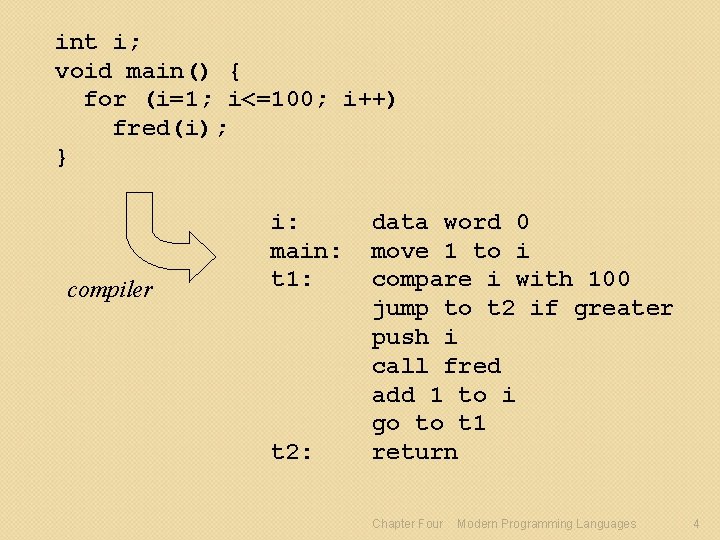
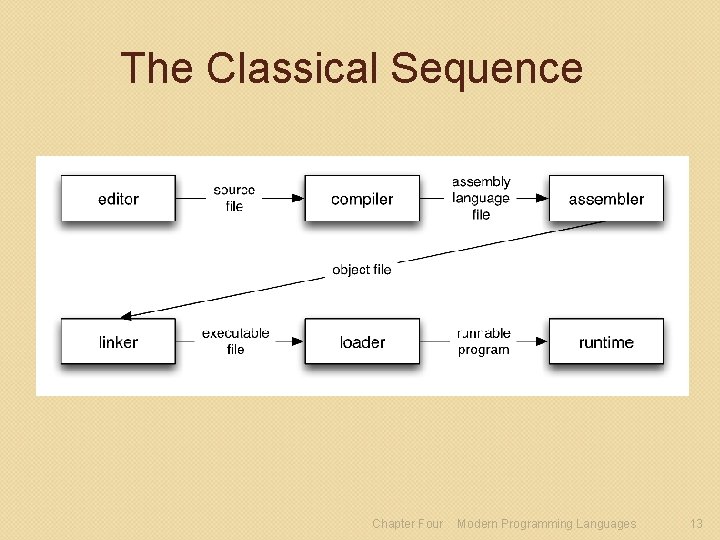
Compiling �Compiler translates ◦ Machine-specific to assembly language �This is the first step in going from source code to an executable… Chapter Four Modern Programming Languages 3
int i; void main() { for (i=1; i<=100; i++) fred(i); } compiler i: main: t 1: t 2: data word 0 move 1 to i compare i with 100 jump to t 2 if greater push i call fred add 1 to i go to t 1 return Chapter Four Modern Programming Languages 4
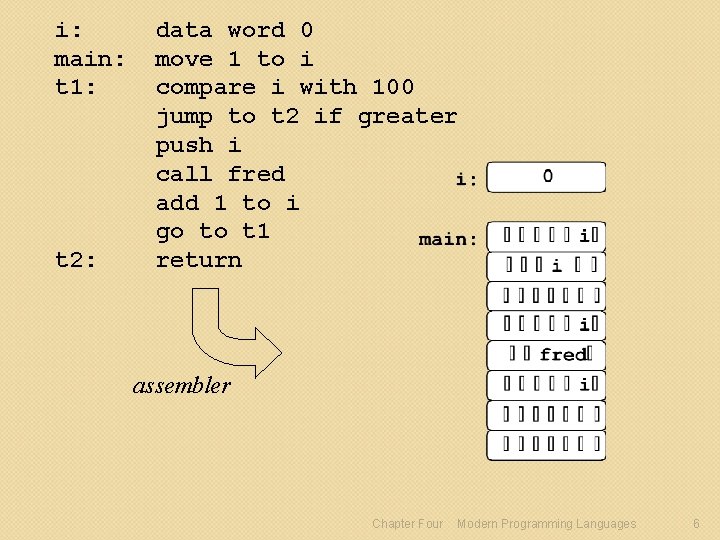
Assembling � Assembly language is not directly executable ◦ Still text format, readable by (nerdy) people ◦ Still has names, not memory addresses � Assembler converts each assembly-language instruction into machine language ◦ Resulting object file not readable by people � This step is not visible in ◦ And may even be skipped modern compilers Chapter Four Modern Programming Languages 5
i: main: t 1: t 2: data word 0 move 1 to i compare i with 100 jump to t 2 if greater push i call fred add 1 to i go to t 1 return assembler Chapter Four Modern Programming Languages 6
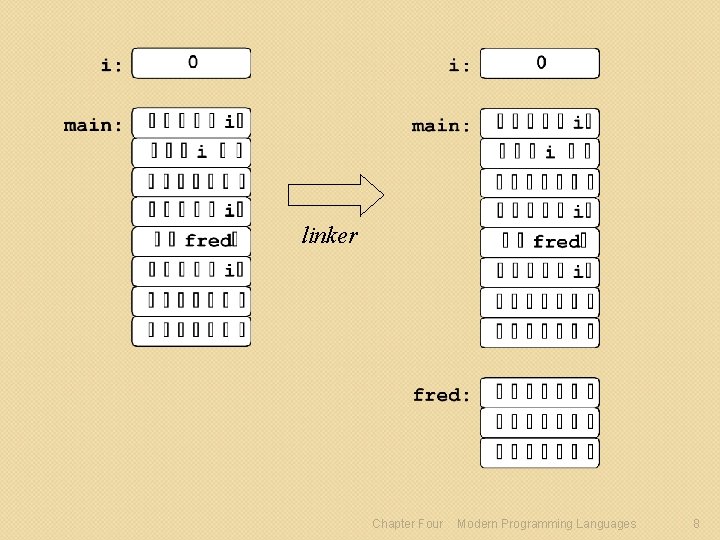
Linking � Object file still not directly executable ◦ Still has some names � Linker � In combines all the different parts our example, fred was compiled separately, may even have been written in a different high-level language � Result is the executable file Chapter Four Modern Programming Languages 7
linker Chapter Four Modern Programming Languages 8
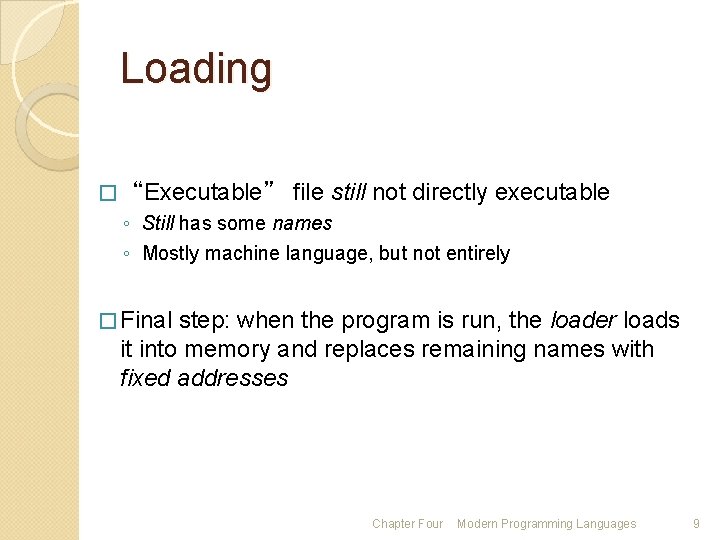
Loading � “Executable” file still not directly executable ◦ Still has some names ◦ Mostly machine language, but not entirely � Final step: when the program is run, the loader loads it into memory and replaces remaining names with fixed addresses Chapter Four Modern Programming Languages 9
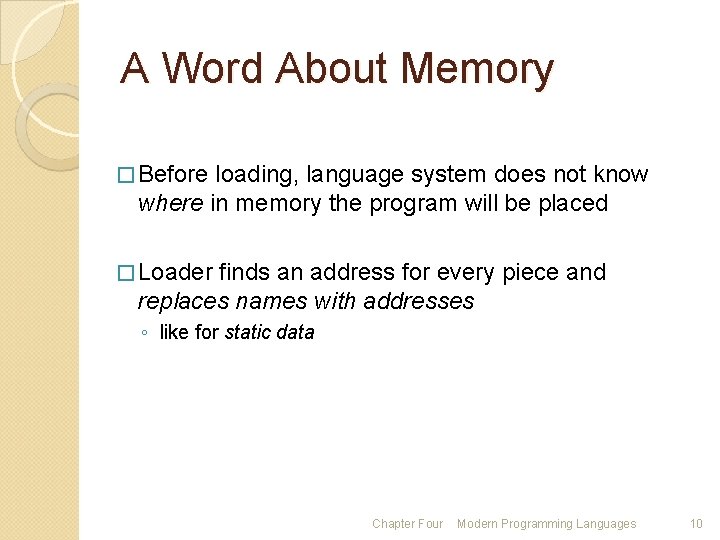
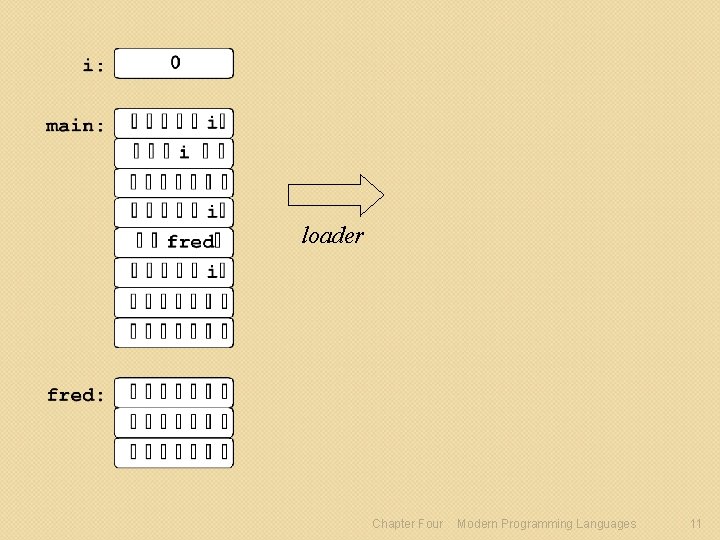
A Word About Memory � Before loading, language system does not know where in memory the program will be placed � Loader finds an address for every piece and replaces names with addresses ◦ like for static data Chapter Four Modern Programming Languages 10
loader Chapter Four Modern Programming Languages 11
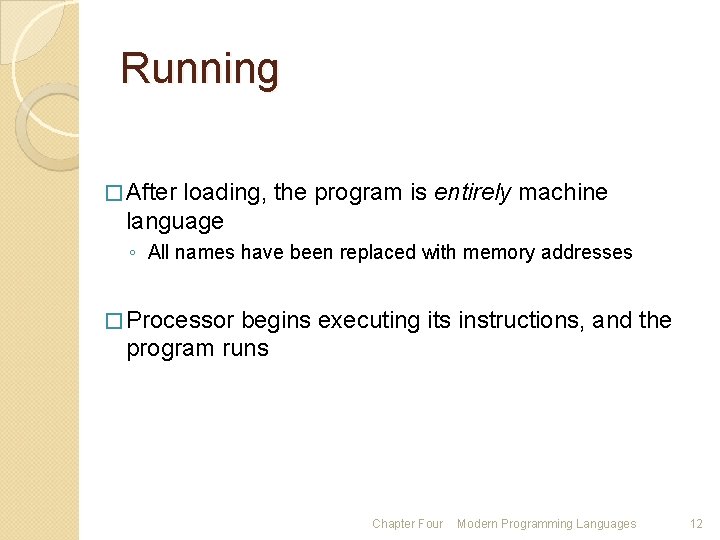
Running � After loading, the program is entirely machine language ◦ All names have been replaced with memory addresses � Processor begins executing its instructions, and the program runs Chapter Four Modern Programming Languages 12
The Classical Sequence Chapter Four Modern Programming Languages 13
About Optimization � Code generated by a compiler is usually optimized to make it faster, smaller, or both � Other optimizations may be done by the assembler, linker, and/or loader Chapter Four Modern Programming Languages 14
Example � Original code: int i = 0; while (i < 100) { a[i++] = x*x*x; } � Improved code, with loop invariant moved: int i = 0; int temp = x*x*x; while (i < 100) { a[i++] = temp; } Chapter Four Modern Programming Languages 15
Example � Loop invariant removal is handled by most compilers � That is, most compilers generate the same efficient code from the previous example � So it is a waste of the programmer’s time to make the transformation manually � “Premature optimization is the root of all evil” ( -Knuth) � Premature “pessimization” isn’t so great either : -) Chapter Four Modern Programming Languages 16
Other Optimizations � Some, like LIR, add variables � Others remove variables, remove code, add code, move code around, etc. � All make the connection between source code and object code more complicated � A simple question, such as “What assembly language code was generated for this statement? ” may have a complicated answer � Very important issue with concurrency Chapter Four Modern Programming Languages 17
Outline �The classical sequence �Variations on the classical sequence �Binding times �Runtime support Chapter Four Modern Programming Languages 18
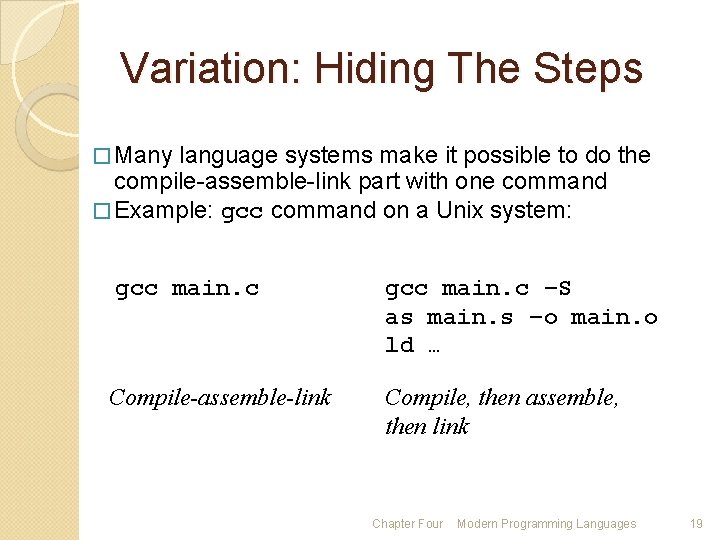
Variation: Hiding The Steps � Many language systems make it possible to do the compile-assemble-link part with one command � Example: gcc command on a Unix system: gcc main. c –S as main. s –o main. o ld … Compile-assemble-link Compile, then assemble, then link Chapter Four Modern Programming Languages 19
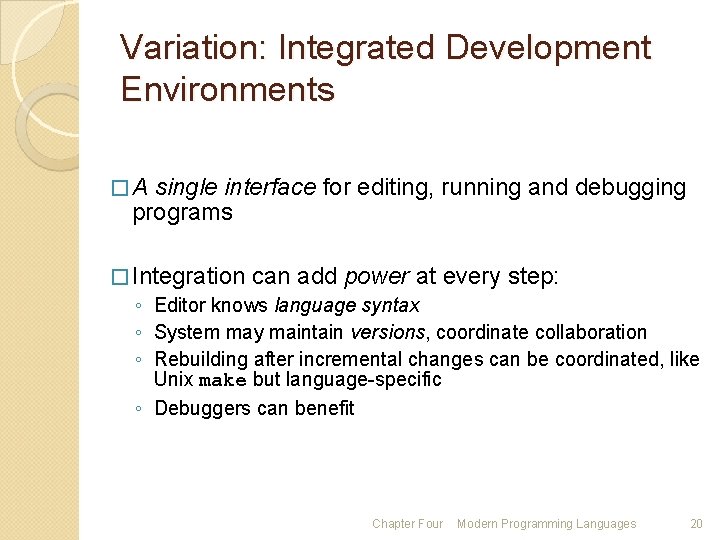
Variation: Integrated Development Environments �A single interface for editing, running and debugging programs � Integration can add power at every step: ◦ Editor knows language syntax ◦ System may maintain versions, coordinate collaboration ◦ Rebuilding after incremental changes can be coordinated, like Unix make but language-specific ◦ Debuggers can benefit Chapter Four Modern Programming Languages 20
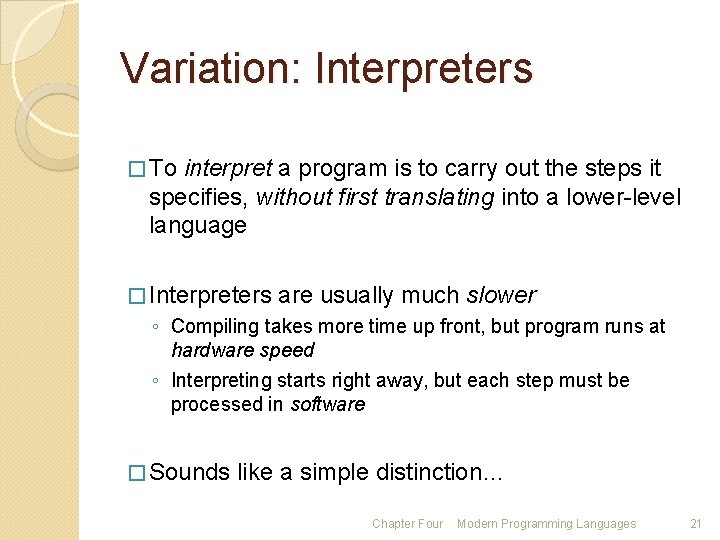
Variation: Interpreters � To interpret a program is to carry out the steps it specifies, without first translating into a lower-level language � Interpreters are usually much slower ◦ Compiling takes more time up front, but program runs at hardware speed ◦ Interpreting starts right away, but each step must be processed in software � Sounds like a simple distinction… Chapter Four Modern Programming Languages 21
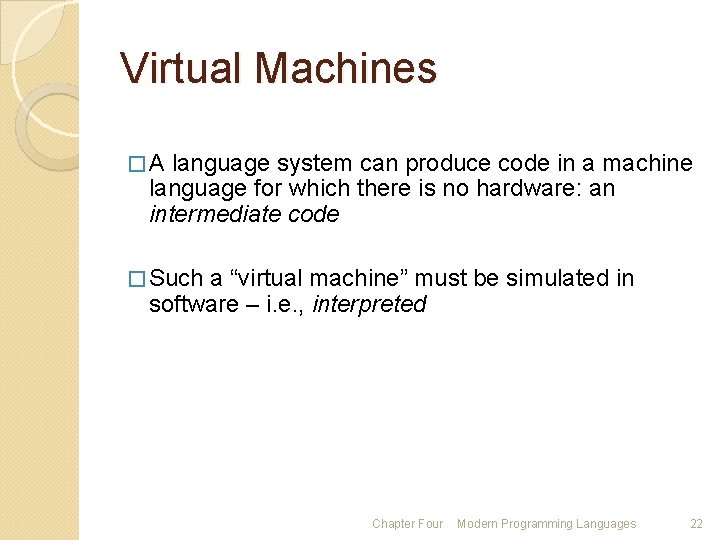
Virtual Machines �A language system can produce code in a machine language for which there is no hardware: an intermediate code � Such a “virtual machine” must be simulated in software – i. e. , interpreted Chapter Four Modern Programming Languages 22
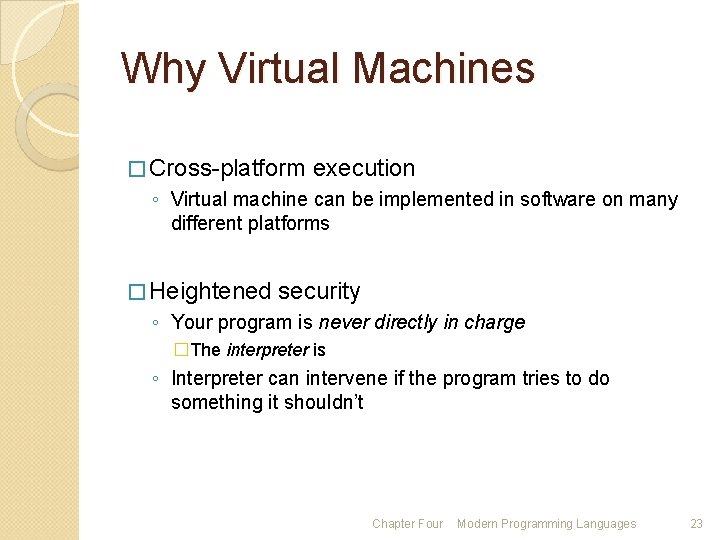
Why Virtual Machines � Cross-platform execution ◦ Virtual machine can be implemented in software on many different platforms � Heightened security ◦ Your program is never directly in charge �The interpreter is ◦ Interpreter can intervene if the program tries to do something it shouldn’t Chapter Four Modern Programming Languages 23
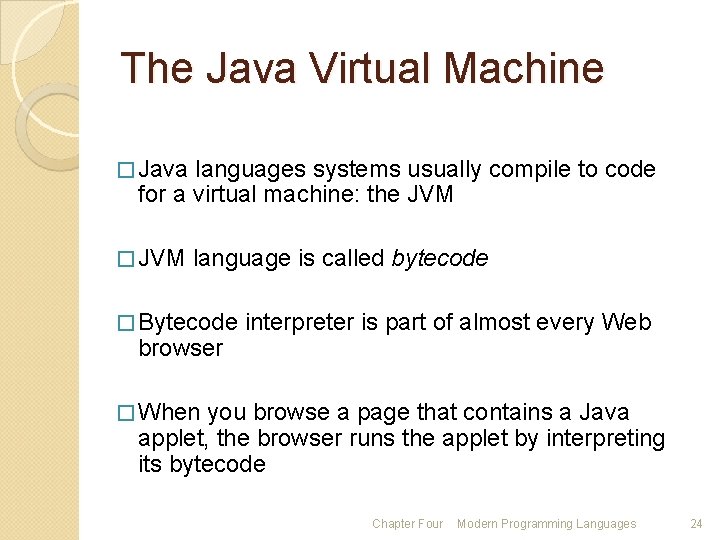
The Java Virtual Machine � Java languages systems usually compile to code for a virtual machine: the JVM � JVM language is called bytecode � Bytecode browser interpreter is part of almost every Web � When you browse a page that contains a Java applet, the browser runs the applet by interpreting its bytecode Chapter Four Modern Programming Languages 24
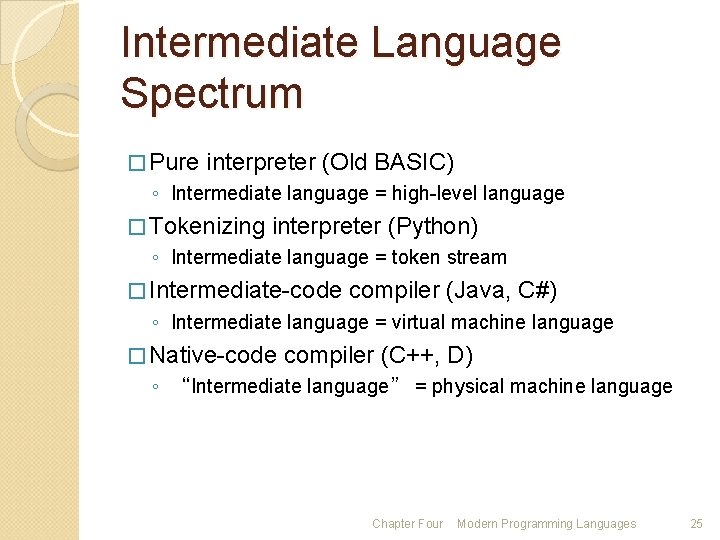
Intermediate Language Spectrum � Pure interpreter (Old BASIC) ◦ Intermediate language = high-level language � Tokenizing interpreter (Python) ◦ Intermediate language = token stream � Intermediate-code compiler (Java, C#) ◦ Intermediate language = virtual machine language � Native-code compiler (C++, D) ◦ “Intermediate language” = physical machine language Chapter Four Modern Programming Languages 25
Delayed Linking � Delays the linking step to load or runtime � Code for library functions is not included in the executable file of the calling program Chapter Four Modern Programming Languages 26
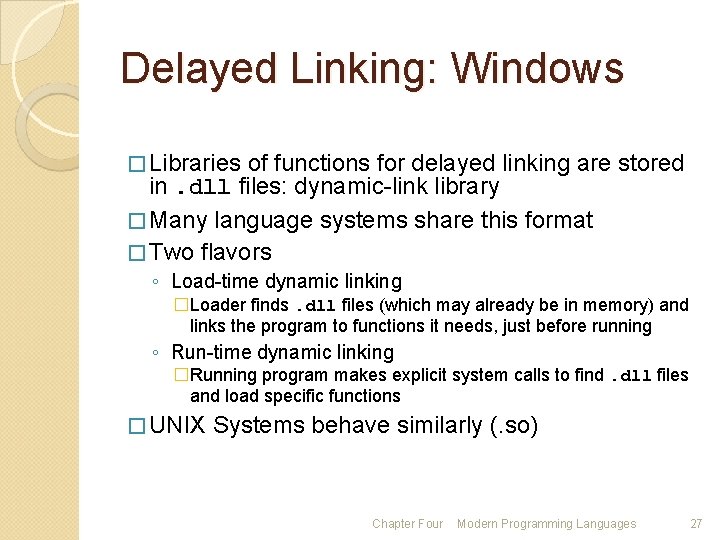
Delayed Linking: Windows � Libraries of functions for delayed linking are stored in. dll files: dynamic-link library � Many language systems share this format � Two flavors ◦ Load-time dynamic linking �Loader finds. dll files (which may already be in memory) and links the program to functions it needs, just before running ◦ Run-time dynamic linking �Running program makes explicit system calls to find. dll files and load specific functions � UNIX Systems behave similarly (. so) Chapter Four Modern Programming Languages 27
Delayed Linking: Java � JVM automatically loads and links classes when a program uses them � Class loader does a lot of work: ◦ May load across Internet ◦ Thoroughly checks loaded code to make sure it complies with JVM requirements Chapter Four Modern Programming Languages 28
Delayed Linking Advantages � Multiple programs can share a copy of library functions: only one copy on disk � Library functions can be updated independently of programs: all programs use repaired library code next time they run � Can avoid loading code that is never used Chapter Four Modern Programming Languages 29
Dynamic Compilation � Some compiling takes place after the program starts running � Many variations: ◦ Compile each function only when first called ◦ Start by interpreting, compile only those pieces that are called frequently ◦ Compile roughly at first (for instance, to intermediate code); spend more time on frequently executed pieces (for instance, compile to native code and optimize) � Just-in-time (JIT) compilation Chapter Four Modern Programming Languages 30
Outline �The classical sequence �Variations on the classical sequence �Binding times �Runtime support Chapter Four Modern Programming Languages 31
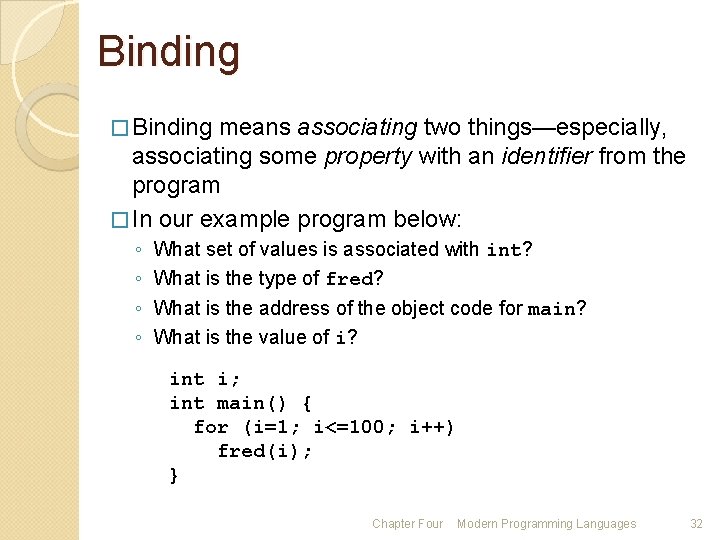
Binding � Binding means associating two things—especially, associating some property with an identifier from the program � In our example program below: ◦ ◦ What set of values is associated with int? What is the type of fred? What is the address of the object code for main? What is the value of i? int i; int main() { for (i=1; i<=100; i++) fred(i); } Chapter Four Modern Programming Languages 32
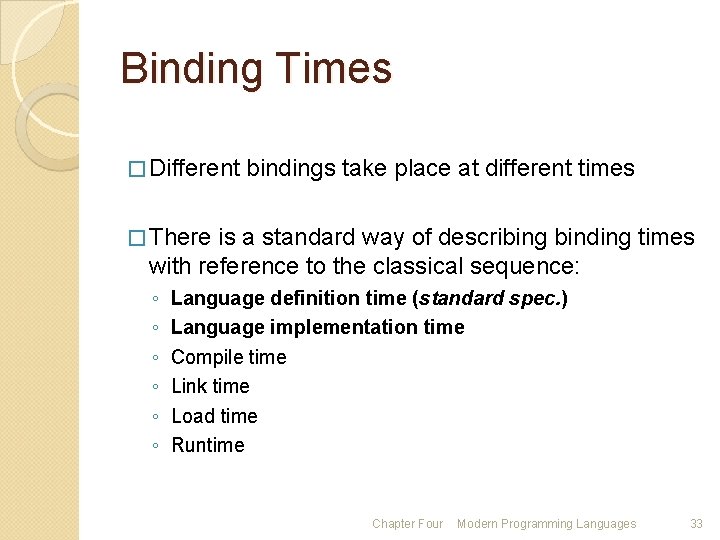
Binding Times � Different bindings take place at different times � There is a standard way of describing binding times with reference to the classical sequence: ◦ ◦ ◦ Language definition time (standard spec. ) Language implementation time Compile time Link time Load time Runtime Chapter Four Modern Programming Languages 33
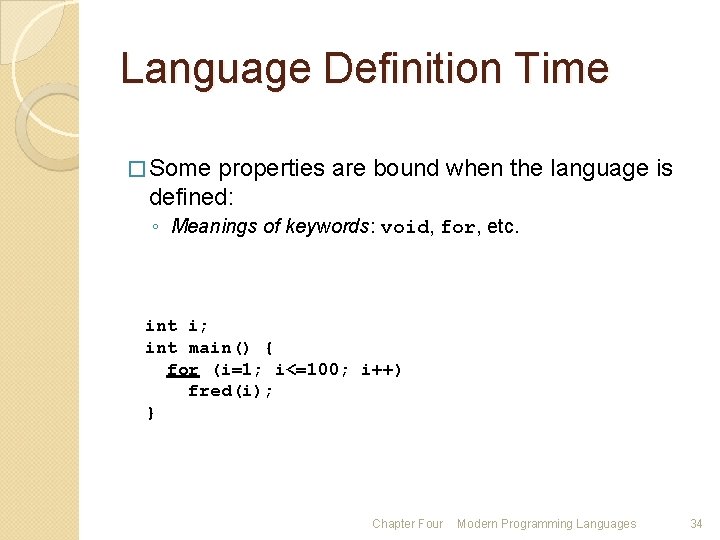
Language Definition Time � Some properties are bound when the language is defined: ◦ Meanings of keywords: void, for, etc. int i; int main() { for (i=1; i<=100; i++) fred(i); } Chapter Four Modern Programming Languages 34
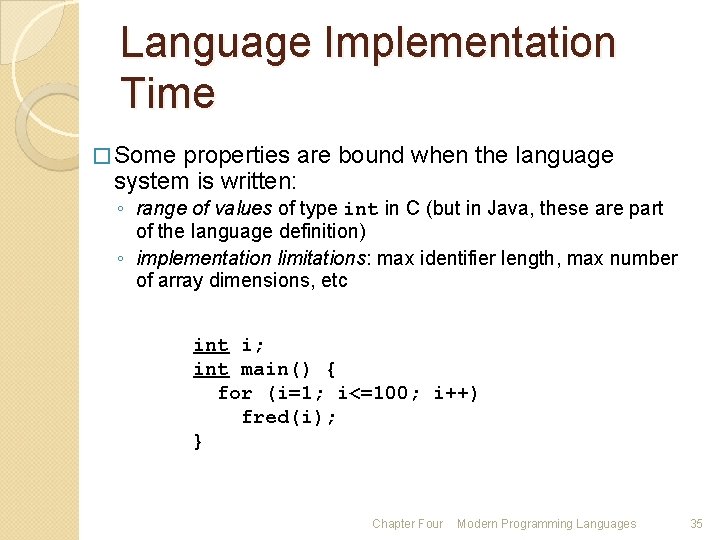
Language Implementation Time � Some properties are bound when the language system is written: ◦ range of values of type int in C (but in Java, these are part of the language definition) ◦ implementation limitations: max identifier length, max number of array dimensions, etc int i; int main() { for (i=1; i<=100; i++) fred(i); } Chapter Four Modern Programming Languages 35
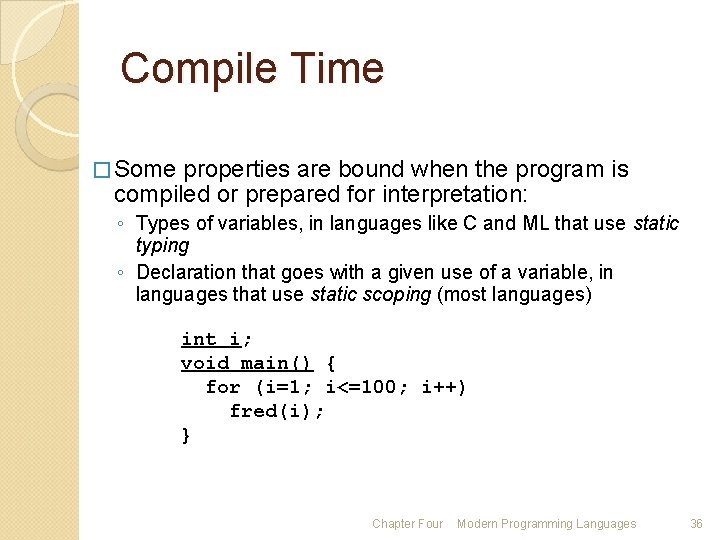
Compile Time � Some properties are bound when the program is compiled or prepared for interpretation: ◦ Types of variables, in languages like C and ML that use static typing ◦ Declaration that goes with a given use of a variable, in languages that use static scoping (most languages) int i; void main() { for (i=1; i<=100; i++) fred(i); } Chapter Four Modern Programming Languages 36
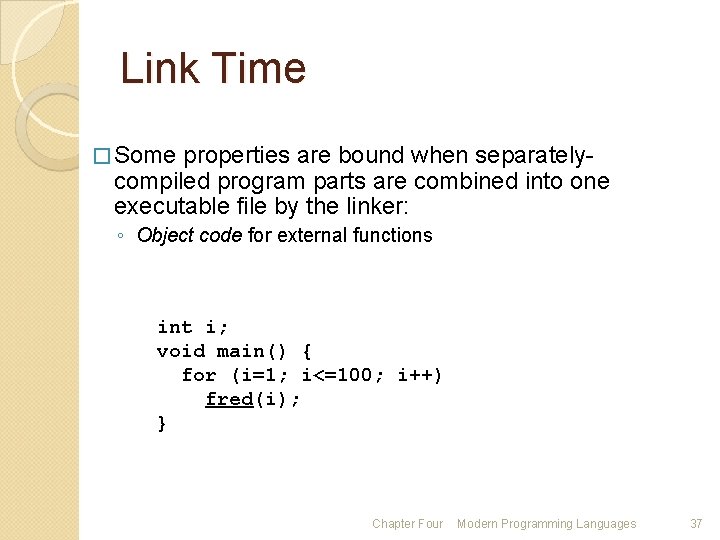
Link Time � Some properties are bound when separatelycompiled program parts are combined into one executable file by the linker: ◦ Object code for external functions int i; void main() { for (i=1; i<=100; i++) fred(i); } Chapter Four Modern Programming Languages 37
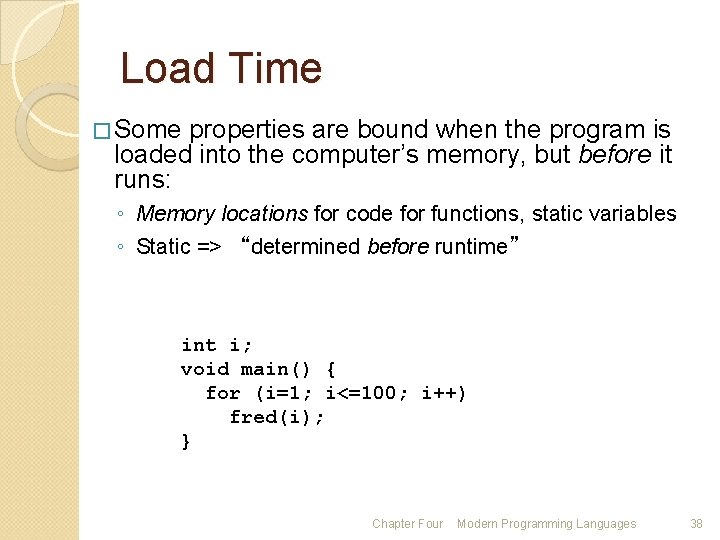
Load Time � Some properties are bound when the program is loaded into the computer’s memory, but before it runs: ◦ Memory locations for code for functions, static variables ◦ Static => “determined before runtime” int i; void main() { for (i=1; i<=100; i++) fred(i); } Chapter Four Modern Programming Languages 38
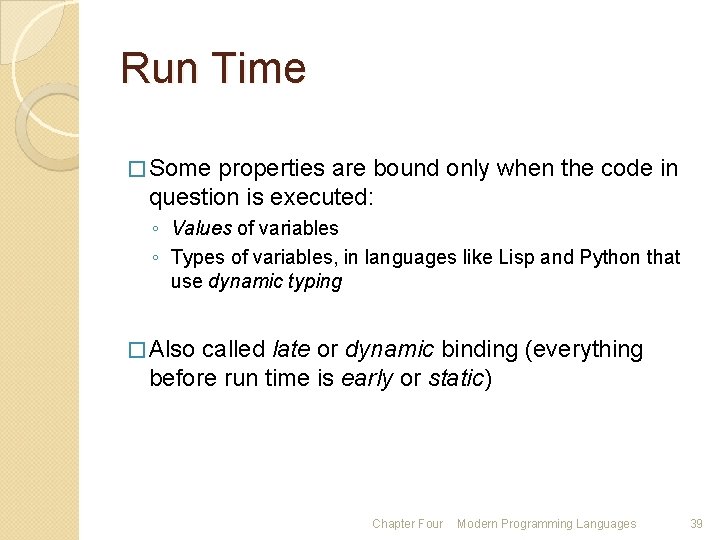
Run Time � Some properties are bound only when the code in question is executed: ◦ Values of variables ◦ Types of variables, in languages like Lisp and Python that use dynamic typing � Also called late or dynamic binding (everything before run time is early or static) Chapter Four Modern Programming Languages 39
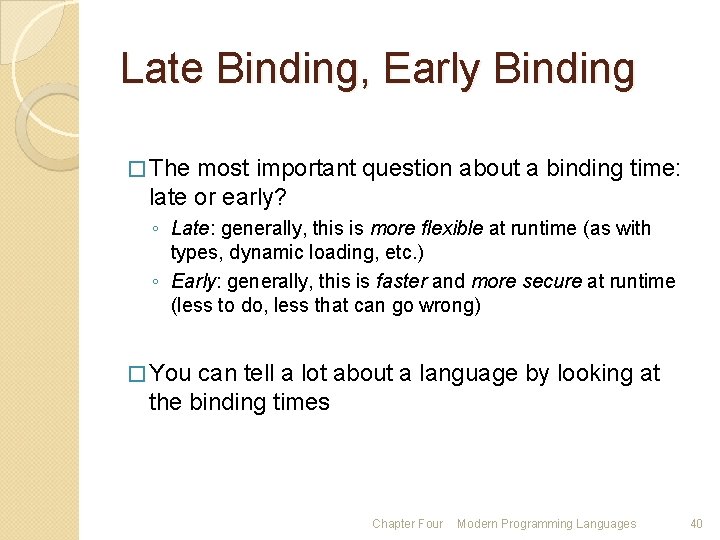
Late Binding, Early Binding � The most important question about a binding time: late or early? ◦ Late: generally, this is more flexible at runtime (as with types, dynamic loading, etc. ) ◦ Early: generally, this is faster and more secure at runtime (less to do, less that can go wrong) � You can tell a lot about a language by looking at the binding times Chapter Four Modern Programming Languages 40
Outline �The classical sequence �Variations on the classical sequence �Binding times �Runtime support Chapter Four Modern Programming Languages 41
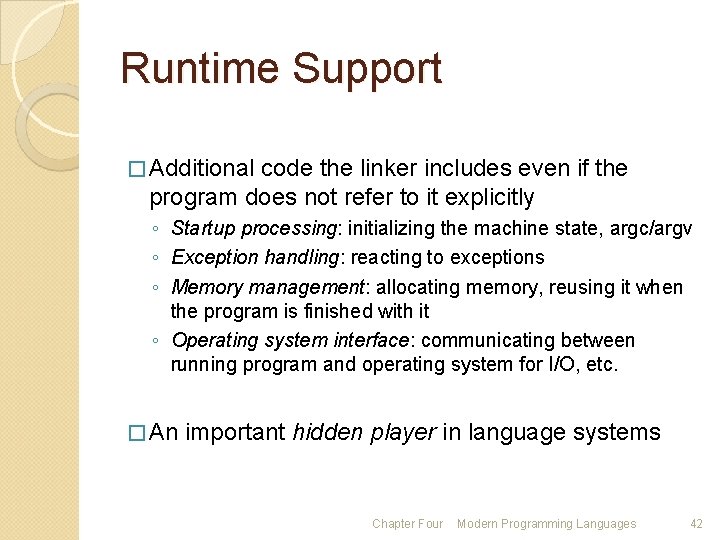
Runtime Support � Additional code the linker includes even if the program does not refer to it explicitly ◦ Startup processing: initializing the machine state, argc/argv ◦ Exception handling: reacting to exceptions ◦ Memory management: allocating memory, reusing it when the program is finished with it ◦ Operating system interface: communicating between running program and operating system for I/O, etc. � An important hidden player in language systems Chapter Four Modern Programming Languages 42
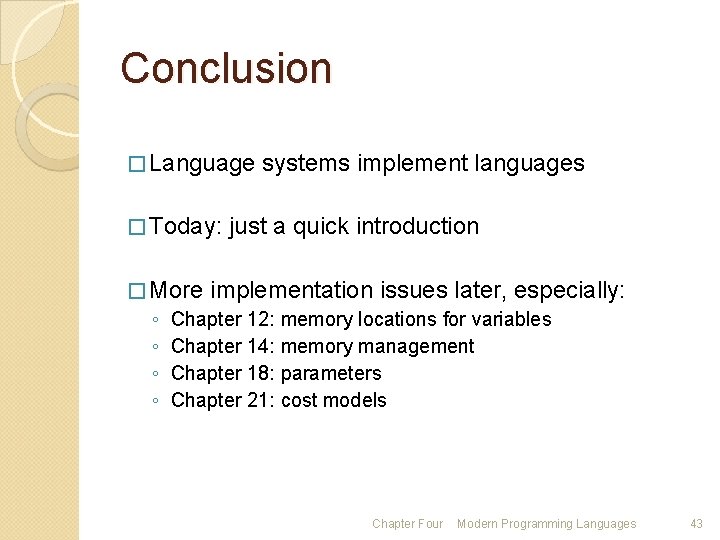
Conclusion � Language � Today: systems implement languages just a quick introduction � More implementation issues later, especially: ◦ Chapter 12: memory locations for variables ◦ Chapter 14: memory management ◦ Chapter 18: parameters ◦ Chapter 21: cost models Chapter Four Modern Programming Languages 43