
Language Support for Concurrency Common programming errors Process
![Producer Consumer using Monitors Monitor Producer_Consumer { any_t buf[N]; int n = 0, tail](https://slidetodoc.com/presentation_image_h2/48a28c100a9baf770f11eb13d4b73a41/image-9.jpg "Producer Consumer using Monitors Monitor Producer_Consumer { any_t buf[N]; int n = 0, tail")
![Mesa-style monitor subtleties char buf[N]; int n = 0, tail = 0, head =](https://slidetodoc.com/presentation_image_h2/48a28c100a9baf770f11eb13d4b73a41/image-12.jpg "Mesa-style monitor subtleties char buf[N]; int n = 0, tail = 0, head =")
![Mesa-style subtleties char buf[N]; int n = 0, tail = 0, head = 0;](https://slidetodoc.com/presentation_image_h2/48a28c100a9baf770f11eb13d4b73a41/image-13.jpg "Mesa-style subtleties char buf[N]; int n = 0, tail = 0, head = 0;")
- Slides: 19
Language Support for Concurrency
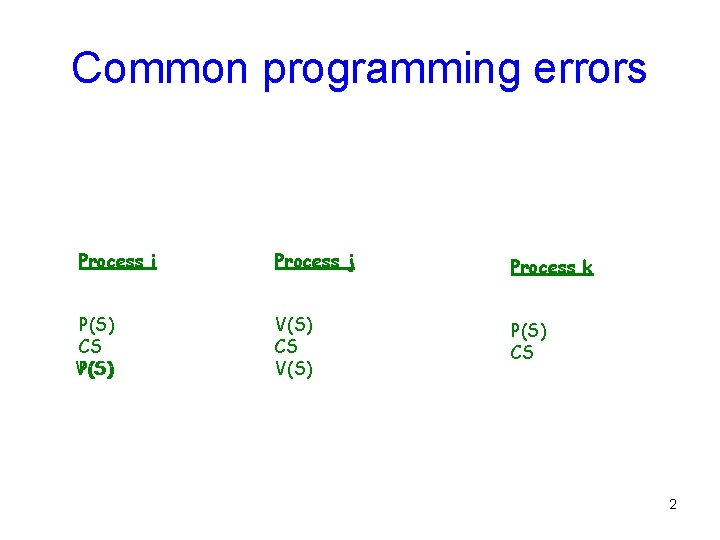
Common programming errors Process i Process j Process k P(S) CS P(S) V(S) CS V(S) P(S) CS 2
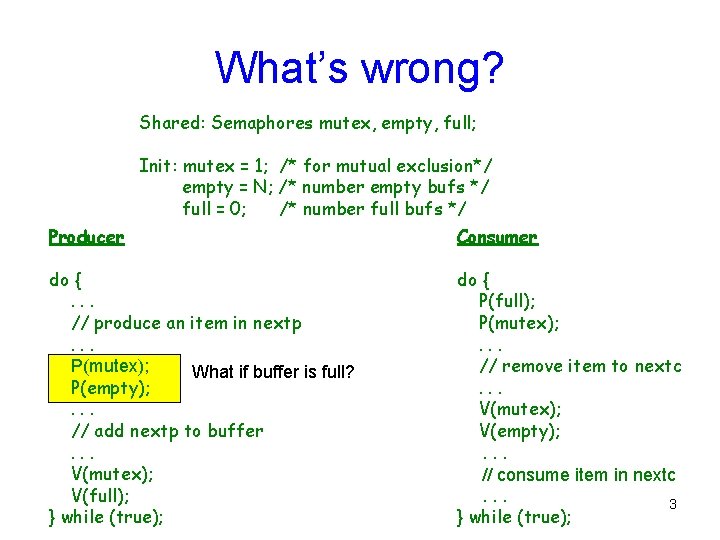
What’s wrong? Shared: Semaphores mutex, empty, full; Init: mutex = 1; /* for mutual exclusion*/ empty = N; /* number empty bufs */ full = 0; /* number full bufs */ Producer Consumer do {. . . // produce an item in nextp. . . P(mutex); What if buffer is full? P(empty); . . . // add nextp to buffer. . . V(mutex); V(full); } while (true); do { P(full); P(mutex); . . . // remove item to nextc. . . V(mutex); V(empty); . . . // consume item in nextc. . . 3 } while (true);
Revisiting semaphores! • Semaphores are still low-level – Users could easily make small errors – Similar to programming in assembly language • Small error brings system to grinding halt – Very difficult to debug • Simplification: Provide concurrency support in compiler – Monitors 4
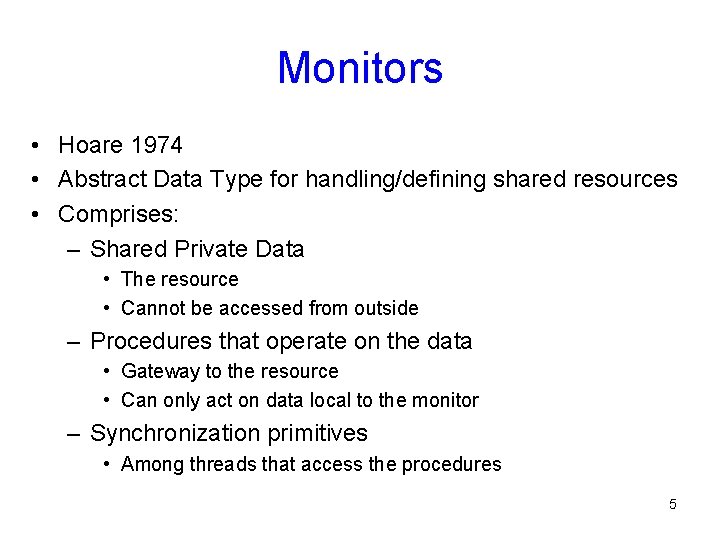
Monitors • Hoare 1974 • Abstract Data Type for handling/defining shared resources • Comprises: – Shared Private Data • The resource • Cannot be accessed from outside – Procedures that operate on the data • Gateway to the resource • Can only act on data local to the monitor – Synchronization primitives • Among threads that access the procedures 5
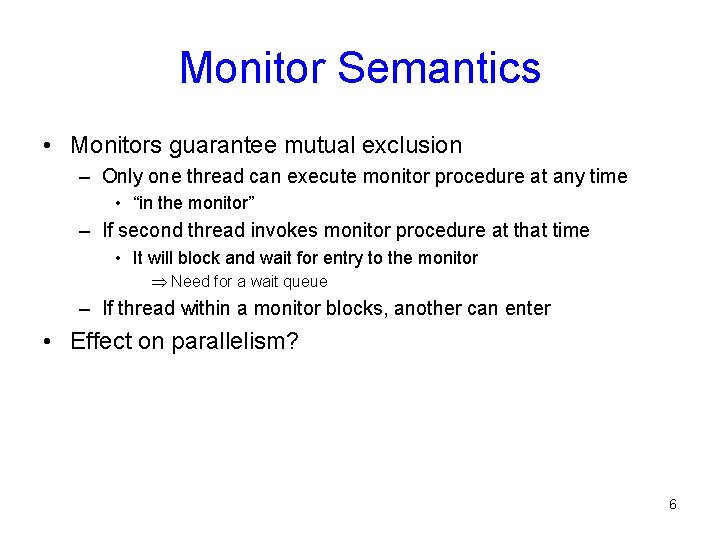
Monitor Semantics • Monitors guarantee mutual exclusion – Only one thread can execute monitor procedure at any time • “in the monitor” – If second thread invokes monitor procedure at that time • It will block and wait for entry to the monitor Need for a wait queue – If thread within a monitor blocks, another can enter • Effect on parallelism? 6
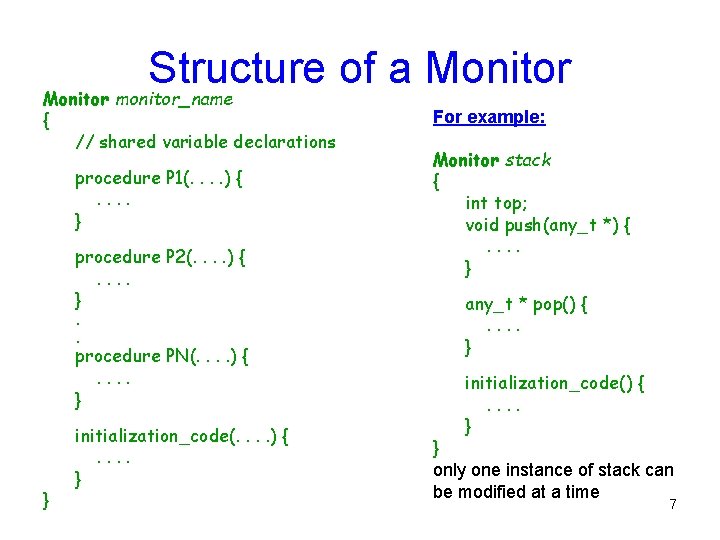
Structure of a Monitor monitor_name { For example: // shared variable declarations procedure P 1(. . ) {. . } procedure P 2(. . ) {. . }. . procedure PN(. . ) {. . } } initialization_code(. . ) {. . } Monitor stack { int top; void push(any_t *) {. . } any_t * pop() {. . } initialization_code() {. . } } only one instance of stack can be modified at a time 7
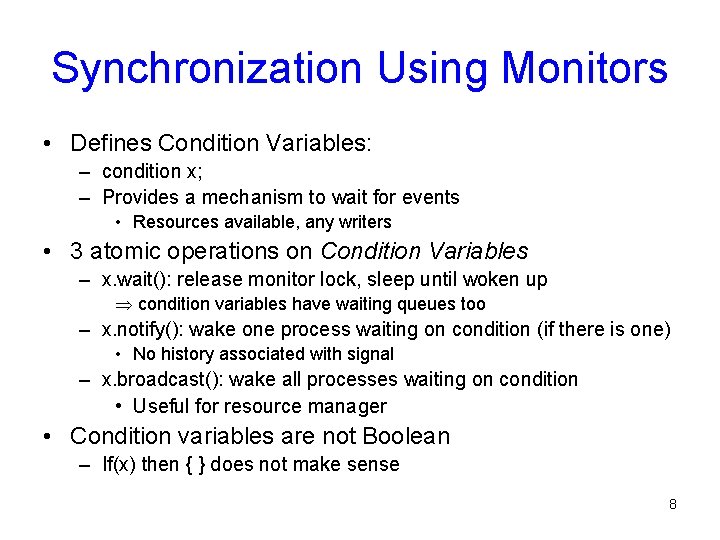
Synchronization Using Monitors • Defines Condition Variables: – condition x; – Provides a mechanism to wait for events • Resources available, any writers • 3 atomic operations on Condition Variables – x. wait(): release monitor lock, sleep until woken up condition variables have waiting queues too – x. notify(): wake one process waiting on condition (if there is one) • No history associated with signal – x. broadcast(): wake all processes waiting on condition • Useful for resource manager • Condition variables are not Boolean – If(x) then { } does not make sense 8
Producer Consumer using Monitors Monitor Producer_Consumer { any_t buf[N]; int n = 0, tail = 0, head = 0; condition not_empty, not_full; void put(char ch) { if(n == N) wait(not_full); buf[head%N] = ch; head++; n++; signal(not_empty); } char get() { if(n == 0) wait(not_empty); ch = buf[tail%N]; tail++; n--; signal(not_full); return ch; } } What if no thread is waiting when signal is called? 9
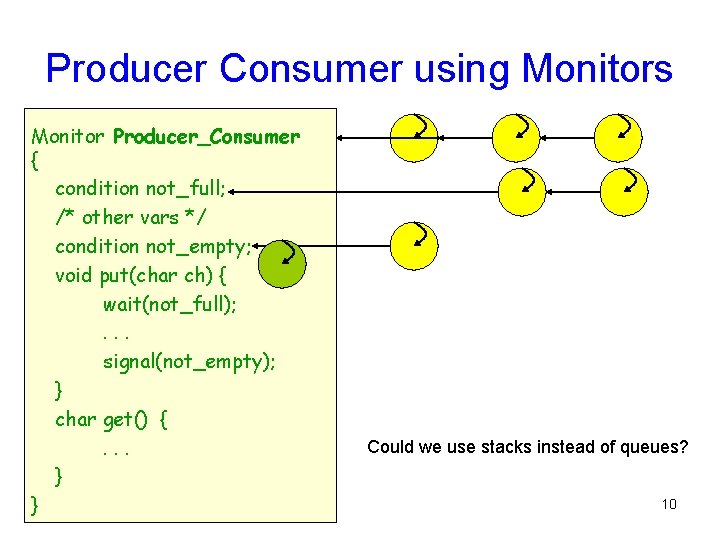
Producer Consumer using Monitors Monitor Producer_Consumer { condition not_full; /* other vars */ condition not_empty; void put(char ch) { wait(not_full); . . . signal(not_empty); } char get() {. . . } } Could we use stacks instead of queues? 10
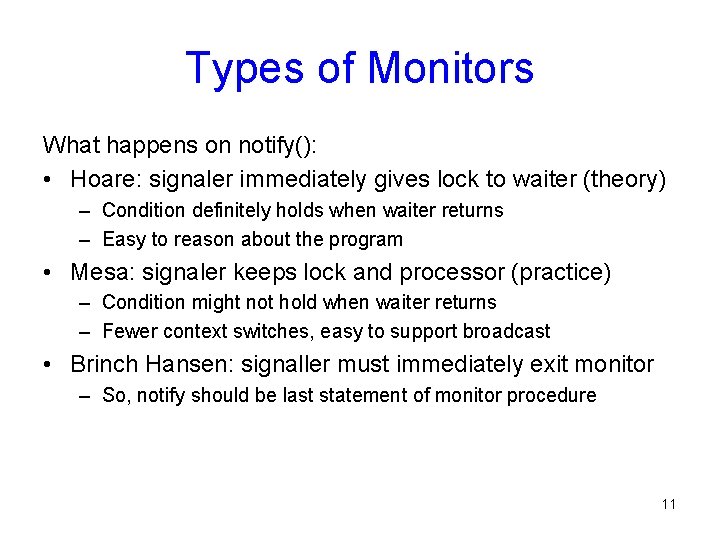
Types of Monitors What happens on notify(): • Hoare: signaler immediately gives lock to waiter (theory) – Condition definitely holds when waiter returns – Easy to reason about the program • Mesa: signaler keeps lock and processor (practice) – Condition might not hold when waiter returns – Fewer context switches, easy to support broadcast • Brinch Hansen: signaller must immediately exit monitor – So, notify should be last statement of monitor procedure 11
Mesa-style monitor subtleties char buf[N]; int n = 0, tail = 0, head = 0; condition not_empty, not_full; void put(char ch) if(n == N) wait(not_full); buf[head%N] = ch; head++; n++; signal(not_empty); char get() if(n == 0) wait(not_empty); ch = buf[tail%N]; tail++; n--; signal(not_full); return ch; // producer/consumer with monitors Consider the following time line: 0. initial condition: n = 0 1. c 0 tries to take char, blocks on not_empty (releasing monitor lock) 2. p 0 puts a char (n = 1), signals not_empty 3. c 0 is put on run queue 4. Before c 0 runs, another consumer thread c 1 enters and takes character (n = 0) 5. c 0 runs. Possible fixes? 12
Mesa-style subtleties char buf[N]; int n = 0, tail = 0, head = 0; condition not_empty, not_full; void put(char ch) while(n == N) wait(not_full); buf[head] = ch; head = (head+1)%N; n++; signal(not_full); char get() while(n == 0) wait(not_empty); ch = buf[tail]; tail = (tail+1) % N; n--; signal(not_full); return ch; // producer/consumer with monitors When can we replace “while” with “if”? 13
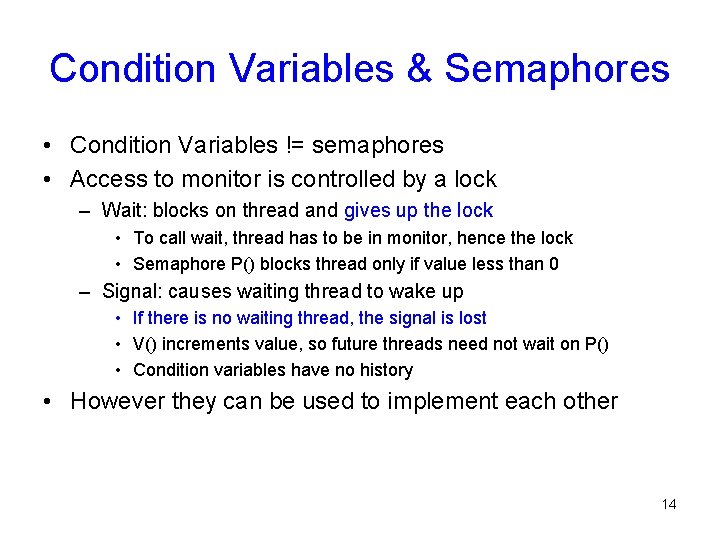
Condition Variables & Semaphores • Condition Variables != semaphores • Access to monitor is controlled by a lock – Wait: blocks on thread and gives up the lock • To call wait, thread has to be in monitor, hence the lock • Semaphore P() blocks thread only if value less than 0 – Signal: causes waiting thread to wake up • If there is no waiting thread, the signal is lost • V() increments value, so future threads need not wait on P() • Condition variables have no history • However they can be used to implement each other 14
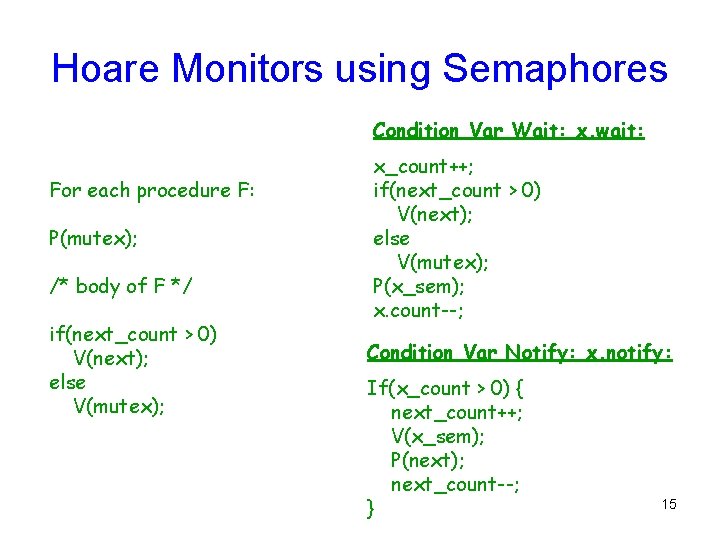
Hoare Monitors using Semaphores Condition Var Wait: x. wait: For each procedure F: P(mutex); /* body of F */ if(next_count > 0) V(next); else V(mutex); x_count++; if(next_count > 0) V(next); else V(mutex); P(x_sem); x. count--; Condition Var Notify: x. notify: If(x_count > 0) { next_count++; V(x_sem); P(next); next_count--; } 15
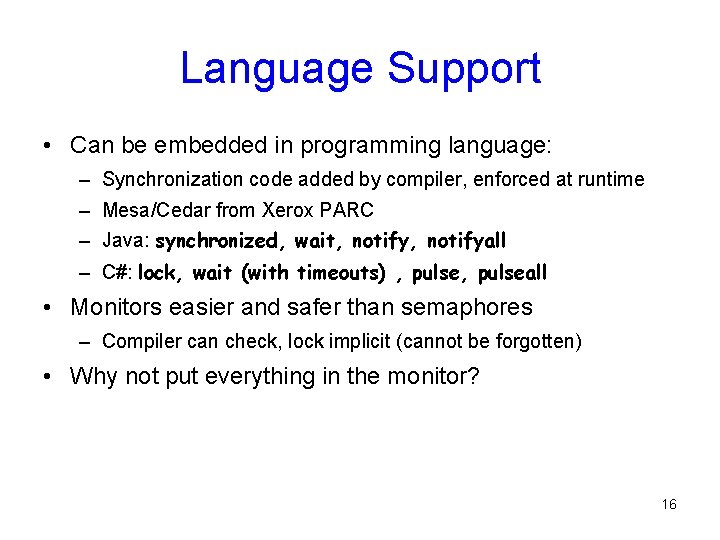
Language Support • Can be embedded in programming language: – Synchronization code added by compiler, enforced at runtime – Mesa/Cedar from Xerox PARC – Java: synchronized, wait, notifyall – C#: lock, wait (with timeouts) , pulseall • Monitors easier and safer than semaphores – Compiler can check, lock implicit (cannot be forgotten) • Why not put everything in the monitor? 16
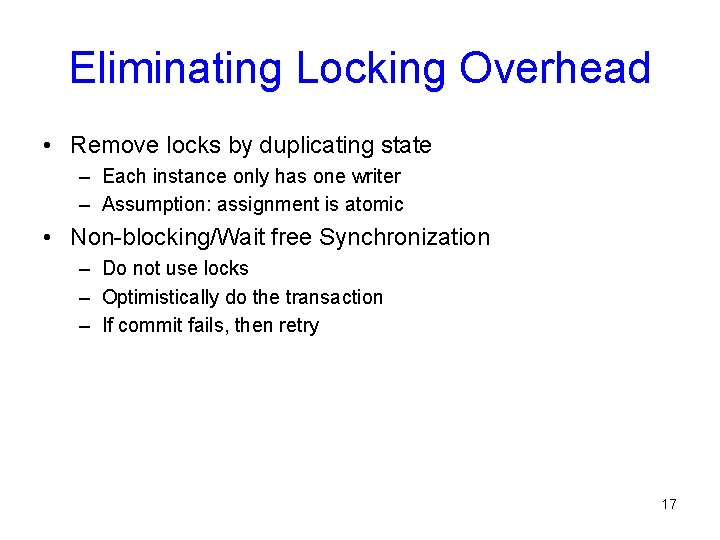
Eliminating Locking Overhead • Remove locks by duplicating state – Each instance only has one writer – Assumption: assignment is atomic • Non-blocking/Wait free Synchronization – Do not use locks – Optimistically do the transaction – If commit fails, then retry 17
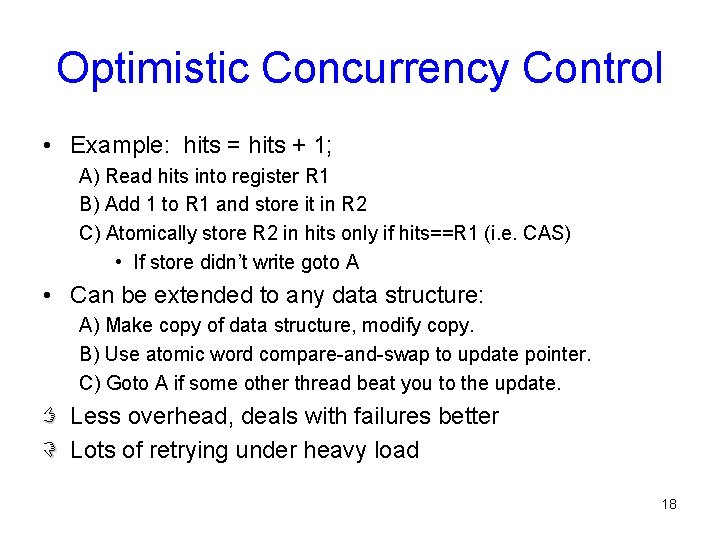
Optimistic Concurrency Control • Example: hits = hits + 1; A) Read hits into register R 1 B) Add 1 to R 1 and store it in R 2 C) Atomically store R 2 in hits only if hits==R 1 (i. e. CAS) • If store didn’t write goto A • Can be extended to any data structure: A) Make copy of data structure, modify copy. B) Use atomic word compare-and-swap to update pointer. C) Goto A if some other thread beat you to the update. Less overhead, deals with failures better Lots of retrying under heavy load 18
To conclude • Race conditions are a pain • We studied five ways to handle them – Each has its own pros and cons • Support in Java, C# has simplified writing multithreaded applications 19