
LANGUAGE SEMANTICS AND MEANING EN 262 ENGLISH LITERATURE




- Slides: 41
LANGUAGE, SEMANTICS, AND MEANING EN 262 ENGLISH LITERATURE DEPARTMENT 2020 Instructor: Philipus Pirenomulyo pireno 49@gmail. com
Part One SOCIOLINGUISTICS Adapted from Holmes, J. (2003). An introduction to sociolinguistics. New York: Pearson Longman
Unit 1: What do sociolinguists study? • Sociolinguists study the relationship between language and society. • They are interested in explaining why we speak differently in different social contexts, and they are concerned with identifying the social functions of language and the ways it is used to convey social meaning.
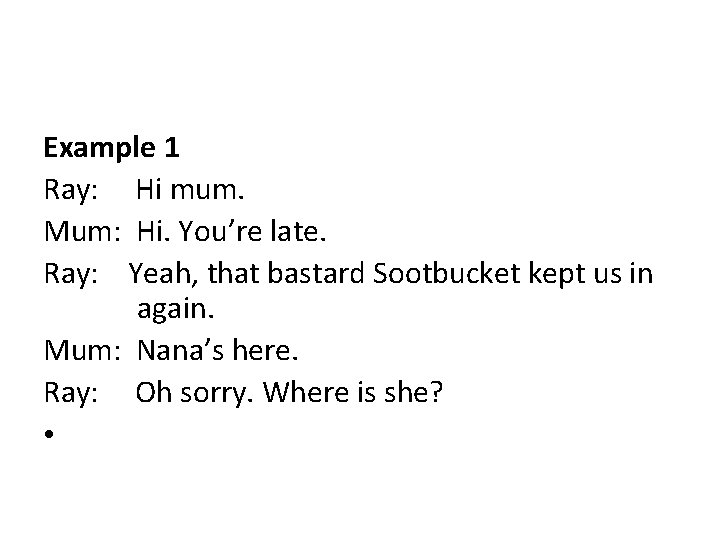
Example 1 Ray: Hi mum. Mum: Hi. You’re late. Ray: Yeah, that bastard Sootbucket kept us in again. Mum: Nana’s here. Ray: Oh sorry. Where is she? •
• Ray’s description of his teacher would have been expressed differently if he had realized his grandmother could hear him. • The way people talk is influenced by the social context in which they are talking • It matters who can hear us and where we are talking, as well as how we are feeling. The same message may be expressed very differently to different people. • We use different styles in different social contexts.
Leaving school, Ray had run into the school principal: Example 2 Ray: Good afternoon, sir. Principal: What are you doing here at this time? Ray: Mr. Sutton kept us in, sir.
• This response indicated Ray’s awareness of the social factors which influence the choice of appropriate ways of speaking in different social contexts. Sociolinguistics is concerned with the relationship between language and the context in which it is used.
• The conversation between Ray and his mother also illustrates the fact that language serves a range of functions. • We use language to ask for and give people information. We use it to express indignation and annoyance, as well as admiration and respect. • Often one utterance will simultaneously convey both information and express feelings.
• Ray’s utterance: “Yeah, that bastard Sootbucket kept us in again. ” not only tells his mother why he is late, his choice of words also tells her how he feels about the teacher concerned, and tells us something about his relationship with his mother (he can use words like bastard talking to her) compared to his grandmother and the principal (to whom he uses “sir”).
• The way Ray expresses himself indicates that his relationship with his mother is an intimate and friendly one, rather than a formal, distant or respectful one.
• Exercise 1 a. Identify the words in Examples 1 and 2 which suggest that Ray’s relationship with his mother is a friendly one compared to his relationship with the principal. What does this suggest about the social significance of choice of words?
b. Ray greeted the principal with the words “Good afternoon, sir. ” • How do or did you greet your school principal? • Would you use the same words to your father or mother? • Would you use the same greeting to your best friend? Why (not)?
c. Nicknames can express affection as well as dislike. What clues indicate that Ray is not feeling affectionate towards his teacher?
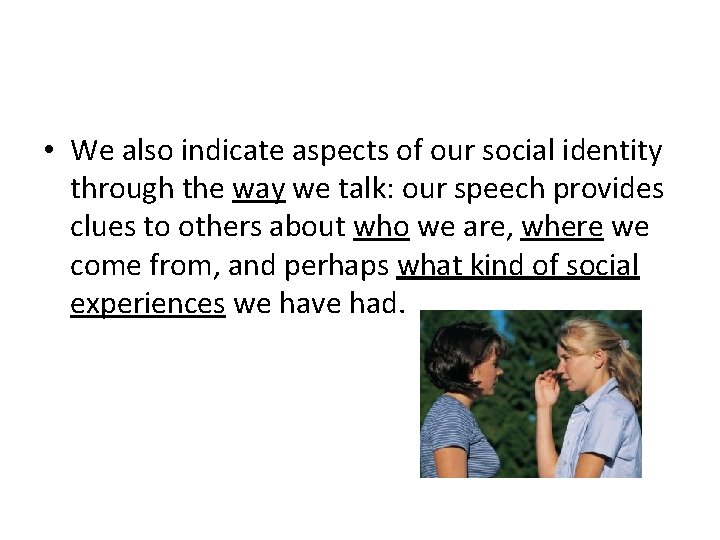
• We also indicate aspects of our social identity through the way we talk: our speech provides clues to others about who we are, where we come from, and perhaps what kind of social experiences we have had.
Why do we say the same thing in different ways? Example 3 Every afternoon my friend packs her bag and leaves her Cardiff office in Southern Wales at about 5 o’clock. As she leaves, her business partner says goodbye Margaret (she replies goodbye Mike), her secretary says see you tomorrow (she replies bye Jill), and the caretaker says bye Mrs Walker (to which she responds goodbye Andy).
As she arrives home she is greeted by hi mum from her daughter, Jenny, hello dear, have a good day? from her mother, and simply you’re late again ! from her husband. Later in the evening the president of the local flower club calls to ask if she would like to join the club. Good evening, is that Mrs Billington? she asks. No, it’s Margaret Walker, but my husband’s name is David Billington, Margaret answers. What can I do for you? Finally a friend calls Hello Meg, sut wyt ti?
• Languages provide a variety of ways of saying the same thing – addressing and greeting others, describing things, paying compliments. • As Examples 1 and 2 illustrate, our final choices provide clues to social factors, such as the relationship between the people in the particular situation, and how the speaker feels about the person addressed.
• In Example 3, Margaret’s mother’s choice of dear expresses her affectionate feelings towards Margaret. If she had been annoyed with her daughter, she might have used her full name Margaret, or not greeted her at all. • Margaret’s friend’s use of sut wyt ti? (‘how are you? ’) as a greeting indicates her Welsh ethnicity.
• The choice of one linguistic form rather than another is a useful clue to nonlinguistic information; linguistic variation can provide social information.
• Exercise 2 Make a list of all the names you are called by people who know you. For each name note who uses it to you and when or where. Do some people call you by more than one name? What are the reasons why people choose one name rather than another for you?
• Exercise 3 We often have different names for people when we are addressing them directly, as opposed to when we are referring to them in different contexts. Note what you call your mother in different contexts: (a) addressing her (i) at home alone with her, (ii) on the telephone with friends listening , (iii) in your school.
• Linguistic variation occurs at other levels of linguistic analysis too: sounds, word-structure (or morphology), and grammar (or syntax) as well as vocabulary. • Within each of these linguistic levels, there is variation which offers the speaker a choice of ways of expression.
• They provide us with different linguistic styles for use in different social contexts. • Choices may even involve different dialects of a language, or quite different languages, as we shall see: Example 4 Sam : You seen our ‘enry’s new ‘ouse yet? It’s in ‘alton you know. Jim : I have indeed. I could hardly miss it Sam. Your Henry now owns the biggest house in Halton.
• In the above example, the most obvious linguistic variation involves pronunciation. Sam ‘drops his h-es’ while Jim doesn’t. • Just as vocabulary choices convey social information, so using different pronunciation conveys social information, too. • Sam is a coal-miner and Jim is an old friend of Sam’s son, Henry. The difference in Sam’s and Jim’s [h]-dropping behavior is the result of their different educations and occupations.
• Exercise 5 How many varieties (languages, dialects, styles) do you use on a normal weekday? Consider which variety you use: • in your home • at school/college/university • at the shops/malls • in a coffee bar Do you ever use more than one variety in the same social context? If so why?
Social factors, dimensions and explanations • In each of the examples discussed, certain social factors have been relevant in accounting for the particular variety used. • Some relate to the users of language – the participants; others relate to its uses – the social setting and function of the interaction. • Who is talking to whom (e. g. wife – husband, customer – shopkeeper, boss – worker) is an important factor.
• The setting or social context (e. g. home, work, school) is generally a relevant factor too. • The aim or purpose of the interaction (informative, social) may be important. • And, in some cases, the topic has proved an influence on language choice.
• University students in countries which use English for tertiary education, such as Tanzania, Indonesia and Papua New Guinea, often find it easier to discuss their university subjects using English, for example, just as the students from Hemnesberget used standard Norwegian rather than the local dialect to discuss national politics.
• In any situation, linguistic choices generally indicate people’s awareness of the influence of one or more of the following components: 1. The participants: (a) who is speaking, and (b) who are they speaking to ? 2. The setting or social context of the interaction: where are they speaking? 3. The topic: what is being talked about? 4. The function: why are they speaking and in what purpose?
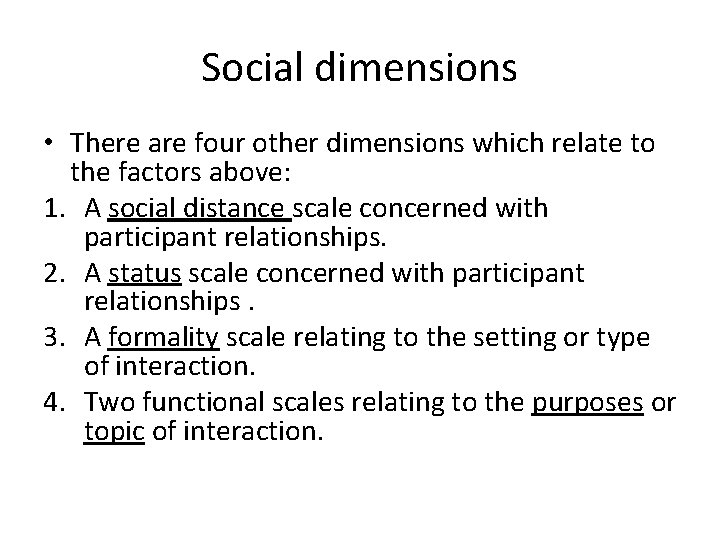
Social dimensions • There are four other dimensions which relate to the factors above: 1. A social distance scale concerned with participant relationships. 2. A status scale concerned with participant relationships. 3. A formality scale relating to the setting or type of interaction. 4. Two functional scales relating to the purposes or topic of interaction.
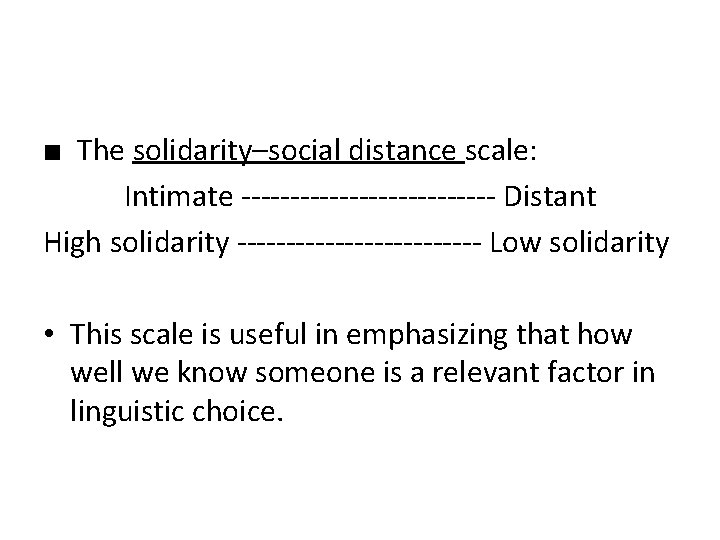
■ The solidarity–social distance scale: Intimate ------------- Distant High solidarity ------------- Low solidarity • This scale is useful in emphasizing that how well we know someone is a relevant factor in linguistic choice.
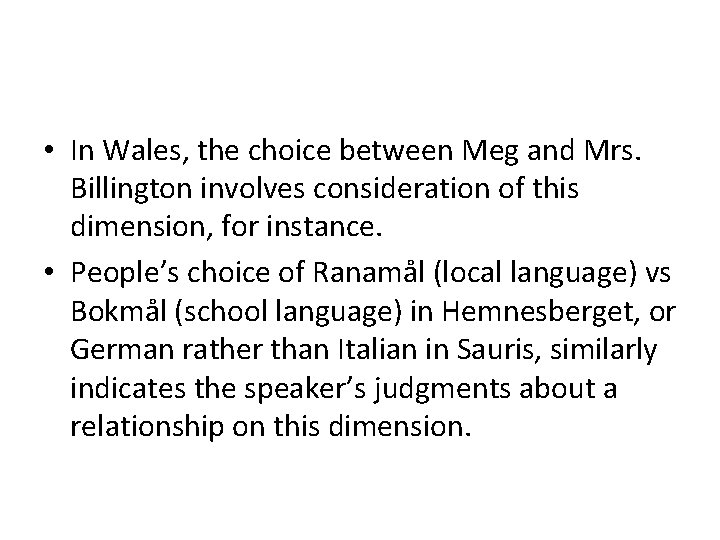
• In Wales, the choice between Meg and Mrs. Billington involves consideration of this dimension, for instance. • People’s choice of Ranamål (local language) vs Bokmål (school language) in Hemnesberget, or German rather than Italian in Sauris, similarly indicates the speaker’s judgments about a relationship on this dimension.
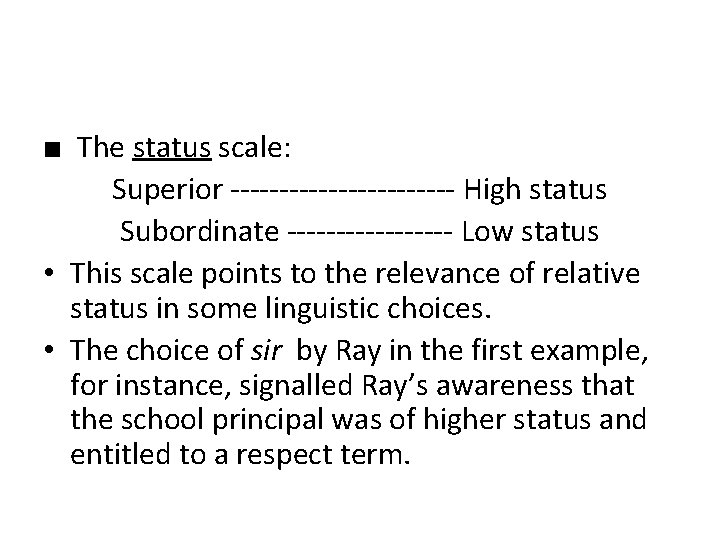
■ The status scale: Superior ------------ High status Subordinate --------- Low status • This scale points to the relevance of relative status in some linguistic choices. • The choice of sir by Ray in the first example, for instance, signalled Ray’s awareness that the school principal was of higher status and entitled to a respect term.
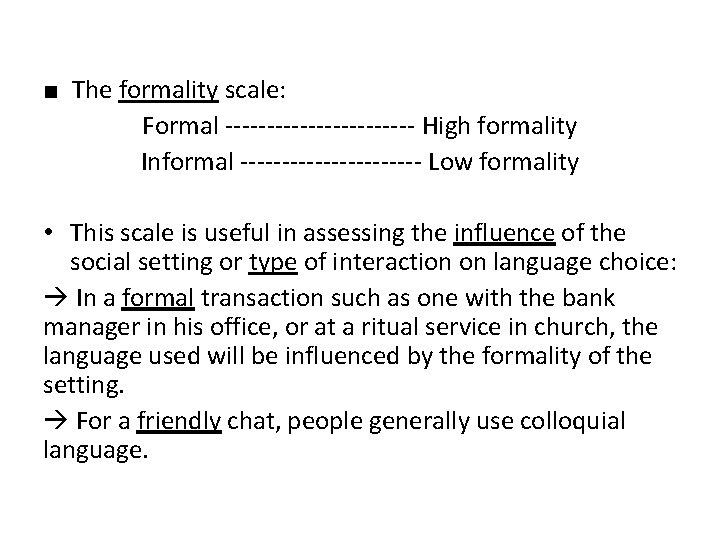
■ The formality scale: Formal ------------ High formality Informal ----------- Low formality • This scale is useful in assessing the influence of the social setting or type of interaction on language choice: In a formal transaction such as one with the bank manager in his office, or at a ritual service in church, the language used will be influenced by the formality of the setting. For a friendly chat, people generally use colloquial language.
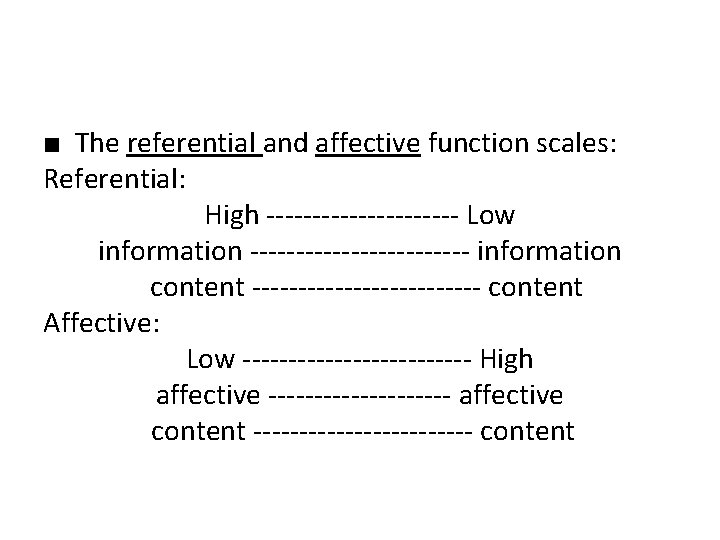
■ The referential and affective function scales: Referential: High ----------- Low information ------------ information content ------------- content Affective: Low ------------- High affective ---------- affective content ------------ content
• Language can convey objective information of a referential kind; and it can also express how someone is feeling. Ray’s utterance “Yeah, that bastard Sootbucket kept us in again” simultaneously expresses both information about why he is late, while also conveying his feelings about the teacher referred to.
• Exercise 6 Answer the following two questions for each of utterances a, b, and c, below: (i) What information does the utterance provide about the relationship between the people talking in the context of their talk? (ii) What is the function of the utterance in the context? Does it convey primarily affective or referential information? (a) Here is the forecast for the Wellington district until midnight Tuesday issued by the meteorological service at 6 o’clock on Monday evening. It will be rather cloudy overnight with some drizzle, becoming fine again on Tuesday morning. The outlook for Wednesday – a few morning showers then fine. (b) Good morning little one – you had a good big sleep, didn’t you, pet? (c) Excuse me, Mr Clayton. I’ve finished your letters, sir.
q Looking for explanations • Sociolinguists aim to describe sociolinguistic variation and, if possible, explain why it happens. • Why, for example, should Ray describe a teacher differently when talking to his mother and when answering the school principal? • Why do different people call my friend Margaret by different names? • Why should a formal grammatical construction with formal vocabulary sound sarcastic when used by your mother?
• The first two steps which need to be taken are: 1. to identify clearly the linguistic variation involved (e. g. vocabulary, sounds, grammatical constructions, styles, dialects, languages). 2. to identify clearly the different social or nonlinguistic factors which lead speakers to use one form rather than another (e. g. features relating to participants, setting or function of the interaction).
• Then we can begin to look for patterns which will help to formulate an explanation of why people use one set of forms in some contexts, but different forms in others. • When the two sociolinguists Blom and Gumperz visited Hemnesberget, what did they ask? First of all, ‘what are the linguistic forms used in this village? ’ Secondly, ‘what are the social factors which lead people to use one set of forms rather than the other? ’ And finally, ‘can we explain why particular social factors lead to the use of one set of forms rather than another? ’