
Language Proof and Logic Methods of Proof for
- Slides: 6
Language, Proof and Logic Methods of Proof for Boolean Logic Chapter 5
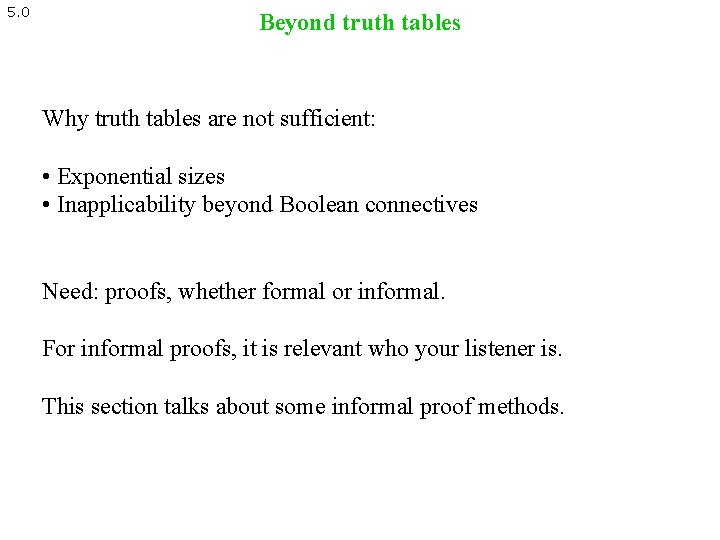
5. 0 Beyond truth tables Why truth tables are not sufficient: • Exponential sizes • Inapplicability beyond Boolean connectives Need: proofs, whether formal or informal. For informal proofs, it is relevant who your listener is. This section talks about some informal proof methods.
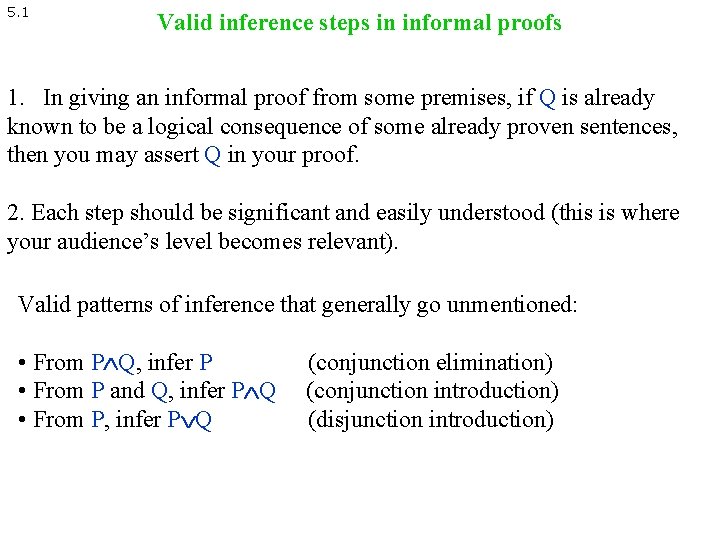
5. 1 Valid inference steps in informal proofs 1. In giving an informal proof from some premises, if Q is already known to be a logical consequence of some already proven sentences, then you may assert Q in your proof. 2. Each step should be significant and easily understood (this is where your audience’s level becomes relevant). Valid patterns of inference that generally go unmentioned: • From P Q, infer P • From P and Q, infer P Q • From P, infer P Q (conjunction elimination) (conjunction introduction) (disjunction introduction)
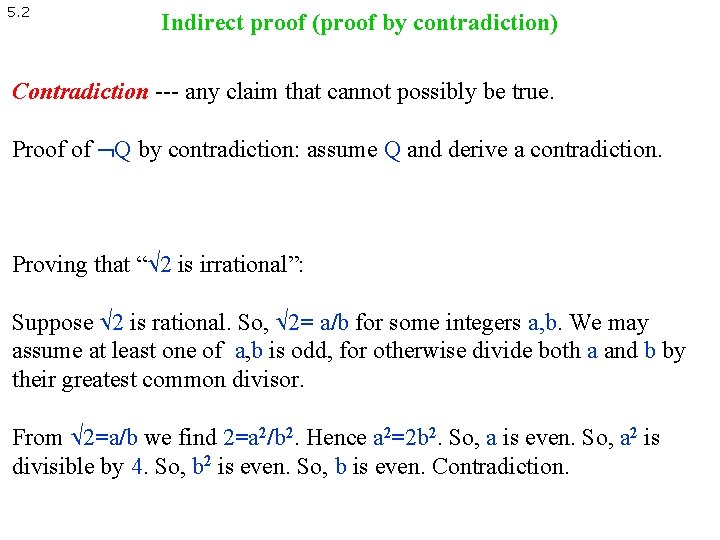
5. 2 Indirect proof (proof by contradiction) Contradiction --- any claim that cannot possibly be true. Proof of Q by contradiction: assume Q and derive a contradiction. Proving that “ 2 is irrational”: Suppose 2 is rational. So, 2= a/b for some integers a, b. We may assume at least one of a, b is odd, for otherwise divide both a and b by their greatest common divisor. From 2=a/b we find 2=a 2/b 2. Hence a 2=2 b 2. So, a is even. So, a 2 is divisible by 4. So, b 2 is even. So, b is even. Contradiction.
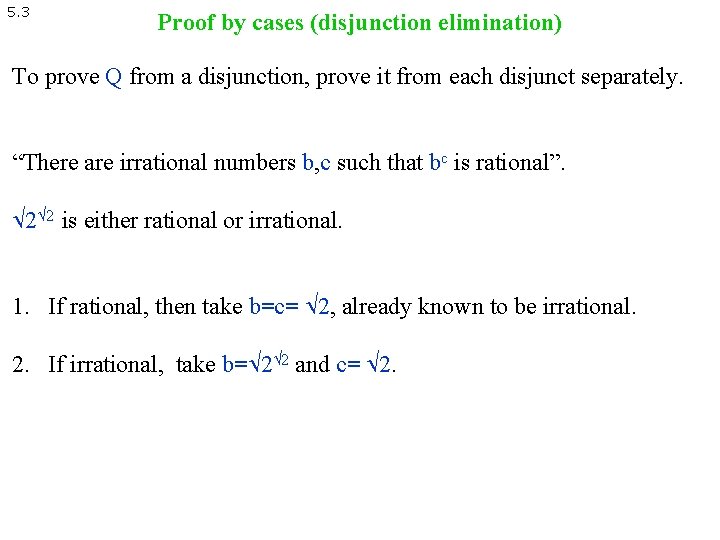
5. 3 Proof by cases (disjunction elimination) To prove Q from a disjunction, prove it from each disjunct separately. “There are irrational numbers b, c such that bc is rational”. 2 2 is either rational or irrational. 1. If rational, then take b=c= 2, already known to be irrational. 2. If irrational, take b= 2 2 and c= 2.
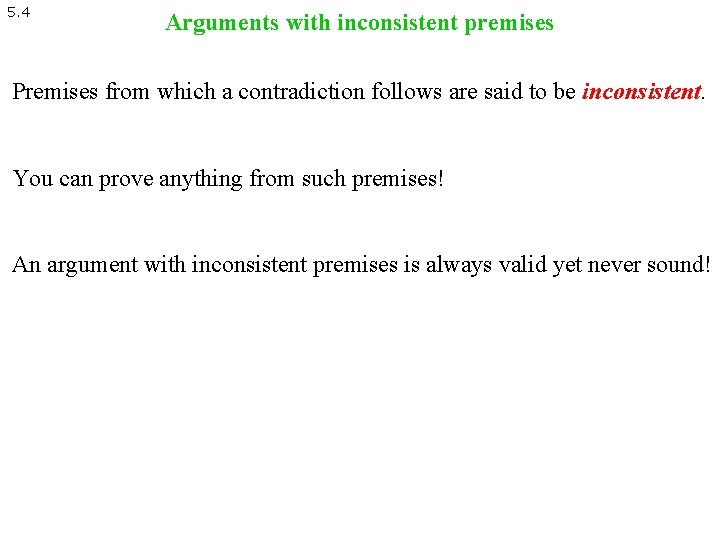
5. 4 Arguments with inconsistent premises Premises from which a contradiction follows are said to be inconsistent. You can prove anything from such premises! An argument with inconsistent premises is always valid yet never sound!