
Language of the Month January 2021 Language of
- Slides: 20
Language of the Month January 2021
Language of the Month January 2021
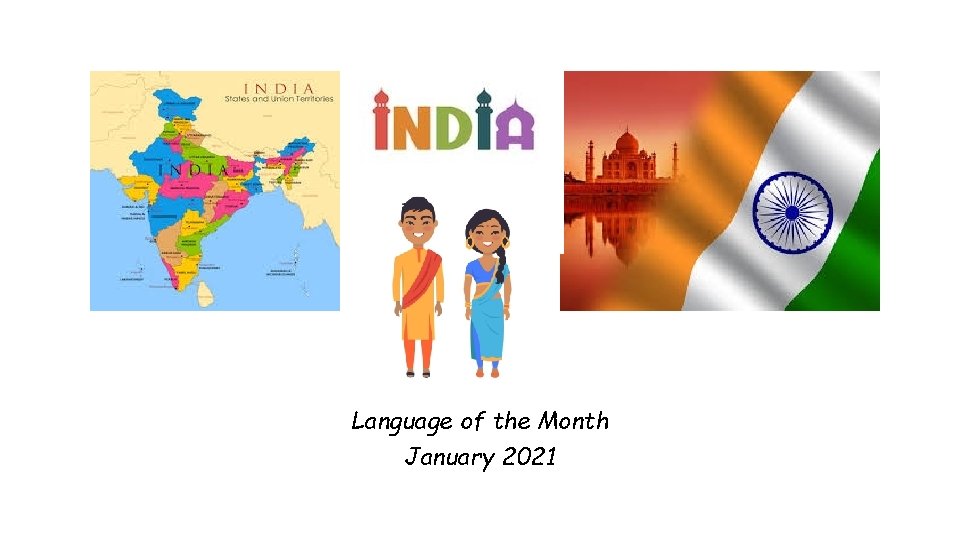
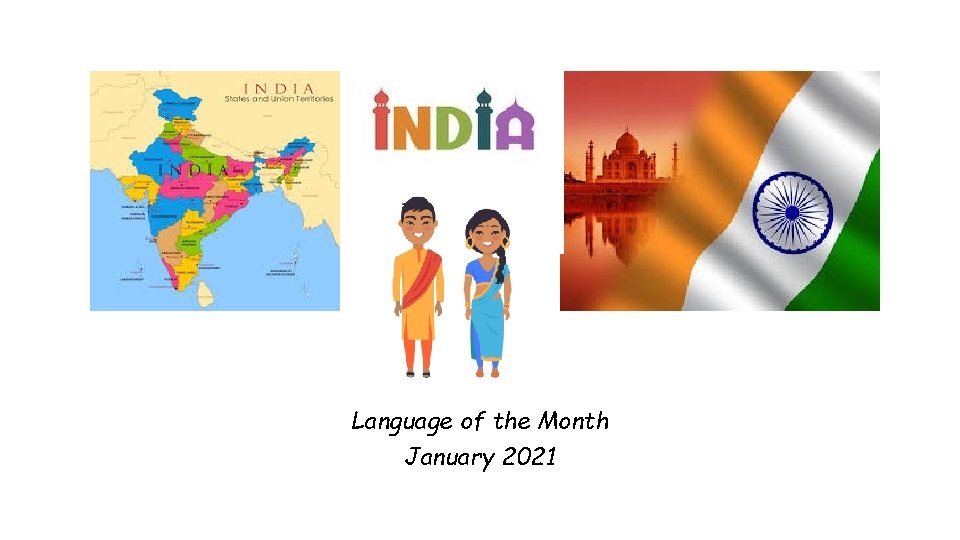
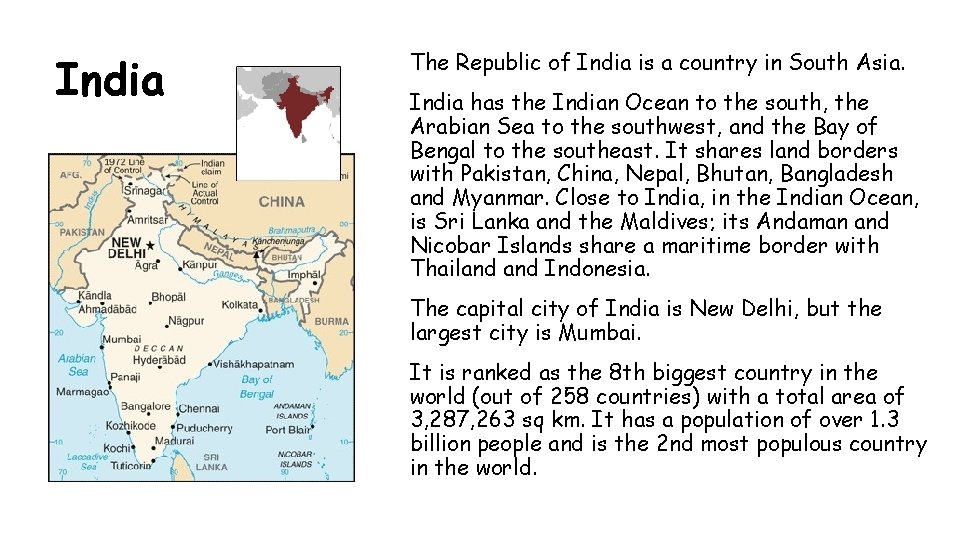
India The Republic of India is a country in South Asia. India has the Indian Ocean to the south, the Arabian Sea to the southwest, and the Bay of Bengal to the southeast. It shares land borders with Pakistan, China, Nepal, Bhutan, Bangladesh and Myanmar. Close to India, in the Indian Ocean, is Sri Lanka and the Maldives; its Andaman and Nicobar Islands share a maritime border with Thailand Indonesia. The capital city of India is New Delhi, but the largest city is Mumbai. It is ranked as the 8 th biggest country in the world (out of 258 countries) with a total area of 3, 287, 263 sq km. It has a population of over 1. 3 billion people and is the 2 nd most populous country in the world.
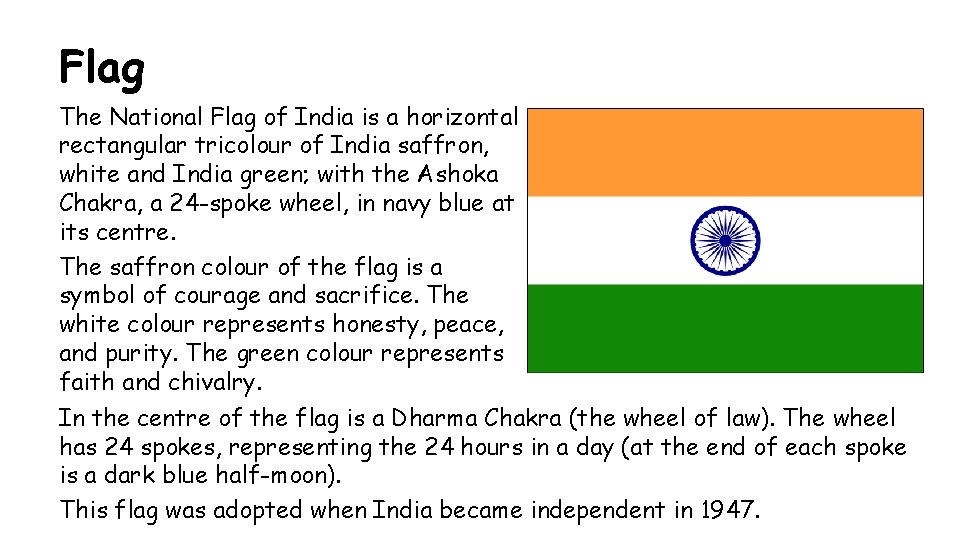
Flag The National Flag of India is a horizontal rectangular tricolour of India saffron, white and India green; with the Ashoka Chakra, a 24 -spoke wheel, in navy blue at its centre. The saffron colour of the flag is a symbol of courage and sacrifice. The white colour represents honesty, peace, and purity. The green colour represents faith and chivalry. In the centre of the flag is a Dharma Chakra (the wheel of law). The wheel has 24 spokes, representing the 24 hours in a day (at the end of each spoke is a dark blue half-moon). This flag was adopted when India became independent in 1947.
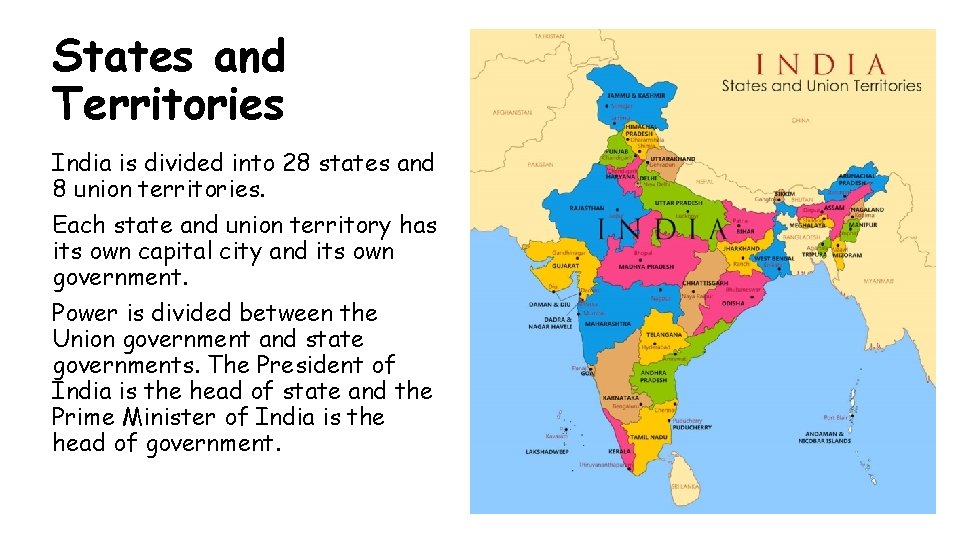
States and Territories India is divided into 28 states and 8 union territories. Each state and union territory has its own capital city and its own government. Power is divided between the Union government and state governments. The President of India is the head of state and the Prime Minister of India is the head of government.
The States are: Andhra Pradesh Arunachal Pradesh Assam Bihar Chhattisgarh Goa Gujarat Haryana Himachal Pradesh Jharkhand Karnataka Kerala Madhya Pradesh Maharashtra Manipur Meghalaya Mizoram Nagaland Odisha Punjab Rajasthan Sikkim Tamil Nadu Telangana Tripura Uttar Pradesh Uttarakhand West Bengal The Union Territories are: Andaman and Nicobar Islands Chandigarh Dadra and Nagar Haveli and Daman and Diu Delhi Jammu and Kashmir Ladakh Lakshadweep Puducherry
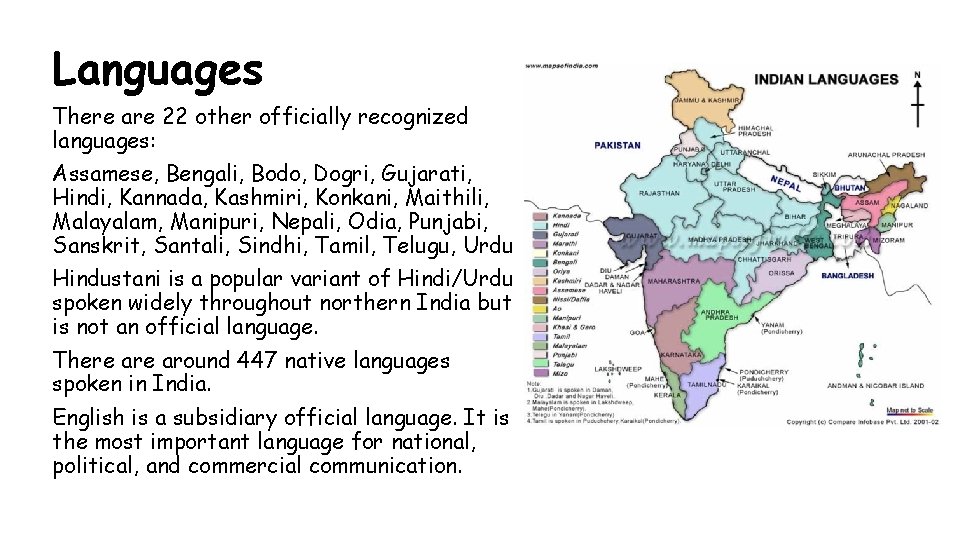
Languages There are 22 other officially recognized languages: Assamese, Bengali, Bodo, Dogri, Gujarati, Hindi, Kannada, Kashmiri, Konkani, Maithili, Malayalam, Manipuri, Nepali, Odia, Punjabi, Sanskrit, Santali, Sindhi, Tamil, Telugu, Urdu Hindustani is a popular variant of Hindi/Urdu spoken widely throughout northern India but is not an official language. There around 447 native languages spoken in India. English is a subsidiary official language. It is the most important language for national, political, and commercial communication.
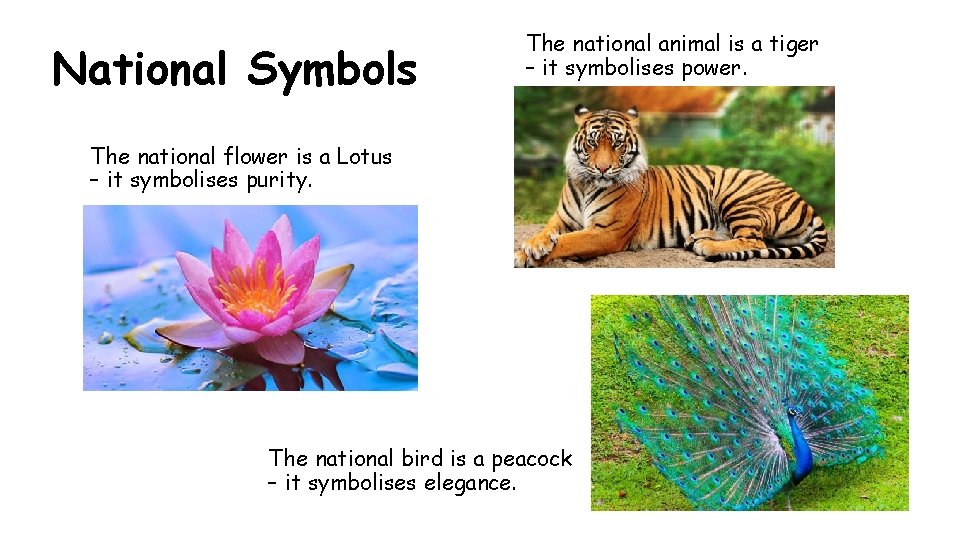
National Symbols The national animal is a tiger – it symbolises power. The national flower is a Lotus – it symbolises purity. The national bird is a peacock – it symbolises elegance.
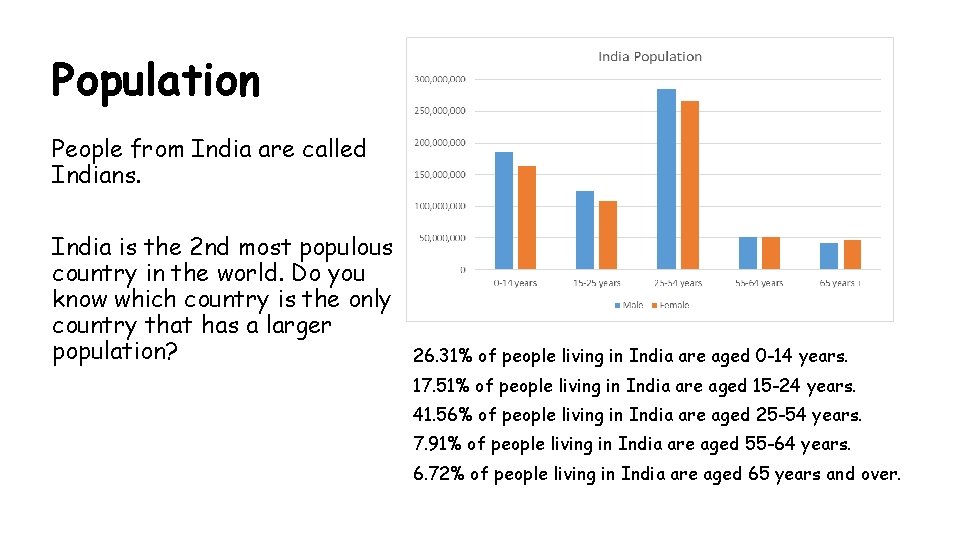
Population People from India are called Indians. India is the 2 nd most populous country in the world. Do you know which country is the only country that has a larger population? 26. 31% of people living in India are aged 0 -14 years. 17. 51% of people living in India are aged 15 -24 years. 41. 56% of people living in India are aged 25 -54 years. 7. 91% of people living in India are aged 55 -64 years. 6. 72% of people living in India are aged 65 years and over.
Big cities 35% of the population in India live in towns and cities. Bangalore used to be referred to as the “Pensioner’s Paradise” and the “Garden City of India” because of its large, green spaces. It is one of the most beautiful cities in India, and lush green forests can still be found in the outskirts. Bangalore is also the main centre of the IT industry, commonly known as the “Silicon Valley of India”. Chennai is a beautiful city and the gateway to the south of India. It has a distinct culture based on Tamil traditions. The city is also a modern cosmopolitan city with a very diverse population. The architectural landscape includes both beautiful ancient temples and modern high-rises. Delhi is the capital of India, home to the executive, judiciary and legislative branches of the Government. It is also a creative hub. The city is home to some of the most stunning temples, mosques and forts. These include the Red Fort, Jama Masjid and the Baha’i Lotus Temple. Kolkata is a city of contrasts, with run-down but beautiful British Raj period houses, historical colleges and stunning gardens. Jaipur is commonly known as the ‘Pink City’ due to its stunning buildings which were painted pink in 1876 to welcome the Prince of Wales and Queen Victoria. Mumbai was once called Bombay. It is the biggest city in India. The city’s most notable attraction is the Gateway of India, built in 1911 to commemorate a royal visit.
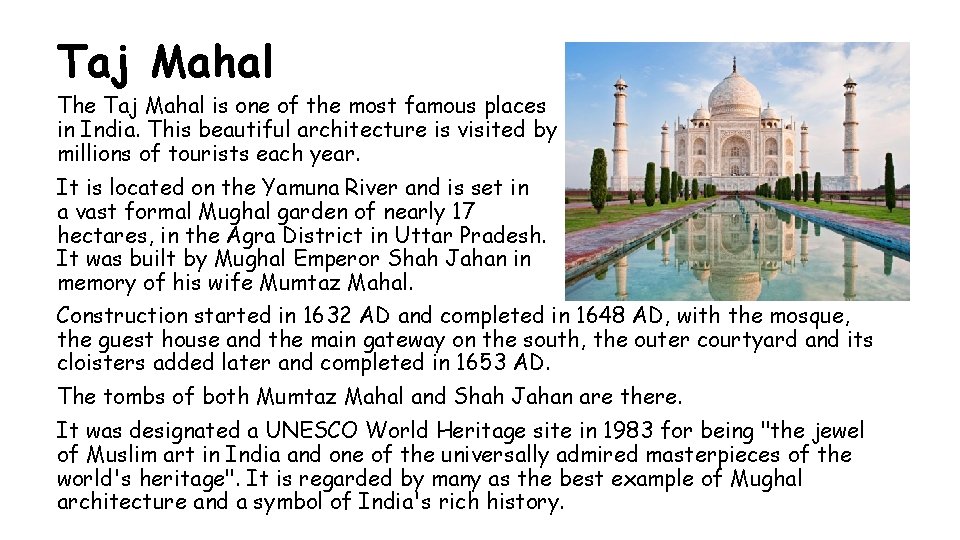
Taj Mahal The Taj Mahal is one of the most famous places in India. This beautiful architecture is visited by millions of tourists each year. It is located on the Yamuna River and is set in a vast formal Mughal garden of nearly 17 hectares, in the Agra District in Uttar Pradesh. It was built by Mughal Emperor Shah Jahan in memory of his wife Mumtaz Mahal. Construction started in 1632 AD and completed in 1648 AD, with the mosque, the guest house and the main gateway on the south, the outer courtyard and its cloisters added later and completed in 1653 AD. The tombs of both Mumtaz Mahal and Shah Jahan are there. It was designated a UNESCO World Heritage site in 1983 for being "the jewel of Muslim art in India and one of the universally admired masterpieces of the world's heritage". It is regarded by many as the best example of Mughal architecture and a symbol of India's rich history.
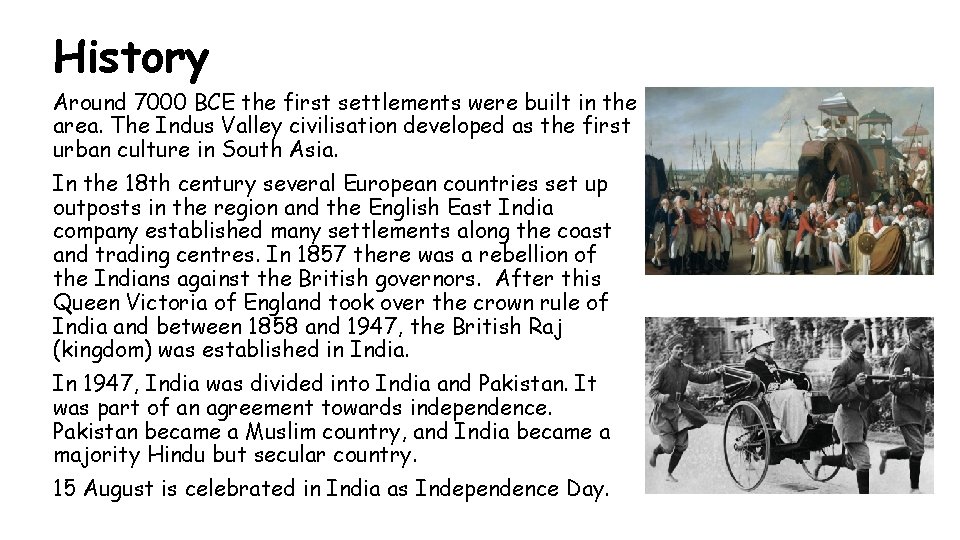
History Around 7000 BCE the first settlements were built in the area. The Indus Valley civilisation developed as the first urban culture in South Asia. In the 18 th century several European countries set up outposts in the region and the English East India company established many settlements along the coast and trading centres. In 1857 there was a rebellion of the Indians against the British governors. After this Queen Victoria of England took over the crown rule of India and between 1858 and 1947, the British Raj (kingdom) was established in India. In 1947, India was divided into India and Pakistan. It was part of an agreement towards independence. Pakistan became a Muslim country, and India became a majority Hindu but secular country. 15 August is celebrated in India as Independence Day.
National Days Republic day is celebrated every year on 26 th January. It marks India's adoption of a republic constitution (with a president rather than a monarch) on January 26, 1950, after gaining of independence from British rule in 1947. It is celebrated with the Republic Day Parade. The Beating the Retreat Ceremony on the evening of the 29 th marks the end of Republic Day celebrations. India has three national days: Republic Day, Independence Day and Gandhi's Birthday! Independence Day is celebrated every year on 15 th August as a national holiday in India commemorating the nation's independence from the United Kingdom in 1947. It is celebrated with flag-hoisting ceremonies, parades and cultural events. In some places it is celebrated with kite flying. Many people decorate themselves, homes, cars and accessories with the Indian flag. The anniversary of Mahatma Gandhi's birthday is celebrated every year on 2 October. It is a major national holiday called Gandhi Jayanti. Gandhi is known as India's 'Father of the Nation' and was born on this day in 1869. This holiday is marked with a prayer for peace, ceremonies and events throughout the country. The United Nations has also declared October 2 as the International Day of Nonviolence to honour Gandhi's message.
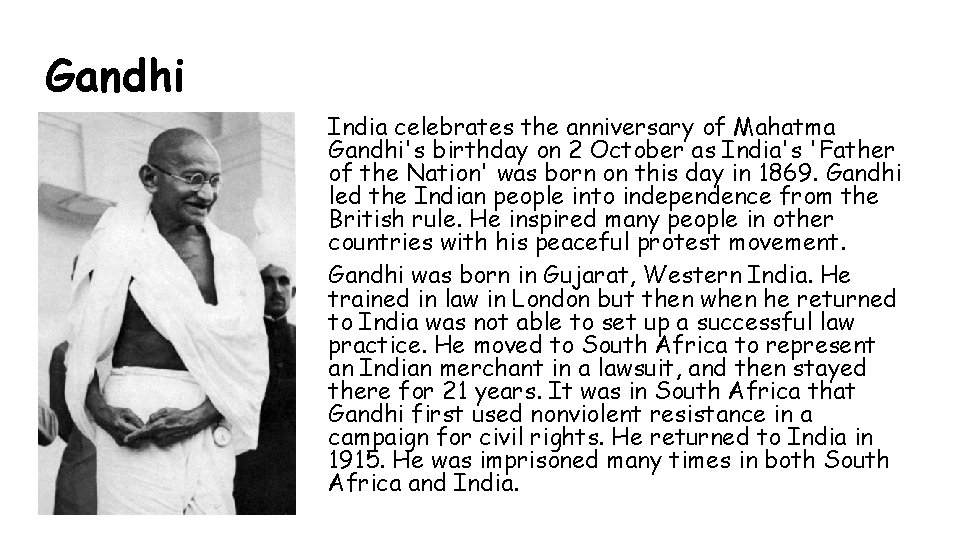
Gandhi India celebrates the anniversary of Mahatma Gandhi's birthday on 2 October as India's 'Father of the Nation' was born on this day in 1869. Gandhi led the Indian people into independence from the British rule. He inspired many people in other countries with his peaceful protest movement. Gandhi was born in Gujarat, Western India. He trained in law in London but then when he returned to India was not able to set up a successful law practice. He moved to South Africa to represent an Indian merchant in a lawsuit, and then stayed there for 21 years. It was in South Africa that Gandhi first used nonviolent resistance in a campaign for civil rights. He returned to India in 1915. He was imprisoned many times in both South Africa and India.
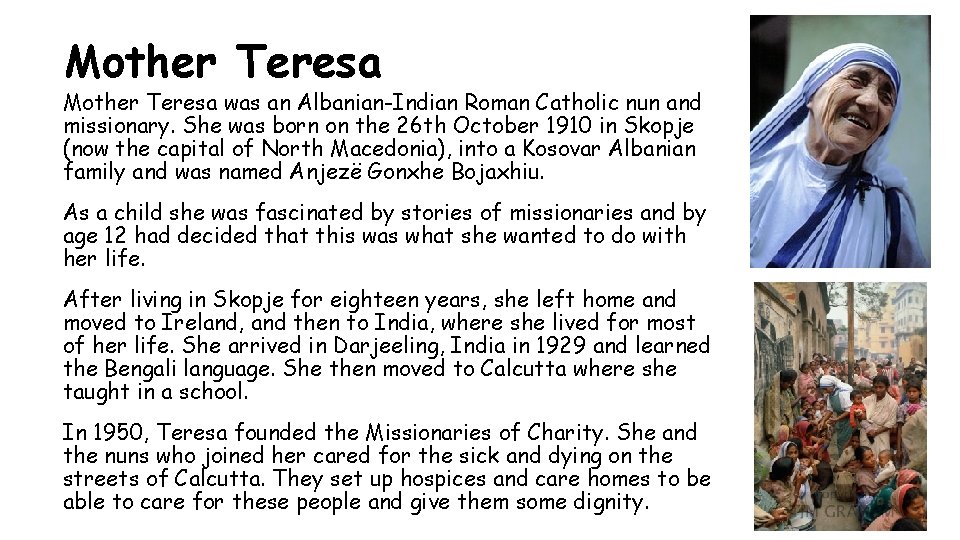
Mother Teresa was an Albanian-Indian Roman Catholic nun and missionary. She was born on the 26 th October 1910 in Skopje (now the capital of North Macedonia), into a Kosovar Albanian family and was named Anjezë Gonxhe Bojaxhiu. As a child she was fascinated by stories of missionaries and by age 12 had decided that this was what she wanted to do with her life. After living in Skopje for eighteen years, she left home and moved to Ireland, and then to India, where she lived for most of her life. She arrived in Darjeeling, India in 1929 and learned the Bengali language. She then moved to Calcutta where she taught in a school. In 1950, Teresa founded the Missionaries of Charity. She and the nuns who joined her cared for the sick and dying on the streets of Calcutta. They set up hospices and care homes to be able to care for these people and give them some dignity.
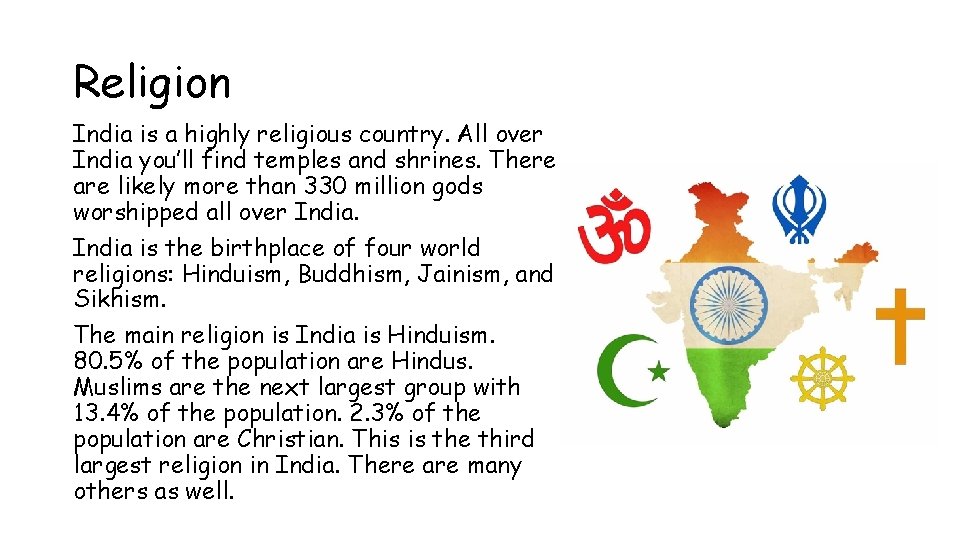
Religion India is a highly religious country. All over India you’ll find temples and shrines. There are likely more than 330 million gods worshipped all over India is the birthplace of four world religions: Hinduism, Buddhism, Jainism, and Sikhism. The main religion is India is Hinduism. 80. 5% of the population are Hindus. Muslims are the next largest group with 13. 4% of the population. 2. 3% of the population are Christian. This is the third largest religion in India. There are many others as well.
The Great Festival “Come on! Wake up!” Sanjay said, shaking his brother. “It’s nearly dawn. The holy men are already on their way down to the river. It’s time for us to go. ” All around them were brightly coloured tents of millions of people who’d also come for the Kumbh Mela festival. The two brothers started their adventure a week earlier, when they left their village to walk to Allahabad, India’s “city of gods. ” They were going to the great festival, or mela, at the holy place where the Ganges and Yamuna rivers meet. Sometimes a farmer gave the boys a ride on his bullock cart. Once or twice they travelled on crowded buses. But mostly they walked along hot, dusty paths and roads. As they finally reached the river, Sanjay and his brother were caught up in a huge crowd of pilgrims. Everyone was pushing, slipping and sliding, dodging sacred cows and wandering goats, on their way down to the riverbank. At last they reached the mighty river, and stepped into the flowing water. Sanjay faced the rising sun, and poured water over himself. He hoped it would wash away his sins. Kumbh Mela is one of India’s great religious festivals. It happens at this sacred place just once every twelve years. Hindus rich and poor, high and low caste, come from all over India, to wash away their sins in the Ganges. *from ‘Window in the World’ by Operation World
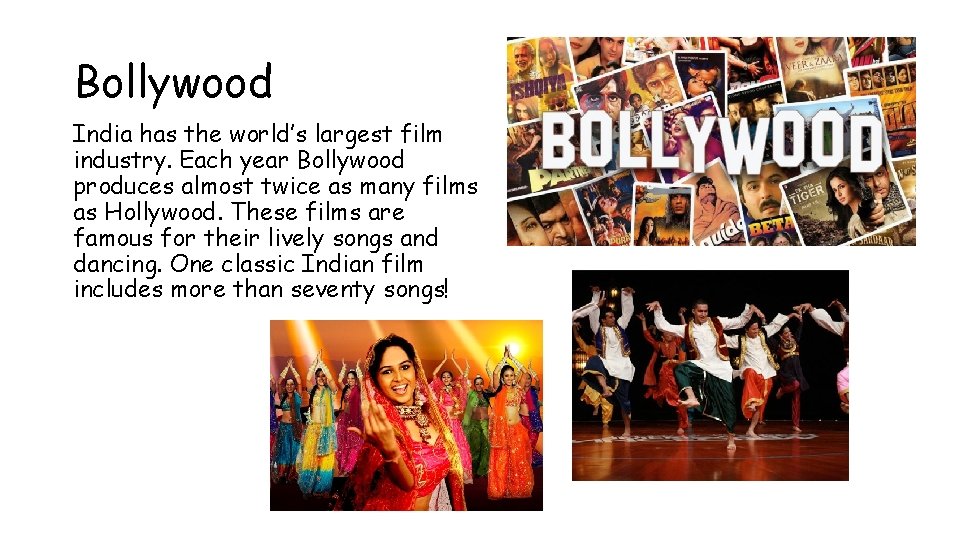
Bollywood India has the world’s largest film industry. Each year Bollywood produces almost twice as many films as Hollywood. These films are famous for their lively songs and dancing. One classic Indian film includes more than seventy songs!
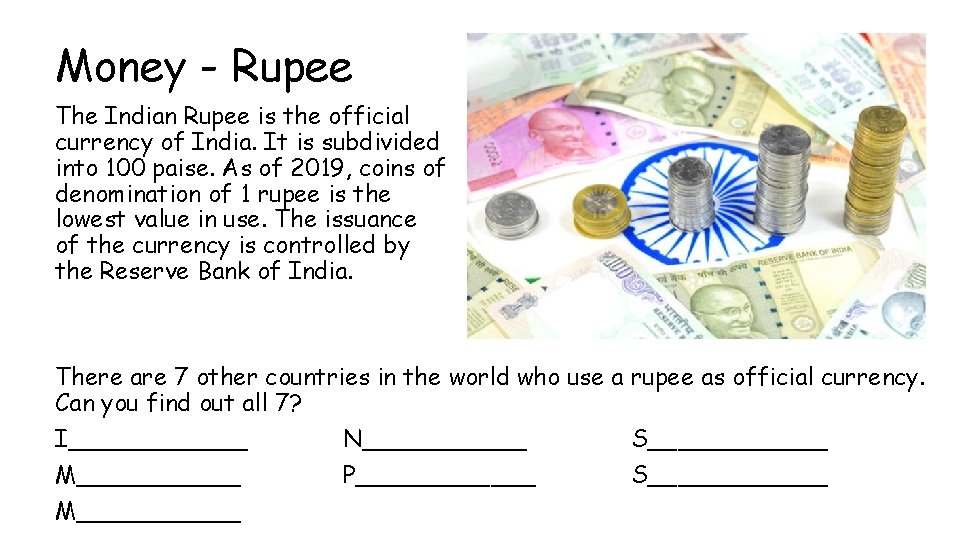
Money - Rupee The Indian Rupee is the official currency of India. It is subdivided into 100 paise. As of 2019, coins of denomination of 1 rupee is the lowest value in use. The issuance of the currency is controlled by the Reserve Bank of India. There are 7 other countries in the world who use a rupee as official currency. Can you find out all 7? I______ N______ S______ M______ P______ S______ M______
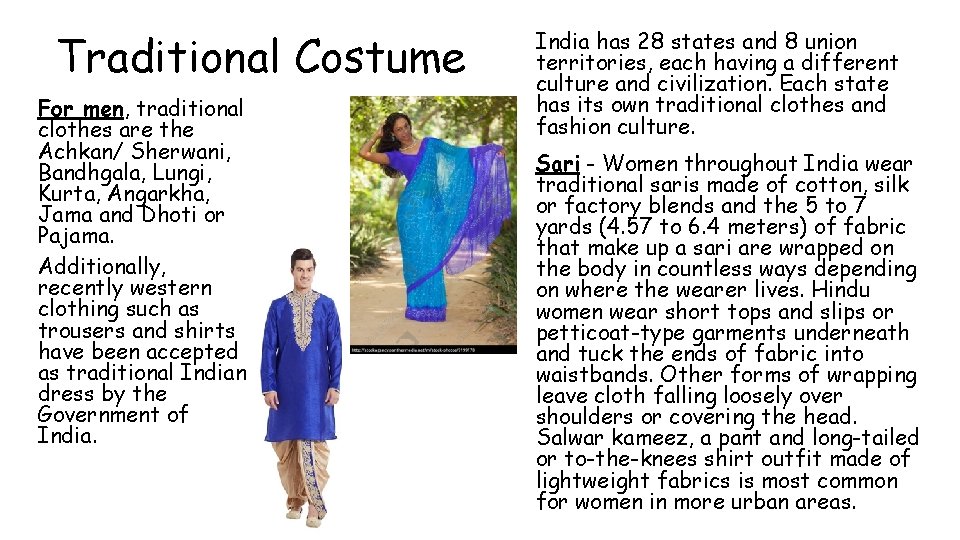
Traditional Costume For men, traditional clothes are the Achkan/ Sherwani, Bandhgala, Lungi, Kurta, Angarkha, Jama and Dhoti or Pajama. Additionally, recently western clothing such as trousers and shirts have been accepted as traditional Indian dress by the Government of India has 28 states and 8 union territories, each having a different culture and civilization. Each state has its own traditional clothes and fashion culture. Sari - Women throughout India wear traditional saris made of cotton, silk or factory blends and the 5 to 7 yards (4. 57 to 6. 4 meters) of fabric that make up a sari are wrapped on the body in countless ways depending on where the wearer lives. Hindu women wear short tops and slips or petticoat-type garments underneath and tuck the ends of fabric into waistbands. Other forms of wrapping leave cloth falling loosely over shoulders or covering the head. Salwar kameez, a pant and long-tailed or to-the-knees shirt outfit made of lightweight fabrics is most common for women in more urban areas.