
Language of Legal Documents By Rashid Mahmood English
Language of Legal Documents By: Rashid Mahmood
English of Legal Documents • The field of legal documents covers a wide range: statutes, decrees, legal provisions, economic contracts, commodity warranty, deeds of trust, insurance policies, wills and testaments, leases and installment plans, etc. • They are concerned with imposing of obligations and conferring of rights. • It is highly formal, even dignified. • In terms of mode, all of them are recorded in a written form.
English of Legal Documents • It is essentially a visual language meant to be scrutinized in silence. • In order to ensure that a document says exactly what it is meant to say, composers of the document will take the greatest pains to make it communicate just one set of meanings and avoid any possible ambiguity. • Owing to the composers' reliance on established forms and their reluctance to adopt new and untested modes of expression, legal English appears extremely conservative and presents some striking oddities in form and wording.
Graphological Features • Use of different types: a first glance at the legal document reveals that it is printed in different shapes of type. • Use of different types is a means of drawing the reader's attention to the unit or combination of units • Words capitalized include various personalia referred to, such as Affiant, Attorney, Grantors, Creditor, Receiver, Trustee, etc.
Graphological Features • The blocks of print are dear, with white space between them and with indentations and/or numbers (or letters) at the beginning of paragraphs or clauses that are subordinate to the foregoing paragraph. • All this is evidently an effort to give the content a good organization and make its internal relationship clear. • The most characteristic phenomenon of some old form of legal texts is perhaps the dearth (lack) of punctuation.
Graphological Features • The most characteristic phenomenon of some old form of legal texts is perhaps the dearth (lack) of punctuation. • Many of them are either unpunctuated or punctuated only with a final period or a colon. The idea is to avoid any possible forgery -- either addition or deletion. • Today, however, the tendency is to employ a limited range of punctuation marks as a useful guide to grammatical structure.
Grammatical Features • Tendency to long sentences: Unlike other kinds of discourse -- especially conversation, legal English tends to put all such sequences into the form of very complex sentences capable of standing alone, by means of subordinating devices. • Some documents are composed as just one very long sentence. • As is the nature of legal documents, most of the sentences are statements with no questions and only an occasional command
Grammatical Features • A large number of sentences are of the structure S P 0 (C) A or A S P 0 • Conditional clauses introduced by if, provided that, in the event of , etc are many in this variety. – If the progress of the works is suspended on the written instructions of the engineer and if permission to resume work is not given by the engineer within a period of 84 days from the date of suspension then, unless such suspension is within a, b, e or d of subclause 40. 1, the contractor may give notice to the engineer requiring permission to proceed with the works in regard to which progress is suspended.
Adverbials • Unusual positioning of adverbials in this variety of English is noteworthy. • Normally adverbials are not placed between a transitive verb and its object. But in legal English adverbials often come before the object; as in: – To pay on behalf of the insured all sums. . . – to defend, with attorneys selected by and compensated by the company , any suit against the insured. . . – a proposal to effect with the Society an assurance. . . • The idea is to give emphasis to the adverbials, or to avoid any possible ambiguity.
Noun Group • Legal English is highly nominal-- many of its features operate within its nominal groups. • There is a marked preference for heavy postmodification. – any other person who sustains bodily injury, caused by accident, while occupying the owned motor vehicle if such vehicle is used by an insured • The post-modifications are all linked with one another, each dependent on the foregoing modification: The relative clause that modifies 'person' has a past participial phrase modifying 'injury', and a while-clause modifying 'caused', and an if -clause modifying the while –clause.
Noun Group • Another Example: – All of my estate, real, personal and mired, of every nature, kind and description, wherever situated and however held, which is or may be subject to my testamentary disposition at the time of my death • There are three coordinating adjectives, one prepositional phrase, two shortened adverbial clauses, and one relative clause, all of which modify the word 'estate‘.
Noun Group • Participial phrases are frequently used as post-modifiers, such as: – the Provisions and Stipulations Stated Herein or Added Hereto, the Premium Above Specified (or specified in endorsements) made a part hereof, an amount not exceeding the limit of liability above specified , the Insured named in the Declaration above etc. • Clearly, heavy use of post-modification is an effort to suit the need for exactness of expression so as to rule out any possible misinterpretation.
Noun Group • Pre-modification in the nominal group is confined to the use of a few words such as the (insured), its (terms), their (free act), (the) (following) described etc. • Such is repeatedly used as a determiner but without accompaniment of the indefinite article a (an) ; as in such policy, such payment, such proposal, such sum, etc, which, together with said (payment), has become a marker of legal English.
Noun Group • The use of this and my to modify will together in this my Will is also noteworthy. • Adjectives are also restrained in their use: lawful (claims), (the) actual (value), (the) final (payment), proper (place), total (amount), promissory (note). • Adjectives with affective meaning such as splendid, wise , disgusting and happy are not used in the samples; nor are intensifiers like very, rather etc. • This is in keeping with the highly impersonal nature of legal documents.
Verbal Groups • Compared with nominal groups, verbal groups in legal documents are structurally simple. • In insurance policies and contracts quite a number of verbs are of the type 'modal auxiliary (often shall ) + be + past participle' or 'modal auxiliary (often shall or may ) + be or do • Shall is invariably used to express obligation or certainty. – Whenever the company shall pay the lien-holder any sum for loss under this policy and shall claim that, as to the named insured, no liability there for existed, the company shall , to the extent of such payment, be thereupon legally surrogate to all the rights of the party to whom such payment shall be made , under all securities held as collateral to the debt. • As is decided by the formal quality of legal texts no verbs occur in contracted forms.
Lexical Features: Archaic Words • Frequent employment of archaic words and phrases: • In order to render the legal documents highly formal and dignified, lawyers often employ words and phrases that are unique to this variety. Words like herein, hereto, hereof, hereinafter, hereby, hereinabove, hereon, heretofore, thereafter, thereby, thereinafter, thereof, thereto, thereunder, whereby, whereof where-on ; • Phrases like forever in fee simple, in witness whereof, legally selected and possessed of, of sound and disposing mind, at the time of my death, upon his official bond , are well studded in legal documents; • They are either unique to legal English or are endowed with a strong legal flavor.
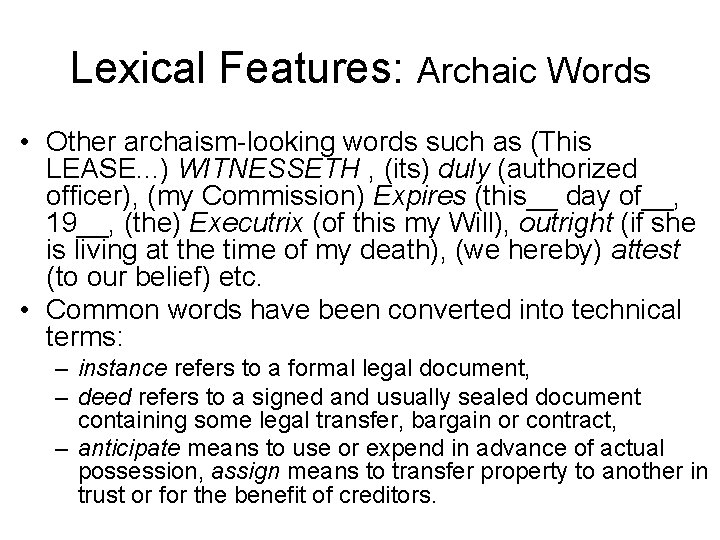
Lexical Features: Archaic Words • Other archaism-looking words such as (This LEASE. . . ) WITNESSETH , (its) duly (authorized officer), (my Commission) Expires (this__ day of__, 19__, (the) Executrix (of this my Will), outright (if she is living at the time of my death), (we hereby) attest (to our belief) etc. • Common words have been converted into technical terms: – instance refers to a formal legal document, – deed refers to a signed and usually sealed document containing some legal transfer, bargain or contract, – anticipate means to use or expend in advance of actual possession, assign means to transfer property to another in trust or for the benefit of creditors.
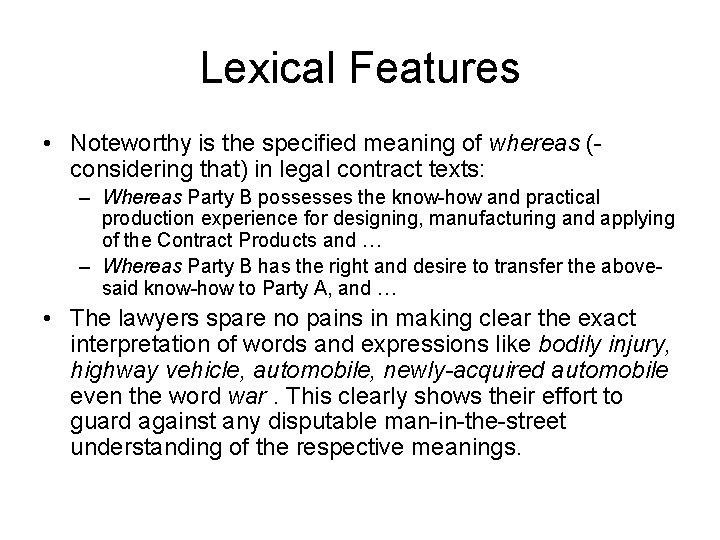
Lexical Features • Noteworthy is the specified meaning of whereas (considering that) in legal contract texts: – Whereas Party B possesses the know-how and practical production experience for designing, manufacturing and applying of the Contract Products and … – Whereas Party B has the right and desire to transfer the abovesaid know-how to Party A, and … • The lawyers spare no pains in making clear the exact interpretation of words and expressions like bodily injury, highway vehicle, automobile, newly-acquired automobile even the word war. This clearly shows their effort to guard against any disputable man-in-the-street understanding of the respective meanings.
- Slides: 18